This
Duluth News Tribune article was published in early March, but was only recently brought to my attention. Apparently a
Wisconsin fire-fighter and hunter, Mark Smith, proposed that the state classify free-roaming
domestic cats (also called
“feral” cats) as an “unprotected” species. If the state were to do so,
Felis catus could be legally killed by any hunter in possession of a small-game license.
Smith states, “I get up in the morning and if there’s new snow, there’s cat tracks under my bird feeder…I look at them as an
invasive species, plain and simple.”
He's correct. In the
United States alone, domestic cats are
responsible for the death of hundreds of millions of
birds,
billions of small
mammals and millions of
reptiles and
amphibians each year. Many
wildlife biologists contend that cats are responsible for more
extinctions worldwide than any other cause, with the exception of habitat destruction.
Yet my cat-loving friends contest these facts, pointing out that the numbers are “just estimates.” Or they will highlight my willingness to damn the domestic cat when I don’t condemn other superb
predators such as
mountain lions (
Puma concolor) or
red foxes (
Vulpes vulpes). Estimates are often useful tools but, more importantly, there is a substantial difference between a native predator and the introduced variety. (
Conservation-minded
Puerto Ricans do not appreciate the
mongoose (
Herpestes javanicus) presence and few folks on
Guam find the
brown tree snake (
Boiga irregularis) praiseworthy. Other than our association with house cats as just that, there is no difference between it and other feral, introduced species.)
Compounding matters is the protection and attention offered
Felis catus. What other predator species has access to a dependable source of food and protection from disease? Also, unlike many other predators, the domestic cat does not demonstrate a marked decrease in hunting desire when already sated.
Felis catus is a killer that enjoys the killing.
I grew up on a farm where any cat spotted without a collar fell victim to a
.22 rifle. Most of these animals were large, filthy
tomcats that had been living feral for months or years, but a few were groomed and well-fed. No matter. On a 300-acre farm designed to attract and protect wildlife, the appearance of an “unattached” cat meant dead or threatened wildlife.
The concept of predator control troubles many people, myself included. The balance is delicate; not every
raccoon (
Procyon lotor) or fox that a land owner or
refuge manager spots should be killed, especially if the animal will not be utilized - eaten, worn - in a respectful manner. But when discussing an “invasive” species, the choice becomes more clear-cut. Why then, does Mark Smith’s Wisconsin proposal engender such an angry response all over the United States, especially when
Minnesota and
South Dakota already allow such kitty culling?
When I
Google the topic, I find a link to
this hateful blog. The author writes,
“So Mr. Mike Smith lets make a deal, we will allow open cat season just for you as long as you allow us to have an open season to hunt your ass down."
He also points out, astutely, that "birds can fly away from a bird" (one assumes he meant to write 'cat') whereas a cat has no chance against a
12-gauge shotgun. The writer clearly knows nothing about
firearms or the hunting prowess of a cat. No individual seriously trying to kill a feral cat would use a shotgun unless they were confident in their ability to stalk within range, a difficult feat for even seasoned scouts. And, even outfited with a collar bell, a cat will learn to stalk so as not to let the bell ring, until the pounce...and bye-bye, birdy.
On another website discussing the issue, post after post bemoans Mark Smith’s proposal, suggesting we pursue “more humane” ways of controlling the cat population. The most often proposed alternative is a three-step process: live trapping,
neutering, and release. Proponents of this approach argue that, within several generations, the feral cat population would plummet as a result. While true, what may be more humane for the cat does not afford other animal species much help – with an estimated 12% of the world’s bird species in danger of extinction this century, such measures do little to help sustain
biodiversity – but, more pragmatically, tax payers aren’t very willing to foot the hefty bill for such birth control programs. As a result,
The Humane Society of the United States and
PETA have been encouraging cat owners to
spay/neuter their pets and keep them indoors for years now, but many, if not most, cat owners continue to ignore this advice. On the one hand, then, pet owners are unwilling to take responsiblity for their pets and, on the other, they are unwilling to pay taxes which will help alleviate the problems their negligence contributes to.
That's the attitude, America!The only sound alternative to legalized hunting of cats, as I see it, involves trapping the cats, offering them up for adoption at a shelter (to be spayed/neutered at the client’s expense) and
euthanizing them if they are not claimed within a given time. This method is undoubtedly more humane than shooting, as the needle will less often “miss its mark,” and it doesn't put the "murderers back out on the streets," but again we are faced with an intimidating price tag. I'm willing to add a few hundred dollars to my yearly tax burden to help alleviate
Felis catus pressure. Are you? (Based on my informal poll at the office today, most people aren't. In fact, my much
beloved co-worker tells me her parents' cats, which only come into the house at night, don't kill other animals but more than once every two years. Unfortunately, living in denial doesn't help biodiversity.)
In an ideal world, the hunters interested in shooting the cats would be steady marksman and the country’s biodiversity could be done a great service in a relatively humane fashion – a bullet through the brain or heart is only marginally less humane than a
lethal injection. On the other hand, in a truly ideal world, pet owners would take responsibility for the creatures they choose to purchase or adopt, keeping cats indoors and
dogs closely monitored while taking care to spay or neuter the animals. In this ideal scenario, we would also learn how to take better care of our own fellow man and approach human population, land use, and
economic growth with some degree of thoughtfulness. Oh, wait...those continue to seem like unrealistic short-term goals? Well, then, lock-and-load, because the cat problem is far more pressing than the more socially acceptable
white-tailed deer (
Odocoileus virginianus) "scourge."
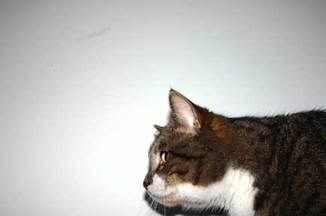
Do not misunderstand. I adore house cats and cherish the good times I have spent with my own (pictured above). Discovered on the side of the road as a kitten, Mr. Misi had not yet opened his eyes when I adopted him. He had to be fed warm milk from a baby bottle and, for those first months, he slept on my pillow, curled in the crook of my neck and shoulder. Would I weep were Misi shot by a hunter? Of course. Would I understand why? Yes. For that reason, Misi is not allowed outside and he was neutered years ago. When he visits a rural area, I put a collar around his neck, making him easily identifiable as a “pet” if he should manage to slip outside.
Note: As of this afternoon, I learn that the Wisconsin public has given the
go-ahead for the cat hunting. It will be taken to the state legislature next.
Photo credit: Hungry Hyaena, 2004