Ruminating on an Art World Malaise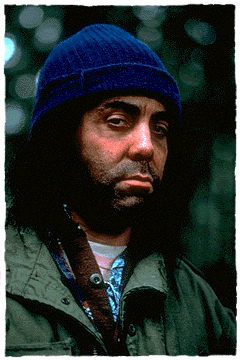
Adam, a character from "Northern Exposure"
Courtesy Universal StudiosThe arctic front that swept south over
New England and
the MidWest two weeks ago further dispirited folks already battling
seasonal affective disorder, but even before
Punxsutawney Phil botched his forecast at
Gobbler's Knob, many of my artist friends were brooding. Since the middle of January, I've sensed a general anxiety or frustration in my bar conversations, art blog trolling, and gallery exchanges. Initially, I dismissed these vibes as
transference or
projection of my own doubts and uncertainties, but, in fact, my work has been going very well, and
I cherish the winter months. Could it be, then, that the New York art world (and maybe the art world at large) is slogging through a mild doldrums now? I decided to ask others if they were aware of any upsurge in art world agnosticism.
Apparently, they were. One artist told me that his friends were "fed up with New York" and had begun fantasizing about "escape." Another friend, when asked what she made of such general malaise, replied "Everyone is over it now. We're all just having a really hard time." Such sentiments were expressed often, irrespective of an artist's market success. Unlike many of the artists and curators I talked to, I'm
not struggling in the studio, but neither am I free of angst. Of late, I spend my studio breaks browsing property listings in
Maine and
New Hampshire. Looking at photographs of beautiful, undeveloped tracts just outside
Bangor - available for a song! - the escape fantasies percolate. Likewise, I find myself critiquing my attempts to participate in art world reindeer games. After seven years in New York, I'm asking myself some very difficult questions. The questions aren't new, by any means, but they are more pressing.
With these uncomfortable questions foregrounded, I revisited "
Inside Out," an
HH post from December 2005. In that essay, I compared
Outsider artists to a "less acknowledged class of art world outsider," a type that I dubbed the Insider Outsider artist. (It's an awkward term for an vague class, but it serves its purpose well enough!) This caste, I wrote, wants to be part of the art world, but they are unwilling (or unable) to schmooze - attend openings, smile handsomely, shake hands - and they don't fill the bill in terms of their work or, sometimes, their physical appearance and carriage. As a result, they remain at the scene's fringe; if they're represented by a gallery, they're likely the "other" artist.
A sub-class of Insider Outsider is comprised of those artists who, having secured a tie to the art world while living in a cultural center, retreat to a rural setting to work in seclusion. The two examples of this sub-class that I discussed in "Inside Out" were
Winslow Homer and
Lee Bontecou, the former a historical figure and the latter a contemporary. I chose them because both were celebrated artists prior to their relocation. Eventually, many years after their respective departures from New York City, they were again pulled into the fold, although, in Homer's case, posthumously. Lee Bontecou found creative sustenance away from the city, too, and even though the art world has reclaimed her as one of their own, interviews with the artist suggest she is still most comfortable away "from the noise, the parties and the intrigue."
In the fall of 1999, when I moved to New York, I intended to leave town after establishing a relationship with a reputable gallery. Although I realized that nurturing such a relationship would take time, I still assumed that I would be living somewhere other than New York City by my 30th birthday. Green as I was then, at 22, I nurtured the naive fantasy that, after moving to some remote New England farm, I would spend all of my time painting, writing, and enjoying the outdoors, interrupted once in a great while by a dealer visiting the studio to select works for exhibition. My direct art world participation would be limited to occasional trips to one city or another, during which I would visit galleries and museums, catch up with friends, and maybe participate in a lecture or panel.
Within a few years of arriving in New York, however, I understood just how unlikely (if not impossible) that idyll was. At first I didn't much mind; I partied and met lots of people, and lived pretty much the way any other twenty-something does when they land in the city. But, as I wrote in "Inside Out,"
"Kicking off an evening of excess with an opening can be fun, but these events, like the evenings themselves, start to blend together; if you've been to twenty openings, believe me, you've been to them all. Frankly, after six years of New York thrills, I admire more the artist who tells me she plans to skip out on an opening to get work done in the studio."
So here I sit, typing this post on a Saturday evening. I'll head back into the studio in short order and, hopefully, get some good work done before I retire for the evening. But to secure this time for myself I turned down more than one invitation to an opening or a party. It's not that I'm a misanthrope; I do enjoy the company of others, but one or two social evenings a week is ample. Those weeks when I find myself committed to four or five social evenings, I grow frustrated, and struggle to keep smiling. That frustration can quickly turn into resentment as it carries over into my studio time.
It's discouraging, then, to read articles like Sharon Reier's "
Contemporary art: The new status investment," in the
International Herald Tribune, or
Jerry Saltz's recent
Village Voice piece, "
Seeing Dollar Signs: Is the art market making us stupid? Or are we making it stupid?" In Reier's report, a former gallery owner and art collector lists some of the principal criteria by which emerging artists are judged by auction houses. Firstly, the collector says, these artists should be under 35 years of age. They should also be represented by a gallery with auction house recognition, have been reviewed by an established art critic, have had their works purchased by known, respected collectors, be part of a "community" -
African American,
gay,
Jewish,
Native American, etc. - and, ideally, have participated in
the Venice Biennale. Granted, these criteria needn't be met for an artist to have a
viable career, but reading the list I can't help but think that I've jumped the shark on the whole art thing.
I still have six years before I reach the 3-5 mark. I'd like to think that I'll be represented by a gallery and have had a review by an established critic before I reach that milestone. But I'm skeptical; I don't play the game well. As Saltz writes in his article,
"The current market feeds the bullshit machine, provides cover for a lot of vacuous behavior, revs us up while wearing us down, breeds complacency, and is so invasive that it forces artists to regularly consider issues of celebrity, status, and money in their studios."
But Saltz also points out that the burgeoning art market "allows more artists to make more money without having to work full-time soul-crushing jobs" and that "everyone is trying the best they can." True enough. When I consider my artist friends who
do have promising careers in the making, I appreciate the opportunity born of a market flush with cash. They do, too. But they also enjoy the social aspects of the contemporary artist lifestyle. Me? Not so much. When I look at photographs of art world dinner parties on the
Painter Paparazzi blog, I feel revulsion. If I could "make it" without ever having to attend one of these events, I'd be a happier man for it. That's nearly impossible, though, so I'm forced to return to those aforementioned, fundamental questions.
Professor Srikumar Rao asks students in his "Creativity and Personal Mastery" class at the
Columbia University Graduate School of Business to compose a list of things they need, as individuals, in order to be happy. Most of the men and women taking Rao's class have already earned
MBA degrees; business is their trade. You'd expect many of them to respond that financial security, if not wealth, is essential to their happiness. Perhaps because they know Professor Rao wouldn't want to hear so mercenary an answer, or perhaps because they really are on the path to
enlightenment, they list more soulful needs: laughter, hugs, and sunshine.
I'm impressed, surprised, and, frankly, a little suspicious. The promising young business executives surely accept that their line of work requires them to pore over the pages of
Machiavelli's
The Prince more often than those of the
Dalai Lama's
The Art of Happiness. But Professor Rao goes a step further. He accepts their answers as honest, but proclaims them all wrong.
"None of this is necessary for you to be happy. None of it. Most of us function under the model we have to get something in order to do something, in order to be something. If this happens then I will be happy. And I'm suggesting to you that we live our entire lives based on that model, and that model is fundamentally flawed."
This idea isn't revolutionary, but it can still seem extreme. We don't need the support of friends and loved ones? I'm incredulous. And sunshine? I mean, c'mon, Professor Rao...unless we're content to evolve into
Morlocks, we
do need daylight. But my objections are beside the point. As Rao points out, "Anything you can get you can lose." In other words, if you believe you need to
get this or
achieve that to find happiness, you're setting yourself up for failure. Individuals who set out to find sunshine, a good laugh, or love usually find what they seek only when they stop hunting for it
(1); it finds them, in fact.
One of Rao's students says, "[these ideas] reinforced a lot of what my parents taught me as a young person, but which I never believed." Indeed. In particular, I remember my parents telling me that they would love me unconditionally, but that they still expected me to work very hard to perform up to their expectations. Although I know well that they do support my decisions and that they are proud of me, it's no longer
their expectations I'm worried about.
It's increasingly hard to accept anything less than our teenage aspirations. Those of us living in the industrialized
First World are more entitled than ever before.
Dr. Jean Twenge, a psychologist at San Diego State University, calls those of us born in the last three decades of the twentieth century "Generation Me." In her book,
Generation Me: Why Today's Young Americans Are More Confident, Assertive, Entitled - and More Miserable Than Ever Before, Twenge suggests the ambitions of "Me'ers" are peaking "just as the world is becoming more competitive, creating an enormous clash between expectations and reality."
The two episodes of
American Idol that I've watched this season focused on the audition process. I feel sorry for the rejected (and dejected) contestants, but I'm also appalled by their delusions of grandeur. When they exit the audition room without a "golden ticket" - representing passport to the next stage of the competition - their friends and family embrace them and commiserate, saying the appropriate things, often assuring them, as mine did and do, that they "still love you." (As if that was ever in question?!) Most of these rejected contestants will recover, of course, and their brief appearance on a television-show-cum-cultural-phenomenon may even become a fond memory in time, but there are some who react in a way that disturbs me. These are the truly ambitious people, those who aspire to "greatness" (or mere fame), but have put the cart before the horse. They can't sing or dance - many of them don't even look the part of a pop star - but they are determined to become "the next big thing." These are people who would do well to sit down and compile Professor Rao's list of needs, then consider his philosophy. It would do them some good and, possibly, save us all some grief.
(2) But, lest I only judge, so might I benefit from Rao's exercise.
Things I need to be/remain happy in life:- Continued experience of the
Universal breath and the
pneuma- The love and support of a core group of friends that I can trust and rely on
- The love and support of my family
- A home that allows me to easily access untrammeled Nature
- Enough income from art sales (or a day job) and, more importantly, enough
time to continue making art and writing
Right now, living in Queens, New York, I satisfy four of these five needs. Knowing that I will move eventually to a more rural locale, I'm happy enough with my present standing. But the list above isn't quite complete; I left off one need, neglected because I'd rather not accept it as critical to my achieving happiness. So what is this embarrassing need?
- The respect and admiration of the art world
I cringe just acknowledging it. I'm just one more ambitious "Me'er," looking to "get mine." This sense of entitlement, this belief that I will eventually succeed in the art world because I deserve to, would send Professor Rao into apopletic fits.
I've always claimed that I make art for myself, that art is a calling, a vocation, that I must heed. To some extent, that's accurate. When I must stop painting and drawing for a time, whatever the reason, I suffer from a kind of withdrawal. Worse still, when I
sink into a trough period, I become a very unpleasant person, misanthropic, and judgmental. Even when my art is going well, I'll lie to friends and others in order to secure more studio time. It's also true that I'm most content when alone in the studio. In that sense, I'm a loner, and my art is made to satisfy a very personal need.
But, significantly, it is also made to communicate. I smile at the thought of another person living with - and having a "conversation" with - one of my paintings, just as I enjoy living with the work of other artists. Admittedly, collecting is a base instinct, akin to the animal desire to scent mark. Collectors proclaim their individuality by displaying their tastes and, in this sense, it's related to the act of art making itself; artists assemble their visions to better explain themselves just as collectors - and many artists are also collectors - assemble the work of others because they find something of themselves in it.
Again turning to an old artist statement of mine,
"In essence, this is the stuff of art – a flawed platform with no up or down, no east or west, on which to build the self and, in turn, shape objects to explain the proposed self. Art reveals the private obsessions of the psyche and better expresses the individual’s inner fragmentation, a consequence of the ideal being at odds with the real."
The ideal being at odds with the real? I wrote that statement almost ten years ago, but it seems all too pertinent given the questions at hand. Were I to fully embrace Professor Rao's teachings, I'd leave New York City this fall. Discouraged by the social component of the art world game, staying in NYC can only further wear me down, potentially corrupting what optimism I have, an optimism rooted in experiences more often had outside the city. At the risk of sounding hokey, my spiritual life is most enriched and informed when I find myself in the woods, the marsh, or any landscape relatively free of the human footprint, or at least free of the heavy marks of human industry.
A month ago, I was inspired to revisit the television series "
Northern Exposure," a program that originally aired on
CBS in the early 1990s. In "
Aurora Borealis: A Fairy Tale For Big People," the final episode of the first season,
Dr. Joel Fleischman, the fish-out-of-water New York City doctor, meets
Adam, an intensely misanthropic hermit living in the wilds of southern
Alaska. Although Adam is rumored to be a Bigfoot-like monster by the townsfolk, Fleischman discovers that Adam is, in fact, an accomplished gourmet chef who, after having become disillusioned with the industry in New York, fled his previous life and landed in Alaska becoming, in Fleishman's words, "big, threatening, wild." The episode is terrific, but I found myself squirming uncomfortably as I watched it. In one scene, Adam becomes angrily jealous when he learns of the success a one-time student of his has had in the New York restaurant world. Adam may have fled the business, but he hasn't escaped his ambition. Similarly, I remain unwilling (or unable) to adjust my expectations; even if Professor Rao would have me recognize that "need" as a cancer, I'm compelled to stay put for the time being. I'm not yet enlightened. That last, embarrassing item on my happiness list remains.
+++++
(1) Most successful hunting consists of reading signs and waiting. This is true in the rest of the animal kingdom, too. There is usually a burst of chase and violence in the final moments, but hunting requires, above all else, methodical observation (using all senses) and patience. Those "hunts" in which quarry is actively pursued - fox or rabbit, for example - are really the provence of the dog and can be more accurately considered chases.
(2) Unrealized ambition in highly motivated and determined individuals can manifest itself in terrible ways.
Peter Schjeldahl says most artists arrive at their vocation for three reasons: joy, revenge, and camaraderie. The first and the last are healthy, but the second? I've often argued that
Adolf Hitler was one of the 20th centuries "greatest artists," despite his early failings as a painter. Rather than explain this assertion in my own words, I'll turn to the film critic
Peter Bradshaw's review of "
Max" in
The Guardian Weekly: "The point of the movie isn't that Adolf is fatefully tempted away from a mediocre but harmless artistic career. Rather the reverse: art remains his vocation, but he reinvents it, horribly. He embraces the grotesquely higher artistic calling of popular politics, which he is to supplement with spectacle, stagecraft and hatred, fusing the kitsch bad art that comes so naturally to him with the boiling subversion of modernism..." Not that I'm particularly worried about those
American Idol participants grabbing on to the shoots of fascism that are sprouting in the United States, but ambitious individuals who prove themselves impotent in one milieu often look for greener pastures, sometimes at extreme cost, and not only to themselves.