This past Saturday morning, I rode the N train into downtown Manhattan. Sitting across from me, a tired-looking father played with his young sons. Lowering my magazine for a minute, I watched the three of them. Although the boys' antics disturbed some of our fellow passengers, the father was unflappable, and cheerfully committed to the childrens' exuberance. He responded as he needed to, reining in a stray arm, hushing a piercing squeal, but also participating in the boys' adventure, pointing out curious subway details and posing fun questions about this, that and the other. When the father's eyes caught my considerate gaze, I smiled and slightly bowed my head in greeting. The man looked at me for an instant, then returned his attention to the boys. "Ours is the next stop, guys, so I want to see how you high you can jump as we get off." Each child grabbed one of their father's hands and, when the subway doors opened, they shrieked with delight as the father stepped out of the subway car and raised his arms up and out, lifting the young boys several feet off the ground. The doors closed behind them.

Saturday, January 31, 2009

Wednesday, January 28, 2009
Mapcidy
A new website named Mapcidy has materialized online. It bills itself as "a blog, hyperlocal guide, and social utility."
I'm honored to be included in Mapcidy's list of "Best Art Blogs in NYC," even if the editor's accurate observation that "people are more eager for news than for truth" saddens me.
I am a blogger, but the "up-to-the-minute" nature of most blogs is not a draw; in fact, it's a major reason I read so few of them. Call me a conservative dinosaur, but I continue to prefer the thoughtful, edited writing published in major periodicals. But as more readers turn to the Internet for their reading and news, more conscientious and talented writers will provide the content. The blogosphere, so easily pilloried today, will evolve into an online equivalent to the heyday of print publication. The role of future William Randolph Hearsts, however, remains in doubt.
Anyway, I'm honored that Hungry Hyaena was included on "a list [of the best art blogs] culled from some of the best art schools in NYC," and that one of those MFA candidates described my writing as "insightful." You made my day, unknown young artist. Thank you.
I'm honored to be included in Mapcidy's list of "Best Art Blogs in NYC," even if the editor's accurate observation that "people are more eager for news than for truth" saddens me.
I am a blogger, but the "up-to-the-minute" nature of most blogs is not a draw; in fact, it's a major reason I read so few of them. Call me a conservative dinosaur, but I continue to prefer the thoughtful, edited writing published in major periodicals. But as more readers turn to the Internet for their reading and news, more conscientious and talented writers will provide the content. The blogosphere, so easily pilloried today, will evolve into an online equivalent to the heyday of print publication. The role of future William Randolph Hearsts, however, remains in doubt.
Anyway, I'm honored that Hungry Hyaena was included on "a list [of the best art blogs] culled from some of the best art schools in NYC," and that one of those MFA candidates described my writing as "insightful." You made my day, unknown young artist. Thank you.
Tuesday, January 27, 2009
Dreamtime
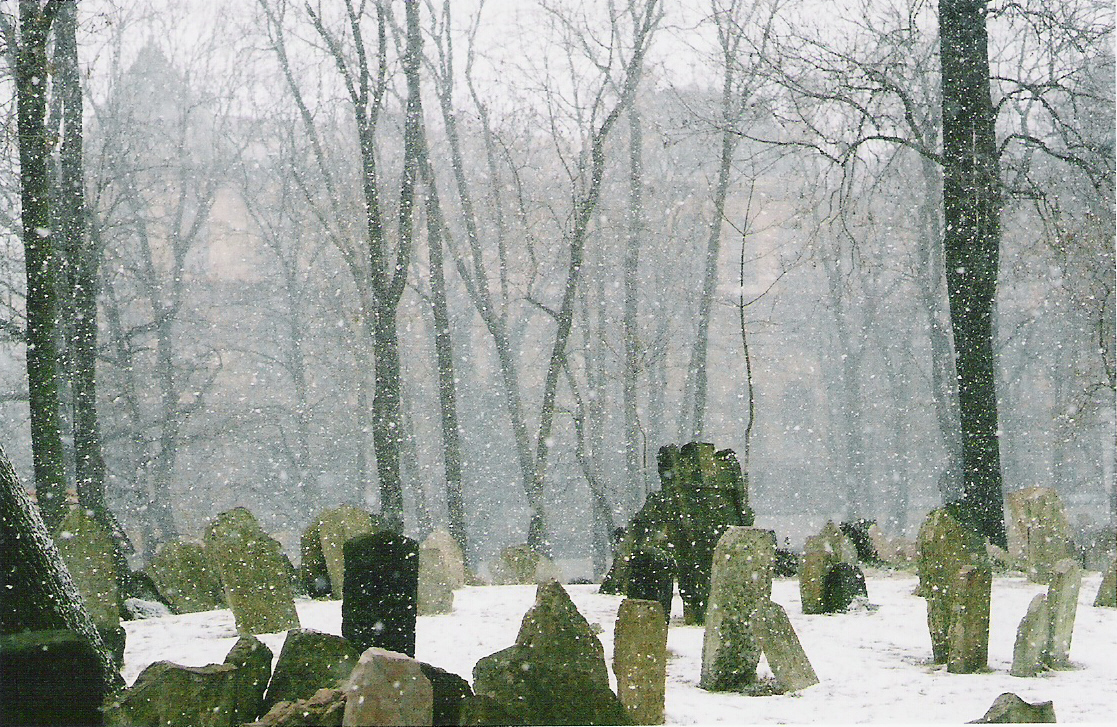
Last night's fitful sleep granted me a remarkable number of dream vignettes. One of them haunts me.
Dressed in a suit and standing alongside an unknown companion, I contemplated the soil at my feet, made hard by winter's bitter touch. I thought particularly about the difficulty of digging a grave in frost baked ground.
Looking up to survey the landscape, I realized that my macabre musing was only appropriate. My mysterious friend and I were in a vast cemetery; headstones freckled the gently rolling topography. My gaze returning to the hard soil in front of me, I recited the closing words of James Joyce's short story, "The Dead."
"It was falling, too, upon every part of the lonely churchyard on the hill where Michael Furey lay buried. It lay thickly drifted on the crooked crosses and headstones, on the spears of the little gate, on the barren thorns. His soul swooned slowly as he heard the snow falling faintly through the universe and faintly falling, like the descent of their last end, upon all the living and the dead."As if the Joyce lines were an invocation, snow began to fall.
Over the course of fifteen years, I've read "The Dead" several times. Never have I been especially moved by the story's mundane events, but the closing paragraphs stay with me. Even after reading my favorite of Joyce's works, "Portrait of the Artist as a Young Man," and later happily slogging through the rather self-conscious "Ulysses," it is the final words of the short story that first come to mind when someone mentions Joyce.
It's a curious thing that the art most significant to our unconscious is not always held in high regard in waking life.
Photo credits: Old Jewish cemetery from Bygning's Flickr photostream
Wednesday, January 21, 2009
Sensation
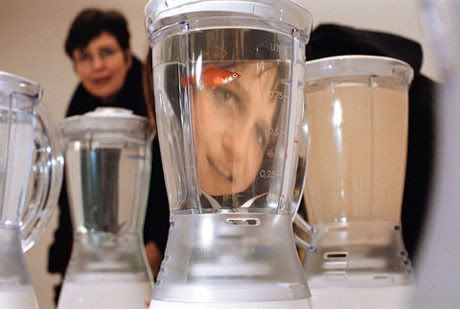
The Chilean-born artist Marco Evaristti is best known for his 2000 work, "Helena." Inside Denmark's Trapholt Art Museum, Evaristti installed ten electric blenders, their power cords visibly connected to electrical outlets. He filled the blenders with fresh water and placed a live goldfish in each. Foolish, disturbed or sickly curious museum visitors might choose to turn on a blender, thereby taking the life of a goldfish. Two people did just that. Public outcry followed and law suits were brought against the artist and the museum.
When I first read about "Helena," I thought it a puerile stunt. Most artists, critics and viewers reacted similarly, but these condemnations and dismissals were perhaps what Evaristti sought. Because the piece attracted so much derision, "Helena" transformed a little known sensationalist into an international art circuit commodity.
In time, however, I forgot Evaristti's name...but I didn't forget about "Helena." Despite my initial censure of the work, the disdainful tone of those who condemned Evaristti forced me to revisit the controversy. After all, what had the artist or the museum director done wrong, really? Evaristti presented a scenario in which another person might harm the goldfish. He provided museum goers with the necessary tools to kill a fish, but he didn't encourage them to do so. Still, he was smeared by animal rights groups, religious organizations and artist collectives.
I believe that the outcry over "Helena" was so vitriolic because Evaristti positioned himself as a public moralist. The mirror was turned to face art viewers in a difficult moment, and we didn't like what we saw there. While I may not hold Evaristti's risky installation in high regard, it is the art world's angry response that worries me. Indeed, the protests and the criminal charges suggest that many people (perhaps the majority) lack faith in the moral fiber of their fellow man.
Do most people believe that ours is an innately murderous species? Do most of us feel that moral calculus is irrelevant when another person or power has pointed you to a certain, dark end? I can not (and do not) accept such pessimistic attitudes. If I were to hand you a frog and a bat, would you think it okay to play frog baseball? I doubt it. And what are we to make of the vast majority of automobile drivers, those of us that don't opt to direct our vehicle into pedestrians, bicyclists or road-crossing chickens?
As Evaristti put it, he aimed to create "a dilemma" in which people might "do battle with their conscience." Because the artist included no signs or other directives instructing museum visitors to turn on a blender or blenders, I do not believe that the fish killers could fall back on the Stanley Milgram defense; visitors were not "good Germans," recklessly obedient to some unseen authority. (Indeed, only two visitors have ever "flipped the switch," a nearly negligible minority of the work's many viewers/subjects.)
A more convincing criticism posits that the museum setting is one of institutionalized safety; visitors therefore feel that their turning on a blender will not, in fact, bring a goldfish to an untimely, gruesome end. This is a valid supposition, but I maintain that only visitors with a sick curiosity would cross that final threshold, committing to the loaded "What if I do this?" (Again, it is instructive that just two visitors went so far.)
Whatever you think of "Helena," Evaristti's most recent project ups the ante. The work is sure to generate plenty of negative publicity in the coming months...and, of course, that's exactly what the Denmark-based shock artist wants.
2008 MyArtSpace Undergraduate Scholarship
An occasional contributor to MyArtSpace>Blog, I thought it worth mentioning that the results of the 2008 MyArtSpace Undergraduate Scholarship Competition are in. Most members of the growing MyArtSpace community are early to mid-career artists, and this generous scholarship befits MyArtSpace's mission to support the development of young artists.
Thursday, January 15, 2009
Coasts

"The deepest level of communication is not communication, but communion."
The impressive montane forest brought to mind a quotation I copied into one of my commonplace books some years ago. In his account of an interview with a Venezuelan native, the celebrated 19th century German naturalist Alexander von Humboldt claims that the Indian critiqued the Christian God of the European explorers and conquerors, observing, "Your god keeps himself shut up in a house as if he were old and infirm. Ours is in the forest and in the fields and on the mountains when the rain comes." Although no rain graced Mount Tamalpais this December 29th, the Indian's god was also mine.

Mount Tamalpais is located in southern Marin County, California, just north of San Francisco. The lush Douglas fir and redwood forests of the region are magical places. They served as inspiration for George Lucas's forested moon Endor and they call to mind the epic majesty of J.R.R. Tolkien's Middle-earth. (In fact, some "Star Wars" fans reasonably suggest that Lucas named his verdant moon in homage to Tolkien. Tolkien, a celebrated linguist and scholar, invented languages for his fantasy fiction and in the Quenya tongue, one of the elvish languages he created, the word for Middle-earth is Endor.)
Of all Tolkien's creatures, the elegant and noble elves of Lothlorien especially appealed to me when I first read "The Hobbit" and "The Lord of the Rings." The elves are wise, fair and gracious beings, but also wild, intimately attached to the world of the hunter and to Nature's ambivalent magic. Twenty years after my first reading of Tolkien's fantasy epic, I still proudly characterize myself as a Nature worshiper.
The economist and sociologist Max Weber famously said that the secularization of society and increasing specialization of methodological inquiry had led to a "disenchantment of the world." Indeed, they have, but Baruch Spinoza's brand of naturalistic pantheism allows for a happy marriage of the material and metaphysical worlds. The two spheres, like the taijitu's yin and yang, are complementary parts of a whole. Necessarily, then, exclusion or disparagement of one of these two realms is limiting.
Although the Enlightenment's separation of reason and imagination, and of science and religion, has yielded exemplary human achievements, it also alienates us from the integrated aggregate. We no longer conceive of the universe (or our experience of it) as coherent or unified; since at least the 17th century, the prevailing philosophical current is Cartesian, depicting the universe as a random assemblage of disparate parts. As a result, those individuals who, like the brilliant 19th century critic John Ruskin, strive to reconcile "the broken harmonies of fact and fancy, thought and feeling, and truth and faith" are considered naive or fey. Even Gershom Scholem, the renowned historian of Jewish mysticism, described his philosopher friend Walter Benjamin's work as "an often puzzling juxtaposition of the two modes of thought, the metaphysical-theological and the materialistic." I align myself with the philosophical dissidents because, like Ruskin and Benjamin, I feel that the material and metaphysical realms are locked in a harmonious, reciprocal relationship. Framed another way, I believe that the mundane is the sacred; I deny the divisive "and."
"My dear brothers and sisters, we are already one. But we imagine that we are not. So what we have to recover is our original unity."

That December evening, Elizabeth and I motored along Grizzly Peak's ridge line and, as the Pacific horizon took the sun, we admired the colorful strata deposited over San Francisco's hills, city lights and bay. Later, after a lovely dinner in Berkeley, we returned to Elizabeth's home and relaxed with her parents and brothers. It was a superlative day. Yet because I'm accustomed to spending my birthday in brooding solitude, it was also an exceptional one, and therefore I wasn't surprised when, driving to Grizzly Peak, I felt a twinge of regret.
To be sure, the day was nearly perfect, but I had to ignore the call issued by the deep blues and purples of twilight, an invitation to submerge myself in the gathering darkness. I remarked to Elizabeth that it felt very strange to observe my birthday without making space for rumination. We turned onto Grizzly Peak Boulevard. I watched the car's headlights rake across a stand of trees, frightening back the dark.

The Trappist monk Thomas Merton described his contemplative practice as "death for the sake of life." Merton may be guilty of rhetorical flourish, but one of contemplation's principal goals is the erasure of self or the death, if you will, of the self-conscious individual. I consider myself lucky; I once experienced release from the first-person, a rare gift in our culture of consumption and distraction. I consider those exceptional moments an ecstatic opening to The All, a glimpse of the integrated, infinite universe.
The word ecstasy is derived from the Greek word for "to stand out of place." On the dike at Heron's Foot, my conscious being was literally outside (or at least without) the self. For a time, the atoms, molecules, cells and organs that comprise "me" were undifferentiated from the greater web. Religious mystics usually refer to this variety of fundamental experience as "seeing God." That name bothers me less than it did in my militantly atheistic adolescence, but I prefer The All (or an apophatic counterpart, The Nothing) because the name possesses majesty and mystery but none of the unfortunate authoritarian baggage. Furthermore, the rituals of institutionalized religion and its "under God" subjects are no more or less valuable than the rituals of the heathen mystic. John Dewey's "live animal" might just as easily be awakened in the gropings of sex as in penitential prayer, and God is just as easily found in the forests of Mount Tamalpais as in the acolyte's cathedral. After all, there is nothing supernatural about ecstasy; it is only a mode of hyper awareness, a more immediate connection to the universe, or at least as much of one as our limited vessels can perceive.
Now, January already half gone, I sit at my day-job desk and look out on Manhattan's East River. The late afternoon sun's angled glow paints the 59th Street Bridge in peach-yellow and refracts off the west face of Citibank's glass obelisk in Queens. A herring gull flaps over Roosevelt Island and the river runs slack as it awaits the pull of outgoing tide. In "Rewriting Nature," an essay published in The New Yorker, Adam Gopnik wrote "[Charles] Darwin disenchanted believers in Heaven, but he reenchanted lovers of Earth."
I concur.
"What we have to be is what we are."

Note: all indented quotations, Thomas Merton
Photo credits: all images, Hungry Hyaena, 2008
Wednesday, January 07, 2009
Denise Bibro's "Winter Salon 2009"
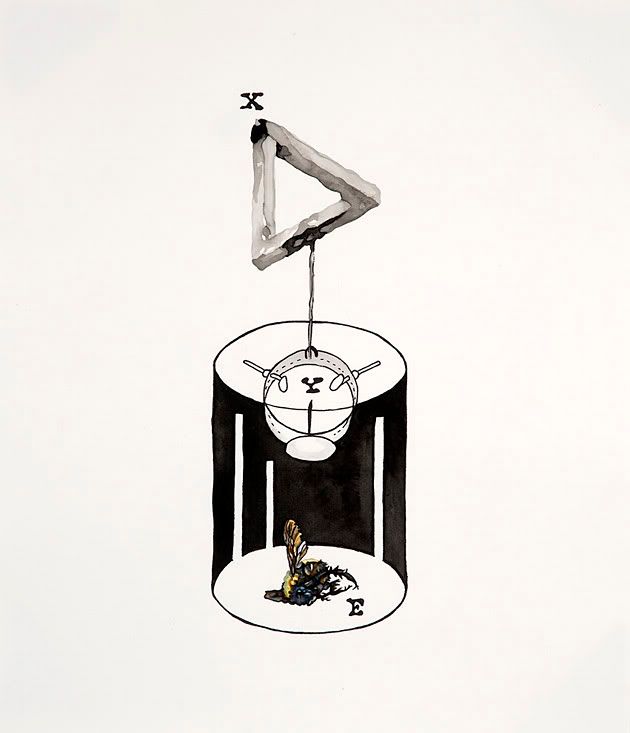
"Transmutation #1"
2008
Pen and ink, sumi ink and watercolor on Arches paper
13 1/4 x 11 1/2 inches
I'm including some previously exhibited works in Denise Bibro Gallery's "Winter Salon." This group exhibition opens tomorrow evening and I will stop by the reception around 7 PM (depending on what time I escape the day job).
Pertinent details are below.
"Winter Salon"
December 18, 2008 - January 31, 2009
Opening reception: January 8, 6:00 PM - 8:00 PM
Denise Bibro Fine Art
529 West 20th Street 4W
New York, NY 10011
Tel: 212-647-7030
Sunday, January 04, 2009
DIaBEtic DEW555 Interview
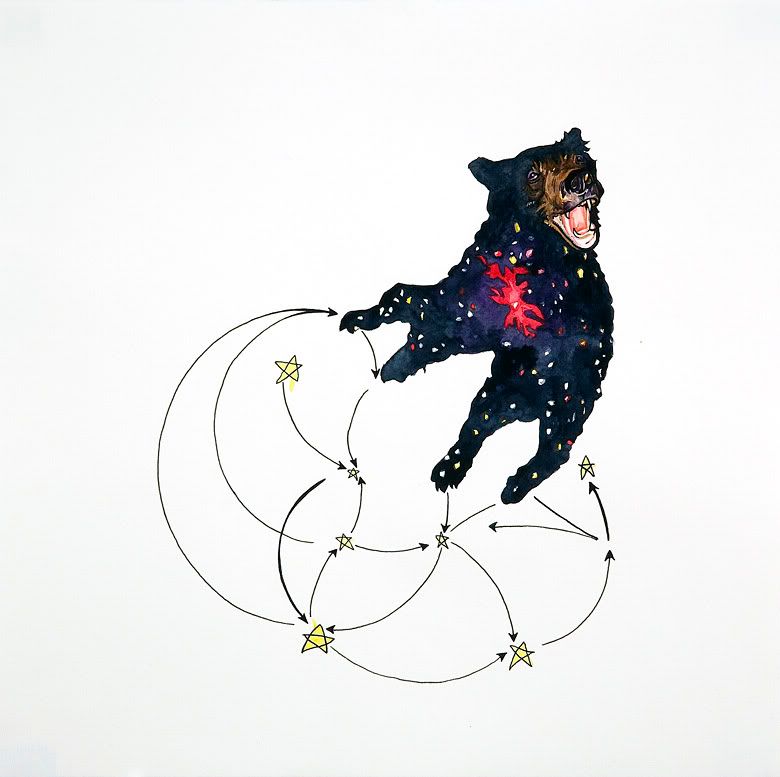
"Constellation (however I moan)"
2008
Watercolor, gouache, pen and sumi ink on Arches paper
11 7/8 x 12 inches
Claudio Parentela, the Italian artist, art journalist and zine magnate, posted a brief interview with me on one of his many blogs, DIaBEtic DEW555.
Click here to read it. (On some browsers, you may need to scroll down the page.)
Saturday, January 03, 2009
New work
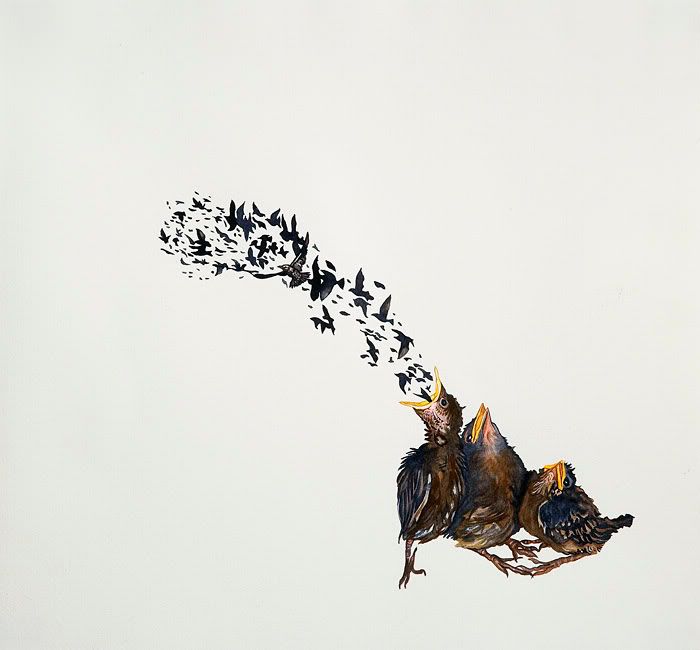
"further murmuration"
2008
Watercolor, gouache, pen and sumi ink on Arches paper
12 3/8 x 13 1/4 inches
I've added some work to the 2008 section of my website.
Feedback is welcome.
Friday, January 02, 2009
Artist A Day, Flavorpill and Letters From the Inquisition
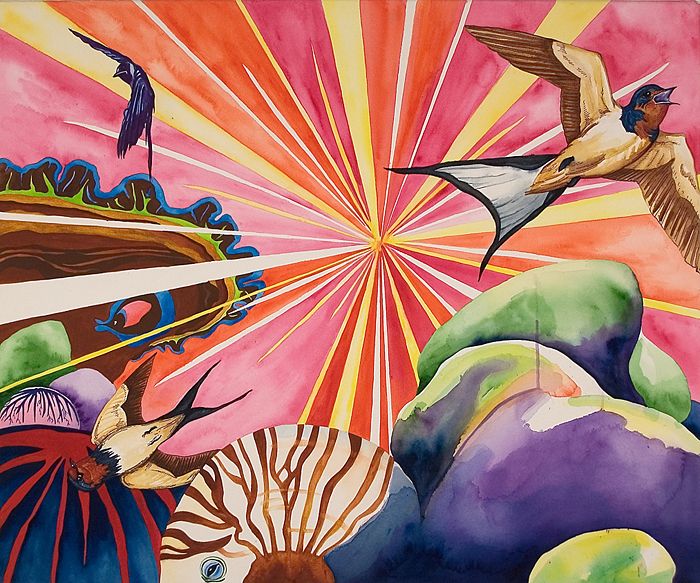
"Sublime Revelation"
2006
Watercolor, gouache, and marker on Arches paper
27 x 32 inches
Welcome to 2009, everyone! I'm feeling very good about the year of the ox.
I have three quick announcements to make.
1) This past Tuesday (12/30/08), I was the featured artist on Artist A Day. The feature is something of a belated birthday present; I reached my 31st anniversary on December 29th. If you visit the site, please take a second to rate my work (on the right side of the page), as I'd like the feedback. Better yet, add a comment.
2) On the same day, Flavorpill used a detail of one of my earlier paintings - 2006's 'Sublime Revelation" - for it's New York edition banner (Issue 447, December 30th). Although some of the information included in the associated bio is a bit out-dated, this was another pleasant surprise.
3) I will now be an (ir)regular contributer to Letters From the Inquisition. Michael McDevitt, a friend and professional peer for over a decade, invited me to contribute over a month ago, but I'm only now getting around to writing some posts. Michael and I met in 1996 at the College of William & Mary, in Williamsburg, Virginia. During our time at William & Mary, we co-founded Synoddity, a cross-disciplinary arts organization. Synoddity championed generalism over specialization but, acknowledging that our current body of knowledge is increasingly divided and sub-divided, encouraged conversation and exchange across fields. In many respects, Letters From the Inquisition is similarly inclined, and I'm pleased to be a part of it.
Subscribe to:
Posts (Atom)