It's not news that some folks find the
theory of evolution unsettling. While the stereotypical denialist of evolution is a Bible-beating, trailer-owning bumpkin, there are an increasing number of thoughtful, educated individuals that do not accept the claim that humans evolved from single-celled organisms. Even more "outrageous" to these denialists is the claim that, eons ago, our ancestors may have resembled fish or, God forbid,
apes.
But another hotly contested debate preoccupies my thoughts this afternoon:
Nature versus Nurture. The case for Nature, if choosing between the two, relinquishes our individual destinies to our genes. Critics of the Nature argument insist that it reduces
Homo sapiens to
automata. At the very least, humans tumble a few notches down the
scalae naturae; we are rendered but one more brute species.
Most people who follow the debate, professionals and amateurs alike, agree that Nature
and Nurture play important roles, but increasing evidence seems to place more emphasis on proteins and, as this research appears in popular journals and newspapers, outrage on the part of the Nurture loyalists may be imminent.
Nicholas Wade's
Science Times article, "
A Gene for Romance? So It Seems (Ask The Vole)" (Tuesday, July 19, 2005,
New York Times) got me thinking about the popular reaction to genetics research (and the associated scientific claims). The research Wade describes will not surprise anyone who reads scientific journals such as
Nature or
Proceedings of the National Academy of Sciences (PNAS), but these are specialized publications with an audience generally limited to scientific professionals. In the
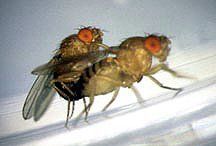
NY Times piece, statements such as, "Researchers discovered how the gene is naturally modulated in a population of voles so as to produce a spectrum of behaviors from monogamy to polygamy, each of which may be advantageous in different ecological circumstances," are likely to make some readers squirm. It is, however, the gene dubbed "fruitless" that will capture the fearful imaginations of most casual readers. "The gene is called fruitless because when it is disrupted in male [
Drosophila fruit flies] they lose interest in females and instead form mating chains with other males." Biologists have isolated the gene and are able to manipulate it successfully, changing fly sexual preferences.
"Fruitless serves as a master switch of behavior, just as other known genes serve as master switches for building an eye or other organs. Are behaviors and organs constructed in much the same way, each with a master switch gene that controls a network of lower level genes?"
I showed the
Times article to a gay co-worker. Like him, I believe that homosexuality is largely genetic, but new research suggests that environmental factors must not be dismissed.
"'Among mammals,' Dr. Meaney and colleagues wrote in a report of their findings last year, 'natural selection may have shaped offspring to respond to subtle variations in parental behavior as a forecast of the environmental conditions they will ultimately face once they become independent of the parent.'
A full understanding of these behavior genes would include being able to trace every cellular change, whether in a hormone or pheromone or signaling molecule, that led to activation of the gene and then all the effects that followed. Dr. Robinson has proposed the name 'sociogenomics' for the idea of understanding social life in terms of the genes and signaling molecules that mediate them."
Sociogenomics? Accurate though the name may be, I'm sure many readers will associate the term with genetic engineering; my co-worker and I certainly did.
Curiously, he was most concerned by the notion that one's environment can cause chemical alteration of proteins, thereby changing the genetic makeup (and behavior) of the individual. "If people believe there is a certain way to raise a kid so that he isn't gay," he worried, "then many parents will do their best to eliminate homosexuals." True, but why stop there? If biologists can "flip" the fruitless gene in
Dropsophilia, I assume a similar gene (or series of associated genes) in
Homo sapiens will one day be isolated. Given this, a "
GATTACA"-like scenario is no longer very fanciful. Fortunately, humans don't make the best test subjects and are more prone to serious complications than either voles or fruit flies. Even in
Drosophilia flies, removal - as opposed to "flipping" - of the fruitless gene results in fly death.
For the time being, though, I like where we stand. We're beginning to realize just how influential genes are on human behavior, psychology and physiology. It's exciting...even if we need to society to work against any outliers who see genetic-engineering as an opportunity to rebirth sanctioned eugenics.
Photo credit: Tracey Chapman and Linda Partridge


