Showing posts with label environmentalism. Show all posts

Sunday, September 08, 2013

Bad Ideas For "America's Best Idea"

"In a soul-searching, head-scratching journey of its own, the agency that manages some of the most awe-inspiring public places is scrambling to rethink and redefine itself to the growing number of Americans who do not use the parks in the way that previous — mostly white — generations did. Only about one in five visitors to a national park site is nonwhite, according to a 2011 University of Wyoming report commissioned by the Park Service, and only about 1 in 10 is Hispanic — a particularly lackluster embrace by the nation’s fastest-growing demographic group.

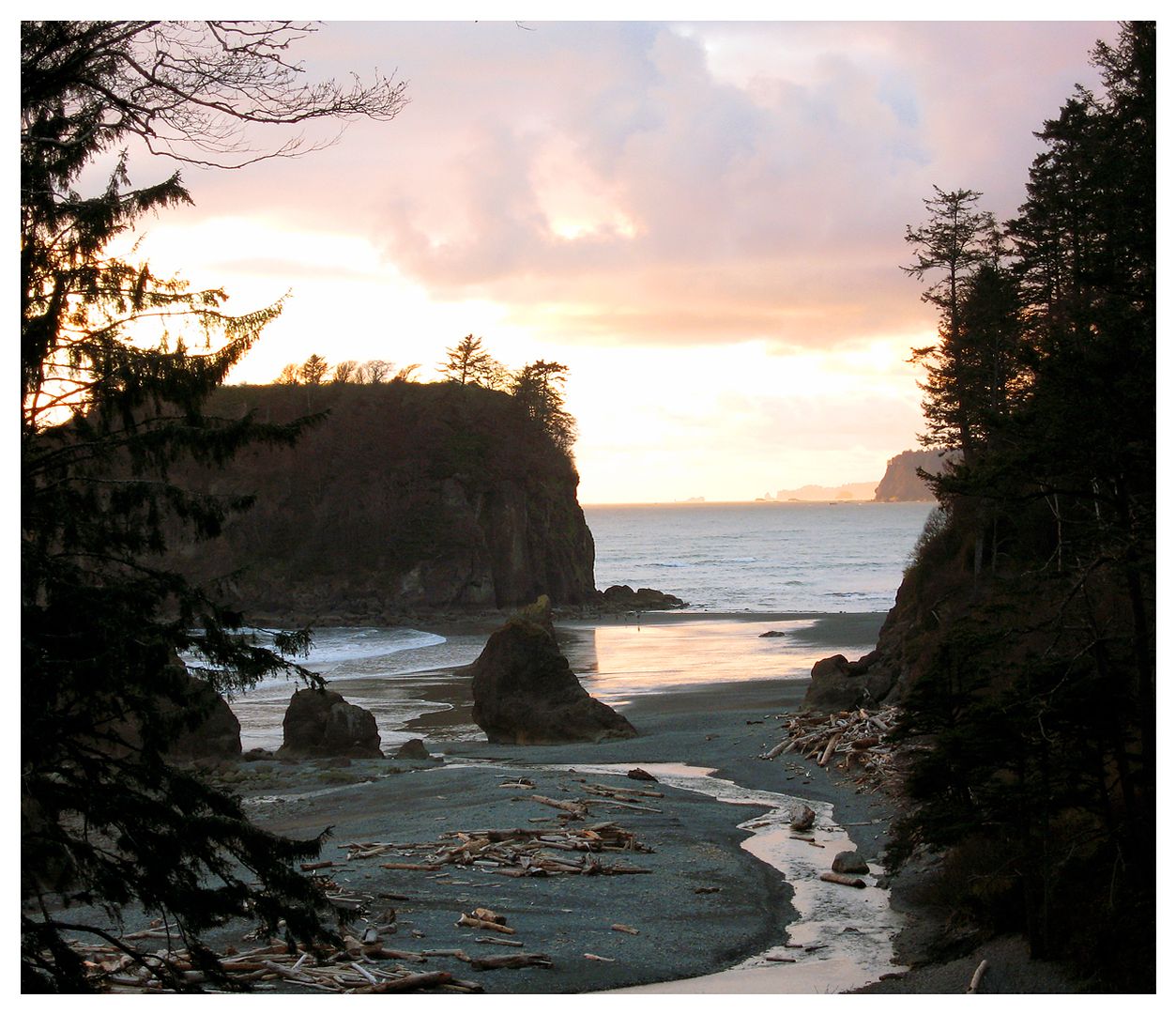
View of Ruby Beach, Olympic National Park
April 2008
[…] But the new effort goes further, to the question of how, and how much, the parks themselves must change to attract a fundamentally different audience. Wireless access, for example — still nonexistent in much of the Park Service universe — could divide older park visitors from minorities and young people, the so-called millennial generation, who want to share the experience live in social media with their peers.

'Boomers maybe want to get away, and millennials want to be connected; that changes how you use the space,' said Laura Swapp, REI’s director of diversity and inclusion. Music events could be another potential generational dividing line — peace and quiet versus entertainment — but would also draw the demographic the Park Service is after, Ms. Swapp said."

Here's hoping Jay-Z and Lady Gaga never perform on stages in Yellowstone or Yosemite.

Although I, too, would like to see more cultural and racial variety on our parks' trails, further developing the parks with WiFi towers and concert venues would be a myopic and ultimately fruitless move. Few areas of the American landscape afford us with the opportunity to "tune in" by tuning out, and the National Park Service should not fundamentally alter its mission in an effort to appeal to younger and more diverse demographics.

Instead, the NPS needs to celebrate the conservation heroes of color -- Majora Carter and Van Jones, for example, as well as the growing number of African American and Latino NPS rangers -- thereby providing role models for today's youth. Most importantly, we need more programs that get urban kids into our parks, encouraging them to recognize that these tracts belong to them. It's possible that their time afield without phone calls, Facebook, and Reddit will stay with them, appreciated, even if they're less than enthusiastic about the mosquito bites.

Photo credit: Christopher Reiger, 2008

Sunday, November 27, 2011

Elisheva Biernoff's "Inheritance"


Elisheva Biernoff
"Inheritance"
2010
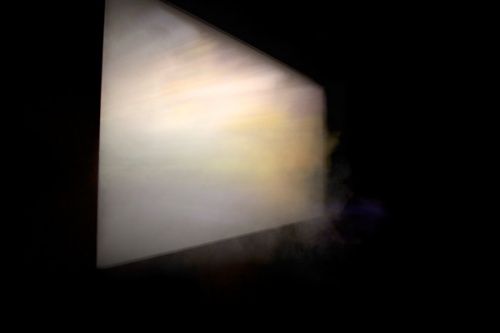
80 slides of endangered wilderness areas projected onto mist from a humidifier housed in a plywood and fabric enclosure

Environmental historian William Cronon argues that "only people whose relation to the land was already so alienated could hold up wilderness as a model for human life in nature, for the romantic ideology of wilderness leaves precisely nowhere for human beings actually to make their living from the land." I recalled Cronon's incisive critique of wilderness ideology as I pondered artist Elisheva Biernoff's "Inheritance," a compelling installation included in Eli Ridgway Gallery's recent group show, "Better A Live Ass Than A Dead Lion."

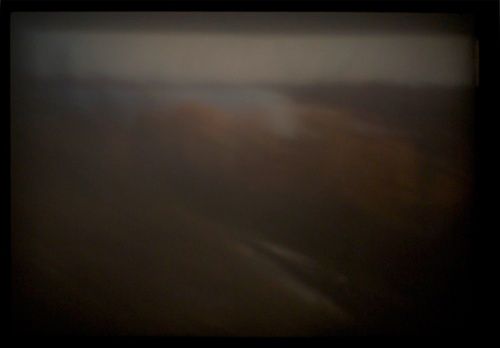
"Inheritance" was installed in a dark side gallery on Ridgway's lower level. A wall-mounted, carousel slide projector cast images of "endangered wilderness areas [...] onto mist from a humidifier housed in a plywood and fabric enclosure." The humidifier's fog billowed out of a television-sized opening cut into the plywood, and the projected photographs reflected by the haze were sometimes -- for an instant, when the mist was just so -- recognizable as landscapes, but rarely as specific environments or locations. Without the artist's accompanying list of "disappearing places," viewers couldn't know they were looking at Alaska's Tongass National Forest, Florida's Everglades, Brazil's Pantanal, China's Gobi Desert, or another of nearly 80 imperiled landscapes.


Elisheva Biernoff
"Inheritance"
2010
80 slides of endangered wilderness areas projected onto mist from a humidifier housed in a plywood and fabric enclosure

Biernoff's installation, which was also included in ProArts Gallery's 2010 "2 X 2 Solos" exhibition program (and, by virtue of its strength, will likely be a part of future exhibitions), is luminous and its effect almost ethereal, but unlike the meditative Light and Space works of James Turrell or Doug Wheeler, Biernoff's installation doesn't provide opportunity for reverie. The transitions between the images are abrupt, and marked by the noisy, mechanical advance of the slide carousel. Ka-jenk, Ka-jenk. Just as we begin to discern the vision roiling in the mist -- 'Is that a jungle? Perhaps a swamp?' -- we're jarred from our musing. Ka-jenk, Ka-jenk. Again, we endeavor to interpret the play of light and color in the vapor, and again: Ka-jenk, Ka-jenk! A contemplative inclination is foiled by the machine's relentless progress, and there's sly humor in Biernoff's frustration of our stubborn need to identify and classify; viewers can see the specters in the mist, but can't make much (if any) sense of them. Even so, we'll continue to plumb the rolling fog for clues.

Our ancestors assigned supernatural qualities to fluid media. They scried smoke to portend future events and viewed it as a vehicle of conveyance, capable of carrying the essence of a sacrifice to the god or spirits of a people. In "The Wizard of Oz," the face of the eponymous wizard appears to the protagonists in a cloud of reddish smoke, causing them to tremble in awe. Seeking a similar experience of wonder, many of the people who visit wilderness areas do so to behold nature's majesty. Their language is often reverent; they speak of the sublime and the transcendent. But what is a wilderness area, exactly? According to the United States Wilderness Act of 1964, wilderness is land that "generally appears to have been affected primarily by the forces of nature, with the imprint of man's work substantially unnoticeable [...that is] designated for preservation and protection in [its] natural condition." Unfortunately, the "imprint of man" is not always readily observable (consider the nuanced affects of climate change or the irradiated, if picturesque Red Forest that surrounds the decommissioned Chernobyl Nuclear Power Plant). More problematically, as Cronon makes clear, the Wilderness Act definition sets man apart from "the forces of nature." This latter move is a Romantic, naive impulse. All habitats are interconnected; even protected landscapes are affected by activities outside their boundaries. Moreover, because many refuges, parks, and wilderness areas are disconnected from other undeveloped lands, the flora and fauna living in these protected areas risk genetic isolation and face an increased risk of local extinction (e.g., the Florida panther and many other critically endangered species). Outside of the Wilderness Act and our collective imagination, then, there is no "original" or "virgin" landscape.

The dreamlike quality of Biernoff's installation is therefore appropriate. The notion of "wilderness" is as indefinite as the mirages the artist creates for us with light and vapor. Some fictions, though, are useful. If the dream of Eden compels us to be better stewards, it's all for the good. Yet Biernoff reminds us that we're more likely to avoid the pitfalls of ideology if we recognize wilderness is an illusion, that the specter before us is manufactured using a humidifier and an outmoded piece of technology. The artist presents us with the wizard's face, but also reminds us of the man behind the curtain.

Elisheva Biernoff's "Inheritance" was on view October 8 - November 5, 2011, at Eli Ridgway Gallery (172 Minna Street, San Francisco).


Elisheva Biernoff
"Inheritance"
2010
80 slides of endangered wilderness areas projected onto mist from a humidifier housed in a plywood and fabric enclosure

Image credits: "Inheritance" installation photographs, courtesy Eli Ridgway Gallery

Note: Due to carelessness, this write-up was originally published as a "Review In Brief." It's longer than the pieces in that series, however, and is no longer associated with it.

Saturday, September 24, 2011

Acknowledging Exceptionality

"As glass office and condominium towers have proliferated in the last decade, so, too, have calls to make them less deadly to birds. The San Francisco Planning Commission adopted bird-safety standards for new buildings in July, and this month that city’s Board of Supervisors will vote on making it law. Legislation is pending in Washington that would require many federal buildings to incorporate bird-friendly designs. The United States Green Building Council, a nonprofit industry group that encourages the creation of environmentally conscious buildings, will introduce a bird-safety credit this fall as part of its environmental certification process, called LEED."
- "A City of Glass Towers, and a Hazard for Migratory Birds," New York Times, September 14, 2011
I enjoyed reading "A City of Glass Towers, and a Hazard for Migratory Birds," a recent New York Times article about bird-building collision mortality. Lisa Foderaro's piece is a hopeful account of how a confluence of activism, technology, and regulation can improve the lot of animals, especially in cases where a particular species has been adversely affected by human development.

The comments that follow the article, however, are predominated by doom-and-gloom attitudes. A representative survey follows:
All that matters are people and every little whim. We're a doomed species.
-Karma Every Moment, NY, NY

The people who tell us that evolution and climate change are just unproved theories have no idea how life formed this planet since its inception and no understanding whatsoever of the role of extinction in maintaining the climate within habitable bounds when any one plant or animal breaks the equilibrium. They convinced me long ago that there is no future for my own children.
-Steve Bolger, NY, NY

Yet another example of the consequences of man's selfish and destructive behavior. So sad.
-agetibi, Carrboro, NC
No wonder over 50% of Americans polled by The Nature Conservancy caricatured environmentalists as preachy reactionaries. In the words of the Conservancy's Chief Scientist, Peter Kareiva, most people see members of the environmental movement as "misanthropic, anti-technology, anti-growth, dogmatic, purist, zealous, exclusive pastoralists." Unsurprisingly, this negative stereotype has led to a dwindling of the movement's ranks.

I consider myself an environmentalist, but I distinguish between preservation and conservation (placing myself in the latter camp) and, more critically, I believe that environmentalism needs to embrace a "can do" attitude. If the majority of my fellow Times readers identify as environmentalists, their comments suggest that they're a well-intentioned pox. Wholesale condemnation of our species is as wrongheaded and malignant as exclusive glorification. In order to decry humanity as a "selfish and destructive" brute, one must stubbornly overlook all the evidence to the contrary. I wrote about such oversight in an essay included in the catalog for "A Live Animal," a group show that Selene Foster and I co-curated at Root Division.
"Although 'deep ecologists' and animal rights activists bemoan conservation approaches that prioritize human interests, the fact remains that human beings are exceptional animals. Skeptics and naysayers need only consider our species' biological and imaginative success to find evidence of our unprecedented faculty. But of all our remarkable features and feats, among the most notable examples of humanity's anomalous nature is our interest in and empathy for other species. Although there is growing scientific agreement that some other species possess self-awareness and even a capacity for empathy -- whales, dolphins, elephants, and our ape relatives are especially interesting in this regard -- humans are the only animal striving to learn about and better the lot of other creatures and environments. It's true that we often prioritize short-term, anthropocentric interests and it's also clear that reckless human activity has contributed to dramatic climate change and the ongoing Holocene extinction (our geological epoch's staggering loss of biodiversity), but conservation efforts and legislation, as well as our burgeoning interest in sustainability, speak to another, more hopeful human impulse; we possess an innate ability to see ourselves in other animals and, in turn, to recognize our capability as their stewards and representatives."
In short, we're not all bad. If you believe that we are, then you're guilty of sapping our species' potential. Christopher Cokinos is excellent on this point. I've quoted his terrific "Consolations of Extinction" essay before; I'll do it again.
"Too much grief for the world means less energy to help it along. [When] you find yourself free of the poisons that too much angst can cultivate, then something marvelous happens. You can sense how very old the planet is, how very old life and death are, and you can keep going on, you can keep doing the work you do in this universe, feeling despair when you feel despair, feeling - amazing - joy when you feel joy."

Sunday, September 05, 2010

ESPP at Chicago's Renegade Craft Fair


The Endangered Species Print Project will be exhibiting at the Renegade Craft Fair, taking place this September 11th and 12th, in Chicago.

Co-founders Jenny Kendler and Molly Schafer will be selling prints to raise funds for all of the fourteen species so far featured in ESPP prints, as well as some upcoming print subjects, including my red wolf (Canis rufus).

I'm pleased to report that, to date, the ESPP has raised $4,000 for critically endangered species, and hopes to raise another $6,000 at Renegade! If you're in or around the Windy City, please pay them a visit.

Wednesday, July 21, 2010

ESPP Anniversary


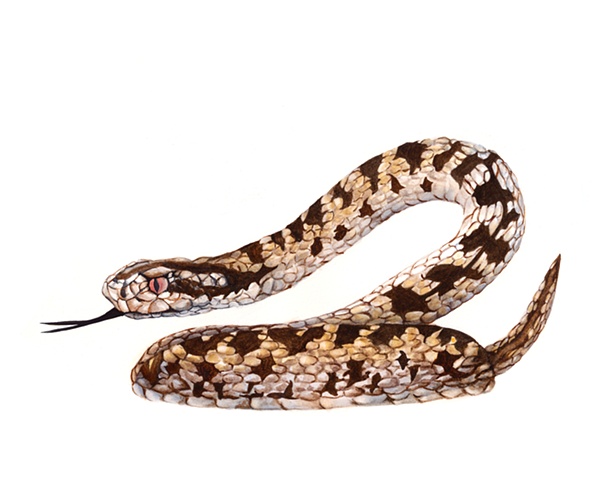
Molly Schafer
"Moldavian Meadow Viper"
2010
Archival giclee print (Edition of 2000)
8 x 10 inches

The Endangered Species Print Project recently celebrated their one year anniversary! To mark it, they released three new prints.

I'm especially fond of the two newly available limited editions created by the project's co-founders, Molly Schafer and Jenny Kendler...and I'm most drawn to the Moldavian Meadow Viper (Vipera ursinii ssp. moldavica). This, for three reasons: Molly rendered the animal beautifully; I adore serpents, and Molly evidently does, too; I have an irrational attachment to Hungary, since my paternal great-grandparents hail from the country, and sales of the print benefit the Hungarian Meadow Viper Conservation Center, a conservation organization based there.

Visit the ESPP site to see the other prints.

Image credit: Courtesy the Endangered Species Print Project

Sunday, May 09, 2010

What Remains


I've posted Chris Jordan's photographs on HH in years past, but I haven't before showcased his pictures of albatross remains. The images are powerful reminders of the too often unseen and unconsidered impacts of our species' prolific, reckless consumption.


On his website, Jordan writes of the series, "Midway: Message from the Gyre,
"These photographs of albatross chicks were made in September, 2009, on Midway Atoll, a tiny stretch of sand and coral near the middle of the North Pacific. The nesting babies are fed bellies-full of plastic by their parents, who soar out over the vast polluted ocean collecting what looks to them like food to bring back to their young. On this diet of human trash, every year tens of thousands of albatross chicks die on Midway from starvation, toxicity, and choking.

To document this phenomenon as faithfully as possible, not a single piece of plastic in any of these photographs was moved, placed, manipulated, arranged, or altered in any way. These images depict the actual stomach contents of baby birds in one of the world's most remote marine sanctuaries, more than 2000 miles from the nearest continent."
Today, as crude oil continues to spread over the Gulf of Mexico from the Deepwater Horizon rig, we'd do well to remember that one of the significant uses of crude oil is the production of petroleum-based plastics. Individually, we can help alleviate our reliance on offshore oil wells and imported oil by consuming less plastic and recycling what we must use.


Photo credits: all images, Chris Jordan

Wednesday, April 28, 2010

Revisiting the Steady State Economy

On the heels of not one, not two, but three Republican blockades of financial regulatory legislation in the U.S. Senate this week, I thought it worth reposting the below essay on the concept of a Steady State Economy. The essay was originally posted on HH in April 2005; five years later, there's only that much more reason for thoughtful, comprehensive reform.

+++


Environmentalism is becoming something of a religion. Those who subscribe to most or all of the tenants of the environmentalist doctrine are among the movement’s acolytes, composting and recycling, canvas bagging it and buying organic, living what they consider “healthier,” less “impactful” lives. A thoughtful environmentalist should recognize these actions to be sacraments grounded in a hybrid moral code. “I am doing my part to rectify the mess made by the sinners around me.” How persuasive is this feeling of self-worth and moral superiority? Like all religious conviction, it is undeniably powerful and fulfilling, but it comes at a cost. Too often this fetal “religion” ignores fact in favor of that which is deemed morally superior. For example, radical environmentalists demand a wilderness without humans, ignoring the fact that management (stewardship) is now an unfortunate necessity given our exuberant use of natural resources and our continued sprawl. Reason must enter into the equation. Thoughtful environmentalism of the secular variety is possible, as long as we don’t allow ourselves to become vain.

This brings me to the concept of the Steady State Economy.

I first heard wind of Brian Czech’s Center for the Advancement of the Steady State Economy (CASSE) project a year ago. My initial reaction was positive, though I feared support for the concept would be relegated to left-wing environmental groups of the “religious” variety. Surprisingly, I am hearing the term used with more frequency these days, sometimes by folks with little interest in preserving biodiversity or encouraging ecological sustainability.

I am a proponent of the philosophy (read this .pdf for an excellent summary). The front page of the CASSE website states:
“Economic growth is an increase in the production and consumption of goods and services. It entails increasing population, per capita consumption, or both. Economic growth leaves a larger ecological footprint, causing civil strife and bringing nations into conflict.”
This simplifies, for the sake of dramatic impact, the arguments made by the economists behind the SSE. For me, the heart of the matter is touched on in the following selection.
“…Wildlife biologists know that a wide variety of social structures may produce stable populations. The same holds true for a steady state economy. For example, a steady state economy with long human life spans entails low birth and death rates. In our opinion this is preferable, within reason, to a steady state economy with short life spans, high birth rates, and high death rates. The same concept applies to capital and durable goods such as automobiles. We opine that a relatively slow flow of high-quality, long-lasting goods is preferable to a fast flow of low-quality, short-lived goods.”
The SSE will not take hold in the United States anytime soon, but in more socially-minded democracies, like Sweden or England, the approach is not so alien. The truth is, however, such a transition from market-driven capitalism to stability-driven capitalism is unlikely to occur unless the populous desires as much. In the United States, our stock market would require overhaul, making it “less of a casino,” by decreasing its volatility and demand for liquidity. This seems unlikely, especially in the immediate future. In fact, were the transition to begin today, the market would likely hemorrhage. Making things even more unattractive for the “powers that be,” implementation of the Steady State Economy requires, for countries like the United States, a marked decrease in Gross Domestic Product. As a result, I believe the SSE can not become a concrete reality in the foreseeable future, but that we should strive for it no less.

As the selection below suggests, there is much to be gained from the sustainable lifestyle.
“Nor would any cultural stagnation result from a steady state economy. John Stuart Mill (1806-1873), one of the greatest economists and political philosophers in history, emphasized that an economy in which physical growth was no longer the goal would be more conducive to political, ethical, and spiritual improvements.”
Ah, yes, ethical and spiritual improvement… So we’re back to individual action and lifestyle choices, rubbing shoulders with the “religious” environmentalists. Where do I sign up to feel superior to the rest of the heathens? I already recycle, canvas bag it, and eat only meat that I have caught or killed myself. I’m a few sacraments shy of donning a robe and shuffling off to the commune. Why shouldn’t I begin buying everything carefully and, in my own way, push for the adoption of the SSE at a local level?

Well, the truth is I should.

I self-consciously poke fun at the problematic aspects of environmentalism only because it is so close to my heart. I am not a religious man in the popular or traditional understanding of the word. Biology, anthropology, paleontology, history: these are my holy tomes. Yet I firmly believe that through careful consideration, research, and political pressure we can arrive at a more complete conservation ethic, one which addresses not only biodiversity and “wilderness” (my principal areas of interest), but also global poverty and human rights.

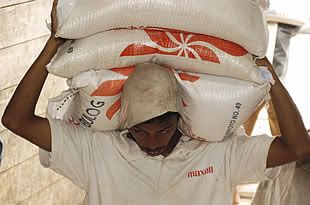
Photo credit: ripped from the World Food Programme website

Friday, April 09, 2010

Javan Rhinoceros ESPP Prints Available


Christopher Reiger
"diminishing returns"
2010
Pen and sumi ink, gouache and watercolor on Arches paper
15 x 12 inches

My 2010 drawing "diminishing returns" has been made into a limited edition print for the Endangered Species Print Project. The drawing features the Javan Rhinoceros (Rhinoceros sondaicus), a species on the very brink of extinction.

From the ESPP website:
"The Javan, or Sunda, Rhinoceros, is one of five extant rhinoceros species. The species was once widespread throughout Asia but is today critically endangered. There are currently between 37 and 44 Javan Rhinos in Ujung Kulon National Park, in West Java Indonesia, and no more than 5 in Cat Tien National Park, in Vietnam. Sadly, with only two known populations in the wild and none in captivity, this rhino species may be the rarest large mammals on our planet."
As per the ESPP model, this is a limited edition of 49 prints, the number determined by the featured animal's current population. The print measures 8 x 10 inches, and costs a mere $50.00. ALL proceeds from sale of the prints will be donated to the International Rhino Foundation.

The drawing was something of a first for me. As I explain for the ESPP artist notes,
"Animals figure prominently in my drawings and paintings. Usually, however, there is plenty of photographic art scrap to use as source material. In the case of the Javan Rhinoceros, this is definitely not the case!

In order to minimize stress for the critically endangered rhino, researchers study the species via fecal sampling and camera traps; the animals are rarely encountered or observed. As a general rule, the Javan Rhino is wary of humans and retreats into dense forests when they sense our presence. When humans do approach, whether intentionally or by mistake, the Javan Rhino becomes aggressive and will often attack, stabbing with the incisors of its lower jaw while thrusting upward with its head. Of course, such wariness and aggression are good survival tactics, but it makes the rhinos extremely difficult to study. (Interestingly, some researchers contend that these behaviors are a recent adaptation to population stresses. Historical records indicate that the species was once more gregarious.)

Because so little photographic documentation is available, this drawing marked the first time I've had to work from both images and written descriptions. It was a very curious process, and I hope that I've done the Javan Rhino justice!"
Visit the ESPP site to learn more.

Thursday, March 18, 2010

Mixed Environmental News

In HH's early days, I often wrote about the health of marine ecosystems and the urgent need for more sustainable fisheries. While I no longer address these issues as frequently as I did at the project's outset, I'm every bit as invested in environmental and conservation causes. Thus, I find today's New York Times piece "UN Rejects Export Ban on Atlantic Bluefin Tuna" discouraging...but also slightly promising.

It's discouraging to read, because the news is generally bad:
"A U.S.-backed proposal to ban the export of Atlantic bluefin tuna prized in sushi was rejected Thursday by a U.N. wildlife meeting, with scores of developing nations joining Japan in opposing a measure they feared would devastate fishing economies. It was a stunning setback for conservationists who had hoped the 175-nation Convention on International Trade in Endangered Species, or CITES, would give the iconic fish a lifeline. They joined the proposal's sponsor Monaco in arguing that extreme measures were necessary because the stocks have fallen by 75 percent due to widespread overfishing.

'Let's take science and throw it out the door,' said Susan Lieberman, director of international policy with the Pew Environment Group in Washington. 'It's pretty irresponsible of the governments to hear the science and ignore the science. Clearly, there was pressure from the fishing interests. The fish is too valuable for its own good.'"
The report is also slightly promising, however, because the United States has again positioned itself as a proponent of conservation measures.
"Only the United States, Norway and Kenya supported the proposal outright. [...] The tuna defeat came hours after delegates rejected a U.S. proposal to ban the international sale of polar bear skins and parts, suggesting that economic interests at this meeting were trumping conservation.

The Americans argued that the sale of polar bears skins is compounding the loss of the animals' sea ice habitat due to climate change. There are projections that the bear's numbers, which are estimated at 20,000 to 25,000, could decline by two-thirds due by 2050 due to habitat loss in the Arctic."
The end result, then, is by no means a happy one...but what a welcome policy change from the days of Bush & Company!?

Note: This post also appears on the Endangered Species Print Project blog.

Tuesday, February 16, 2010

Endangered Species Condom Project


I'm happy to help spread word about The Center for Biological Diversity's terrific Endangered Species Condom Project. The organization is addressing human overpopulation in a novel, fun way.

Such approaches are vital to opening a floor for further discussion. Even though our species' population is a clear-and-present threat to hundreds of thousands of other species (as well as to the Earth's limited natural resources), population control remains a fiercely debated and sensitive subject.

From the CBD's press release:
"At 6.8 billion people, the human race is not only the most populous large mammal on Earth but the most populous large mammal that has ever existed. Providing for the needs and wants of this many people — especially those in high-consumption, first-world nations — has pushed Homo sapiens to absorb 50 percent of the planet’s freshwater and develop 50 percent of its landmass. As a result, other species are running out of places to live.

To help people understand the impact of overpopulation on other species, and to give them a chance to take action in their own life, the Center is distributing free packets of Endangered Species Condoms depicting six separate species: the polar bear, snail darter, spotted owl, American burying beetle, jaguar, and coquí guajón rock frog.

The beautifully designed packages, featuring clever slogans, are being distributed by a network of 3,000 volunteers ranging from ministers to grandmothers to healthcare providers to college students and biologists. The condoms will be handed out at concerts, bars, universities, spiritual groups, local events, and farmer’s markets. Along with two condoms, each package contains original artwork and information on the species, facts about overpopulation and the extinction crisis, and suggestions on how the human population can be stabilized."
I'm certainly no fan of the tribalistic and despicable practices of groups like Quiverfull, but the general population needs to be better educated about the dangers of overpopulation, too. I'll be distributing the condoms around New York City during the next two weeks.

If you know me, be sure to ask for one of the handsome packages, each of which is adorned with artwork by Molly Schafer or Jenny Kendler, of Endangered Species Print Project renown.

For more information on the Endangered Species Condom Project, please visit the website.

Friday, January 29, 2010

Climate Change, Dullardism, and What We Can Do About It

Below, I've reposted my most recent guest contribution to the Endangered Species Print Project Blog. Because it is pertinent, I've also included the National Resource Defense Council Action Fund's "This Is Our Moment" public service announcement.

Please devote three minutes to the PSA. The celebrity cast is definitely "of the moment," and some of their references won't make sense five years from today, but that's the point. We need to be calling our senators now! (Or, if you prefer, email them, as the PSA suggests. Click here.)

Legislative action on these issues is long overdue...and our ailing country will benefit from the new jobs and the display of a little moral backbone. Let's not pass up the opportunity. Call. Email. Rally. Please.

+++++


When the post below originally appeared on Hungry Hyaena, in June of 2005, polls suggested that the American public were increasingly aware of the fact that climate change (or "global warming") posed a serious threat to our environmental status quo. In fact, the number of Americans that favored legislative action to curb anthropogenic greenhouse emissions and to mitigate the negative effects of climate change continued to grow into 2008.

Recent studies, however, reveal a troubling trend: Americans' concern about climate change diminished in the last year, so much so, according to some polls, that a majority of United States citizens today doubt that climate change is a threat, and dismiss global warming as a fantasy. Whatever the actual numbers, the up-tick in skepticism is real, even in the face of overwhelming scientific consensus. The frightening anxiety of the burgeoning global village, our contemporary economic upheaval, and the requisite priorities of our elected legislators notwithstanding, action on climate change is no less a moral and ethical imperative today than it was five years ago.

+++++
"The problem of modern man isn't to escape from one ideology to another, nor to escape from one formulation to find another; our problem is to live in the presence and in the attributes of reality."

-Frederick Sommer, The Poetic Logic of Art and Aesthetics
Although surveys suggest that most of the American public still believes that climate change is a future threat, many thousands of species are already threatened by shrinking environmental ranges and changing precipitation patterns; some of these species are on the verge of extinction. The negative impact of climate change occurs now and later.

I encourage those readers curious about the subject, particularly those who believe that we will "solve" the problem via improved technologies, to read "Climate Change is Totally Awesome," a recent post at Organic Matter. The author dissects a Telegraph article by Robert Matthews, entitled, "Warmer, wetter and better (or the good news that the climate change lobby doesn't want you to hear)."

Interviewed for the Telegraph piece, Professor Philip Stott of the University of London argues that reducing emissions will not alleviate the threat, and that the steps required to significantly reduce emissions would render us technologically impotent.
"Even if we shut every fossil-fuel power station, crushed every car and grounded every aircraft, the Earth's climate would still continue to get warmer, according to Prof Stott. 'The trouble is, we would all be too impoverished to cope with the consequences.'"
I agree that the warming trend is natural and that, even were we to de-industrialize, the world would continue to warm. But anthropogenic action accelerates climate change to such a devastating degree that biodiversity and, ultimately, human stability are in peril.

Furthermore, Stott's concept of technological impoverishment is misguided. To be sure, if we First Worlders are to transition to sustainable development, we must give up many of the conveniences that we now take for granted. It remains to be seen whether we will make this sacrifice of our own volition or if we will do nothing until Nature demands it of us. In either case, the sacrifice will not make us incapable of coping with climate change.

It will, however, demand a significant restructuring of our cultural and technological priorities. Our taste for spectacle and distraction must be unlearned. Cultural critic and anthropologist Morris Berman, in his outstanding book Wandering God: A Study in Nomadic Spirituality, dubs the social spirit of contemporary, industrialized nations "dullardism."
"With dullardism, the goal is simply to go unconscious, by means of tranquilizers, alcohol, TV, spectator sports, organized religion, compulsive busyness and workaholism, and so on (even though many of these do provide a short-term 'high')."
Dullardism is not endemic to contemporary, industrialized societies. Equivalent symptoms were documented in the late years of the Roman and Mayan civilizations, and I suspect that they also existed in Sumer and other early civilizations.

The human animal is not evolutionarily equipped to flourish in society; our brains remain "wired" for the Pleistocene, and the rapid transition to an agrarian, sedentary, and "civil" existence has been rapid and fraught. We therefore exhibit displacement behavior, seeking escape via fundamentalism, sports, entertainment, and drug abuse.

Does this mean that advanced civilization makes us ill-equipped to deal with environmental catastrophe? Not necessarily (we have to hope not!), but we must reexamine our social mores in order to create something akin to a new social order, one that balances our primitive lusts for progress and power with pragmatism and stewardship. It's a tall order, to be sure, but one that we must fill.

Wednesday, December 16, 2009

Global Climate Justice Fast


350 Candle Vigil; Washington Square Park, NYC; December 2009

"How well we control our numbers, our appetites, and the efficiency with which we satisfy those appetites will ordain just how desperate the situation becomes. They are the battles for our time, as morally compulsory as the battles for civil rights or against totalitarianism."

- Bill McKibben, The End of Nature

The group gathered at the northern entrance of Washington Square Park last Friday evening was smaller than I'd anticipated. We were assembled for a candle vigil in conjunction with the United Nations Climate Change Conference in Copenhagen, Denmark, and 350.org, environmental activist Bill McKibben's project to increase global awareness of the environmental (and status quo) threats posed by the exacerbation of climate change due to anthropogenic influence.

The New York City vigil was one of hundreds of similar events happening around the world on December 11th. Given the date, the vigil was also a satisfying way to bring in Hanukkah, a holiday that, despite its complicated history, is essentially about standing up for the causes that you feel most strongly about, even in the face of overwhelming odds. Small though our Washington Square Park group may have been, then, I was upbeat and hopeful.

Tomorrow (Thursday, December 17th), there is more cause for hope. I'll be one of thousands (hopefully one of many thousands) of true cosmopolitans forgoing food as part of the Global Climate Justice Fast. Bill McKibben's organization is trying to spread the word from Copenhagen, but the easiest place to sign up is at the Climate Justice Fast website. The official statement of the fast participants reads:
"We will fast voluntarily, for one day on Thursday, in solidarity with the millions who have and could lose their lives to preventable and involuntary hunger, disease and conflict resulting from climate change.

We call on world leaders for a real climate deal now--a deal grounded in science and strong enough to get us back to 350 [parts per million]."
I urge HH readers to take action this season. The specifics of your engagement matters less than its spirit. As I wrote not long ago,
"If global warming isn't appealing to your still, small voice, get involved with political activism, volunteer at your local homeless shelter, pledge financial support to non-profit activist organizations working for causes that you feel strongly about; it doesn't matter what you do, but it does matter that you do something. Turn off the television, put down the tabloid. I beg this of you."
If you have the energy and spirit to take action in multiple ways, so much the better, but every little bit helps. We're all in this marvelous mess together.

Friday, October 23, 2009

Imagine


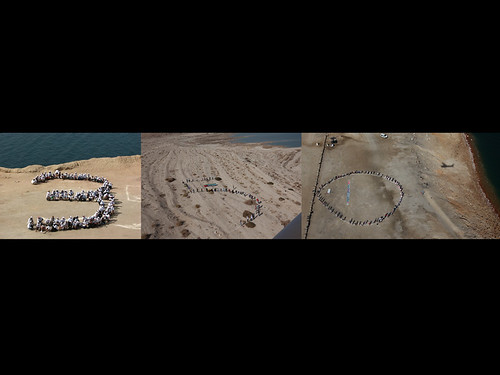
"On October 24th, Israelis, Palestinians, and Jordanians will gather around the Dead Sea to form giant human numbers: Israelis will form a 3, Palestinians a 5, and Jordanians a 0. An aerial photograph will link them together to form the number 350."
Cynics and "realists" will dismiss some of the international events taking place tomorrow as naive, idealistic flights of fancy. I suggest that we instead celebrate them as exactly that!

Human imagination is a marvelous adaptive development, one that grants us "flights of fancy" that can, in fact, change the world. The naive, idealistic innovation of one age is the accepted reality of the following age.

This morning, I repeat yesterday's appeal. Get involved, however and wherever you can!

Photo credit: Photo ripped from the 350.org Flickr photostream

Thursday, October 22, 2009

Acting Out (Peacefully) Against the Culture of Competition


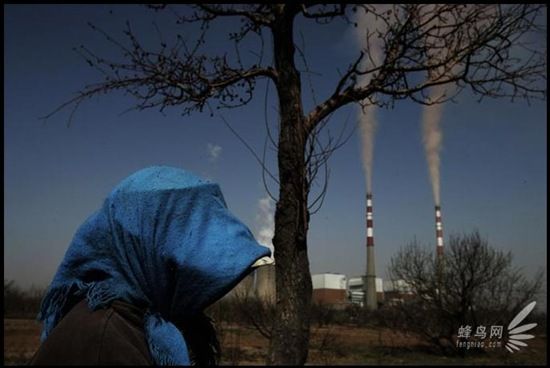
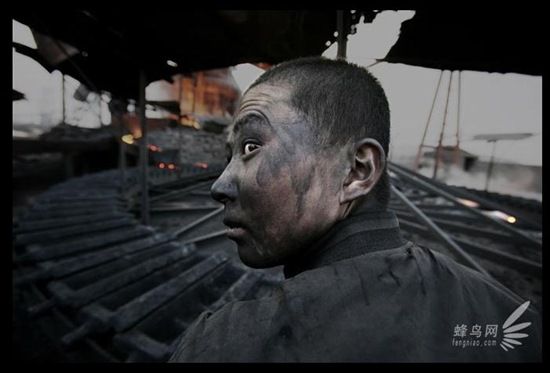
Shizuishan Industrial district in Ningxia. Residents cover themselves against the falling dust when going outside.
April 22, 2006

This Saturday, October 24th, I'll join a mob of peaceful activists and march across the Brooklyn Bridge, from Manhattan to Brooklyn, in hopes of further raising public awareness about the reality of climate change and the need for a comprehensive international climate treaty. The march is associated with 350.org's Day of Action.
"350.org is an international campaign dedicated to building a movement to unite the world around solutions to the climate crisis--the solutions that science and justice demand. Our mission is to inspire the world to rise to the challenge of the climate crisis—to create a new sense of urgency and of possibility for our planet. Our focus is on the number 350--as in parts per million, the level scientists have identified as the safe upper limit for CO2 in our atmosphere. But 350 is more than a number--it's a symbol of where we need to head as a planet. [...] This December, world leaders will meet in Copenhagen, Denmark to craft a new global treaty on cutting emissions. The problem is, the treaty currently on the table doesn't meet the severity of the climate crisis—it doesn't pass the 350 test. In order to unite the public, media, and our political leaders behind the 350 goal, we're harnessing the power of the internet to coordinate a planetary day of action on October 24, 2009. We hope to have actions at hundreds of iconic places around the world - from the Taj Mahal to the Great Barrier Reef to your community - and clear message to world leaders: the solutions to climate change must be equitable, they must be grounded in science, and they must meet the scale of the crisis."
350.org was founded by author and environmentalist Bill McKibben and, although some legitimate philosophical criticisms of the project have been raised, I feel strongly that the organization's mission is vital.


Due to long-term consumption of water contaminated by industrial waste, 50 people have cancer and cerebral thrombosis in Kang village of Linfen City, Shanxi Province..
64-year-old Wang Baosheng has fester wounds all over his body, and must sleep sitting, face down on the edge of the bed each day.
July 10, 2005

Should you doubt the urgent need for an international climate treaty that demands accountability and systemic change, or should you remain skeptical of the human influence on atmospheric carbon levels, I encourage you to take a look at the distressing pictures that ChinaHush recently published. Photographer Lu Guang's series "Pollution in China" is a testament to the cruel realities of the international, industrial market.

In his book-length essay Life Is A Miracle, the author, poet, essayist, and critic Wendell Berry describes the global, capitalist world view as,
"one culture of division and dislocation, opposition and competition, which is to say the culture of colonialism and industrialism. This culture has steadily increased the dependence of individuals, regions, and nations upon larger and larger collective economies at the same time that is has thrown individuals, regions, and nations into a competitiveness with one another that is limitlessly destructive and demeaning."
The "collateral damage" caused by this monstrous steam engine is not limited to elevated carbon levels, and its poisons don't just affect the dispossessed or the politically and economically powerless.

Nicholas Kristoff reminds us, in a recent New York Times OpEd piece, that the staggering number of "deformed frogs and intersex fish [found in or near United States' waters] — not to mention the growing number of deformities in newborn boys — should jolt us."
"In the Potomac watershed near Washington, male smallmouth bass have rapidly transformed into 'intersex fish' that display female characteristics. This was discovered only in 2003, but the latest survey found that more than 80 percent of the male smallmouth bass in the Potomac are producing eggs. Now scientists are connecting the dots with evidence of increasing abnormalities among humans, particularly large increases in numbers of genital deformities among newborn boys. [...] Apprehension is growing among many scientists that the cause of all this may be a class of chemicals called endocrine disruptors. They are very widely used in agriculture, industry and consumer products. Some also enter the water supply when estrogens in human urine — compounded when a woman is on the pill — pass through sewage systems and then through water treatment plants."
Herpetologists have been sounding the alarm for years, but the policy makers are warm in the pockets of the immoral corporations and the populace, by and large, prefers to escape in celebrity pregnancy updates and corporate-owned sporting events. Amphibians were the ignored canary in the coal mine. Now many animal families (ours included) are paying a terrible price, one that we can not yet fully appreciate.


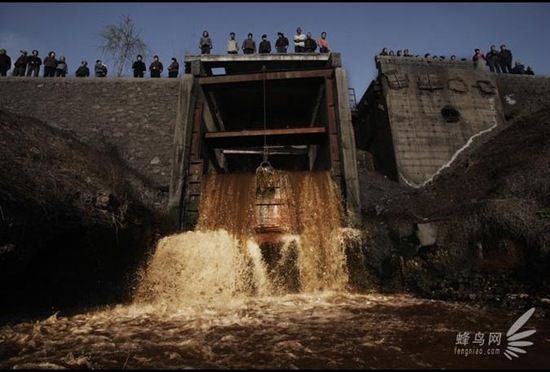
Henan Anyang iron and steel plant’s sewage flowed into Anyang River. March 25, 2008

Still, it's not too late to stand up to the "culture of colonialism and industrialism." Visit 350.org. Find out how to get involved in the effort. If global warming isn't appealing to your still, small voice, get involved with political activism, volunteer at your local homeless shelter, pledge financial support to non-profit activist organizations working for causes that you feel strongly about; it doesn't matter what you do, but it does matter that you do something. Turn off the television, put down the tabloid. I beg this of you.


Breathing large amounts of dust into their lungs, people become sick after working here for 1-2 years. Most of these migrant workers come from area of poverty.
April 10, 2005

Photo credits: all photographs, Lu Guang; ripped from ChinaHush

Thursday, October 15, 2009

Autumn Birds and Birding


View of Manhattan skyline from Central Park, Manhattan

On my way to the gym Tuesday morning, on the corner of 64th Street and 1st Avenue, I discovered a dead American goldfinch (Carduelis tristis). Feathers askew, a pink wound was visible on the head of the small, yellow bird. The injury was likely sustained when the goldfinch crashed into a window of one of the nearby apartment towers. I said a quiet goodbye to the bird, and continued on my way. An hour-and-a-half later, while running a work errand, I came upon a dead red-bellied woodpecker (Melanerpes carolinus), crumpled on the corner of 68th Street and York Avenue. People gave the bird's body little attention.

It's the time of year when our avian brethren fall from the sky above Manhattan and land, sometimes dead, sometimes injured, sometimes merely confused, on the city's sidewalks. It is the time of autumn migration and restlessness. Neither the goldfinch nor the woodpecker are properly migratory species, but both birds will sometimes fly a short distance south when the temperature drops.

I can't say whether or not the individuals that I found on Tuesday morning were on the move when they met their respective ends. Still, their fate is a common one during New York City's autumn. As the NYC Audubon Society's Project Safe Flight mission statement explains,
"Located at the nexus of hundreds of bird species’ migratory routes, New York City’s tall buildings and reflective glass pose a serious threat to over 100 species of migratory birds, some of which are experiencing long-term population declines."
Resident species are also vulnerable, of course. Since Project Safe Flight's inception, in 1997, "over 4,000 dead and injured birds have been collected and documented in [Audubon's] database." That number is a fraction of the total bird deaths that Manhattan's buildings cause.

What can each of us do to help curb the buildings' toll? The easiest action involves turning off your office or apartment lights at night. Many office towers leave the lights on, needlessly wasting electricity and killing birds. As Project Safe Flight’s Lights Out New York initiative explains,
"Lights can distract birds from their migration path and cause them to collide with buildings during bad weather. Turning off the lights and drawing the blinds can help save thousands of birds from over 100 different species every year."
Let's help our feathered friends fly safely, folks.

+++++


Watching a Winter Wren on the wall of Belevedere Castle; Central Park, Manhattan

I rose earlier than usual on Wednesday morning, so that I could be at Central Park's Loeb Boathouse by 7:30 AM, where I met five other Nature Conservancy bird watchers. The six of us spent a very pleasant two and a quarter hours birding.

I love being outdoors in the early morning, and I greatly enjoyed observing even the familiar species as they foraged, fought, and flitted about. House finches (Carpodacus mexicanus) and European starlings (Sturnus vulgaris) are species taken for granted by most birders, but, illuminated by the morning sunlight, each is a marvel.

I was especially excited to see several Eastern phoebes, a relatively common species that, courtesy of Edward Hoagland, I associate with my beloved notion of reconstitution, and a winter wren (Troglodytes troglodytes), a dark, small relative of the more familiar Carolina wren (Thryothorus ludovicianus), a bird for which I was almost named. (Wren Reiger would have been a hard sell on the grade school playground, and I'm thankful that my parents elected to shelve the name.)


Belvedere Castle; Central Park, Manhattan

Photo credits: All images, Hungry Hyaena, 2009

Thursday, September 17, 2009

Kimmel Harding Nelson: Day 11

As I began jotting down notes this morning, it occurred to me that many of the ideas I've been ruminating on during my time in Nebraska City were nicely tied together in an essay almost a year old. "Eric Beltz and 'The Good Land'," a response to artist Eric Beltz's Fall 2008 solo exhibition at Morgan Lehman Gallery, in New York City, raises questions of American exceptionalism, conservation, religion, and human conceptions of "wilderness."

I subscribe to the notion that every artist or academic has just one big idea that, over a career, appears in a variety of forms or expressions. Why not, then, revisit the Beltz essay in the context of the writing I've done at the KHN residency? It follows nicely on yesterday's post, and connects our American ecological dilemma to the arts, or at least to two artists' considerations of the dilemma, namely Beltz's and my own.

+++++
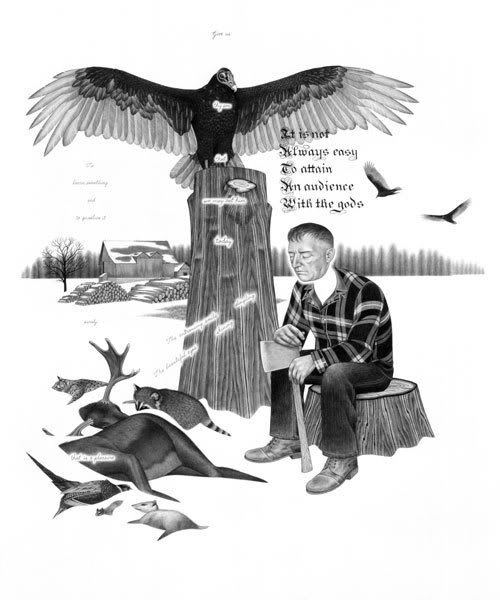

Eric Beltz
"By this Axe I Rule"
2008
Graphite on Bristol
27 1/2 x 23 inches

"All conservation of wildness is self-defeating, for to cherish we must see and fondle, and when enough have seen and fondled, there is no wilderness left to cherish."
-Aldo Leopold

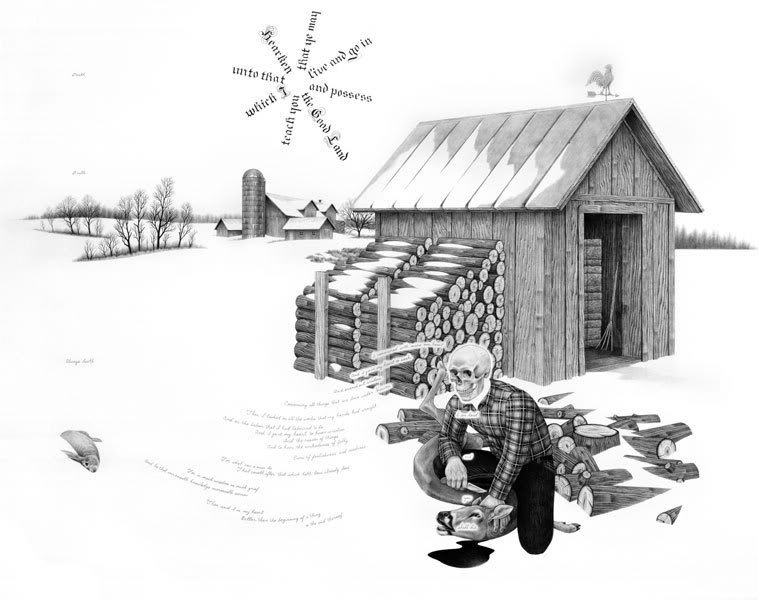
The exquisitely rendered graphite drawings included in "The Good Land," Eric Beltz's recent exhibition at Morgan Lehman Gallery, are sophisticated responses to our American folkways and myths. As darkly funny as they are disarmingly earnest, the graphic works are both exhortations and critiques of our nation's inborn exceptionalism and romanticism.

Of particular interest to Beltz is our American relationship to landscape. In "By This Axe I Rule," a contemplative outdoorsman sits on a tree stump, ax in hand. The bodies of a white-tailed deer, a moose, an opossum, a raccoon and other animals are partially concealed by snow drifts at his feet; a turkey vulture is perched above, wings spread. The man bears a striking resemblance to renowned ecologist Aldo Leopold. The likeness may be coincidental, but is nonetheless pertinent. 2008 is the 60th anniversary of Leopold's death. Like Henry David Thoreau and John Muir, Leopold is a lodestar for many contemporary environmentalists. His "A Sand County Almanac," published posthumously in 1949, remains a critical conservation text.

Unlike Rachel Carson's "Silent Spring," the 1962 bestseller that catalyzed the modern environmental movement, Leopold's "Almanac" is not a call for corporate and federal responsibility. Although Leopold would surely support such measures, his book is principally concerned with our reforging an intimate connection to the landscape we inhabit. "We can be ethical only in relation to something we can see, feel, understand, love, or otherwise have faith in," he wrote.

It's noteworthy that Leopold's faith is not of the starry-eyed variety; his "land ethic" includes hunting, controlled burns, and other practices typically condemned by preservationists. Contrary to the romantic conception of wilderness, Leopold's ethic acknowledges that the tools invented by humans (the saws, shovels, axes, picks, and pitchforks that figure prominently in Beltz's drawings) are not simply cruel agents of mastery. Humans are animals and, as such, we are not apart, but rather a part of a complicated, messy ecology. No matter how we manipulate our environment, dominion remains a comforting delusion.

Yet most of us do not conceive of Nature in this way. Just as we distinguish between the self and the group, so too do we draw a hard-line distinction between humanity and the “natural world.” William Cronon, a respected, if controversial environmental historian, argues that we must alienate ourselves from Nature before it can be understood as something pristine, virgin, or more wild than ourselves. In his celebrated 1983 book, “Changes in the Land”, Cronon reveals the quixotic quality of preservationist impulse.
"If the nature of Concord [Massachusetts] in the 1850s - a nature which many Americans now romanticize as the idyllic world of Thoreau's own Walden - was as 'maimed' and 'imperfect' as he said, what are we to make of the wholeness and perfection which he thought preceded it? It is tempting to believe that when the Europeans arrived in the New World they confronted Virgin Land, the Forest Primeval, a wilderness which had existed for eons uninfluenced by human hands. Nothing could be further from the truth....the land was less virgin than it was widowed. Indians had lived on the continent for thousands of years, and had to a significant extent modified the environment to their purposes…The choice is not between two landscapes, one with and one without a human influence; it is between two human ways of living, two ways of belonging to an ecosystem."
The preservationists' dualistic attitude (i.e., Humanity vs. Nature) provides only simple answers to our complex questions. By contrast, Beltz’s allegorical drawings shirk simplistic moralizing in favor of contradiction, ambivalence and multiplicity. His scenes speak to an active communion with Nature, albeit one that includes suffering, death and a melancholy nod to the essential absurdity of existence. By turns, Beltz eulogizes, champions and satirizes Thoreau's self-sufficiency and Andrew Wyeth's rural romanticism.


Eric Beltz
"Hysteria"
2008
Graphite on paper
17 x 13 3/4 inches

Beltz critiques America's religious and economic landscape, as well. Four of his drawings comprise a series entitled “Back to Eden.” In each, a headless body clothed in overalls, workman boots ,and a shirt with rolled up sleeves – the uniform of the outdoorsman-farmer - is slumped in or alongside a pile of cut logs and other vegetation. Above each of these tableaus, Beltz has written one word, in cursive: Asthma; Hysteria; Cancer; Delirium.

Considering the series, I recall Adam Smith’s ignored admonition concerning the dangers of loosely regulated capitalism. Smith, the 18th century Scottish philosopher best known for his influential treatise "The Wealth of Nations," is canonized by contemporary capitalists for laying down the principals of free market economics, but he entertained doubts about and acknowledged the shadows cast by such a system.

"Power and riches," Smith wrote, "are immense fabrics, which it requires the labor of a life to raise, which threaten every moment to overwhelm the person that dwells in them, and which, while they stand, can protect him from none of the severer inclemencies of the season. They keep off the summer shower, not the winter storm, but leave him always as much and sometimes more exposed than before to anxiety, to fear and to sorrow, to diseases, to danger and to death." Smith’s misgivings were warranted. Contemporary life is rife with social ailments and, in combination with our alienation from Nature, secular capitalism is a principal causative factor.

Curiously, free market capitalism is close kin to Manifest Destiny, the divine doctrine of conquest and consumption. Capitalism is exported with no less zeal than our cruel spread west from the colonies. Harriet Beecher Stowe, the 19th century novelist best remembered as an outspoken proponent of abolition, wrote that America is "a nation specifically raised up by God to advance a cause of liberty and religion." She did not say “liberty of religion.” America was founded by Protestant fundamentalists fleeing religious persecution in Europe. Arriving on these contested shores, they took names like Ezekiel, Jacob, and Issac, and likened their journey to the Jewish Exodus from Egypt. These religious settlers are the forebears of a great many contemporary Americans.

Appropriately, Beltz’s drawings incorporate Biblical texts and his subjects are recognizable as America's founding fathers and God-fearing, anonymous farmers. But Beltz draws from a peculiarly American well, the proverbial melting pot. Each drawing is suffused with currents of Eastern philosophy and shamanism. His farmers and historical figures are also mystics. American philosophy is more plural than we care to admit, and Beltz's admixture of East and West, allegory and history, supernatural and natural is a fair reckoning. (American transcendentalism, for example, the philosophy so vital to Thoreau and Ralph Waldo Emerson, was a hybrid of Protestant Unitarianism, Romanticism, Hinduism, and European intellectualism.)
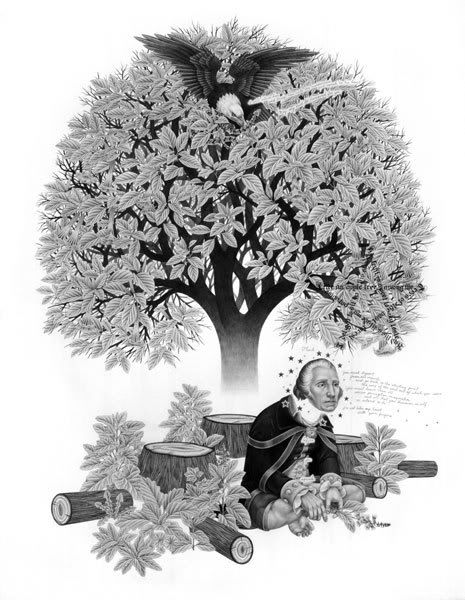

Eric Beltz
"Tree of the Evil Eagle"
2008
Graphite on paper
40 x 30 inches

Still, the Bible is the first book of the United States, and many Americans regard the Constitution and founding fathers with astonishing reverence (to the extent that, in some circles, the former is sacrosanct). But documents and philosophies are of a particular time. Guarded by strict interpreters, the Constitution of the United States can become as regressively dogmatic as any primary religious text. Without thoughtful interpretation of Constitutional scripture, the significance and relevance of the founding fathers' enterprise will wane.

But most Americans (politicians and citizens alike) are in the business of denying the inevitable, be it the death of a loved one, an unregulated economy, or an ideology. Rather than confront our heavy history (and with it our future), the United States cloaks itself in exceptionalism. We remove ourselves from a fact-based historical narrative so that the road to future success is understood as an unyielding continuation of the present, divinely-ordained course. Like the empires that rose and fell before us, America's clarity of vision is obscured by global power and a history that privileges mythic glory over fact. Because we make history, many of our leaders feel strongly that we don't need to know it. Moreover, the history we make is irreproachable because it is consecrated.

Yet the secular capitalist world view strives to replace religion and the supernatural with consumerism. Manifest Destiny Version 3.0 is not ordained by God so much as by the Almighty dollar. And the replacement worked, more or less. The secular capitalist model is today the global standard. But sociologists, anthropologists, and, now, some neuroscientists agree that the substitution is inadequate. This deficiency is most apparent in a religious nation like the United States, where fundamentalism and cultism, reactionary responses to the secular world, are thriving. Despite our founding fathers' dismissal of the New Testament's Book of Revelation (Thomas Jefferson described it as "the ravings of a maniac"), a 2002 CNN/Time magazine poll found that 59 percent of Americans believe the prophecies therein are real and that the gruesome judgment of the Second Coming is imminent. James Watt, former President Reagan's Secretary of the Interior, is among that majority. He famously stated that protecting our nation's natural resources was not a priority because Jesus Christ would return only "after the last tree is felled."

Yet some evangelical fundamentalists are more fair-minded. They focus instead on the Bible's call for stewardship, and argue that the success or failure of the environmental movement depends on which interpretation gains the upper hand. Will we embrace a dominionist or stewardship theology?

The crux of that question is the American notion of wilderness. Cronon writes, "the flight from history that is very nearly the core of wilderness represents the false hope of an escape from responsibility, the illusion that we can somehow wipe clean the slate...and return to the tabula rasa that supposedly existed before we began to leave our marks on the world...Non-use is not an option: to live in nature is to use and change it by our presence. The choice we face is not to leave no marks - that is impossible - but rather to decide what kinds of marks we wish to leave."

Eric Beltz
"The Good Land"
2008
Graphite on paper
30 x 40 inches

Beltz's meticulously rendered works don't offer any answers, but neither do they shrug off the dilemma. With a richly ironic sensibility and a sensitivity to the complexities of our national character and (natural) history, Beltz embraces our clusterfuck approach even as he skewers it. "The Good Land" is sublimely ambivalent.

Photo credit: all images ripped from the artist's website

Friday, September 11, 2009

Kimmel Harding Nelson Residency: Day 5


Chicken coop breed variation display; River Center Nature Center; Nebraska City

What accounts for the amplified patriotism that I feel? This American ardor is not specific to my time in Nebraska City. Over the course of the last year, my national pride has swelled, even as I'm daily disappointed by the reactionary ignorance of so many fellow citizens. Still, in this smallish, midwestern town, I am acutely aware of my American identity.

Perhaps Nebraska City's abundant reminders of our nation's meteoric, messy, and astonishing history forefront my appreciation for my peoples' achievements? Or perhaps it is the love of place reflected in the town's twelve museums, each one a heartfelt labor?


Upstairs annex; River Center Nature Center; Nebraska City

Consider, for example, Joe Voges' River Country Nature Center. Voges, born 96 years ago in Nebraska City, began learning the craft of taxidermy in 1933, at 20 years of age. 47 years later, in 1975, he opened the Nature Center, a collection of mounted wildlife - 90 percent of the taxidermy on display is his handiwork - grouped into natural history dioramas and educational exhibits. In 2005, the museum expanded and moved from Nebraska City's old fire hall to a spacious, street level location nearby.

The taxidermy is by turns amateurish and professional, but the information presented is up-to-date and effectively communicated. The best of the Nature Center exhibits are of American Museum of Natural History quality, and, throughout, one senses Voges' driving desire to educate subsequent generations about the importance of preserving biodiversity and conserving natural resources.


Albinism display; River Center Nature Center; Nebraska City

Perhaps Voges' tellurian impetus is part of the reason I feel a particularly "American" pride in Nebraska City? Like our national history, we're a contradictory, complicated lot, but we fundamentally remain a people that identify the "great outdoors" as a reflection of our values and beliefs, and vice versa. Certainly, there is myth involved in that association, but there is some truth, too.

The contemporary character of this American identification with the land is both Romantic and Utilitarian; it incorporates a self-conscious brand of rugged individualism that, on the one hand, allows for George W. Bush's popular appeal, and, on the other, has made the United States an international wellspring of conservation efforts and environmental philosophy. Despite the previous presidential administration's willingness to bend to the will of extractive industry, the United States remains uniquely positioned to foster among the international community a conservation ethic. Indeed, an overwhelming number of internationally active organizations working for preservationist and conservationist causes are American in origin or base; we are yet the vanguard in the environmental arena.

But even - nay, especially - on the streets of Nebraska City, on the banks of the great Missouri River, at the head of the Oregon Trail, I must inoculate my healthy patriotism against the virus of nationalism. I sometimes wish that "America the Beautiful," Katherine Lee Bates' celebratory hymn, were our country's national anthem, instead of Francis Scott Key's "Star Spangled Banner."

Whereas the "Star Spangled Banner," set to the tune of a popular British drinking song, extols military valor and revolution in the name of freedom, Bates' "America" is both a celebration of our vast American landscape and a plea for social justice, pragmatic politics, and humility. Hers is the United States of America that fills my breast with pride; hers is the clay that I am made of.
"O beautiful for patriot dream
That sees beyond the years [...]
America! America!
God mend thine every flaw,
Confirm thy soul in self-control,
Thy liberty in law!"
In 1930, then Secretary of Agriculture Henry Wallace stated, "There is as much need today for a Declaration of Interdependence as there was for a Declaration of Independence in 1776." I agree, and we're overdue, but I'm starting with the anthem. The Brits can take back their drinking and fighting tune.


Missouri River display; River Center Nature Center; Nebraska City

Photo credits: all photos, Hungry Hyaena, 2009

Saturday, August 01, 2009

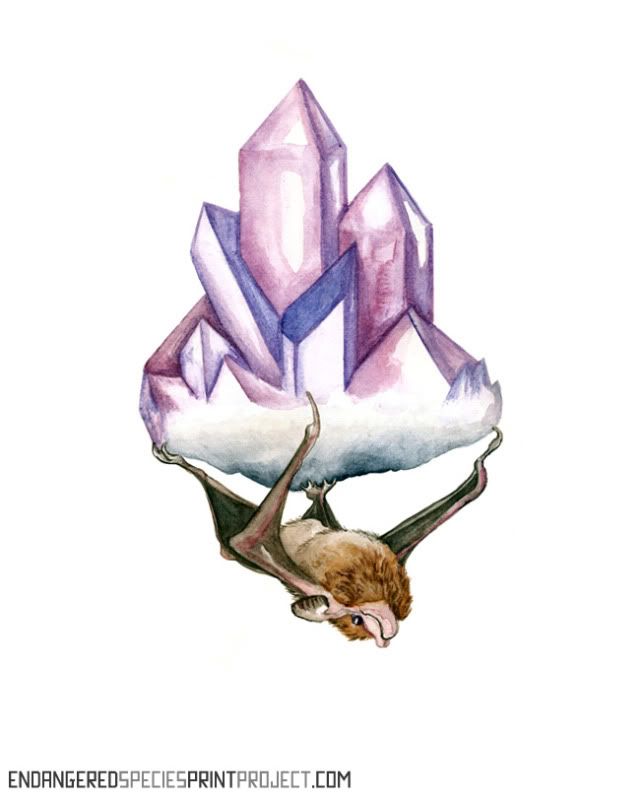
The Endangered Species Print Project


Molly Schafer
"The Seychelles Sheath-tailed Bat"
2009
Archival giclee print (Edition of 37)
8 x 10 inches

Chicago-based artists Jenny Kendler and Molly Schafer recently launched the Endangered Species Print Project. The ESPP offers limited edition prints of critically endangered species for sale to collectors, and ALL proceeds are donated to conservation programs working to perpetuate the featured species. For each print edition, the total number of prints corresponds to the featured animal's current population. For example, only 37 Seychelles Sheath-tailed bats remain in the wild, so for that edition, 37 prints will be produced.

The ESPP is already generating buzz. The Center for Biological Diversity and The Sierra Club are both promoting the project and have expressed interest in collaborating with Schafer and Kendler. I'm not surprised. The ESPP is a terrific undertaking, a fine example of the sort of environmentally and socially responsible efforts that I dearly wish more contemporary artists would involve themselves with.

As such, I'd promote ESPP even if I weren't planning to produce some prints for the project. I expect to produce two original drawings that will be turned into prints before the end of this year. My subjects will be the Javan, or Sunda, rhinoceros (Rhinoceros sondaicus) and the red wolf (Canis rufus). Also, in 2010, I hope to produce prints featuring other endangered species, including some birds, reptiles, and plants.

Prints of the following species are already available: the Panamanian Golden frog (Atelopus zeteki); the Vancouver Island Marmot (Marmota vancouverensis); the Seychelles Sheath-tailed bat (Coleura seychellensis); and the Indri lemur (Indri indri). Visit the ESPP site to learn more.