Showing posts with label responsibility. Show all posts

Tuesday, July 16, 2013

Commonplace Book Time Machine #1:
Novus Ordo Seclorum


One of the two chapbooks I initially proposed creating in conjunction with my Aggregate Space & Featherboard Writing Series writing residency will not be produced. Because the residency is only five weeks long, I've decided I must devote the lion's share of the period to the more substantial of the two projects, a meditation on my childhood comprehension of death and killing. Still, rather than let the preliminary work I'd done for the commonplace book chapbook go to waste, I thought I'd share a few of the scanned pages here, on Hungry Hyaena, along with some editorializing. The first of these posts follows.

+++++
2-page spread from one of my commonplace books, 2000

Just after my twenty-second birthday, I began a new commonplace book. At the time, I was living in the basement bedroom of an Alphabet City apartment in Manhattan, laboring five days a week at a Soho art gallery and, nights and weekends, drawing and painting in my bedroom or working on a solipsistic vampire novel titled, appropriately, Me. My income was meagre; I'd grown used to dinners of white rice (generously seasoned with soy sauce) and I socialized just one night a week (not counting too many hours spent watching recorded episodes of Mr. Show with my roommates). Necessarily thrifty, then, I elected not to purchase a new journal to use for the commonplace book; instead, I picked up a journal that I'd cast aside a couple of years prior after filling its early pages with adolescent agitation.

Monday, June 17, 2013

Off to Sci Foo this weekend!

I'm excited to head to the Googleplex this coming weekend for Science Foo Camp! Usually referred to as Sci Foo, the eight-year-old invitation-only "unconference" is organized by Google, the science journal, Nature, Digital Science, and O'Reilly Media. Sci Foo brings together "between 200 and 300 leading scientists, technologists, writers, and other thought-leaders at the Googleplex for a weekend of unbridled discussion, demonstration, and debate." (You can learn more about SciFoo here.)

Selene and I were invited because of the BAASICS mission, and I'm pleased to see that one of the proposed SciFoo sessions is titled "Building Better Art-Science Partnerships." Naturally, we're looking forward to engaging in lively, informative conversations with other participants about the art-science interface and to explaining what it is we aim to do with BAASICS and why we feel it's so important. That said, while BAASICS got me invited, I'm super jazzed about attending (and perhaps participating in) many of the other sessions that have been proposed. A few of my favorites:
- Using Emerging Technologies to Advance Conservation
- Science Advocacy
- Rethinking National Security
- Defragging Government (How Can Scientists and Engineers Help?)
- Science and Popular Skepticism
To my way of thinking, Sci Foo's interdisciplinary angle and relaxed format are outgrowths of Bay Area culture, a place where idealism, art, science, and technology commingle, often with exciting results. I'm encouraged to see sessions like "DeFragging Government" on the list, and I have the impression that many of the Sci Foo participants recognize our responsibility -- both that of the individual and the group -- to be active beyond our more particular spheres.

BAASICS will be live tweeting from the event and I'll provide a short update -- with photographs -- after my return.

Image credit: ripped from the Sci Foo Camp website

Sunday, January 20, 2013

"Private Frontiers" at Hosfelt Gallery

Michael Light
"Lake Las Vegas 2010-2012 20. 'Casa Palermo' Lake Las Vegas Homes Looking Southwest, Henderson, Nevada"
2010
Pigment print mounted on aluminum
40 x 50 inches
Edition of 5
I recently visited Hosfelt Gallery's impressive new space, currently home to "Private Frontiers," a two person show featuring works by Brooklyn-based painter Chris Ballantyne and San Francisco-based photographer Michael Light. According to the press release, the two artists "have been in dialogue for the past year to develop work that examines the human urge to stake territory and its more absurd manifestations on the American landscape." Whatever the specifics of the artists' conversation, Ballantyne's paintings are a terrific compliment to Light's large-format aerial photographs. Exhibited on their own in the expansive Hosfelt loft, Ballantyne's colorful and occasionally whimsical works would risk being swallowed up as bittersweet morsels. Hanging alongside Light's grand photographs, though, Ballantyne's modestly-sized pictures comport themselves especially well; their affability and humor endure, but undercurrents of earnestness and melancholy, too easily missed if exhibited on their own in so airy a space, are amply felt.

Tuesday, November 27, 2012

Heide Hatry's Provocative Flowers

Heide Hatry is not a household name, but the New York-based German artist's reputation is blossoming. She has smartly positioned herself at the intersection of the art world and popular culture and, as a result, is of particular interest to me, convinced as I am that the fine arts need mass reach (if not necessarily mass appeal -- see Thomas Kinkade) in order to play the vital cultural role they're intended to.

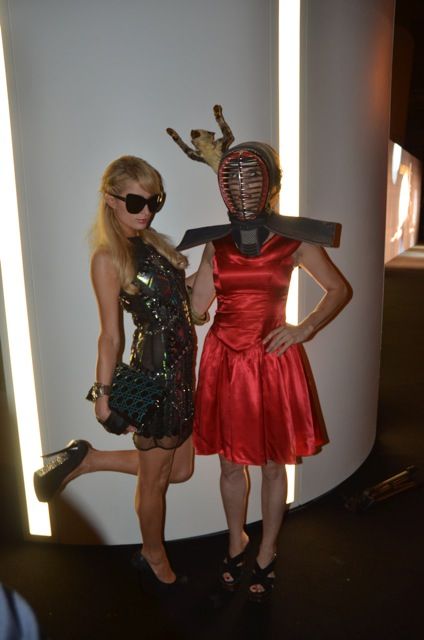
Heide Hatry, right, with Paris Hilton at the Guggenheim Museum
In September, Hatry performed "Schrodinger's Cat" at Lady Gaga's Guggenheim Museum perfume launch. Although Gaga's arty public appearances and carefully cultivated persona evidence how readily pop culture co-opts and/or draws inspiration from the fine arts, most people view Gaga as a pop star, not an artist. Hatry, on the other hand, is always identified as the latter, so when she is photographed rubbing shoulders with the likes of Paris Hilton or her work is written about by the scientist and popular writer Steven Pinker, I'm heartened. The art world isn't usually so accessible.

Naysayers might dismiss Hatry as the art world equivalent of a shock jock, insisting the popular attention she has received is only the result of her pushing our buttons. Certainly provocation plays a part, but Hatry has so far managed to balance titillation with thoughtful questions. (Arguably, Damien Hirst managed to do the same for a time...before he jumped the preserved shark.)

Saturday, February 04, 2012

Choosing Past and Future

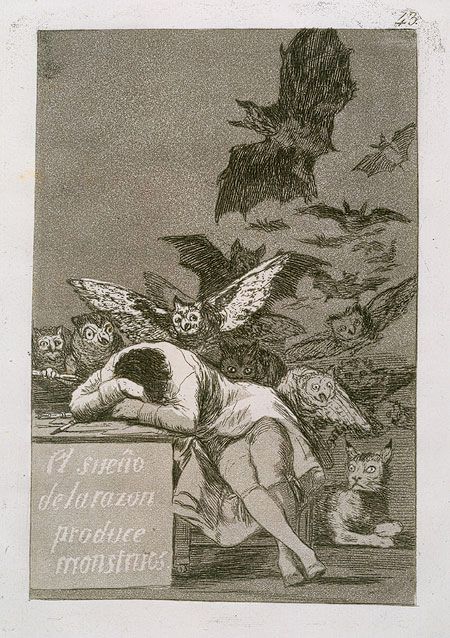
Francisco Goya
"The Sleep of Reason Produces Monsters"
1797
Etching, aquatint, drypoint, and burin
"It is the reviving wine of history that defends the future against the past."

- Lewis Lapham, "Democracy 101"
(Harper's Magazine, April 2011)
As high school students, we're often told that history repeats itself, the implication being that a sound education in history will allow us to avoid repeating past mistakes. I think of this as the "Groundhog Day" school of thought. It's true, despite the fact that most people (and states) tend to trip over the same stumbling blocks time and again.

Still, I prefer Lapham's formulation above because his statement implies that the study of history provides us with the necessary confidence to continue and to hope, to view our progress as two steps forward for one step back. Moreover, it's important for us to choose the bottle of wine that we drink from. As President Obama articulated in his brilliant inaugural address,
"the time has come to reaffirm our enduring spirit; to choose our better history; to carry forward that precious gift, that noble idea, passed on from generation to generation."
May we choose wisely, and drink deep.

Monday, January 30, 2012

Art From Goodland

The view from Meredith Trombles' Holiday Inn room; Goodland, Kansas

Yesterday, Bay Area artist and writer Meredith Tromble launched Art & Shadows, a new blog that received the 2011 Creative Capital/Warhol Foundation Arts Writer Grant in advance of its inception.

In her inaugural post, Tromble introduces several of the challenging questions she plans to ruminate on at Art & Shadows.
"As I look out towards the prairie from my hotel room, it seems right that this first Art & Shadows should come from Kansas, and from a small town. The questions I want to explore in this blog, questions about the art world and about what art is, how we know art when we see it, and what it means in our lives, are my questions in part because of where I grew up. I am passionately involved with contemporary art, but I've never gotten comfortable with the disconnect between art now and art here. For example, there's a lot of talk about 'community' in the works I encounter in my everyday life as an artist, writer, and teacher; but the thinking doesn't always seem to encompass the kind of community consciousness shared by the rural people who live here."
Perhaps I respond so positively to Tromble's Kansas hotel room musings because of my own rural upbringing -- I'm similarly uncomfortable with the disconnect she describes -- but I believe that the questions she raises are urgent and universal, and that they must be part of the general art conversation. If we approach them earnestly -- as objectively as our subjective realm permits, and with as little posturing as our egos will allow -- we could shape a sustainable and robust 21st century art world, one that might even incorporate both "art now" and "art here."

Image credit: Meredith Tromble, 2012

Monday, January 02, 2012

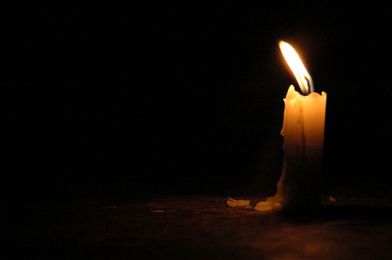
Keep the Flame Alive In 2012


2011 will be best remembered as a year of popular dissatisfaction and uprisings. Lacking a crystal ball, such instability -- especially the prospective political transitions from despotism to democracy in Egypt and Libya -- can cause acute anxiety.

As we enter 2012, it's useful to keep in mind that democracy is a pendulum that forever swings from equilibrium to imbalance and back. The uncertainty and tensions associated with the political and ideological landscape of today's Middle East are also endemic to established democracies. Lewis Lapham described the workings of a democratic government in "Democracy 101," an essay published in the April 2011 issue of Harper's Magazine.
"Democracy is a dangerous business; it allies itself with change, which engenders movement, which induces friction, which implies unhappiness, which assumes conflict not only as the normal but also as the necessary condition of its existence. The idea collapses unless countervailing stresses oppose one another with competing weight - unless enough people stand willing to sustain the argument between the governing and the governed, between city and town, capital and labor, men and women, matter and mind. [...It] is the freedoms of thought that rescue a democracy from its stupidities and crimes, the courage of its dissenting citizens that protects it against the despotism of wealth and power backed up with platitudes and billy clubs and subprime loans."
This description should ignite fire in the belly of all United States citizens, wherever they place themselves on the political spectrum.

In late January 2009, I wrote an essay titled "Eudamonia." The piece explored the possible causes of a "bout of optimism [that] seemed remarkable in both duration and degree." That optimism is tempered today, but it still burns, despite the growth of "triumphant pessimism" among our populace. I remain optimistic because I believe in long term improvement, in two steps forward for one step back.

Let us all be devoted, active citizens in 2012, realistic, but not cynical, hopeful, but not naive, critical, but not destructive.

Image credit: uncredited photograph ripped from Care2 Make A Difference website

Monday, December 12, 2011

I Can See The Whole Emperor!


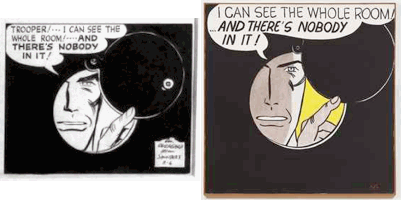
In a 2006 post titled "Lichtenstein the Ingrate," I bemoaned Roy Lichtenstein's elitism. I explained that I was bothered less by the famous artist's "questionable sampling" of newspaper and comic book artists' work than I was by his disregard for the skill of those he copied. In a 1963 interview, Lichtenstein distinguished between his source material and his paintings.
"What I do is form, whereas the comic strip is not formed in the sense I'm using the word; the comics have shapes but there has been no effort to make them intensely unified...The difference is often not great, but it is crucial."
Throughout my late teens and twenties, Lichtenstein's comic-inspired artworks inflamed my sense of righteous indignation. I don't get especially worked up about Lichtenstein's appropriation anymore, but I still believe the man was a charlatan. Had he acknowledged his indebtedness to the artists he imitated, his comic panel paintings could be interpreted as a cynical project highlighting the role of class and money in the appraisal of culture (i.e., it's not fine art if it's in a newspaper, but if it's in a gallery and the "right" person will pay a lot of money for it, it is). That still wouldn't make it particularly thoughtful artwork, but Lichtenstein could have been remembered as a winking champion of the comic artists that nourished him.


Left: William Overgard original
Right: Lichtenstein's rendition

In 2006, I believed that Lichtenstein was "turning into a cultural blip." I took comfort in that presumption, but it's no longer so clear to me that Lichtenstein will be forgotten. A recent ArtInfo article by Judd Tully compares last month's Christie's auction sales price of Lichtenstein's "I Can See The Whole Room!...And There's Nobody In It!" to the EBay auction sales price, last August, of the William Overgard artwork that was the source of Lichtenstein's painting. The former sold for $43,202,500; the latter, for $431. According to the art market, then, the Lichtenstein version is worth more than 100,000 times what the Overgard original is worth! Sure, Lichtenstein's is a bigger picture, but the enormity of the price difference is testament to the intangibles in play in the art market. I love looking at, writing about, and making art, but contemplation of the art market is a depressing affair.

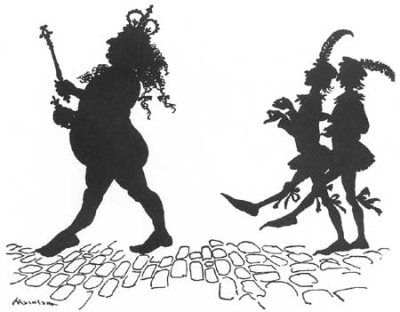
Image credit: "The Emperor's New Clothes" illustration, ripped from My Fresh Plans site (illustrator uncredited); Overgard and Lichtenstein reproductions "appropriated" from The Daily Cartoonist

Friday, December 09, 2011

Coaching For Critics?


I recently read "My Disappointment Critic," a short essay by Jonathan Lethem in The Los Angeles Review of Books (November 7, 2011). I particularly appreciated the four quotations Letham prefaced his piece with. The first of these was drawn from "The Perils of Pauline," a consideration of celebrated film critic Pauline Kael's career by Renata Adler. In 1980, when Adler published the essay in The New York Review of Books, her dismissal of much of Kael's criticism divided readers. But whatever one makes of Adler's Kael-specific critique, the excerpt Lethem picked out is unassailable.
“The job of the regular daily, weekly, or even monthly critic resembles the work of the serious intermittent critic, who writes only when he is asked to or genuinely moved to, in limited ways and for only a limited period of time … What usually happens is that (the staff critic) writes for some time at his highest level: reporting and characterizing accurately … and producing insights, and allusions, which, if they are not downright brilliant, are apposite … What happens after a longer time is that he settles down. The simple truth — this is okay, this is not okay, this is vile, this resembles that, this is good indeed, this is unspeakable — is not a day’s work for a thinking adult. Some critics go shrill. Others go stale. A lot go simultaneously shrill and stale. A few critics, writing quietly and well, bring something extra into their work … Some staff critics quit and choose to work flat out again, on other interests and in intermittent pieces. By far the most common tendency, however, is to stay put and simply to inflate, to pretend that each day’s text is after all a crisis…”
How does a critic avoid going "shrill and stale"? Art bloggers, who often feel the need to write about the same "crisis" several times over the course of one day, are especially at risk.

A week before I read Adler's diagnosis of critical slump, I'd finished Atul Gawande's most recent New Yorker essay, "Personal Best." (Does anyone else wonder just how Gawande does it? He's a highly regarded surgeon, a professor, a staff writer for the New Yorker, a federal health-policy advisor, and just about 101 other things!) Gawande begins his essay by admitting that, as a surgeon, he'd reached cruising altitude.
"I’ve been a surgeon for eight years. For the past couple of them, my performance in the operating room has reached a plateau. I’d like to think it’s a good thing—I’ve arrived at my professional peak. But mainly it seems as if I’ve just stopped getting better. [...] Over time, you learn how to head off problems, and, when you can’t, you arrive at solutions with less fumbling and more assurance. After eight years, I’ve performed more than two thousand operations. [...] As I went along, I compared my results against national data, and I began beating the averages. My rates of complications moved steadily lower and lower. And then, a couple of years ago, they didn’t. It started to seem that the only direction things could go from here was the wrong one."
Gawande surmises that surgeons, like athletes and singers, could benefit from good coaching. To test the idea, he recruits a coach of his own.
"Since I have taken on a coach, my complication rate has gone down. It’s too soon to know for sure whether that’s not random, but it seems real. I know that I’m learning again. I can’t say that every surgeon needs a coach to do his or her best work, but I’ve discovered that I do. [...] In the past year, I’ve thought nothing of asking my hospital to spend some hundred thousand dollars to upgrade the surgical equipment I use, in the vague hope of giving me finer precision and reducing complications. Avoiding just one major complication saves, on average, fourteen thousand dollars in medical costs—not to mention harm to a human being. So it seems worth it. But the three or four hours I’ve spent with [my coach] each month have almost certainly added more to my capabilities than any of this."
So, I wonder, why not have coaches for critics, too? Certainly, a good editor is a kind of coach, and today every other comment-leaving reader seems to know what the critic could have done better and or how she got it wrong, but I'm thinking of another dynamic, a relationship that is more coaching specific. What if critics coached one another? For example, I could plow Critic X's work for flow, strength of argument, original thinking, and all the other elements we desire of critical writing, then provide X with a thoughtful response. X could do the same for Critic Y. These relationships would surely help the coached writers, but they'd also benefit the coaches. Acting as a bullshit detector and whip-cracker, the coach is likely to carry an invigorated critical capacity into his or her own writing.

Still, as Gawande points out, "the greatest difficulty...may simply be a profession’s willingness to accept the idea. The prospect of coaching forces awkward questions about how we regard failure." True, but our culture is also a invested in results, and good ones will change skeptical minds.

Image credit: Sylvester Stallone and Burgess Meredith as boxer and coach in "Rocky," United Artists, 1976

Monday, November 07, 2011

Jerry Saltz's "Clusterfuck Synchronicity"


Some folks love to grumble about Jerry Saltz. Whether it's his writing craft, his demeanor, or his decision to participate as a judge on Bravo's "Work Of Art" reality series, Saltz's haters always find something to bemoan. Whatever.

I don't know Jerry well, but I enjoy reading his reviews and I appreciated the two classes he taught at the School of Visual Arts. Saltz's proclivity for, in his words, "speak[ing] about art more directly and more often to anyone willing to listen [...] even if they didn't go to art-school or don't know the secret handshakes and lingo of the art world" distinguishes him from many of his professional counterparts. Admittedly, I'm biased by this populist attitude. As I wrote here a few months ago, "artists need to make art that connects to common human experience, and both artists and art writers need to communicate more effectively with the general audience." Saltz generally succeeds on that count, and he should be cheered for that achievement. But this very success often inspires his detractors because, in the eyes of some, fine art isn't meant to appreciated by the masses.

In the course of a recent interview with ArtInfo, Saltz expressed his disappointment with "the many who continually pooh-pooh art-galleries."
"For these complainers the art world is not good enough. Contemporary art is not up to their standards. They're always disappointed. I always want to say to these people, 'Go away. We can't help you.'"
The same goes for most of the Saltz haters, in my view. Go away. Help yourself. ("Most of," because a small minority of Saltz naysayers articulately and thoughtfully express their grievances and invest their energy in creating the type of criticism or point of view that they champion.)

The ArtInfo interview is short and worth a quick read. If you're a writer, some of Saltz's responses will be particularly resonant.
What's the most indispensable item in your office?
My doctor said, "You have almost no vitamin D in your system." I said, "Probably because over the last 12 years or so I barely go out of my house other than to see shows and buy deli coffee each evening to refrigerate for the following day." So, until my number comes in, the most important thing in my office is the picture window I sit next to all day, every day, and look at the world going by. 


Where are you finding ideas for your work these days?
I believe in a sort of clusterfuck synchronicity. I believe anything and everything I'm reading, seeing, thinking, or talking about has something to do with whatever I'm working on at that exact moment. I pay very careful attention to all of these things and use as much of it as possible. It is no longer possible for me to look at something and not think, "This has something to do with my work."
I especially like "clusterfuck synchronicity." Thank you, Jerry. If you write it, they will come...for better and for worse.

Photo credit: NBC Universal, Inc., 2010

Friday, September 30, 2011

Tuesday, September 27, 2011

Finding Unicorns


someguy
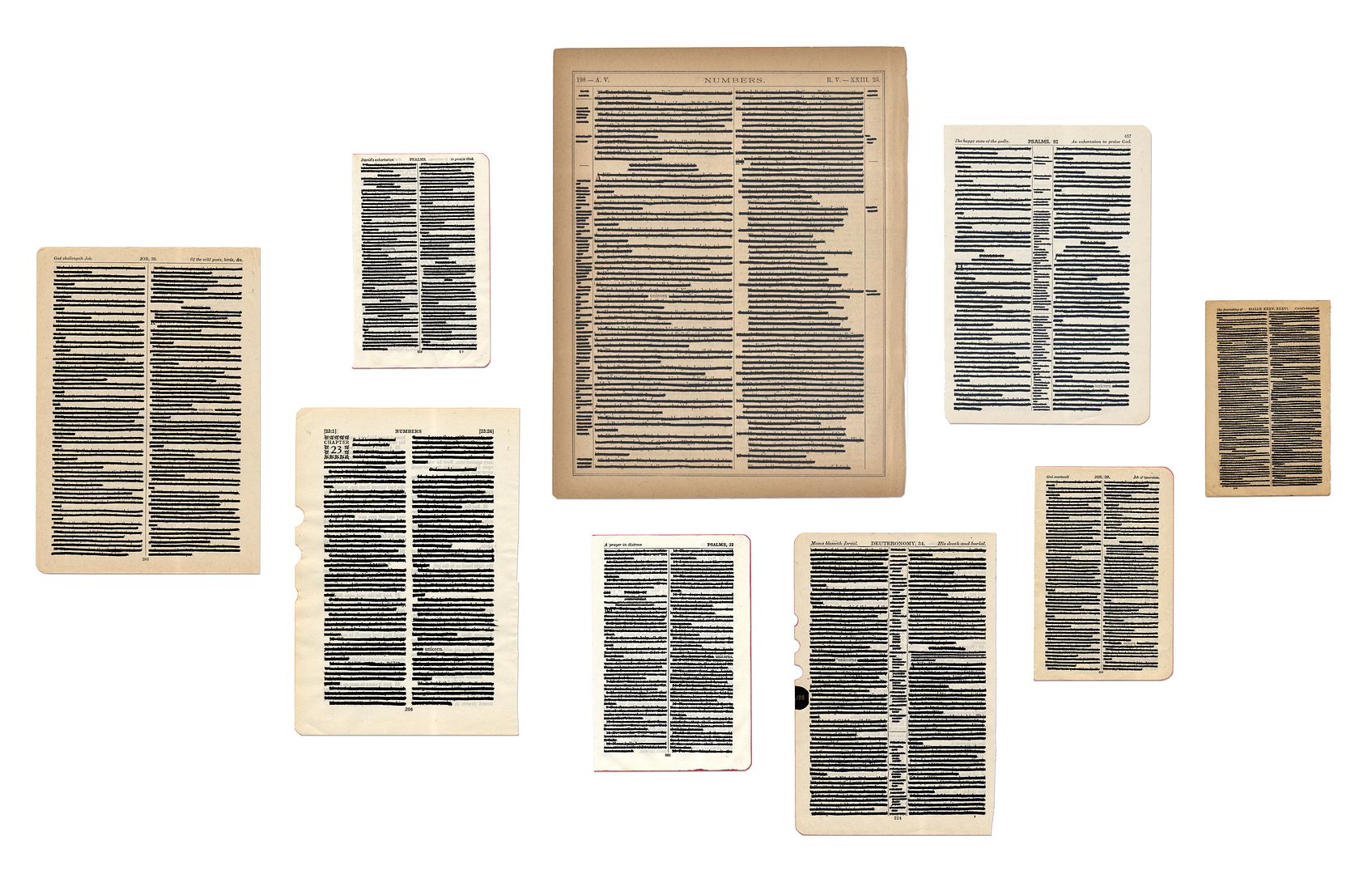
"9 Unicorns"
2011
Individual vintage bible pages

Large, juried shows are usually confused affairs. "Proof," the latest rendition of Southern Exposure's annual "entry-fee free juried exhibition of Northern California artists," is no exception. Of the 47 artworks (by as many artists), 5 pieces stand out: Kelly Falzone Inouye's "Tagging Sequence 1"; Robert Larkin's "Original Art"; Summer Mei Ling Lee's "Les preuves fatiguent la verite"; Kate Nartker's "West Main 1984"; and Someguy's "9 Unicorns."

"9 Unicorns," in particular, provided much to mull over. Someguy displays 9 pages from vintage Bibles; on each of these, all text except for the page heading and the word "unicorn" is blacked out. On his website, the artist states, "it's not commonly known, but the Bible mentions unicorns 9 times." I suspect that Someguy intends his handsomely presented editing job as a winking critique of religious literalism. By highlighting the occurrence of the word, the artist reminds viewers that mythological creatures populate the tome that literalists insist is non-fiction and most U.S. president-elects place their hands upon when they're sworn into office. Little girls notwithstanding, most of us are informed and sensible enough to dismiss unicorns as harmless hokum. Why, then, doesn't an overwhelming majority also view the Abrahamic narrative as an epic myth (i.e., fiction)?

Religious apologists point out that the Hebrew Bible makes no mention of unicorns. Instead, readers will find an ox, auroch, rhinoceros, or bison, depending on the edition. These more mundane creatures are indicated by the ancient Hebrew term re'em. The word was first translated as "unicorn" by the Greeks who, between 250 BCE and 100 CE, crafted the immensely important Septuagint, bringing the Hebrew scriptures to the Western world. Still, lest we too hastily ascribe an elevated rationality to the Jews of antiquity, scholars believe that re'em was not meant to describe an ordinary animal. The oral traditions of the Israelites and early Jews spoke of a powerful, monstrous auroch, a creature of gargantuan proportion, large enough to be mistaken for a mountain. Because they were unfamiliar with this monster bull, it's only sensible that the Greek translators and editors of the Septuagint substituted another fanciful creature, one better known to their audience; enter the unicorn.

Point being, the Bible, no matter the translation, is chock-a-block with fantasy. Most epic stories (and especially those with the staying power to warrant inclusion in a sacred narrative) are tall tales. Fictional or exaggerated narrative often pushes reality out of popular memory. The rhinoceros becomes a unicorn and the large crocodile becomes a dragon in the same way that the angler's fish grows through successive tellings; generations after the big mackerel was caught, it's Leviathan. But knowing how unicorns came to appear in some translations of the Bible doesn't justify easy dismissal of the sacred canon. Even for secular culture, the ancient stories are the closest approximation of universal myths, and they have much to offer readers with a critical bent -- much more, in fact, than they afford literalists.


someguy
Detail of "9 Unicorns"
2011
Individual vintage bible pages

But "9 Unicorns" isn't just about the relationship between religious texts and fairy tales; it's also a critique of our postmodern malady. Today, technology and globalization expose us to a heretofore unprecedented quantity of information. As a result, it's progressively more difficult to wrest fact from fiction. As the late Senator Daniel Patrick Moynihan quipped, "Everyone is entitled to their own opinions, but not their own facts." Disappointingly, most of us reject Moynihan's gospel, instead opting to go at our texts with a Sharpie, making of them whatever we wish. This willful shirking of intellectual responsibility is amply on display in the fractious debate about the meaning of the United States Constitution and the legacy of our "founding fathers." Benjamin Franklin, one of those very prophets, smartly observed, "so convenient a thing it is to be a reasonable creature, since it enables one to find or make a reason for everything one has a mind to do."

Someguy's "9 Unicorns" evidences our species' taste for selective reading, subjective "truths," and rationalizations. Ever more interconnected, such an unhealthy disposition can become dangerous. Someguy's piece is a visual fable of sorts, cautioning us to master our appetites.


someguy
Detail of "9 Unicorns"
2011
Individual vintage bible pages


Image credits: all someguy images, courtesy the artist

Friday, August 19, 2011

Making More "Live Animals"


Two weeks ago, I presented a lecture at the Art College Center of Design, in Pasadena, California, titled "Aesthetics, Ethics, and Experience." It was my first attempt to respond to the question of how contemporary artists might connect the "fine arts" to society at large, and I drew from an array of sources, classical (Heraclitus; Aristotle) and contemporary (Dave Hickey; David Milch; Erik Reece), to constellate what I'd like to think Aristotle would have described as a virtuous way of being in the world (as an artist). After the lecture, one of the students remarked that it was the "most liberal arts style" approach she'd come across in art school. I appreciated her compliment, but it reminded me of the urgent need for more generalism in arts education.

As I often insist, there is a lot of beautiful and compelling artwork produced and exhibited today, but it generally lives apart from popular culture. We -- that is, those of us active in the fine arts -- are complicit in this ghettoization because we're content to carry on a conversation among ourselves. Moreover, because we've come to preference our tribe's voices over others, there is a surplus of insider commentary and critique passed off as art. Almost all of this work and wordiness is irrelevant to the world outside the ghetto walls and, because young artists are educated in this context, with little or no pedagogical emphasis on disciplines other than art theory, the art and commentary become, over time, increasingly provincial. The wellspring of this contemporary predicament is as old as modernism.

On the heels of co-curating "A Live Animal" with Selene Foster, I've been rereading John Dewey's brilliant Art & Experience essays (1934). Dewey writes, and I quote him at length because he articulates the crux of the problem so eloquently:
" [Art is today] isolated from the human conditions under which it was brought into being and from the human consequences it engenders in actual life experience. [...] Art is remitted to a separate realm, where it is cut off from that association with the materials and aims of every other form of human effort, undergoing, and achievement. A primary task is thus imposed upon one who undertakes to write upon the philosophy of the arts. This task is to restore continuity between the refined and intensified forms of experience which are works of art and everyday events, doings, and sufferings that are universally recognized to constitute experience.

[...] So extensive and subtly pervasive are the ideas that set Art upon a remote pedestal, that many a person would be repelled rather than pleased if told that he enjoyed his casual recreations, in part at least, because of their esthetic quality. The arts which today have most vitality for the average person are things he does not take to be arts: for instance, the movie, jazzed music, the comic strip, and, too frequently, newspaper accounts of love-nests, murders, and exploits of bandits. For, when what he knows as art is relegated to the museum and gallery, the unconquerable impulse towards experiences enjoyable in themselves finds such outlet as the daily environment provides.

[...] For the popular notion comes from a separation of art from the objects and scenes of ordinary experience that many theorists and critics pride themselves upon holding and even elaborating. The times when select and distinguished objects are closely connected with the products of usual vocations are the times when appreciation of the former is most rife and most keen. [...] Theory can start with and from acknowledged works of art only when the esthetic is already compartmentalized, or only when works of art are set in a niche apart instead of being celebrations, recognized as such, of the things of ordinary experience. Even a crude experience, if authentically an experience, if more fit to give a clue to the intrinsic nature of esthetic experience than is an object already set apart from any other mode of experience. [...The] trouble with existing theories is that they start from a ready-made compartmentalization, or from a conception of art that 'spiritualizes' it out of connection with the objects of concrete experience. The alternative, however, to such spiritualization is not a degrading and Philistinish materialization of works of fine art, but a conception that discloses the way in which these works idealize qualities found in common experience. Were works of art placed in a directly human context in popular esteem, they would have a much wider appeal than they can have when pigeon-hole theories of art win general acceptance.

[...] The sources of art in human experience will be learned by him who sees how the tense grace of the ball-player infects the onlooking crowd; who notes the delight of the housewife in tending her plants, and the intent of her goodman in tending the patch of green in front of the house; the zest of the spectator in poking the wood burning on the hearth and in watching the darting flames and crumbling coals."
Amen, Mr. Dewey...though I'd add that the "primary task" to "restore continuity between" works of art and the everyday is not only the obligation of the art writer; it is also incumbent upon the conscientious artist. Artists need to make art that connects to common human experience, and both artists and art writers need to communicate more effectively with the general audience.


I thought of Dewey's argument when watching a video of Scottish cyclist Danny MacAskill that was recently shared by a friend on Facebook. The video offers a more visceral (and therefore meaningful) aesthetic experience than most of the contemporary art I've viewed in the last weeks. An acrobat with his bike, Macaskill is Dewey's "live animal," "fully present, all there" because of he has honed his craft and is, as we often hear athletes put it, "in the zone."

Can contemporary fine art inspire people to exclaim, as one person did in the comments under my friend's Facebook posting of the Macaskill video, "That's crazy & beautiful!"? Can artists again enthuse the general audience?

I believe that we can, and I hope that I can one day have an opportunity to design (or help to design) an undergraduate or graduate art curriculum that prioritizes generalism and social responsibility.

Photo credit: photo of Danny MacAskill ripped from CyclePath Magazine

Thursday, March 24, 2011

Communicating Art's Relevance (Or Not)


Science journalists have penned a profusion of articles about the scientific community's failure to communicate effectively with the general public. The articles bemoan how un- or misinformed Americans are about the science of vaccination, global climate change, mass extinction, and myriad other subjects. But the journalists don't blame the great unschooled for their ignorance; instead, they point the finger at scientists and, almost as often, at themselves. As a result, there are a growing number of journals, graduate programs, and institutions devoted to tackling the science literacy problem.

The aptly named Center for Communicating Science, at Stony Brook University, is one of these. It's mission is straightforward: "to enhance understanding of science by helping train the next generation of scientists and health professionals to communicate more effectively with the public." It's an uphill battle, but we must all hope that their efforts (and those of similar institutions or programs) succeed. Presuming (hopefully) that the majority of the world's states remain liberal democracies, the future health of the planet and our species may be contingent on a greater popular appreciation of science.

Although it is a matter of less urgency and consequence, the contemporary American art world should consider a comparable movement. We also need programs dedicated to training "the next generation of [curators and art] professionals to communicate more effectively with the public." I'm not being facetious. There are brilliant, sensitive art writers and curators working today, but they are a small minority who, despite their talents, generally fail to reach a popular audience. Just as so much good science is shrugged off (or even angrily rejected) by the public, so, too, with art. Most Americans see science as extraneous esoterica crafted by white-coated wonks. Similarly, contemporary art is seen as the province of effete Onanists devoid of "family values."

But the respective responses of the two realms to these ugly public perceptions is critically different. The scientific community has confronted the issue head-on, spilling ink, hosting panel discussions, and building programs. Whether or not this conscientious approach will change things for the better remains to be seen, but scientists and science academics can't be criticized for inaction. Should an art writer or organization assert, however, that negative popular sentiment indicates the art world is faltering, they won't receive donations for a new graduate program or institution dedicated to improving the art world's communication skills. In fact, many (if not most) professionals in the art world rankle at the suggestion that fine art should even consider appealing to the masses. They believe that popularity debases art because, in order to achieve it, the artist must cater to the interests and intellect of the lowest common denominator. This stance is obviously elitist but, more importantly, it's also defeatist. Shouldn't those of us who care about art's role in society strive to make it accessible to the general public? After all, unlike those skeptical of science, "Joe the Plumber" isn't the only one who dismisses contemporary art! The large majority of my college-educated friends -- scientific researchers, English professors, political journalists, doctors, lawyers, actors, musicians -- make no space for contemporary art in their lives. Contrary to the avant garde aspirations and claims of so many artists, curators, collectors, and critics, most of America views the contemporary art world as a cultural backwater; it has become functionally irrelevant (excepting its role as a luxury commodity market).

But the art world is not irrelevant; there is vital, inspiring contemporary artwork being produced, work that the public can be in dialogue with (and even without initiation into our art cult)! But the onus is on us, as representatives of the art world, to make a case for why fine art matters today. If curators and artists (or dealers writing press releases) can't express why an artwork or body of work is vital, then they need to ask themselves hard questions. Is this work really and truly meaningful? Is it made with intent to improve, in whatever way, the world (i.e., not intended merely as an exercise in critique)? Clinging to the myth of the avant garde is unacceptable unless the "vanguard" work is, in the view of the curator, artist, or dealer, essential. Art professionals shouldn't be making or promoting work that they can't make an impassioned case for and, in order to do so, they have to be able to speak about art intelligently and plainly.

I'm interested in hearing reader's thoughts on this subject. Barring the introduction of requisite communication courses in American art programs, what are some ways to begin to chip away at the wall between the art world and the rest of it? Can we be as relevant and respected as pop music or Hollywood, creative industries that produce both edifying brilliance and schlock, but that are not maligned by the general public? Can the American art world play as much of a role in the lives of citizens as does the European art world, an orbit in which the educated classes regularly visit galleries and recognize the names of prominent fine artists? What do you think?

Update: Jessica Palmer, ever erudite, remarks on this post at Bioephemera. I encourage readers to jump over to BioE for her take; Jessica is an artist, writer, and science communicator...though she wears other hats, too.

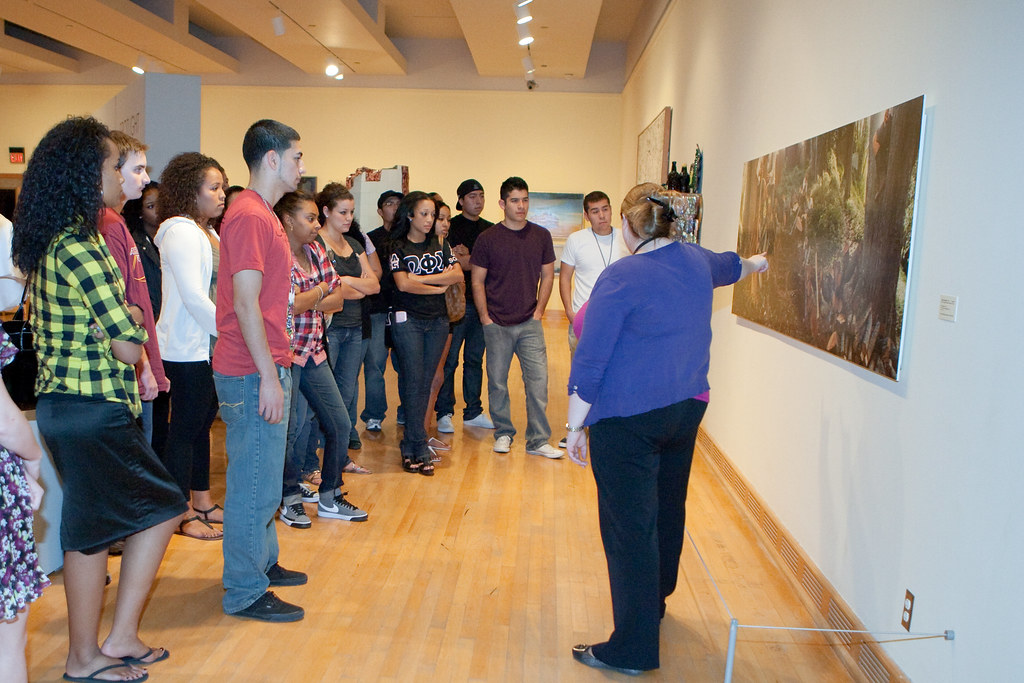
Photo credit: copyright 2009, Diane Wallace, ASU Art Museum

Friday, January 14, 2011

Artifacts


Butt Johnson
"Various Video Game Controllers, Maps, and a Robotic Accessory"
2007
Ballpoint pen on paper
15 X 19 inches

It's been five years since I owned a video game console. It's been even longer since I abandoned myself to a game, a happy pastime (read: addiction) of my teens and early twenties. Just as I made a teenaged vow that I would always be knowledgeable about new music -- Damn it, I wouldn't be the adult who plays the same John Denver tape on the car stereo, day after day! -- I also promised myself that I'd always own a technologically sophisticated gaming system. Although I accepted the cruel fact that my body would age and degrade, I believed that I'd remain young at heart if I remained a serious gamer. In retrospect, this latter, already broken vow seems laughably naive. If I were still gaming (even casually), I'd be hard-pressed to juggle my art-making with my writing, my volunteer commitments with earning a living, my solitary "thinking time" with my relationship; where would gaming fit!?

In any case, artist Butt Johnson's drawing "Various Video Game Controllers, Maps, and a Robotic Accessory" strikes a nostalgic chord. Over the years, I've owned or used all of the controllers depicted (with the exception of the unfamiliar robot). Today, a little more than twenty-five years after the release of the tremendously popular Nintendo Entertainment System (NES) console, we consider the system's controller (top row, third from the right) an artifact of a bygone gaming era. And the Atari joystick? A fossil! It's curious to feel wistful about technology so recently outmoded.

On a tangentially related note, I recommend Nick Paumgarten's New Yorker profile of Shigero Miyamoto, one of the creative minds behind Nintendo's success and the creator of revolutionary games like Super Mario Bros., The Legend of Zelda, and Star Fox. He's also one of the idea men behind the industry-dominating Wii console. Like Paumgarten, I find it revealing that Miyamoto cites his active imagination and the outdoors as the foundation of his creative success.
"When Shigeru Miyamoto was a child, he didn’t really have any toys, so he made his own, out of wood and string. He put on performances with homemade puppets and made cartoon flip-books. He pretended that there were magical realms hidden behind the sliding shoji screens in his family’s little house. There was no television. His parents were of modest means but hardly poor. This was in the late nineteen-fifties and early nineteen-sixties, in the rural village of Sonobe, about thirty miles northwest of Kyoto, in a river valley surrounded by wooded mountains. As he got older, he wandered farther afield, on foot or by bike. He explored a bamboo forest behind the town’s ancient Shinto shrine and bushwhacked through the cedars and pines on a small mountain near the junior high school. One day, when he was seven or eight, he came across a hole in the ground. He peered inside and saw nothing but darkness. He came back the next day with a lantern and shimmied through the hole and found himself in a small cavern. He could see that passageways led to other chambers. Over the summer, he kept returning to the cave to marvel at the dance of the shadows on the walls.

Miyamoto has told variations on the cave story a few times over the years, in order to emphasize the extent to which he was surrounded by nature, as a child, and also to claim his youthful explorations as a source of his aptitude and enthusiasm for inventing and designing video games. The cave has become a misty but indispensable part of his legend, to Miyamoto what the cherry tree was to George Washington, or what LSD is to Steve Jobs. It is also a prototype, an analogue, and an apology -- an illuminating and propitious way to consider his games, or, for that matter, anyone else’s. It flatters a vacant-eyed kid with a joystick (to say nothing of the grownups who have bought it for him or sold it to him) to think of himself, spiritually, as an intrepid spelunker. The cave, certainly, is an occasion for easy irony: the man who has perhaps done more than any other person to entice generations of children to spend their playtime indoors, in front of a video screen, happened to develop his peculiar talent while playing outdoors, at whatever amusements or mischief he could muster. Of course, no one in the first wave of video-game designers could have learned the craft by playing video games, since video games didn’t exist until people like Miyamoto invented them. Still, there may be no starker example of the conversion of primitive improvisations into structured, commodified, and stationary technological simulation than that of Miyamoto, the rural explorer turned ludic mastermind."
My solitary, television-deprived childhood was akin to Miyamoto's, an enchanted, wondrous world of books and nature. That changed during my sixth grade year, when my parents purchased a television. A few years later, they presented me with a Nintendo console. For years after that purchase, I spent more time with a console controller in my hand than I did exploring or contemplating the world around me.

It's misguided to dismiss video games as artless or to condemn them as escapism, but I wonder whether my connection to natural history and my investment in ecology would be so concrete had my early, formative years included television and gaming. What if I'd been born eight years later, after the introduction of the NES and home computers?

I have a positive view
of humanity; an overview of our species' short history reveals a social animal that takes two steps forward for every step back. Technology is an essential part of this gradual and steady improvement. Psychologically, however, we're growing ever more distant from our fellow species; our contemporary songlines resonate more in the virtual world than in natural history. Technology is no less a part of that unfortunate development.

Image credit: ripped from Butt Johnson's website

Wednesday, December 29, 2010

Relative Birthday Abundance


Tundra (or Whistler) swans; Heron Hope; Locustville, VA; December 2010

As an enthusiastic amateur naturalist living in New York City, I grew fond of the hearty, adaptive species that populated the boroughs' streets, parks, and waterfronts: pigeons and gulls, rats and red-tailed hawks, starlings and squirrels. When I felt out of step with my urban friends and neighbors, as I occasionally did, I found that watching the animals helped. Chittering around the base of a corner garbage can, the sparrows and starlings chastised me for moping. The herring gull's shrill shout over the East River exhorted me to shake off my self-conscious alienation. All of these species were part of my urban wildlife support network. Watching them reminded me to get on with the business of grateful L-I-V-I-N', no matter where I might be. Now that I live in San Francisco, a town with greater biodiversity than NYC, I'm happy to have Steller's jays, Brewer's blackbirds, and ravens keeping me company, too.

Today, however, my girlfriend and I are visiting my parents on the Eastern Shore of Virginia. Dumped on by the latest "snowpocalypse," we've been locked in for most of our visit. Not that I mind. Yesterday morning, I trudged through the snow drifts around my home ground, eyes squinted in the dazzling winter light. In the space of an hour, I saw thousands of snow geese rise noisily from a partially exposed barley field; turkey vultures sweep across the sky, scenting for an unfortunate victim of the biting weather; a woodcock flush from a hedge; coyote tracks that skirted a small cemetery; mouse tracks that emerged from under a snow-covered plow and lightly skipped across the snowfall's surface to a patch of open grass; a yellow-rumped warbler and a Carolina wren vying for position atop a perch; two tundra (or whistling) swans flying low overhead; Canada geese and green-winged teal gathered in the open water of the estuary; a cottontail peer from a tangle of grasses. It occurred to me, as I contemplated such abundance and diversity, that my urban wildlife support network, whatever its personal value, is but a shadow of what I witnessed this December morning.


Sunset; Heron Hope; Locustville, VA; December 2010

Last year, at this time, I wrote, "32 years on this Earth, and still I feel like I am opening my eyes for the first time." Now 33, that statement is no less true. Given my stubborn optimism, I presume that it will be true at 43, 53, or 83 (should I survive so long). Still, I wish that I could open my eyes to greater species diversity in the cities that I call home. We humans are an increasingly urban species, and we must take care not to forget about the world's collapsing biodiversity. It isn't just the country folks that benefit from it; we all do, whether we appreciate that fact or not.

All the same, I'm looking forward to hearing the belated birthday croaks from the ravens above the Inner Sunset.

Happy 2011, friends. May it be a rich, sweet, and happy year!


Snow Geese; Heron Hope; Locustville, VA; December 2010

Photo credit: Hungry Hyaena, 2010

Friday, December 03, 2010

Red Wolf ESPP Prints Released!


Christopher Reiger
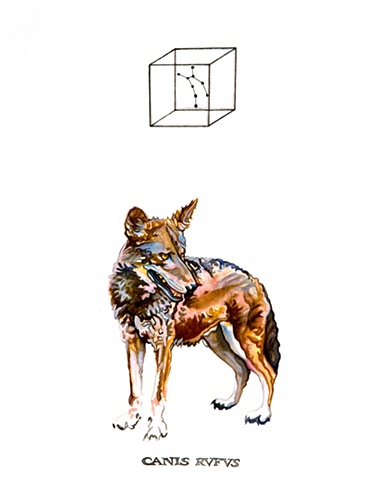
"Constellation (Canis rufus)"
2010
Pen and sumi ink, gouache, and watercolor on Arches paper
15 x 12 inches

My 2010 drawing "Constellation (Canis rufus)" has been made into a limited edition print for the Endangered Species Print Project (ESPP). The drawing features the red wolf (Canis rufus), a critically endangered wolf species.

I wrote the following description of the red wolf and its plight for the ESPP website:
"The Red Wolf (Canis rufus) is a medium-sized North American canid, generally larger than a coyote but smaller than the gray wolf. As the common name suggests, red wolves often have reddish fur on and around their ears, neck, and legs. Like other wolves, the Red Wolf is a social species that lives in packs, groups typically comprised of a mated pair and their offspring (of multiple generations). Red Wolves are crepuscular predators, most active at dusk and at dawn. They prey on white-tailed deer, raccoons, opossums, rabbits, and rodents, but are also known to scavenge.

The Red Wolf once occupied a range that extended over the forests, swamps, and coastal plains of the southern and eastern areas of the United States, as far west as Texas and as far north as New York. As with most non-domesticated canines, however, the Red Wolf was vilified as a dangerous competitor of man (and, erroneously, a "man-eater"). These entrenched, negative attitudes gave rise to aggressive predator control campaigns; wolves were poisoned, shot, and trapped. This persecution was compounded by habitat loss and disease, taking a terrible toll on red wolf populations. By 1980, the species was extinct in the wild.

Today, though, there is good news. Thanks to several focused preservation and reintroduction programs, and especially to the efforts of the Point Defiance Zoo & Aquarium (PDZA) and the United States Fish & Wildlife Service (USFWS), in conjunction with programs like that at Mill Mountain Zoo, the Red Wolf is staging a small, isolated recovery. There are now approximately 100 wolves living wild in eastern North Carolina and up to 250 individuals in zoo-based captive breeding programs."
As per the ESPP model, this is a limited edition of 100 prints, the number determined by the featured animal's current wild population. The print measures 8 x 10 inches, and costs a mere $50.00. ALL proceeds from sale of the prints will be donated to the Port Defiance Zoo & Aquarium Red Wolf Recovery Program.

As I explain in the ESPP artist notes, my fascination with taxonomy increased my interest in researching this particular species:
"Ecology, wildlife biology, and natural history are subjects that I'm passionate about, and I'm especially intrigued by taxonomy, the classification of different species. The ever-evolving field's binomial nomenclature is chock-a-block with curious etymological backstories and, more importantly, taxonomists are endlessly debating species classification. Names change, species become subspecies (and vice versa), and protected animals become unprotected animals on what seems to be a month-to-month basis! The red wolf is no exception. It's an honor to produce an artwork that may, in some small way, help save a keystone predator from extinction and genetic isolation; I must admit, however, that I also planned to use the print as an excuse to learn more about the particulars of the red wolf taxonomic debate.

Some wildlife biologists insist that the red wolf's scientific name is Canis lupus rufus and that the animal is a subspecies of gray wolf (Canis lupus). Another camp, one that the US Fish & Wildlife Service concurs with, believes the wolf to be a species distinct from the gray wolf. It is their classification, Canis rufus, that I use in the species description above. Frankly, both groups make valid arguments; the different verdicts depend on whether the red wolf is classified according to the biological classification rule (i.e., if Wolf A can make viable pups with Wolf B, the two wolves belong to the same species) or the phenotypic/phylogenetic approach to classification, based on distinct physiological or genetic characteristics. Because the phenotypic/phylogenetic approach leads to a great many more species, it remains a source of contention within wildlife biologist communities and complicates conservation politics, for better and for worse.

Of primary importance, though, are the animals. Whether red wolves are ultimately deemed their own species or a subspecies of gray wolf, they're on the brink of extinction. There is ample cause for hope, however, and you can make that hope a little more concrete by purchasing a print!"
Visit the ESPP site to learn more and, during this holiday season, please consider helping the species by buying a print as a gift.

Wednesday, September 22, 2010

The RSA's "21st Century Enlightenment"


Sure, the video is 11 minutes long, well over the too-long-to-watch mark for readers casually trolling the blogosphere, but it's worth bookmarking and saving for later. (In fact, I encourage you to watch it on YouTube or the RSA website, as the resolution is better than that of the above embed.)

The ideas articulated are vital and might provide some solace for those of you who, like so many of my friends, suffer from political apocalypse syndrome! Moreover, the animation is terrific and the narrator, like the Royal Society for the Encouragement of the Arts (RSA), is British, satisfying the Anglophile in all of us.

Enjoy.

(Thanks to Michael McDevitt for turning me on to this RSA video.)

Sunday, September 05, 2010

ESPP at Chicago's Renegade Craft Fair


The Endangered Species Print Project will be exhibiting at the Renegade Craft Fair, taking place this September 11th and 12th, in Chicago.

Co-founders Jenny Kendler and Molly Schafer will be selling prints to raise funds for all of the fourteen species so far featured in ESPP prints, as well as some upcoming print subjects, including my red wolf (Canis rufus).

I'm pleased to report that, to date, the ESPP has raised $4,000 for critically endangered species, and hopes to raise another $6,000 at Renegade! If you're in or around the Windy City, please pay them a visit.

Wednesday, July 21, 2010

ESPP Anniversary


Molly Schafer
"Moldavian Meadow Viper"
2010
Archival giclee print (Edition of 2000)
8 x 10 inches

The Endangered Species Print Project recently celebrated their one year anniversary! To mark it, they released three new prints.

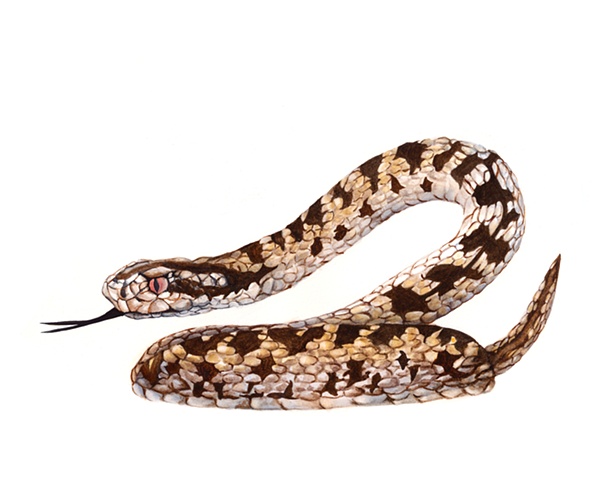
I'm especially fond of the two newly available limited editions created by the project's co-founders, Molly Schafer and Jenny Kendler...and I'm most drawn to the Moldavian Meadow Viper (Vipera ursinii ssp. moldavica). This, for three reasons: Molly rendered the animal beautifully; I adore serpents, and Molly evidently does, too; I have an irrational attachment to Hungary, since my paternal great-grandparents hail from the country, and sales of the print benefit the Hungarian Meadow Viper Conservation Center, a conservation organization based there.

Visit the ESPP site to see the other prints.

Image credit: Courtesy the Endangered Species Print Project