Showing posts with label modernism. Show all posts

Friday, August 26, 2011

Gregory Ito's "Point of Vision"

Gregory Ito
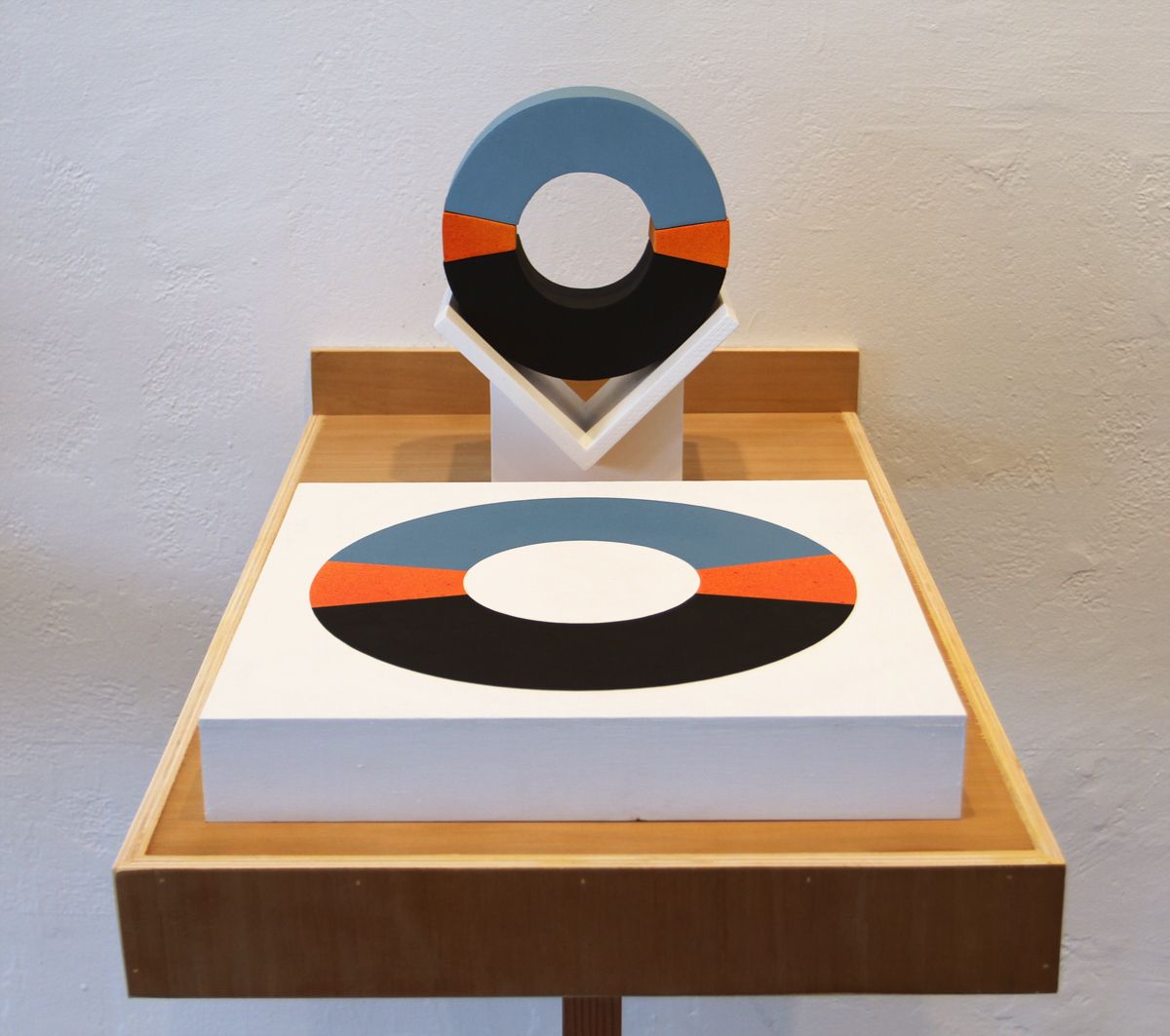
"Untitled (Time Diagram Set B)"
2011
Acrylic and gouache on wood panel, acrylic on handmade wood object, and table

Like it or not, context informs our experience and interpretation of artworks. We generally think of context as a work's physical situation (e.g., how and where it is installed) or its social and art historical framework, but most important is the context provided by an individual viewer. What is the viewer's profession? What book is she reading? Who was she talking to an hour ago, and what about? Of course, artists can't control for these subjective factors, and many craft artist statements that provide viewers with what the artists believe is appropriate context for the artwork. Too often, though, these statements tell viewers what the "take away" should be, thereby forfeiting the most vital and collaborative element of the artistic enterprise, the creation of meaning by the viewer.

How refreshing, then, to find Gregory Ito's healthy twist on the artist statement in his terrific "Point of Vision" exhibition at Gallery Hijinks. While the artist and gallery provide a press release (usually an artist statement reworked and edited by the gallery staff), Ito also includes "Sources," a tidy stack of books on the floor, spines out so that the titles are easily read. Is "Sources" intended as a found object sculpture? Kinda sorta (after all, it's titled, is situated among Ito's other work, and is included on the exhibition price list, albeit "NFS"), but its principal valuable is as an alternative to the formal statement. It provides viewers with context without bullying them into a particular conclusion.
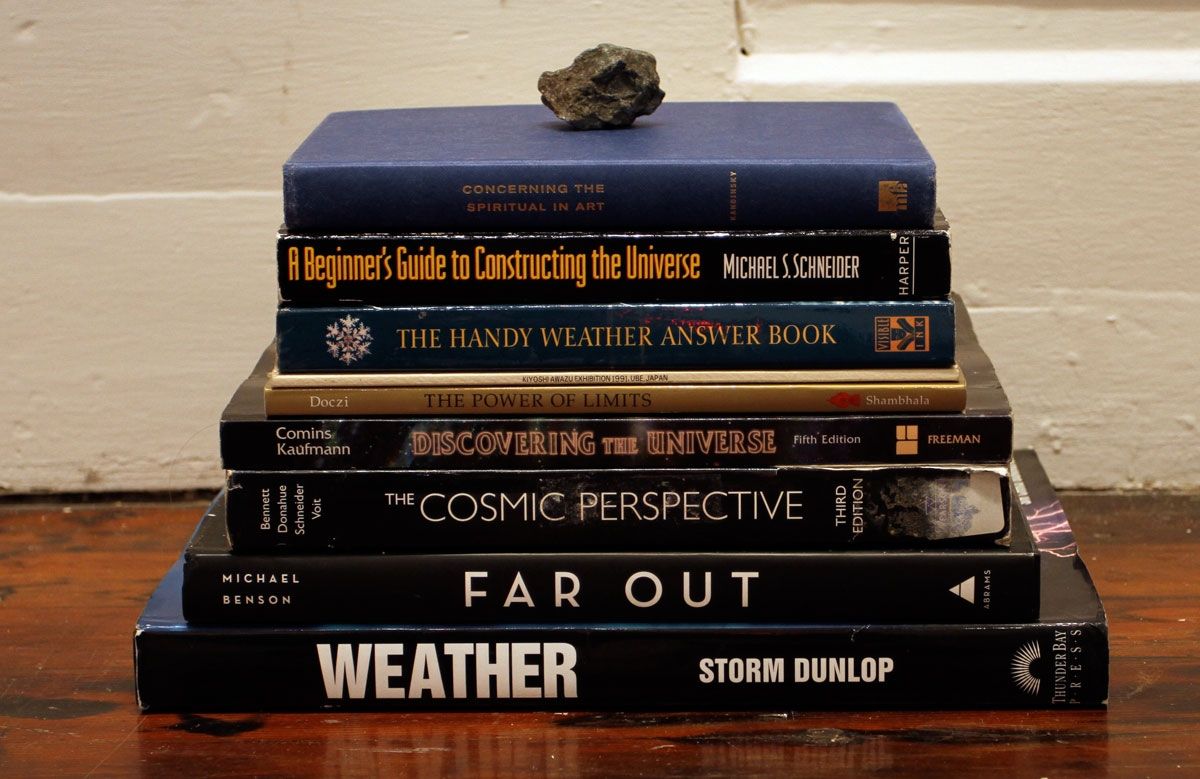
Gregory Ito
"Sources"
2011
Book collection

"Sources" is something of a companion piece to "Self Portrait (Object Collage)." Installed in one of the gallery windows, "Self Portrait" includes a beach chair, flip flops, a towel, a pile of diary-like journals, an ashtray, empty beer bottles, a candle, and 28 snapshots mounted on a board that faces the chair. One imagines the artist in his chair, sipping beer and smoking as he contemplates his collection of isolated observations. The photographs are mostly of clouds and sun-soaked skies, but there are also landscapes, some abstract imagery, a rainbow, and an illuminated light fixture. These pictures complement Ito's reading list. A Beginner's Guide to Constructing the Universe, by Michael Schneider, Concerning the Spiritual In Art, by Wassily Kandinsky, The Cosmic Perspective, Third Edition, by Bennett, Donahue, Schneider, and Voit, The Handy Weather Answer Book, and other titles included in Ito's book pile suggest that the artist is preoccupied with sublime, existential mysteries and celebrating our species' impulse to solve them.
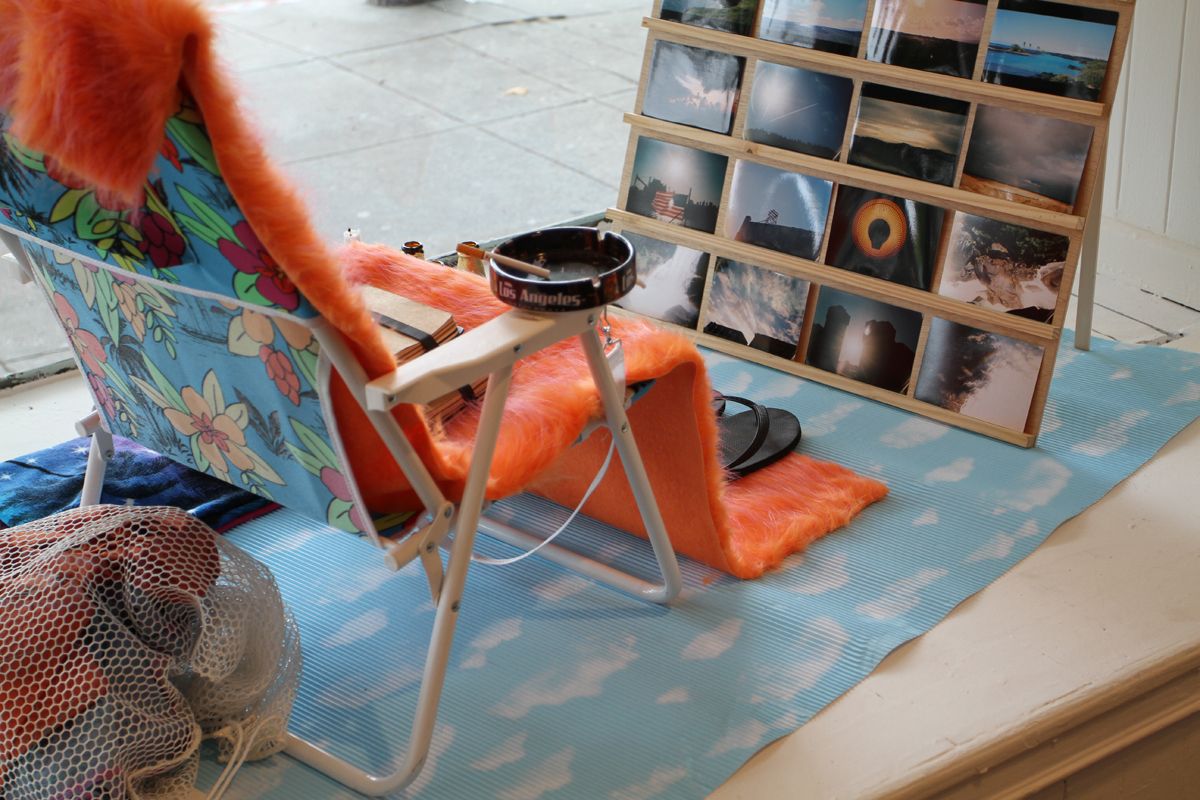
Gregory Ito
"Self Portrait (Object Collage)"
2011
Window installation with 28 photographs and wood display

Ito's sculptures, paintings, and installations reflect this focus. Especially in the gallery's "white cube" setting, they read as speculative objects and diagrams as much as they do aesthetic entities. The artist is well aware of this; he titles the two most compelling installations on view, "Untitled (Time Diagram Set A)" and "Untitled (Time Diagram Set B)." He pairs a painting with a sculpture in each. The paintings are straightforward illustrations of the sculptures, but, displayed in the gallery setting with the three-dimensional objects they depict, the images read as icons, potent stand-ins for the "real" or "true" object. Curiously, by virtue of having been depicted, the sculptures also gain in significance. The meaning of these pictures and objects remains somewhat esoteric. I infer, based on the works' titles and Ito's "Sources," that these are representations of space-time's nature or shape, but that's a rather general interpretation. Still, the sculptures resonate as totems and the paintings as their icons. This reciprocal dynamic is compelling, and serves as an oblique reminder that all artwork exists in relationship to the world and ideas outside of the gallery and studio, a fact too often overlooked since the advent of modernism.
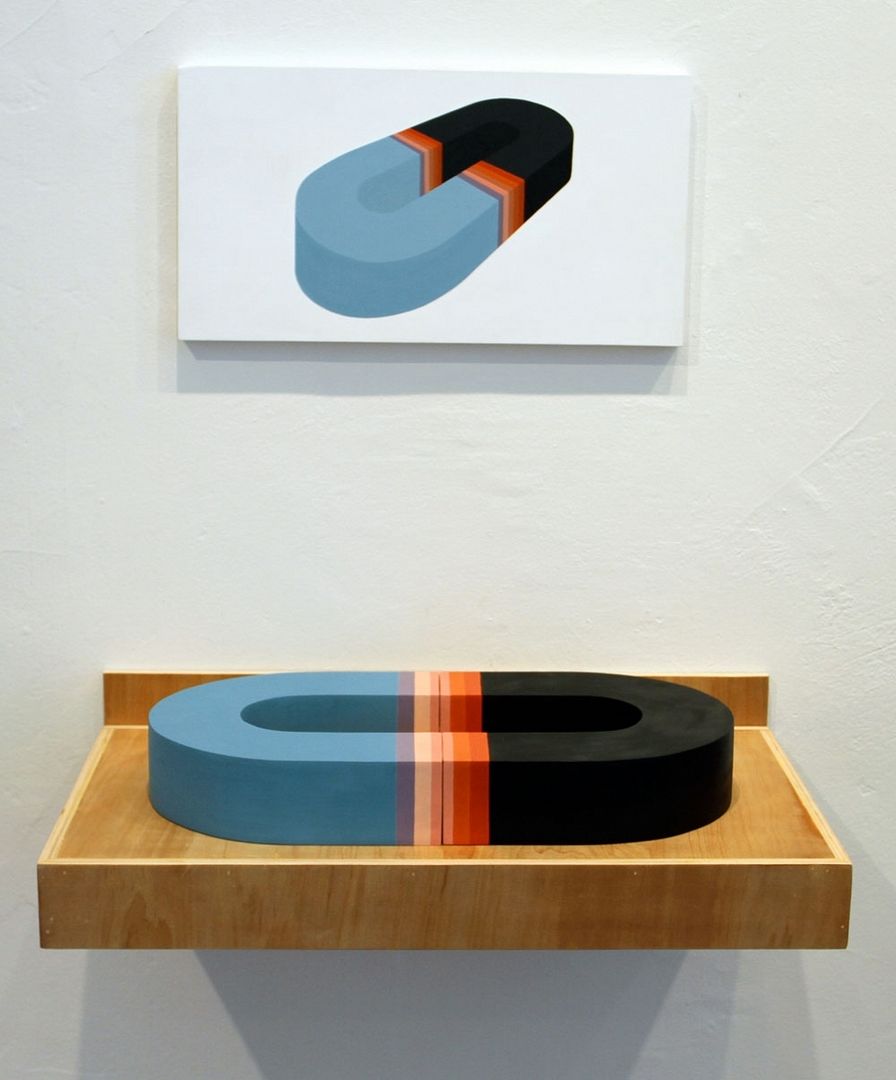
Gregory Ito
"Untitled (Time Diagram Set A)"
2011
Acrylic on wood panel, acrylic on handmade wood object, and shelf

In other works, Ito more directly highlights what I've elsewhere described as "the wonder current." In "Human Euphoria," a disembodied ceramic head of a girl in a big-brimmed, yellow hat rests on top of a block of adobe clay, apparently gazing at an ocean sunset. The piece is a winking, contemporary tribute to Caspar David Friedrich's Romantic masterpiece, "Wanderer above the Sea of Fog," but Ito's head is better-suited to contemplation than the vigorous morning constitutionals of Friedrich's dapper hero. Is this a comment on the continued dominance of conceptual concerns over aesthetic and material considerations in contemporary art? Perhaps; perhaps not. Ito's better pieces excel precisely because they can be interpreted as "art for art's sake" or, taking a hint from his "Sources," as art about the stupefying magnificence of being.

Gregory Ito
"The Embrace Installation"
2011
Acrylic and gouache on wood panel, found book with handmade page holders, and petrified object on shelf

Image credits: all images, courtesy Gallery Hijinks and Gregory Ito, 2011

Friday, August 19, 2011

Making More "Live Animals"


Two weeks ago, I presented a lecture at the Art College Center of Design, in Pasadena, California, titled "Aesthetics, Ethics, and Experience." It was my first attempt to respond to the question of how contemporary artists might connect the "fine arts" to society at large, and I drew from an array of sources, classical (Heraclitus; Aristotle) and contemporary (Dave Hickey; David Milch; Erik Reece), to constellate what I'd like to think Aristotle would have described as a virtuous way of being in the world (as an artist). After the lecture, one of the students remarked that it was the "most liberal arts style" approach she'd come across in art school. I appreciated her compliment, but it reminded me of the urgent need for more generalism in arts education.

As I often insist, there is a lot of beautiful and compelling artwork produced and exhibited today, but it generally lives apart from popular culture. We -- that is, those of us active in the fine arts -- are complicit in this ghettoization because we're content to carry on a conversation among ourselves. Moreover, because we've come to preference our tribe's voices over others, there is a surplus of insider commentary and critique passed off as art. Almost all of this work and wordiness is irrelevant to the world outside the ghetto walls and, because young artists are educated in this context, with little or no pedagogical emphasis on disciplines other than art theory, the art and commentary become, over time, increasingly provincial. The wellspring of this contemporary predicament is as old as modernism.

On the heels of co-curating "A Live Animal" with Selene Foster, I've been rereading John Dewey's brilliant Art & Experience essays (1934). Dewey writes, and I quote him at length because he articulates the crux of the problem so eloquently:
" [Art is today] isolated from the human conditions under which it was brought into being and from the human consequences it engenders in actual life experience. [...] Art is remitted to a separate realm, where it is cut off from that association with the materials and aims of every other form of human effort, undergoing, and achievement. A primary task is thus imposed upon one who undertakes to write upon the philosophy of the arts. This task is to restore continuity between the refined and intensified forms of experience which are works of art and everyday events, doings, and sufferings that are universally recognized to constitute experience.

[...] So extensive and subtly pervasive are the ideas that set Art upon a remote pedestal, that many a person would be repelled rather than pleased if told that he enjoyed his casual recreations, in part at least, because of their esthetic quality. The arts which today have most vitality for the average person are things he does not take to be arts: for instance, the movie, jazzed music, the comic strip, and, too frequently, newspaper accounts of love-nests, murders, and exploits of bandits. For, when what he knows as art is relegated to the museum and gallery, the unconquerable impulse towards experiences enjoyable in themselves finds such outlet as the daily environment provides.

[...] For the popular notion comes from a separation of art from the objects and scenes of ordinary experience that many theorists and critics pride themselves upon holding and even elaborating. The times when select and distinguished objects are closely connected with the products of usual vocations are the times when appreciation of the former is most rife and most keen. [...] Theory can start with and from acknowledged works of art only when the esthetic is already compartmentalized, or only when works of art are set in a niche apart instead of being celebrations, recognized as such, of the things of ordinary experience. Even a crude experience, if authentically an experience, if more fit to give a clue to the intrinsic nature of esthetic experience than is an object already set apart from any other mode of experience. [...The] trouble with existing theories is that they start from a ready-made compartmentalization, or from a conception of art that 'spiritualizes' it out of connection with the objects of concrete experience. The alternative, however, to such spiritualization is not a degrading and Philistinish materialization of works of fine art, but a conception that discloses the way in which these works idealize qualities found in common experience. Were works of art placed in a directly human context in popular esteem, they would have a much wider appeal than they can have when pigeon-hole theories of art win general acceptance.

[...] The sources of art in human experience will be learned by him who sees how the tense grace of the ball-player infects the onlooking crowd; who notes the delight of the housewife in tending her plants, and the intent of her goodman in tending the patch of green in front of the house; the zest of the spectator in poking the wood burning on the hearth and in watching the darting flames and crumbling coals."
Amen, Mr. Dewey...though I'd add that the "primary task" to "restore continuity between" works of art and the everyday is not only the obligation of the art writer; it is also incumbent upon the conscientious artist. Artists need to make art that connects to common human experience, and both artists and art writers need to communicate more effectively with the general audience.


I thought of Dewey's argument when watching a video of Scottish cyclist Danny MacAskill that was recently shared by a friend on Facebook. The video offers a more visceral (and therefore meaningful) aesthetic experience than most of the contemporary art I've viewed in the last weeks. An acrobat with his bike, Macaskill is Dewey's "live animal," "fully present, all there" because of he has honed his craft and is, as we often hear athletes put it, "in the zone."

Can contemporary fine art inspire people to exclaim, as one person did in the comments under my friend's Facebook posting of the Macaskill video, "That's crazy & beautiful!"? Can artists again enthuse the general audience?

I believe that we can, and I hope that I can one day have an opportunity to design (or help to design) an undergraduate or graduate art curriculum that prioritizes generalism and social responsibility.

Photo credit: photo of Danny MacAskill ripped from CyclePath Magazine

Friday, February 19, 2010

Originality and (Re)cognition


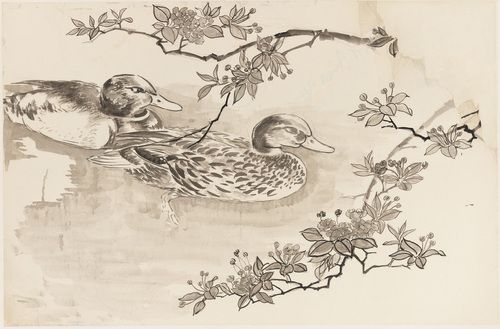
Xie Zhiliu (Chinese, 1910–1997)
"Ducks and Blossoming Branches"
Pencil and ink on paper
20 1/2 x 30 3/4 inches

In his recent review of the Metropolitan Museum of Art's exhibition of works on paper by the late Chinese artist Xie Zhiliu ("Tracing the Path to Chinese Finesse," New York Times, February 14, 2010), art critic Ken Johnson reminds readers that imitation is often a prerequisite for originality. Johnson's piece begins with a Western commonplace,
"Copying is bad; originality is good. That’s what we learn from toddlerdom on. In art as in life, be yourself. Don’t pretend. Nobody likes phonies, fakes or frauds. Forgery is illegal. Authenticity is holy.

But wait. Copying and imitating have been the rule for most of the history of human civilization. In the West artists from Raphael to Picasso have profited from copying the works of others. In art there is no such thing as pure originality."
Or is there?

I suppose it depends on one's definition of originality. Having recently come under the intellectual sway of George Steiner, I wholeheartedly endorse the philosopher-critic's distinction between originality and novelty, detailed in his book Real Presences.
"Originality is antithetical to novelty. The etymology of the word alerts us. It tells of 'inception' and of 'instauration,' of a return, in substance and in form, to beginnings. In exact relation to their originality, to their spiritual-formal force of innovation, aesthetic inventions are 'archaic.' They carry in them the pulse of the distant source."
Put another way, novelty is self-conscious invention or difference for the sake of invention or difference (that is, mere newness), whereas originality is an individual's expression of a primordial and universal resonance.

What better way to absorb the lessons of your predecessors (to better prepare yourself for originality) than by reproducing the work of those artists? More from Johnson's article:
"Maxwell K. Hearn, the exhibition’s organizer and a curator of Chinese painting and calligraphy at the Met, explained in an interview that the show’s main significance is in what it reveals about methods used by traditional artists. It turns out that the kind of graceful naturalism that Xie achieved in his best works came not from extensive study of nature but by tracing over and over the works of other artists on sheets of semitransparent paper. [...] Repeatedly tracing the works of old masters as Xie did might be compared to a pianist practicing a composition by Bach. This may sound suffocating for a modern artist, but it is not unlike how many young artists learn to draw: by copying their favorite comic-book characters over and over."
I was no exception. I spent countless teenage hours copying comic strips and, later, comic book characters. The graphic line and compositional sense that I learned from emulating those comic artists significantly informs my artwork today.

Johnson is correct, however; these ideas "may sound suffocating for a modern artist." That copying (a casual form of apprenticeship) might offend contemporary sensibilities is further evidence of the excesses of modernism and postmodernism. Too much was purged in the revolution of modern aesthetics; the rabble is today without coherence.

Fortunately, the art world is undergoing a sea change. The majority of artists under 40 years of age (and an increasing number of those over 40) do not mistake novelty of expression for originality, and they will readily acknowledge the value of copying, especially for the young artist. In fact, we realize the genuineness of Steiner's insistence that such activity is vital in all aesthetic disciplines.
"To learn by heart is to afford the text or music an indwelling clarity and life-force. Ben Johnson's term, 'ingestion,' is precisely right. What we know by heart becomes an agency in our consciousness, a 'pace-maker' in the growth and vital complication of our identity.

[...] Accurate recollection and resort in remembrance not only deepen our grasp of the work: they generate a shaping reciprocity between ourselves and that which the heart knows. As we change, so does the informing context of the internalized poem or sonata. In turn, remembrance becomes recognition and discovery (to re-cognize is to know anew)."
Image credit: Metropolitan Museum of Art

Wednesday, February 03, 2010

"Inherited Purpose and Pattern"


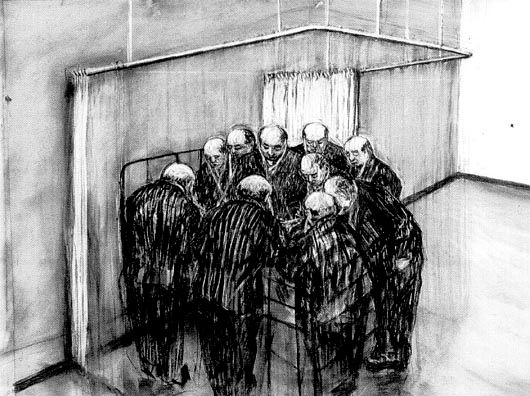
William Kentridge
Still from "History of the Main Complaint"
Animation
1996

I enjoyed reading Calvin Tomkins' recent profile of William Kentridge ("Lines of Resistance," The New Yorker, January 18, 2010). Tomkins includes some fascinating details about Kentridge's background and family, and I especially appreciated some of the remarks made by the artist. The following quotation was particularly resonant.
"[Working in South Africa,] I was aware of Joseph Beuys - Beuys and his honey pump, which was supposed to be political art. But politics is not spreading honey around the main building at the Documenta art exhibition. It's putting electrodes on people's testicles, locking them up, putting them in fear of their lives."
Kentridge acknowledges his South African perspective (the artist was born into a state of apartheid and is today living through its often grim aftermath), but his observation also speaks to the general disconnect between so much 20th century fine art and "the real world."

Both modernism and postmodernism prioritize iconoclasm and individual achievement over "a system of inherited purpose and patterns."(1) It's thoughtless to dismiss the sibling -isms (both offer valuable insights and fundamentally inform our contemporary world), but the march of globalization is revealing the societal impotence of the philosophies. Absent "inherited purpose" and narrative, postmodern community is soulless, a mere facade. One of many casualties, the artist is but a mote in a vast and turbulent sea of competing sentiments and ideologies. Graphic design and advertising occupy the popular position once given to fine art, but, excellent though some of both may be, these are commodity driven disciplines; as such, they can make no genuine claim to political or moral coherence.

Still, I don't believe that we should bemoan our station as the end of the line. Globalization is in its infancy, and the 21st century will likely see a new concept of cosmopolitan citizen emerge, one that could usher in an era of shared mythos. Back to the future, so to speak.

(1) This definition of pre-modern art is drawn from Adam Gopnik's fantastic essay, "Van Gogh's Ear." (The New Yorker, January 4, 2010)