Showing posts with label advertising. Show all posts

Monday, February 28, 2011

So Many True Colors


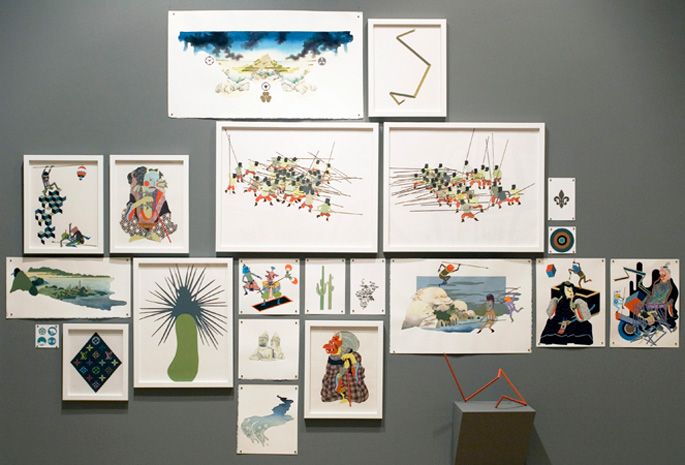
Installation at Haines Gallery
"Studies for La Destitution de la Jeune Fille"
2010
Gouache on paper and wood
Dimensions Variable

French artist Katya Bonnenfant has adopted the moniker The Old Boys' Club. TOBC's current exhibition at Haines Gallery - a scaled-down version of the recent wallpaper and sculptural installation at the Yerba Buena Center for the Arts - is titled "La Destitution de al Jeune Fille (The Deposition of the Young Girl)." According to the gallery's press release, the title references a "post-Situationist theory [...] initially put forth by the anonymous collective, Tiqqun." Apparently, Tiqqun "advances the notion of the young girl as embodiment of the capitalist machine and the meaninglessness of modern life." Further research reveals that the preponderance of content published in Tiqqun's now defunct journal is jejune and impotent pseudo-philosophy, the sort of tripe that too many artists mistake for genuine thoughtfulness. Happily, despite her meager inspiration, TOBC puts on a good show.


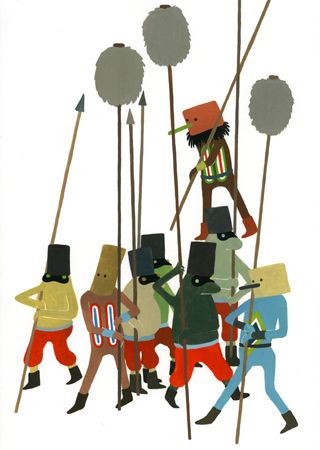
"Study for La Destitution de la Jeune Fille #41"
2010
Gouache on paper
12 x 9 inches

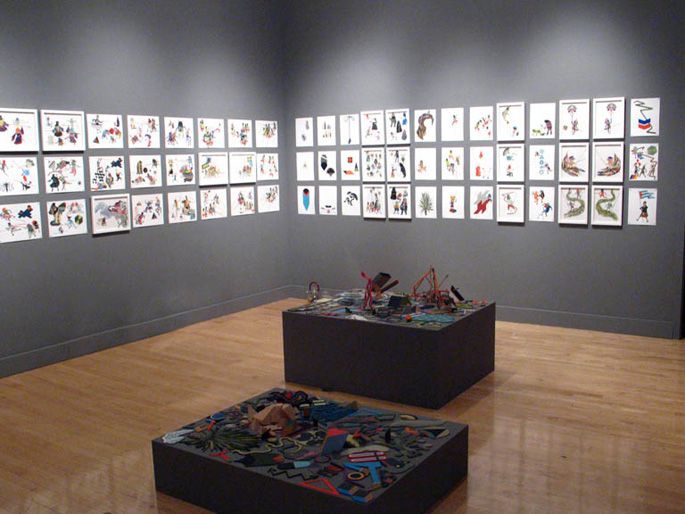
The back gallery at Haines is pleasantly crowded with TOBC's colorful and riotous gouache drawings and sculptures. Bonnenfant's cast of cartoon characters is diverse; celebrities like Darth Vader and Waldo appear, but most of the artist's spear-wielding insurgents are humble and unfamiliar. What treasure or ideology are they fighting over, exactly? Narrative particulars are few and no critical players or turning points are obviously apparent; it's a ceaseless and meaningless melee (like Tiqqun's conception of modern life!).

The opaque, vivid colors of TOBC's gouaches call to mind the advertising industry's heraldry and, in combination with the masks and costumes of Bonnenfant's characters, emphasize the combatants' ethnic or cultural differences. The effect is gestalt; Bonnenfant's oddball cast of warrior mascots is a manifestation of the physical and economic violence of globalization. That's also what Tiqqun aimed to communicate but, where they failed, TOBC succeeds artfully and without pretension.


Installation at Haines Gallery
"Studies for La Destitution de la Jeune Fille"
2010
Gouache on paper and wood
Dimensions Variable

Image credits: all images from the artist's website and Haines Gallery website

Wednesday, February 03, 2010

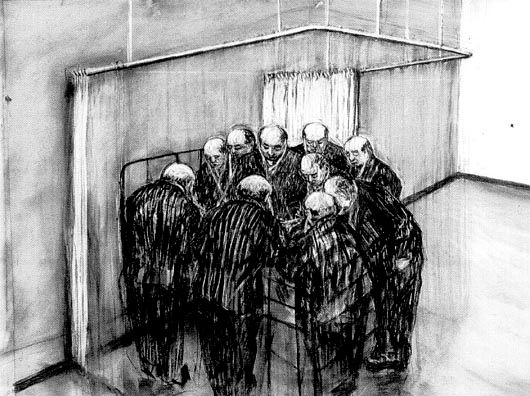
"Inherited Purpose and Pattern"


William Kentridge
Still from "History of the Main Complaint"
Animation
1996

I enjoyed reading Calvin Tomkins' recent profile of William Kentridge ("Lines of Resistance," The New Yorker, January 18, 2010). Tomkins includes some fascinating details about Kentridge's background and family, and I especially appreciated some of the remarks made by the artist. The following quotation was particularly resonant.
"[Working in South Africa,] I was aware of Joseph Beuys - Beuys and his honey pump, which was supposed to be political art. But politics is not spreading honey around the main building at the Documenta art exhibition. It's putting electrodes on people's testicles, locking them up, putting them in fear of their lives."
Kentridge acknowledges his South African perspective (the artist was born into a state of apartheid and is today living through its often grim aftermath), but his observation also speaks to the general disconnect between so much 20th century fine art and "the real world."

Both modernism and postmodernism prioritize iconoclasm and individual achievement over "a system of inherited purpose and patterns."(1) It's thoughtless to dismiss the sibling -isms (both offer valuable insights and fundamentally inform our contemporary world), but the march of globalization is revealing the societal impotence of the philosophies. Absent "inherited purpose" and narrative, postmodern community is soulless, a mere facade. One of many casualties, the artist is but a mote in a vast and turbulent sea of competing sentiments and ideologies. Graphic design and advertising occupy the popular position once given to fine art, but, excellent though some of both may be, these are commodity driven disciplines; as such, they can make no genuine claim to political or moral coherence.

Still, I don't believe that we should bemoan our station as the end of the line. Globalization is in its infancy, and the 21st century will likely see a new concept of cosmopolitan citizen emerge, one that could usher in an era of shared mythos. Back to the future, so to speak.

(1) This definition of pre-modern art is drawn from Adam Gopnik's fantastic essay, "Van Gogh's Ear." (The New Yorker, January 4, 2010)

Tuesday, October 16, 2007

Ethical food choices...for cars


Each fall the Major League Baseball postseason reintroduces me to alcohol and automobile advertising. Advertising is our most popular art form and, as a result, every American is comfortable critiquing commercials (even those who remain reluctant to discuss paintings, novels, or films). As a stubborn idealist, I'd rather opt out of the conversation altogether, but I'm compelled to comment on Chevrolet's recent alternative fuel vehicles television spots.

Like the other major motor companies, Chevy is ramping up alternative fuel advertising in an effort to earn "green" stripes, but (no surprise here) they fudge the facts. For example, in the commercial for Chevy's e85 ethanol line, a user-friendly spokesman tells a group of children that the biofuel vehicle is "vegetarian." That label is disingenuous. No matter what the captains of industry claim, biofuel is not an environmentally sensitive option. George Monbiot, a vigilant activist and journalist, has been crying foul on this front for years, even when most environmental groups were still touting biofuel as a promising alternative.

But, among environmentalists, consensus is slow in coming and, having been reached, even slower to result in an about-face. Because Americans and Europeans are at last embracing gasoline alternatives, environmental activists are nervous about backtracking, even as news from the lands of palm and sugarcane grows more dire. Consider this recent piece from the Manchester Guardian.
"Until now palm oil - of which 83% is produced in Indonesia and Malaysia - was produced for food. But the European Union's aim of cutting greenhouse gas emissions by 20% by 2020, partly by demanding that 10% of vehicles be fuelled by biofuels, will see a fresh surge in palm oil demand that could doom the rainforests.

That is likely to kill off the 'flagship species' of wildlife such as the Asian elephant, the Sumatran tiger and the orang-utan of Borneo which are already under enormous pressure from habitat loss. Plantation owners regard the orang-utan as pests because it eats the young palm oil plants and hunt them down ruthlessly."
I stopped eating meat - i.e., became a vegetarian - because of the wasteful, unethical way meat comes to the plate in our time. Given the equally destructive reality of biofuel production, I wince as I watch the Chevy commercials, worried that most well-meaning people associate the vehicles with positive change rather than, among other sins, the slaughter of orangutans by hungry have-nots.

Sure, the car is vegetarian. Industrialized capitalism, however, is anything but.

Photo credit: ripped from ABC Australia

Wednesday, October 05, 2005

Selling Atheism and Myth

Image hosted by Photobucket.com
When transferring from the A/C/E subway line to the N/R/W at 42nd Street in Manhattan, passengers must walk down a long, underground tunnel. If they happen to look up at the tunnel's low ceiling, they'll notice three or four word excerpts on signs mounted to the ceiling reinforcements. If one reads the signs as he walks the length of the tunnel, he'll realize that each sign is a "piece" of a poem. The subject matter is mundane, literally, and the poem rather bleak. In short, the uncredited writer asks why we wake and go to work, day after day, our lives spiritually empty and dull. In the context of the smelly, humid subway tunnel, crowded with commuters, the poem resonates.

This past Saturday afternoon, as I made the E to W transfer, a group of teenage girls walked just behind me. Half listening to their conversation, I realized they were discussing the poem. They mocked it. "It's so stupid," one of them giggled. "What the fuck? I mean...," another girl trailed off. To some extent, I can sympathize with their reaction; the poem doesn't convey the most original sentiment. "You know what I don't get?," said a third girl. "What's it even advertising?"

Oh...my...God.

What is it advertising?! What is this MTA commissioned public poetry advertising?! Burma Shave, this ain't, babe.

I should know better than to be surprised. These girls, roughly seventeen years of age, are plugged into consumer culture. Theirs is the generation of the spectacle and the billboard. They were thirteen when the World Trade Center fell (on television, again and again and again) and they represented America's youngest consumer demographic, parental parasites, during the economic bubble of the late nineties. The third girl's question is, from their perspective, a fair one. Why isn't this poem an advertisement?

I didn't know whether to laugh or shudder. I slipped into a brooding mood. These are dark times, I thought.

But it's not enough to criticize, break down, and dismiss. Even constructive criticism, that much celebrated will-o-the-wisp, which can be invaluable to the artist, politician, and athlete, provides little reward for the critic himself. He may be able to pinpoint a conceptual contradiction, a fatal weakness in policy, or an unfortunate quirk in form, but how useful is his ability to notice the negative? Is the critic able to turn his judgment inward to correct his own failings?

I enjoy reading good criticism, be it social, literary, or aesthetic, but even the most capable wordsmiths can't make criticism complete unless they prescribe some balm. A batter who has fallen into a slump will not be helped by a coach who only cites what the batter does wrong. The good coach - the complete coach - recognizes the failing and attempts to correct it, explaining to his player not just what is wrong, but also what might work.

Incomplete though most criticism may be, negative noise must be made before there exists any serious striving for improvement. I regularly talk with people who share my sense of disillusionment and betrayal. I see folks shake their heads when reading the day's newspaper headlines and I often hear folks complaining about the administration or about the passing of a particular bill, but our overall complacency is noteworthy. There is some noise being made, of course, but the majority of protests lack focus - people shout 'No blood for oil!' while wearing PETA sweatshirts - and the political plays made by those brave politicians - republicans, in the traditional sense of the word - resisting the red tide are far too esoteric for most of America to rally behind. (Thoughtful, politically savvy bloggers may seem ubiquitous, but they remain a tiny fraction of the general populace.)

Why are we so quiet? Has the barrage of bad news made toadies of us all? When I do get worked up about the "general state of things," I feel as though my outrage is excessive. Perhaps vehement rants about the current administration are considered passe, but does this make them any less vital? Is resistance possible in the current culture of distraction and fear? What does it take to reach "every man" in the era of spectacle?

Ronald Aronson has a good review in the most recent Bookforum, entitled, "Faith No More? Against the Rising Tide of Rejuvenated Religion, A Number of Writers Make the Case for Disbelief." In it, he suggests our contemporary apathy results from the unrealized promises of a better future.
"It's safe to say that the future didn't turn out as anyone expected. Scientific and technological progress has been relentless, but its promises of liberation have gone flat. Few still believe that their children's world will be better than theirs. We live after Marxism, after progress, after the Holocaust - and few imaginations are stirred, few hopes raised by our world's long-range tendencies. Indeed, the opposite is happening as terrorism becomes the West's main preoccupation. In countries like the United States, Britain, and France, there has been a turning away from improving societies and toward improving the self."
Aronson, reviewing seven recent books dealing with the decline of atheism, convincingly argues that the return to God and otherworldly authority figures increases the power of those who already hold the reins, and therefore represents a weakening of The Republic, a collapse of democratic ideals. Near the end of his piece, he writes,
"The rational and constantly self-questioning and self-correcting world view is essential to democracy and its ongoing public discussion about everything under the sun. Those disasters of history not explicitly tied to religion in fact still reflect starting points of authority and unquestionable dogma. Democracy, after all, is congruent with freedom, which is in turn congruent with the world view that presupposes little and questions everything. 'Democracy proceeds by one set of principles. Religion by the opposite.' Atheism is 'one of the natural allies' of democratic societies."
As an atheist, I agree with Aronson and the writers of most of the books he reviews. (To feel as I do, you must believe that moral living is better served by non-believers who recognize that an ethical core is "part of the furniture of the universe," as Plato put it. Moral acts or laws - the Ten Commandments, for example - designed to ingratiate a believer to their respective God or gods are necessarily less virtuous and, above all, self-serving.) However, Aronson needs to ask himself why so many atheists are content to revile religion without offering a thoughtful alternative. Such alternatives do exist, but atheists have a hard time making them attractive to the majority because the absence of an afterlife is too troubling for most people to accept. Unhappy in their own narrative, disappointed by the once promising future, they place their trust in a different sort of "future," an altogether supernatural one.

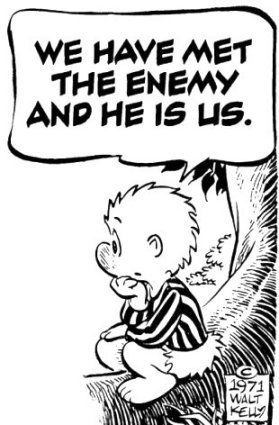
The recent surge in popular interest in aliens, ghosts, supernatural storms, elementals, and any number of other vaguely mystical beings - check the local TV listings if you don't know what I'm referring to - is proof enough that we are a culture living in fear of ourselves. As Pogo, Walt Kelly's philosophical cartoon opossum, said decades ago, "We have met the enemy and he is us." Aronson, trying to salvage some sense of hope, concludes his review with a recipe for a happy, secular society.
"A new atheism must absorb the experience of the twentieth century and the issues of the twenty-first. It must answer questions about living without God, face issues concerning forces beyond our control as well as our own responsibility, find a satisfying way of thinking about what we may know and what we cannot know, affirm a secular basis for morality, point to ways of coming to terms with death, and explore what hope might mean today."
Given the current climate, accomplishment of the goals set forth by Aronson seems highly unlikely at the societal level, though it remains possible for individuals. More importantly, listing what must be done without addressing how it can be done is, like negative criticism, altogether easy and almost pointless.

Underlying the fear and the increasingly fascist feel of the United States is an absence of myth. This is not new. Mark Rothko, the twentieth century painter, wrote extensively on our search for a "master narrative." He was convinced that the loss of myth, so much a part of the Middle Ages and the Renaissance, was responsible for the violence and break-down that led to both World Wars. Though Rothko glossed over some of the more repugnant realities of both these eras - and ugly they could be - the loss of myth, of a central story and purpose - did contribute to what so many have deemed the "decline of Western civilization." Religious fundamentalists argue that this decline occurred as a result of loosening morals and a "turning away" from god worship, but the corruption and violence of the first half of the twentieth century is more accurately moored to the industrial revolution and the myriad temptations of free-market capitalism, both of which forced societies to become more focused on the individual good. I agree with Rothko; a myth is needed where a god is not. Star Wars is a myth - this is only true of the first trilogy, before Lucas introduced the idea of genetic superiority via metachlorion count - and so is The Lord of the Rings. Both sagas weave together the universal myths, those elements that can be found in all theology and everyday life, to create timeless narratives of self-worth and social obligation, reminding us that the little man can make a difference and that good can and will triumph over evil, but not without a lot of heart and courage. The philosophical problems with the concept of "good" and "evil" aside - postmodernism and relativism must take a back seat here - myths rarely grant power to a very few and, when this does occur, the powerful are inevitably overthrown and made examples of.

Without livable myths, most of us turn to the Abrahamic God, abandoning mythical narrative to the realms of science fiction and fantasy. But that god, at least as it is usually conceived of, is a pale shadow of myth for "He" is without practice, only ritual and faith. Faith is a virtue, but it is too easily coopted and dubbed loyalty. Scared by the world we inhabit, we turn to television in the hopes of being frightened further by spectres, aliens, and possessed girls. Dissatisfied with our "little" lives, we celebrate garish displays of wealth, influence, and sexuality, turning all three into absurd caricatures of themselves - reducing them in the process, which ultimately makes them that much more easily abused. But wait! There exists a narrative we can all identify with, a truth all contemporary Americans can rally behind.

"Overworked
So Tired.
If Late
Get Fired.
Why Bother?
Why the Pain?
Just Go Home
Do It Again."

But I don't get it. What's it selling?

Photo credit: 1971, Walt Kelly, "Pogo"

Monday, July 04, 2005

Celebrate America! Buy Now!


When painting, I listen to one of three things. I tune in to National Public Radio, shuffle the tunes on my iPod or, during the summer months, turn on the television and “half-watch” baseball games. This Fourth of July long weekend, I have been doing the latter, enjoying meetings of the New York Mets and Florida Marlins (loss) and, today, the Mets and the Washington Nationals (win). Unfortunately, I must suffer through the commercials; by the end of your average ballgame I've reached the saturation point. The various corporate slogans – “I’m Lovin’ It.” – are stuck in my head and, in some cases, I can recite the commercial voiceovers long after the television is been turned off.

This holiday weekend, the commercials were especially irritating. “Hurry to IKEA for the Summer Sale, ending July 4th!” “Come to P.C. Richard & Son by the 4th to receive big discounts!” “Buy a new Verizon phone by Independence Day and save big!” If I judged the holiday by the television commercials, I would be forced to conclude that the Fourth of July, like Memorial Day, is just another national spending day, or “Freedom Sale,” as one particularly shameless company puts it.

Taking in the commercial frenzy, I feel fortunate that my idea of a good weekend is confined to the studio or a day-trip somewhere relatively unsettled; this way I can avoid the crowds and the angry frustration that sweeps over me when I watch people excessively consume.

A month or so ago, I purchased a scanner at a mid-town Best Buy. While standing in line to swipe my credit card, I watched music videos on televisions hung tactically above the switchback checkout line. Some angry young rockers dressed in grotesque costumes thrashed around on screen – I think this was Slipknot – and I found myself considering our culture's disillusionment. It occurred to me that it wasn’t so very long ago that I stomped around a college campus in combat boots, pierced and angry, listening to Tool and Nine Inch Nails on over-sized headphones.

My gaze drifted from the televisions. On a nearby rack of video games, a display intended to provoke impulse buys, there were more options than I'd had in the early days of Nintendo. Roses, the rural department store near my hometown, usually presented me with four or five gaming options and I would carefully compare each before deciding how to spend my lawn mowing money. Today, by contrast, I’m overwhelmed by the array of choices.

I looked back up at the screaming rock band. Too many options, I thought, have resulted in existential dissatisfaction. The man-children acting out above my head were representative products of the consumer culture. There was a term for this, something I’d learned in Macroeconomics 101, but it escaped me. “Next on line, please.”

The term I had in mind remains a mystery to me, even after many Google searches. What I did find instead was a wealth of similar phrases or terms, such as “the tyranny of choice” or the “choice paradox.” Swathmore College psychologist Barry Schwartz argues that society is sick as a result of the expanding choices.

Whereas the average super-market in the 1950s had around 3,000 items in stock, today the average number is 30,000 items. Ultimately, more choices lead to lost time and confusion for the consumer, as well as impatience and a lack of brand loyalty. These days, video games have limited lasting power and we change toothpaste and fabric softener brands every few months.

Some companies defend themselves by pointing out that “American consumers love to try new things.” The spokespeople use this “fact” to justify the creation of new product lines. Actually, the American “taste test” approach is a result of the plethora of products, not the reverse. Given only three options, consumers will typically pick one and stick with it. Given one hundred options, we’re bound to “try out” different products and we're less likely to stick with any one in particular. Our satisfaction is more difficult to measure. Yet most Americans still believe variety is a good thing, mistaking more choices for better choices and more price points for savings.

I recently requested a free trial subscription to Vitals magazine, just to see what it was all about – I can always use style help – and was horrified by what I found in my mailbox. At once pretentious and superficial, the magazine is a condemnation of both consumer culture and the American upper middle class (the apparent target audience).

In the summer 2005 issue, Daniel Chun, a “humor writer,” includes a silly piece about online shopping, entitled “Shipping & Handling is Stupid and Horrible.” The editorial is meant to be funny, so I won’t suggest that Chun is, in fact, a stupid and horrible man, but one line jumped out at me.
“I’ve gladly forgotten the days when ‘Amazon’ meant a river teeming with wildlife and not a website teeming with value.”
Chun intends to poke fun at the consumer mentality, but his line is only funny because it’s true for most people, if not also for him!

Harper’s Magazine published a round-table discussion between several leading economists in the June 2005 issue. (“The Iceberg Cometh: Can a Nation of Spenders Be Saved?”) Peter Peterson, former U.S. Secretary of Commerce and the current chairman of the Council on Foreign Relations, had this to say of American consumer obliviousness and the corporate atmosphere of the day.
“We’re somehow in a political system that is all gain and no pain, all get and no give. Anybody who suggests that we should give up something is immediately attacked. So first, the American people must be told a lot of hard truths so that they understand what the problem is.”
His recipe for successful change? Higher taxation, less corporate control and “major cuts in entitlement spending.” Of course, mere mention of such “fixes” will see you branded an unpatriotic socialist. Paul Krugman, economist at Princeton University, called for a politician brave enough to take the heat, one willing to tell Americans what their rampant consumerism and willful political ignorance portends.
“[...] To solve our deficit problems, there would have to be a politician grown-up enough to sacrifice something.”
One day...maybe?

Photo credit: www.jimsbigthings.com

Friday, June 17, 2005

Context Is A Curious Thing

Image hosted by Photobucket.com
When I first heard Daft Punk's popular single, "Technologic," I assumed the French duo intended to satirize or critique our contemporary, wasteful attitudes. Over a straightforward marching guitar and bass line, a robotic voice fires commands at us relentlessly.
"Buy it, use it, break it, fix it,
Trash it, change it, melt - upgrade it,
Charge it, pawn it, zoom it, press it,
Snap it, work it, quick - erase it,
...
Name it, rate it, tune it, print it,
Scan it, send it, fax - rename it,
Touch it, bring it, obey it, watch it,
Turn it, leave it, stop - format it."
Intrigued by the simple, catchy track, I found the associated music video online. The video's concept confirms that Daft Punk intend "Technologic" as a condemnation of our consumptive ways. In the video, a skeletal robot with human gums and teeth watches itself on television. The televised robot delivers the track's "lyrics" from a pulpit-like position in a geometric world dominated by red skies and black mountains. The minimal treatment and the color choices call to mind fascist regimes, making explicit the critique.

Enter Apple. Once a relatively small company sustained by a devoted minority of computer users, Apple is now an industry Big Boy, thanks to the success of its iPod. The colorful iPod television commercials are by now familiar to most of us living in the United States or Europe. Currently, Apple is using Daft Punk's "Technologic" as the accompanying music for one of these television spots. Watching silhouettes of hip, urban youth dance to a song about disposability, the track no longer critiques; it now celebrates.

iPods are not known for their durability. Distressingly, most iPod owners of several years are working on their second or third unit. Sure, I'm holding on to my old, broken model until I can find a way to recycle its parts safely, but I have a feeling that many people just toss broken iPods into the trash. Not only is such a practice dangerous - iPods, like computers, are filled with toxins and metals that, once leaked, have been linked to environmental problems and human illness - but the very act itself represents a turn towards carelessness. Just as the slob who drops litter on the subway tracks or tosses an empty soda can out the car window accepts less responsibility with each such action, so too does the contemporary consumer of disposable technology. This is precisely the sort of irresponsible behavior Daft Punk highlights with "Technologic," but Apple turns the message on its head, making it a gleeful anthem for those who don't give a shit about anything except their entertainment. I can't help but think of the lyrics to another, more dated pop song, "Smells Like Teen Spirit."
"With the lights out it’s less dangerous
Here we are now
Entertain us
I feel stupid and contagious
Here we are now."
Photo credit: Top, still from Daft Punk's "Technologic" video; Bottom, still from Apple iPod commercial