I'm pleased to announce that one of my mixed media paintings is included in "Imaginatio(n)ow," an exhibition curated by artist and curator Christina You-sun Park in conjunction with Arizona State University's Institute for Humanities Research. I've included the text of the press release below. If any Hungry Hyaena readers are near Tempe, Arizona, please check out the exhibition!

Showing posts with label mythology. Show all posts
Showing posts with label mythology. Show all posts
Tuesday, February 05, 2013


Friday, October 26, 2012
The Mystics Downtown
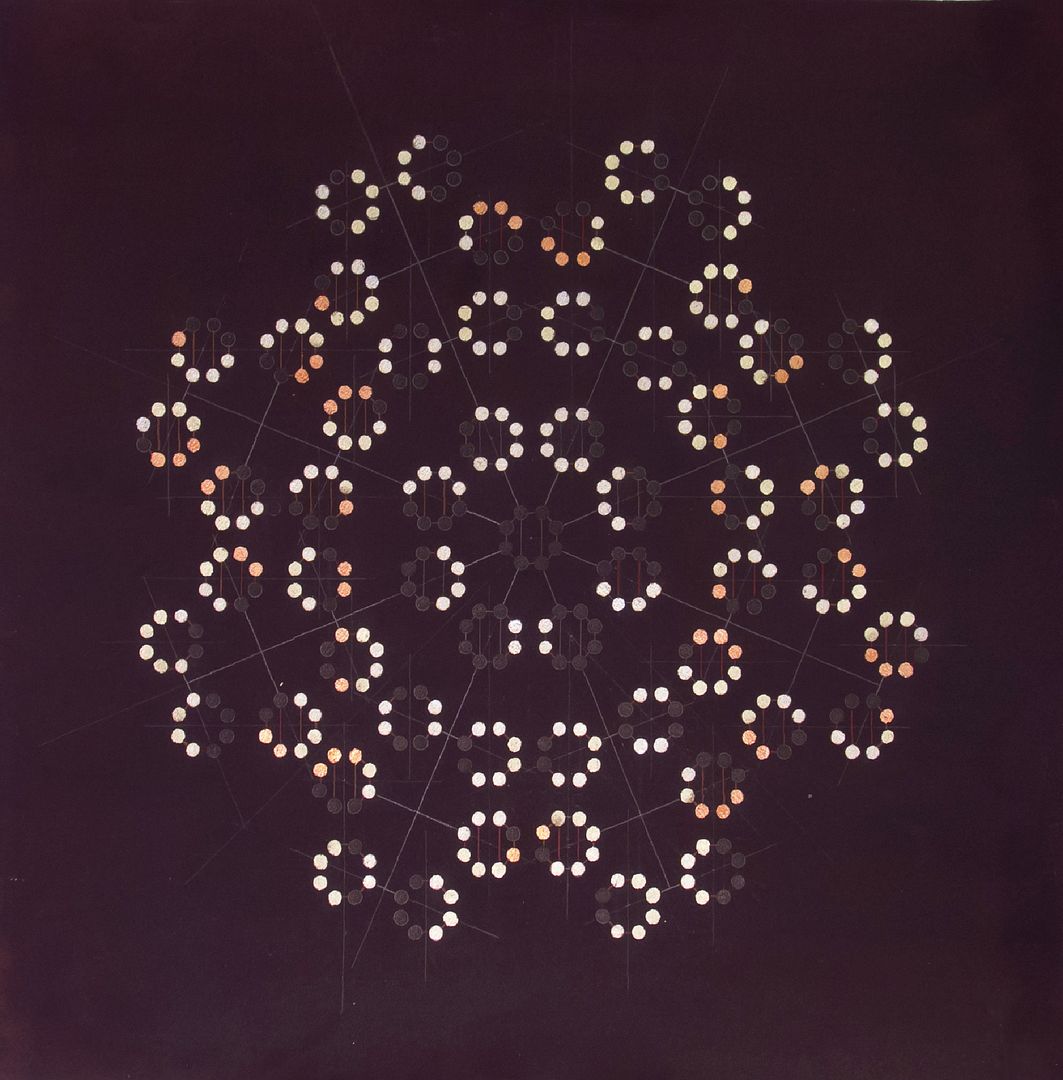 |
| Owen Schuh "Two Folds" 2012 Graphite, gold copper and silver leaf, and sumi ink on paper 32 x 32 inches |
+++++
"Uncharted," a handsome group show of works on paper at Cain Schulte Gallery, "explore[s] the concept of mapping as the visual and conceptual categorization and organization of relationships, systems, and interactions." Remarkably, the works included in "Uncharted" all relate well to one another (rare for a group show with such a broad theme), and the exhibition is compelling both visually and conceptually, but a few artists' contributions stand out.
Owen Schuh's "Two Folds" is an elegant diagram illustrating all of the possible ways a piece of paper can be folded in two. Schuh is a precise craftsman, and his circles and lines add up to a kind of mathematical sublime. Without the aid of the press release, I wouldn't have recognized what it is that Schuh has mapped, but that isn't necessarily a problem. "Two Folds" also works as an arcane design, calling to mind the complicated but specific hierarchies of, say, a Kabbalist. That Schuh has produced an image that is as readily associated with mathematics as it is esoteric mysticism shouldn't surprise; just ask your neighborhood theoretical astrophysicist to discuss notions of beauty.
Tuesday, September 27, 2011
Finding Unicorns
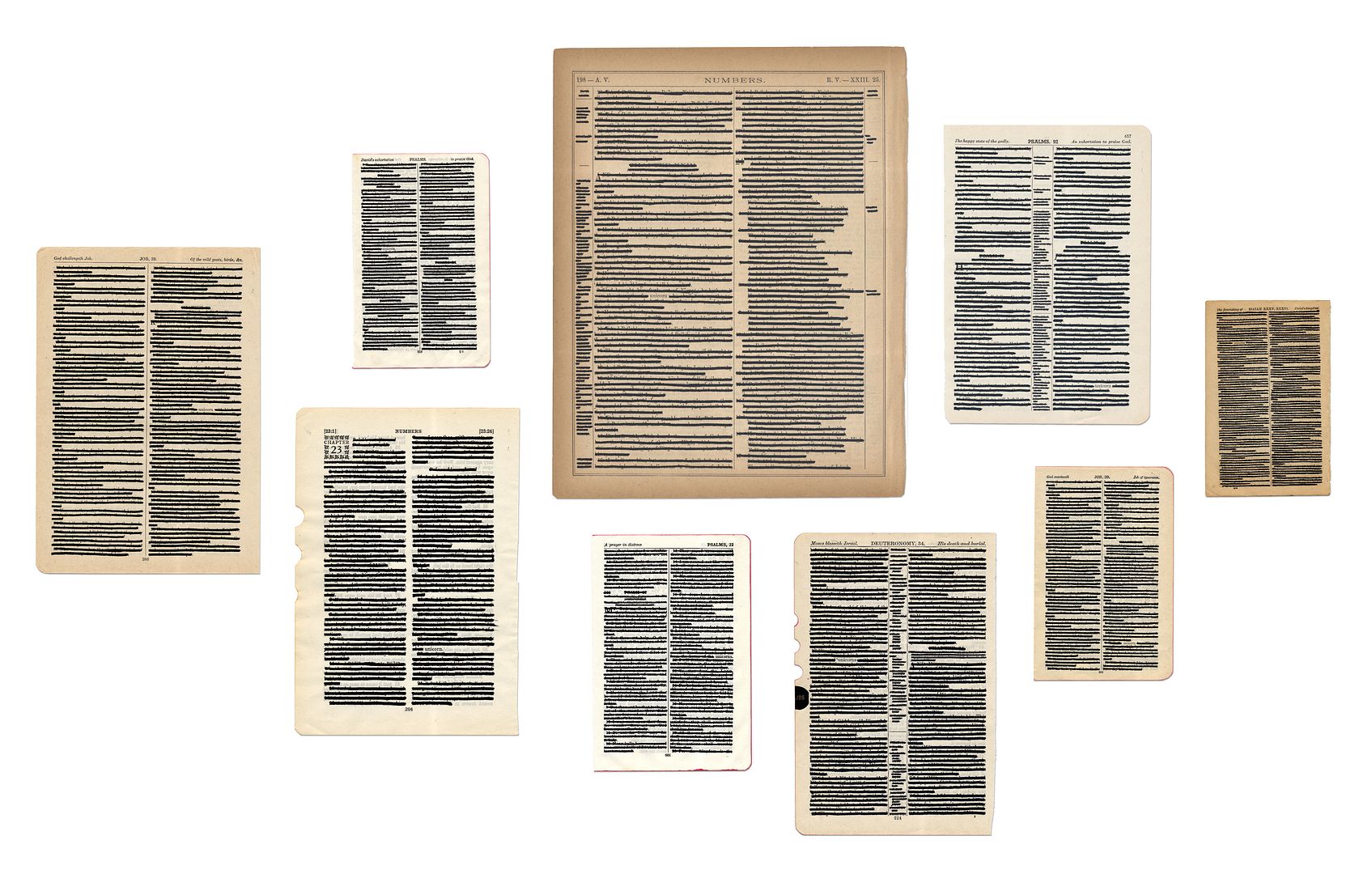
"9 Unicorns"
2011
Individual vintage bible pages
Large, juried shows are usually confused affairs. "Proof," the latest rendition of Southern Exposure's annual "entry-fee free juried exhibition of Northern California artists," is no exception. Of the 47 artworks (by as many artists), 5 pieces stand out: Kelly Falzone Inouye's "Tagging Sequence 1"; Robert Larkin's "Original Art"; Summer Mei Ling Lee's "Les preuves fatiguent la verite"; Kate Nartker's "West Main 1984"; and Someguy's "9 Unicorns."

"9 Unicorns," in particular, provided much to mull over. Someguy displays 9 pages from vintage Bibles; on each of these, all text except for the page heading and the word "unicorn" is blacked out. On his website, the artist states, "it's not commonly known, but the Bible mentions unicorns 9 times." I suspect that Someguy intends his handsomely presented editing job as a winking critique of religious literalism. By highlighting the occurrence of the word, the artist reminds viewers that mythological creatures populate the tome that literalists insist is non-fiction and most U.S. president-elects place their hands upon when they're sworn into office. Little girls notwithstanding, most of us are informed and sensible enough to dismiss unicorns as harmless hokum. Why, then, doesn't an overwhelming majority also view the Abrahamic narrative as an epic myth (i.e., fiction)?
Religious apologists point out that the Hebrew Bible makes no mention of unicorns. Instead, readers will find an ox, auroch, rhinoceros, or bison, depending on the edition. These more mundane creatures are indicated by the ancient Hebrew term re'em. The word was first translated as "unicorn" by the Greeks who, between 250 BCE and 100 CE, crafted the immensely important Septuagint, bringing the Hebrew scriptures to the Western world. Still, lest we too hastily ascribe an elevated rationality to the Jews of antiquity, scholars believe that re'em was not meant to describe an ordinary animal. The oral traditions of the Israelites and early Jews spoke of a powerful, monstrous auroch, a creature of gargantuan proportion, large enough to be mistaken for a mountain. Because they were unfamiliar with this monster bull, it's only sensible that the Greek translators and editors of the Septuagint substituted another fanciful creature, one better known to their audience; enter the unicorn.
Point being, the Bible, no matter the translation, is chock-a-block with fantasy. Most epic stories (and especially those with the staying power to warrant inclusion in a sacred narrative) are tall tales. Fictional or exaggerated narrative often pushes reality out of popular memory. The rhinoceros becomes a unicorn and the large crocodile becomes a dragon in the same way that the angler's fish grows through successive tellings; generations after the big mackerel was caught, it's Leviathan. But knowing how unicorns came to appear in some translations of the Bible doesn't justify easy dismissal of the sacred canon. Even for secular culture, the ancient stories are the closest approximation of universal myths, and they have much to offer readers with a critical bent -- much more, in fact, than they afford literalists.
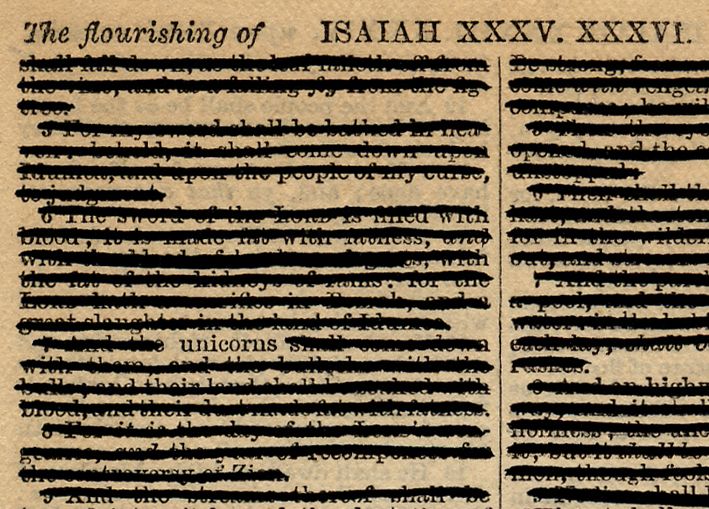
Detail of "9 Unicorns"
2011
Individual vintage bible pages
But "9 Unicorns" isn't just about the relationship between religious texts and fairy tales; it's also a critique of our postmodern malady. Today, technology and globalization expose us to a heretofore unprecedented quantity of information. As a result, it's progressively more difficult to wrest fact from fiction. As the late Senator Daniel Patrick Moynihan quipped, "Everyone is entitled to their own opinions, but not their own facts." Disappointingly, most of us reject Moynihan's gospel, instead opting to go at our texts with a Sharpie, making of them whatever we wish. This willful shirking of intellectual responsibility is amply on display in the fractious debate about the meaning of the United States Constitution and the legacy of our "founding fathers." Benjamin Franklin, one of those very prophets, smartly observed, "so convenient a thing it is to be a reasonable creature, since it enables one to find or make a reason for everything one has a mind to do."

Someguy's "9 Unicorns" evidences our species' taste for selective reading, subjective "truths," and rationalizations. Ever more interconnected, such an unhealthy disposition can become dangerous. Someguy's piece is a visual fable of sorts, cautioning us to master our appetites.

Detail of "9 Unicorns"
2011
Individual vintage bible pages
Image credits: all someguy images, courtesy the artist
Saturday, January 23, 2010
Quantity or Quality?

"Passage"
2009
Acrylic on Panel
24 × 48 inches
"The world we inhabit is not, in this sense, a determinate set of objective processes. It is our larger flesh, a densely intertwined and improvisational tissue of experience. It is a sensitive sphere suspended in the solar wind, a round field of sentience sustained by the relationships between the myriad lives and sensibilities that compose it. We come to know more of this sphere not by detaching ourselves from our felt experience, but by inhabiting our bodily experience all the more richly and wakefully, feeling our way into deeper contact with other experiencing bodies, and hence with the wild, intercorporeal life of the Earth itself.David Abram's essay "The Air Aware" eloquently expands on ideas that I attempt to present succinctly in my artist statement. Brevity is difficult, however, for those of us who are preoccupied with the exciting interchange of anthropology, ecology, ethology, phenomenology, and theology.
[...]
In truth, it’s likely that our solitary sense of inwardness (our experience of an interior mindscape to which we alone have access), is born of the forgetting, or repressing, of a much more ancient interiority that was once our common birthright: the ancestral sense of the surrounding earthly cosmos as the voluminous inside of an immense Body, or Tent, or Temple.
[...]
Experiential qualities once felt to be proper to the surrounding terrain—feeling-tones, moods, the animating spirits-of-place known to reside in particular wetlands and forests—all lost their home with the dissolution of the enclosing, wombish character of the pre-Copernican cosmos. Such qualities now had no place in the surrounding world, itself newly conceived as a set of objects connected by purely external, mechanical relationships: a world of quantities. Unlike quantities, qualities are fluid, mercurial realities arising from the internal, felt relations between beings. Qualities—these ephemeral and fluid powers—require at least a provisional sense of enclosure to hold them. When they could no longer be contained by the visible world (no longer encompassed and held within the curved embrace of the spheres), these ambiguous, ever-shifting qualities quit the open exteriority of the physical surroundings, taking refuge within the new interiority of each person’s 'inner world.' Henceforth they would be construed as merely subjective phenomena."
- David Abram, "The Air Aware", Orion Magazine, September/October 2009
It's interesting, then, that the work of visual artists who explore this conceptual terrain is often quietly awesome. Interesting...and yet so natural.
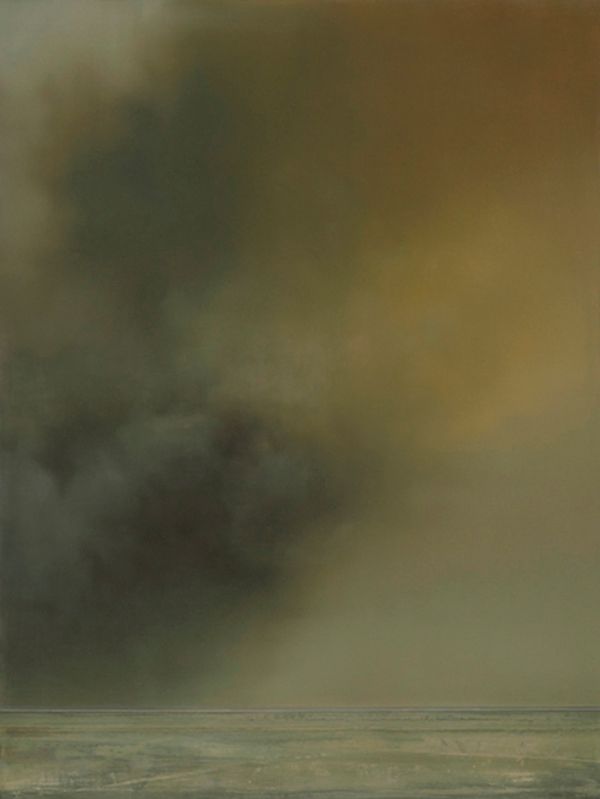
"Whitenoise Suite no.6"
2009
Oil on linen
24 x 18 inches
Image credits: both painting reproductions, courtesy the artists
Friday, August 21, 2009
A Practice of Naming
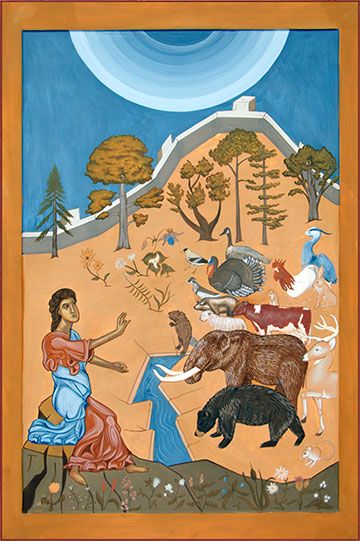
Christopher van Donkelaar
"Adam Naming the Animals"
Handmade pigments and mixed media
2008
"Praise to the first man who wrote down this joy clearly, for we cannot remain in love with what we cannot name."A lover of etymology and taxonomy, one of my most cherished reference books is Arthur Frederick Gotch's Latin Names Explained: A Guide to the Scientific Classification of Reptiles, Birds and Mammals. In it, Gotch catalogs and dissects the scientific names of some 4,000 animal species. That number appears relatively insignificant when we consider that biologists estimate 25,000 species of bird, mammal, and reptile currently exist on Earth, but Gotch's record is so far unparalleled. Each entry provides the animal's common and scientific names, followed by an explication of the Latin and Greek and, sometimes, a blurb about the species' range and habitat.
- Robert Bly
For example, consider Gotch's entry on one of my very favorite North American snake species:
Copperhead Agkistrodon contortrixAlthough the range information suggests that the copperhead is more confined to the southeastern United States than the species and subspecies actually are - they thrive in New York State, for example - Gotch's entry informs readers that the snake commonly called a copperhead is universally and technically named Fish-hook shaped tooth twister or, if you prefer, The Twisting One With Hook Shaped Teeth. Knowledge of this name allows me to appreciate the beautiful reptile from another angle.
agkistrodon (Gr) a fish-hook; odon (Gr) a tooth; a reference to the curved fangs, though of course they are not barbed; contorqueo (L) I twist, turn; contortus (L) full of turns, twisted; contortrix (L) one that is able to turn, twist. Inhabiting the south-eastern part of the USA including Florida. The top of the head is reddish brown.
But what's in a name, really?
Although I'm generally baffled by Biblical literalism, I appreciate the Genesis accounts of creation for their gratifying metaphor. In particular, I'm drawn to rabbinic and Jewish mystics' interpretations of the conjoined, aboriginal narratives. More so than their Christian counterparts, Jewish theologians and mystics endow language and names with ontological significance. The Hebrew alphabet is understood as a powerful code: the written word is creative potential, and the spoken word, procreative. The god of Genesis 1 creates neither with a wave of the hand nor by shaping raw material, but by speaking the world into being; annunciation and incantation are the means of creation. Because of the vocative nature of naming, observant Jews place great value on words and speech. (They are even prohibited utterance of the tetragrammaton, the four-letter Hebrew name of God, transliterated as Yahweh. Appropriately enough, the colloquial name for God is Hashem, or "the word.")
In Genesis 2, the creator god is anthropomorphized and physically involved with creation, shaping man and the other animals from earth. Yet the power of language and names remains significant in this account. God asks Adam, the first naked ape, to name all of the other animal species. That's no mean task, and apparently Adam died before he finished the job. His descendants, at least the taxonomists among them, are still working at the task of naming.
But even those individuals who do not share my affection for taxonomy will find value in a practice of observation and naming. As Carol Kaesuk Yoon writes in her recent New York Times paean to taxonomy, "Reviving the Lost Art of Naming the World,"
"Even when scads of insistent wildlife appear with a flourish right in front of us, and there is such life always — hawks migrating over the parking lot, great colorful moths banging up against the window at night — we barely seem to notice. We are so disconnected from the living world that we can live in the midst of a mass extinction, of the rapid invasion everywhere of new and noxious species, entirely unaware that anything is happening. Happily, changing all this turns out to be easy. Just find an organism, any organism, small, large, gaudy, subtle — anywhere, and they are everywhere — and get a sense of it, its shape, color, size, feel, smell, sound. Give a nod to Professor Franclemont and meditate, luxuriate in its beetle-ness, its daffodility. Then find a name for it. Learn science’s name, one of countless folk names, or make up your own. To do so is to change everything, including yourself. Because once you start noticing organisms, once you have a name for particular beasts, birds and flowers, you can’t help seeing life and the order in it, just where it has always been, all around you."Beautiful. Let's name something.
See also "The Plant Whisperer," another brief HH essay considering similar ideas.
Image credit: van Donkelaar painting ripped from the Nurturing Faith website
Tuesday, July 03, 2007
Gallery Report: June 27, 2007
Part Two : Totemic Art
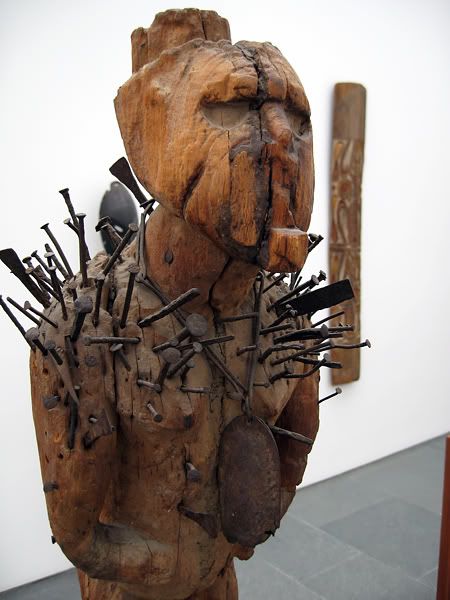
"Power Figure: Nkondi" (detail)
Wood and metal
approx. 24 3/4 x 8 x 8 inches
* * * * *
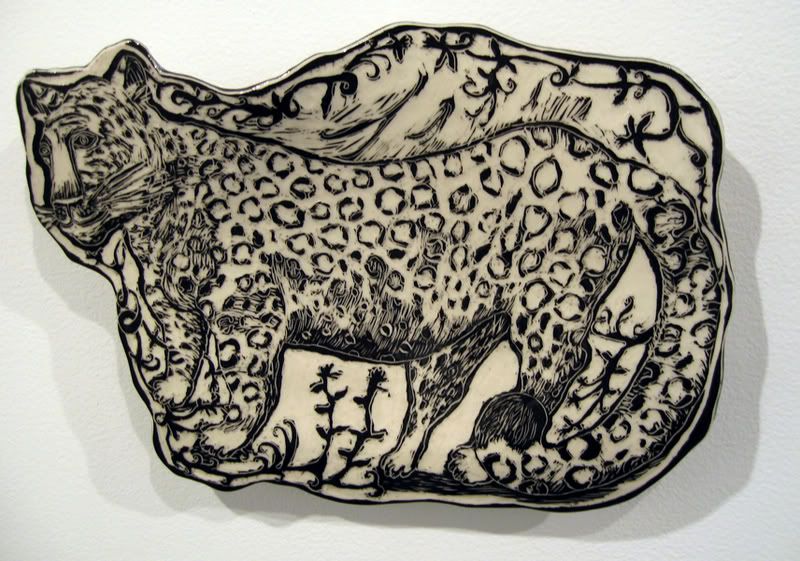
Kate Horne
"The Escape"
2006
Glazed porcelain & mason stain
9 x 12 x 1 inches
RARE: Artist collectives are a curious affair. The creative communion offered by a collective is appealing to many artists, yet so many of us would just as soon close the studio door and be left to our own devices. But that isolationist inclination makes the concept of a collective more valuable, particularly when the group concerns itself with a set of values or ideas, whether abstract or rigidly delineated, rather than some stylistic mode.
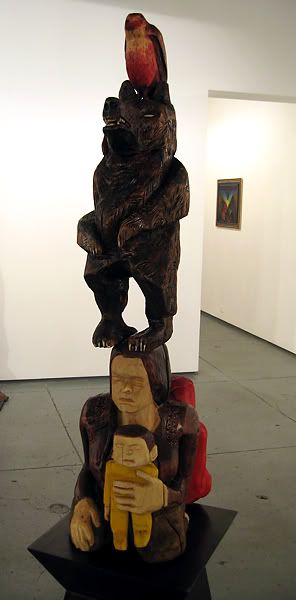
Amie Cunningham
"The Steadfast Warrior (Totem)"
2007
Maple wood, stain
78 x 17 1/2 x 20 inches
The Orchestra does just that. Pat Berran, Amie Cunningham, Candice Hoeflinger, and Kate Horne "[explore] the creation of modern-ray relics with a sensitivity to history, craft, and humans' precarious relationship with nature." An increasing number of young artists, myself among them, are setting up shop in this territory, an unsurprising migration given the complicated, fractured interdependency of modern man and the rest of it. The exemplary pieces in the RARE exhibition, "The Steadfast Warrior (Totem)," by Cunningham, and a series of porcelain relief paintings by Kate Horne, return to a totemic representation of Nature to "search for modern spiritual significance."
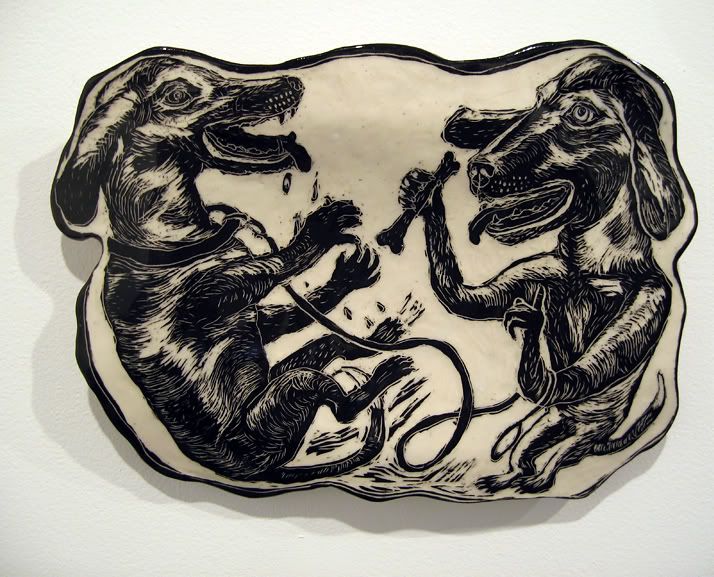
Kate Horne
"No Cookie"
2007
Glazed porcelain & mason stain
9 x 12 1/2 x 1 inches
Several months ago, I wrote about the paintings of Tom Uttech, a painter central to my pantheon. In that essay, I described totemic Nature as "a world of symbol and ecstatic interpretation" borne of sensual experience. That may seem a fanciful description to attach to Cunningham's totem or Horne's plates, but their work seems driven in part by a desire for natural reciprocity, a wanting to be alive as part of the greater weave. So many of us today yearn for this forgotten language, straining to apprehend the words despite our tongue's unfamiliarity. A rural childhood attunes the ear more than one spent in suburbia or the city; as we become an increasingly urban species, will we hear our history or taste our present without technological mediation?
* * * * *
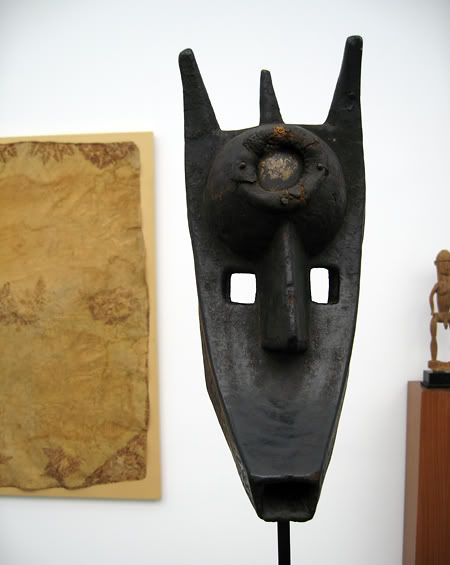
"Bamana, Kore Hyena Mask, Mali, Africa"
Late 19th century
Wood, metal and leather
approx. 17 x 9 x 8 inches
Betty Cuningham: I can not say for sure whether or not the members of The Orchestra spent a lot of time outdoors as youngsters, but the artists responsible for the masks, clubs, statues, daggers, shields, and blankets included in "It's All Spiritual: Art from Tribal Cultures" definitely did. The show's curator, Alan Steele, writes, "The title...reflects the belief that all great art - to some degree or another - has a spiritual component and that nowhere is this seen better than in the tribal arts from remote cultures."
The spiritual component of these works - which, by the way, would be vetted even by the likes of John Dewey, as they are beautiful and utilitarian - removes the need for dressy conceptual underpinning. (Discouragingly, the reverse is also true; an alarming majority of contemporary art is largely short on "spirit." As contemporary humanity's relationship to Nature has become more clouded and distressed, so too has our awareness of the immediate, animating forces been thoroughly abstracted. We are no longer, then, satisfied with what is, and we develop a greater dependency on the theatre of possibility and promises of progress, in turn denying the present and the social body, and so exhibiting more pretense, anxiety, and depression. But this is a whole 'nother can of worms.)
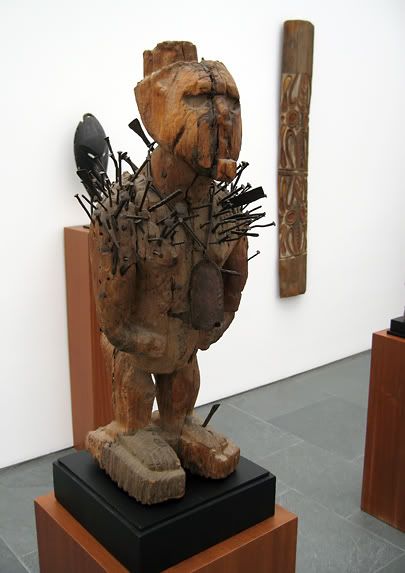
"Power Figure: Nkondi"
Wood and metal
approx. 24 3/4 x 8 x 8 inches
One could argue, however, that the tribal works are conceptual in that they draw on the myths and magical narratives central to each culture, but those narratives are themselves the product of a local hunter-gatherer lifestyle, and the iconography is rooted in direct involvement with the resources and ecosystems from which the materials are drawn. I've long felt that the "primitive" works from the Africa, Oceania, and Americas collection at the Metropolitan Museum of Art are among the most inspiring under that roof. But seen in the context of so impressive and vast a hoard, those objects are most easily read as artifacts, as historical channel markers; the education offered by the museum presentation, while valuable, can distract from direct experience of the work, making it less edifying. This is one reason why we hear so much griping about the museum as mausoleum(1), and why the Betty Cuningham Gallery exhibition, smaller and more random in organization, allows viewers to experience the objects in much the same way they would contemporary works of art. Their vitality and relevance is immediately clear.
"It's All Spiritual" is a hopeful show. On the W train back to Queens I wondered if museums shouldn't start partnering with galleries on a more regular basis. Contemporary artists - indeed, all gallery goers - would be well served by it.

"Human/Prairie Dog Fetish, Southern Plains"
Last quarter of 19th century
Wood, green pigment, brass tacks
approx. 9 1/2 x 5 x 4 inches
* * * * *
Photo credit: all images, Hungry Hyaena
(1) Mausoleum or not, the Met is a true marvel. If you stop and think for a moment about what is housed inside...you gotta pinch yourself. Frankly, I don't spend nearly enough time there.
"Power Figure: Nkondi" (detail)
Wood and metal
approx. 24 3/4 x 8 x 8 inches
Kate Horne
"The Escape"
2006
Glazed porcelain & mason stain
9 x 12 x 1 inches
RARE: Artist collectives are a curious affair. The creative communion offered by a collective is appealing to many artists, yet so many of us would just as soon close the studio door and be left to our own devices. But that isolationist inclination makes the concept of a collective more valuable, particularly when the group concerns itself with a set of values or ideas, whether abstract or rigidly delineated, rather than some stylistic mode.
Amie Cunningham
"The Steadfast Warrior (Totem)"
2007
Maple wood, stain
78 x 17 1/2 x 20 inches
The Orchestra does just that. Pat Berran, Amie Cunningham, Candice Hoeflinger, and Kate Horne "[explore] the creation of modern-ray relics with a sensitivity to history, craft, and humans' precarious relationship with nature." An increasing number of young artists, myself among them, are setting up shop in this territory, an unsurprising migration given the complicated, fractured interdependency of modern man and the rest of it. The exemplary pieces in the RARE exhibition, "The Steadfast Warrior (Totem)," by Cunningham, and a series of porcelain relief paintings by Kate Horne, return to a totemic representation of Nature to "search for modern spiritual significance."
Kate Horne
"No Cookie"
2007
Glazed porcelain & mason stain
9 x 12 1/2 x 1 inches
Several months ago, I wrote about the paintings of Tom Uttech, a painter central to my pantheon. In that essay, I described totemic Nature as "a world of symbol and ecstatic interpretation" borne of sensual experience. That may seem a fanciful description to attach to Cunningham's totem or Horne's plates, but their work seems driven in part by a desire for natural reciprocity, a wanting to be alive as part of the greater weave. So many of us today yearn for this forgotten language, straining to apprehend the words despite our tongue's unfamiliarity. A rural childhood attunes the ear more than one spent in suburbia or the city; as we become an increasingly urban species, will we hear our history or taste our present without technological mediation?
"Bamana, Kore Hyena Mask, Mali, Africa"
Late 19th century
Wood, metal and leather
approx. 17 x 9 x 8 inches
Betty Cuningham: I can not say for sure whether or not the members of The Orchestra spent a lot of time outdoors as youngsters, but the artists responsible for the masks, clubs, statues, daggers, shields, and blankets included in "It's All Spiritual: Art from Tribal Cultures" definitely did. The show's curator, Alan Steele, writes, "The title...reflects the belief that all great art - to some degree or another - has a spiritual component and that nowhere is this seen better than in the tribal arts from remote cultures."
The spiritual component of these works - which, by the way, would be vetted even by the likes of John Dewey, as they are beautiful and utilitarian - removes the need for dressy conceptual underpinning. (Discouragingly, the reverse is also true; an alarming majority of contemporary art is largely short on "spirit." As contemporary humanity's relationship to Nature has become more clouded and distressed, so too has our awareness of the immediate, animating forces been thoroughly abstracted. We are no longer, then, satisfied with what is, and we develop a greater dependency on the theatre of possibility and promises of progress, in turn denying the present and the social body, and so exhibiting more pretense, anxiety, and depression. But this is a whole 'nother can of worms.)
"Power Figure: Nkondi"
Wood and metal
approx. 24 3/4 x 8 x 8 inches
One could argue, however, that the tribal works are conceptual in that they draw on the myths and magical narratives central to each culture, but those narratives are themselves the product of a local hunter-gatherer lifestyle, and the iconography is rooted in direct involvement with the resources and ecosystems from which the materials are drawn. I've long felt that the "primitive" works from the Africa, Oceania, and Americas collection at the Metropolitan Museum of Art are among the most inspiring under that roof. But seen in the context of so impressive and vast a hoard, those objects are most easily read as artifacts, as historical channel markers; the education offered by the museum presentation, while valuable, can distract from direct experience of the work, making it less edifying. This is one reason why we hear so much griping about the museum as mausoleum(1), and why the Betty Cuningham Gallery exhibition, smaller and more random in organization, allows viewers to experience the objects in much the same way they would contemporary works of art. Their vitality and relevance is immediately clear.
"It's All Spiritual" is a hopeful show. On the W train back to Queens I wondered if museums shouldn't start partnering with galleries on a more regular basis. Contemporary artists - indeed, all gallery goers - would be well served by it.
"Human/Prairie Dog Fetish, Southern Plains"
Last quarter of 19th century
Wood, green pigment, brass tacks
approx. 9 1/2 x 5 x 4 inches
Photo credit: all images, Hungry Hyaena
(1) Mausoleum or not, the Met is a true marvel. If you stop and think for a moment about what is housed inside...you gotta pinch yourself. Frankly, I don't spend nearly enough time there.
Saturday, April 29, 2006
Progeny
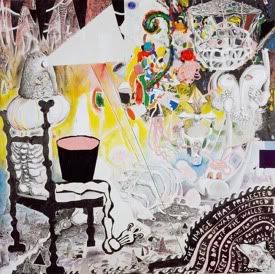
Trenton Doyle Hancock
"Las Luces, Looses, and Losses"
2005
Mixed media on canvas
60 3/4 X 60 3/4 X 4 inches
An inordinate amount of Trenton Doyle Hancock buzz was generated and disseminated this February and March. Hoping the coverage would die down and/or that my recollection of it would dim, I put off a visit to Hancock’s recent solo effort, "In The Blestian Room," at James Cohan Gallery, for as long as I could. Galleries aren't in the business of humoring persnickety calendar demands, however, and I found myself studying Hancock's handiwork with the hoopla still on my mind.(1)

Trenton Doyle Hancock
"In The Blesstian Room"
2005
Mixed media on canvas
90 x 108 x 6 inches
Clearly, I’m a biased viewer, but I found "In The Blestian Room" disappointing. My dissatisfaction is rooted in suspicion of motive, not, as one might assume, in aesthetics. That is to say, while some of Hancock's decisions - attaching studio detritus to the paintings, for example - seem self-conscious, fraught denotations of race, attitude, or spontaneous process, I was more disturbed by the sense that Hancock is dangerously close to becoming an art world personality. That is to say, his work seems calculated, more akin to Warhol than Darger or Dubuffet. Hancock turns his uncouthness into a commodity. As Donald Kuspit writes, "The artist outsider is well rewarded in our society - so long as he is an insider in art society."(2)
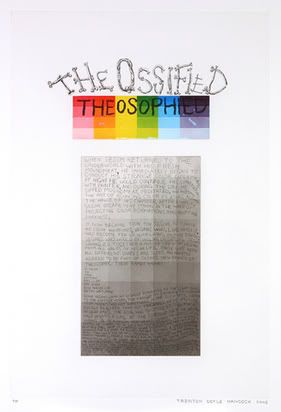
Trenton Doyle Hancock
“The Ossified Theosophied, (Title Page)”
2005
Color etching, Edition of 35
19 1/2 X 25 inches
Hancock's use of narrative scaffolding seems more like a marketing tactic than an essential ingredient in the artist's process. While it is not uncommon for contemporary artists to invent a cosmology on which to base a body of work - Matthew Ritchie is a notable example - most keep the details of their created worlds largely private. Hancock, by contrast, not only cooked up the Mounds saga, a picaresque epic with vaguely religious resonance, he also makes sure viewers know about it. “In The Blestian Room” includes a limited edition print (see above) that amounts to little more than a sloppy, hand-written chapter of the chronicle. Hancock is making up the story as he goes along – this, at least, is how it is presented to the viewer – giving it the appeal of a zany soap opera. (What is Sesom up to now? Come find out! What will he get into next? What crazy characters will he meet tomorrow? Will we witness a great war between the Mounds and the Vegans? You'll have to wait until the next installment/exhibition! Don’t miss it, ‘cuz the art world doesn’t do Tivo!)
Before I continue, it should be noted that I cheer for those making art away from established cultural centers; I enjoy comic books, graphic novels, and cartoons(3); I hold dear much fantasy and myth, from Kipling's "Just So Stories" and Aesop's Fables to The Lord of the Rings; I am fascinated by religious narrative and the clever weaving of historical "fact" with spiritual rendering in such tellings. Given this laundry list of likes, I expected to find a confederate in James Cohan Gallery. What I discovered instead was calculation.
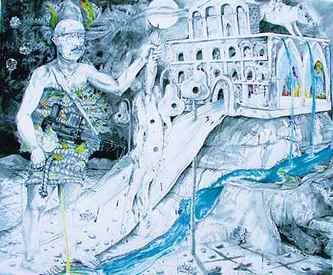
Lee Baxter Davis
"Family Tree"
2005
Ink, watercolor & collage
36 x 44 inches
What's more, Hancock’s still unrecognized debt to the artist who spawned him, Lee Baxter Davis, raises eyebrows. If I were not already an admirer of Davis, I very much doubt I would know of their relationship. The CUE Art Foundation recently exhibited about twenty of Davis’s drawings and paintings. Long overdue, the show was the artist’s first in New York. Early in the associated press release, the writer draws attention to Davis' influential role.
“A regional icon, Davis’ thirty-years of teaching printmaking and drawing at East Texas State University (now called Texas A & M, Commerce) has influenced the careers of some of his very prized students including exhibition curator, Gary Panter, along with Whitney Biennial artists Trenton Doyle Hancock, Robyn O’Neil, and Christian Schumann, among others.”An Internet search for “Lee Baxter Davis” turns up little, whereas “Trenton Doyle Hancock” nets many relevant articles and websites. In pieces about Hancock, the names William Blake, Hieronymus Bosch, Philip Guston, Max Ernst, and Gary Panter are repeatedly cited as influences, but Davis is nowhere credited. This is a curious oversight, the result of Davis' being a relative unknown in the New York art world. Closer to home - his home - he looms large.
"In the 1970s, The Lizard Cult was a vaguely derogatory term applied to East Texas State University (as it was known then)'s Art Professor Lee Baxter Davis and many of his most talented students. It was called that because so much of their work closely approximated his - rife with comic sensibility, lush textures and lurid details....Once viewed with condescension, The Lizard Cult has not only grown up, many of Davis' students have prospered and become regionally and nationally prominent." (J R Compton, "Lee Baxter Davis and The Lizard Cult Grows Up," Dallas Arts Review)With the exception of Gary Panter, Davis' celebrated proteges are all much younger (by thirty or more years, typically) and, therefore, more attractive (for the moment) to the youth-obsessed art market. Furthermore, whereas Davis is a retired art professor now working as an assistant pastor of St. William the Confessor Catholic Church in Greenville, Texas, his former students manage to bridge the divide between "living and working" in Texas and, well, living in Texas. In other words, though Hancock and O'Neil still live in the state (Paris and Houston, respectively), they have attached themselves to the larger art world in a way that Davis has not. Why, one wonders, have so many of Davis' students achieved art world success while he remains a regional icon? In part, the answer lies with the man himself, with a desire to remain unrecognized, but I can't shake the sense that a more perverse process is also at work.
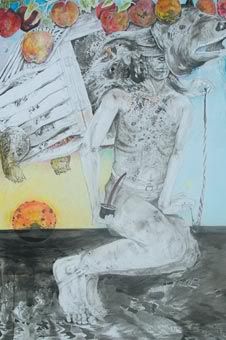
Lee Baxter Davis
"Big Bear"
2005
Pen, ink, watercolor & collage
21" x 29 inches
In his recent indictment of postmodern art, The End of Art, Kuspit describes two artist archetypes. The first is a "reclusive alchemist struggling to purify the dross of everyday reality," and the second, an "entertainer representing a mass audience's everyday wishes." Although Kuspit argues that the monkish model is exclusively modern and, today, extinct, this is not the case; both are alive and well. As a general rule, however, it is the second type, those interested in "having an audience that will make them popular, giving them the celebrity and charisma they believe they are entitled to as artists," that finds success in the art world.
Lee Baxter Davis is the very picture of Kuspit's reclusive alchemist. Not only are his paintings alchemical, but his lifestyle and approach to art-making fit the bill, too.
"Like a hermit practicing his art in millennia past, Davis is isolated. He has chosen to separate himself from society, locating his studio, home and family life far from the hustle and bustle of Dallas, Houston, San Antonio, or Austin. Davis finds peace and purity of existence in the quietude of a rural existence. Instead of reaping and sowing the land for its hearty edibles, he reaps and sows the earth for intellectual nourishment. It is a type of sustenance that could only come from the coupling of separation and deliberation - from self-willed banishment to the silent wilds of a life found deep in the nowhere lands of Texas." (Charissa N. Terranova, "Alchemist of Imagination," ARTL!ES, Issue 43)Furthermore, Davis is as invested in (or consumed by) his contemplation of philosophy, religion, and pop culture as he is the local environment.
"Growing up in the small towns of Texas, Davis' boyish pursuits included immersing himself within the complex sagas told by great Southern writers, the harrowing poems of Edgar Allen Poe, and a dizzying array of post WWII popular comic books and newspaper strips such as BlackHawk, Pogo Possum, and Mad Magazine. Largely raised by his Methodist minister grandfather, and having read the bible since childhood, Davis has long harbored a deep-rooted fascination with the more mysterious elements of faith...Believing laughter and prayer to be close to the same thing, he creates illusions whose idiosyncrasies harbor nervous fits of laughter as buffers against existential angst."(Gary Panter, "Lee Baxter Davis," CUE Art Foundation press release)
Davis' layered pastiche is, for him, a metaphysical search, one that ties vulgar realities to marvelous visions, the profane to the sacred. Viewers - western viewers, in particular - will recognize many of the embedded symbols, but they must interpret the work subjectively, nurturing their own hybrid narrative. Thus, something approaching the intrinsic alchemy of the making - Davis' journey - is experienced by the viewer. To an extent this is true of all visual art, but Davis' symbolic content elevates the exchange.
Hancock's Mounds fiction, on the other hand, is altogether different. Viewers must learn about the Mounds before the narrative becomes meaningful. We are given a choice: disregard the mythology and treat the work as illustrative reverie, or become an initiate of Hancock, learning the magic words, the symbols, and the gestures. In essence, Hancock offers viewers a cult of personality. Davis allows us a subjective experience by drawing on shared myth; Hancock gives us an opportunity to participate in his manufactured, flimsy one.
Yet the son has surpassed the father, at least in terms of renown. Hancock is more savvy than Davis. Whether by virtue of his nature or the waving of an agent's wand, he presents us with the "high art" version of an "outsider"/low-brow aesthetic. His awareness of the supposed division between these two orbits is clear. For many, this makes the work more easy to digest, but also more intelligent and contemporary. For others, myself included, that awareness results in self-conscious painting, work that excels at distraction and affirmation, but fails to address universal experience. Many critics (many friends) disagree, arguing that Hancock melds rich narrative, magic, superstition, faith, and popular culture to produce an original experience, a distinct and contemporary remix. But the father's artwork suggests that same union is less an artistic assertion of individuality than a way of life, an approach allowing us to cope with and consider deeply disturbing axioms.
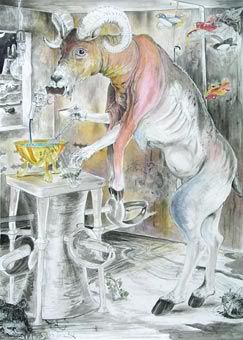
Lee Baxter Davis
"Sideshow"
2005
Pen, ink & collage
28" x 20 inches
(1) Museum exhibitions have a longer lifespan, allowing the details of the 2006 Whitney Biennial coverage, for example, to fade before I finally visit (in late May).
(2) Donald Kuspit, The End of Art, Cambridge University Press, 2004
(3) In fact, I feel Hancock is better served when he sticks to comics - there were some strong pages on display in the rear gallery - and the like. His book, "Me A Mound," is a far more interesting artifact that his paintings or prints, though it, too, suffers for a certain amount of ostentation.
Photo credits: All images ripped from James Cohan Gallery and CUE Art Foundation websites
Wednesday, November 16, 2005
Imagined Worlds
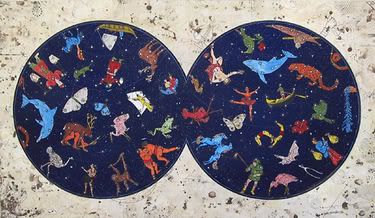
"My Heavens!"
2004
Twelve-color lithograph with silver mylar and collage on Amate paper
30 x 51 inches
This past Saturday I visited AXA Gallery, a pleasant exhibition space affiliated with AXA Financial, Inc. Judging by the company's profile (they specialize in "wealth management"), one might assume that AXA gallery exhibitions would be dull and uninspired. Not so. "Imagined Worlds: Willful Invention and the Printed Image, 1470 - 2005," a joint venture between AXA and the International Print Center New York, is a treat.
I'm biased, however; a number of adored artists are included in the show's all-star lineup. Among my personal favorites are Jane Hammond, Tsukioka Yoshitoshi, and Hendrick Goltzius, but works by William Blake, Albrecht Durer, and Pieter Van Der Heyden (after Pieter Bruegel the Elder, as most of his prints are) also stand out. (What a thrill for Hammond to be included in this company!)
The press release describes the exhibition as follows:
"Imagined Worlds...comprises fine art prints, books, and maps from many cultures, spanning five hundred years. Included are images of remote places and imaginary realms, real and fictional scientific investigations, and serious and comic inventions. What each work has in common is that it was created from an unknown, partially known, or completely unseen subject. Whether based on direct observation or pure fantasy, these prints illustrate the power of imagination and subjectivity in the creation and interpretation of images."Fantasy and "imagined worlds" are en vogue in the contemporary art world, particularly among younger, "emerging" artists. Somewhat reluctantly, I include myself in this camp, and the AXA exhibition is a must-see for those of us producing work that deals with invented cosmologies. To elaborate, I've excerpted some of my own thoughts from an older Hungry Hyaena post, "Of Fairy Tales and Flights of Fancy."
"It is with increasing urgency [...] that I view so much contemporary art produced by my contemporaries [...] in their twenties and thirties. An uncredited New Yorker review writer describes this work as, 'gloomy, craft-spun, fairy-tale escapism endemic among young...artists.' A visit to "Greater New York, 2005," a survey of artists living or working in New York City at P.S.1, will illustrate just how prevalent this mode has become. [Much] of the work on display fills the bill, and while the majority of these are paintings or drawings, a number of videos and installations belong to the same impetus. We are a generation uncertain and intimidated. Rather than engage and participate, we have opted to wear the escapist smile, retreating into the worlds of Alice and the Little Prince. Is it enough to express ourselves in this way? Do these cryptic fairy-tales or self-abusive efforts communicate anything more than immediate frustration? After all, it was largely my [childhood] social incompetence which drove me to chase monsters around dark living rooms. How [...] different is this display?"What distinguishes the work on display in AXA's "Imagined Worlds" from most of the artwork at P.S.1 is the artists' knowledge of history and mythology, which is conspicuous in all included works (with a very few exceptions). For example, the works of Goltzius and Blake are grounded in shared, substantial narratives, even if they interpret the tales differently. Most contemporary fairy-tale artworks, on the other hand, are comprised of disparate, personal symbols; these are carelessly collaged onto a flimsy narrative armature, be it social, political, scientific or religious. iCulture is our zeitgeist and it's unsurprising, then, that young artists elect to celebrate themselves rather than addressing more wide-reaching social narratives. This should give us pause. The armatures need to be reinforced and the classical (maybe "established" is the better word here?) narratives on display at AXA are a terrific inspiration.
Jane Hammond's "My Heavens!" was a pleasant surprise. I was already familiar with Hammond's paintings but I knew little of her ongoing collage series. Those collages that I had seen were not particularly memorable, but after being impressed with "My Heavens!" I did some Googling and discovered a number of beautiful pieces by Ms. Hammond. I am enamored of the system of limitations she has set for herself and I covet many of works in the series.
Tsukioka Yoshitoshi, who lived from 1839 - 1892, was one of the last great ukiyo-e printmakers. He is renowned for his weak constitution - he was prone to debilitating depression - and violent imagery as much as he is for his outstanding craft. Contemporary graphic designers (not to mention artists at large) can learn a lot from the Japanese master's command of composition and color.
Though "The Lucky Tea Pot of Morin Temple" was not included in "Imagined Worlds," I showcase it because the principal player is a tanuki, a Japanese character/animal that I find especially curious.
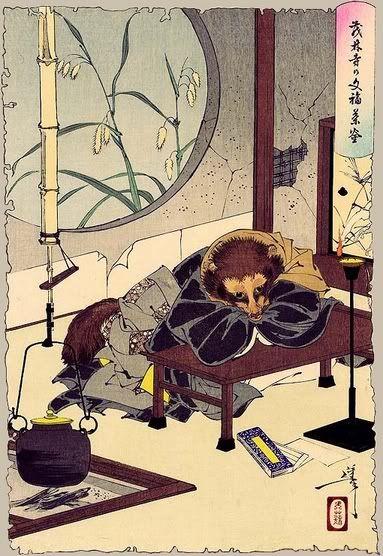
"The Lucky Tea Pot of Morin Temple"
1889-1892
Although Hendrick Goltzius' imagery is not as exciting as that of Hieronymus Bosch or Bruegel the Elder, two of his regional predecessors, his handling is exquisite, particularly in his engravings. His paintings are also impressive, though they are too often dismissed by art historians as second-rate.
I can't recommend the exhibition enough. Go check it out if you can.
Photo credits: "My Heavens!" ripped from Jane Hammond's website; "The Lucky Tea Pot of Morin Temple" ripped from SinisterDesigns.com
Tuesday, November 15, 2005
Thank G-d for the Dalai Lama

Once in a long while, I describe myself in a way that reveals an aspect of my personality or ideology that I had not before acknowledged. This past Saturday, I explained my fascination with biology (and in a more general sense, all the sciences) to a friend as we viewed the excellent "Imagined Worlds" exhibition, at AXA Gallery (more on this terrific show in an upcoming post).
"If not for the painting monkey on my back," I said. "I'd be very happy to work as a field biologist. I think my love of the sciences is, in large part, rooted in a lack of faith in objective scientific truth." Wait! What? I've never framed the idea in that way, but that's exactly right! My love of science is that of the skeptic; my faith is provisional. How bizarre!?
I'm sometimes mischaracterized, even by friends, as a dogmatic champion of science over all other truths or cosmologies. I believe they label me thus for three reasons.
1) I reject the primitive notions of an interventionist sky-god and deny the singular "truth" claims of any religion.
2) I am particularly excited by evolutionary theory.
3) I am a stickler for taxonomic nomenclature.
If considering only these three qualities, I, too, might assume that we're talking about a hardcore bio geek, an individual unwilling to consider "alternative" explanations or allow magic into his or her world view. But I have other interests that provide me counterpoise. Obviously, the visual arts are very important to me, but theology, philosophy, and ethics are among my favorite subjects.
Stacked on my nightstand this month are the following books: The Larousse Encyclopedia of Myth; Bulfinch's Mythology; John Ruskin's On Art and Life; C.S. Lewis's The Discarded Image, an exploration of medieval cosmological transitions; Ernst Mayr's What Evolution Is; and Frans De Waal's Our Inner Ape. As I see it, these books on mythology, aesthetics, theology, history, and evolutionary inheritance are all intimately related. A back-and-forth reading of such texts allows me to cobble together my own cosmology.
For example, I accept that the fundamental elements produced by the Big Bang were hydrogen and helium, but I also conceive of the two primordial elements as Erebus and Nox, the Greek gods begotten by Father Chaos. When these two gods mated, Nox gave birth to a son named Aether, among other offspring. Aether is the personification of the heavens, of the "upper sky," and is therefore synonymous with the celestial elements that formed in the swirl of early space-time. Similarly, I embrace the mystical Jewish conception of the universe's origins, the creation of "Without End" (Ein Sof) from "Nothing" (Ayin, or the cosmic seed), both states of a piece with G-d's supreme body.
Given my penchant for hybrid science-myth cosmologies, I was pleased to read this short statement by Tenzin Gyatso, the 14th and current Dalai Lama, in The New York Times. I recommend reading the whole piece, but I've included some highlights below.
"If science proves some belief of Buddhism wrong, then Buddhism will have to change. In my view, science and Buddhism share a search for the truth and for understanding reality. By learning from science about aspects of reality where its understanding may be more advanced, I believe that Buddhism enriches its own world view.Thank goodness for the Dalai Lama's common sense! How I wish the pious folks in Vatican City would issue a statement such as this. And what of Judaism's Orthodox Union? The conservative Muslim clerics? Where are their voices?
[...] While I agree that certain religious concepts conflict with scientific facts and principles, I also feel that people from both worlds can have an intelligent discussion, one that has the power ultimately to generate a deeper understanding of challenges we face together in our interconnected world.
[...] By invoking fundamental ethical principles, I am not advocating a fusion of religious ethics and scientific inquiry. Rather, I am speaking of what I call "secular ethics," which embrace the principles we share as human beings: compassion, tolerance, consideration of others, the responsible use of knowledge and power. These principles transcend the barriers between religious believers and nonbelievers; they belong not to one faith, but to all faiths."
Surprisingly, I see our nation's evangelical Christians offering some signs of hope. Richard Cizik, Vice President of the National Association of Evangelicals, can strive for some forward progress in the grey realm where science and theology overlap, even though groups such as the NAE usually worry me.
Photo credit: ripped from Centre For The Mind website
Wednesday, October 05, 2005
Selling Atheism and Myth
When transferring from the A/C/E subway line to the N/R/W at 42nd Street in Manhattan, passengers must walk down a long, underground tunnel. If they happen to look up at the tunnel's low ceiling, they'll notice three or four word excerpts on signs mounted to the ceiling reinforcements. If one reads the signs as he walks the length of the tunnel, he'll realize that each sign is a "piece" of a poem. The subject matter is mundane, literally, and the poem rather bleak. In short, the uncredited writer asks why we wake and go to work, day after day, our lives spiritually empty and dull. In the context of the smelly, humid subway tunnel, crowded with commuters, the poem resonates.
This past Saturday afternoon, as I made the E to W transfer, a group of teenage girls walked just behind me. Half listening to their conversation, I realized they were discussing the poem. They mocked it. "It's so stupid," one of them giggled. "What the fuck? I mean...," another girl trailed off. To some extent, I can sympathize with their reaction; the poem doesn't convey the most original sentiment. "You know what I don't get?," said a third girl. "What's it even advertising?"
Oh...my...God.
What is it advertising?! What is this MTA commissioned public poetry advertising?! Burma Shave, this ain't, babe.
I should know better than to be surprised. These girls, roughly seventeen years of age, are plugged into consumer culture. Theirs is the generation of the spectacle and the billboard. They were thirteen when the World Trade Center fell (on television, again and again and again) and they represented America's youngest consumer demographic, parental parasites, during the economic bubble of the late nineties. The third girl's question is, from their perspective, a fair one. Why isn't this poem an advertisement?
I didn't know whether to laugh or shudder. I slipped into a brooding mood. These are dark times, I thought.
But it's not enough to criticize, break down, and dismiss. Even constructive criticism, that much celebrated will-o-the-wisp, which can be invaluable to the artist, politician, and athlete, provides little reward for the critic himself. He may be able to pinpoint a conceptual contradiction, a fatal weakness in policy, or an unfortunate quirk in form, but how useful is his ability to notice the negative? Is the critic able to turn his judgment inward to correct his own failings?
I enjoy reading good criticism, be it social, literary, or aesthetic, but even the most capable wordsmiths can't make criticism complete unless they prescribe some balm. A batter who has fallen into a slump will not be helped by a coach who only cites what the batter does wrong. The good coach - the complete coach - recognizes the failing and attempts to correct it, explaining to his player not just what is wrong, but also what might work.
Incomplete though most criticism may be, negative noise must be made before there exists any serious striving for improvement. I regularly talk with people who share my sense of disillusionment and betrayal. I see folks shake their heads when reading the day's newspaper headlines and I often hear folks complaining about the administration or about the passing of a particular bill, but our overall complacency is noteworthy. There is some noise being made, of course, but the majority of protests lack focus - people shout 'No blood for oil!' while wearing PETA sweatshirts - and the political plays made by those brave politicians - republicans, in the traditional sense of the word - resisting the red tide are far too esoteric for most of America to rally behind. (Thoughtful, politically savvy bloggers may seem ubiquitous, but they remain a tiny fraction of the general populace.)
Why are we so quiet? Has the barrage of bad news made toadies of us all? When I do get worked up about the "general state of things," I feel as though my outrage is excessive. Perhaps vehement rants about the current administration are considered passe, but does this make them any less vital? Is resistance possible in the current culture of distraction and fear? What does it take to reach "every man" in the era of spectacle?
Ronald Aronson has a good review in the most recent Bookforum, entitled, "Faith No More? Against the Rising Tide of Rejuvenated Religion, A Number of Writers Make the Case for Disbelief." In it, he suggests our contemporary apathy results from the unrealized promises of a better future.
"It's safe to say that the future didn't turn out as anyone expected. Scientific and technological progress has been relentless, but its promises of liberation have gone flat. Few still believe that their children's world will be better than theirs. We live after Marxism, after progress, after the Holocaust - and few imaginations are stirred, few hopes raised by our world's long-range tendencies. Indeed, the opposite is happening as terrorism becomes the West's main preoccupation. In countries like the United States, Britain, and France, there has been a turning away from improving societies and toward improving the self."Aronson, reviewing seven recent books dealing with the decline of atheism, convincingly argues that the return to God and otherworldly authority figures increases the power of those who already hold the reins, and therefore represents a weakening of The Republic, a collapse of democratic ideals. Near the end of his piece, he writes,
"The rational and constantly self-questioning and self-correcting world view is essential to democracy and its ongoing public discussion about everything under the sun. Those disasters of history not explicitly tied to religion in fact still reflect starting points of authority and unquestionable dogma. Democracy, after all, is congruent with freedom, which is in turn congruent with the world view that presupposes little and questions everything. 'Democracy proceeds by one set of principles. Religion by the opposite.' Atheism is 'one of the natural allies' of democratic societies."As an atheist, I agree with Aronson and the writers of most of the books he reviews. (To feel as I do, you must believe that moral living is better served by non-believers who recognize that an ethical core is "part of the furniture of the universe," as Plato put it. Moral acts or laws - the Ten Commandments, for example - designed to ingratiate a believer to their respective God or gods are necessarily less virtuous and, above all, self-serving.) However, Aronson needs to ask himself why so many atheists are content to revile religion without offering a thoughtful alternative. Such alternatives do exist, but atheists have a hard time making them attractive to the majority because the absence of an afterlife is too troubling for most people to accept. Unhappy in their own narrative, disappointed by the once promising future, they place their trust in a different sort of "future," an altogether supernatural one.
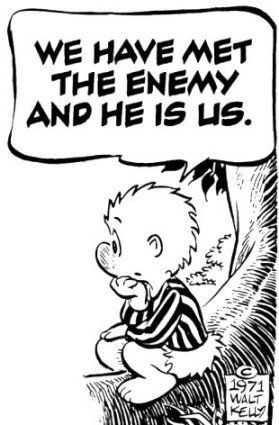
The recent surge in popular interest in aliens, ghosts, supernatural storms, elementals, and any number of other vaguely mystical beings - check the local TV listings if you don't know what I'm referring to - is proof enough that we are a culture living in fear of ourselves. As Pogo, Walt Kelly's philosophical cartoon opossum, said decades ago, "We have met the enemy and he is us." Aronson, trying to salvage some sense of hope, concludes his review with a recipe for a happy, secular society.
"A new atheism must absorb the experience of the twentieth century and the issues of the twenty-first. It must answer questions about living without God, face issues concerning forces beyond our control as well as our own responsibility, find a satisfying way of thinking about what we may know and what we cannot know, affirm a secular basis for morality, point to ways of coming to terms with death, and explore what hope might mean today."Given the current climate, accomplishment of the goals set forth by Aronson seems highly unlikely at the societal level, though it remains possible for individuals. More importantly, listing what must be done without addressing how it can be done is, like negative criticism, altogether easy and almost pointless.
Underlying the fear and the increasingly fascist feel of the United States is an absence of myth. This is not new. Mark Rothko, the twentieth century painter, wrote extensively on our search for a "master narrative." He was convinced that the loss of myth, so much a part of the Middle Ages and the Renaissance, was responsible for the violence and break-down that led to both World Wars. Though Rothko glossed over some of the more repugnant realities of both these eras - and ugly they could be - the loss of myth, of a central story and purpose - did contribute to what so many have deemed the "decline of Western civilization." Religious fundamentalists argue that this decline occurred as a result of loosening morals and a "turning away" from god worship, but the corruption and violence of the first half of the twentieth century is more accurately moored to the industrial revolution and the myriad temptations of free-market capitalism, both of which forced societies to become more focused on the individual good. I agree with Rothko; a myth is needed where a god is not. Star Wars is a myth - this is only true of the first trilogy, before Lucas introduced the idea of genetic superiority via metachlorion count - and so is The Lord of the Rings. Both sagas weave together the universal myths, those elements that can be found in all theology and everyday life, to create timeless narratives of self-worth and social obligation, reminding us that the little man can make a difference and that good can and will triumph over evil, but not without a lot of heart and courage. The philosophical problems with the concept of "good" and "evil" aside - postmodernism and relativism must take a back seat here - myths rarely grant power to a very few and, when this does occur, the powerful are inevitably overthrown and made examples of.
Without livable myths, most of us turn to the Abrahamic God, abandoning mythical narrative to the realms of science fiction and fantasy. But that god, at least as it is usually conceived of, is a pale shadow of myth for "He" is without practice, only ritual and faith. Faith is a virtue, but it is too easily coopted and dubbed loyalty. Scared by the world we inhabit, we turn to television in the hopes of being frightened further by spectres, aliens, and possessed girls. Dissatisfied with our "little" lives, we celebrate garish displays of wealth, influence, and sexuality, turning all three into absurd caricatures of themselves - reducing them in the process, which ultimately makes them that much more easily abused. But wait! There exists a narrative we can all identify with, a truth all contemporary Americans can rally behind.
"Overworked
So Tired.
If Late
Get Fired.
Why Bother?
Why the Pain?
Just Go Home
Do It Again."
But I don't get it. What's it selling?
Photo credit: 1971, Walt Kelly, "Pogo"
Wednesday, June 15, 2005
Journal Scraps: Punk Wigs and Prom Dresses

"Those who think that the world of today is more gentle and graceful than the primeval and predatory passions from which [the great] myths spring are either not aware of reality or do not wish to see it in art."
- Adolph Gottlieb and Mark Rothko in a statement attempting to explain abstract expressionism, June 7, 1943
+++
"The more modern and technological we become - the more our lives become a mechanized routine against instinct - the more the most instinctual forces within us rebel. And in those places that fail to compete technologically, many young men may become ancient warriors, raping and pillaging and wearing tribal insignia rather than uniforms..."
- Robert D. Kaplan, "The Return of Ancient Times"
+++
"My casual routine ended on the fourth day, when Lendu warriors first appeared on the streets. I saw them walking down Lumumba Boulevard with a sickening swagger, drinking beer outside the gates of the Hotel Musafira and getting stoned on the milky potions contained in ampoules that dangled from their bandoliers. They carried taped-up Kalashnikovs across their shoulders and slid their fingers across their throats as they passed young Hema girls. Some wore clear-plastic masks on their faces, sequined prom dresses that glittered in the sun, and punked-out yellow wigs on their heads.
Little by little, they took a piece of Bunia each time the sun went down. After it was all over, they would own a small piece of everyone who had been there, or leave what they had taken on the boulevard to rot in the equatorial sun. They had taken a piece of my interpreter, Johnny, when they murdered his father two years ago; they shot him in the back as he tried to run away during a raid north of town. His body had lain in the street for three days while Johnny hid in the bush."
- Bryan Mealer, "In the Valley of the Gun: A Massacre Unfolds in Eastern Congo"

Photo credit: "The Porcelain War Museum Project," guns made of porcelain by artist Charles Krafft; UPC child soldier in Bunia, Congo; Karel Prinsloo, AP (Ostensibly, the UPC fights against the Lendu and protects the Hema, but as with so many other ethnic battles, boundaries are blurred; everyone seems to kill everyone else.)
Subscribe to:
Posts (Atom)