
Showing posts with label generalism. Show all posts
Showing posts with label generalism. Show all posts
Tuesday, March 05, 2013
Help Make BAASICS.3: The Deep End Possible
In 2011, I co-founded BAASICS (Bay Area Art & Science Interdisciplinary Collaborative Sessions), a series of San Francisco-based evening programs that brings together artists, scientists, and interdisciplinary thinkers to present engaging multi-media lectures and performances. Each BAASICS program is built around a particular theme, with participants given the green light to express their brilliance and share their passions in ways that don't always involve a Powerpoint presentation and a microphone. All BAASICS programs are free and open to the public on a first-come, first-served basis. We aim to make the contemporary arts and sciences more accessible and less esoteric, thereby inspiring guests to think about how the two spheres relate to one another and to society at large. To date, we've put on two successful programs, BAASICS.1: A Live Animal (July 2011) and BAASICS.2: The Future (June 2012). Our third program, BAASICS.3: The Deep End, will take place at the ODC Theater on May 6, 2013.

Thursday, February 16, 2012
"Unreliable Narrator": Ward Shelley at Pierogi
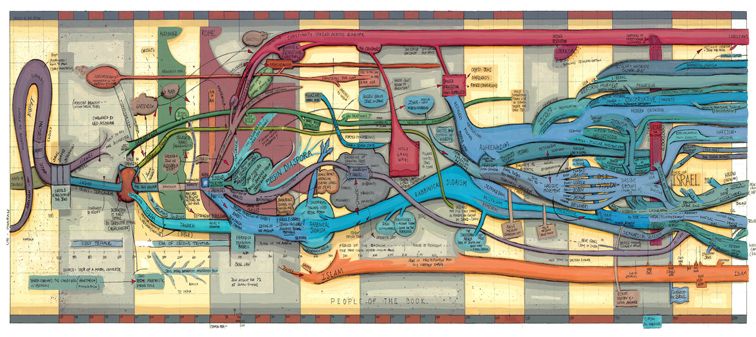 |
| Ward Shelley "People of the Book" 2012 Oil and toner on mylar 36 x 75.5 inches |
"[Shelley's] striking [...] paintings anatomize the development of intellectual and social streams within the humanities. The artist describes them as 'attempts to use real information to depict our understandings of how things evolve and relate to one another, and how this develops over time.'Aesthetically speaking, I liked every piece in the show, but the most edifying works were those that considered "significant, sweeping lineages," and I concluded the write-up with the hope that Shelley's lens would broaden.
In spirit as well as in appearance, then, Shelley's paintings are cousin to phylogenetic trees, the taxonomic diagrams that biologists use to denote evolutionary relationships among species. But, though Shelley's genealogies look like mappings of biological exuberance, the subjects of his brightly colored, illustrative works are not so scientific: Frank Zappa; Beat Generation writers; nodes of postmodern philosophy; modern art movements."
Wednesday, December 14, 2011
Chesterton's Dragons

"Smaug the Magnificent"
“Fairy tales are more than true; not because they tell us that dragons exist, but because they tell us that dragons can be beaten.”I admire the English writer G.K. Chesterton's intellect and curiosity. Today, he's best known for his proverbs, but I appreciate his generalism no less. As his Wikipedia entry details, "[Chesterton's] prolific and diverse output included philosophy, ontology, poetry, plays, journalism, public lectures, and debates, literary and art criticism, biography, Christian apologetics, and fiction, including fantasy and detective fiction." (And I thought I had a catholic disposition!)
- G.K. Chesteron
Chesterton was independent-minded enough to turn his incisive critique to any subject, including those he held dear, and thoughtful enough to engage in courteous debate with his antagonists (a trait today's intellectual leaders typically lack or deny).
Still, he wasn't perfect; some of his writing is flavored with antisemitism and, by many accounts, his strengthening religious convictions dulled his later criticism. Chesterton was right about the value of fairy tales, but too many brave knights ride off in search of dragons to slay, unmindful of the beasts within.
Image credit: ripped from Fine Art America
Friday, November 04, 2011
Announcing BAASICS
I'm very excited to announce that artist-curator Selene Foster and I have received a Southern Exposure Alternative Exposure Grant award for our Bay Area Art & Science Interdisciplinary Collaborative Sessions (BAASICS) proposal! BAASICS is a series of San Francisco-based evening programs that bring together local visual artists, choreographers, composers, scientists, and interdisciplinary thinkers to present engaging, multi-media lectures and performances that consider a given theme. The programs are free and open to the public.
In conjunction with A Live Animal, a group exhibition that Selene and I co-curated at Root Division in July 2011, we assembled 4 visual artists, 3 scientists, and 1 choreographer in San Francisco's ODC Theater to further explore the exhibition's theme in a program of TED Talk-like lectures and performances. The evening was a terrific success, drawing a capacity crowd and generating excited conversation during the reception that followed. Many of the attendees enthusiastically requested more such events.
With BAASICS, Selene and I hope to foment creative exchange and even long-term, mutually beneficial relationships between artists and scientists. Despite much talk of commonality between the disciplines, there is little substantive dialogue. Laudably, there are an increasing number of efforts to cultivate interdisciplinary, art-science projects; unfortunately, the lion's share of these result in vaguely "sciency" artworks or analyses of aesthetics rooted in cognitive neuroscience or sociobiology.
BAASICS isn't goal or project oriented; after all, there are many important differences between art and science, but one undeniable likeness is that the best discoveries are often stumbled upon, not planned for. We hope that BAASICS will provide a forum for artists and scientists to come together to share the ideas and practices that animate their lives and work. A principal aspiration of BAASICS is that we will learn from and be inspired by one another.
Even more important than facilitating relationships and the sharing of ideas, however, is the possibility of engaging a general audience. In the United States, the contemporary fine arts and sciences are generally set apart from popular discourse. Because BAASICS programs are free and open to the public, we hope to make the fine and performing arts and sciences less esoteric, inspiring guests to think about how art and science relate to one another and to society at large.
FYI: The theme of the second BAASIC event -- albeit the first associated with the name -- will be technology and notions of "the future." The roster of presenters hasn't been determined (it will take place in May or early June 2012), but speakers and performers might ponder, for example, robotics, artificial intelligence, medical advances and human nature, how our globalizing culture will shape technology, or dystopian versus utopian prospects. If HH readers know of Bay Area visual artists, composers, choreographers, scientists, or general smarty-pants who are engaging technology in some way and might be interested in participating, please put them in touch with me. Selene and I want to review as large a pool of applicants as possible.
Saturday, October 29, 2011
AIRIE Residency: Update #5
This update is associated with my 2-week-long Artists In Residence In the Everglades (AIRIE) writing and art residency.

AIRIE Housing; Everglades National Park; October 2011
Notes from Days 12, 13, & 14:
- I had the privilege of joining Florida International University Honors College professors Peter Machonis and Devon Graham as they led their "Everglades: From beginning to end?" seminar class on a slough slog. Before we waded into the river of grass, I presented a short lecture on my artwork, the importance of biodiversity, and the Endangered Species Print Project (ESPP).
I wrapped up the talk by highlighting the Endangered Species Condom project, an ESPP collaboration with the Center for Biological Diversity that aims to raise public awareness of the environmental impact of a burgeoning human population on natural resources, habitats, and thousands of critically endangered species around the world...and, of course, I distributed the Endangered Species Condoms to all in attendance.
The real fun started about an hour later, when we stepped into the water. As regular readers of HH know, I've seen plenty of flora and fauna from the roads and trails in my two weeks in Everglades National Park, but sloshing through sawgrass marshes and into two bald cypress stands provided another, more sensual prespective. We met countless spiders (all species unidentified, unfortunately), diminutive American green tree frogs, and Halloween pennant dragonflies (as well as other, unidentified dragonfly species) on our way to the cypress dome.
Once inside the dome's shaded, cooler, and humid environment, most of the students found seats on a hurricane-felled tree and the rest of us took up positions nearby. We ate lunch while the class described some of what they'd seen during our slog to the cypress stand. Afterwards, Peter led a discussion of Their Eyes Were Watching God, the novel by Zora Neale Hurston, which the class recently read. As students offered their insights, a curious, juvenile American alligator swam close to our group, provoking some "ooo"s and "aww"s (admittedly, tyke gators are cute).
I kept my eyes peeled for the flow of a Burmese python through the water. The python population in the Everglades is one of the most celebrated invasive species concerns in the United States. The week before I arrived, rangers caught a python crossing Anhinga Trail, a popular park destination. The rangers killed and dissected the large reptile to learn what it had been preying on. The pythons aren't picky eaters and they grow to nearly 20 feet in length; the recent capture had only birds and water rats in its belly, but these invaders have been known to feed on fish, raccoons, river otters, bobcats, deer, and even the occasional alligator. One ranger remarked to me that he rarely sees small mammals in the park anymore. A decade ago, he told me, visitors were guaranteed to see marsh rabbits, Eastern cottontail rabbits, Eastern grey squirrels, and nine-banded armadillos along the park's roads, but I haven't seen even one of these animals during my two weeks here.
"Do you think the pythons are responsible?," I asked the ranger. He shrugged and said, "Well, it could be a coincidence. Rabbits have population boom-and-bust cycles." "What about the armadillos?," I asked. He raised his eyebrows and shrugged. "I'm not really sure about their populations. We can't prove anything yet." Some researchers now estimate that the established, breeding population of Burmese pythons in the Everglades is in the thousands.
Highlights of the slog (besides talking with some of the students and the professors) included seeing 2 American bitterns, a bird that I'm particularly fond of, and watching (and feeling) the mandibles of a grasshopper (unidentified as of yet) work on the the upper layer of my index finger's skin, scraping away little flecks of it, which the insect appeared to eat. It didn't hurt; it felt like a cross between being tickled and rubbed with a small piece of sandpaper. Had it been a larger grasshopper, I may not have been so obliging, but I enjoyed watching the insect at work.
Finally, I tip my hat to the aims of Peter and Devon. Their class curriculum is designed to introduce students to Everglades' natural history and "the political nature of local and regional environmental issues," but also to "read critically, to understand the interconnectedness of art, literature, and other disciplines." Amen! Its exactly the sort of generalist class I'd like to take....and the type of class I hope to one day teach. I hope that most of the students realize how fortunate they are to be a part of it.
- During the early days of my stay in the park, I didn't hear any cicadas. Now that the rain has become infrequent, however, I hear their clicking whine all day long. It reminds me of the Eastern Shore of Virginia, my home ground.

Tricolored Heron and Anhinga; Anhinga Trail; Everglades National Park; October 2011
- While I watched, a male anhinga caught a bluegill in the flooded borrow pit by Anhinga Trail. The fish was at least 3 inches in length, and the anhinga decided that he'd better not attempt to eat the fish while still in the water. Unlike most fish-eating birds, anhingas have to throw the fish they catch up into the air, open their beak wide, and swallow the fish as it descends. It's quite a trick to see, especially when the fish, as in the case of this bluegill, is of a fair size. The anhinga waddled (like penguins, anhingas are evolved for diving and swimming, and they're graceless on land) up the grass slope at the borrow pit's edge, his catch held tight in his bill. He moved onto the paved trail and, surrounded by a small group of excited German tourists (and me), pulled off the fish tossing feat with aplomb.

Common Snapping Turtle; Main Road; Everglades National Park; October 2011
- I stopped for 2 more common snapping turtles crossing park roads. One of these was an especially fine model. I also rescued a Florida box turtle from harassment by two American crows. Whether the crows would have eventually gotten past the turtle's shell defense, I don't know, but corvids are clever birds and, though I'm very fond of them, I opted to spoil their fun and potential meal by moving the turtle off the road and into the undergrowth at the forest's edge. The crows clucked and rattled at me in disapproval.

Florida Box Turtle with American Crows; Everglades National Park; October 2011
- I had an on-the-move photo shoot with another road-crosser, an Eastern diamondback rattlesnake. As it continued to move across the road and through the grass on the far side, it kept its head and one s-curve of its body angled toward me, prepared to strike were I to molest it. The encounter was a treat; I've long wanted to meet an Eastern diamondback outside of an enclosure and now I have! Like the cottonmouth I met earlier in my visit, this is a snake that I have no inclination to handle and examine more closely, so I don't know it's gender.

Eastern Diamondback Rattlesnake; Everglades National Park; October 2011
- Sadly, not far from where I came upon the rattler, I found a dead, partially crushed and ant-consumed rough green snake, a beautiful species that, when alive, is a radiant emerald; even dead, they are pretty snakes. Not counting insects or the dead dog wasting away on the roadside outside of park land (there are many dogs with apparently negligent owners living near the park), this is the 3rd dead-on-road (DOR) critter I've found. A red-shouldered hawk and a great blue heron also lost their lives to cars during my time here. There are almost certainly others that I didn't happen to discover.

DOR Rough Green Snake; Everglades National Park; October 2011
Photo credits: all photos, Hungry Hyaena (Christopher Reiger), 2011
Related post: "ESPP and an Everglades Slough Slog," at The Endangered Species Print Project Blog
Notes from Days 12, 13, & 14:
- I had the privilege of joining Florida International University Honors College professors Peter Machonis and Devon Graham as they led their "Everglades: From beginning to end?" seminar class on a slough slog. Before we waded into the river of grass, I presented a short lecture on my artwork, the importance of biodiversity, and the Endangered Species Print Project (ESPP).
I wrapped up the talk by highlighting the Endangered Species Condom project, an ESPP collaboration with the Center for Biological Diversity that aims to raise public awareness of the environmental impact of a burgeoning human population on natural resources, habitats, and thousands of critically endangered species around the world...and, of course, I distributed the Endangered Species Condoms to all in attendance.

The real fun started about an hour later, when we stepped into the water. As regular readers of HH know, I've seen plenty of flora and fauna from the roads and trails in my two weeks in Everglades National Park, but sloshing through sawgrass marshes and into two bald cypress stands provided another, more sensual prespective. We met countless spiders (all species unidentified, unfortunately), diminutive American green tree frogs, and Halloween pennant dragonflies (as well as other, unidentified dragonfly species) on our way to the cypress dome.
Once inside the dome's shaded, cooler, and humid environment, most of the students found seats on a hurricane-felled tree and the rest of us took up positions nearby. We ate lunch while the class described some of what they'd seen during our slog to the cypress stand. Afterwards, Peter led a discussion of Their Eyes Were Watching God, the novel by Zora Neale Hurston, which the class recently read. As students offered their insights, a curious, juvenile American alligator swam close to our group, provoking some "ooo"s and "aww"s (admittedly, tyke gators are cute).
I kept my eyes peeled for the flow of a Burmese python through the water. The python population in the Everglades is one of the most celebrated invasive species concerns in the United States. The week before I arrived, rangers caught a python crossing Anhinga Trail, a popular park destination. The rangers killed and dissected the large reptile to learn what it had been preying on. The pythons aren't picky eaters and they grow to nearly 20 feet in length; the recent capture had only birds and water rats in its belly, but these invaders have been known to feed on fish, raccoons, river otters, bobcats, deer, and even the occasional alligator. One ranger remarked to me that he rarely sees small mammals in the park anymore. A decade ago, he told me, visitors were guaranteed to see marsh rabbits, Eastern cottontail rabbits, Eastern grey squirrels, and nine-banded armadillos along the park's roads, but I haven't seen even one of these animals during my two weeks here.
"Do you think the pythons are responsible?," I asked the ranger. He shrugged and said, "Well, it could be a coincidence. Rabbits have population boom-and-bust cycles." "What about the armadillos?," I asked. He raised his eyebrows and shrugged. "I'm not really sure about their populations. We can't prove anything yet." Some researchers now estimate that the established, breeding population of Burmese pythons in the Everglades is in the thousands.
Highlights of the slog (besides talking with some of the students and the professors) included seeing 2 American bitterns, a bird that I'm particularly fond of, and watching (and feeling) the mandibles of a grasshopper (unidentified as of yet) work on the the upper layer of my index finger's skin, scraping away little flecks of it, which the insect appeared to eat. It didn't hurt; it felt like a cross between being tickled and rubbed with a small piece of sandpaper. Had it been a larger grasshopper, I may not have been so obliging, but I enjoyed watching the insect at work.
Finally, I tip my hat to the aims of Peter and Devon. Their class curriculum is designed to introduce students to Everglades' natural history and "the political nature of local and regional environmental issues," but also to "read critically, to understand the interconnectedness of art, literature, and other disciplines." Amen! Its exactly the sort of generalist class I'd like to take....and the type of class I hope to one day teach. I hope that most of the students realize how fortunate they are to be a part of it.
- During the early days of my stay in the park, I didn't hear any cicadas. Now that the rain has become infrequent, however, I hear their clicking whine all day long. It reminds me of the Eastern Shore of Virginia, my home ground.
- While I watched, a male anhinga caught a bluegill in the flooded borrow pit by Anhinga Trail. The fish was at least 3 inches in length, and the anhinga decided that he'd better not attempt to eat the fish while still in the water. Unlike most fish-eating birds, anhingas have to throw the fish they catch up into the air, open their beak wide, and swallow the fish as it descends. It's quite a trick to see, especially when the fish, as in the case of this bluegill, is of a fair size. The anhinga waddled (like penguins, anhingas are evolved for diving and swimming, and they're graceless on land) up the grass slope at the borrow pit's edge, his catch held tight in his bill. He moved onto the paved trail and, surrounded by a small group of excited German tourists (and me), pulled off the fish tossing feat with aplomb.
- I stopped for 2 more common snapping turtles crossing park roads. One of these was an especially fine model. I also rescued a Florida box turtle from harassment by two American crows. Whether the crows would have eventually gotten past the turtle's shell defense, I don't know, but corvids are clever birds and, though I'm very fond of them, I opted to spoil their fun and potential meal by moving the turtle off the road and into the undergrowth at the forest's edge. The crows clucked and rattled at me in disapproval.
- I had an on-the-move photo shoot with another road-crosser, an Eastern diamondback rattlesnake. As it continued to move across the road and through the grass on the far side, it kept its head and one s-curve of its body angled toward me, prepared to strike were I to molest it. The encounter was a treat; I've long wanted to meet an Eastern diamondback outside of an enclosure and now I have! Like the cottonmouth I met earlier in my visit, this is a snake that I have no inclination to handle and examine more closely, so I don't know it's gender.
- Sadly, not far from where I came upon the rattler, I found a dead, partially crushed and ant-consumed rough green snake, a beautiful species that, when alive, is a radiant emerald; even dead, they are pretty snakes. Not counting insects or the dead dog wasting away on the roadside outside of park land (there are many dogs with apparently negligent owners living near the park), this is the 3rd dead-on-road (DOR) critter I've found. A red-shouldered hawk and a great blue heron also lost their lives to cars during my time here. There are almost certainly others that I didn't happen to discover.
Photo credits: all photos, Hungry Hyaena (Christopher Reiger), 2011
Related post: "ESPP and an Everglades Slough Slog," at The Endangered Species Print Project Blog
Friday, August 19, 2011
Making More "Live Animals"
Two weeks ago, I presented a lecture at the Art College Center of Design, in Pasadena, California, titled "Aesthetics, Ethics, and Experience." It was my first attempt to respond to the question of how contemporary artists might connect the "fine arts" to society at large, and I drew from an array of sources, classical (Heraclitus; Aristotle) and contemporary (Dave Hickey; David Milch; Erik Reece), to constellate what I'd like to think Aristotle would have described as a virtuous way of being in the world (as an artist). After the lecture, one of the students remarked that it was the "most liberal arts style" approach she'd come across in art school. I appreciated her compliment, but it reminded me of the urgent need for more generalism in arts education.
As I often insist, there is a lot of beautiful and compelling artwork produced and exhibited today, but it generally lives apart from popular culture. We -- that is, those of us active in the fine arts -- are complicit in this ghettoization because we're content to carry on a conversation among ourselves. Moreover, because we've come to preference our tribe's voices over others, there is a surplus of insider commentary and critique passed off as art. Almost all of this work and wordiness is irrelevant to the world outside the ghetto walls and, because young artists are educated in this context, with little or no pedagogical emphasis on disciplines other than art theory, the art and commentary become, over time, increasingly provincial. The wellspring of this contemporary predicament is as old as modernism.
On the heels of co-curating "A Live Animal" with Selene Foster, I've been rereading John Dewey's brilliant Art & Experience essays (1934). Dewey writes, and I quote him at length because he articulates the crux of the problem so eloquently:
" [Art is today] isolated from the human conditions under which it was brought into being and from the human consequences it engenders in actual life experience. [...] Art is remitted to a separate realm, where it is cut off from that association with the materials and aims of every other form of human effort, undergoing, and achievement. A primary task is thus imposed upon one who undertakes to write upon the philosophy of the arts. This task is to restore continuity between the refined and intensified forms of experience which are works of art and everyday events, doings, and sufferings that are universally recognized to constitute experience.Amen, Mr. Dewey...though I'd add that the "primary task" to "restore continuity between" works of art and the everyday is not only the obligation of the art writer; it is also incumbent upon the conscientious artist. Artists need to make art that connects to common human experience, and both artists and art writers need to communicate more effectively with the general audience.
[...] So extensive and subtly pervasive are the ideas that set Art upon a remote pedestal, that many a person would be repelled rather than pleased if told that he enjoyed his casual recreations, in part at least, because of their esthetic quality. The arts which today have most vitality for the average person are things he does not take to be arts: for instance, the movie, jazzed music, the comic strip, and, too frequently, newspaper accounts of love-nests, murders, and exploits of bandits. For, when what he knows as art is relegated to the museum and gallery, the unconquerable impulse towards experiences enjoyable in themselves finds such outlet as the daily environment provides.
[...] For the popular notion comes from a separation of art from the objects and scenes of ordinary experience that many theorists and critics pride themselves upon holding and even elaborating. The times when select and distinguished objects are closely connected with the products of usual vocations are the times when appreciation of the former is most rife and most keen. [...] Theory can start with and from acknowledged works of art only when the esthetic is already compartmentalized, or only when works of art are set in a niche apart instead of being celebrations, recognized as such, of the things of ordinary experience. Even a crude experience, if authentically an experience, if more fit to give a clue to the intrinsic nature of esthetic experience than is an object already set apart from any other mode of experience. [...The] trouble with existing theories is that they start from a ready-made compartmentalization, or from a conception of art that 'spiritualizes' it out of connection with the objects of concrete experience. The alternative, however, to such spiritualization is not a degrading and Philistinish materialization of works of fine art, but a conception that discloses the way in which these works idealize qualities found in common experience. Were works of art placed in a directly human context in popular esteem, they would have a much wider appeal than they can have when pigeon-hole theories of art win general acceptance.
[...] The sources of art in human experience will be learned by him who sees how the tense grace of the ball-player infects the onlooking crowd; who notes the delight of the housewife in tending her plants, and the intent of her goodman in tending the patch of green in front of the house; the zest of the spectator in poking the wood burning on the hearth and in watching the darting flames and crumbling coals."
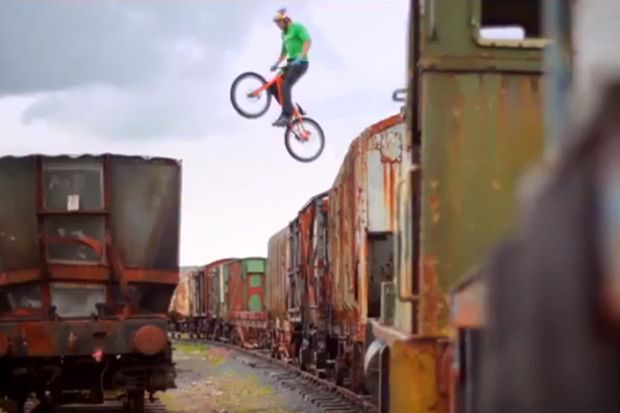
I thought of Dewey's argument when watching a video of Scottish cyclist Danny MacAskill that was recently shared by a friend on Facebook. The video offers a more visceral (and therefore meaningful) aesthetic experience than most of the contemporary art I've viewed in the last weeks. An acrobat with his bike, Macaskill is Dewey's "live animal," "fully present, all there" because of he has honed his craft and is, as we often hear athletes put it, "in the zone."
Can contemporary fine art inspire people to exclaim, as one person did in the comments under my friend's Facebook posting of the Macaskill video, "That's crazy & beautiful!"? Can artists again enthuse the general audience?
I believe that we can, and I hope that I can one day have an opportunity to design (or help to design) an undergraduate or graduate art curriculum that prioritizes generalism and social responsibility.
Photo credit: photo of Danny MacAskill ripped from CyclePath Magazine
Wednesday, April 20, 2011
Navigating the Flood
"By [Claude] Shannon's definition, the world now produces more information in 48 hours than it did throughout all human history to 2003. [...But] if the universe is information, it has always been producing a deluge of data, and humans have always found patterns of meaning in the waters visible to us."
-uncredited writer in The Week
Wednesday, September 22, 2010
The RSA's "21st Century Enlightenment"
Sure, the video is 11 minutes long, well over the too-long-to-watch mark for readers casually trolling the blogosphere, but it's worth bookmarking and saving for later. (In fact, I encourage you to watch it on YouTube or the RSA website, as the resolution is better than that of the above embed.)
The ideas articulated are vital and might provide some solace for those of you who, like so many of my friends, suffer from political apocalypse syndrome! Moreover, the animation is terrific and the narrator, like the Royal Society for the Encouragement of the Arts (RSA), is British, satisfying the Anglophile in all of us.
Enjoy.
(Thanks to Michael McDevitt for turning me on to this RSA video.)
Saturday, April 03, 2010
"Ouroboros" at ISE Cultural Foundation

I'm intrigued by the many positive reviews of "Ouroborus: The History of the Universe," a six-screen, 3-D video installation by biochemist, philosopher, and video artist Ali Hossaini and the collaborative duo of Blake Shaw and Bruno Levy, aka SWEATSHOPPE, currently on view at the ISE Cultural Foundation. Many write-ups of the exhibition describe the installation as meditative, and excitedly relate the artists' intent to "[tell] the history of cosmic evolution - from the Big Bang to Lady Gaga - by animating over 30,000 images."
In fact, although "historical spiritual illustrations of the cosmos, from vedic yantras, buddhist mandalas, and sacred geometry," are prominently featured on three of the installation's six screens, the effect is less mindful (and certainly not meditative) than it is visually assaultive and superficial. And, though the triptypch "cosmic evolution" might incorporate over 30,000 images, it is best described as a pastiche of generally significant forms rendered insignificant in presentation. As a gallery companion remarked to me, "This isn't communicating anything; it's just a 'Clockwork Orange' brainwashing machine." It's a shame that's true, as Hossaini's accompanying artist statement is insightful and important. I include the full text of his statement below.
"Nowhere is the fragmentation of the human psyche more evident than in how we treat the environment. We know we're pillaging our habitat, but we can't make the leap from knowledge to right action. I attribute this disconnect, and many others, to the factionalizing of culture that began with modern science, industry and art.I agree completely, but Hossaini's collaboration with SWEATSHOPPE has neither shed "light on the complexities and responsibilities of being self-aware" nor integrated contradictions into new levels of experience. Their intent is laudable, but their effort lacking.
I'm not saying we should turn our backs on the Enlightenment. But neither should we take it as dogma - we need to rethink its foundation, integrating our psyche into the cosmos in a way that builds on premodern wisdoms as well as modern science. The Enlightenment freed physics, astronomy and eventually art - think 'art for art's sake' - from tradition, spawning remarkable advances along with deep alienation.
It's time to produce culture in a more holistic, organic way. For now science, art and religion - and I use 'religion' here to mean a generalized psychology - lie in private tracks, each requiring extensive knowledge for appreciation let alone practice. How can these disciplines work together more effectively?
The answer doesn't lie in the rejecting, merging or reconciling science and spirit. Instead we need to create a framework for integrating our experiences of these different realms, and this is precisely what artists can do. Art needs to step out of its self-referential confines, the safe house of galleries, museums and markets. It needs to be Saturday night and Sunday morning, be the new church, and it needs to invade pop culture. Mass appeal is critical.
Most of all art needs to rejoin itself to science. Both embody urges to explore, understand and create, and both have become specialized, mechanized and self-absorbed, given to destructive irony. Art cannot be science, but it can convey the sense of wonder that drives scientists. It can visualize the worlds of science while honoring our sense of self as beings that transcend the mundane.
Our experiences of spirit and matter cannot be reconciled, but they can be represented. And they can be represented in a way that sheds light on the complexities and responsibilities of being self-aware. Artists can rise above the dilemmas of modern life: they can comprehend the contradictions, integrating them into new levels of experience where knowledge, desire and energy meet the limits of human freedom."
Yet Hossaini's statement resonates and, as I left the ISE Cultural Foundation, I recalled Ron Fricke's tremendous film "Baraka." Hossaini and SWEATSHOPPE have inspired me to revisit Fricke's beautiful, moving tribute to transcendent oneness, and to eagerly await the long-awaited sequel, "Samsara." It's hopeful to recognize that sometimes art does step outside "its self-referential confines."
Wednesday, September 16, 2009
Kimmel Harding Nelson Residency: Day 10

Lewis & Clark Visitors Center; Nebraska City
Naturalists, Puritans, and New Territories
"I think our governments will remain virtuous for many centuries; as long as there shall be vacant lands in any part of America. When they get piled upon one another in large cities, as in Europe, they will become corrupt."The American polymath Thomas Jefferson ranks highly in my pantheon of heroes. Yeoman farmer, architect, inventor, philosopher, naturalist, Virginia gentleman, and statesman, Jefferson defies easy classification. His political pragmatism and philosophy reflect his broad excavations, and the complex of sometimes contradictory ideas that Jefferson put down over the course of his long life allows his legacy to be fairly claimed by contemporary pundits of every stripe. His name and statements are marshaled to support causes across the political spectrum, including state's rights, internationalism, provincialism, gun control, the right to bear arms, unregulated capitalism, anarchy, secularism, and even the call for the United States to be officially deemed "a Christian nation." It is not, however, Jefferson's nuanced political philosophy that is responsible for his cultural ebb; he was a slave-owner and a patriarchal figure who decried "intellectual women." By today's standards, he was a deeply flawed man. But Jefferson died 183 years ago. It is wrongheaded to dismiss the whole of the man for latter-day sins. In any case, his accomplishments and legacy are profound.
- Thomas Jefferson, 1787
Jefferson was irredeemably curious and hopeful. The man's hunger for knowledge and his faith that the human lot can forever be improved upon vitalize the Jeffersonian heritage. The Enlightenment-inspired, exuberant optimism of Benjamin Franklin, Joseph Priestley, Thomas Jefferson, and others in their mold watered the soil of American social, political, and technological revolution. And, as I wrote two days ago, "it's a happy wonder to contemplate [...] the maturation and proliferation of human technology." But at what price did so much "happy" change come?

Lewis & Clark Visitors Center; Nebraska City
President Jefferson, in March of 1803, commissioned Captain Meriwether Lewis to lead the Corps of Discovery with William Clark. Jefferson obtained federal funding for the expedition on the grounds that, if successful, Lewis and Clark might "offer the most direct and practicable water communication across [the] continent for the purposes of commerce," but the president's principal interests were other. He wrote to Lewis,
"The object of your mission is to explore the Missouri River. [...] Objects worthy of notice will be the soil & face of the country, it's growth & vegetable productions, especially those not of the U.S.; the animals of the country generally, & especially those not known in the U.S., the remains or accounts of any which may be deemed rare or extinct; the mineral productions of every kind; but more particularly metals, limestone, pit coal, & saltpetre; salines & mineral waters, noting the temperature of the last, & such circumstances as may indicate their character; volcanic appearances; climate, as characterized by the thermometer, by the proportion of rainy, cloudy, & clear days, by lightening, hail, snow, ice, by the access & recess of frost, by the winds prevailing at different seasons, the dates at which particular plants put forth or lose their flower, or leaf, times of appearance of particular birds, reptiles or insects."Historians suggest that the excitement Jefferson felt on the eve of this great expedition was quite real. His impetus was curiosity, not Puritan conquest.

Mayhew Historic Village; Nebraska City
The Pilgrim settlers of this country had little curiosity about the natural history or native peoples of their "New World." William Bradford, five-time governor of Plymouth Colony from 1621 - 1657, described (what little he knew of) the North American continent as "a hideous and desolate wilderness." Jefferson, by contrast, wrote that "there is not a sprig of grass that shoots uninteresting to me." He saw the natural world as an Eden to be studied and, as author Erik Reece describes it, as "an antidote to the deadening forces" of civilization. For Jefferson, the notion of "God and country" was shaped by topography and the human place in it.
But Lewis and Clark's great voyage of discovery didn't simply educate Americans living east of the Appalachian spine about the continent's interior and western Edens. It paved the way for mass migration, mass slaughter, and mass industry. What happened on this vast continent parallels the greater history of mankind and, indeed, of all life.

Lewis & Clark Visitors Center; Nebraska City
Historian Daniel Boorstin wrote in 1953 that, "the genius of American democracy comes not from any special virtue of the American people but from the unprecedented opportunities of this continent." Similarly, the remarkable evolution of the human ape, from tree-dweller, to hunter-gatherer, to agriculturist, to civilized man, comes from no special virtue of our species, but from the unprecedented opportunities of this Earth. One thing, as it were, led to another, and our species proved able and willing to exploit to the fullest extent. Loren Eiseley writes, in The Immense Journey,
"The stolen energy that would take man across the continents [as a hunter-gatherer] would fail him at last. The great Ice Age herds were destined to vanish. When they did so, another hand like the hand that grasped the stone by the river long ago would pluck a handful of grass seed and hold it contemplatively. In that moment, the golden towers of man, his swarming millions, his turning wheels, the vast learning of his packed libraries, would glimmer dimly there in the ancestor of wheat, a few seeds held in a muddy hand."So it was with North America. The "meteoric, messy, and astonishing history" of the United States was fueled, above all, by a distinctly un-Jeffersonian conquest of the land's native peoples, animals, and resources.
Near the end of his sweeping ecological history of North America, The Eternal Frontier, Tim Flannery writes,
"During the nineteenth century, [...] the European Americans were developing a new economy. It was an economy based on systems of mass production and mass exploitation that needed enormous resources to operate. The key decade was 1880-90, for only then did European machinery become sophisticated enough to destroy the great herding and flocking species [the passenger pigeon, the American bison, and the Eskimo curlew]. Their enormous numbers provided an ideal teething rusk for an economic machine that would soon produce cars in the millions and hamburgers in the billions."We devoured the continent.

Lewis & Clark Visitors Center; Nebraska City
What allowed for this? What became of the Enlightened foresight of the founding minds? How did we move, in one hundred years, from Thomas Jefferson to Henry Ford? And could we have made such astounding, "happy" progress in human rights, suffrage, and science without surrendering to this demonic appetite? There is no tidy answer to these questions and, in any case, it's irresponsible to wade in what-might-have-been when you can instead strive toward what-yet-could-be. Still, the history perplexes.
Jefferson bemoaned the Christian scriptures' inclusion of miracles and the emphasis, in Christian doctrine, on the afterlife. Erik Reece explains in An American Gospel that Jefferson realized,
"the more Christian fundamentalism emphasizes that the kingdom of God awaits as a reward in the afterlife, the more it ignores [...] Jesus' teachings of how we should act while we inhabit this earthly realm. [...] The relevance of Christianity to most Americans has far more to do with the promise of eternal salvation from this world."Jefferson's famous and sensible solution was to edit the Christian New Testament, deleting any and all miracles, including the Virgin Birth and the Resurrection. He called the result "The Life and Morals of Jesus of Nazareth." Today, the book is best known as "The Jefferson Bible." Perhaps, if more good Christians had followed their incarnate God's example and teachings in this life - the one that actually matters! - the west would have been settled in accord with the land. Unfortunately, most in our "Christian nation" don't know of Jefferson's earnest effort to save Christianity from other-worldly supernaturalism, from, as he called Puritanical ministers, "the soothsayers and necromancers."
Neither do most Americans know of Jefferson's effort to temper our faith in industrialism. Jefferson's agrarian dream for America was impossible; the United States was then and is now a burgeoning country, and true pastoralism can only ever be embraced on a small scale. But we would do well to remember Jefferson's vision, to remember that we are part of a greater system, and that the expiration date for America's frontier mentality, its faith in boldly going and exploiting, is past.
Despite our exceptionalist tendencies, our nation is like any other. Every nation is a tiny part of the greater superorganism, and every nation's story is a life cycle. The sprawling, arrogant United States is no longer an adolescent, and it can't afford to continue acting like one, to continue "lighting out for the territories." If we fail to mature, our reckless faith in what lies over the next mountain, in the future and in the afterlife, will prove our nation's undoing. It is faith in what exists here and now, in the place where we stand, that needs resurrection.

Lewis & Clark Visitors Center; Nebraska City
Most Americans are estranged from their own nature, as well as from the nature all around them. Reece writes,
"[We are estranged from] the sources of our food, the sources of our clothes, and the sources of the energy that run our homes. Beyond these basic needs, money and corporate influence have estranged us from our own government. Our isolation within suburban homes has estranged us from our neighbors and communities. [...] Cars have estranged us from our own bodies. [...] Our modern condition of estrangement has led us to live in ways that show a remarkable abdication of responsibility."Reece proposes that Aldo Leopold's philosophy "carries us back into an ethic of responsibility." I agree.
Leopold, the godfather of modern conservation, inherited Jefferson's dream. Like Jefferson, he was a Romantic pragmatist, a type as well-suited to diplomacy as to conservation. Leopold acknowledged that resource use, like the economy, can be regulated thoughtfully, but the Romantic in Leopold was dismayed by the dark side of our equating land with money. He wrote,
"I suspect that the forces inherent in...economic evolution are not all beneficent. Like the forces inside our own bodies, they may become malignant, pathogenic. I believe that many of the economic forces inside the modern body-politic are pathogenic in respect to harmony with land."He deemed his heroically optimistic response to the increasing pressures of population and market a "land ethic." Despite the difficulties of cultivating such an appreciation of the natural world in the twentieth century, Leopold persisted.
"That land is a community is the basic concept of ecology, but that land is to be loved and respected is an extension of ethics. [...] A land ethic, then, reflects the existence of an ecological conscience, and this in turn reflects a conviction of individual responsibility for the health of land. [...] We can be ethical only in relation to something we can see, feel, understand, love, or otherwise have faith in."The American estrangement from land and from the rest of nature (including the dark, interior wilderness of the psyche) is redressed through cultivation of a land ethic. And, in so far as I am "happy" to contemplate the incredible rate of technological evolution, I am made happier still by the prospect of a mature, tempered America.

This morning, I sat for a while and talked with an older gentleman in Long Home Coffee Shop, on Nebraska City's Central Avenue. A retired physicist, he expressed concern about the future of America and, more generally, of the human species. "It's all terribly depressing," he observed. "I have my good days and my bad," I concurred. "But the bleak pessimism is more rare than it was, just because it's unproductive." He nodded, and his heavy eyes seemed to say both, 'Thank goodness for the optimism of youth!' and 'Bloody damned fool!'
But I'm not a fool, and neither is he. An hour after we talked, as I sat at a table scribbling the notes that became this essay, he attended, in the back room of the coffee shop, a meeting regarding the construction of a community garden at the west end of town. The city has provided the group with a vacant lot, a local corporation will provide the initial revenue for construction, and the garden will be tended and managed by volunteers, providing food for those in need.
Now that, I contend, is positively Jeffersonian!
Photo credits: all photos, Hungry Hyaena, 2009
Sunday, September 13, 2009
Kimmel Harding Nelson Residency: Day 7

Attunement on a Sunday Morning
I'm a generalist. As such, I'm inclined to connect the dots between purportedly distinct realms of inquiry. It's impossible, of course, to conduct a truly holistic survey, but my crude efforts have led me to conceive of life - what we know of it, at least - as a component part of a vast, even infinite superorganism. I freely admit to finding value in mysticism, and this superorganism notion is readily dismissed by some scientists and scholars as mystical metaphysics, but science itself speaks to an integrity beyond human comprehension.
As Loren Eiseley describes it,
"[This is] one of life's strangest qualities - it's eternal dissatisfaction with what is, its persistent habit of reaching out into new environments and, by degrees, adapting itself to the most fantastic circumstances."Eiseley was an anthropologist, and he claimed to be a man of "no religion." That may be so, but Eiseley's writing offers humility, wonder, gratitude, and communion in abundance. As I see it, those are the four pillars of religious practice. The fourth of these vital practices, communion, is alluded to by the very word "religion," from the Latin religare, meaning "to bind" or "to tie." Religious action aims to bind the individual to society and, in turn, to the greater whole.
For a decade, I proudly identified as an atheist and, by the measure of most religious people, my cosmology and metaphysics still qualify me as such. It occurs to me, on this Sunday morning, with Nebraska City's church parking lots at capacity, that many of this town's good Christians would reject my claim of religiosity, and not only because my practice rests on a Jewish foundation. My doctrine-less faith appreciates the stories of the Hebrew Tanakh, the Christian New Testament, and the Muslim Koran as parables, poetry, and anthropological artifacts. I read these books in the same way that I do the Tao Te Ching or Herakleitos; they are annotated, analyzed, interpreted, digested, then, in the fullness of time, returned to for a new understanding. But these collections are not my sacred texts. In the eyes of most religious believers, that disqualifies me from tribal membership. Thank G-d.

Sign reads, "Faith Removes Mountains Or Tunnels Through"
Still, I am a religious believer, in my way. My holy books are written by biologists and physicists, naturalist poets and essayists, as well as rabbis, ministers, and theologians. None of them is the word of an interventionist, judging god, even though all of them are necessarily part of a greater, unknowable whole, the aforementioned superorganism.
It doesn't matter what you call this organism. As essayist and literature professor Doug Thorpe writes in Rapture of the Deep, "Call it the sublime, call it the Tao, Om, or I AM; still the names don't hold." I most often call it The All, The No-thing, or Hashem, literally "The Name." In the Tanakh, when Moses asks the name of the Presence he has discovered in the burning bush, It replies, "Ehyeh asher ehyeh." "I will be who I will be," or "I will be that I will be." You can call It whatever you will, for It is you. It is also me. It is the sidewalk; It is the grass of the Otoe County courthouse lawn, on which Nebraska City authorities have installed a carved monument to the Ten Commandments, an act that approaches violation of Thomas Jefferson's shrewd "separation of Church and State"; and It is the ether connecting all of these.

If the faith that has grown in me is dogmatic in some way, it is in its insistence on universalism. Literally translated, "universe" means "one turning." Our universe is just that, one breath, one round, one cycle. All that we know and all that we don't know, everything that we can imagine, is but an infinitesimal sliver of The All, one note of an eternal symphony. Even Herakleitos, ancient proponent of reason and science, turned to poetics when he contemplated ultimate meaning; "Nature loves to hide," he wrote. Interestingly, the Hebrew word for universe is olam, a derivative of alam, meaning "to conceal." Jewish mystics, like many of their Hindu, Sufi, and Christian counterparts, believe that God is hidden in the universe, an ineffable force that pervades every dimension, known and unknown.
Theoretical astrophysicists now suggest that our universe is but one component part of a multiverse, requiring of us another Copernican shift; yet again, the superorganism is re-conceived. In that stretch of the mind are humility, wonder, gratitude, and communion. Science and philosophy, it seems, can also be religious.

So, yes, I'm a religious believer. Paintings, sculptures, and other hand-crafted objects are among my adored icons, but I find occasion for worship in every place, in every form, in every moment. The Monarch butterfly that flapped yoyo-like this morning in front of the KHN Center's kitchen window is worthy of exaltation. I recognize that, for some other viewer, the insect may be ignorable or irrelevant. For others, it is an idol. So, too, might the weathered brick of a downtown Nebraska City building be deemed a clay calf by unimaginative or close-minded "believers." Placing my palm on this brick today, though, my thoughts range through eons of geologic time to consider the primeval mud from which, eventually, we emerged as a gasping fish thing.
Doubtless some of the folks singing inside the walls of the Lutheran, Episcopalian, Catholic, Baptist, Presbyterian, and Methodist churches this morning don't share my enthusiasm for our scaley ancestors. But I'm not concerned with their narrow definition of religion or their selfish understanding of "truth." Although I no longer consider myself a materialist, I'm an unremitting idolater. To those that would condemn that impulse as sacrilegious, I offer Eiseley's reaction.
"People have occasionally written me harsh letters and castigated me for a lack of faith in man when I have ventured to speak of [..] some greater unity that lay incalculably beyond us. [...] They distrust, it would seem, all shapes and thoughts but their own. They would bring God into the compass of a shopkeeper's understanding and confine Him to those limits, lest He proceed to some unimaginable and shocking act - create perhaps as a casual afterthought, a being more beautiful than man. As for me, I believe nature capable of this, and having been part of the flow of the river, I feel no envy."And I feel no envy, either. There is only dumbfounding, smiling celebration.
Love is, I think, a bit like religion. Humility, wonder, gratitude, and communion are requisite in both, and, as Thorpe puts it, love "demands of us a new way of being in our old world." Religion might be construed as a love affair with The All. It's not always easy, but religious attunement can turn each day, each hour, or each instant, into "a new way of being." Every step is a psalm, every directed gaze is a prayer. Truly, on the streets of Nebraska City this morning, I am an exuberant, enthusiastic mystic.
Photo credits: all photos, Hungry Hyaena, 2009
Tuesday, March 17, 2009
Art Connect "Extraordinary Art Blog" Series
I'm honored to report my selection as the third interviewee for Art Connect's "Extraordinary Art Blog" series. Read my interview with Managing Director Peter Cowling here.
Art Connect is a relatively new website that provides the valuable service of reviewing and cataloging art blogs. The blog reviews are terrifically helpful and the interview series is so far excellent. From the Art Connect site:
I encourage readers to check out the Art Connect interview series.
Art Connect is a relatively new website that provides the valuable service of reviewing and cataloging art blogs. The blog reviews are terrifically helpful and the interview series is so far excellent. From the Art Connect site:
"In the process of compiling over 100 art blog profiles, and starting what will be an ongoing survey of the art blog scene, we accumulated a whole range of questions we wanted to investigate further. As a part of this series, we have explored the extraordinary growth of an art blog with Ruben Natal-San Miguel, from ARTmostfierce, how to produce extraordinary art critique with Catherine Spaeth, and providing extraordinarily cohesive coverage with Christopher Reiger from Hungry Hyaena."The interview with Catherine Speath is of particular interest to me, given her defense of accessible, yet rigorous art writing. She writes,
"I do, however, take very strong objection to what you are referring to as 'dumbing down' when it is relied upon as uncritical fodder for the market. For this reason there is a very important role for the academy and the museum to uphold a place for scholarly research. But I have also seen some atrocious academic writing, produced by galleries especially, that relies upon a history of philosophical thought to dress something up for the market."Ms. Spaeth also discusses the issue of online plagarism, particularly as it relates to bloggers. This issue is very important, and I hope that it will engender more conversation.
I encourage readers to check out the Art Connect interview series.
Monday, October 06, 2008
"Art and the Commons"
An essay I wrote for Hungry Hyaena in January of 2007, "Creative Restraint and Responsibility: Artists, Documentarians and Copyright," was referenced by Chris Desser in a lecture given at The California College of Arts on March 10, 2008. Desser is a fellow at On the Commons, an organization dedicated to encouraging cross-disciplinary engagement and an open-source approach to all resources, be they natural, artistic, or intellectual.
The text of Desser's lecture, entitled "Art and the Commons," is reprinted on both the On The Commons and GreenMuseum websites. It's worth a read, particularly on the heels of my previous post, about finding our way back to wonder via a more integrated approach.
Excerpted from "Art and the Commons":
"It is perhaps an inescapable part of the human condition to 'divide up the world' into mental categories. The categories may be immensely useful, but they are also partial and misleading. Philosopher and scientist Jacob Brownowski has described the process of science—the process by which we gain empirical knowledge—as that of decoding a 'completely connected world.' This decoding requires dividing that completely connected world into what is relevant and what is not relevant to the matter at hand, in order to create a meaningful context for study. But this division, Bronowski warned, does violence to the actual, organic nature of the real world. We must always bear in mind that we are 'certainly not going to get the world right, because the basic assumption that [we] have made about dividing the world into the relevant and irrelevant is in fact a lie.'"
Tuesday, November 15, 2005
Thank G-d for the Dalai Lama
Once in a long while, I describe myself in a way that reveals an aspect of my personality or ideology that I had not before acknowledged. This past Saturday, I explained my fascination with biology (and in a more general sense, all the sciences) to a friend as we viewed the excellent "Imagined Worlds" exhibition, at AXA Gallery (more on this terrific show in an upcoming post).
"If not for the painting monkey on my back," I said. "I'd be very happy to work as a field biologist. I think my love of the sciences is, in large part, rooted in a lack of faith in objective scientific truth." Wait! What? I've never framed the idea in that way, but that's exactly right! My love of science is that of the skeptic; my faith is provisional. How bizarre!?
I'm sometimes mischaracterized, even by friends, as a dogmatic champion of science over all other truths or cosmologies. I believe they label me thus for three reasons.
1) I reject the primitive notions of an interventionist sky-god and deny the singular "truth" claims of any religion.
2) I am particularly excited by evolutionary theory.
3) I am a stickler for taxonomic nomenclature.
If considering only these three qualities, I, too, might assume that we're talking about a hardcore bio geek, an individual unwilling to consider "alternative" explanations or allow magic into his or her world view. But I have other interests that provide me counterpoise. Obviously, the visual arts are very important to me, but theology, philosophy, and ethics are among my favorite subjects.
Stacked on my nightstand this month are the following books: The Larousse Encyclopedia of Myth; Bulfinch's Mythology; John Ruskin's On Art and Life; C.S. Lewis's The Discarded Image, an exploration of medieval cosmological transitions; Ernst Mayr's What Evolution Is; and Frans De Waal's Our Inner Ape. As I see it, these books on mythology, aesthetics, theology, history, and evolutionary inheritance are all intimately related. A back-and-forth reading of such texts allows me to cobble together my own cosmology.
For example, I accept that the fundamental elements produced by the Big Bang were hydrogen and helium, but I also conceive of the two primordial elements as Erebus and Nox, the Greek gods begotten by Father Chaos. When these two gods mated, Nox gave birth to a son named Aether, among other offspring. Aether is the personification of the heavens, of the "upper sky," and is therefore synonymous with the celestial elements that formed in the swirl of early space-time. Similarly, I embrace the mystical Jewish conception of the universe's origins, the creation of "Without End" (Ein Sof) from "Nothing" (Ayin, or the cosmic seed), both states of a piece with G-d's supreme body.
Given my penchant for hybrid science-myth cosmologies, I was pleased to read this short statement by Tenzin Gyatso, the 14th and current Dalai Lama, in The New York Times. I recommend reading the whole piece, but I've included some highlights below.
"If science proves some belief of Buddhism wrong, then Buddhism will have to change. In my view, science and Buddhism share a search for the truth and for understanding reality. By learning from science about aspects of reality where its understanding may be more advanced, I believe that Buddhism enriches its own world view.Thank goodness for the Dalai Lama's common sense! How I wish the pious folks in Vatican City would issue a statement such as this. And what of Judaism's Orthodox Union? The conservative Muslim clerics? Where are their voices?
[...] While I agree that certain religious concepts conflict with scientific facts and principles, I also feel that people from both worlds can have an intelligent discussion, one that has the power ultimately to generate a deeper understanding of challenges we face together in our interconnected world.
[...] By invoking fundamental ethical principles, I am not advocating a fusion of religious ethics and scientific inquiry. Rather, I am speaking of what I call "secular ethics," which embrace the principles we share as human beings: compassion, tolerance, consideration of others, the responsible use of knowledge and power. These principles transcend the barriers between religious believers and nonbelievers; they belong not to one faith, but to all faiths."
Surprisingly, I see our nation's evangelical Christians offering some signs of hope. Richard Cizik, Vice President of the National Association of Evangelicals, can strive for some forward progress in the grey realm where science and theology overlap, even though groups such as the NAE usually worry me.
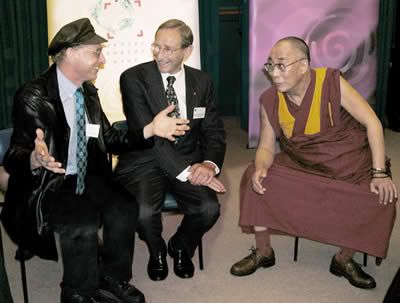
Photo credit: ripped from Centre For The Mind website
Thursday, October 27, 2005
Considering Excavations
On Tuesday night I attended a cocktail reception at Mixed Greens' new Chelsea digs, a nice, contemporary space with a comfortable flow. The reception was billed as a private affair and there were only twenty to thirty people in attendance, making art viewing and navigation easy.
The affair was pleasant enough; I sipped white wine and shuffled about the room, chatting with an artist friend of mine who had spent the day studying for the Graduate Record Exam (GRE). When I applied to art graduate programs in 1999, no schools requested GRE scores, so I was surprised to learn that Stanford, a program on my friend's list, does so. In most respects, I feel that the requirement is a good one; too many artists lack a liberal arts grounding. My friend, however, but pointed out that the GRE isn't a reliable measure of general knowledge, even if it does provide review committees with some sense of an applicant's aptitude. We moved to the bar area, refilled our empty plastic cups and the conversation moved in some other direction.
Still, this is a concern that I return to regularly. Many contemporary artists, despite the impressive sums they (or their family) have spend on graduate schooling, are un(der)educated, ignorant especially of literature, science, and history. This cultural and intellectual illiteracy compromises their work. Little wonder so many artists draw only on their immediate experience or the events of the day without regard to context beyond art world borders!
Some of the onus for this failure must be placed on the art world itself. When applying to art graduate programs, prospective students have a better chance of being accepted if they are familiar with "the system." Attending an undergraduate program with a "fine arts" focus, rather than a general liberal arts college with multi-disciplinary requirements, makes the applicant more art world savvy. These fine arts undergrad programs are essentially high-priced trade schools; the young artist is an apprentice. Their time in these stepping stone institutions prepares them well for many aspects of the art world - whether graduate school applications, grant writing, or mastery of art speak - but it leaves them unable to discuss the similarity between Shakespeare and H. L. Mencken or the political factors which led to the twentieth century's European nationalism. In fact, some of the artists I know deride such knowledge as esoteric (or "nerdy") and conversations about these subjects as self-consciously "heady." (Last week's "The Significance of Pluto to the Waterboy" essay addresses this anti-intellectual posturing.)
But what serious artist wouldn't want to learn as much as possible and, more importantly, apply it? T.H. White's Merlin, in "The Once and Future King," puts it well.
“You may grow old and trembling in your anatomies, you may lie awake at night listening to the disorder of your veins, you may miss your only love, you may see the world about you devastated by evil lunatics, or know your honour trampled in the sewers of baser minds. There is only one thing for it then—to learn. Learn why the world wags and what wags it. That is the only thing that the mind can never exhaust, never alienate, never be tortured by, never fear or distrust, and never dream of regretting.”Personally, I agree with the wizard's prescription, but it doesn't apply universally. A great many ignorant people are perfectly happy! Still, the work of even the happiest, un(der)educated artist risks cultural irrelevance because it is too tied to art world insularity.
The celebrated art critic Donald Kuspit insists that most contemporary art "reifies innovation into novelty and upsets the balance, leaving a disspirited intellectuality in its wake." Indeed, the art world's decision to prioritize innovation is an imaginative failure. Moreover, the work produced in the quest for novelty is usually (and paradoxically) unoriginal, overly indebted to art world and auction house trade winds.
The variety of art world artist that I'm critiquing might be characterized as Archilochus's hedgehog, the creature that knows only one "big thing." The hedgehog is a specialist, in the context of the art world, shaped by trade school and the market. The fox, according the Archilochus, is a generalist, an animal that knows many things, but nothing so well as the hedgehog knows his or her one. Not surprisingly, I gravitate toward artwork made by foxes whose excavations are broad, even if their digs are more shallow. Digging deeply in just one spot will eventually make your work irrelevant to all but those who share your particular focus.
Bear in mind that, compared to most contemporary artists, I'm an intellectual conservative. I might even be labelled something of a traditionalist. Although I champion cultural relativism, I detest postmodern approaches to philosophy or morality; I'm as much a realistic pragmatist as I am a progressive dreamer, and I'm often out of step with contemporary aesthetic thinking. When I find a work of art frivolous, cloying or stupid, it's likely that other artists and critics will agree that it is superior, possibly even historically important!
Alvin Lustig, the twentieth century designer, believed that
"modernism reflected larger social goals of integrating art and life, blurring the boundaries that had separated high art and utilitarian object. As he put it, 'If I seem to place a heavy mantle of responsibility on the shoulders of those who are really only expected to make nice shapes and colors, it is because history demands it. Every act that allows productive facilities to serve only itself, contributes inevitably to the threat of destruction that already looms on the horizon.'"That a work engages the intellect or is truly utilitarian is important to me. Lustig may have considered only architecture and graphic design capable of fulfilling these requirements, but I feel strongly that the best contemporary painting, drawing and sculpture can communicate in as vital a way as the walls of Lascaux. Centuries have complicated our interpretation of images, and necessitated that we process a great deal more information than our forebears, but we remain the essential ape.
Photo credit: ripped from mathscareers.org
Wednesday, March 23, 2005
Biology For The "Everyman"
The range maps and brief habitat descriptions found in field guides – most people will be familiar with a "bird book" and the colorful diagrams explaining where the different species winter, summer, and breed – are not gospel; there are always exceptions to the rule. Unfortunately, even wildlife biologists sometimes forget this.
Some years ago my father, a conservationist and writer, observed a Trumpeter Swan (Cygnus buccinator) on our Virginia farm. He called some ornithologist friends to report the unusual sighting, but the scientists scoffed at the notion of a Trumpeter visiting a coastal Virginia pond. Undeterred, my father photographed the bird, had the film developed, and sent them all images, at which point they changed their tone and agreed that this was a remarkable occurrence. Thanks to my father's documentation, this story ended happily, but I remain frustrated that the ornithologists, who all know my father to be an excellent birder (he's written books on the subject), doubted him.
For years, I bemoaned the "intellectual arrogance" of wildlife biologists, caricaturing them as stern bureaucrats more concerned with establishing reputations than expanding what we know of a species. By my early twenties, though, I realized that some degree of skepticism on the part of biologists is necessary. Dubious sightings are reported all the time: a wild grizzly bear in Florida; a crazed grey wolf in Massachusetts; a "poisonous black snake" chasing Maggie Ann across the yard. So many of these erroneous claims are relayed to biologists, especially at the local level, that they are forced to install a "junk" filter. Unfortunately, reports of real interest are lost in the process.
The scientists' skepticism also discourages people from reporting their observations in the first place. Several times I've suggested someone report an interesting sighting and the typical reaction is something like, "I'm not a scientist. What am I gonna tell them? Um, so I saw a mountain lion in West Virginia... They'll think I'm an idiot." In the age of the digital camera, though, some of the more far-fetched accounts may garner professional attention. (On the other hand, maybe the age of the digital manipulation automatically makes all documentation suspect?)
At any rate, this article serves as an encouraging counter-point. Diane Peterson, a remarkable elementary school teacher in Washington, hasn't just turned her students on to science, she has allowed them to produce valuable data, which will now be used (by the initially skeptical biologists) to expand our knowledge of short-horned lizards (Phrynosoma douglasi). If more educators were this innovative, the world would be a better place.
Subscribe to:
Posts (Atom)