Showing posts with label division. Show all posts

Friday, August 19, 2011

Making More "Live Animals"


Two weeks ago, I presented a lecture at the Art College Center of Design, in Pasadena, California, titled "Aesthetics, Ethics, and Experience." It was my first attempt to respond to the question of how contemporary artists might connect the "fine arts" to society at large, and I drew from an array of sources, classical (Heraclitus; Aristotle) and contemporary (Dave Hickey; David Milch; Erik Reece), to constellate what I'd like to think Aristotle would have described as a virtuous way of being in the world (as an artist). After the lecture, one of the students remarked that it was the "most liberal arts style" approach she'd come across in art school. I appreciated her compliment, but it reminded me of the urgent need for more generalism in arts education.

As I often insist, there is a lot of beautiful and compelling artwork produced and exhibited today, but it generally lives apart from popular culture. We -- that is, those of us active in the fine arts -- are complicit in this ghettoization because we're content to carry on a conversation among ourselves. Moreover, because we've come to preference our tribe's voices over others, there is a surplus of insider commentary and critique passed off as art. Almost all of this work and wordiness is irrelevant to the world outside the ghetto walls and, because young artists are educated in this context, with little or no pedagogical emphasis on disciplines other than art theory, the art and commentary become, over time, increasingly provincial. The wellspring of this contemporary predicament is as old as modernism.

On the heels of co-curating "A Live Animal" with Selene Foster, I've been rereading John Dewey's brilliant Art & Experience essays (1934). Dewey writes, and I quote him at length because he articulates the crux of the problem so eloquently:
" [Art is today] isolated from the human conditions under which it was brought into being and from the human consequences it engenders in actual life experience. [...] Art is remitted to a separate realm, where it is cut off from that association with the materials and aims of every other form of human effort, undergoing, and achievement. A primary task is thus imposed upon one who undertakes to write upon the philosophy of the arts. This task is to restore continuity between the refined and intensified forms of experience which are works of art and everyday events, doings, and sufferings that are universally recognized to constitute experience.

[...] So extensive and subtly pervasive are the ideas that set Art upon a remote pedestal, that many a person would be repelled rather than pleased if told that he enjoyed his casual recreations, in part at least, because of their esthetic quality. The arts which today have most vitality for the average person are things he does not take to be arts: for instance, the movie, jazzed music, the comic strip, and, too frequently, newspaper accounts of love-nests, murders, and exploits of bandits. For, when what he knows as art is relegated to the museum and gallery, the unconquerable impulse towards experiences enjoyable in themselves finds such outlet as the daily environment provides.

[...] For the popular notion comes from a separation of art from the objects and scenes of ordinary experience that many theorists and critics pride themselves upon holding and even elaborating. The times when select and distinguished objects are closely connected with the products of usual vocations are the times when appreciation of the former is most rife and most keen. [...] Theory can start with and from acknowledged works of art only when the esthetic is already compartmentalized, or only when works of art are set in a niche apart instead of being celebrations, recognized as such, of the things of ordinary experience. Even a crude experience, if authentically an experience, if more fit to give a clue to the intrinsic nature of esthetic experience than is an object already set apart from any other mode of experience. [...The] trouble with existing theories is that they start from a ready-made compartmentalization, or from a conception of art that 'spiritualizes' it out of connection with the objects of concrete experience. The alternative, however, to such spiritualization is not a degrading and Philistinish materialization of works of fine art, but a conception that discloses the way in which these works idealize qualities found in common experience. Were works of art placed in a directly human context in popular esteem, they would have a much wider appeal than they can have when pigeon-hole theories of art win general acceptance.

[...] The sources of art in human experience will be learned by him who sees how the tense grace of the ball-player infects the onlooking crowd; who notes the delight of the housewife in tending her plants, and the intent of her goodman in tending the patch of green in front of the house; the zest of the spectator in poking the wood burning on the hearth and in watching the darting flames and crumbling coals."
Amen, Mr. Dewey...though I'd add that the "primary task" to "restore continuity between" works of art and the everyday is not only the obligation of the art writer; it is also incumbent upon the conscientious artist. Artists need to make art that connects to common human experience, and both artists and art writers need to communicate more effectively with the general audience.


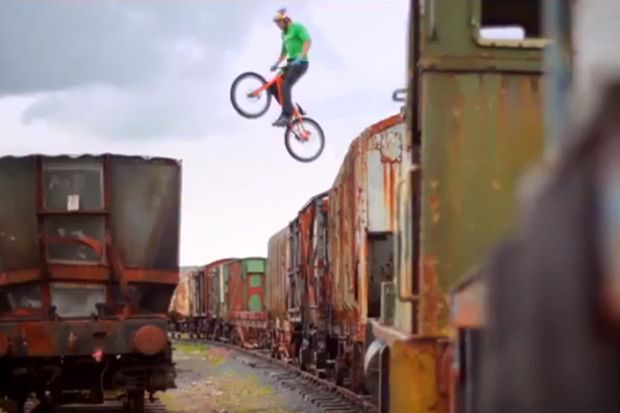
I thought of Dewey's argument when watching a video of Scottish cyclist Danny MacAskill that was recently shared by a friend on Facebook. The video offers a more visceral (and therefore meaningful) aesthetic experience than most of the contemporary art I've viewed in the last weeks. An acrobat with his bike, Macaskill is Dewey's "live animal," "fully present, all there" because of he has honed his craft and is, as we often hear athletes put it, "in the zone."

Can contemporary fine art inspire people to exclaim, as one person did in the comments under my friend's Facebook posting of the Macaskill video, "That's crazy & beautiful!"? Can artists again enthuse the general audience?

I believe that we can, and I hope that I can one day have an opportunity to design (or help to design) an undergraduate or graduate art curriculum that prioritizes generalism and social responsibility.

Photo credit: photo of Danny MacAskill ripped from CyclePath Magazine

Wednesday, February 17, 2010

Evolution Weekend


This past weekend, countless couples the world over celebrated Valentine's Day. Far fewer, however, marked Evolution Weekend 2010 on our calendars. I did not participate in any Evolution Weekend events this year; I hope to rectify that oversight next year, as the goals of the project are worthy and important.

From the project's website:
"Evolution Weekend is an opportunity for serious discussion and reflection on the relationship between religion and science. One important goal is to elevate the quality of the discussion on this critical topic - to move beyond sound bites. A second critical goal is to demonstrate that religious people from many faiths and locations understand that evolution is sound science and poses no problems for their faith. Finally, [...] Evolution Weekend makes it clear that those claiming that people must choose between religion and science are creating a false dichotomy. Through sermons, discussion groups, meaningful conversations and seminars, the leaders [of this effort] will show that religion and science are not adversaries."
To date, roughly 13,000 American Christian, Jewish, and Unitarian Universalist clergy have signed letters stating that evolution and religion are compatible. To some of us, this compatibility is a no-brainer, but for many intractable anti-religionists and literal-minded religious Americans, there can be no comfortable cohabitation. Both extremes are guilty of arrogance, thoughtlessness, or both.

Yet those of us in the middle might do well to take a lesson from the activist extremes. As Rabbi Robert Barr, of Congregation Beth Adam in Loveland, Ohio, said recently,
"It is amazing and disturbing that biblical literalists have been able to successfully challenge the concept of evolution and in doing so change how science is taught in school and [require] congregations and clergy to stand up and endorse an idea that is 150 years old. [...] Perhaps what has made the anti-evolution crowd most successful is their passion. While I disagree with them, I appreciate their energy and their commitment, and I want those of us who embrace science, modernity, and religion to be equally committed to our beliefs."
It's not enough to know that there needn't be conflict between the material and metaphysical. We must also speak truth to bigotry and ignorance.

Image credit: ripped from C95 FM website

Thursday, August 13, 2009

Lowbrow Meets Highbrow


Issue of Juxtapoz Magazine
Cover art by Shepard Fairy
"A frog is either lowbrow or highbrow.

If you catch it, it's low. If you order it in a French restaurant, it's high."

-Unidentified chef, from Burkhard Bilger's Noodling for Flatheads
In 2007, commenting on the blog PaintersNYC, artist Kelli Williams observed that it's hard to be a Juxtapoz artist "in an ArtForum world." Juxtapoz is a popular magazine dedicated to showcasing contemporary "lowbrow art." It was founded by the artist Robert Williams in 1994. The "ArtForum world" of Kelli William's statement references the magazine of that name, but also the "high art" scene it covers, of which New York City, for the time being, remains an - if not the - epicenter. Until recently, the artwork featured in ArtForum was very different from that seen in the pages of Juxtapoz. Juxtapoz is representative of the Los Angeles art scene, and the U.S. west coast scene more generally, where the aesthetics of pop surrealism, folk art, post-graffiti, or street art are wholly embraced.

But artwork infused by Juxtapoz's colorful spirit is no longer uncommon in New York galleries. Andrew Schoultz, Tim Biskup, and Jeff Soto, talented west coast artists regularly lauded in the pages of Juxtapoz, today exhibit with the Morgan Lehman and Jonathan Levine galleries, and influential post-graffiti artist Barry "Twist" McGee is represented by the renowned Deitch Projects. Jonathan Levine makes plain his dedication to the post-graffiti aesthetic; his gallery's website states that its mission is to exhibit "work influenced by illustration, comic books, graffiti art and pop imagery." Perhaps it's no longer so hard, then, to be a Juxtapoz artist "in an ArtForum world"?

But, more importantly, does lowbrow art require the affirmation of the "high art" world - for easy contrast, let's call it highbrow art - in order to be considered mainstream or legitimate? If so, what exactly is the cultural significance of highbrow art to the world at large?


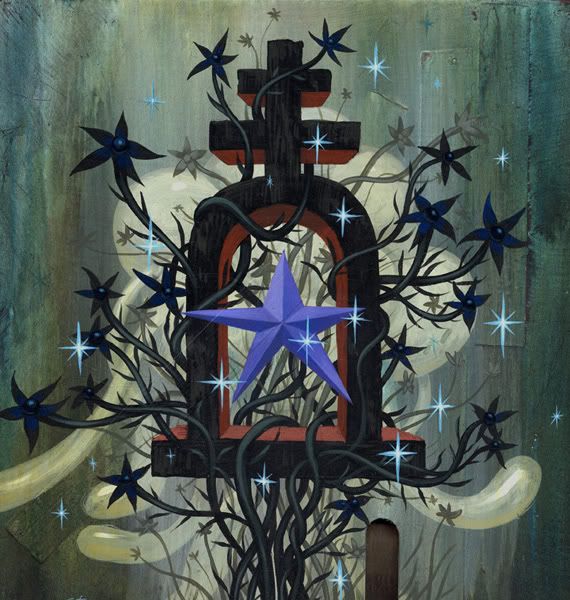
Jeff Soto
"Purple Heart"
2007
Acrylic on wood
12 x 12 inches

The commercial success of books like Beautiful Losers: Contemporary Art and Street Culture and Wall and Piece, the latest offering from the infamous British artist, Banksy, suggest that pop surrealism, post-graffiti, and street art succeed in connecting with the multitudes. On the other hand, it's an uncontroversial fact that highbrow art generally doesn't move the masses (with the exception of its remarkable ability to offend the religious sensibilities of the Christian Right and certain mayors). But highbrow art doesn't simply fail to connect with the general population; the fact is, most folks sneer at, mistrust, or resent ArtForum's world.

Perhaps because they feel beleaguered by popular tastes, many players in the world of highbrow art - artists, gallerists, critics, and curators alike - reject the influx of pop surrealism and post-graffiti flavor. But their objections will inevitably prove inconsequential; as the Borg of "Star Trek" put it, "resistance is futile." Even if some of the more esoteric subcultures of the Juxtapoz arena - Tiki culture, for example - are unlikely to find a toehold in the world of "high art," the graphic influences common to post-graffiti work already inform the paintings of contemporary art world darlings like Dana Schutz, Marcel Dzama, Trenton Doyle Hancock, Ryan McGuinness, Lisa Yuskavage, Yoshitomo Nara, and Jules de Balincourt. (In fact, Dzama and McGuinness have been featured in Juxtapoz; it won't be long before other celebrated highbrow artists are, too. One wonders if the lowbrow label will be applicable for much longer.) And then there are artists like Judith Schaechter, whose stained glass works were lauded in the pages of Juxtapoz years before her work hung in the Whitney Museum or before she received Guggenheim and National Endowment for the Arts Fellowships.


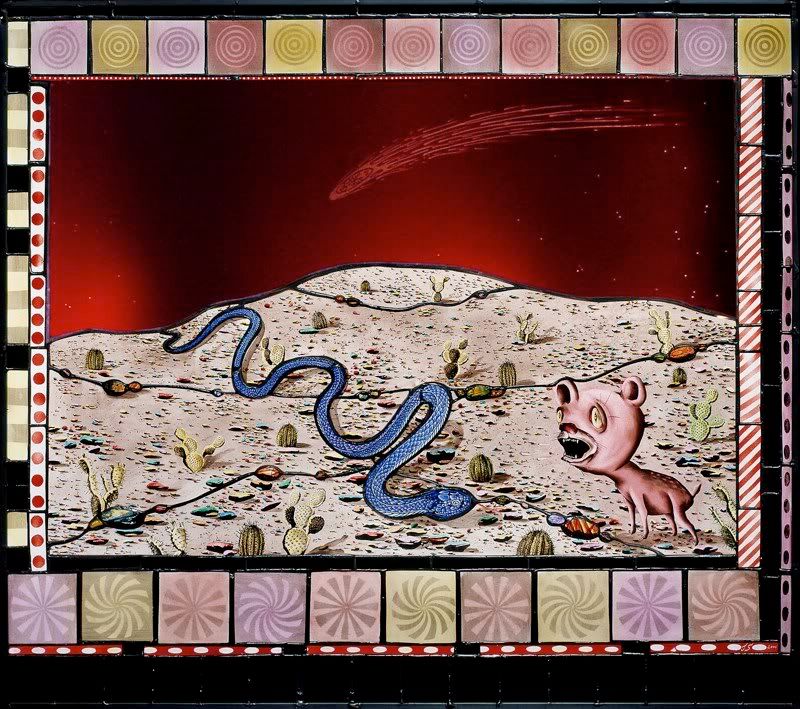
Judith Schaechter
"Hyena Snake Comet"
2004-2008
Stained glass
30 x 33 inches

Much of the highbrow resistance to pop surrealism and post-graffiti is rooted in the self-identified elites' distrust of populism. Comic books and strips are intended for mass consumption, but graffiti is unquestionably the most populist of the lowbrow tributaries. No art form has fewer barriers to entry; all you need is a can of spray paint and a little chutzpah. Ask someone knowledgeable about the subject to relate the history of modern graffiti, and you'll likely hear an abridged version, one that begins in the 1970s, in and around New York City's Bronx River Houses, and runs parallel to the development of hip hop. City funding for arts and culture programs was pitifully low at the time, and enterprising teens looked for new ways to entertain and express themselves. As Lady Pink, an influential graffiti artist of the late 1970s and 1980s, explains, graffiti was the most available "forum for free speech."

Of course, the human urge to make marks predates the Bronx River Houses by millennia. Our ancestors depicted their quarry on cave walls and, more recently, citizens of ancient Rome scribbled their political opinions on market stalls (hence the word's etymology, from the Italian graffiare, meaning "to scratch or scribble.") But during the early days of modern graffiti's ascendancy, practitioners prioritized ego over observation or socio-political commentary. The pioneers of the 1970s and 1980s graffiti scenes in New York City and Philadelphia - Taki 183, StayHigh 149, Cat 161, and Cornbread, among others - were primarily known for their "tags," stylized monikers spray painted on walls and subway cars. They vied for renown by tagging as many surfaces as they could, and walls that were difficult to access had a special cache. The competitive behavior of these early graffiti "artists" might be best described as base scent marking, activity essentially indistinguishable from the industry of the bored high school student who scratches "(x) was here" on the wall of the bathroom stall. Fortunately, as more artists entered the nascent graffiti scene, such adolescent "battling" became insufficient impetus; soon, the egotistical tag evolved into something more colorful and complex. Artists added characters, often comic in nature, a result of their limited palettes and time frame, and, before long, these characters evolved into "pieces" (short for masterpieces). The best graffiti artists came to value style and artistry as much as placement.

The conceptual and social strengths of graffiti and street art are rooted in the artists' acceptance of temporality and his or her desire to engage the environment and citizenry directly. As Simon Hattenstone, a features writer for The Manchester Guardian, writes, "Since spotting my first few Banksies I have been desperately seeking out more. They make me smile and feel optimistic about the possibilities of shared dreams and common ownership." Insofar as it is truly democratic, the street artist's approach is fundamentally distinct from that of those who aspire to "high art" success. "Fine artists" are essentially aristocratic in inclination. They are the elites who operate within the context of "high art" institutions; their work is most often viewed in semi-sacred, unlived in spaces, by people who talk about the work in reverent whispers. Street art, by contrast, is viewed by everybody who happens past the artwork. But, today, as the post-graffiti movement sees many of its more celebrated artists entering the "high art" sphere, the populist flavoring of the culture is eroding.


Banksy
"Balloongirl"
Artwork on West Bank barrier between Israel and the West Bank
2005

Is the aesthetic melting pot a bad thing? The answer depends on your perspective, of course; personally, I'm all for it. Like many contemporary artists, I'm not alone in feeling that my artwork and aesthetic inclinations plant a standard somewhere between the poles of Juxtapoz and ArtForum. Just as I feel torn between my rural roots and the creative community and energy of city life, so too am I drawn to elements of both art orbits, east and west, highbrow and lowbrow. I live and work in New York, so I've cultivated an appreciation for the importance of conceptual heft. But I'm also an erstwhile subscriber to Juxtapoz who, in my youth, eagerly thumbed through the pages of the Advanced Dungeons & Dragons Monster Manual, read fantasy novels and comic books, and honed my drawing chops by copying from comic strips. Perhaps I'm biased, then, but it seems that aesthetic commingling introduces hybrid vigor into otherwise "inbred" scenes.

Too many circles of the "high art" world are poisoned by intellectual pretension, obscurantism, and exclusivity. The ArtForum world is principally concerned with auction results and art historical significance. In east coast MFA programs, the mills of the contemporary "high art" world, a common question asked of students is, "Where does your work fit in the historical trajectory?" Indeed, at great cost to social legitimacy, the "high art" world has prioritized originality and artistic genealogy.

Much of the "lowbrow" scene, by contrast, is blighted by the artists' focus on disposable pop culture, their willingness to cozy up to the marketing machine, and their populist posturing. In an interview with Juxtapoz, one young artist said,
"When it comes right down to it, I draw the stuff I like, and people can take it all for whatever they want. I would say that 95 percent is liking big boobs and butts, the other five percent is brain farts that end up in a sketchbook that later ends up as a painting or whatever."
Although I wrote down this quotation without recording the artist's name, I do recall appreciating some of his graphic skill. Still, when I'm confronted with such a thoughtless statement, I can appreciate the animus that brooding, theory-oriented types have for lowbrow art. Where is the evidence of this young artist's vocational mindfulness, his rigorous passion, his poetic sensibility? Of course, his defenders would likely praise his candor, but, in truth, he's posturing as much as the bespectacled, black-clad fellow who insists in his jargon-laden artist statement that Jacques Derrida informs all of his output.


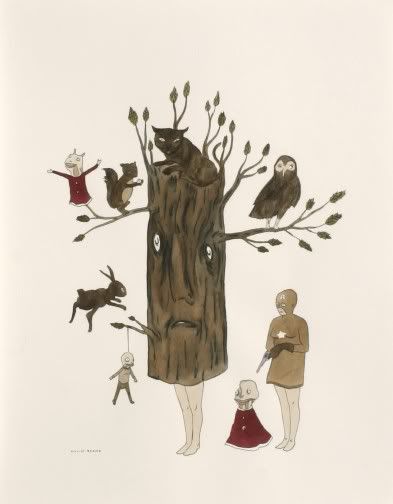
Marcel Dzama
"Untitled"
2005
Watercolor on paper
14 x 11 inches

Despite haughty sneers from individuals on both sides, it seems to me that the transition that so many post-graffiti artists are making, from the streets to the galleries, could (and should) help create a less sectarian art world. The selfish pretensions of the highbrow art world could be tempered by an influx of no-nonsense, illustrative exuberance, and the lowbrow art world could jettison some of their conceptual superficiality by taking the philosophical and moral obligations of their vocation more seriously. That is, in any case, my hope.

Image credits: Juxtapoz cover image ripped from Rotofugi.com;; Jeff Soto image ripped from the Jonathan Levine Gallery website; Judith Schaechter image ripped from the artist's website; Banksy image ripped from the Brian Sewell Art Directory; Marcel Dzama image ripped from David Zwirner website

Thursday, July 02, 2009

Repairing America (and beyond)


Micanopy, Florida


While visiting central Florida last month, an acquaintance told me that all of her Gainesville co-workers are fans of Rush Limbaugh's radio punditry. On the highways around the small city, I saw countless pro-life billboards and a good number of "NObama" bumper stickers on passing pickup trucks. Although the city's populace supported Obama in the 2008 presidential election (as did the state), it was very clear that the city represents a blue dot in a red region.

Contemplating this red state mentality, I recalled Thomas Frank's "Lie Down for America," an excellent, if depressing article published in the April 2004 issue of Harper's Magazine. Frank dissected, in his words, "how the Republican Party sows ruin on the Great Plains."
"Whereas earlier forms of conservatism emphasized fiscal sobriety, the backlash mobilizes voters with explosive social issues - summoning public outrage over everything from busing to un-Christian art - which it then marries to pro-business economic policies. Cultural anger is marshaled to achieve economic ends.

[...] 'Rural America is pissed,' a small-town Pennsylvania man told a reporter from Newsweek. Explaining why he and his neighbors voted for George Bush, he said: 'These people are tired of moral decay. They're tired of everything being wonderful on Wall Street and terrible on Main Street.'"
The same Wall Street-Main Street dichotomy was trotted out by campaigning Republicans four years later, in 2008, to cast the GOP as the party of the people. But did the tactic really work? After all, Obama won the 2008 election. Aren't rural and Middle America coming around, realizing that the Republican party doesn't have their best interests in mind, even in those cases where the social issues of the Right more closely align with their values?

I hope so, but I wouldn't bet on it. Middle America will jab an angry finger at someone, and faithful Rush can't be the enemy. Our country is already waging a war against Islam, so we know that the Muslims are "against us," but they're not pulling America's economic strings. And, as a general rule, black folks don't have too much power, Obama not withstanding. But, wait a second...aren't there a lot of socialist Jews whispering in Obama's ear? Hell, isn't he related to a rabbi!?

The July 2009 issue of Harper's includes two disturbing poll results.
Chance that an American thinks 'the Jews' were moderately or very much to blame for the financial crisis: 1 in 4

Chance he or she thinks they were 'a little' to blame: 1 in 7
This is a shocking statistic! I wonder what percentage of Americans believe that "the Jews" are no more culpable than any other ethnic or religious group?

Oh, but that's a silly question! After all, "the Jews" are the denizens of Wall Street, and Main Street folk like Dubya and Rush don't like that sinful, unAmerican place. It should be clear to me that the current recession - when should we start calling it a depression? - is not the result of the unsustainable, myopic economic policies of the last sixty years (amped up by Ronald Reagan, but embraced by both Democrat and Republican administrations). It's instead the vast Zionist conspiracy! The socialist Jews have teamed up with the capitalist Jews to forge an unholy alliance, and they're running the global economy into the ground!

Would that I could laugh off such frightening ignorance. Unfortunately, the bigotry is not evidenced only on the Right. In fact, the same study cited in Harper's showed that the registered Democrat respondents were 12% more likely than responding Republicans to blame "the Jews" at moderate or higher levels. There is a time-tested, inverse relationship between economic performance and anti-Semitism, and this correlation isn't affected, evidently, by political affiliation.

The New York Times reports today that "U.S. Job Losses Rise and Unemployment Reaches 9.5%."
"The American economy lost 467,000 jobs in June [2009] and the unemployment rate edged up to 9.5 percent in a sobering indication that the most painful downturn since the Great Depression has yet to release its hold."
Things are going to get a lot worse for Middle America. Finger pointing does none of us any good (and certainly not the tiny Jewish minority in the United States).

Still, I remain optimistic. As I wrote in January,
"Call it Obamatism, call it naive idealism, call it what you will...but it's time to participate, to put aside our generation's infantilism and get to Aristotle's happy work. [...] We will pass through our challenging stage of human social development but, fraught as it is, the need for an active and immediate commitment to bettering our world's future is great."
Jews call that tikkun olam, repairing the world. Get to it, people!


Photo credit: Hungry Hyaena, 2009

Friday, June 05, 2009

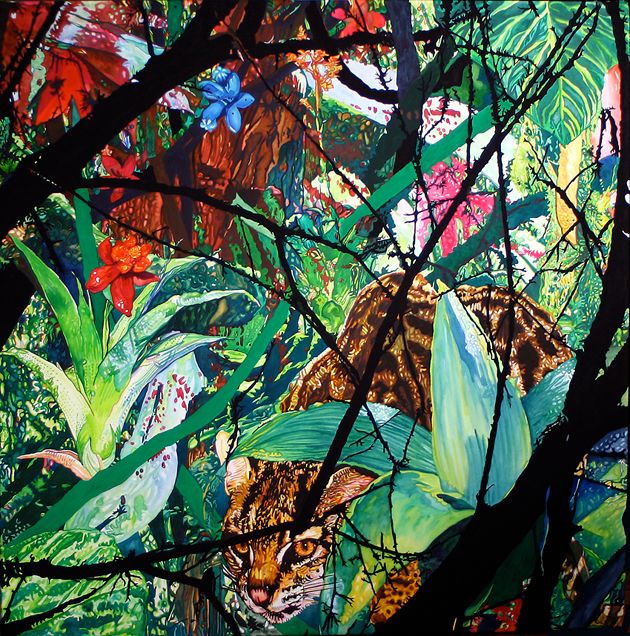
Ocelots at the Gate!


Christopher Reiger
"between meaning and material (h.H.R.)"
2007
Watercolor, gouache, graphite and marker on Arches paper
32 x 32 inches


Diminutive yet captivating, the ocelot (Leopardus pardalis) is my favorite cat species. I've only appreciated the beautiful feline on film and in photographs, but am nonetheless impressed to near reverence. I delight in the animal; I marvel at his dappled coat as he passes through dense foliage and I am humbled by her grace and cunning gaze.

Years ago, when working at a eco-tourism tent camp on Costa Rica's Osa Peninsula, I had the privilege of tracking an ocelot's nighttime doings along a Pacific beach that abuts a steep jungle mountain. I didn't discover the cat, but I took great pleasure in tracing the cat's movements, and I was deeply grateful for the opportunity to commune with the creature, even in so simple a fashion.

It is with great distress, then, that I consider the plight of the ocelot and other species in the Lennox Foundation Southmost Preserve, a 1,034-acre preserve located at the southern tip of Texas. As proposed by the United States Department of Homeland Security, the Mexico-U.S. border fence will pass through the center of this preserve, up to a mile-and-a-half north of the actual border. Three quarters of the preserve will thereafter be inaccessible by employees of the Nature Conservancy, the organization that currently manages the property. Because the Nature Conservancy refused the USDHS buy out, they are being sued by our federal government.

In her Nature Conservancy Magazine article "Don't Fence Me Out," Jennifer Winger writes:
"Once known as the Wild Horse Desert, south Texas may support more wildlife per acre than any other habitat in North America. And although the Rio Grande Valley itself has lost more than 95 percent of its wildlife habitat, Southmost Preserve is a shining exception: Its lands and waters provide habitat for endangered species such as jaguarundis and ocelots, as well as indigo snakes, Texas tortoises and migratory birds.

But recently, this valuable habitat has been threatened by an 18-foot-tall concrete and steel fence proposed by the Department of Homeland Security. Most of the proposed 670-mile-long border fence, with segments from California to West Texas, has already been constructed, but the section slated to cut through the Conservancy’s land is on hold, pending the outcome of a legal battle.

...If the fence is built, nearly 700 acres — 75 percent of the preserve — would be trapped in a no-man’s-land between the fence and the Rio Grande, including all preserve facilities and the home of the preserve manager. The proposed fence would effectively cut off access to the native plant nursery, which is critical to reforestation efforts throughout south Texas. Additionally, the fence would sever a critical corridor for wildlife, as it could block animals from accessing protected areas to the north and freshwater resources to the south."
Contemplating the myopic vision of the USDHS, I recalled an earlier HH post that questioned that morality of building a border fence. In light of this recent news from Texas, I've decided to republish "Border (Bio)diversity (of opinion)" today.

+++++


The Robert Smithson in me is bemused by international borders, particularly those boundaries that are not physically demarcated, lines that exist only in cartography and our collective political imagination. Last night, I contemplated a striking black-and-white photograph of the Mexico-U.S. border. The image was dominated by a rural "vehicle barrier" fence (similar to the one shown above), far removed from an official border checkpoint or crossing. In the desert of the American Southwest, this fence draws an arbitrary line in wire and steel.

It struck me as an emblem of humanity's absurdly tenuous existence, a reminder that our species is an insignificant mote in an incomprehensibly tremendous weave. As the artist Carl Buell wrote in the comments section of a recent HH post,
"With every change in sea level and shoreline, with the raising or eroding of every mountain range, with every changing weather pattern, life spreads out as it can and comes into contact with new environments, opportunities and hazards...As I get older (than dirt), I find myself starting to think like the hills themselves. Some day after eroding and washing out to sea, I’ll be a hill again."
Indeed, each of us (and, eventually, our species) will be reconstituted, and our arbitrary borders, those lines in the mud of space-time, will be erased. In this respect, the border fence is a healthy reminder of our existential folly, but it also reveals humanity's darker inclinations. We build fences, after all, to divide "us" from "them," the demonized "other."

The photograph that inspired this post was printed in the most recent issue of Wildlands Connection, the Wildlands Project newsletter. It accompanied an article about wildlife bottlenecks at the Mexico-U.S. border. The Wildlands Project's mission is to create vast, uninterrupted linkages, known as wildlife corridors, that will extend from Canada into Mexico (on the Rockies spine) and from Canada into Florida (on the Appalachian spine). The U.S.-Mexico border fence is a major obstacle to the organization's first goal.

Yet physical barricades are but one of the obstacles that ambitious conservationists face. Consider wildlife trade legislation that protects species in one country, but not another, adjacent nation. If strict laws prohibit the trapping or hunting of a species in China, for example, but not in neighboring Mongolia, is the Chinese legislation effectively addressing species welfare (particularly when Chinese citizens are paying top dollar to have the killed contraband imported)? Similar issues haunt conservation efforts the world over.

The humanitarian and social concerns that ethically-minded conservationists must take into account present a more nuanced hurdle. Environmental groups in the European Union are warring with one another about how best to create the legislative and physical infrastructure necessary for sustainable energy development. How can you raise thousands of wind turbines without hindering bird migration, ruining aesthetics, or plopping towers in the backyards of folks too poor and disenfranchised to protest?

If the various interest groups in the EU, one of the most environmentally progressive governing bodies in the world, are at odds, is it realistic to expect conservation to become a truly supra-national affair? After all, the EU's concerns are petty alongside those of the southern hemisphere. Whereas Europe is a sprawl of cultivated landscape relatively lacking in biodiversity, the "Third World" represents the usually disastrous meeting of remarkable biodiversity and an exploding human population. Impressed by our terrible example, the citizens of these nations emulate the unsustainable behavior of the "First World." In order to counter the detrimental environmental effects of Third World industrialization, international legislation will face increasingly substantial challenges. The supra-national bodies can create laws, but can we enforce these laws without wielding the colonial sceptre? More critically, can we conserve biodiversity and healthy ecosystems without subjugating the rights of the humans that call the Third World home?

These questions bring me to "Climate of Fear," a recent book by the eloquent Nigerian poet, essayist and Nobel Laureate, Wole Soyinka. Though Soyinka is writing about humanity's attempt to cope with terrorism, his political thrust is applicable to all realms, and his message is clarion.
"The gray zones of moral definitions where relativity reigns and remote cause are evoked to justify the abhorrent will continue to haunt certain casts of mind. The rest will insist on the primacy of an ethical will, one that dictates that some deeds demand to be judged within an identifiable and shared moral universe, however restricted...The ethical will is the redeeming assertion that, even when all other considerations of social conduct are subjected to the fortuitous, one, an ethical core, remains inviolate."
All of our fences fail. Perhaps we should recognize in that certainty both an entropic truth and an implicit morality. Within the context of this "shared moral universe," we are impelled to remove artificial barriers, whether they are constructed to stem the natural tide of human migrations or to protect us from our enemies. No matter the justification for the boundaries we draw, they are immoral inventions. And man, it is said, is the moral animal.

Photo credit: ripped from Kris Eggle's website

Tuesday, February 17, 2009

False Divisions

I recommend Bioephemera posts often enough to be mistaken for that blog's unofficial spokesperson, but I'll continue to do so, and without reservation. It's an exceptionally well-written and thoughtful blog...plus it has a lot of really cool things to look at!

I encourage HH readers that are interested in the ongoing debate between science and religion to read Jessica Palmer's recent essay, "Taking Darwin's name in vain." Jessica offers a reasonable take on a complicated, fraught issue. I include her particularly quotable conclusion below.
"There's danger in thinking that just because something is or was evolutionarily adaptive, it is good for us. Science can shed great light on why humans might perceive things as good or bad, but it can't tell us what is good or bad. That's a question with which we have to constantly struggle, just as Darwin struggled with the existence of God.

One of the difficult realities evolutionary theory has made clear to us is that the human mind is not optimized for truth. It's optimized for survival. We routinely embrace adaptive fictions. If we want to use our understanding of evolutionary processes to improve society, we must accept that evolution did not bestow upon us a dispassionate, non-spiritual, strictly evidence-based worldview. We're passionate, spiritual, emotional, irrational, subjective creatures who are poorly equipped to imagine incremental change taking place at an invisibly tiny scale over millions of years - because we evolved this way! Getting the human mind to run the scientific method as its primary OS is a bit like getting a Nintendo to run Linux: we should be impressed that it can be done, not complaining that it's hard. And when people express deep spiritual reservations or conflicted feelings about the religious implications of evolutionary theory, just as Darwin did, scientists have to understand that it's not just because they're ignorant or obstinate. It's because they're human."
Read the essay here.

Tuesday, February 05, 2008

Party Faithful

"If I could not go to heaven but with a party, I would not go there at all."
-Thomas Jefferson
A registered independent, I can't vote in New York State's closed primary today.

What sort of sense does this make in a democracy?

Wednesday, January 09, 2008

Same 'ol...

A co-worker orders me an Old Bushmills whiskey. When the bartender begins to pour a Jameson instead, my co-worker balks. "No, that's Catholic whiskey, Pat! We want the orange, the Protestant."

Behind us, on the television, a Rudy Giuliani campaign commercial features footage of gun-toting insurgents, explosions, and Iranian president Ahmadinejad. The voiceover: "Hate without boundaries. A people perverted. A religion betrayed."

Monday, November 06, 2006

Vote, baby, vote


Please, please, please vote!

Whatever your politics may be! Vote. However mired in cynicism you may sometimes feel! Vote.

(Especially if you're eligible in my home state.)

Photo credit: ripped from funnydog.net

Tuesday, July 11, 2006

Thinking Like A Mountain?


Erik Reece's eloquent essay, "Death Of A Mountain: Radical Strip Mining and the Leveling of Appalachia," was included in the April 2005 issue of Harper's Magazine. The piece examines and responds to environmentally devastating coal mining practices in eastern Kentucky. Appropriately enough, I read the work while standing in an abominably long line at the World Expo, in Aichi, Japan, the first World's Fair dedicated to "green" thinking or, as the Japanese organizers dubbed it, "Nature's Wisdom."

Every pavilion in the Aichi Expo was sponsored by either a nation or a corporation (a sign o' the times), and they all forecast a happy, healthy, and sustainable future for humanity and for the planet. Reece's melancholy report provided a sobering counterpoint. A "green future" is tenable only if the necessary changes in technology and lifestyle generate an altogether different kind of green: cash money. As the wife of a Kentucky coal miner asks Reece, "What use are the mountains to us other than coal? When are you going to start thinking about us instead of the environment?" Until alternative energy cheerleaders assuage the concerns of those citizens dependent on income provided by companies like Leslie Resources Inc., one of the mining outfits indicted in Reece's article, America's hard-working, blue-collar folks will remain united in opposition to the relatively privileged mouthpieces of environmentalism.

In "Death of a Mountain," Reece describes the minutes of a Kentucky hearing addressing an Environmental Impact Statement on mountaintop removal, the principal method of tapping into buried coal seams. The local coalfield citizens in attendance, many of them employed by the region's energy companies, reacted against "outsiders" telling them what was best for them and for their land. They even hinted "at a conspiracy afoot by the rest of the state to keep eastern Kentucky poor." Not surprisingly, such vehement antagonism to "greening" measures were not highlighted at the Aichi Expo. Likewise, they receive scant attention in environmental publications, even those produced by more thoughtful organizations,including The Sierra Club, Natural Resources Defense Council and EarthJustice. It's clear that most environmentalists don't consider the lives of those people displaced by expanding parkland or laid off by companies under siege from environmental legislation. It's little wonder that "Third World" countries and blue-collar workers like the Kentucky miners or the fishermen of the Galapagos islands object to what they consider do-gooder meddling.

In Aichi, I looked up from the magazine and noticed a Japanese teenager in line not far behind me. He was wilting under a sun umbrella, wearing a t-shirt emblazoned with a picture of the popular American hip-hop duo, Outkast. Fond of connecting seemingly unrelated strands, I thought of the Outkast song, "Return of the G." The lyrics of the song begin, "Every time I try to get peace of mind, niggas try to get a piece of mine, so I gotta grab my piece." The song concisely describes an ugly, myopic cycle, but how much easier for me to characterize it as such when I can afford a plane ticket to Japan and enough over-priced, organic vegetables to fill my canvas grocery sacks?

As a proponent of conservation and environmental protection, I'm necessarily guilty of prioritizing the sustainable long-view over the millions of people vying to put food on their plate. I considered this distressing reality as I entered the air-conditioned Hitachi Pavilion in Aichi to watch an animated feature about the catastrophic - nay, apocalyptic - events brought on by humanity's cavalier approach to natural resource consumption.


A mushroom cap raises a mossy roof

Similar considerations were on my mind this past week, when I traveled to the Monongahela National Forest, in eastern West Virginia, for some camping, hiking, and herping. I know very little about West Virginia, despite having spent several summers at Camp Greenbrier, situated just outside Alderson, in the southern part of the state. During those summers I learned about kayaking, archery, riflery, rock climbing, and the cruel conduct of boys left unsupervised, but I was too young - just nine or ten years of age - to absorb much about the region save the scenic beauty.

Following those camp years, John Denver's song "Country Roads," a particular favorite of my mother, acquired new significance for me. "West Virginia, mountain momma...take me home," Denver sings. Having appreciated the lush splendor of the Appalachian range for myself, Denver's lyrics imparted an aesthetic association as well as the allusion to a mother's buxom embrace. But Denver's paean doesn't only acknowledge West Virginia's awesome landscape. He refers to the state as the "miner's lady...dark and dusty." Even the state's coat of arms, central on the state flag, pictures a miner, pickaxe slung over his shoulder, standing alongside a farmer. But modern miners have largely abandoned the pickaxe in favor of cranes and bulldozers, and evidence of mountain top removal can be seen from the state's highways. Treeless plateaus neighbor intact peaks and, although geologic time will see these scars support trees and other vegetation anew, one can not help but wonder what has become of the once healthy water supply fed by the decapitated mountain streams.

Happily - some might even say selfishly - I was able to avoid despair during my time in Monongahela. Unlike so much of the state, the mountains of the National Forest have been spared extensive surgery. All the same, the park map is peppered with mine sites, demarcated by a pick and shovel. The stream water I drank - after an iodine pill dosing - seemed safe enough (I didn't get sick), but I couldn't quite shake worries about mercury or heavy metal content. Encouragingly, we found plenty of amphibians in the streams, and this suggests that the water is clean.
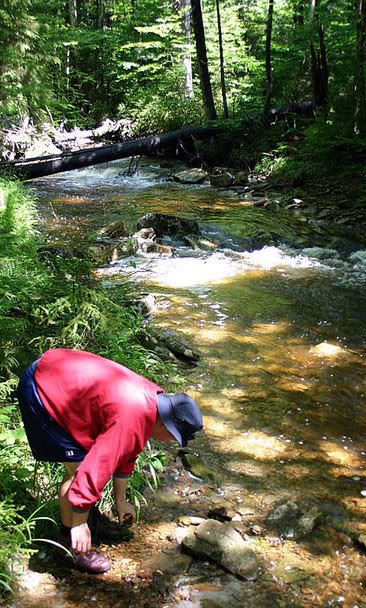

Salamander hunting near Cheat Mountain Camp

* * * * *

Amphibians: We identified four species of salamander; one example of each is pictured below.


Mountain Dusky Salamander (Desmognathus ochrophaeus)

The Mountain Dusky Salamander (Desmognathus ochrophaeus) was the most common, at least according to our crude census. They seemed to flourish alongside streams, under partially submerged rocks, and on the mountain's face, under woodland detritus - bits of rotten limbs or clumps of moss. The coloration of this species is wide-ranging. Some of the individuals we came upon could have passed for the unrelated redback (Plethodon cinereus), while others appeared more yellow, tan, or even chocolate. Fortunately, one of my companions is an avid herper and he was readily able to distinguish the two species by examining the head and nostrils. When in doubt, I defer to his expertise.
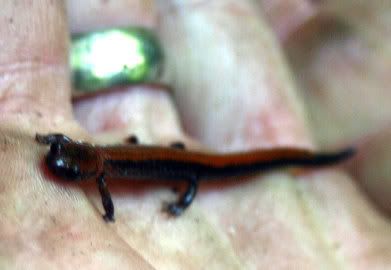

Redback Salamander (Plethodon cinereus)

Comparatively scarce was the redback salamander and, if I'm recalling accurately, we only discovered this species near woodland vernal ponds. Unfortunately, all my photographs of the species turned out poorly. The models, this one included, didn't much take to posing, forcing me to hurry the shots.
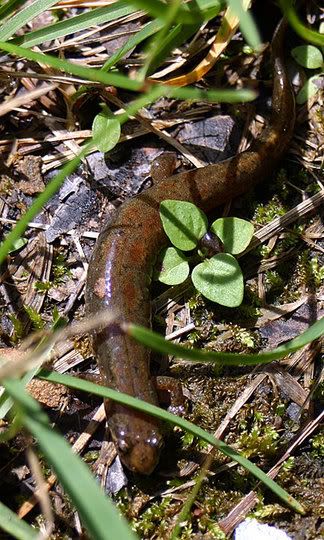

Spotted Dusky Salamander (Desmognathus fuscus conanti)

The most unusual discovery of the trip was a Spotted Dusky Salamander (Desmognathus fuscus conanti). The species is not known to live in the region - according to field guide range maps, anyway - but, nevertheless, we encountered this individual under a flat rock in an insignificant stream and spent some time confirming the ID. Proof, once again, that nature is always throwing curve balls, particularly in this time of accelerating climate change. The patterned salamander was strikingly colored and appeared almost translucent, it's distinctive markings discernible beneath a superficial layer of clear skin.
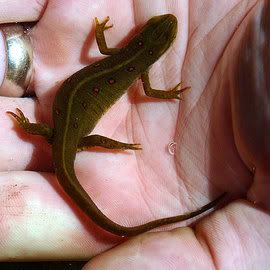

Red-spotted Newt (Notophthalmus viridescens viridescens)

Just up the hill from the Spotted Dusky discovery, we noticed a Red-spotted Newt (Notophthalmus viridescens viridescens) in a puddle of standing water. I was thrilled to see one up close, as it had been the better part of a decade since I last admired this species in person. As it turned out, almost anywhere water pooled in Monongahela, the newts were present. By the time we departed, we'd seen close to a hundred.

Before transitioning into its principally aquatic adulthood, however, the newt spends time on land, as the terrestrial red eft. These attractive little amphibians are perhaps the most charismatic of salamanders. Their stunning outfit is complimented by their not being as retiring as other species. If you find yourself in prime habitat, a keen eye will spot the efts crawling on logs or over leaves, seemingly unperturbed by exposure.
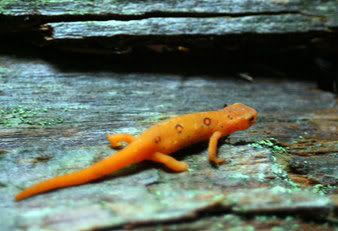

Red-spotted Newt in Red Eft stage (Notophthalmus viridescens viridescens)

Tadpoles, like the newts, could be found in almost every pond or puddle. Although we could not ID the species with certainty, we believe most to be the aquatic larvae of the wood frog (Rana sylvatica), though we did notice a few American bullfrog (Rana catesbeiana) tadpoles. The bullfrog is something of a bully, infamous for out-competing other amphibians and adapting to a wide range of habitats. Biologists designate such a species a trophic generalist. Despite the potential threat to biodiversity, a piece of me admires the pluck of the bullfrog, just as I grudgingly take my hat off to the European starling (Sturnis vulgaris) and the raccoon (Procyon lotor).

Although we saw countless tadpoles, we saw only three adult frogs. One bullfrog, one wood frog, and one upland chorus frog (Pseudacris triseriata feriarum). The upland chorus frog is closely related to, but distinct from, the eastern (or New Jersey) chorus frog (Pseudacris ferairum kalmi), with which I am familiar from my childhood on the Eastern Shore of Virginia.
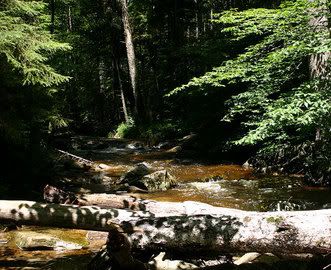

A Monongahela stream

Reptiles: Our snake hunting forays proved less successful. We shined flashlights into crevices and carefully examined sun-lit leaf litter in hopes of revealing a timber rattlesnake (Crotalus horridus) or a northern copperhead (Agkistrodon contortrix), but neither species graced us with an appearance. I was discouraged, but not surprised. Snake hunting is usually a kettle watching exercise and the animals seem to materialize only once you cease searching.

We found two snakes in Monongahela. Sadly, one of these was a DOR (dead on road) eastern garter snake (Thamnophis sirtalis sirtalis), a victim of the automobile. Given the infrequent use of this remote forest road, I decided the unfortunate snake must have accrued some very shitty karma. At least an unidentified land snail was feeding on the dead snake, a welcome reminder of our shared mortality and interdependence.

The identity of the other snake we observed remains in question, but I'm almost certain it was a juvenile eastern milk snake (Lampropeltis triangulum triangulum). It was a very slender snake, not even pencil-thick, wearing alternating bands of red and white. We noticed the snake on the bottom of a shallow, water-filled ditch. It was attempting to feed on small tadpoles. When we clumsily hurried over for a closer look, it retreated into submerged grasses lining the ditch. After a wait of about fifteen minutes, it emerged from hiding and I attempted to ID it as it zigged and zagged across the bottom. I failed, unfortunately, and we did not see the little reptile again. According to field guides, eastern milk snakes are no stranger to stream bottoms. This knowledge, combined with the distinctive markings, leaves me with little doubt of the species, but, as I say, the verdict it still out.


Snake hunting on the southern exposure

Mammals: I hoped to see a black bear (Ursus americanus) or two, but I had to settle for a smattering of tracks. Because we arrived in Monongahela at the tail end of a long wet spell, the trails and back country were muddy and soft. Although the rain made the first night miserable - we rigged a tarp and pitched the tents after dark, in hard rain - the saturation made spotting animal tracks easy, although in some cases the ground was so wet that fresh prints were already partially obscured. White-tailed deer (Odocoileus virgianus) tracks were plentiful, but we saw more deer in the backyards of the houses fringing the National Forest than we did in Monongahela proper. This isn't surprising, as deer are harder to spot in dense forest and, what's more, they thrive in and around human settlement, as so many suburbanites know. Also abundant was the bouncy eastern chipmunk (Tamias striatus).

Birds: We were ill-prepared for bird watching. Although we were careful to pack everything needed for a camping trip - right down to the campfire utensil sets - we somehow neglected to include binoculars. I'm not sure how this oversight occurred, but none of us had a pair in hand, making anything beyond guessing difficult, especially since most of Monongahela's bird species are relatively small. In the shadowed forests, identification is all but hopeless without ocular assistance. Fortunately, one of my friends has a competent ear and some species were identified by their call.

Slate-colored juncos (Junco hyemalis) were innumerable. It seems spring comes late to the upper elevations, as the rhododendrons had yet to bloom and, on the final afternoon, we were scolded by two adult juncos as we hustled past a fledgling perched on a low-hanging branch. The prize for Most Handsome Bird goes to the Blackburnian warbler (Dendroica fusca), a fire-headed fellow with a striking voice. We thought we heard this bird's song in the woods, and our supposition was verified when an individual landed just above us, in the branches of a spruce tree.

Most exciting for me, however, was the family of American woodcock (Philohela minor) that we startled into awkward flight. I'm used to the jump, flutter, and glide behavior of the woodcock in the open, flat fields of coastal Virginia, but in the mountain woods of Monongahela, the woodcocks' comical eruption from among the leaves and ferns betrayed the provenance of the species nickname, the timber doodle. The first bird to take off flapped and jerked and reared and leaned as it moved all of twenty feet in the air, before pitching hard and vanishing into a mess of fallen limbs. Realizing we had disturbed a family group, we made our way downhill at a good clip, so as to allow the birds to regroup.

Plenty of common ravens (Corvus corvax) and cedar waxwings (Bombycilla cedrorum) were about, but we saw only one American blue jay (Cyanocitta cristata) and one turkey vulture (Cathartes aura), species I certainly expected to see more of. Had we been properly equipped (read: not forgotten the $@*&%!! binoculars), I would have more to report, but I was all too happy to concentrate on reptiles and amphibians, as they are particularly exciting to me.

* * * * *

Rising with dawn's birdsong on the final morning, we quickly packed our gear, lowered the bear bag, and began the five hour drive to Washington, D.C., where I was to catch the Chinatown Bus back to New York City. As we headed east, I slouched in the cramped back seat and admired the mountains of West Virginia, even as I again noted signs of resource extraction. My thoughts returned to Reece's "Death of a Mountain" and I made a mental note to reread it upon returning to New York.

Near the end of the article, Reece quotes Aldo Leopold, the famous American ecologist and conservationist. Leopold bemoaned the fact that "one of the penalties of an ecological education is that one lives alone in a world of wounds." I'm not sure that this is still the case. Those of us who are environmentally conscious do not live alone, even if we do remain surrounded by wounds. More than ever before, "green" sentiments are also popular sentiments; many folks share a penchant for preservation. Leopold would argue, however, that most contemporary environmentalists remain blissfully ignorant of ecological pragmatism. He was a conservationist, not a preservationist, and he understood that protectionism alone rarely leads to long-term sustainability.

Keeping this conservation/preservation dynamic in mind, I think it noteworthy that my companions in the forests of Monongahela were a biology professor and a writer. For our purposes here, the biologist might be characterized as a biological determinist and the writer, as a moral idealist. Though these two characterizations are by no means mutually exclusive, it makes for an interesting contrast in perspective, even though both appreciate the outdoors equally. Rereading "Death of a Mountain," I was surprised to find this divide touched on in the closing paragraphs.
"If our species is to make it through [the 21st] century, the forces of science and technology must be tempered by two other forces - ethics and aesthetics. All ethical philosophies, from Aristotle on down, are based on this ecological principle as stated by Leopold: 'The individual is a member of a community of interdependent parts.' And as the cave art at Lascaux makes brilliantly clear, we are a species that has evolved to find beauty in the natural world. This trait serves - or should serve - an evolutionary purpose: we love what we find beautiful, and we do not destroy what we love. A strip job is more than a moral failure; it is a failure of the imagination. It is time we stopped thinking like those who conquer a mountain and started thinking like the mountain itself."
A strip job, as Reece writes, is a moral and imaginative failure, but what does it mean to think like a mountain? It would seem to me that to think like a mountain requires us to abandon morality and imagination, both exceptional human virtues. Is my ambivalence concerning invasive species control an example of mountainous thinking? Moral ambivalence - that is, amorality - is Nature's way. But isn't ambivalence, too, problematic? Is it not cousin to apathy? Humans, at their best, are moral animals; morality necessitates choice and action. Strict environmental controls, then, are moral, pragmatic, and rational, flailing efforts in our human time scale not at all like the geologic contemplation of a mountain. We humans consider a skewed equation and strive to balance it. This calculus comes at some cost. For the sensitive aesthete, slavishly devoted to what Reece calls beauty, the dualistic thinking of a moral pragmatist - right or wrong, good or evil - can seem an ugly, even unnecessary evolutionary holdover. Where, then, can the conscientious among us stand? It's an impossible question, really, more of a koan than a query, but it nags nonetheless.

Something approaching an answer is wrapped up in the lyrics of Denver's "Country Roads," in the fight bruised arms of young boys, in the remarkable persistence of trophic generalists, in the determined antagonism of the coal miner's wife, in the scarred plateaus, and in the slurried bear tracks. Thankfully, when I'm painting, or when I'm appreciating back country settings like Monongahela, I'm reminded that contentment, for me, requires acceptance of a messy, mongrel truth. For my part, it's both necessary and natural to be both an idealistic aesthete and a moralistic number cruncher.


Fungi thrive in the moist, dense forests

Photo credit: all photos, Hungry Hyaena, 2006

Tuesday, December 13, 2005

Border (Bio)diversity (of opinion)


The Robert Smithson in me is bemused by international borders, particularly those boundaries that are not physically demarcated, lines that exist only in cartography and our collective political imagination. Last night, I contemplated a striking black-and-white photograph of the Mexico-U.S. border. The image was dominated by a rural "vehicle barrier" fence (similar to the one shown above), far removed from an official border checkpoint or crossing. In the desert of the American Southwest, this fence draws an arbitrary line in wire and steel.

It struck me as an emblem of humanity's absurdly tenuous existence, a reminder that our species is an insignificant mote in an incomprehensibly tremendous weave. As the artist Carl Buell wrote in the comments section of a recent HH post,
"With every change in sea level and shoreline, with the raising or eroding of every mountain range, with every changing weather pattern, life spreads out as it can and comes into contact with new environments, opportunities and hazards...As I get older (than dirt), I find myself starting to think like the hills themselves. Some day after eroding and washing out to sea, I’ll be a hill again."
Indeed, each of us (and, eventually, our species) will be reconstituted, and our arbitrary borders, those lines in the mud of space-time, will be erased. In this respect, the border fence is a healthy reminder of our existential folly, but it also reveals humanity's darker inclinations. We build fences, after all, to divide "us" from "them," the demonized "other."

The photograph that inspired this post was printed in the most recent issue of Wildlands Connection, the Wildlands Project newsletter. It accompanied an article about wildlife bottlenecks at the Mexico-U.S. border. The Wildlands Project's mission is to create vast, uninterrupted linkages, known as wildlife corridors, that will extend from Canada into Mexico (on the Rockies spine) and from Canada into Florida (on the Appalachian spine). The U.S.-Mexico border fence is a major obstacle to the organization's first goal.

Yet physical barricades are but one of the obstacles that ambitious conservationists face. Consider wildlife trade legislation that protects species in one country, but not another, adjacent nation. If strict laws prohibit the trapping or hunting of a species in China, for example, but not in neighboring Mongolia, is the Chinese legislation effectively addressing species welfare (particularly when Chinese citizens are paying top dollar to have the killed contraband imported)? Similar issues haunt conservation efforts the world over.

The humanitarian and social concerns that ethically-minded conservationists must take into account present a more nuanced hurdle. Environmental groups in the European Union are warring with one another about how best to create the legislative and physical infrastructure necessary for sustainable energy development. How can you raise thousands of wind turbines without hindering bird migration, ruining aesthetics, or plopping towers in the backyards of folks too poor and disenfranchised to protest?

If the various interest groups in the EU, one of the most environmentally progressive governing bodies in the world, are at odds, is it realistic to expect conservation to become a truly supra-national affair? After all, the EU's concerns are petty alongside those of the southern hemisphere. Whereas Europe is a sprawl of cultivated landscape relatively lacking in biodiversity, the "Third World" represents the usually disastrous meeting of remarkable biodiversity and an exploding human population. Impressed by our terrible example, the citizens of these nations emulate the unsustainable behavior of the "First World." In order to counter the detrimental environmental effects of Third World industrialization, international legislation will face increasingly substantial challenges. The supra-national bodies can create laws, but can we enforce these laws without wielding the colonial sceptre? More critically, can we conserve biodiversity and healthy ecosystems without subjugating the rights of the humans that call the Third World home?

These questions bring me to "Climate of Fear," a recent book by the eloquent Nigerian poet, essayist and Nobel Laureate, Wole Soyinka. Though Soyinka is writing about humanity's attempt to cope with terrorism, his political thrust is applicable to all realms, and his message is clarion.
"The gray zones of moral definitions where relativity reigns and remote cause are evoked to justify the abhorrent will continue to haunt certain casts of mind. The rest will insist on the primacy of an ethical will, one that dictates that some deeds demand to be judged within an identifiable and shared moral universe, however restricted...The ethical will is the redeeming assertion that, even when all other considerations of social conduct are subjected to the fortuitous, one, an ethical core, remains inviolate."
All of our fences fail. Perhaps we should recognize in that certainty both an entropic truth and an implicit morality. Within the context of this "shared moral universe," we are impelled to remove artificial barriers, whether they are constructed to stem the natural tide of human migrations or to protect us from our enemies. No matter the justification for the boundaries we draw, they are immoral inventions. And man, it is said, is the moral animal.

Photo credit: ripped from Kris Eggle's website