Showing posts with label America. Show all posts

Sunday, September 08, 2013

Bad Ideas For "America's Best Idea"

"In a soul-searching, head-scratching journey of its own, the agency that manages some of the most awe-inspiring public places is scrambling to rethink and redefine itself to the growing number of Americans who do not use the parks in the way that previous — mostly white — generations did. Only about one in five visitors to a national park site is nonwhite, according to a 2011 University of Wyoming report commissioned by the Park Service, and only about 1 in 10 is Hispanic — a particularly lackluster embrace by the nation’s fastest-growing demographic group.

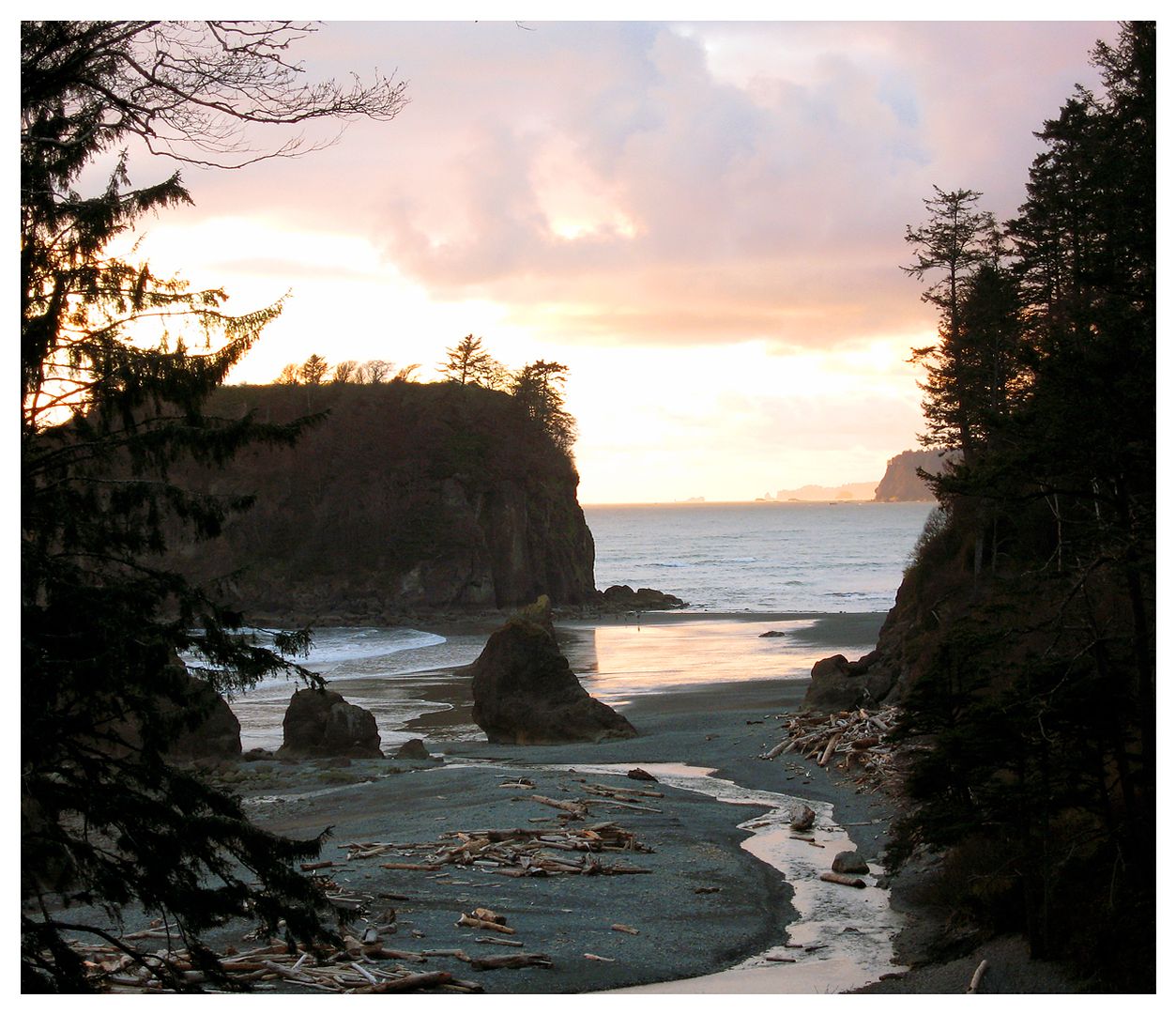
View of Ruby Beach, Olympic National Park
April 2008
[…] But the new effort goes further, to the question of how, and how much, the parks themselves must change to attract a fundamentally different audience. Wireless access, for example — still nonexistent in much of the Park Service universe — could divide older park visitors from minorities and young people, the so-called millennial generation, who want to share the experience live in social media with their peers.

'Boomers maybe want to get away, and millennials want to be connected; that changes how you use the space,' said Laura Swapp, REI’s director of diversity and inclusion. Music events could be another potential generational dividing line — peace and quiet versus entertainment — but would also draw the demographic the Park Service is after, Ms. Swapp said."

Here's hoping Jay-Z and Lady Gaga never perform on stages in Yellowstone or Yosemite.

Although I, too, would like to see more cultural and racial variety on our parks' trails, further developing the parks with WiFi towers and concert venues would be a myopic and ultimately fruitless move. Few areas of the American landscape afford us with the opportunity to "tune in" by tuning out, and the National Park Service should not fundamentally alter its mission in an effort to appeal to younger and more diverse demographics.

Instead, the NPS needs to celebrate the conservation heroes of color -- Majora Carter and Van Jones, for example, as well as the growing number of African American and Latino NPS rangers -- thereby providing role models for today's youth. Most importantly, we need more programs that get urban kids into our parks, encouraging them to recognize that these tracts belong to them. It's possible that their time afield without phone calls, Facebook, and Reddit will stay with them, appreciated, even if they're less than enthusiastic about the mosquito bites.

Photo credit: Christopher Reiger, 2008

Tuesday, July 16, 2013

Commonplace Book Time Machine #1:
Novus Ordo Seclorum


One of the two chapbooks I initially proposed creating in conjunction with my Aggregate Space & Featherboard Writing Series writing residency will not be produced. Because the residency is only five weeks long, I've decided I must devote the lion's share of the period to the more substantial of the two projects, a meditation on my childhood comprehension of death and killing. Still, rather than let the preliminary work I'd done for the commonplace book chapbook go to waste, I thought I'd share a few of the scanned pages here, on Hungry Hyaena, along with some editorializing. The first of these posts follows.

+++++
2-page spread from one of my commonplace books, 2000

Just after my twenty-second birthday, I began a new commonplace book. At the time, I was living in the basement bedroom of an Alphabet City apartment in Manhattan, laboring five days a week at a Soho art gallery and, nights and weekends, drawing and painting in my bedroom or working on a solipsistic vampire novel titled, appropriately, Me. My income was meagre; I'd grown used to dinners of white rice (generously seasoned with soy sauce) and I socialized just one night a week (not counting too many hours spent watching recorded episodes of Mr. Show with my roommates). Necessarily thrifty, then, I elected not to purchase a new journal to use for the commonplace book; instead, I picked up a journal that I'd cast aside a couple of years prior after filling its early pages with adolescent agitation.

Thursday, March 24, 2011

Communicating Art's Relevance (Or Not)


Science journalists have penned a profusion of articles about the scientific community's failure to communicate effectively with the general public. The articles bemoan how un- or misinformed Americans are about the science of vaccination, global climate change, mass extinction, and myriad other subjects. But the journalists don't blame the great unschooled for their ignorance; instead, they point the finger at scientists and, almost as often, at themselves. As a result, there are a growing number of journals, graduate programs, and institutions devoted to tackling the science literacy problem.

The aptly named Center for Communicating Science, at Stony Brook University, is one of these. It's mission is straightforward: "to enhance understanding of science by helping train the next generation of scientists and health professionals to communicate more effectively with the public." It's an uphill battle, but we must all hope that their efforts (and those of similar institutions or programs) succeed. Presuming (hopefully) that the majority of the world's states remain liberal democracies, the future health of the planet and our species may be contingent on a greater popular appreciation of science.

Although it is a matter of less urgency and consequence, the contemporary American art world should consider a comparable movement. We also need programs dedicated to training "the next generation of [curators and art] professionals to communicate more effectively with the public." I'm not being facetious. There are brilliant, sensitive art writers and curators working today, but they are a small minority who, despite their talents, generally fail to reach a popular audience. Just as so much good science is shrugged off (or even angrily rejected) by the public, so, too, with art. Most Americans see science as extraneous esoterica crafted by white-coated wonks. Similarly, contemporary art is seen as the province of effete Onanists devoid of "family values."

But the respective responses of the two realms to these ugly public perceptions is critically different. The scientific community has confronted the issue head-on, spilling ink, hosting panel discussions, and building programs. Whether or not this conscientious approach will change things for the better remains to be seen, but scientists and science academics can't be criticized for inaction. Should an art writer or organization assert, however, that negative popular sentiment indicates the art world is faltering, they won't receive donations for a new graduate program or institution dedicated to improving the art world's communication skills. In fact, many (if not most) professionals in the art world rankle at the suggestion that fine art should even consider appealing to the masses. They believe that popularity debases art because, in order to achieve it, the artist must cater to the interests and intellect of the lowest common denominator. This stance is obviously elitist but, more importantly, it's also defeatist. Shouldn't those of us who care about art's role in society strive to make it accessible to the general public? After all, unlike those skeptical of science, "Joe the Plumber" isn't the only one who dismisses contemporary art! The large majority of my college-educated friends -- scientific researchers, English professors, political journalists, doctors, lawyers, actors, musicians -- make no space for contemporary art in their lives. Contrary to the avant garde aspirations and claims of so many artists, curators, collectors, and critics, most of America views the contemporary art world as a cultural backwater; it has become functionally irrelevant (excepting its role as a luxury commodity market).

But the art world is not irrelevant; there is vital, inspiring contemporary artwork being produced, work that the public can be in dialogue with (and even without initiation into our art cult)! But the onus is on us, as representatives of the art world, to make a case for why fine art matters today. If curators and artists (or dealers writing press releases) can't express why an artwork or body of work is vital, then they need to ask themselves hard questions. Is this work really and truly meaningful? Is it made with intent to improve, in whatever way, the world (i.e., not intended merely as an exercise in critique)? Clinging to the myth of the avant garde is unacceptable unless the "vanguard" work is, in the view of the curator, artist, or dealer, essential. Art professionals shouldn't be making or promoting work that they can't make an impassioned case for and, in order to do so, they have to be able to speak about art intelligently and plainly.

I'm interested in hearing reader's thoughts on this subject. Barring the introduction of requisite communication courses in American art programs, what are some ways to begin to chip away at the wall between the art world and the rest of it? Can we be as relevant and respected as pop music or Hollywood, creative industries that produce both edifying brilliance and schlock, but that are not maligned by the general public? Can the American art world play as much of a role in the lives of citizens as does the European art world, an orbit in which the educated classes regularly visit galleries and recognize the names of prominent fine artists? What do you think?

Update: Jessica Palmer, ever erudite, remarks on this post at Bioephemera. I encourage readers to jump over to BioE for her take; Jessica is an artist, writer, and science communicator...though she wears other hats, too.

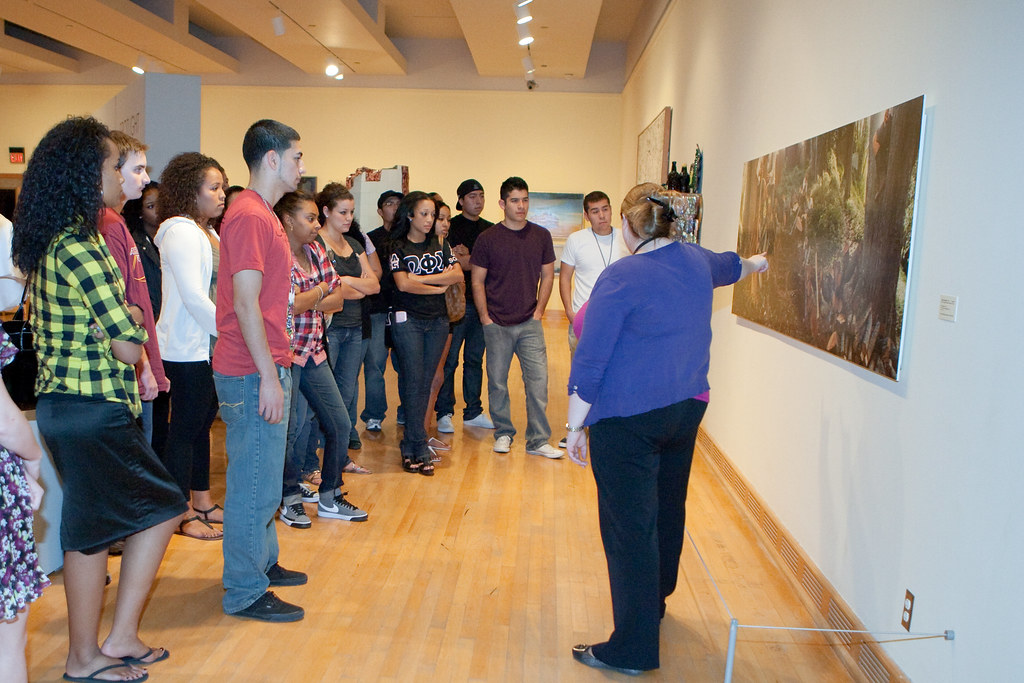
Photo credit: copyright 2009, Diane Wallace, ASU Art Museum

Thursday, February 03, 2011

Enter the Rabbit


A red rabbit for the Chinese New Year

Although New York City has a larger Chinese American population than does San Francisco, the Chinese New Year is a much bigger deal in Fog City than it is in the Big Apple. The Chinese American population in New York accounts for approximately 4.5% of the total population; in San Francisco, it constitutes close to 20%.

Like New York, San Francisco has ethnic enclaves that exaggerate these demographics. I live in a part of the city known as the Inner Sunset, located at the eastern edge of the expansive Sunset District. About half of the Sunset's population is Asian American, mostly of Chinese extraction. In an interview published in the current issue of San Francisco Arts Quarterly (SFAQ), celebrated Bay Area artist Barry McGee remarks that he dislikes the Sunset District because "it's foggy, and there's a big Asian population." The interviewer asks, "You don't like Asians?," and McGee replies, "[...]well it's not that I don't like Asians, but I don't like that many Asians, you know?" I presume that the half-Chinese McGee is joking, but his tongue-in-cheek comment speaks to our species' inborn, tribal orientation.

Curiously, while I'm acutely aware of how "out of place" I am in some ethnic neighborhoods, I've never felt incongruous or unwelcome in predominantly Chinese American communities. There are, of course, significant cultural differences - I'd almost certainly feel homesick and alien were I to live in Beijing or Shanghai for a time - but, unlike McGee, I think the substantial Asian American population is a feather in the Sunset's cap, and I was pleased to see a number of red lanterns and celebratory banners hanging from Sunset awnings yesterday morning.

Maybe, though, there is a more novel reason why I appreciate the Chinese New Year? As a would-be ger (or convert to Judaism), I also observe a new year that's not dictated by the Gregorian calendar. I made my New Year resolutions in early September, during the days preceding Rosh Hashanah, a period that saw no spike in gym memberships.

What is to be made of this hybrid identity of mine, especially in light of our increasingly universalistic aspirations? I'm a straight, white male, and my family tree has a preponderance of English and Scottish Protestants; in other words, like it or not, I was born "the man." Yet I am also, by means of the mystical and psychological process of conversion, a Jew (technically speaking, I'm almost one, mikveh pending). Although most of us associate ethnic identity with skin color or bloodline, ethnicity is by definition a stew of heritage, language, culture, and religion; it is compound. Thus, though I'm only 1/8 Jewish by blood (i.e., genetically or physiologically), I'm able to identify as wholly so (i.e., psychologically).

Because of this rewiring of my identity, I'm ever more appreciative and proud of the diverse makeup of the United States. Many Americans nurture a composite identity (e.g., Italian American, Japanese American, or, less specifically, African American). Although it's crucial that we must prioritize the shared aspect of these respective identities, we should also celebrate the differences. In other words, just as our membership in the family of humankind does not preclude our identifying as part of nations, clubs, or families, American peoplehood does not prohibit membership in particularistic communities, subsets of the greater national identity. Contrary to the well-intentioned, "all you need is love" promises of misguided ideologues, our nation's principal virtue may be it's appreciation for both the universal and the particular.

So, to my many Chinese American neighbors, and to the rest of our experimental nation, cheers to yet another Happy New Year!

Image credit: ripped from Sweety Petey Eco-friendly Baby Toys

Sunday, September 26, 2010

Update: Jane Hammond's "Fallen"


Jane Hammond
"Fallen"
2010
Dimensions variable

In January 2006, I wrote a short post about Jane Hammond's mixed-media, evolving sculpture "Fallen," a melancholy and beautiful tribute to the lives lost during the (now sort-of-but-not-really-over) Iraq War.

When it was exhibited in 2005, the work consisted of 1,500 paper leaves, each meticulously crafted by the artist and inscribed with the name of an American soldier who met his or her end during the invasion or occupation of Iraq. At the time of my post, I wondered if Hammond had continued to add leaves to the work.

A couple of weeks ago, four-and-a-half years after I wrote about "Fallen," the artist sent me an email telling me more about the life of the sculpture. I share the bulk of her update below, along with some images of the piece as it was in 2005 (below) and as it looks more recently (above, and detail below).
"I make the leaves by hand and each is based on a real leaf which I gather and digitally scan, then there is cutting, hand-painting, a little fiberglassing and more hand-painting, then they are signed by me with sumi ink and a brush pen and molded into a three-dimensional form.

[...A]ll the leaves in the piece you saw at Lelong were from upstate Connecticut, gathered in the Fall of 2004—I have now gathered leaves in Hawaii. Washington State, California, Colorado, Texas, Arkansas, Missouri, Michigan, Mississippi, Alabama, Virginia, Maryland, Massachussetts, Vermont, New Hampshire, Maine and Rhode Island. And adding to the original group from 2004, I have gathered in the Autumns of 2005, 2006, 2007, 2008, 2009. And I am sure I will gather some in 2010 this Fall.

[...]This Fall, ["Fallen"] will [...] be shown at the Taubman Museum in Roanoke, Virginia from September 23rd until January 10th, 2011. It will open with 4,390 leaves."

Jane Hammond
"Fallen" detail
2010
Dimensions variable

Sadly, she does have more leaves yet to add.


Jane Hammond
"Fallen"
2005
Dimensions variable


Image credits: courtesy Jane Hammond

Friday, June 11, 2010

Rescuing Hokget and Everybody Else


Several months ago, I read "The Problem With Human Compassion," an excerpt from Shankar Vedantam's book The Hidden Brain, printed in the February 19th issue of The Week. I include a lengthy selection here.
"On March 13, 2002, a fire broke out in the engine room of an oil tanker about 800 miles south of Hawaii. The fire moved so fast that the Taiwanese crew did not have time to radio for help. Eleven survivors and the captain’s dog, a terrier named Hokget, retreated to the tanker’s forward quarters with supplies of food and water.

[...] Drawn by wind and currents, the Insiko got within 220 miles of Hawaii. It was spotted by a cruise ship, which rescued the crew. But as the cruise ship pulled away, a few passengers heard the sound of barking.

The captain’s dog had been left behind on the tanker. A passenger who heard the barking dog called the Hawaiian Humane Society in Honolulu. [...] The Society alerted fishing boats about the lost tanker and soon media reports began appearing about Hokget.

[...] Money poured in to fund a rescue. Donations eventually arrived from 39 states and four foreign countries. One check was for $5,000. 'It was just about a dog,' Pamela Burns, president of the Hawaiian Humane Society, told me. 'This was an opportunity for people to feel good about rescuing a dog. People poured out their support. A handful of people were incensed. These people said, ‘You should be giving money to the homeless.’' But Burns thought the great thing about America was that people were free to give money to whatever cause they cared about, and people cared about Hokget.

The problem with a rescue was that no one knew where the Insiko was. The U.S. Coast Guard estimated it could be anywhere in an area measuring 360,000 square miles. Two Humane Society officers set off into the Pacific on a tugboat. The Society paid $48,000 to a private company called American Marine to look for the ship.

[...] The U.S. Coast Guard had said it could not use taxpayer money to save the dog, but under the guise of training exercises, the called the U.S. Navy began quietly hunting for the Insiko.

[...] Human beings from around the world came together to try to save a dog. The vast majority of people who sent in money would never personally see Hokget. It was, as Pamela Burns suggested to me, an act of pure altruism and a marker of the remarkable capacity human beings have to empathize with the plight of others.

There are a series of disturbing questions, however: Eight years before the Hokget saga began, the same world that showed extraordinary compassion for a dog sat on its hands as hundreds of thousands of human beings were killed in the Rwandan genocide.

The philosopher Peter Singer once devised a dilemma that highlights a central contradiction in our moral reasoning. If you see a child drowning in a pond—and you would ruin a fine pair of shoes worth $200 if you jumped into the water—would you save the child or save your shoes? Most people react incredulously to the question; obviously, a child’s life is worth more than a pair of shoes. But if this is the case, Singer asked, why do large numbers of people hesitate to write checks for $200 to a reputable charity that could save the life of a child halfway around the world—when there are millions of children who need our help?

The answer is that our moral responsibilities feel different in these situations; one situation feels visceral, the other abstract. We feel personally responsible for one child, whereas the other is one of millions who need help - there are many people who could write that check.

[...] The brain is simply not very good at grasping the implications of mass suffering. Americans would be far more likely to step forward if only a few people were suffering or a single person were in pain. Hokget did not draw our sympathies because we care more about dogs than people; she drew our sympathies because she was a single dog lost on the biggest ocean in the world. [...] We are best able to respond when we are focused on a single victim."
Vedantam and Singer are correct; we humans act more compassionately when we are able to put a face to a cause, yet too many faces dull our response.

I've noticed such a benumbing in myself recently, an unexpected consequence of my transitioning from New York City to San Francisco. Both cities have substantial homeless populations, but panhandling in San Francisco is far more common. My street charity policy, modeled on the approach of a rabbi I heard lecture, is simple enough: I give change to any panhandler who says that he or she will use the money for food (or cites hunger as their reason for begging). I don't give change to those individuals requesting money for any other reason. In New York City, confronted with a few beggars each day, I typically gave change two or three times every week. In San Francisco, however, beggars ask for handouts on every other block, and a good number of them say that they're hungry. If I hold to my standard, I'll give change two or three times a day, if not more often! Shamefully, I've noticed that I've almost ceased giving during my visits to San Francisco.

This is a personal failure that I must address. Each of those many faces is an individual, a single person in need, despite the fact that their larger numbers and concentration counter-intuitively make them relatively anonymous or invisible. The rabbi's rule should be no less applicable in San Francisco than it is in New York. I'm confronted, then, with more need, and I must respond in kind; a hungry person is a hungry person.

But what about a hungry dog? Is Vedantam right to suggest that the thousands of people who contributed money to the Hokget search did not "care more about dogs than people"? Not exactly.

Our species' evolved, inborn behaviors haven't made our adaptation to the globalized world easy. In fact, it seems that contemporary humans are increasingly suspicious of other humans, especially of those outside our respective tribe, whereas animals (and perhaps especially dogs) are seen as uncomprehending innocents. I don't mean to suggest that no one cares about miners trapped in a coal mine, but it's clear that the little girl trapped in a well sells more newspapers, and that the little dog trapped on an abandoned tanker not only sells newpapers, but also inspires a flood of unsolicited donations and generates public outcry.
"Facing intense public pressure to save Hokget, government officials concluded that asking the Navy to sink the tanker—750 miles from Hawaii and drifting away from the distant U.S. mainland—posed unacceptable environmental risks. The Coast Guard finally agreed to access $250,000 in U.S. taxpayer funds to recover the Insiko. It wasn’t officially called an animal-rescue effort. Instead it was authorized under the Oil Spill Liability Trust Fund, based on the argument that if the aimless Insiko managed to drift westward for 250 straight miles, it might run aground on Johnston Atoll and harm marine life.

[...] On April 26, nearly a month and a half after the dog’s ordeal began, the tugboat’s crew found the Insiko and boarded the tanker. Hokget was still alive, hiding in a pile of tires. [...] Hokget arrived in Honolulu on May 2 and was greeted by crowds of spectators, a news conference, banners welcoming her to America, and a red Hawaiian lei."
What a marvelously strange species we are!? I applaud our ability to extend compassion to other animals (we're one of handful of species that have demonstrated such empathic ability), but I wonder at our brains' curious moral calculus.

I suppose all I can do is begin with myself, and humbly pledge to keep my pockets filled with coins.

Image credit: ripped from Corbis Images

Wednesday, April 28, 2010

Revisiting the Steady State Economy

On the heels of not one, not two, but three Republican blockades of financial regulatory legislation in the U.S. Senate this week, I thought it worth reposting the below essay on the concept of a Steady State Economy. The essay was originally posted on HH in April 2005; five years later, there's only that much more reason for thoughtful, comprehensive reform.

+++


Environmentalism is becoming something of a religion. Those who subscribe to most or all of the tenants of the environmentalist doctrine are among the movement’s acolytes, composting and recycling, canvas bagging it and buying organic, living what they consider “healthier,” less “impactful” lives. A thoughtful environmentalist should recognize these actions to be sacraments grounded in a hybrid moral code. “I am doing my part to rectify the mess made by the sinners around me.” How persuasive is this feeling of self-worth and moral superiority? Like all religious conviction, it is undeniably powerful and fulfilling, but it comes at a cost. Too often this fetal “religion” ignores fact in favor of that which is deemed morally superior. For example, radical environmentalists demand a wilderness without humans, ignoring the fact that management (stewardship) is now an unfortunate necessity given our exuberant use of natural resources and our continued sprawl. Reason must enter into the equation. Thoughtful environmentalism of the secular variety is possible, as long as we don’t allow ourselves to become vain.

This brings me to the concept of the Steady State Economy.

I first heard wind of Brian Czech’s Center for the Advancement of the Steady State Economy (CASSE) project a year ago. My initial reaction was positive, though I feared support for the concept would be relegated to left-wing environmental groups of the “religious” variety. Surprisingly, I am hearing the term used with more frequency these days, sometimes by folks with little interest in preserving biodiversity or encouraging ecological sustainability.

I am a proponent of the philosophy (read this .pdf for an excellent summary). The front page of the CASSE website states:
Economic growth is an increase in the production and consumption of goods and services. It entails increasing population, per capita consumption, or both. Economic growth leaves a larger ecological footprint, causing civil strife and bringing nations into conflict.”
This simplifies, for the sake of dramatic impact, the arguments made by the economists behind the SSE. For me, the heart of the matter is touched on in the following selection.
“…Wildlife biologists know that a wide variety of social structures may produce stable populations. The same holds true for a steady state economy. For example, a steady state economy with long human life spans entails low birth and death rates. In our opinion this is preferable, within reason, to a steady state economy with short life spans, high birth rates, and high death rates. The same concept applies to capital and durable goods such as automobiles. We opine that a relatively slow flow of high-quality, long-lasting goods is preferable to a fast flow of low-quality, short-lived goods.”
The SSE will not take hold in the United States anytime soon, but in more socially-minded democracies, like Sweden or England, the approach is not so alien. The truth is, however, such a transition from market-driven capitalism to stability-driven capitalism is unlikely to occur unless the populous desires as much. In the United States, our stock market would require overhaul, making it “less of a casino,” by decreasing its volatility and demand for liquidity. This seems unlikely, especially in the immediate future. In fact, were the transition to begin today, the market would likely hemorrhage. Making things even more unattractive for the “powers that be,” implementation of the Steady State Economy requires, for countries like the United States, a marked decrease in Gross Domestic Product. As a result, I believe the SSE can not become a concrete reality in the foreseeable future, but that we should strive for it no less.

As the selection below suggests, there is much to be gained from the sustainable lifestyle.
“Nor would any cultural stagnation result from a steady state economy. John Stuart Mill (1806-1873), one of the greatest economists and political philosophers in history, emphasized that an economy in which physical growth was no longer the goal would be more conducive to political, ethical, and spiritual improvements.”
Ah, yes, ethical and spiritual improvement… So we’re back to individual action and lifestyle choices, rubbing shoulders with the “religious” environmentalists. Where do I sign up to feel superior to the rest of the heathens? I already recycle, canvas bag it, and eat only meat that I have caught or killed myself. I’m a few sacraments shy of donning a robe and shuffling off to the commune. Why shouldn’t I begin buying everything carefully and, in my own way, push for the adoption of the SSE at a local level?

Well, the truth is I should.

I self-consciously poke fun at the problematic aspects of environmentalism only because it is so close to my heart. I am not a religious man in the popular or traditional understanding of the word. Biology, anthropology, paleontology, history: these are my holy tomes. Yet I firmly believe that through careful consideration, research, and political pressure we can arrive at a more complete conservation ethic, one which addresses not only biodiversity and “wilderness” (my principal areas of interest), but also global poverty and human rights.

Photo credit: ripped from the World Food Programme website

Thursday, March 18, 2010

Mixed Environmental News

In HH's early days, I often wrote about the health of marine ecosystems and the urgent need for more sustainable fisheries. While I no longer address these issues as frequently as I did at the project's outset, I'm every bit as invested in environmental and conservation causes. Thus, I find today's New York Times piece "UN Rejects Export Ban on Atlantic Bluefin Tuna" discouraging...but also slightly promising.

It's discouraging to read, because the news is generally bad:
"A U.S.-backed proposal to ban the export of Atlantic bluefin tuna prized in sushi was rejected Thursday by a U.N. wildlife meeting, with scores of developing nations joining Japan in opposing a measure they feared would devastate fishing economies. It was a stunning setback for conservationists who had hoped the 175-nation Convention on International Trade in Endangered Species, or CITES, would give the iconic fish a lifeline. They joined the proposal's sponsor Monaco in arguing that extreme measures were necessary because the stocks have fallen by 75 percent due to widespread overfishing.

'Let's take science and throw it out the door,' said Susan Lieberman, director of international policy with the Pew Environment Group in Washington. 'It's pretty irresponsible of the governments to hear the science and ignore the science. Clearly, there was pressure from the fishing interests. The fish is too valuable for its own good.'"
The report is also slightly promising, however, because the United States has again positioned itself as a proponent of conservation measures.
"Only the United States, Norway and Kenya supported the proposal outright. [...] The tuna defeat came hours after delegates rejected a U.S. proposal to ban the international sale of polar bear skins and parts, suggesting that economic interests at this meeting were trumping conservation.

The Americans argued that the sale of polar bears skins is compounding the loss of the animals' sea ice habitat due to climate change. There are projections that the bear's numbers, which are estimated at 20,000 to 25,000, could decline by two-thirds due by 2050 due to habitat loss in the Arctic."
The end result, then, is by no means a happy one...but what a welcome policy change from the days of Bush & Company!?

Note: This post also appears on the Endangered Species Print Project blog.

Tuesday, February 23, 2010

The Propagandist's Purpose


"The propagandist's purpose is to make one set of people forget that certain other sets of people are human."

-Aldous Huxley, The Independent

Photo credits: ripped from Jim Gogek's blog

Friday, January 29, 2010

Climate Change, Dullardism, and What We Can Do About It

Below, I've reposted my most recent guest contribution to the Endangered Species Print Project Blog. Because it is pertinent, I've also included the National Resource Defense Council Action Fund's "This Is Our Moment" public service announcement.

Please devote three minutes to the PSA. The celebrity cast is definitely "of the moment," and some of their references won't make sense five years from today, but that's the point. We need to be calling our senators now! (Or, if you prefer, email them, as the PSA suggests. Click here.)

Legislative action on these issues is long overdue...and our ailing country will benefit from the new jobs and the display of a little moral backbone. Let's not pass up the opportunity. Call. Email. Rally. Please.

+++++


When the post below originally appeared on Hungry Hyaena, in June of 2005, polls suggested that the American public were increasingly aware of the fact that climate change (or "global warming") posed a serious threat to our environmental status quo. In fact, the number of Americans that favored legislative action to curb anthropogenic greenhouse emissions and to mitigate the negative effects of climate change continued to grow into 2008.

Recent studies, however, reveal a troubling trend: Americans' concern about climate change diminished in the last year, so much so, according to some polls, that a majority of United States citizens today doubt that climate change is a threat, and dismiss global warming as a fantasy. Whatever the actual numbers, the up-tick in skepticism is real, even in the face of overwhelming scientific consensus. The frightening anxiety of the burgeoning global village, our contemporary economic upheaval, and the requisite priorities of our elected legislators notwithstanding, action on climate change is no less a moral and ethical imperative today than it was five years ago.

+++++
"The problem of modern man isn't to escape from one ideology to another, nor to escape from one formulation to find another; our problem is to live in the presence and in the attributes of reality."

-Frederick Sommer, The Poetic Logic of Art and Aesthetics
Although surveys suggest that most of the American public still believes that climate change is a future threat, many thousands of species are already threatened by shrinking environmental ranges and changing precipitation patterns; some of these species are on the verge of extinction. The negative impact of climate change occurs now and later.

I encourage those readers curious about the subject, particularly those who believe that we will "solve" the problem via improved technologies, to read "Climate Change is Totally Awesome," a recent post at Organic Matter. The author dissects a Telegraph article by Robert Matthews, entitled, "Warmer, wetter and better (or the good news that the climate change lobby doesn't want you to hear)."

Interviewed for the Telegraph piece, Professor Philip Stott of the University of London argues that reducing emissions will not alleviate the threat, and that the steps required to significantly reduce emissions would render us technologically impotent.
"Even if we shut every fossil-fuel power station, crushed every car and grounded every aircraft, the Earth's climate would still continue to get warmer, according to Prof Stott. 'The trouble is, we would all be too impoverished to cope with the consequences.'"
I agree that the warming trend is natural and that, even were we to de-industrialize, the world would continue to warm. But anthropogenic action accelerates climate change to such a devastating degree that biodiversity and, ultimately, human stability are in peril.

Furthermore, Stott's concept of technological impoverishment is misguided. To be sure, if we First Worlders are to transition to sustainable development, we must give up many of the conveniences that we now take for granted. It remains to be seen whether we will make this sacrifice of our own volition or if we will do nothing until Nature demands it of us. In either case, the sacrifice will not make us incapable of coping with climate change.

It will, however, demand a significant restructuring of our cultural and technological priorities. Our taste for spectacle and distraction must be unlearned. Cultural critic and anthropologist Morris Berman, in his outstanding book Wandering God: A Study in Nomadic Spirituality, dubs the social spirit of contemporary, industrialized nations "dullardism."
"With dullardism, the goal is simply to go unconscious, by means of tranquilizers, alcohol, TV, spectator sports, organized religion, compulsive busyness and workaholism, and so on (even though many of these do provide a short-term 'high')."
Dullardism is not endemic to contemporary, industrialized societies. Equivalent symptoms were documented in the late years of the Roman and Mayan civilizations, and I suspect that they also existed in Sumer and other early civilizations.

The human animal is not evolutionarily equipped to flourish in society; our brains remain "wired" for the Pleistocene, and the rapid transition to an agrarian, sedentary, and "civil" existence has been rapid and fraught. We therefore exhibit displacement behavior, seeking escape via fundamentalism, sports, entertainment, and drug abuse.

Does this mean that advanced civilization makes us ill-equipped to deal with environmental catastrophe? Not necessarily (we have to hope not!), but we must reexamine our social mores in order to create something akin to a new social order, one that balances our primitive lusts for progress and power with pragmatism and stewardship. It's a tall order, to be sure, but one that we must fill.

Monday, January 18, 2010

MLK Jr. Day: Prayer As Action


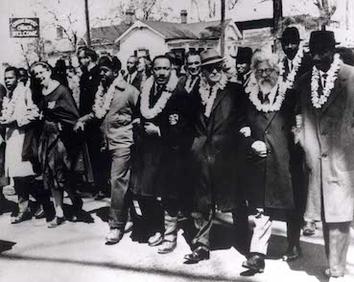
In March 1965, after marching alongside Reverend Martin Luther King, Jr. in Selma, Alabama, the celebrated theologian and rabbi Abraham Joshua Heschel wrote, "When I marched in Selma, my feet were praying."

Heschel's formulation explicitly equates righteous action (or activism) with prayer. In this time of increased fundamentalist agitation and violence, Heschel's notion is vital to both contemporary religion and secular humanism; that is to say, it is vital to every human being.

It seems very appropriate, then, that King, Jr. Day is observed by many in the United States as the King Day of Service, a day in which we honor the message and aspirations of Martin Luther King, Jr. by volunteering our time and effort for humanitarian causes (or, as I've also done this year, signing up for forthcoming volunteer projects and donating money to important aid efforts).

It is also a day, of course, to remember the man and the many he inspired to act or speak out against prejudice and oppression. May there be many more such prophets.

Saturday, January 09, 2010

The Art Community and Common Sense


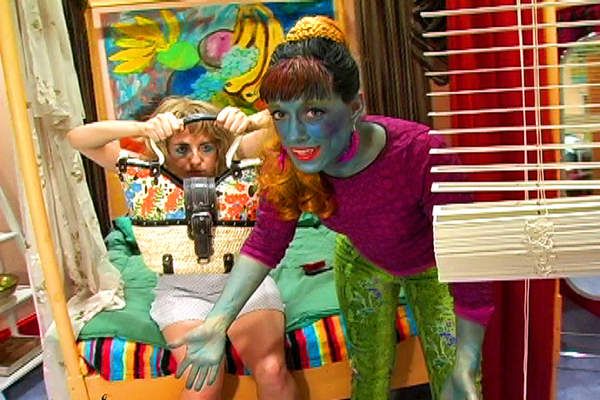
Ryan Trecartin
"I-BE AREA"
2007
"Everybody gets so much information all day long that they lose their common sense."

- Gertrude Stein
We're a week-and-a-half into 2010, and I'm hoping that the din produced by so much fin-de-decade media will soon die down. It's no secret that we citizens of the United States (and all other essentially "Americanized" peoples) are principally defined by our consumption. What's more, after decades of adaptation to the consumer role, we've become so fond of the talk surrounding our consumer products that the consumer reviews themselves have become another kind of consumable. Regrettably, this is no less true in the arts.

I've made a contrarian effort this year to avoid most of the "Top" lists and their Op-Ed equivalents, but I've not been totally chaste. The diviners of social, political, or cultural trends have been working furiously to meet their deadlines, and the surplus of art-related stock-taking is in large part responsible for the dearth of new HH content. Anything that I write here will only add to the pervasive and stupefying hubbub; it is further distraction from the business of life well-lived.

And yet, here I sit, writing this post. Like all the other commentators, I'm guilty of editorializing and contextualizing that which is better meditated upon individually or mulled over with our loved ones. And I'm guilty of adding one more perspective to the countless millions already vocalized, furthering the unfortunate and wrong-headed belief that subjectivity reigns. What I'm engaging in, then, is dangerous. While post-modern notions of relativism are valid and philosophically valuable, our globalized culture must strive to sort, such that we can, the wheat from the chaff. That is to say, in a time of increasing cross-cultural interaction, the need for some consensus, some agreed upon hierarchy of moral, ethical, and aesthetic value, is acute. It is a dangerous and exciting era; as such, it is a good time to be a artist.

I agree with Roberta Smith's contention that "the years 2000 to 2009 saw the emergence of a tremendous number of really good, interesting, promising artists." My list of "really good" artists, however, is very different from hers, and Ryan Trecartin, one of the artists that the New York Times' critic celebrates in her recent article, "Make Room for Video, Performance and Paint," is definitely not on it. I don't know Trecartin personally, and he may be a well-meaning, pleasant enough person, but his artwork is poisonously self-absorbed. In this respect, at least, Smith is right to assert that he is an important representative of the decade past. The art world, and especially that of New York City, the community to which I'm most attached, has seen an explosion of navel gazing.

To be fair, most artists engage in some level of narcissism. At the end of the 1990s, when I was in my early twenties, I had puerile aspirations to produce "art videos" of my ejaculating penis (paging Sterling Ruby), and my paintings were dominated by angst-ridden self-portraits and hyper-sexualized imagery. The few paintings of that period that survive are today stacked in my parents' Virginia garage, partly covered by a plastic tarpaulin and years of accumulated mouse shit and winter-killed wasp corpses. Such is the fate of personal history. Serpent-like, we periodically shed our skins and move on, hopefully a little more wise. Some of us, however, put our sheddings and bruises on display, mistaking personal exposure for bravery. Indeed, in some contexts it is brave, but when the sharing is marshalled in service of a cult of personality, it is a celebration of individual dysfunction. And when such exhibitionism is mistaken for art, it is an indication of critical and cultural dysfunction.

Believing that art is fundamental to humanity, and that it is transformative and sacred, I don't accept Freud's famous contention that the artist is a neurotic who seeks to attenuate or postpone confrontation of his or her mature psyche. In fact, for most of our species' tenure, the role of the artist was precisely the opposite; we were called upon to ground our brethren is real experience, be it material or metaphysical. Yet Freud's categorization accurately describes much of the juvenalia that passes for contemporary art. Certainly, we artists should be embarrassed by this trend, but you can't kill the messenger, as the saying has it; Trecartin and others creating hysterical or megalomaniacal artworks are reflections of the dominant (and apparently yet ascendant) iCulture. It is instead the critics and the gallerists, the purveyors of taste, that should be most ashamed of themselves.

Essayist, critic, and philosopher George Steiner is far more intelligent and incisive than I, so I include a pastiche of pertinent excerpts from his 1989 book, Real Presences.
"The usages and values predominant in the consumer societies of the West today [are] the secondary and the parasitic[...]. Literate humanity is solicited daily by millions of words, printed, broadcast, screened, about books which it will never open, music it will not hear, works of art it will never set eyes on. A perpetual hum of aesthetic commentary, of on-the-minute judgments, of pre-packaged pontifications, crowds the air. Presumably, the greater part of art-talk or literary reportage, of music reviews or ballet criticism, is skimmed rather than read, heard but not listened to. None the less, the effect is antithetical to that visceral, personal encounter[...]. There is little 'ingestion'; it is the 'digest' that prevails.

[...]

The journalistic vision sharpens to the point of maximum impact every event, every individual and social configuration; but the honing is uniform. Political enormity and the circus, the leaps of science and those of the athlete, apocalypse and indigestion, are given the same edge. Paradoxically, this monotone of graphic urgency anaesthetizes. The utmost beauty or terror are shredded at close of day. We are made whole again, and expectant, in time for the morning edition.

[...]

Two principal impulses energize the American spirit: immanence and egalitarianism. The crux of American time is now. The past matters in direct reference to its usability in and by the present. [...] No other culture has so dignified the immanent. [...] Poets, novelists, choreographers, painters of the most derivative or passing interest, are made the object of seminars and dissertations, of undergraduate lectures and post-doctoral research. The axioms of the transcendent in the arts of understanding and of judgment [...] are invested in the overnight."
Steiner, I presume, frowns on the Top Ten lists and "best of the decade" summaries as much as I do. I also believe that he would dismiss as "derivative or [of] passing interest" most (though not all) of the artists that Smith praises in her article. The cultural longevity of most on Smith's list is questionable, certainly alongside the likes of Alec Soth, Bill Viola, Matthew Day Jackson, Omer Fast, or Tom Uttech, all contemporary artists crafting intelligent and soulful artworks.

Smith writes, at the article's close, "In all, we are confronted with the distinct possibility that quantity and quality may not be so mutually exclusive after all. More means more better." That's very true. But more also means more bad, of course, which is why we today have an urgent need for critics, curators, and gallerists who, like Steiner and Donald Kuspit, are willing to reside outside the community, to avoid political entanglements, and to judge, sometimes harshly. To those critics, artists, and gallerists already plugged in, let's begin this decade, this arbitrary but useful marker in our human journey, with a renewed commitment (a resolution, if you prefer) to be more rigorous, contemplative, and socially committed. The art world, like the world at large, needs fixing, and responsible action is the only thing for it.

Happy Twenty-Ten. Here's hoping that it's healthy and auspicious.

Image credit: Ryan Trecartin, 2007

Sunday, November 29, 2009

Picturing Alternative Futures


James Griffioen
From the "Feral Houses" series

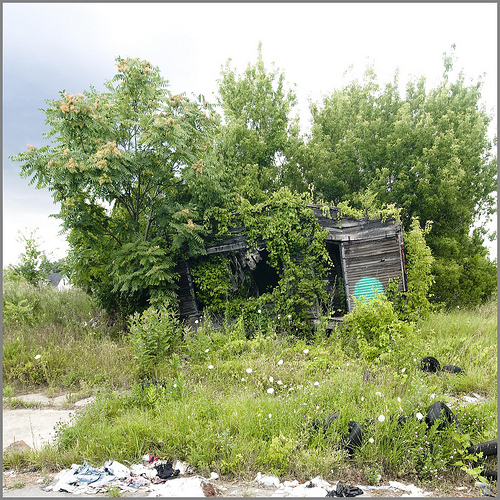
Last week, Flavorpill's Flavorwire newsletter introduced me to James Griffioen's photography. "Feral Houses," the series featured by Flavorpill, focuses on abandoned houses in Detroit, Michigan. Griffioen writes,
"For a few beautiful months every summer, some of the tens of thousands of abandoned houses become feral in every sense: they disappear behind ivy or the untended shrubs and trees planted generations ago to decorate their yards. As the city of Detroit disappears, nature is flourishing."
Considered as a whole, the "Feral Houses" series is a record of our complicated relationship with the land upon which we live and depend, as well as of our ailing community roots.


James Griffioen
From the "Feral Houses" series

Detroit's Rust Belt era history is generally bleak. Today, much of the city is classified as a food desert. Sitting down for a hearty meal with friends and family this Thanksgiving evening, I recalled Rebecca Solnit's inspiring Harper's Magazine article, "Detroit Arcadia" (July 2007). Solnit writes,
"Detroit is a cautionary tale about one-industry towns: it shrank the way the old boomtowns of the gold and silver rushes did, as though it had been mining automobiles and the veins ran dry, but most of those mining towns were meant to be ephemeral. People thought Detroit would go on forever. [...] I took many pictures on my visits to Detroit, but back home they just looked like snapshots of abandoned Nebraska farmhouses or small towns farther west on the Great Plains. Sometimes a burned-out house would stand next to a carefully tended twin, a monument to random fate; sometimes the rectilinear nature of city planning was barely perceptible, just the slightest traces of a grid fading into grassy fields accented with the occasional fire hydrant. One day after a brief thunderstorm, when the rain had cleared away and chunky white clouds dotted the sky, I wandered into a neighborhood, or rather a former neighborhood, of at least a dozen square blocks where trees of heaven waved their branches in the balmy air. Approximately one tattered charred house still stood per block. I could hear the buzzing of crickets or cicadas, and I felt as if I had traveled a thousand years into the future."
Yet the central focus of Solnit's essay are the heroic, local reclamations of Detroit's abandoned lots for community gardens or small-scale farming enterprises.
"I also saw the lush three-acre Earth Works Garden, launched by Capuchin monks in 1999 and now growing organic produce for a local soup kitchen. I saw a 4-H garden in a fairly ravaged east-side neighborhood, and amid the utter abandonment of the west side, I saw the handsome tiled buildings of the Catherine Ferguson Academy for Young Women, a school for teenage mothers that opens on to a working farm, complete with apple orchard, horses, ducks, long rows of cauliflower and broccoli, and a red barn the girls built themselves. I met Ashley Atkinson, the young project manager for The Greening of Detroit, and heard about the hundred community gardens they support, and the thousands more food gardens that are not part of any network. The food they produce, Atkinson told me, provides food security for many Detroiters. 'Urban farming, dollar for dollar, is the most effective change agent you can ever have in a community,' she said. Everywhere I went, I saw the rich soil of Detroit and the hard work of the gardeners bringing forth an abundant harvest any organic farmer would envy."
Similar projects are gaining momentum in American cities that aren't suffering as acutely as Detroit. Community garden and farmer's market movements are thriving in many urban centers, and urbanite hunters are no longer unheard of. Last week, the New York Times reported on the growing number of locavores taking up hunting, but, unlike Charlottesville, Virginia's "Deer Hunting for Locavores" class and San Francisco's Bull Moose Hunting Society, ventures made possible by relative privilege and foresight, Detroit's repurposing and enterprise is born of pressing need.


James Griffioen
From the "Feral Houses" series

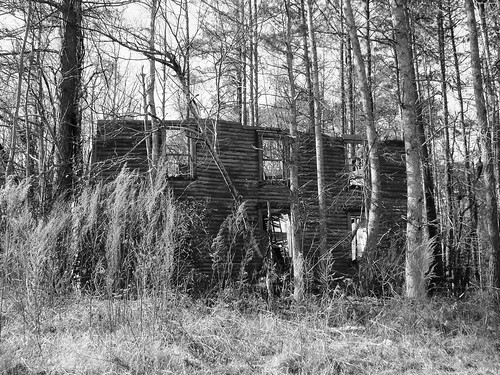
Contemplating Griffioen's handsome photographs, it's impossible not to think of Detroit's economic and health struggles. Still, his subjects, the "feral houses" themselves, don't strike this Eastern Shore boy as that unusual. All regions marked by poverty offer up monuments to the ceaseless action of Nature and time. Recent studies show that Accomack, the Virginia county that I was raised in and that my parents call home, is "the fattest" county in the state. It is also one of the poorest. Abandoned houses and overgrown automobiles figure as prominently in my mental portrait of the Shore as do salt marshes and the rich smell of freshly turned earth.

Unlike the citizens of Detroit's urban environment, Eastern Shore folks are not strangers to hunting, fishing, or farming. One might therefore assume that food desertification and obesity are unlikely. Unfortunately, access to fresh, healthy foods doesn't mean that locals won't instead opt for fast food! Furthermore, community ties might be even weaker on the Shore than they are in Detroit, eroded in part by an epidemic reliance on the automobile and big-box stores.

What does the future portend for Detroit and Virginia's Eastern Shore? Taking the long view, I'm optimistic. A decade hence, Detroit might well provide a more sustainable model for beleaguered urban communities. The Eastern Shore, however, is a different type of community, and one still on the decline; recovery will come more slowly.


Don Amadeo
House on White's Neck Road; Parksley, Virginia

Like Griffioen's pictures, Don Amadeo's photographs of the Eastern Shore remind us of the slow creep of geologic time, the long long view. Human communities may rise and fall and rise again, but all eventually succumb. So, too, with species. There is an ambivalent beauty in overgrown ruins; they celebrate the wonder of life's eternal striving even as they proclaim mortality.


Don Amadeo
Ole Rusty; Parksley, Virginia

Photo credit: "Feral Houses" photographs, courtesy James Griffioen; ShoreRebel photographs, courtesy Don Amadeo

Tuesday, November 10, 2009

Falling Down


In the wake of last Thursday's tragic shooting at Fort Hood, the American media have made much of Major Nidal Malik Hasan's religious affiliation and, more specifically, of his connection to a radical Muslim cleric based in Yemen.

Many voices on the right have touted Hasan's heinous actions as the latest evidence of Islam's corrupt and violent core. Most of the commentators on the left, by contrast, insist that Major Hasan was a victim of circumstance, and that his murderous rampage was precipitated by external pressures. Considering the left's reasoning, Michael Douglas's defense contractor turned urban vigilante in the 1993 film "Falling Down" comes to mind. At the time of that film's release, critic Roger Ebert wrote of it,
"What is fascinating about the Douglas character, as written and played, is the core of sadness in his soul. [...] There is no exhilaration in his rampage, no release. He seems weary and confused, and in his actions he unconsciously follows scripts that he may have learned from the movies, or on the news, where other frustrated misfits vent their rage on innocent bystanders."
There is salient insight in the left's response, but generally assessments on both the political left and right are ideological and reductionistic. Media pundits are involved in a fraught game of Pin the Tail on the Donkey. While the right-wing strives to pin the tail on Islam, left-wing pundits do what they can to prevent that stigma from sticking. Precious intellectual and creative energy is expended in the process; these commentators could instead provide a full accounting of what causes people to turn to religious extremism, or to extremism of any sort.

I especially appreciated, then, Dave Belden's "How Do We Understand Major Hasan?," an OpEd-style post at Tikkun Daily. I encourage folks to read it. Belden writes,
"Given that in all of our lives personal pain intersects with cultural narratives, then it is surely no surprise that for the killers it’s rarely ever a simple question of either a sick individual or a follower of extremist ideas. Timothy McVeigh was surely both when he bombed the Oklahoma Federal Building. To mention his personal pain is not to excuse him, but should give pause to all those who demonize others."
In response, I wrote in the comment section of Belden's post,
"In the media frenzy that passes for much contemporary news and politics, the humane aspects of most events or socio-political dynamics are generally overlooked. So, too, are the individuals involved reduced to caricatures and concepts. I wish I had some ideas as to how we, as a community, might address this ugly, dangerous spin. Alas…

As for David Brooks and [those to his right], I frequently marvel at their incomplete assertion that Muslim extremism is the culprit (at Fort Hood, in particular, but globally, too). Why not continue the diagnosis, revealing the imbalanced, immoral global system that produces extreme poverty, social and political disenfranchisement, and national/ethnic resentment/competition as the source of the tsoris that drives so many young men and women to embrace extremism (or, at least, adds to the appeal of a black-and-white, reductionist world view)?

Certainly religious extremism should be condemned and confronted, but addressing the root cause (which is also to address social justice globally) seems more sensible. But, were the conservative commentators to finger that root, they would implicitly condemn their own condemnation, as it, too, is born of a naive, black-hat-versus-white-hat construction of our volatile, shrinking world."
Photo credit: image ripped from Voice of America News

Thursday, September 17, 2009

Kimmel Harding Nelson: Day 11

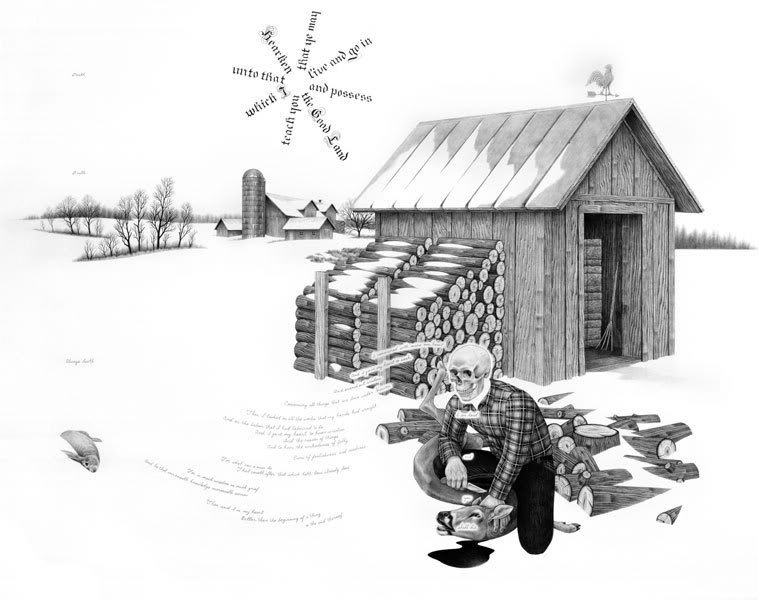
As I began jotting down notes this morning, it occurred to me that many of the ideas I've been ruminating on during my time in Nebraska City were nicely tied together in an essay almost a year old. "Eric Beltz and 'The Good Land'," a response to artist Eric Beltz's Fall 2008 solo exhibition at Morgan Lehman Gallery, in New York City, raises questions of American exceptionalism, conservation, religion, and human conceptions of "wilderness."

I subscribe to the notion that every artist or academic has just one big idea that, over a career, appears in a variety of forms or expressions. Why not, then, revisit the Beltz essay in the context of the writing I've done at the KHN residency? It follows nicely on yesterday's post, and connects our American ecological dilemma to the arts, or at least to two artists' considerations of the dilemma, namely Beltz's and my own.

+++++


Eric Beltz
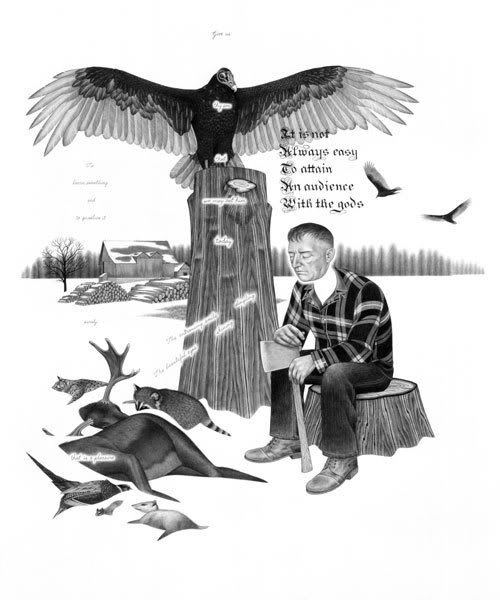
"By this Axe I Rule"
2008
Graphite on Bristol
27 1/2 x 23 inches

"All conservation of wildness is self-defeating, for to cherish we must see and fondle, and when enough have seen and fondled, there is no wilderness left to cherish."
-Aldo Leopold

The exquisitely rendered graphite drawings included in "The Good Land," Eric Beltz's recent exhibition at Morgan Lehman Gallery, are sophisticated responses to our American folkways and myths. As darkly funny as they are disarmingly earnest, the graphic works are both exhortations and critiques of our nation's inborn exceptionalism and romanticism.

Of particular interest to Beltz is our American relationship to landscape. In "By This Axe I Rule," a contemplative outdoorsman sits on a tree stump, ax in hand. The bodies of a white-tailed deer, a moose, an opossum, a raccoon and other animals are partially concealed by snow drifts at his feet; a turkey vulture is perched above, wings spread. The man bears a striking resemblance to renowned ecologist Aldo Leopold. The likeness may be coincidental, but is nonetheless pertinent. 2008 is the 60th anniversary of Leopold's death. Like Henry David Thoreau and John Muir, Leopold is a lodestar for many contemporary environmentalists. His "A Sand County Almanac," published posthumously in 1949, remains a critical conservation text.

Unlike Rachel Carson's "Silent Spring," the 1962 bestseller that catalyzed the modern environmental movement, Leopold's "Almanac" is not a call for corporate and federal responsibility. Although Leopold would surely support such measures, his book is principally concerned with our reforging an intimate connection to the landscape we inhabit. "We can be ethical only in relation to something we can see, feel, understand, love, or otherwise have faith in," he wrote.

It's noteworthy that Leopold's faith is not of the starry-eyed variety; his "land ethic" includes hunting, controlled burns, and other practices typically condemned by preservationists. Contrary to the romantic conception of wilderness, Leopold's ethic acknowledges that the tools invented by humans (the saws, shovels, axes, picks, and pitchforks that figure prominently in Beltz's drawings) are not simply cruel agents of mastery. Humans are animals and, as such, we are not apart, but rather a part of a complicated, messy ecology. No matter how we manipulate our environment, dominion remains a comforting delusion.

Yet most of us do not conceive of Nature in this way. Just as we distinguish between the self and the group, so too do we draw a hard-line distinction between humanity and the “natural world.” William Cronon, a respected, if controversial environmental historian, argues that we must alienate ourselves from Nature before it can be understood as something pristine, virgin, or more wild than ourselves. In his celebrated 1983 book, “Changes in the Land”, Cronon reveals the quixotic quality of preservationist impulse.
"If the nature of Concord [Massachusetts] in the 1850s - a nature which many Americans now romanticize as the idyllic world of Thoreau's own Walden - was as 'maimed' and 'imperfect' as he said, what are we to make of the wholeness and perfection which he thought preceded it? It is tempting to believe that when the Europeans arrived in the New World they confronted Virgin Land, the Forest Primeval, a wilderness which had existed for eons uninfluenced by human hands. Nothing could be further from the truth....the land was less virgin than it was widowed. Indians had lived on the continent for thousands of years, and had to a significant extent modified the environment to their purposes…The choice is not between two landscapes, one with and one without a human influence; it is between two human ways of living, two ways of belonging to an ecosystem."
The preservationists' dualistic attitude (i.e., Humanity vs. Nature) provides only simple answers to our complex questions. By contrast, Beltz’s allegorical drawings shirk simplistic moralizing in favor of contradiction, ambivalence and multiplicity. His scenes speak to an active communion with Nature, albeit one that includes suffering, death and a melancholy nod to the essential absurdity of existence. By turns, Beltz eulogizes, champions and satirizes Thoreau's self-sufficiency and Andrew Wyeth's rural romanticism.


Eric Beltz
"Hysteria"
2008
Graphite on paper
17 x 13 3/4 inches

Beltz critiques America's religious and economic landscape, as well. Four of his drawings comprise a series entitled “Back to Eden.” In each, a headless body clothed in overalls, workman boots ,and a shirt with rolled up sleeves – the uniform of the outdoorsman-farmer - is slumped in or alongside a pile of cut logs and other vegetation. Above each of these tableaus, Beltz has written one word, in cursive: Asthma; Hysteria; Cancer; Delirium.

Considering the series, I recall Adam Smith’s ignored admonition concerning the dangers of loosely regulated capitalism. Smith, the 18th century Scottish philosopher best known for his influential treatise "The Wealth of Nations," is canonized by contemporary capitalists for laying down the principals of free market economics, but he entertained doubts about and acknowledged the shadows cast by such a system.

"Power and riches," Smith wrote, "are immense fabrics, which it requires the labor of a life to raise, which threaten every moment to overwhelm the person that dwells in them, and which, while they stand, can protect him from none of the severer inclemencies of the season. They keep off the summer shower, not the winter storm, but leave him always as much and sometimes more exposed than before to anxiety, to fear and to sorrow, to diseases, to danger and to death." Smith’s misgivings were warranted. Contemporary life is rife with social ailments and, in combination with our alienation from Nature, secular capitalism is a principal causative factor.

Curiously, free market capitalism is close kin to Manifest Destiny, the divine doctrine of conquest and consumption. Capitalism is exported with no less zeal than our cruel spread west from the colonies. Harriet Beecher Stowe, the 19th century novelist best remembered as an outspoken proponent of abolition, wrote that America is "a nation specifically raised up by God to advance a cause of liberty and religion." She did not say “liberty of religion.” America was founded by Protestant fundamentalists fleeing religious persecution in Europe. Arriving on these contested shores, they took names like Ezekiel, Jacob, and Issac, and likened their journey to the Jewish Exodus from Egypt. These religious settlers are the forebears of a great many contemporary Americans.

Appropriately, Beltz’s drawings incorporate Biblical texts and his subjects are recognizable as America's founding fathers and God-fearing, anonymous farmers. But Beltz draws from a peculiarly American well, the proverbial melting pot. Each drawing is suffused with currents of Eastern philosophy and shamanism. His farmers and historical figures are also mystics. American philosophy is more plural than we care to admit, and Beltz's admixture of East and West, allegory and history, supernatural and natural is a fair reckoning. (American transcendentalism, for example, the philosophy so vital to Thoreau and Ralph Waldo Emerson, was a hybrid of Protestant Unitarianism, Romanticism, Hinduism, and European intellectualism.)


Eric Beltz
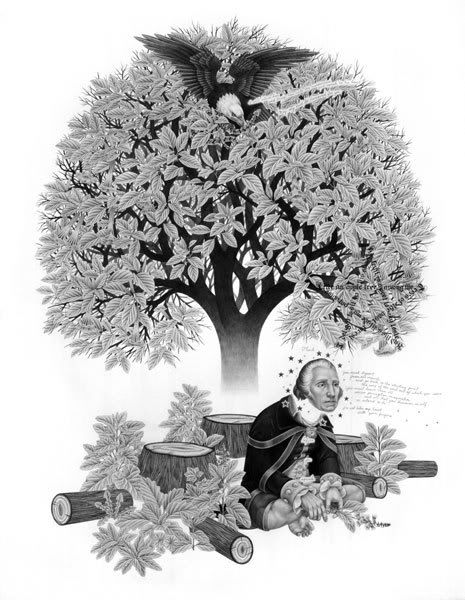
"Tree of the Evil Eagle"
2008
Graphite on paper
40 x 30 inches

Still, the Bible is the first book of the United States, and many Americans regard the Constitution and founding fathers with astonishing reverence (to the extent that, in some circles, the former is sacrosanct). But documents and philosophies are of a particular time. Guarded by strict interpreters, the Constitution of the United States can become as regressively dogmatic as any primary religious text. Without thoughtful interpretation of Constitutional scripture, the significance and relevance of the founding fathers' enterprise will wane.

But most Americans (politicians and citizens alike) are in the business of denying the inevitable, be it the death of a loved one, an unregulated economy, or an ideology. Rather than confront our heavy history (and with it our future), the United States cloaks itself in exceptionalism. We remove ourselves from a fact-based historical narrative so that the road to future success is understood as an unyielding continuation of the present, divinely-ordained course. Like the empires that rose and fell before us, America's clarity of vision is obscured by global power and a history that privileges mythic glory over fact. Because we make history, many of our leaders feel strongly that we don't need to know it. Moreover, the history we make is irreproachable because it is consecrated.

Yet the secular capitalist world view strives to replace religion and the supernatural with consumerism. Manifest Destiny Version 3.0 is not ordained by God so much as by the Almighty dollar. And the replacement worked, more or less. The secular capitalist model is today the global standard. But sociologists, anthropologists, and, now, some neuroscientists agree that the substitution is inadequate. This deficiency is most apparent in a religious nation like the United States, where fundamentalism and cultism, reactionary responses to the secular world, are thriving. Despite our founding fathers' dismissal of the New Testament's Book of Revelation (Thomas Jefferson described it as "the ravings of a maniac"), a 2002 CNN/Time magazine poll found that 59 percent of Americans believe the prophecies therein are real and that the gruesome judgment of the Second Coming is imminent. James Watt, former President Reagan's Secretary of the Interior, is among that majority. He famously stated that protecting our nation's natural resources was not a priority because Jesus Christ would return only "after the last tree is felled."

Yet some evangelical fundamentalists are more fair-minded. They focus instead on the Bible's call for stewardship, and argue that the success or failure of the environmental movement depends on which interpretation gains the upper hand. Will we embrace a dominionist or stewardship theology?

The crux of that question is the American notion of wilderness. Cronon writes, "the flight from history that is very nearly the core of wilderness represents the false hope of an escape from responsibility, the illusion that we can somehow wipe clean the slate...and return to the tabula rasa that supposedly existed before we began to leave our marks on the world...Non-use is not an option: to live in nature is to use and change it by our presence. The choice we face is not to leave no marks - that is impossible - but rather to decide what kinds of marks we wish to leave."


Eric Beltz
"The Good Land"
2008
Graphite on paper
30 x 40 inches

Beltz's meticulously rendered works don't offer any answers, but neither do they shrug off the dilemma. With a richly ironic sensibility and a sensitivity to the complexities of our national character and (natural) history, Beltz embraces our clusterfuck approach even as he skewers it. "The Good Land" is sublimely ambivalent.

Photo credit: all images ripped from the artist's website

Wednesday, September 16, 2009

Kimmel Harding Nelson Residency: Day 10


Jefferson Sculpture
Lewis & Clark Visitors Center; Nebraska City

Naturalists, Puritans, and New Territories
"I think our governments will remain virtuous for many centuries; as long as there shall be vacant lands in any part of America. When they get piled upon one another in large cities, as in Europe, they will become corrupt."

- Thomas Jefferson, 1787
The American polymath Thomas Jefferson ranks highly in my pantheon of heroes. Yeoman farmer, architect, inventor, philosopher, naturalist, Virginia gentleman, and statesman, Jefferson defies easy classification. His political pragmatism and philosophy reflect his broad excavations, and the complex of sometimes contradictory ideas that Jefferson put down over the course of his long life allows his legacy to be fairly claimed by contemporary pundits of every stripe. His name and statements are marshaled to support causes across the political spectrum, including state's rights, internationalism, provincialism, gun control, the right to bear arms, unregulated capitalism, anarchy, secularism, and even the call for the United States to be officially deemed "a Christian nation." It is not, however, Jefferson's nuanced political philosophy that is responsible for his cultural ebb; he was a slave-owner and a patriarchal figure who decried "intellectual women." By today's standards, he was a deeply flawed man. But Jefferson died 183 years ago. It is wrongheaded to dismiss the whole of the man for latter-day sins. In any case, his accomplishments and legacy are profound.

Jefferson was irredeemably curious and hopeful. The man's hunger for knowledge and his faith that the human lot can forever be improved upon vitalize the Jeffersonian heritage. The Enlightenment-inspired, exuberant optimism of Benjamin Franklin, Joseph Priestley, Thomas Jefferson, and others in their mold watered the soil of American social, political, and technological revolution. And, as I wrote two days ago, "it's a happy wonder to contemplate [...] the maturation and proliferation of human technology." But at what price did so much "happy" change come?


Mandan Fort recreation
Lewis & Clark Visitors Center; Nebraska City

President Jefferson, in March of 1803, commissioned Captain Meriwether Lewis to lead the Corps of Discovery with William Clark. Jefferson obtained federal funding for the expedition on the grounds that, if successful, Lewis and Clark might "offer the most direct and practicable water communication across [the] continent for the purposes of commerce," but the president's principal interests were other. He wrote to Lewis,
"The object of your mission is to explore the Missouri River. [...] Objects worthy of notice will be the soil & face of the country, it's growth & vegetable productions, especially those not of the U.S.; the animals of the country generally, & especially those not known in the U.S., the remains or accounts of any which may be deemed rare or extinct; the mineral productions of every kind; but more particularly metals, limestone, pit coal, & saltpetre; salines & mineral waters, noting the temperature of the last, & such circumstances as may indicate their character; volcanic appearances; climate, as characterized by the thermometer, by the proportion of rainy, cloudy, & clear days, by lightening, hail, snow, ice, by the access & recess of frost, by the winds prevailing at different seasons, the dates at which particular plants put forth or lose their flower, or leaf, times of appearance of particular birds, reptiles or insects."
Historians suggest that the excitement Jefferson felt on the eve of this great expedition was quite real. His impetus was curiosity, not Puritan conquest.


Mt. Zion African Methodist Church yard
Mayhew Historic Village; Nebraska City

The Pilgrim settlers of this country had little curiosity about the natural history or native peoples of their "New World." William Bradford, five-time governor of Plymouth Colony from 1621 - 1657, described (what little he knew of) the North American continent as "a hideous and desolate wilderness." Jefferson, by contrast, wrote that "there is not a sprig of grass that shoots uninteresting to me." He saw the natural world as an Eden to be studied and, as author Erik Reece describes it, as "an antidote to the deadening forces" of civilization. For Jefferson, the notion of "God and country" was shaped by topography and the human place in it.

But Lewis and Clark's great voyage of discovery didn't simply educate Americans living east of the Appalachian spine about the continent's interior and western Edens. It paved the way for mass migration, mass slaughter, and mass industry. What happened on this vast continent parallels the greater history of mankind and, indeed, of all life.


Bison diorama
Lewis & Clark Visitors Center; Nebraska City

Historian Daniel Boorstin wrote in 1953 that, "the genius of American democracy comes not from any special virtue of the American people but from the unprecedented opportunities of this continent." Similarly, the remarkable evolution of the human ape, from tree-dweller, to hunter-gatherer, to agriculturist, to civilized man, comes from no special virtue of our species, but from the unprecedented opportunities of this Earth. One thing, as it were, led to another, and our species proved able and willing to exploit to the fullest extent. Loren Eiseley writes, in The Immense Journey,
"The stolen energy that would take man across the continents [as a hunter-gatherer] would fail him at last. The great Ice Age herds were destined to vanish. When they did so, another hand like the hand that grasped the stone by the river long ago would pluck a handful of grass seed and hold it contemplatively. In that moment, the golden towers of man, his swarming millions, his turning wheels, the vast learning of his packed libraries, would glimmer dimly there in the ancestor of wheat, a few seeds held in a muddy hand."
So it was with North America. The "meteoric, messy, and astonishing history" of the United States was fueled, above all, by a distinctly un-Jeffersonian conquest of the land's native peoples, animals, and resources.

Near the end of his sweeping ecological history of North America, The Eternal Frontier, Tim Flannery writes,
"During the nineteenth century, [...] the European Americans were developing a new economy. It was an economy based on systems of mass production and mass exploitation that needed enormous resources to operate. The key decade was 1880-90, for only then did European machinery become sophisticated enough to destroy the great herding and flocking species [the passenger pigeon, the American bison, and the Eskimo curlew]. Their enormous numbers provided an ideal teething rusk for an economic machine that would soon produce cars in the millions and hamburgers in the billions."
We devoured the continent.


Fake Prarie Dog burrows and mural
Lewis & Clark Visitors Center; Nebraska City

What allowed for this? What became of the Enlightened foresight of the founding minds? How did we move, in one hundred years, from Thomas Jefferson to Henry Ford? And could we have made such astounding, "happy" progress in human rights, suffrage, and science without surrendering to this demonic appetite? There is no tidy answer to these questions and, in any case, it's irresponsible to wade in what-might-have-been when you can instead strive toward what-yet-could-be. Still, the history perplexes.

Jefferson bemoaned the Christian scriptures' inclusion of miracles and the emphasis, in Christian doctrine, on the afterlife. Erik Reece explains in An American Gospel that Jefferson realized,
"the more Christian fundamentalism emphasizes that the kingdom of God awaits as a reward in the afterlife, the more it ignores [...] Jesus' teachings of how we should act while we inhabit this earthly realm. [...] The relevance of Christianity to most Americans has far more to do with the promise of eternal salvation from this world."
Jefferson's famous and sensible solution was to edit the Christian New Testament, deleting any and all miracles, including the Virgin Birth and the Resurrection. He called the result "The Life and Morals of Jesus of Nazareth." Today, the book is best known as "The Jefferson Bible." Perhaps, if more good Christians had followed their incarnate God's example and teachings in this life - the one that actually matters! - the west would have been settled in accord with the land. Unfortunately, most in our "Christian nation" don't know of Jefferson's earnest effort to save Christianity from other-worldly supernaturalism, from, as he called Puritanical ministers, "the soothsayers and necromancers."

Neither do most Americans know of Jefferson's effort to temper our faith in industrialism. Jefferson's agrarian dream for America was impossible; the United States was then and is now a burgeoning country, and true pastoralism can only ever be embraced on a small scale. But we would do well to remember Jefferson's vision, to remember that we are part of a greater system, and that the expiration date for America's frontier mentality, its faith in boldly going and exploiting, is past.

Despite our exceptionalist tendencies, our nation is like any other. Every nation is a tiny part of the greater superorganism, and every nation's story is a life cycle. The sprawling, arrogant United States is no longer an adolescent, and it can't afford to continue acting like one, to continue "lighting out for the territories." If we fail to mature, our reckless faith in what lies over the next mountain, in the future and in the afterlife, will prove our nation's undoing. It is faith in what exists here and now, in the place where we stand, that needs resurrection.


Missouri River Overlook
Lewis & Clark Visitors Center; Nebraska City

Most Americans are estranged from their own nature, as well as from the nature all around them. Reece writes,
"[We are estranged from] the sources of our food, the sources of our clothes, and the sources of the energy that run our homes. Beyond these basic needs, money and corporate influence have estranged us from our own government. Our isolation within suburban homes has estranged us from our neighbors and communities. [...] Cars have estranged us from our own bodies. [...] Our modern condition of estrangement has led us to live in ways that show a remarkable abdication of responsibility."
Reece proposes that Aldo Leopold's philosophy "carries us back into an ethic of responsibility." I agree.

Leopold, the godfather of modern conservation, inherited Jefferson's dream. Like Jefferson, he was a Romantic pragmatist, a type as well-suited to diplomacy as to conservation. Leopold acknowledged that resource use, like the economy, can be regulated thoughtfully, but the Romantic in Leopold was dismayed by the dark side of our equating land with money. He wrote,
"I suspect that the forces inherent in...economic evolution are not all beneficent. Like the forces inside our own bodies, they may become malignant, pathogenic. I believe that many of the economic forces inside the modern body-politic are pathogenic in respect to harmony with land."
He deemed his heroically optimistic response to the increasing pressures of population and market a "land ethic." Despite the difficulties of cultivating such an appreciation of the natural world in the twentieth century, Leopold persisted.
"That land is a community is the basic concept of ecology, but that land is to be loved and respected is an extension of ethics. [...] A land ethic, then, reflects the existence of an ecological conscience, and this in turn reflects a conviction of individual responsibility for the health of land. [...] We can be ethical only in relation to something we can see, feel, understand, love, or otherwise have faith in."
The American estrangement from land and from the rest of nature (including the dark, interior wilderness of the psyche) is redressed through cultivation of a land ethic. And, in so far as I am "happy" to contemplate the incredible rate of technological evolution, I am made happier still by the prospect of a mature, tempered America.


Vacant lot on Central Avenue; Nebraska City

This morning, I sat for a while and talked with an older gentleman in Long Home Coffee Shop, on Nebraska City's Central Avenue. A retired physicist, he expressed concern about the future of America and, more generally, of the human species. "It's all terribly depressing," he observed. "I have my good days and my bad," I concurred. "But the bleak pessimism is more rare than it was, just because it's unproductive." He nodded, and his heavy eyes seemed to say both, 'Thank goodness for the optimism of youth!' and 'Bloody damned fool!'

But I'm not a fool, and neither is he. An hour after we talked, as I sat at a table scribbling the notes that became this essay, he attended, in the back room of the coffee shop, a meeting regarding the construction of a community garden at the west end of town. The city has provided the group with a vacant lot, a local corporation will provide the initial revenue for construction, and the garden will be tended and managed by volunteers, providing food for those in need.

Now that, I contend, is positively Jeffersonian!

Photo credits: all photos, Hungry Hyaena, 2009