Showing posts with label global warming. Show all posts

Friday, January 29, 2010

Climate Change, Dullardism, and What We Can Do About It

Below, I've reposted my most recent guest contribution to the Endangered Species Print Project Blog. Because it is pertinent, I've also included the National Resource Defense Council Action Fund's "This Is Our Moment" public service announcement.

Please devote three minutes to the PSA. The celebrity cast is definitely "of the moment," and some of their references won't make sense five years from today, but that's the point. We need to be calling our senators now! (Or, if you prefer, email them, as the PSA suggests. Click here.)

Legislative action on these issues is long overdue...and our ailing country will benefit from the new jobs and the display of a little moral backbone. Let's not pass up the opportunity. Call. Email. Rally. Please.

+++++


When the post below originally appeared on Hungry Hyaena, in June of 2005, polls suggested that the American public were increasingly aware of the fact that climate change (or "global warming") posed a serious threat to our environmental status quo. In fact, the number of Americans that favored legislative action to curb anthropogenic greenhouse emissions and to mitigate the negative effects of climate change continued to grow into 2008.

Recent studies, however, reveal a troubling trend: Americans' concern about climate change diminished in the last year, so much so, according to some polls, that a majority of United States citizens today doubt that climate change is a threat, and dismiss global warming as a fantasy. Whatever the actual numbers, the up-tick in skepticism is real, even in the face of overwhelming scientific consensus. The frightening anxiety of the burgeoning global village, our contemporary economic upheaval, and the requisite priorities of our elected legislators notwithstanding, action on climate change is no less a moral and ethical imperative today than it was five years ago.

+++++
"The problem of modern man isn't to escape from one ideology to another, nor to escape from one formulation to find another; our problem is to live in the presence and in the attributes of reality."

-Frederick Sommer, The Poetic Logic of Art and Aesthetics
Although surveys suggest that most of the American public still believes that climate change is a future threat, many thousands of species are already threatened by shrinking environmental ranges and changing precipitation patterns; some of these species are on the verge of extinction. The negative impact of climate change occurs now and later.

I encourage those readers curious about the subject, particularly those who believe that we will "solve" the problem via improved technologies, to read "Climate Change is Totally Awesome," a recent post at Organic Matter. The author dissects a Telegraph article by Robert Matthews, entitled, "Warmer, wetter and better (or the good news that the climate change lobby doesn't want you to hear)."

Interviewed for the Telegraph piece, Professor Philip Stott of the University of London argues that reducing emissions will not alleviate the threat, and that the steps required to significantly reduce emissions would render us technologically impotent.
"Even if we shut every fossil-fuel power station, crushed every car and grounded every aircraft, the Earth's climate would still continue to get warmer, according to Prof Stott. 'The trouble is, we would all be too impoverished to cope with the consequences.'"
I agree that the warming trend is natural and that, even were we to de-industrialize, the world would continue to warm. But anthropogenic action accelerates climate change to such a devastating degree that biodiversity and, ultimately, human stability are in peril.

Furthermore, Stott's concept of technological impoverishment is misguided. To be sure, if we First Worlders are to transition to sustainable development, we must give up many of the conveniences that we now take for granted. It remains to be seen whether we will make this sacrifice of our own volition or if we will do nothing until Nature demands it of us. In either case, the sacrifice will not make us incapable of coping with climate change.

It will, however, demand a significant restructuring of our cultural and technological priorities. Our taste for spectacle and distraction must be unlearned. Cultural critic and anthropologist Morris Berman, in his outstanding book Wandering God: A Study in Nomadic Spirituality, dubs the social spirit of contemporary, industrialized nations "dullardism."
"With dullardism, the goal is simply to go unconscious, by means of tranquilizers, alcohol, TV, spectator sports, organized religion, compulsive busyness and workaholism, and so on (even though many of these do provide a short-term 'high')."
Dullardism is not endemic to contemporary, industrialized societies. Equivalent symptoms were documented in the late years of the Roman and Mayan civilizations, and I suspect that they also existed in Sumer and other early civilizations.

The human animal is not evolutionarily equipped to flourish in society; our brains remain "wired" for the Pleistocene, and the rapid transition to an agrarian, sedentary, and "civil" existence has been rapid and fraught. We therefore exhibit displacement behavior, seeking escape via fundamentalism, sports, entertainment, and drug abuse.

Does this mean that advanced civilization makes us ill-equipped to deal with environmental catastrophe? Not necessarily (we have to hope not!), but we must reexamine our social mores in order to create something akin to a new social order, one that balances our primitive lusts for progress and power with pragmatism and stewardship. It's a tall order, to be sure, but one that we must fill.

Wednesday, December 16, 2009

Global Climate Justice Fast


350 Candle Vigil; Washington Square Park, NYC; December 2009

"How well we control our numbers, our appetites, and the efficiency with which we satisfy those appetites will ordain just how desperate the situation becomes. They are the battles for our time, as morally compulsory as the battles for civil rights or against totalitarianism."

- Bill McKibben, The End of Nature

The group gathered at the northern entrance of Washington Square Park last Friday evening was smaller than I'd anticipated. We were assembled for a candle vigil in conjunction with the United Nations Climate Change Conference in Copenhagen, Denmark, and 350.org, environmental activist Bill McKibben's project to increase global awareness of the environmental (and status quo) threats posed by the exacerbation of climate change due to anthropogenic influence.

The New York City vigil was one of hundreds of similar events happening around the world on December 11th. Given the date, the vigil was also a satisfying way to bring in Hanukkah, a holiday that, despite its complicated history, is essentially about standing up for the causes that you feel most strongly about, even in the face of overwhelming odds. Small though our Washington Square Park group may have been, then, I was upbeat and hopeful.

Tomorrow (Thursday, December 17th), there is more cause for hope. I'll be one of thousands (hopefully one of many thousands) of true cosmopolitans forgoing food as part of the Global Climate Justice Fast. Bill McKibben's organization is trying to spread the word from Copenhagen, but the easiest place to sign up is at the Climate Justice Fast website. The official statement of the fast participants reads:
"We will fast voluntarily, for one day on Thursday, in solidarity with the millions who have and could lose their lives to preventable and involuntary hunger, disease and conflict resulting from climate change.

We call on world leaders for a real climate deal now--a deal grounded in science and strong enough to get us back to 350 [parts per million]."
I urge HH readers to take action this season. The specifics of your engagement matters less than its spirit. As I wrote not long ago,
"If global warming isn't appealing to your still, small voice, get involved with political activism, volunteer at your local homeless shelter, pledge financial support to non-profit activist organizations working for causes that you feel strongly about; it doesn't matter what you do, but it does matter that you do something. Turn off the television, put down the tabloid. I beg this of you."
If you have the energy and spirit to take action in multiple ways, so much the better, but every little bit helps. We're all in this marvelous mess together.

Friday, October 23, 2009

Imagine


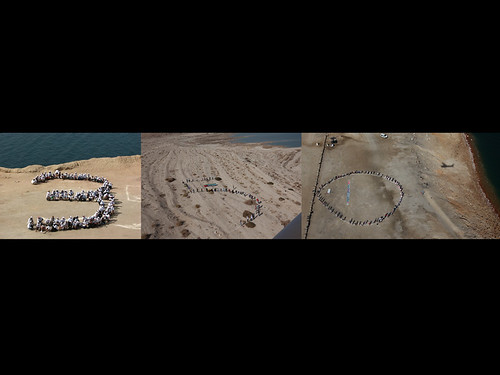
"On October 24th, Israelis, Palestinians, and Jordanians will gather around the Dead Sea to form giant human numbers: Israelis will form a 3, Palestinians a 5, and Jordanians a 0. An aerial photograph will link them together to form the number 350."
Cynics and "realists" will dismiss some of the international events taking place tomorrow as naive, idealistic flights of fancy. I suggest that we instead celebrate them as exactly that!

Human imagination is a marvelous adaptive development, one that grants us "flights of fancy" that can, in fact, change the world. The naive, idealistic innovation of one age is the accepted reality of the following age.

This morning, I repeat yesterday's appeal. Get involved, however and wherever you can!

Photo credit: Photo ripped from the 350.org Flickr photostream

Thursday, October 22, 2009

Acting Out (Peacefully) Against the Culture of Competition


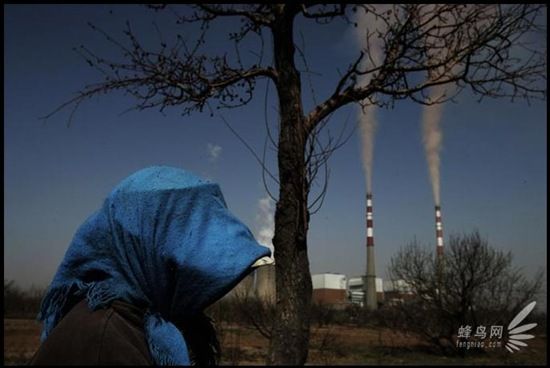
Shizuishan Industrial district in Ningxia. Residents cover themselves against the falling dust when going outside.
April 22, 2006

This Saturday, October 24th, I'll join a mob of peaceful activists and march across the Brooklyn Bridge, from Manhattan to Brooklyn, in hopes of further raising public awareness about the reality of climate change and the need for a comprehensive international climate treaty. The march is associated with 350.org's Day of Action.
"350.org is an international campaign dedicated to building a movement to unite the world around solutions to the climate crisis--the solutions that science and justice demand. Our mission is to inspire the world to rise to the challenge of the climate crisis—to create a new sense of urgency and of possibility for our planet. Our focus is on the number 350--as in parts per million, the level scientists have identified as the safe upper limit for CO2 in our atmosphere. But 350 is more than a number--it's a symbol of where we need to head as a planet. [...] This December, world leaders will meet in Copenhagen, Denmark to craft a new global treaty on cutting emissions. The problem is, the treaty currently on the table doesn't meet the severity of the climate crisis—it doesn't pass the 350 test. In order to unite the public, media, and our political leaders behind the 350 goal, we're harnessing the power of the internet to coordinate a planetary day of action on October 24, 2009. We hope to have actions at hundreds of iconic places around the world - from the Taj Mahal to the Great Barrier Reef to your community - and clear message to world leaders: the solutions to climate change must be equitable, they must be grounded in science, and they must meet the scale of the crisis."
350.org was founded by author and environmentalist Bill McKibben and, although some legitimate philosophical criticisms of the project have been raised, I feel strongly that the organization's mission is vital.


Due to long-term consumption of water contaminated by industrial waste, 50 people have cancer and cerebral thrombosis in Kang village of Linfen City, Shanxi Province..
64-year-old Wang Baosheng has fester wounds all over his body, and must sleep sitting, face down on the edge of the bed each day.
July 10, 2005

Should you doubt the urgent need for an international climate treaty that demands accountability and systemic change, or should you remain skeptical of the human influence on atmospheric carbon levels, I encourage you to take a look at the distressing pictures that ChinaHush recently published. Photographer Lu Guang's series "Pollution in China" is a testament to the cruel realities of the international, industrial market.

In his book-length essay Life Is A Miracle, the author, poet, essayist, and critic Wendell Berry describes the global, capitalist world view as,
"one culture of division and dislocation, opposition and competition, which is to say the culture of colonialism and industrialism. This culture has steadily increased the dependence of individuals, regions, and nations upon larger and larger collective economies at the same time that is has thrown individuals, regions, and nations into a competitiveness with one another that is limitlessly destructive and demeaning."
The "collateral damage" caused by this monstrous steam engine is not limited to elevated carbon levels, and its poisons don't just affect the dispossessed or the politically and economically powerless.

Nicholas Kristoff reminds us, in a recent New York Times OpEd piece, that the staggering number of "deformed frogs and intersex fish [found in or near United States' waters] — not to mention the growing number of deformities in newborn boys — should jolt us."
"In the Potomac watershed near Washington, male smallmouth bass have rapidly transformed into 'intersex fish' that display female characteristics. This was discovered only in 2003, but the latest survey found that more than 80 percent of the male smallmouth bass in the Potomac are producing eggs. Now scientists are connecting the dots with evidence of increasing abnormalities among humans, particularly large increases in numbers of genital deformities among newborn boys. [...] Apprehension is growing among many scientists that the cause of all this may be a class of chemicals called endocrine disruptors. They are very widely used in agriculture, industry and consumer products. Some also enter the water supply when estrogens in human urine — compounded when a woman is on the pill — pass through sewage systems and then through water treatment plants."
Herpetologists have been sounding the alarm for years, but the policy makers are warm in the pockets of the immoral corporations and the populace, by and large, prefers to escape in celebrity pregnancy updates and corporate-owned sporting events. Amphibians were the ignored canary in the coal mine. Now many animal families (ours included) are paying a terrible price, one that we can not yet fully appreciate.


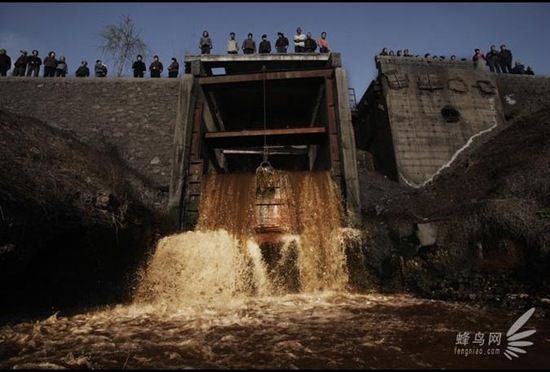
Henan Anyang iron and steel plant’s sewage flowed into Anyang River. March 25, 2008

Still, it's not too late to stand up to the "culture of colonialism and industrialism." Visit 350.org. Find out how to get involved in the effort. If global warming isn't appealing to your still, small voice, get involved with political activism, volunteer at your local homeless shelter, pledge financial support to non-profit activist organizations working for causes that you feel strongly about; it doesn't matter what you do, but it does matter that you do something. Turn off the television, put down the tabloid. I beg this of you.


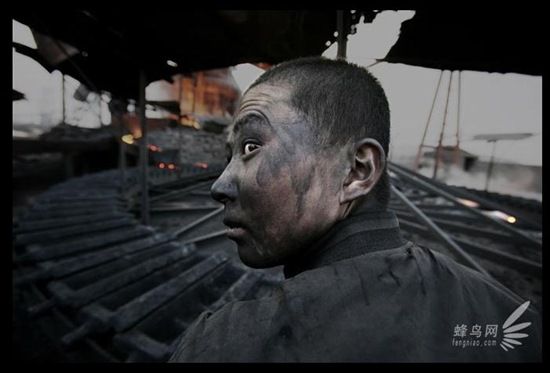
Breathing large amounts of dust into their lungs, people become sick after working here for 1-2 years. Most of these migrant workers come from area of poverty.
April 10, 2005

Photo credits: all photographs, Lu Guang; ripped from ChinaHush

Thursday, May 14, 2009

A Thursday in the Holocene


Over dinner this Tuesday evening, a friend and I discussed our species' more homogeneous future. I suggested that miscegenation and intercultural activity will lead to future generations comprised of individuals that look and act more alike. In turn, violent conflict between human groups will decrease; in this world of mutts, superficial differences such as race and custom will be less visible and therefore less contentious.

My friend shares my hopeful outlook, but expressed skepticism. Citing the Rwandan genocide and the fractious political situation within Israel, he contended that greater physiological and sociological similarity are just as likely to increase conflict. Humans will always find some reason to fight, he believes, and superficial similarity will lead not to a peaceable kingdom, but instead to the exacerbation of subtle differences or the outright invention of philosophical or genetic justifications for the vilification of "the other." I can't dismiss his forecast, but if Homo sapiens sapiens survives long enough to witness that homogeneous era, our species will have learned a great deal more about cooperation. This, I feel, bodes well for the less violent prospect.

But what-if suppositions about the far distant future are of little practical value to the here-and-now. I have faith in teleological eudaimonia, but the lot of Earth's inhabitants won't gradually improve unless our policies and actions are informed principally by consideration of a more immediate future...say, one or two generations. And, although it will be a thousand years, at least, before miscegenation makes all humans mocha, our planet's ecology is right now undergoing drastic changes.

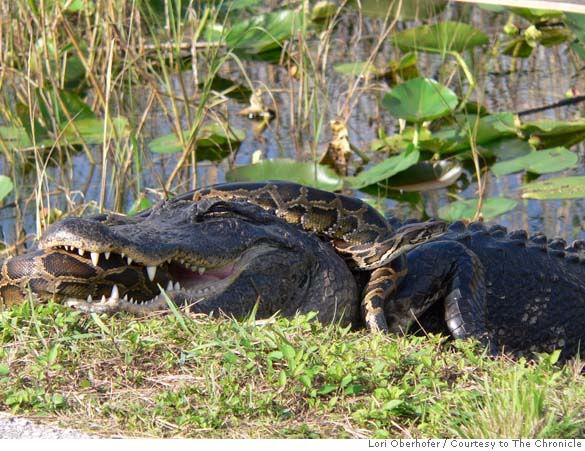
Burkhard Bilger's "Swamp Things" (The New Yorker, April 20, 2009) highlights the explosion of "invasive" species in Florida. Bilger focuses particularly on the success of the Burmese python (Python molurus bivittatus) in the Florida Everglades, but notes that a great variety of exotic species have gained toeholds in the state.
"Florida now has more exotic lizard species than there are natives in the entire [American] Southeast. On a single tree you could conceivably find plants and animals from six continents, including parrots from South America, mynah birds and Old World climbing ferns from Asia, vervet monkeys from Africa, ladybird beetles from Australia, and feral cats from Europe, via Africa and Asia. In some cases, the recent immigrants would be more genetically diverse than their cousins back home. The state's ecology is a kind of urban legend come true -- the old alligator-flushed-down-the-toilet story repeated a thousand times with a thousand species.

Some find all this thrilling. Florida has become an open-air zoo, richer in species than ever before. To others, it's the harbinger of a new and depressingly undifferentiated age, when the old biological borders begin to fade and every place starts to look like every other. Ecologists have even given it a name: the Homogecene."
Indeed, the Homogecene may soon overtake the Holocene.

Note: The post's title is a nod to Christopher Cokinos's terrific essay, "The Consolations of Extinction" (Orion Magazine, May/June 2007). In it, Cokinos
"[suggests] that our PalmPilots and DayMinders and Nature Conservancy calendars show not only year, month, date, and day of the week but also geologic epoch. It’s a Tuesday in the Holocene."
Photo credit: Burmese python and American alligator, copyright 2008, Lori Oberhofer, National Park Service

Sunday, November 30, 2008

Missing the snows


Sunrise over Heron's Foot impoundment; November 2008


Friday morning at Heron's Foot was unseasonably warm. Even in the relative chill of pre-dawn, gloves were not necessary and, by sunrise, the temperature was in the upper 40s.

With the exception of a mid-November cold snap, the region's fall and winter temperatures are well above average this year. The warming effects are especially notable with respect to migratory waterfowl patterns. During my Thanksgiving visit in 2005, four to five thousand snow geese (Chen caerulescens) nightly took refuge in the estuary alongside Heron Hope. One year later, only a few hundred of the birds roosted there and, by the end of December 2006, the flock had grown to around one thousand individuals, at least three thousand birds shy of the previous year. 2007's numbers were similarly low and, astonishingly, I saw only a dozen geese this Thanksgiving! But I shouldn't be surprised. If the temperatures don't force the issue, what reason do migratory birds have to continue south?

I caught a ride back to New York on Friday afternoon. In southern Maryland, I spotted small groups of snow geese feeding in the roadside fields. As daylight faded and we approached the Maryland-Delaware state line, I finally saw the impressive flocks of thousands, trading in the half light from field to field. Soon, they would rise en masse for their evening flight.

These were the very birds that have made my childhood home their winter refuge but, this year, they've settled seventy miles north of Heron's Hope. I miss seeing and hearing them there, but I must also marvel at the rapidity of the changes we're witness to. Everything, always, is in sensitive flux.


Northern pintail decoy; Heron's Foot impoundment; November 2008


Photo credits: Hungry Hyaena, 2008

Monday, January 01, 2007

Happy (warm) new year!

I'm a cold weather man. Winter days and nights possess an obscure magic that buoys my spirit and heartens my constitution. I'm particularly sensitive to this variety of dark enchantment when I'm alone in winter woods. We humans have grown complacent in our throne atop the food chain, and I enjoy my body's reaction to harsh conditions as I also appreciate occasional haunting by the specter of predation. Both are humbling, gratifying reminders of what we've come from, and of what we are.

But this winter has been unseasonably warm. As always, I traveled south to Virginia to visit my parents. The temperature on the morning of my birthday, December 29th, was 52 degrees Fahrenheit; by late afternoon, it was over 60. Yet still the talking heads on the local news speak of global warming as if it may be a fiction! Skepticism serves its purpose in science, and shouldn't be dismissed offhand, but whether we're attributing warming to human activity or to natural fluctuations, an examination of the data shows that the general trend is all too apparent.

Snow Geese Beyond Morning Trees
A flock of about 800 snows departs the estuary in search of morning food

Because of the warm temperatures, the travels of migratory species are unusual this year. Last Thanksgiving, I watched four or five thousand snow geese (Chen caerulescens) pitch into the salt water estuary alongside my parents' house. The birds arrive in last light to roost, and they depart just after dawn, moving on to feed in the fields of winter wheat.

This year, by contrast, the late December roosts were limited to one thousand birds, give or take a couple hundred. The weather is warm enough that the geese, heading south from their Arctic breeding grounds, don't need to fly so far to find food and refuge. The spectacular flocks that I watched in the fall of 2005 probably took up winter residence this year in Delaware and New Jersey, or points farther north.

+++++

Great Blue Heron Feet Bound 2
Photo of the heron's feet; monofilament already cut away

Walking my Virginia prpoerty two days before my birthday, my father and I came upon the decapitated body of a great blue heron (Ardea herodias). The beheading was likely the work of a fox or raccoon, but the predator was not responsible for the bird's death. The heron's legs and feet were knotted with monofilament fishing line. Two "toes" on the right foot were tied together. More serious was the mass of line that bound the left leg to the knot on the right foot. The bird had eked out a living by hop hunting. This is handicap enough for any animal, but, for a heron, a creature that specializes in water stalking, hopping surely cost the bird a great many meals.

Apparently this individual was tough. Just as a tree grows around a collar left on too long, so had the heron's flesh swollen around the fishing line as the bird continued to grow. I'm not knowledgeable enough to estimate the heron's age with any accuracy, but, by the looks of it, the line had bound the bird for at least a year. My father cut the monofilament away and we placed the heron's body in the middle of a trail, hoping that the vultures already circling above would descend once the two humans moved on.

Oddly, when I returned to check on the progress the following afternoon, the heron's body remained untouched. No raccoon or fox had returned to finish what they began, and the vultures had apprently elected to pass up this meal in favor of more filling options. (This winter's warm weather has left scavengers at ease and relatively heavy-bellied. As a result, they are less thorough in their clean-up efforts.)

Great Blue Heron Foot w/ My Hand
Photo of heron's left foot w/ my hand, for scale


I examined the heron again, this time photographing the bird's marvelous feet. As far as I'm concerned, anyone familiar with both reptiles and birds must accept their common ancestry. The great blue's long toes and legs share much with those of some lizard species. As a friend remarked upon seeing the bird, "It reminds me of an alligator." Indeed. Ain't evolution wondrous?

Great Blue Heron
Photo of heron's left foot w/ my hand, for scale

Photo credits: all by Hungry Hyaena

Monday, September 18, 2006

Something in the AIR

"AIR is a public, social experiment in which people are invited to use Preemptive Media's portable air monitoring devices to explore their neighborhoods and urban environments for pollution and fossil fuel burning hotspots.

Participants or 'carriers' are able to see pollutant levels in their current locations, as well as simultaneously view measurements from the other AIR devices in the network. An on-board GPS unit and digital compass, combined with a database of known pollution sources such as power plants and heavy industries, allow carriers to see their distance from polluters as well. The AIR devices regularly transmit data to a central database allowing for real time data visualization on this website."
If you're based in or around New York City, I encourage you to participate in this terrific project. I just signed up myself, and I really hope that someone will pass along one of the devices. I'm eager to carry it back to my Queens stomping grounds where, so far, it appears no participants have headed.

Although the binocular sized device that Preemptive Media is distributing only measures carbon monoxide and nitrogen oxide levels, these gases are two of the fivemajor airborne pollutants listed by the Environmental Protection Agency. As such, they are regulated by the Clean Air Act - not to be confused with the dubious, industry-friendly Clean Skies Act of 2003 - along with ground-level ozone, particulate matter (or PM) and sulfur dioxide.

Most human-produced aerosol pollution - as opposed to particulate matter that occurs naturally - concentrates downwind of urban areas and major industries. The AIR initiative, then, will not be a fair assessment of the reach or magnitude of New York's aerosol influence, but the results will surely be of interest to anyone concerned about pollution and, more generally, global warming.

But the numbers aren't what I find so exciting about AIR. The greatest boon of this project is its appeal to a demographic that must become more invested in environmental and political issues. When air pollution or water quality measurements are made "hip" - I can envision an AIR advertising campaign riffing on the ubiquitous iPod posters and commercials - and accessible, an opportunity is provided for individual investigation of fields that most of us comprehend only in an abstract and limited way. In this case, the invisible world is made pertinent and, in turn, the individual made part of the greater organism.


Photo credit: both images ripped from the AIR website

Thursday, March 23, 2006

Do You Feel Lucky, Pan sapiens?


There are a lot of reasons to be baffled by the renewed attacks on the theory of evolution(1), but I'm particularly bemused by the denialists' contention that the theory is a dangerous dogma. It's true that there's no shortage of dull-witted biologists who can be too stubborn in their pronouncements, as unwilling to consider a dissenting perspective as the loudest denialist(2), but any scientist worth her salt - or, for that matter, any informed, reasonable individual - realizes that the theory of evolution is, itself, evolving. Sure, some scientists can be dogmatic, but the theory in question is not a dogma. It is adaptable.

When most of us hear the word, evolution, crude caricatures of chimpanzees, Neanderthals, and walking fish-reptiles come to mind. Sometimes, we may even think of diagrammed cell division or an eukaryote propelling itself by means of rudimentary flagella. Yet rarely, if ever, do we consider change at the molecular level. Biophysicists Harold Morowitz, of George Mason University, and Eric Smith, of the Santa Fe Institute, do exactly that, suggesting that a "central set of chemical reactions has been in place since life's earliest moments about four billion years ago." Journalist Joel Achenbach explains the Morowitz/Smith hypothesis in a recent National Geographic piece, "The Origin of Life...Through Chemistry."
"These reactions involve just 11 small carbon molecules, such as citric and acetic acids, very ordinary stuff that would have been abundant on the young Earth. Those 11 molecules could have played a role in other chemical reactions that led to the development of such biomolecules as amino acids, lipids, sugars, and eventually some kind of genetic molecule such as RNA."
What makes the hypothesis so fascinating, though, is the suggestion that survival of the fittest or, more accurately, natural selection, occurs at the molecular level. Acenbach clarifies: "Some types of molecular chains outcompeted other molecular chains for the planet's resources, and gradually they led to the type of molecules that life depends upon - all this before the first living thing oozed forth." Wow! It seems obvious, really. Of course molecules compete in the same way genes do.

Unmentioned in the Geographic article is the divide between Millerites, evolutionary biologists who stand by Stanley Miller's mid-twentieth century hypothesis that life began at surface level, when electricity, atmospheric gases, and water interacted in such a way as to form the oft-mentioned biotic soup, and ventists, the scientists who feel such a soup was more likely arrived at on the ocean's floor, a by-product of interactions involving pressure and heat near hydrothermal vents. (I prefer to think of the two perspectives as the Frankenstein approach (electricity) and the oven hypothesis (hydrothermal) and, although I remain uncertain of which I "support," when the two camps duke it out the Frankenstein approach always seems to be forced back against the ropes.) Morowitz and Smith are ventists. Will their molecular metabolism hypothesis, viable both on the surface and under the sea, come under fire from Millerites because they are "the enemy"?

Such language - "duke it out," "the enemy" - is hyperbolic, but most folks would be shocked by how nasty the debates in the halls of evolutionary biology can become. Whatever impression the more extreme denialists seek to convey (e.g., Darwin was a blasphemer who today inspires countless secularists, marching in lockstep, to carry on his unholy work), the theory of evolution is anything but settled. Darwin's theories provide a spring board, an introduction, but are not fast. As with most revolutionary science, Darwin's ideas raise a host of questions.

One of these questions, in particular, has plagued biologists ever since Darwin's theory was first published. Commonly referred to as the "paradox of evolution," it asks, how can we reconcile evolutionary variation - all the shapes, colors, sizes, etc. - with the limited number of structures and systems all species share? The two readily observable realities seem contradictory: unlimited diversity produced by a limited system. Marc Kirschner, chair of the Systems Biology Department at Harvard Medical School, recently proposed a novel answer, facilitated variation. I turn to Robin Marantz Henig's article, "Resolving Evolution's Greatest Paradox," in the March/April 2006 issue of New York Academy of Sciences Update.
"Kirschner used an analogy borrowed from the kindergarten classroom to explain how his and Gerhart's theory differs from evolutionary theory up to this point. Traditionally, he said, biologists have compared life to a lump of modeling clay, 'incredibly plastic, and able—due to the accrual of many small changes—to go in any direction.' But this is the wrong metaphor, he said. In truth, life is more like a bunch of Lego blocks. As with Legos, the basic building blocks of biology are rigid and quite similar to one another, but 'there is a large variety of structures that can be assembled from similar parts.'

Another way of looking at it, Kirschner said, is to try to imagine trying to get a monkey to write the word 'MONKEY.' You could do so by giving the monkey a pen and paper, but that would never work—all you'd get would be 'random lines and scratches.' But if you gave him a typewriter, then you might be getting somewhere. It would take a very long time (Kirschner calculated about ten years, typing at the rate of one keystroke per second round-the-clock), but the monkey would eventually produce all six letters in the right order, because the typewriter restricts the results of his physical actions—always letters instead of scribble-scrabble. 'Letters have at least a chance to be useful,' Kirschner said. 'Most pen scratches do not.'

If, instead of a typewriter, the monkey was pounding on a computer keyboard programmed with an automatic spelling corrector, the time it would take for him to type out the word 'MONKEY' would be reduced dramatically, from ten years to probably less than a single day. 'More constraint equals more useful outcomes,' Kirschner said."
OK. That's clear, but how can the spell checker analogy account for so much complexity and variation?
"Complexity in multicellular organisms—changes and refinements in beak shape, pigmentation, jaw structure, limb formation—can be explained, he said, by forces involved in 'changing the time and extent of a process rather than creating a new process.'...[This] helps account for the surprising fact that the human genome isn't much bigger than the genome of a frog or a fruit fly. The vast differences among these organisms are accounted for not by number of genes, he said, but by how the genes are expressed...In other words, the gene itself doesn't have to be different; what changes is the timing or location of the gene's expression."
Beautiful! One need look no further than the gestation of a human embryo to get a sense of how facilitated variation works, each step recalled and repeated, generation after generation, the species' genome receiving new information all the while. The same "program" is "running" inside frog eggs or the squirrel's womb.

Still, it's important to note that facilitated variation is but a piece of the ever-changing puzzle, no more or less important than punctuated equilibrium or the notion of spandrels. Moreover, though a lovely marriage of genetics and natural selection, Kirschner's theory is less applicable when considering a restricted time line.

"Global Warming Fuels Speedy Evolution," a piece by Larrry O'Hanlon (Discovery News), provides readers with a number of recent, documented cases of dramatic changes in animal phylogeny. Within the past seven years, the cane toad (Bufo marinus) population in Australia - an introduced, destructive species - has evolved longer legs, an adaptation that has made the species considerably more mobile, enabling them to more quickly expand away from the introduction point. Longer legs equals more ground covered which, in turn, means access to virgin territory and plentiful food. In short, further colonization. Not surprisingly, some native Australian snake species viewed the new arrivals as prey. After swallowing the amphibians, however, these reptiles would ingest the toad's toxin and - pardon the pun - croak. Amazingly, in the same seven-year window, these snake species have, via natural selection, developed smaller jaws, thereby preventing them from eating the toads and ingesting the toxin. All this change in seven years and across several unrelated species!

Invasive species aren't the only reason for accelerated, or rapid evolution, as it is officially called. Global warming (better termed climate change) is a prime mover, too.
"Research on toads, frogs, salamanders, fish, lizards, squirrels, and plants are all showing evidence that some species are attempting to adapt to new conditions in a time frame of decades, not eons, say biologists. What's more, one of the biggest reasons for all this evolution right now may be that human-induced changes to climate and landscapes give species few other options....The first known case of a mammal responding genetically to warmer climate warming is the red squirrel of the Yukon Territory. Canadian scientists have discovered that red squirrels are giving birth about 18 days earlier than their great-grandmothers. It's the early squirrel that gets the nut, after all: natural selection in action. 'Climate change is going to be a massive agent of evolution,' said ecologist and rapid evolution researcher David Skelly of Yale University."
Rapid evolution provides more evidence for the punctuated equilibrium hypothesis, suggesting that, when need be, species have the ability to adapt much more quickly than paleontologists, geneticists, and evolutionary biologists originally believed possible. The gaps in the fossil record, so often highlighted by denialists as proof of evil-ution's failings, are easily accounted for when we observe, in the space of just one decade, significant phylogenetic changes within a given population.

All of these observations and new hypotheses are very exciting to me, but I realize a portion of the folks reading Hungry Hyaena, maybe even the majority, find this round-up rather esoteric. I thought it only sensible, then, to wrap up by bringing evolution closer to home or, in this case, closer to man. Biologist Soojin Yi (Georgia Institute of Technology, Atlanta) recently confirmed that both species of chimpanzee (Pan troglodytes and Pan paniscus) are more closely related to humans than previously assumed. In fact, as I've argued often, it looks as though the taxonomy will have to be changed. Homo sapiens will no longer be alone in the genus; Homo troglodytes and Homo paniscus will soon be joining our private party!

I hope this announcement will provide a reality check for our unfathomable human hubris, but, as incredibly happy as I am about it, I'm not altogether satisfied about where it will lead. As I see it, humans should move genus, not chimpanzees. Our species should be dubbed Pan sapiens. In other words, we should willingly discard our crown and step down to join the great unwashed, honest at last when regarding our reflection. I'm not alone in feeling this way. Andrew Rambaut, an evolutionary biologist at Oxford University, says, "It seems a bit human-centric to want to put chimps into the 'Homo' genus and not reclassify humans as 'Pan.'" Jared Diamond, the acclaimed author of Guns, Germs, and Steel and, more recently, Collapse, wrote an excellent, lesser known book in 1991, titled, The Third Chimpanzee, in which, among innumerable salient points, he suggested we do away with the arbitrary Homo delineation. After all, every ape relies on the same damned spell checker.

(1) Some folks refer to intelligent design as "the fourth wave" of resistance. The first wave of opposition dates back to the 1860s, when the theory was nascent and controversial. The second wave, during the 1920s, culminated with the Scopes Trial. Then, in 1987, the Supreme Court ruled against mandatory teaching of creation science - Edwards v. Aguillard - effectively putting an end to the third wave.

(2) Reading "Evolution In Action" (Sid Perkins, Science News, Feb. 25, 2006), I was struck by the us-versus-them tone prevalent throughout the article. The reactionary posturing of some scientists - and, in this case, a science journalist - can take on a disturbing tone: "From 2001 through 2003, anti-evolution activity was reported in 40 states." Anti-evolution activity? Reported? The witch-hunt has begun!

Photo credit: Ripped from brainfuel.tv

Monday, October 17, 2005

Accountability and penguins


I regard Bill Moyers as a national treasure. He is without question one of the more outstanding 20th century American journalists. Though his penchant for rhetoric has been aggressively (and fairly) criticized in the last few years, he remains an active and vital personality. In the course of the last decade, Moyers has become an outspoken defender of sensible environmental standards.

However, reading the transcript of his recent speech at the Society of Environmental Journalists Convention in Texas (found via Sustainablog), I was dismayed to discover a glaring natural history error.

In the speech, Moyers discusses "March of the Penguins," the popular film released earlier this year. He suggests that the filmmakers make a terrible mistake in not including a segment on global warming. Moyers reminds his audience of "...those reports...that the Arctic has suffered another record loss of sea ice."
"This summer, satellites monitoring the region found that ice reached its lowest monthly point on record - the fourth year in a row it has fallen below the monthly downward trend. The anticipated effects are well known: as the Arctic region absorbs more heat from the sun, causing the ice to melt still further, the relentless cycle of melting and heating will shrink the massive land glaciers of Greenland and dramatically raise sea levels. Scientists were quoted saying that with this new acceleration of melt the northern hemisphere may have crossed a critical threshold beyond which the climate cannot recover."
Of course, all of this is true, but what does it have to do with penguins? Moyers continues:
"If you've seen the film 'March of the Penguins,' you know it is a delight to the eye and a tug at the heart. The camera follows the flocks as they trek back and forth over the ice to their breeding ground. You see them huddle together to protect their eggs in temperatures that average 70 degrees below zero Fahrenheit. So powerful and beautiful a film can only increase one's awe of our small neighbors far to the north."
Oh, no he didn't! "Our small neighbors far to the north"? Given my opinion of the man, it pains me to point out that penguins don't live in the Arctic, or anywhere near it. They are creatures of the southern hemisphere, concentrated in Antarctica. The Arctic is home to many species endangered by the accelerating melting associated with global warming - the polar bear is the most notable example - but penguins, no matter the species, are not one of them.

Folks who think this an innocent, trivial slip by Moyers are also likely to feel that I make too big a deal out of natural history ignorance, but considering that the relationship of Arctic melting and penguins is central to Moyer's speech (in fact, the title of the speech references it), I find it appalling. Where is the journalist who checks his facts so that he can not be taken to task for what he sets down or announces? This is sloppy work; there is no way around it, and I imagine quite a few of the journalists in the room were mortified on Moyers' behalf. I've been tearing my hair out about it since I read it.

Photo credit: New York Times, 2004

Thursday, June 16, 2005

Technology, Dullardism, & Climate Change

"The problem of modern man isn't to escape from one ideology to another, nor to escape from one formulation to find another; our problem is to live in the presence and in the attributes of reality."

-Frederick Sommer, The Poetic Logic of Art and Aesthetics
Although surveys suggest that most of the American public still believes that climate change is a future threat, many thousands of species are already threatened by shrinking environmental ranges and changing precipitation patterns; some of these species are on the verge of extinction. The negative impact of climate change occurs now and later.

I encourage those readers curious about the subject, particularly those who believe that we will "solve" the problem via improved technologies, to read "Climate Change is Totally Awesome," a recent post at Organic Matter. The author dissects a Telegraph article by Robert Matthews, entitled, "Warmer, wetter and better (or the good news that the climate change lobby doesn't want you to hear)."

Interviewed for the Telegraph piece, Professor Philip Stott of the University of London argues that reducing emissions will not alleviate the threat, and that the steps required to significantly reduce emissions would render us technologically impotent.
"Even if we shut every fossil-fuel power station, crushed every car and grounded every aircraft, the Earth's climate would still continue to get warmer, according to Prof Stott. 'The trouble is, we would all be too impoverished to cope with the consequences.'"
I agree that the warming trend is natural and that, even were we to de-industrialize, the world would continue to warm. But anthropogenic action accelerates climate change to such a devastating degree that biodiversity and, ultimately, human stability are in peril.

Furthermore, Stott's concept of technological impoverishment is misguided. To be sure, if we First Worlders are to transition to sustainable development, we must give up many of the conveniences that we now take for granted. It remains to be seen whether we will make this sacrifice of our own volition or if we will do nothing until Nature demands it of us. In either case, the sacrifice will not make us incapable of coping with climate change.

It will, however, demand a significant restructuring of our cultural and technological priorities. Our taste for spectacle and distraction must be unlearned. Cultural critic and anthropologist Morris Berman, in his outstanding book Wandering God: A Study in Nomadic Spirituality, dubs the social spirit of contemporary, industrialized nations "dullardism."
"With dullardism, the goal is simply to go unconscious, by means of tranquilizers, alcohol, TV, spectator sports, organized religion, compulsive busyness and workaholism, and so on (even though many of these do provide a short-term 'high')."
Dullardism is not endemic to contemporary, industrialized societies. Equivalent symptoms were documented in the late years of the Roman and Mayan civilizations, and I suspect that they also existed in Sumer and other early civilizations.

The human animal is not evolutionarily equipped to flourish in society; our brains remain "wired" for the Pleistocene, and the rapid transition to an agrarian, sedentary, and "civil" existence has been rapid and fraught. We therefore exhibit displacement behavior, seeking escape via fundamentalism, sports, entertainment, and drug abuse.

Does this mean that advanced civilization makes us ill-equipped to deal with environmental catastrophe? Not necessarily (we have to hope not!), but we must reexamine our social mores in order to create something akin to a new social order, one that balances our primitive lusts for progress and power with pragmatism and stewardship. It's a tall order, to be sure, but one that we must fill.

Wednesday, March 16, 2005

Mercury and Mountains

Organic Matter provides more careful analysis.

Using a new chart comparing the mercury regulations of the 1970 Clean Air Act to those just issued by the Environmental Protection Agency, Chris makes it easy to see exactly how much weaker the new regulations are. More interestingly, though, he briefly explains why the mercury cap-and-trade program is such a bad idea. Mercury is a relatively weighty element and, as such, it doesn't stay in the atmosphere for long. Therefore, all mercury emission results in local pollution. The burden isn't shared, making cap-and-trade less sensible than strict mandatory caps.

Also, check out Organic Matter's recent post on global warming misinformation and Mt. Kilimanjaro. We "greens" really have to do a better job of fact-checking, rather than rushing to the presses with poorly researched material.

Tuesday, March 15, 2005

Yeast In A Barrel


George Monbiot is among our most articulate social critics. In "Mocking Our Dreams," a recent article printed in the Guardian Weekly, Monbiot uses only a few hundred words to sum up humanity's most pressing 21st century dilemma, and he skewers industry spin doctors and our flawed economic framework in the process. His piece will impress even those readers who find nothing revolutionary in the text.

Two weeks ago, I posted "Of Mice And Men," a poisonous rant about our species' inclination to put propagation ahead of sustainability. I compared humanity's situation to that of mice in captivity, and the scenario got rather gruesome. Monbiot chooses a more subtle and more effective analogy: yeast.
"And this leads us to a further reason for turning our eyes away. When terrorists threaten us, it shows that we must count for something, that we are important enough to kill. They confirm the grand narrative of our lives, in which we strive through thickets of good and evil towards an ultimate purpose. But there is no glory in the threat of climate change. The story it tells us is of yeast in a barrel, feeding and farting until it is poisoned by its own waste. It is too squalid an ending for our anthropocentric conceit to accept."
Photo credit:Nature Publishing Group, 2004

Sunday, March 13, 2005

Make Me A Mutt


Every blogger with an interest in sustainability and conservation will certainly be making some reference to Nicholas Kristof’s March 12th op-ed piece in the New York Times. I’m no exception.

Kristof’s conclusion that Michael Shellenberger and Ted Nordhaus, co-authors of “The Death of Environmentalism,” are right, that “modern environmentalism…must die so that something new can live,” is bound to provoke vitriolic response from many folks with “greening” on their mind. (Dave Roberts, the usually thoughtful assistant editor of Grist Magazine, calls Kristof’s article a “lazy, risible piece of sh*t.”)

I’m electing to take the middle road on this one. For every informed environmentalist, there are at least three ignorant screamers. Both sides (if the situation must be reduced to such black-and-white perspectives) know this to be true, and, more importantly, we have all been one of these screamers at some point, no matter how informed we may be otherwise.

Allow me to use myself as an example. I used to rant about the urgent need for blanket prohibitions on the importation of any wild-caught exotic reptiles and amphibians. Further, I insisted that states should require permits, obtained upon completion of a basic training course, for private reptile or amphibian ownership. My reasons were valid: I had grown tired of seeing “pet” reptiles and amphibians improperly cared for and exotic introduction (consider the Burmese pythons currently thriving in Florida’s Everglades) is more likely when dealing with “fad” herp owners, those that think a snake or lizard will be a “cool pet” but soon become bored by a relatively sedentary animal.

Yet, after considering the issue for several years, I no longer think prohibition a wise idea. Economic incentives overseas, in the form of local breeder farms and conservation projects in heavily pressured areas, and restricted foreign breeder partnerships seem a more sound response to the problems caused by the burgeoning interest in herpetoculture. (Of course, this won't prevent a negligent owner from releasing an exotic locally and I still favor a permit system for large or venomous herp ownership.)

So I changed my mind; I still want the same end result, but the means I now think best are notably different. This wouldn’t be a problem if I hadn’t been so eager to hop on the soapbox when I was calling for prohibition. Now, despite my current attitudes being more nuanced and informed, I am what some dub a “flip-flopper.” But flip-flopping is not always bad. It proves one is engaged and considerate. Unfortunately, it can also be cited as a weakness.

What does my flip-flopping have to do with Kristof’s criticism of the environmental movement? In his editorial, Kristof writes,
“The fundamental problem, as I see it, is that environmental groups are too often alarmists. They have an awful track record, so they've lost credibility with the public. Some do great work, but others can be the left's equivalents of the neo-cons: brimming with moral clarity and ideological zeal, but empty of nuance.”
He is right. Too often we opt to bang the table and throw a tantrum, presumably operating on the maxim, “Make enough noise, and they will come.” Jared Diamond, a contemporary hero of mine, correctly suggests that being an alarmist is better than not alerting others to the burning building, but the fact remains, alarmists are annoying. Taking the extreme position - the championing of wind power and denial of related criticism, for example – virtually guarantees you will be deemed wrong in the end. If you tell someone that drunk driving will surely result in their death and they drive off a bridge and nearly drown, they’ve proved you wrong by surviving the terrible accident. Your ultimate point, that drunk driving is stupid, dangerous, and wrongheaded, is true...but, technically, um, you said he would die.

Don’t think for a minute that the “other side” won’t hold us to our word. “Global cooling” is still pilloried by the neo-cons and energy industry spokesmen. If you try to explain that “global cooling” and “global warming” are essentially descriptions of the same phenomenon, you’ll get nowhere fast. The dire forecasts made by meteorologists in the 1970s didn’t materialize. Neither did Paul Ehrlich’s population predictions. Now Kristof cites these as examples of environmentalists crying wolf. Technically, he is correct, but global climate change and population pressures remain serious threats to the health of society and biodiversity.

The challenge that the environmental movement faces now, just as it did thirty years ago, is one of image. The Pew Research Center statistic Kristof cites is encouraging; 3/4 of Americans polled agree that environmental protection is vital. With that sizable majority in mind, it may not be necessary to throw tantrums. Reasonable, determined methods will serve the movement well. In environmentalism, like anything else, contradictions abound. Rather than dogmatically championing every device or idea that comes out of the green camp, we should fully consider each and push for thoughtful action as a diplomat would.

As Garret Keizer writes in his recent essay, “Life Everlasting,”
“We can dare to walk on this ground of dubious footing, because we are holding one another up as best we can, and because it is we ourselves and not some deterministic logic that writes our civil laws…We can sniff out our options and pick and choose among them, a birthright generally less appreciated by a dogmatist than by a dog.”
Photo credit: Superdog Inc, copyright 2003

Thursday, March 10, 2005

Natural Disasters, Icebergs, and Cockroaches


I didn't expect much from the Roland Emmerich film, "The Day After Tomorrow.” Because of my interest in global warming, the televised trailers caught my eye initially, but the sour reviews convinced me to skip the film in theaters. Two months after it was released on DVD and video, however, I decided to rent it.

The movie features a young, blind chemotherapy patient who clings to his copy of "Peter Pan.," much of the dialogue is ham-fisted, and the central father-son story line is threadbare. Still, “The Day After Tomorrow” is markedly better than I expected. The special effects, lampooned by some critics, are excellent and the acting, contrary to critical consensus, is fine. It’s no triumph of cinema, but it does make the viewer ask some tough questions about how we spend our days here.

And while the movie does greatly exaggerate the speed of a sudden onset ice age, is it really deserving of the vitriolic criticism it received? Anthony Lane, writing in The New Yorker, proclaims that he is “determined to double his consumption of fossil fuels” after seeing the film. Perhaps such negative reactions (even those shrouded in half-jest) are a result of the film’s proposal that civilization, movie criticism included, will be wiped away, whether by water, wind, fire, or deep shaking?

Such a humbling possibility should not be taken lightly. Organic Matter recently brought this BBC article on “supervolcano” risks to my attention. In the article, geologist Stephen Self says, “We don't want to be sensationalist about this, but it's going to happen. We just can't say exactly when.” This statement could be applied to any number of natural disasters.

Even in our age of technological wizardry, one in which we litigate to postpone death, clone half-breeds to "save" endangered species, and play video games to wage war, Nature remains our master and commander. It is often said that the cockroach will survive long after humanity expires, after our achievements are covered and meaningless. Perhaps the statement has lost some of its impact through repetition, but I always find myself returning to the chestnut.

The cockroach will survive long after humanity expires. It's a humbling thought, and quite something to consider. An old “artist statement’ of mine comes to mind:
"Whenever I attempt to “explain” my work I find myself thinking of desolate highways or an empty bed with strewn sheets. Long, lonely stretches of highway make me think of icebergs and the tenuous nature of humanity’s accomplishments. To some extent, everything makes me think of our imminent demise: the dust under the sofa, the stars above, pencil shavings, my computer screen. This acceptance of death, whether it be that of an individual or a species, results not in nihilism but in optimistic pessimism. Though we will continue to make mistakes until our end, Nature, herself, will learn from our efforts."
In short, as scary as “The Day After Tomorrow” or supervolcanos are, as helpless as we would be in the face of such natural wrath, we are but part of the greater whole. Though our accomplishments and temples may corrode and crumble, though no one will be here to appreciate them, our energy will live on. The great experiment will continue. Dear, flawed Albert got it right: E=MC2.

Photo credit: ripped from Manaaki Whenua Landcare Research website

Wednesday, March 02, 2005

Brad Pitt's CO2 dues

In this month's (March 2005) Harper's Index:
Number of saplings that Brad Pitt paid to have planted in Bhutan last year to counteract his personal CO2 production: 1,700
That's one of the more bizarre ways of minimizing an individual ecological footprint, but it still deserves attention (and praise).