Showing posts with label geese. Show all posts

Wednesday, September 05, 2007

Daily Conversation


Christopher Reiger
"some shambles of apology"
2002
Pencil, watercolor, gouache, acrylic, sumi ink and marker on stretched Arches paper
25 1/4 x 30 inches
"We opt for what we want as daily conversation in the privacy of our minds, and whether on most days we get to watch the sunrise and listen to a snatch of the genius of Bach. It's not expensive to pay attention to the phases of the moon, to transport lemon lilies, and watch a garter snake birthing thirty babies and a catbird grabbing some, or listen to the itchy-britches of the Canada geese as autumn waxes. We will be motes in the ocean again soon, leached out of the soil of some graveyard, and everlastingly rocking."

-Edward Hoagland, "Compass Points"
Tomorrow night the New York art world will kick start another season. I've been trying to get charged up about the September frenzy, but when I visit Artcal's "Openings : Next 7 Days" listing, I'm daunted by the number of shows. This, despite the fact that I look forward to seeing a great many of them.

After eight years in New York, my stomach still tightens when I anticipate attending openings. Whether taking the polite chit-chat route or opting for an intoxicated art party approach, I'm out of my element. People tell me that I handle myself well enough; I suppose I do - I'm not a misanthrope - but the anxiety and the resulting physical discomfort rarely seem worth it. I prefer to be alone when I'm looking at art.

So, this year, as usual, I plan to attend only my friends' openings. All well and good, except that the reclusive temperament isn't well suited to an art career. Curiously, I'm less worried about this fact than I once was. Work is going well in the studio and, most importantly, I'm happy. As William Gaddis wrote in "The Recognitions,"
"What's any artist, but the dregs of his work? The human shambles that follows it around. What's left of the man when the work's done but a shambles of apology."
This being the case, listening to those Canadas is all that much more important.

Monday, January 01, 2007

Happy (warm) new year!

I'm a cold weather man. Winter days and nights possess an obscure magic that buoys my spirit and heartens my constitution. I'm particularly sensitive to this variety of dark enchantment when I'm alone in winter woods. We humans have grown complacent in our throne atop the food chain, and I enjoy my body's reaction to harsh conditions as I also appreciate occasional haunting by the specter of predation. Both are humbling, gratifying reminders of what we've come from, and of what we are.

But this winter has been unseasonably warm. As always, I traveled south to Virginia to visit my parents. The temperature on the morning of my birthday, December 29th, was 52 degrees Fahrenheit; by late afternoon, it was over 60. Yet still the talking heads on the local news speak of global warming as if it may be a fiction! Skepticism serves its purpose in science, and shouldn't be dismissed offhand, but whether we're attributing warming to human activity or to natural fluctuations, an examination of the data shows that the general trend is all too apparent.

Snow Geese Beyond Morning Trees
A flock of about 800 snows departs the estuary in search of morning food

Because of the warm temperatures, the travels of migratory species are unusual this year. Last Thanksgiving, I watched four or five thousand snow geese (Chen caerulescens) pitch into the salt water estuary alongside my parents' house. The birds arrive in last light to roost, and they depart just after dawn, moving on to feed in the fields of winter wheat.

This year, by contrast, the late December roosts were limited to one thousand birds, give or take a couple hundred. The weather is warm enough that the geese, heading south from their Arctic breeding grounds, don't need to fly so far to find food and refuge. The spectacular flocks that I watched in the fall of 2005 probably took up winter residence this year in Delaware and New Jersey, or points farther north.

+++++

Great Blue Heron Feet Bound 2
Photo of the heron's feet; monofilament already cut away

Walking my Virginia prpoerty two days before my birthday, my father and I came upon the decapitated body of a great blue heron (Ardea herodias). The beheading was likely the work of a fox or raccoon, but the predator was not responsible for the bird's death. The heron's legs and feet were knotted with monofilament fishing line. Two "toes" on the right foot were tied together. More serious was the mass of line that bound the left leg to the knot on the right foot. The bird had eked out a living by hop hunting. This is handicap enough for any animal, but, for a heron, a creature that specializes in water stalking, hopping surely cost the bird a great many meals.

Apparently this individual was tough. Just as a tree grows around a collar left on too long, so had the heron's flesh swollen around the fishing line as the bird continued to grow. I'm not knowledgeable enough to estimate the heron's age with any accuracy, but, by the looks of it, the line had bound the bird for at least a year. My father cut the monofilament away and we placed the heron's body in the middle of a trail, hoping that the vultures already circling above would descend once the two humans moved on.

Oddly, when I returned to check on the progress the following afternoon, the heron's body remained untouched. No raccoon or fox had returned to finish what they began, and the vultures had apprently elected to pass up this meal in favor of more filling options. (This winter's warm weather has left scavengers at ease and relatively heavy-bellied. As a result, they are less thorough in their clean-up efforts.)

Great Blue Heron Foot w/ My Hand
Photo of heron's left foot w/ my hand, for scale


I examined the heron again, this time photographing the bird's marvelous feet. As far as I'm concerned, anyone familiar with both reptiles and birds must accept their common ancestry. The great blue's long toes and legs share much with those of some lizard species. As a friend remarked upon seeing the bird, "It reminds me of an alligator." Indeed. Ain't evolution wondrous?

Great Blue Heron
Photo of heron's left foot w/ my hand, for scale

Photo credits: all by Hungry Hyaena

Monday, November 28, 2005

Home on the Sho'


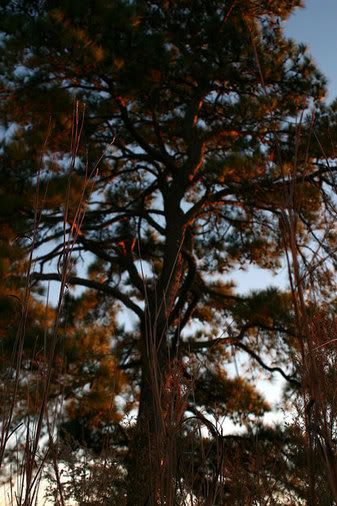
Gnarled Loblolly pine at Heron Hope


Shore Snows

We arrived home on Thanksgiving, just after midnight. Outside, the racket surprised me and, at first, I wasn't sure what I was hearing. City living has retarded my ear but, like a foreign language left unspoken for a time, the sounds of rural life are not forgotten and can be quickly relearned.

"Isn't that wonderful to hear?," my father asked as he quietly shut the door of the pickup truck. "There must be over a thousand out there."

I stared into the darkness beyond the reach of the garages light, at last recognizing the sound's source. A hundred yards away, in the estuary alongside Heron Hope, geese were conversing excitedly. These were not Canada geese (Branta canadensis), the species with which I am most familiar, but snow geese (Chen caerulescens). The species' voices are distinct. As I stood in the fall chill, listening to the birds, I smiled involuntarily. It's good to appreciate your mother tongue anew.

The next morning, my father called down to me a little after sunrise. "Look outside, Christopher! Quickly."

Bleary eyed, I rolled off the couch and stumbled onto the porch. Thousands of snow geese traded about over the estuary. Their white bodies reflected the brilliant morning sun so that the sky seemed full of diamonds.

"I'd say there are around three thousand of them," my father yelled from upstairs. "What a flight!"

The birds' chatted, gossiped, and argued as they rose in great swirls, preparing to move to their inland feeding grounds. They would return at sundown, to once again take refuge in the estuary. I watched the spectacle in silence, duly thankful to be home.

+++++


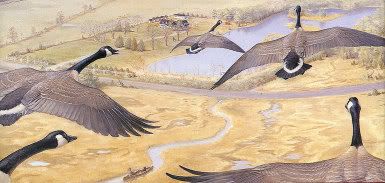
Heron Hill


Ned Smith
"Heron Hill Farm, through a Canada goose's eye"
c. 1983
Acrylic on canvas


My parents purchased land on the Eastern Shore of Virginia in 1970, seven years before my delivery in a Washington, D.C., hospital. They paid $25,000 for sixty-seven acres and a farmhouse that dated to around 1770. ($25,000 in 1970 is the equivalent of $125,000 today. Unfortunately, my parents hit a rough spot shortly after making the purchase. For a time, they adapted to food stamps and the lean life.

Because the house was situated on a rise of land - 10 feet above sea level - in an otherwise low-lying region, my father named the farm Heron Hill. Over the next thirty years he would buy adjoining property as it became available, eventually creating a 280 acre contiguous farm, the bulk of which was managed for wildlife and put into conservation easement.

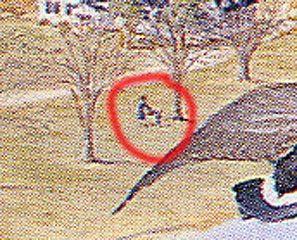
I grew up on Heron Hill. In fact, looking at the Ned Smith painting featured on the dust jacket of The Heron Hill Chronicle, a book my father wrote about his experiences on the farm, viewers might notice my mother and me picking pecans in the front yard (see below). (My father is also depicted, returning from a morning hunt in the marsh.)

As I grew older, I helped my father plant many thousands of trees, build islands, dig ponds, plant crops, and generally shape the ecology of the farm to maximize biodiversity. Given my father's intimate connection to the land, I was surprised when my parents sold the property four years ago. They didn't move far, however, and Heron Hope, a compact, five acre property overlooking a beautiful salt marsh and estuary, is less than a mile from Heron Hill.


+++++
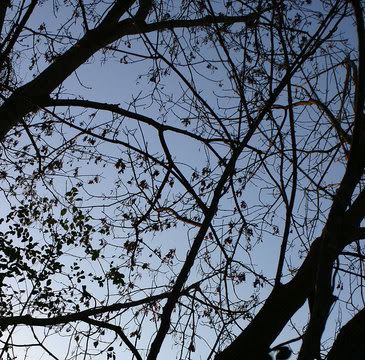


Branch abstract at Heron Hope


Hot Tubs and Parking Lots

After a filling Thanksgiving meal, some friends and I made our way to a vacant house that one of my friends was house sitting. We climbed into an outdoor hot tub on the back deck. The air temperature was in the upper 30s, but the bubbling water was over 100 degrees Fahrenheit; the contrast felt great.

Cool steam dampened my face as I stared up at the heavens, admiring constellations and the occasional passing satellite or airplane. I have long used Orion as a locater, because the three stars of his "belt" are so easy to identify. Contemplating the celestial hunter, my thoughts turned to early humans' perception of the night sky. How very natural the early creation myths are! How could one not believe in God (or gods) in 3000 BCE? How very sensible the cosmology of Plato and Aristotle two thousand years later? How attractive Intelligent Design (as a notion, not a reality) today? One sometimes forgets about these questions living in the city. Flora and fauna aside, one of the most noticeable differences between New York City and the Eastern Shore of Virginia is the night sky.

I returned to Earth and joined the hot tub conversation already in progress. A Japanese girl, three weeks into her first ever visit to the United States, asked why so many Americans lived in such big houses. No one had a good answer, but I did point out that I planned to live in a small house when I finally leave New York.

The next day, the girl excitedly photographed some of the guns in my house. Rather sheepishly, I agreed to pose with one of my shotguns; I imagine this picture will prompt laughter back in Japan. What else is to be made of the scary American with the boom stick?

+++++
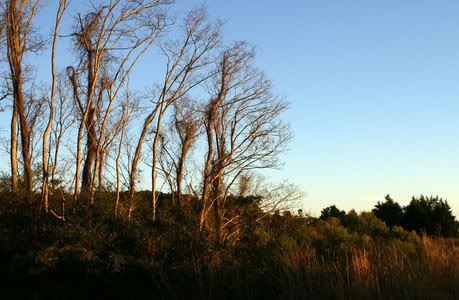


Eastern view from the porch at Heron Hope


Semipalmated Sandpipers

On Saturday morning at low tide, my father and I carried four ducks to the dock for plucking and gutting. As we pulled the feathers from the still warm bodies, a large flock of semipalmated sandpipers (Calidris pusilla) pitched onto an exposed mud flat nearby. Preoccupied with their feeding, they seemed oblivious to our activities. They skittered about, their legs a blur, and stabbed at the mud with their long bills, presumably grabbing invertebrates and other edible material from the flat. In warmer weather, mummichogs (Fundulus heteroclitus) would have nibbled at the duck intestines we dropped into the now narrow stream near the dock, but the cool weather had made these fat little fish inactive. Instead, raccoons and foxes will recycle these guts come sundown.

We carefully removed the duck hearts and placed them on a tray to be cooked that night. As we cleaned up the plucking area and prepared to head indoors, the tide changed and the stream began to expand. The sandpipers rose in unison and moved north a hundred yards to higher ground.

+++++


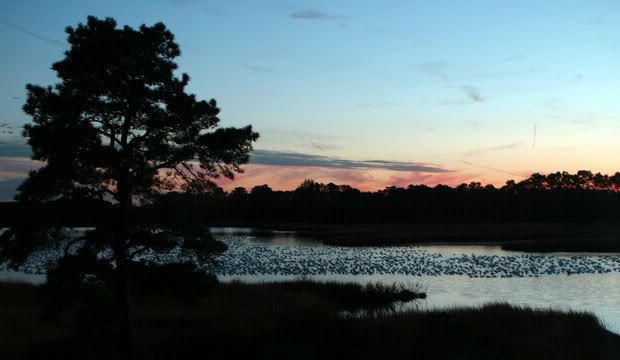
The Big Flight


Snow geese on the estuary at Heron Hope


By Saturday afternoon, I was exhausted. My excessive Thanksgiving eating had taken its toll; I was lazy and groggy. My father headed to the deer stand while I walked around our property, photographing anything that caught my eye. Afterwards, I headed inside and lay down on the porch couch. I belched and felt a little better about life. I'm come to prefer hunger to satiation, and I reminded myself that I should swear off excess, even on holidays.

As I lay there, feeling awful, the sky turned purple and pink. The sun fell behind distant pine stands. Then I heard them. The sound was initially faint, but the volume grew steadily until they were over the house and then everywhere at once. How many thousands, I can not say.

My father, a few miles away in a makeshift tree stand, watched the same flight. He estimated that there were around ten thousand. For the next hour, I lay on the couch and watched the birds pour in, filling the estuary beyond capacity. Packed shoulder to shoulder, the geese hid the water from view. The landscape resembled more a stretch of dirty cotton balls than a small wetland bay.

There were Canadas among the snows, but not many. Apparently, 2005 was a good year for snow goose breeding in the Arctic. Maybe increasing temperatures are adversely affecting their predators? Whatever the cause, the flight was a magical sight. These days we rarely witness such abundance in wildlife populations and, like the vast curtain of stars overhead, a deafening flight of geese can properly humble a human.

Note: The picture above is of a much smaller group of birds in the Heron Hope estuary. In the photograph, there are only about one thousand geese.

Photo credit: all photos, Hungry Hyaena, 2005

Friday, October 28, 2005

Branta canadensis


Last night, after a satisfying workout and a shower, I crawled into bed and picked up a worn copy of "Bullfinch's Mythology". Some short time later, I was distracted from reading by a row in the street below. Two drivers shouted empty threats at one another, punctuating their proclamations with horn honks. I looked at the clock: 1:38 AM. I lowered the open book to my chest and stared at the ceiling, waiting for the unnecessary argument to conclude.

Then, I heard it. At first, I believed it an auditory hallucination. It persisted; barely audible, from high above Astoria, Queens, the sound fell to me. I moved to the bedside window to better listen. By happy chance, the angry drivers moved on, leaving 30th Street relatively quiet. The sound came clear then.

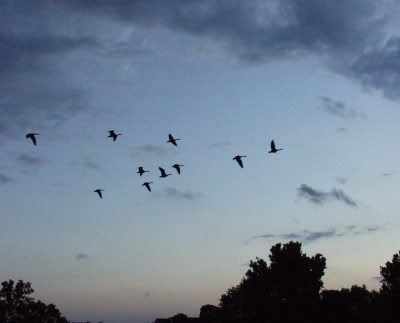
The first Canadas of the season - my first Canadas, anyway - were flying overhead. I imagined their pinion feathers quivering and bending in the cold fall air, their long black necks extended as they exchanged flight updates in the familiar "V" echelon.
"You there?"
"Yeah, you're still there?"
"Oh, yeah."
"Should we rotate the leader position?"
"Not yet."
"Check."
"Attention! Turn more southwest."
"You there?"
"Yeah, you're still there?"
All this, communicated by a steady stream of honk-grunts, a sound impossible to reproduce on the page.

A profound longing, a stretched sadness, came over me as the big birds passed above, making their way south to Delaware, Maryland, North Carolina, or even my childhood home on the Eastern Shore of Virginia. These birds might well be descendants of Canadas that I hunted years ago, lying on my back in a cold-hardened, fallen corn field with a 12-gauge Browning over-and-under heavy on my chest.

Looking down from several thousand feet, a group of geese would spot our decoy spread and begin a long, beautiful pitch to us, a pitch that might take many minutes and, for some of the birds, would be their last. Hours later, a cooked goose would emerge from the oven, dressed and ready for Thanksgiving dinner. My family never ate turkey.

My thoughts return to the present and, glancing at the book nearby, I recall that geese are said to have alerted the Romans of the Gauls' approach, honking out a warning that allowed Roman soldiers to call for reinforcements, even though they still failed to defend the city against the invading army. Almost 2,400 years later, the Canadas above Queens were providing me with a warning of sorts, or more properly a reminder.

They told me that I need to return to fallow winter fields, to lie motionless as cold burns my exposed face and frozen corn stalks rudely stab my lower back. As the birds begin their descent, even breathing slows; only eyes track the existential marvel of Canadas and snows noisily and clumsily finding ground around my body. Whether or not I rise with my gun is unimportant; in fact, I doubt I will carry one into the field many more times. What matters is the erasure of any and all separation, the highlighting of the intimate connection I share with the geese, the field, the morning.

Later, inside the house, huddled around the firestove, my hands burn as they adjust to the warmth and coffee is brewing and people are laughing and we all wear too-heavy woolen clothes and boots. Outside, the geese number in the thousands; they clamor skyward from the saltwater marshes that lie between the barrier islands and the peninsula. The birds break into their loose, hungry skeins and head inland, circling high before pitching into fields to feed. All the while they call. If you are less fortunate than I, still in bed at dawn when the birds take wing, you will likely be awoken by their blanket of sound.

They call on those winter Virginia mornings just as they called over Queens last night, though with many more voices. The birds fade away south from my New York apartment. I roll away from the window, turn out the light and go to sleep happy.

Photo credit: www.highgrove.com, 2005