Showing posts with label Heron's Foot. Show all posts

Sunday, November 30, 2008

Missing the snows


Sunrise over Heron's Foot impoundment; November 2008


Friday morning at Heron's Foot was unseasonably warm. Even in the relative chill of pre-dawn, gloves were not necessary and, by sunrise, the temperature was in the upper 40s.

With the exception of a mid-November cold snap, the region's fall and winter temperatures are well above average this year. The warming effects are especially notable with respect to migratory waterfowl patterns. During my Thanksgiving visit in 2005, four to five thousand snow geese (Chen caerulescens) nightly took refuge in the estuary alongside Heron Hope. One year later, only a few hundred of the birds roosted there and, by the end of December 2006, the flock had grown to around one thousand individuals, at least three thousand birds shy of the previous year. 2007's numbers were similarly low and, astonishingly, I saw only a dozen geese this Thanksgiving! But I shouldn't be surprised. If the temperatures don't force the issue, what reason do migratory birds have to continue south?

I caught a ride back to New York on Friday afternoon. In southern Maryland, I spotted small groups of snow geese feeding in the roadside fields. As daylight faded and we approached the Maryland-Delaware state line, I finally saw the impressive flocks of thousands, trading in the half light from field to field. Soon, they would rise en masse for their evening flight.

These were the very birds that have made my childhood home their winter refuge but, this year, they've settled seventy miles north of Heron's Hope. I miss seeing and hearing them there, but I must also marvel at the rapidity of the changes we're witness to. Everything, always, is in sensitive flux.


Northern pintail decoy; Heron's Foot impoundment; November 2008


Photo credits: Hungry Hyaena, 2008

Thursday, April 05, 2007

The Sweet Spot: Tom Uttech

Shortly after returning to New York City from my annual winter visit to Virginia's Eastern Shore, I wrote "On The Dike At Heron's Foot." In that post I describe a powerful sensory experience I met with on my coastal property. I now consider that episode an awakening to the integrity of mind and matter. I wrote then, "for the first time I fully belonged to 'my property.' For a brief period (whether moments or minutes) there was no distinction between me and the rest of it. Afterwards, as is demanded by waking life, the experience was abstracted by reason. Still, something of the connection remains."

Because I reject the notion of a creative, interventionist God, I can not explain away mystery by assigning works to His hand, but hard science doesn't always satisfy either, at least not in any immediate way. The surgeon and bioethicist Sherwin Nuland says that wonder "is something I share with people of deep faith." He continues, "They wonder at the universe that God has created, and I wonder at the universe that nature has created. But this...sense of awe that motivates the faithful, motivates me. And when I say motivates, it provides an energy for seeking. Just as the faithful will always say, ‘We are seeking,’ I am seeking."(1) Perhaps, then, it is enough to say that my dike experience was the product of wonder, but the words of Ralph Waldo Emerson and Walt Whitman provide my experience with an even more poetic, transcendental framing. Emerson characterizes his marriage to the unconscious as a physical transformation: "Standing on the bare ground,-my head bathed by the blithe air and uplifted into infinite space, all mean egotism vanishes. I become a transparent eyeball; I am nothing; I see all; the currents of the Universal being circulate through me." Whitman also writes of universal tissue, "of the threads that connect the stars, and of wombs and of the father-stuff."

A true rationalist might dismiss Emerson and Whitman as ridiculous transcendentalists, but I departed the Shore just before New Year's, feeling closer to the indefinite whole, the Everything, than ever before. I felt as though I had stumbled ass-backwards into faith; I was calm, satisfied and humbled.

After only a few weeks in New York, fond of it though I am, I felt weary and anxious. The frivolous stress of day-to-day city life made me irritable; I stewed, grumbled, and generally felt out of whack. Close friends mistook my deportment for depression, but I explained to them that I was merely frustrated by city living.

Fortunately, art-making continued to go well, and I found some solace in the long hours spent pondering how best to position myself, geographically speaking, so that I could paint and write without suffering from NYC burn out. I wrote the post "Inside Out (And Upside Down)" in an attempt to work through the issue. I objected to so much in the course of that essay - Art World social demands, consumerism, the cancerous nature of ambition - that one commenter responded, "I...think you’ll be more satisfied once you finally leave the pavement for the woods. Also, why are you tying yourself in knots trying to please an art system whose goals are in direct opposition to your own? I say better to forge your own path." Fair enough. Though I may not yet know where the next five years will take me, I will almost certainly leave New York and, this being the case, I find a great deal of inspiration and hope in the art and life of the contemporary painter and photographer Tom Uttech.

I've been meaning to complete the post that follows for many months, ever since Uttech's Fall 2006 solo exhibition here in New York. As it turns out, I'm glad that the writing took me so long. Revisiting Uttech's paintings and interviews as I edited the piece, I again felt calm, confident that, pending the right choices, I will find what Uttech calls "the sweet spot."

Since 1987, Uttech has lived on a sixty-acre property not far north of Milwaukee, Wisconsin, a city he was "stuck in for a few years." His studio is inside an old barn. As Barbara Joose writes in her 2001 interview with Uttech, "Most artists would have called this place a studio because this is the place where Tom paints. But he doesn't. He calls it a barn...Tom had intended the other room [of the barn] to be a winter studio, but it became a sorting area and storehouse for harvested prairie seeds." Uttech spends the better part of each day outdoors, "planting, harvesting seeds...prairie projects. Or I do birding in the spring...I gradually make my way home and then begin to paint. I paint till my face falls into the palette." In fact, he says his prairie restoration side project has almost developed into a business unto itself. "I collect seeds, grow prairie plants for some of the nurseries...I'd like to do this for a living."(2)

But he doesn't, at least not yet, and the "sweet spot" he speaks of is the kind of life I hope to one day find, even if after years of art school (as both student and, then, teacher) and some critical attention - his work was included in the both the 1975 and 1977 Whitney Biennials - Uttech has little to say about the art world. "When art is about itself, it isn't any good. Those in the art world keep looking at each other....When you begin to seek that as your goal, your art becomes anemic...Dull, listless. Derivative. Vacant." His negative reaction to the contemporary art milieu led him to stop making work altogether. (He describes this decision bluntly, "Just screw it. I'm not an artist. If this is what I have to do to be an artist, I'm not going to be [one].")

Fortunately for the rest of us, his hiatus didn't last too long. Uttech is now in his mid-sixties and his career is established and healthy. All the same, he says, "I've been marginalized by the art world. I'm probably lucky that I've been marginalized. I am lucky - in a lot of ways. I sell everything I do. But I'll never be in the Museum of Modern Art, or a trendy place. I'm not one of the people who are discussed. I'm invisible."(3) Judging by the flurry of gallery shows, museum retrospectives and reviews in the last five years, it seems Uttech isn't so invisible anymore. I'm pleased by the attention his work is receiving and happy that there are exceptions to the rule for younger artists to look up to, particularly when the exceptions are dealing with essential subject matter.

+ + + + +
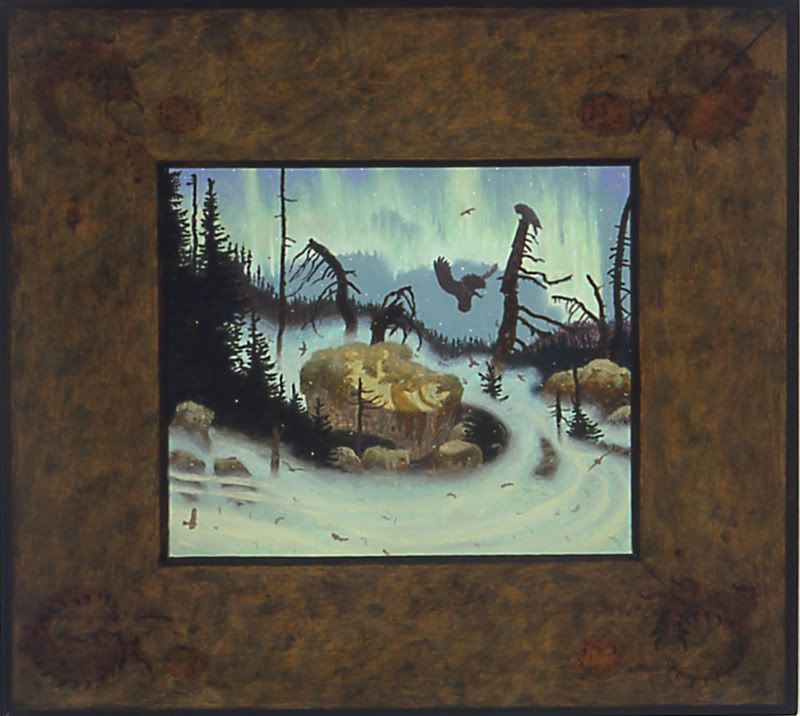


Tom Uttech
"Nin Baba Madaga"
2005
Oil on rag board
16 1/4 x 18 inches
Courtesy Alexandre Gallery

"I am no more lonely than a single mullein or dandelion in a pasture, or a bean leaf, or sorrel, or a horse-fly, or a bumblebee. I am no more lonely than the Mill Brook, or a weathercock, or the north star, or the south wind, or an April shower, or a January thaw, or the first spider in a new house."
- Henry David Thoreau, (1817-1862)

"I kept seeing things in the landscape that would create a very strong feeling, like an aching, a yearning or longing for something, but I didn't know what. But what I think I'm yearning for is to be that thing, to stop being myself in this body and stop being aware of my life and just be that thing. That's why I paint the stuff."
-Tom Uttech
5:05 PM, and the rain was heavy and cold. Pedestrians huddled under awnings or in the doorways of their office buildings, reluctant to brave the downpour. My umbrella proved laughably inadequate; the wind whipped water horizontal, soaking my arms and backpack. The weather was fitting, though. In 2003, on a similarly stormy afternoon, I stumbled into the ample lobby of 41 East 57th Street to escape the elements. I noticed several galleries listed on the building's directory and decided to look at some art while the rain continued. One of the artists exhibiting upstairs, at the Alexandre Gallery, was Tom Uttech, a name then unfamiliar to me. Now, three years later, in similarly inclement weather, I was heading back to the mid-town building to check out Uttech's latest efforts.

Visiting as many shows as I do, I often see artwork that is relevant to my own. The list of my creative cousins grows longer each year; I'm forever being introduced to "new" artists, both living and deceased. Yet it's rare that I come across a work, or body of work, that I might consider a sibling. Tom Uttech's paintings qualify. I feel elated in their presence, reminded of what it is that impels me to create. It's an intensely gratifying experience.

Reading interviews with the artist, or essays about him, I sense a kindred spirit. Uttech bemoans the contemporary disconnect between man and Nature, while still acknowledging the geologic scale. "People have never been less connected to the natural world...It's bleak. (4) [But Nature] doesn't care if it's a gravel pit or a pecan forest. It's all wonderful for nature, but it's not going to be wonderful for us...Nature doesn't give a shit. Life goes on, with or without us.(5)"

When Uttech extols the plenitude of marshes, he describes them as "an absolute cacophony of noise and activity." Until I read this quote in Lucy Lippard's essay profile of the artist, "Magnetic North," I hadn't come across another who had absorbed (and presumably unconsciously co-opted, as creative people are apt to do) Bern Keating's observation that "poets who know no better rhapsodize about the peace of nature, but a well populated marsh is a cacophony." I was young when I first read the Keating line, young enough that I didn't know what the word cacophony meant, but I dutifully looked it up and the quotation has been a favorite of mine since, even appearing as one of my high school senior quotations.

But naturalist sentiments are by no means extraordinary; they are shared by most environmentalists, wildlife biologists, and outdoor enthusiasts. It is unusual, however, for an individual of this ilk to portray or celebrate a supernatural Nature, one shrouded in magic and mystery, informed as much by the shadows of our interior world as by external observation. More often than not, we "nature guys" produce realistic wildlife paintings or photographic documentary. As a result, I've sometimes felt that I might be betraying my calling, that I, too, should paint the natural world as we "know" it (or, more valuable still, funnel my energy and resources into conservation and sustainable development projects). But when I've dabbled in traditional wildlife painting, I've been dissatisfied. I'm compelled to portray a totemic Nature, a world of symbol and ecstatic interpretation that celebrates the ether as much as it does the tangible or the quantifiable. I'm just now learning how this might be done. Clearly, Uttech already knows well.
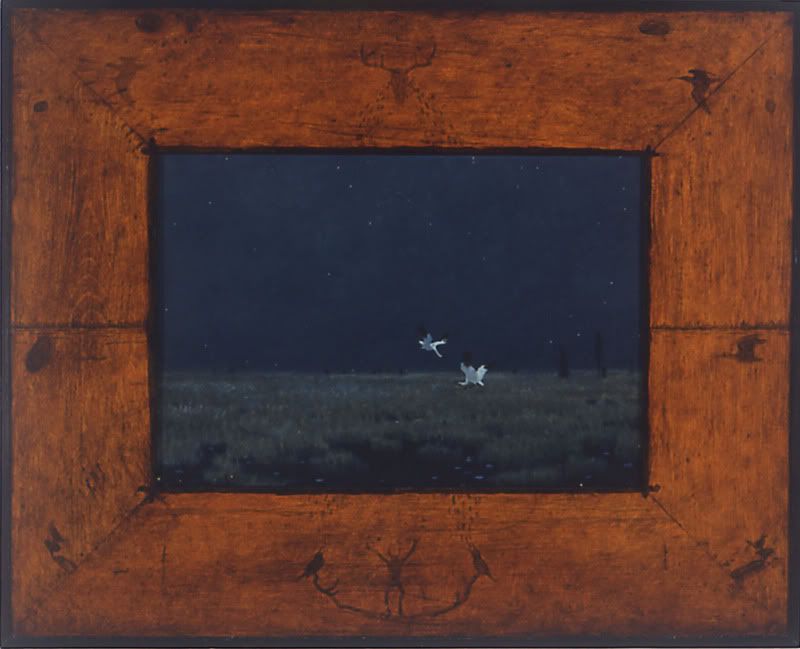

Tom Uttech
"Nin Bapinendam"
2006
Oil on rag board
15 1/2 x 19 1/4 inches
Courtesy Alexandre Gallery


The world Uttech depicts is comprised of signs. Every animal, fallen limb or creeping mist is a stand-in for itself, or for the greater self. A Uttech black bear is not just a black bear, but the very manifestation of Bear. The animal is abstracted and ennobled. This totemic understanding of Nature is appropriate in a time when human contact with the "real thing" - wilderness, the circle of life, or whatever you call it - is increasingly mediated, but no less vital. Adrift as we are in the culture of spectacle, distraction and disposability, Uttech's pictures offer the contemporary viewer an opportunity for grounding and surrogate experience; they satisfy our deeply rooted need for the woods and the sky, for a broad, mythic conception of existence, but only if we're willing to open ourselves to it.

In many of Uttech's paintings, animals stand erect and look out at the viewer. In "Assandjigon," for example, four bears, having risen to their hind legs, stare from the edge of a spruce forest. They are rigid and perfectly still, their dark eyes fixed on us. I discussed John Berger's "imperfectly-met gaze" argument in an essay on the work of painter and sculptor, Deborah Simon, but it bears mentioning again. Berger asserts that humanity possesses other species by visual means, objectifying them to allow us the illusion of dominion. The animals that populate paintings by Uttech and Simon, however, return our gaze. We possess the animal, but they also possess us. "This two-way gaze," I wrote of Simon's work, "allows for the erasure of both individual and special (as in 'species') autonomy." Therefore, the viewer must accept her part in the greater whole. Along these lines, Lippard writes, "Uttech's bears, deer, moose, or wolves fearlessly return our gaze, holding their place with uncanny dignity, defying humanity to imagine that it can dominate nature." Uttech himself puts it more bluntly. "They're standing up and saying 'take a look at me. I'm watching you and not just being observed.'"


Tom Uttech
"Nind Ogwissinam"
2006
Oil on linen
43 x 47 inches
Courtesy Alexandre Gallery


Lippard says Uttech is "almost desperately combating humanity's increasing distance from nature." But in rendering a totemic Nature, even one in which the animals engage the viewer, Uttech is not choosing an aggressive path; his paintings are subtle and risk being overlooked by the skeptical and impatient eye of the contemporary art world initiate. The world of magic and metaphysical significance that he celebrates is attached to ancient experience, but by building his pictures of reflections and silhouettes, Uttech leaves room for the viewer to dismiss the vitality as mere signage. Whereas Simon's paintings force the viewer to return the gaze of the animal subject, viewers of Uttech's paintings might elect to ignore the bears altogether. When Uttech discusses his outings in northern Wisconsin, he describes wildlife as being "present without being visible. But if you spend a lot of time paying a lot of attention - if you start to act like a hunter or think like a bird watcher - you get around that invisibility. And at a number of magic times you actually run into things." His paintings call for this same heightened awareness and, because most contemporary viewers will not "act like a hunter or think like a bird watcher," the bear's gaze will likely go unmet, the magic unfelt. This is less a critique of Uttech's work than a testament to how much we, as animals, have betrayed our biology and spirit.
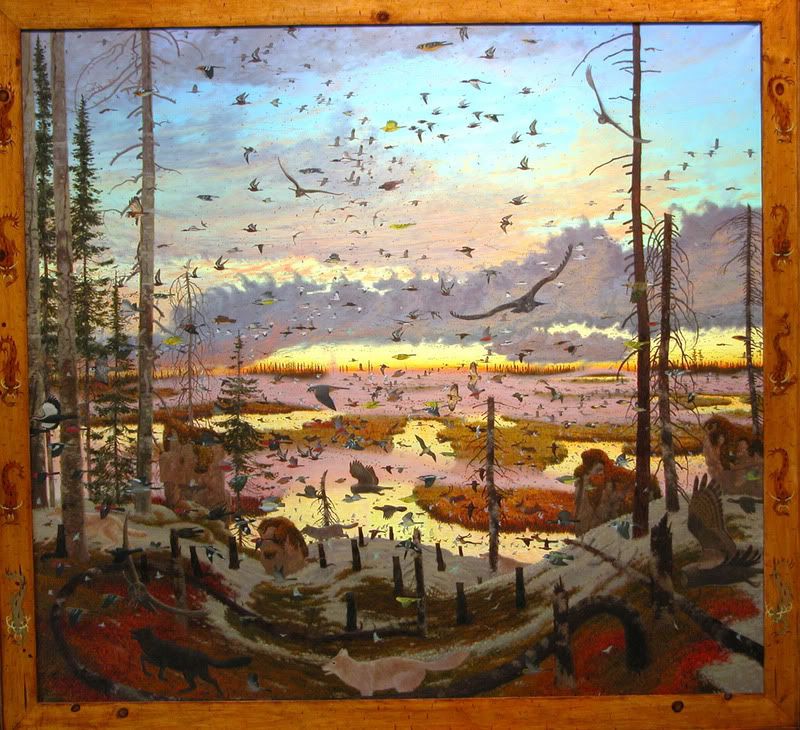

Tom Uttech
"Nin Maminawendam"
2006
Oil on linen
103 x 122 1/2 inches
Courtesy Alexandre Gallery


Uttech's symbolism extends to his handmade frames, onto which he carves, paints or burns "primitive" images of insects, animals, tracks, plants or strange hybrid creatures he calls "tricksters." The "tricksters" appear as though they're lifted from a Hieronymus Bosch tableaux, but Uttech explains that they are loosely based on the Ojibwe character Maymayguishi, or the Wendigo, a malevolent, cannibalistic spirit responsible for, among other things, whisking away that which goes missing. The artist feels that the frame imagery provides further context for the painting, one of "greater magic."

There is another sort of magic present in Uttech's work, however, one that appeals to us in a visceral way. Our evolution shaped us to lust for abundance. Although a surplus of any one species is rarely a net positive for an ecosystem, we associate large numbers of birds, mammals or fish with fecundity and prosperity. When European settlers first arrived in the New World, they marveled at the miraculous bounty available to them. In letters sent back to loved ones and political figures in Europe, the settlers wrote of alewives so tightly packed in rivers that a man could walk across on their backs without getting wet; they also detailed flights of waterfowl so thick that one shotgun blast would fell forty birds and a beaver population healthy enough to provide coats for thousands of sophisticated European ladies. In other words, they were ecstatic salesmen. Even today, when many humans no longer directly equate an animal with commodity - if only because that bloody reality is hidden from the majority view in industrialized nations - we respond to sheer quantity.

Many of Uttech's larger canvases are teeming with life. His skies are crowded with birds and his forest floors and banks are populated by assorted mammals, some hidden, some in obvious view. In the presence of these pictures, one can't help but feel awed. It isn't the paint itself that does this - Uttech is not much concerned with surface or handling, instead choosing to focus on composition, color and narrative - but rather the spectacle he depicts. Because the animals usually move in one direction, reviewers often wonder what has caused the disturbance, what it is that the animals are fleeing. Given our tumultuous times, the assumption of alarm is sensible, but I feel, too, as though the wolves, kestrels, pileated woodpeckers and lynx are propelled by blind exuberance. They aren't necessarily escaping an enemy; they might also be inviting us to discard the Self and run with them into the immensity of the cosmos.
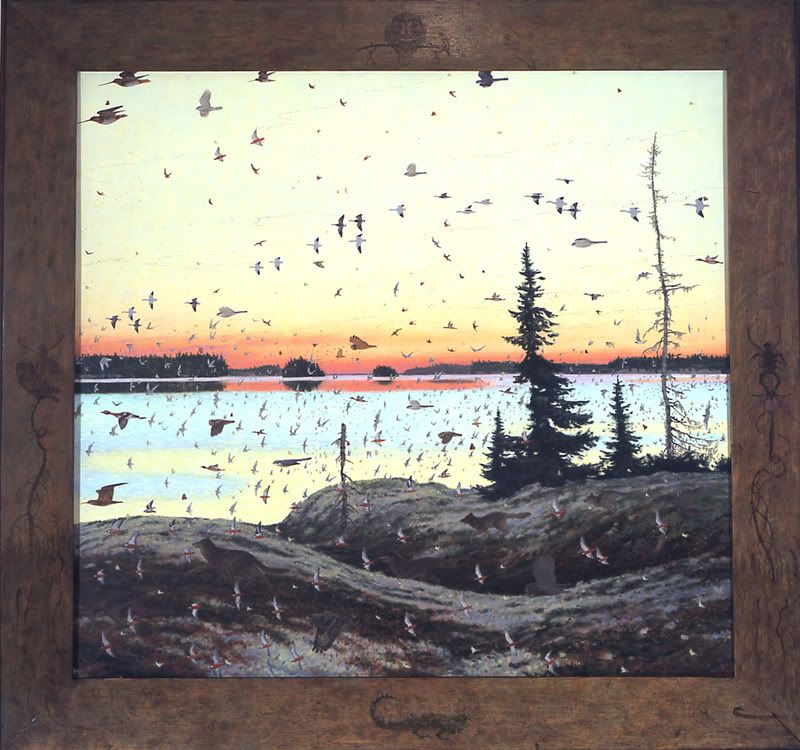

Tom Uttech
"Nin Minodashimin"
2006
Oil on linen
36 1/2 x 38 1/2 inches
Courtesy Alexandre Gallery


Uttech titles each of his paintings using Ojibwe words. He feels these names locate the paintings by honoring their inspiration, the north woods of Wisconsin and southern Ontario. When the artist first began using the language, he had no idea what the words meant; he choose the titles based on "beautiful looking and unpronounceable" map names. He has since studied Ojibwe, but despite what he characterizes as a "complete immersion," Uttech confesses that he has only a very general comprehension of the vocabulary and no appreciation of the grammar. Necessarily, then, his titles make little sense to native speakers. There are some critics of the artist who feel his decision to use a bastardized Ojibwe is an insult to the Indians, a trite nod to authenticity, or both. Their charges aren't unfounded, but experiencing Uttech's work I feel the artist has as much claim to the words as do those who know it as a mother tongue.

Uttech has inherited, if you will, the Ojibwe language just as he inherited their reverence for these woodlands and marshes. He began visiting the region in 1967 and, on his first trip, recognized that the landscape called to his primal nature. "This [is] where my spirit resides," he says; the paintings depict the north woods "because that is what I am." In "Magnetic North," Lippard writes, "There in the woods and wetlands [Uttech] learned to be alone, to deal with blackflies and thunderstorms, to 'walk like a hunter,' and to feel his way confidently through the woods in the dark, every sense quivering - a metaphor for finding his way through art by immersing himself in nature." Uttech's deep connection to the landscape, I believe, makes him a surrogate son, and therefore his borrowing of the region's mostly forgotten language can be forgiven. He may yet be a clumsy child, something of an interloper, but he is fully present in each moment. That's more than can be said for most of us, and reason enough for the rest of us to look at his pictures thoughtfully. Approach Uttech's paintings as John Dewey's "live animal" and you will find that, as Uttech puts it, "what's in the world, it's magic beyond belief."

+ + + + +


Image credits: All images supplied by Alexandre Gallery

(1) Nuland quote from interview with Krista Tippett on NPR program, Speaking Of Faith, January 18, 2007

(2) Artist quote from: Lucy Lippard, "Magnetic North," Milwaukee Art Museum, 2004

(3) Artist quotes in paragraph all from: Barbara Joose, "Tom Uttech: Retreat To Reality," Porcupine Magazine 5, No. 2 (2001)

(4) Artist quote from: Joose

(5) Artist quote from: James Auer, "Wizard of the Wild: State artist explores mysticism, magic of nature," Milwaukee Journal Sentinel, July 10, 2004

(6) Artist quote from: James Auer, "It's All Natural for This Artist," Milwaukee Journal Sentinel, March 10, 2002

Friday, January 05, 2007

On the Dike at Heron's Foot

Eating a Banana at Heron's Foot

“Rooting around on riverbanks and mountain slopes, we may be looking for that missing piece, or love, religion and the rest of it – whatever is missing in us – just as we so often are doing in the digging and rooting of sex.”
-Edward Hoagland, "Bears, Bears, Bears," 1973

I own 35 acres on the Atlantic edge of Virginia’s Eastern Shore, my childhood home. The property was originally purchased over thirty years ago by my father. It was then a fallow, frequently flooded soybean field separated from a sprawl of salt marsh and two brackish creeks by a faulty dike. My father’s conscientious stewardship (1) has since turned the acreage into a haven for wildlife and it is today protected by a Nature Conservancy Conservation Easement. In place of an unproductive field, the land now supports a mixed deciduous forest, two pine groves, a shallow water impoundment, and an extensive canal and fortified dike fringing the marsh, as well as some non-landform improvements, including a handsome, if humble bridge, a buried water control system, two hunting/photography blinds and two small docks.

My father refers to the land as “your property” and he relates to me news of recent or ongoing projects when we talk by phone. For example, he'll tell me, "I cut back some overgrown pines on your property this week, Christopher, and I'd like for you to let me know what you think of this surgery when you're next down." Until recently, though, I hadn't contemplated the significance of his appellation. In my estimation, "your property" meant only that I was the legal landowner, committed to paying the modest, annual property tax.

I blame my thoughtlessness on an earlier, biased relationship to the land. Although I spent many days on the property as a child – dove and duck hunting, planting trees, fishing in the canal, reinforcing the dike – I took it for granted. I dismissively referred to the area as "across the road" because the 35 acre parcel was set apart from Heron Hill, my father’s 250 acre farm, by a well-trafficked country thoroughfare. Heron Hill, so called because of the plentiful great blue herons, our family name (reiger is the Dutch and Middle Low German word for heron), and the homestead's relatively high elevation, literally rose above the low-lying, water-logged property "across the road." When my parents sold Heron Hill in the late 1990s, I was surprised that they held on to the marshy nodule, and even more surprised when they deeded it to me.

Fortunately, opinions change and attitudes evolve. Every winter I travel south to the Eastern Shore and, with each passing year, the property becomes more important to me. This is due, in part, to my having lived in New York City for seven years; the restorative powers of the outdoors are more profoundly felt.

Heron Foot Canal Bridge
View of canal bridge from northeast corner of dike

On my most recent trip, I walked “my property" with a camera. Often an interesting tree or shrub formation provides inspiration for a drawing or painting, and I take a snapshot for future reference. But after a short while, the photography became unimportant. Instead, I inspected animal sign. Three bald areas on the dike betrayed frequent use by white-tailed deer. Bucks displace the topsoil and fallen pine needles when they "scrape," a scent-marking behavior that requires the animal to rub his head and antlers on trees or the ground. I also studied the diggings of a raccoon (or fox) near the canal’s bank, and I spotted a little-used otter slide. The canal, home to a healthy largemouth bass and bluegill population and offering easy access to the marsh, is an inviting residence for a Northern river otter family.

To an outside observer, my activity would have appeared curious. I moved along the dike in a crouch, hopping-and-scurrying as I excitedly looked for further evidence of animal activity. The camera was now slung over my shoulder, and I gave no thought to picture taking. It was a windy morning and various bird calls – snow geese, black ducks, clapper rail, a belted kingfisher – blew to me from the marsh. A group of crows flapped just overhead, fussing about my presence. Thrilled by so much abundance and feeling totally at ease, I remained crouched in one place for a long while, staring at nothing in particular, just listening.

Sometime during this active meditation I lost track of myself. I remember, as if retracing a dream or excavating some buried memory, removing the camera and pawing at the dike. I wasn't looking for anything in particular. It was a purely sensuous experience; I was touching and seeing. And then suddenly I was rolling on the dike’s crest, pine straw clinging to my clothes.

When I "came to," I felt wild-eyed and crazy. I didn't even know where or, more alarmingly, who I was. It took several moments of looking around in mild panic before I recovered my bearings, my sense of self. I’m not sure how long the episode lasted. It was only after I snapped out of the experience that I was able to reflect on what led to my behavior.

I'm still uncertain what prompted it, but I do know this: for the first time, I fully belonged to “my property." For a spell (whether moments or minutes), there was no distinction between me and the rest of it. Afterwards, as is demanded by waking life, the experience was abstracted by reason. Yet something of the connection remains.

Dike View at Heron Foot
On back dike

What happened to me on the dike? Barring a neurodegenerative disease or serious head trauma, most people maintain their sense of self. Indeed, we are individuals, but healthy humans sometimes glimpse their multiplicity. Freud may have been subscribing to Occam’s razorone should not increase, beyond what is necessary, the number of entities needed to explain any phenomenon - when he proposed that the human psyche is composed of three competing parts: the id, the ego, and the superego. As useful as Freud’s psychoanalytic scheme remains, recent research suggests that he vastly underestimated the number of components.

In a normally functioning brain, distinct, specialized areas, called modules, go about the business of identifying, translating, commanding, and so on, enabling each of us to feel that we are the person, the individual, reflected in the mirror. But as Steven Johnson reminds readers in “Mind Wide Open,” "we can experience the modularity of the brain more directly by taking drugs that throw a monkey wrench into its machinery, causing individual modules to take on a new autonomy (which is why people on drugs often feel as though they hear voices).” The auditory hallucinations, or “voices,” associated with ingestion of psilocybin, LSD, and other psychoactive drugs or substances are not really hallucinations, then. They are only the normally ignored commands, thoughts, and impulses of our multitudinous brain. Drug use, in essence, quiets our inner, censorious interpreter and allows us to eavesdrop on the brain's gabble. Necessarily, acceptance of the many-voiced brain raises difficult questions about the validity of the individual.

But I was sober on the dike that afternoon, and I heard no interior voices. To the contrary, I heard only what was outside me, the crows, the kingfishers, and the wind. Still, I lost all sense of self. I was, for a short time, effectively erased. If my "I" wasn't erased by the inner cacophony, the question remains; what happened to me?

Impoundment View (Over Canal) at Heron Foot
Looking over canal to the shallow water impoundment

In this heyday of advertising for pharmaceutical panaceas, we're well aware of how fragile our mind and body are. Last night, standing up after a workout, I pushed and poked at the muscle of my abdomen and at the fat of my lower back, trying to imagine how the different organs were embraced by the ribcage and lower spine. I swallowed and then burped, involuntarily. What an interesting machine!

Like the mind, the body is an aggregate. In turn, the human body is part of a larger organism, and this radiating expansion continues infinitely. Each of us is an insignificant figure in an unfathomably grand equation. This design may seem terrifying, but it doesn't have to be. Contemplation of that grand equation is nullifying but, metaphysically speaking, there is comfort in nullification. The “me” and "I" are spread out such that everything blends into one moment and body. Everyone accepts that each individual is a fraction of infinity, and as Daniel Matt, a scholar of Jewish mysticism, points out, "since infinity cannot be quantified, no matter how it is divided and subdivided, even a fraction of infinity is infinite." Conscious contemplation of this expansive nullification is the intellectual equivalent of Nirvana, a rational rejection of the individual in the name of the Whole.

With respect to practical environmental and social improvement, though, contemplation does us little good. Much of the world’s population is concerned with day-to-day survival; my First World musings are the product of insulation and relative privilege. Rumination and good intentions do little to alleviate injustice abroad or to stave off another species extinction. Yet my experience on the dike can't accurately be described as contemplative. I was not meditating or concentrating on any question when I lost all sense of self. My experience began, in effect, with an absence of thought that was spontaneous, washing over me as I was “rooting around,” as Hoagland puts it, on the dike.

Marsh View at Heron Foot
View of marsh from northeastern corner of dike at Heron's Foot

There is, fortunately, a counterpart to contemplation that offers some explanation for what occurred. In his 1943 landmark work on aesthetic theory, "Art As Experience," John Dewey writes:
"To grasp the sources of aesthetic experience it is...necessary to have recourse to animal life below the human scale. The activities of the fox, the dog, and the thrush may at least stand as reminders and symbols of that unity of experience which we so fractionize when work is labor, and thought withdraws us from the world. The live animal is fully present, all there, in all of its actions: in its wary glances, its sharp sniffings, its abrupt cocking of ears."
I'd like to think that my antics on the dike were those of the live animal. The self-conscious human was, like the camera, for a short time forgotten. The resulting realization that I was intimately tied to the land makes sense; the live animal is indivisible from the rest of it. This concept can be described in more concrete terms. For the live animal, conceptions of property as capital aren't applicable. Ownership as we understand it - taxes and fences - is meaningless without the socioeconomic contract; no one can own property if the currency of power, both literal and figurative, isn't supported by all participating players. Many animist cultures, most of them no longer with us, interpreted land and borders in this more equitable way.

To elucidate the Native-American concept of land ownership in his book, "Changes In The Land," environmental historian Bill Cronon distinguishes between natural and civil rights. The Puritan settlers believed in civil ownership, with strict boundary demarcation and control of all rights to resource consumption within a defined area, whereas the Native-Americans understood land as shared, like water. As a result, settlers often believed they were buying land from local tribe leaders while the Native-Americans instead understood the "deal" as a trade for shared hunting and fishing rights. For the Indians, these deals were "more a diplomatic exchange than an economic one." How does one sell land, after all, if no one possesses it to begin with?

Fred Bird Watching at Heron Foot
A friend birdwatches over the marsh at Heron's Foot

It's difficult to discard cultural mores. The assumptions we are raised with inform us at the most fundamental level, and property accumulation is for Westerners the ultimate measure of self worth. It's curious, then, that it took a temporary erasure, or warping, of self awareness (and, therefore, self assessment) for me to appreciate the land that (on paper) is attached to my name. Indeed, there is a world of difference between ownership and stewardship. The owner is a possessor, a member of a hierarchal system that determines an individual's societal value by calculating the market price of all their accumulated property. The steward is merely a manager, an agent of another. The conscientious landowner does not think of himself as a title holder first. He is a steward working for the land.

As Bill Cronon insists, true wildness is no more; all land will be marked by man, but we can decide what sort of signature we leave. Aldo Leopold, the beloved godfather of modern conservation, was among the first to write at length of the paradoxical, but vital relationship between the steward and the land. Leopold was a Romantic pragmatist(2), a type as well-suited to diplomacy as to conservation, and he was a proponent of hunting and controlled burning, complicated practices deemed wrongful by armchair environmentalists today. Resource use, like the economy, can be regulated thoughtfully (though it rarely is), but the Romantic in Leopold was dismayed by the dark side of our equating land with money.
"I suspect that the forces inherent in...economic evolution are not all beneficent. Like the forces inside our own bodies, they may become malignant, pathogenic. I believe that many of the economic forces inside the modern body-politic are pathogenic in respect to harmony with land."
He deemed his heroically optimistic response to the increasing pressures of population and market a "land ethic." Despite the difficulties of cultivating such an appreciation of the natural world in the twentieth century, Leopold insisted,
"That land is a community is the basic concept of ecology, but that land is to be loved and respected is an extension of ethics...A land ethic, then, reflects the existence of an ecological conscience, and this in turn reflects a conviction of individual responsibility for the health of land...We can be ethical only in relation to something we can see, feel, understand, love, or otherwise have faith in."
Prior to my experience on the dike last week, I lacked a land ethic. I appreciated my father's attachment to the land, but I did so from an intellectual remove. Slogging through the marsh mud with a canvas sack of duck decoys at nine years of age, I didn't think to myself, "This land is me." Returning home tired from middle school, I wasn't buoyed by any natural high when my father and I crossed the road to plant eight hundred small pine trees in fading light. But, rolling around on the dike this winter I understood something new. I felt as I imagine a first-time parent might when cradling a newborn. The experience shook me up.

Rereading bits of Leopold's "A Sand County Almanac" this week, I was struck by his explanation of what a land ethic entails. It "...simply enlarges the boundaries of the community to include soils, waters, plants, and animals, or collectively: the land." Is that what happened to me on the dike? Was I absorbed, for a few moments or minutes, as a live animal, into the greater community, into the integrated universe?

Back Dike at Heron Foot
Back dike at Heron's Foot

I very much doubt I will return to the Eastern Shore of Virginia to live. In fact, I'm looking northward, to Maine, as my disposition is more suited to cold weather and the rolling northwoods. All the same, I will keep the land in Virginia, and do my best to ensure the conservation easement is maintained and that the land is thoughtfully managed. I feel attached to the property in a way I never did before. I am responsible for the species which thrive there. Reciprocally, they are responsible for my well-being. Some readers will argue that this exchange is a selfish one, that the work a steward puts into the land is driven by pride and want of pleasure. I agree, but the pride and pleasure derived is akin to the satisfaction we feel upon completing a rigorous workout or after we introduce a child to a new idea. It satisfies because we are one body; in some cases what feels good to one person is good for the whole.

A few days after the dike incident, the property was properly named. I no longer refer to it as "across the road." The new name honors the original farm, of which the land was a small, but vital part. It also references the property's low elevation and, lamentably, my discovery of a dead great blue heron, feet bound together by knotted fishing monofilament, the day after I was embraced on the dike at Heron's Foot.

(1) The full story – or most of it, anyway – can be found in my father’s book "Heron Hill Chronicle."

(2) The realist in Leopold forced him to contemplate the greater ambition of conservation as most environmentalists will not. "All conservation," he wrote, "is self-defeating, for to cherish we must see and fondle, and when enough have seen and fondled, there is no wilderness left to cherish."

Young Pine Volunteers On Heron Foot Dike
Young pine tree volunteers on the dike at Heron's Foot

Photo credit: all images Hungry Hyaena, 2006 (More pictures from Heron's Foot can be found here.)

Monday, January 01, 2007

Happy (warm) new year!

I'm a cold weather man. Winter days and nights possess an obscure magic that buoys my spirit and heartens my constitution. I'm particularly sensitive to this variety of dark enchantment when I'm alone in winter woods. We humans have grown complacent in our throne atop the food chain, and I enjoy my body's reaction to harsh conditions as I also appreciate occasional haunting by the specter of predation. Both are humbling, gratifying reminders of what we've come from, and of what we are.

But this winter has been unseasonably warm. As always, I traveled south to Virginia to visit my parents. The temperature on the morning of my birthday, December 29th, was 52 degrees Fahrenheit; by late afternoon, it was over 60. Yet still the talking heads on the local news speak of global warming as if it may be a fiction! Skepticism serves its purpose in science, and shouldn't be dismissed offhand, but whether we're attributing warming to human activity or to natural fluctuations, an examination of the data shows that the general trend is all too apparent.

Snow Geese Beyond Morning Trees
A flock of about 800 snows departs the estuary in search of morning food

Because of the warm temperatures, the travels of migratory species are unusual this year. Last Thanksgiving, I watched four or five thousand snow geese (Chen caerulescens) pitch into the salt water estuary alongside my parents' house. The birds arrive in last light to roost, and they depart just after dawn, moving on to feed in the fields of winter wheat.

This year, by contrast, the late December roosts were limited to one thousand birds, give or take a couple hundred. The weather is warm enough that the geese, heading south from their Arctic breeding grounds, don't need to fly so far to find food and refuge. The spectacular flocks that I watched in the fall of 2005 probably took up winter residence this year in Delaware and New Jersey, or points farther north.

+++++

Great Blue Heron Feet Bound 2
Photo of the heron's feet; monofilament already cut away

Walking my Virginia prpoerty two days before my birthday, my father and I came upon the decapitated body of a great blue heron (Ardea herodias). The beheading was likely the work of a fox or raccoon, but the predator was not responsible for the bird's death. The heron's legs and feet were knotted with monofilament fishing line. Two "toes" on the right foot were tied together. More serious was the mass of line that bound the left leg to the knot on the right foot. The bird had eked out a living by hop hunting. This is handicap enough for any animal, but, for a heron, a creature that specializes in water stalking, hopping surely cost the bird a great many meals.

Apparently this individual was tough. Just as a tree grows around a collar left on too long, so had the heron's flesh swollen around the fishing line as the bird continued to grow. I'm not knowledgeable enough to estimate the heron's age with any accuracy, but, by the looks of it, the line had bound the bird for at least a year. My father cut the monofilament away and we placed the heron's body in the middle of a trail, hoping that the vultures already circling above would descend once the two humans moved on.

Oddly, when I returned to check on the progress the following afternoon, the heron's body remained untouched. No raccoon or fox had returned to finish what they began, and the vultures had apprently elected to pass up this meal in favor of more filling options. (This winter's warm weather has left scavengers at ease and relatively heavy-bellied. As a result, they are less thorough in their clean-up efforts.)

Great Blue Heron Foot w/ My Hand
Photo of heron's left foot w/ my hand, for scale


I examined the heron again, this time photographing the bird's marvelous feet. As far as I'm concerned, anyone familiar with both reptiles and birds must accept their common ancestry. The great blue's long toes and legs share much with those of some lizard species. As a friend remarked upon seeing the bird, "It reminds me of an alligator." Indeed. Ain't evolution wondrous?

Great Blue Heron
Photo of heron's left foot w/ my hand, for scale

Photo credits: all by Hungry Hyaena