Showing posts with label Aldo Leopold. Show all posts

Wednesday, September 12, 2012

Platte Clove Residency: Encounter On Devil's Path

Devil's Path Trail; Catskills; NY; July 2012
I value solitude, but prefer not to hike alone. In the event of an injury, it's always better to have a companion. Moreover, since moving west, I've learned that even an ambitious mountain lion is unlikely to consider two or more humans fair game. Simply put, a duo or small group is afforded greater peace of mind. Sometimes, though, in order to take advantage of a window of opportunity, hiking solo is the only option.

Frankly, as I set out from the Platte Clove cabin on my first morning in the Catskills, safety concerns were far from my mind. I'm a confident hiker and I was excited to explore the 7.5-mile route I'd plotted the night before. My planning, though, had been cursory. I didn't realize that Wikipedia describesthe longest segment of my loop as "the toughest hiking trail in the Eastern United States." (In retrospect, I should have been clued in to the trail's difficulty by its name, Devil's Path.) I also shrugged off wildlife precautions. Though they may be the region's namesake, mountain lions were extirpated from the Catskills by the early 20th century; American black bears, however, are plentiful, and regional trail guides encourage hikers to wear bells and to talk at a normal volume so as to alert the animals of their presence. That's good advice, but amateur naturalists like myself shun bells and, when on trails, frown upon extended conversation. We don't go into the woods or up mountains for a constitutional. We go to see other animals, be they birds, porcupines, snakes, squirrels, or bears, and the less noise we make, the more creatures we're privileged to see.

Friday, January 05, 2007

On the Dike at Heron's Foot

Eating a Banana at Heron's Foot

“Rooting around on riverbanks and mountain slopes, we may be looking for that missing piece, or love, religion and the rest of it – whatever is missing in us – just as we so often are doing in the digging and rooting of sex.”
-Edward Hoagland, "Bears, Bears, Bears," 1973

I own 35 acres on the Atlantic edge of Virginia’s Eastern Shore, my childhood home. The property was originally purchased over thirty years ago by my father. It was then a fallow, frequently flooded soybean field separated from a sprawl of salt marsh and two brackish creeks by a faulty dike. My father’s conscientious stewardship (1) has since turned the acreage into a haven for wildlife and it is today protected by a Nature Conservancy Conservation Easement. In place of an unproductive field, the land now supports a mixed deciduous forest, two pine groves, a shallow water impoundment, and an extensive canal and fortified dike fringing the marsh, as well as some non-landform improvements, including a handsome, if humble bridge, a buried water control system, two hunting/photography blinds and two small docks.

My father refers to the land as “your property” and he relates to me news of recent or ongoing projects when we talk by phone. For example, he'll tell me, "I cut back some overgrown pines on your property this week, Christopher, and I'd like for you to let me know what you think of this surgery when you're next down." Until recently, though, I hadn't contemplated the significance of his appellation. In my estimation, "your property" meant only that I was the legal landowner, committed to paying the modest, annual property tax.

I blame my thoughtlessness on an earlier, biased relationship to the land. Although I spent many days on the property as a child – dove and duck hunting, planting trees, fishing in the canal, reinforcing the dike – I took it for granted. I dismissively referred to the area as "across the road" because the 35 acre parcel was set apart from Heron Hill, my father’s 250 acre farm, by a well-trafficked country thoroughfare. Heron Hill, so called because of the plentiful great blue herons, our family name (reiger is the Dutch and Middle Low German word for heron), and the homestead's relatively high elevation, literally rose above the low-lying, water-logged property "across the road." When my parents sold Heron Hill in the late 1990s, I was surprised that they held on to the marshy nodule, and even more surprised when they deeded it to me.

Fortunately, opinions change and attitudes evolve. Every winter I travel south to the Eastern Shore and, with each passing year, the property becomes more important to me. This is due, in part, to my having lived in New York City for seven years; the restorative powers of the outdoors are more profoundly felt.

Heron Foot Canal Bridge
View of canal bridge from northeast corner of dike

On my most recent trip, I walked “my property" with a camera. Often an interesting tree or shrub formation provides inspiration for a drawing or painting, and I take a snapshot for future reference. But after a short while, the photography became unimportant. Instead, I inspected animal sign. Three bald areas on the dike betrayed frequent use by white-tailed deer. Bucks displace the topsoil and fallen pine needles when they "scrape," a scent-marking behavior that requires the animal to rub his head and antlers on trees or the ground. I also studied the diggings of a raccoon (or fox) near the canal’s bank, and I spotted a little-used otter slide. The canal, home to a healthy largemouth bass and bluegill population and offering easy access to the marsh, is an inviting residence for a Northern river otter family.

To an outside observer, my activity would have appeared curious. I moved along the dike in a crouch, hopping-and-scurrying as I excitedly looked for further evidence of animal activity. The camera was now slung over my shoulder, and I gave no thought to picture taking. It was a windy morning and various bird calls – snow geese, black ducks, clapper rail, a belted kingfisher – blew to me from the marsh. A group of crows flapped just overhead, fussing about my presence. Thrilled by so much abundance and feeling totally at ease, I remained crouched in one place for a long while, staring at nothing in particular, just listening.

Sometime during this active meditation I lost track of myself. I remember, as if retracing a dream or excavating some buried memory, removing the camera and pawing at the dike. I wasn't looking for anything in particular. It was a purely sensuous experience; I was touching and seeing. And then suddenly I was rolling on the dike’s crest, pine straw clinging to my clothes.

When I "came to," I felt wild-eyed and crazy. I didn't even know where or, more alarmingly, who I was. It took several moments of looking around in mild panic before I recovered my bearings, my sense of self. I’m not sure how long the episode lasted. It was only after I snapped out of the experience that I was able to reflect on what led to my behavior.

I'm still uncertain what prompted it, but I do know this: for the first time, I fully belonged to “my property." For a spell (whether moments or minutes), there was no distinction between me and the rest of it. Afterwards, as is demanded by waking life, the experience was abstracted by reason. Yet something of the connection remains.

Dike View at Heron Foot
On back dike

What happened to me on the dike? Barring a neurodegenerative disease or serious head trauma, most people maintain their sense of self. Indeed, we are individuals, but healthy humans sometimes glimpse their multiplicity. Freud may have been subscribing to Occam’s razor – one should not increase, beyond what is necessary, the number of entities needed to explain any phenomenon - when he proposed that the human psyche is composed of three competing parts: the id, the ego, and the superego. As useful as Freud’s psychoanalytic scheme remains, recent research suggests that he vastly underestimated the number of components.

In a normally functioning brain, distinct, specialized areas, called modules, go about the business of identifying, translating, commanding, and so on, enabling each of us to feel that we are the person, the individual, reflected in the mirror. But as Steven Johnson reminds readers in “Mind Wide Open,” "we can experience the modularity of the brain more directly by taking drugs that throw a monkey wrench into its machinery, causing individual modules to take on a new autonomy (which is why people on drugs often feel as though they hear voices).” The auditory hallucinations, or “voices,” associated with ingestion of psilocybin, LSD, and other psychoactive drugs or substances are not really hallucinations, then. They are only the normally ignored commands, thoughts, and impulses of our multitudinous brain. Drug use, in essence, quiets our inner, censorious interpreter and allows us to eavesdrop on the brain's gabble. Necessarily, acceptance of the many-voiced brain raises difficult questions about the validity of the individual.

But I was sober on the dike that afternoon, and I heard no interior voices. To the contrary, I heard only what was outside me, the crows, the kingfishers, and the wind. Still, I lost all sense of self. I was, for a short time, effectively erased. If my "I" wasn't erased by the inner cacophony, the question remains; what happened to me?

Impoundment View (Over Canal) at Heron Foot
Looking over canal to the shallow water impoundment

In this heyday of advertising for pharmaceutical panaceas, we're well aware of how fragile our mind and body are. Last night, standing up after a workout, I pushed and poked at the muscle of my abdomen and at the fat of my lower back, trying to imagine how the different organs were embraced by the ribcage and lower spine. I swallowed and then burped, involuntarily. What an interesting machine!

Like the mind, the body is an aggregate. In turn, the human body is part of a larger organism, and this radiating expansion continues infinitely. Each of us is an insignificant figure in an unfathomably grand equation. This design may seem terrifying, but it doesn't have to be. Contemplation of that grand equation is nullifying but, metaphysically speaking, there is comfort in nullification. The “me” and "I" are spread out such that everything blends into one moment and body. Everyone accepts that each individual is a fraction of infinity, and as Daniel Matt, a scholar of Jewish mysticism, points out, "since infinity cannot be quantified, no matter how it is divided and subdivided, even a fraction of infinity is infinite." Conscious contemplation of this expansive nullification is the intellectual equivalent of Nirvana, a rational rejection of the individual in the name of the Whole.

With respect to practical environmental and social improvement, though, contemplation does us little good. Much of the world’s population is concerned with day-to-day survival; my First World musings are the product of insulation and relative privilege. Rumination and good intentions do little to alleviate injustice abroad or to stave off another species extinction. Yet my experience on the dike can't accurately be described as contemplative. I was not meditating or concentrating on any question when I lost all sense of self. My experience began, in effect, with an absence of thought that was spontaneous, washing over me as I was “rooting around,” as Hoagland puts it, on the dike.

Marsh View at Heron Foot
View of marsh from northeastern corner of dike at Heron's Foot

There is, fortunately, a counterpart to contemplation that offers some explanation for what occurred. In his 1943 landmark work on aesthetic theory, "Art As Experience," John Dewey writes:
"To grasp the sources of aesthetic experience it is...necessary to have recourse to animal life below the human scale. The activities of the fox, the dog, and the thrush may at least stand as reminders and symbols of that unity of experience which we so fractionize when work is labor, and thought withdraws us from the world. The live animal is fully present, all there, in all of its actions: in its wary glances, its sharp sniffings, its abrupt cocking of ears."
I'd like to think that my antics on the dike were those of the live animal. The self-conscious human was, like the camera, for a short time forgotten. The resulting realization that I was intimately tied to the land makes sense; the live animal is indivisible from the rest of it. This concept can be described in more concrete terms. For the live animal, conceptions of property as capital aren't applicable. Ownership as we understand it - taxes and fences - is meaningless without the socioeconomic contract; no one can own property if the currency of power, both literal and figurative, isn't supported by all participating players. Many animist cultures, most of them no longer with us, interpreted land and borders in this more equitable way.

To elucidate the Native-American concept of land ownership in his book, "Changes In The Land," environmental historian Bill Cronon distinguishes between natural and civil rights. The Puritan settlers believed in civil ownership, with strict boundary demarcation and control of all rights to resource consumption within a defined area, whereas the Native-Americans understood land as shared, like water. As a result, settlers often believed they were buying land from local tribe leaders while the Native-Americans instead understood the "deal" as a trade for shared hunting and fishing rights. For the Indians, these deals were "more a diplomatic exchange than an economic one." How does one sell land, after all, if no one possesses it to begin with?

Fred Bird Watching at Heron Foot
A friend birdwatches over the marsh at Heron's Foot

It's difficult to discard cultural mores. The assumptions we are raised with inform us at the most fundamental level, and property accumulation is for Westerners the ultimate measure of self worth. It's curious, then, that it took a temporary erasure, or warping, of self awareness (and, therefore, self assessment) for me to appreciate the land that (on paper) is attached to my name. Indeed, there is a world of difference between ownership and stewardship. The owner is a possessor, a member of a hierarchal system that determines an individual's societal value by calculating the market price of all their accumulated property. The steward is merely a manager, an agent of another. The conscientious landowner does not think of himself as a title holder first. He is a steward working for the land.

As Bill Cronon insists, true wildness is no more; all land will be marked by man, but we can decide what sort of signature we leave. Aldo Leopold, the beloved godfather of modern conservation, was among the first to write at length of the paradoxical, but vital relationship between the steward and the land. Leopold was a Romantic pragmatist(2), a type as well-suited to diplomacy as to conservation, and he was a proponent of hunting and controlled burning, complicated practices deemed wrongful by armchair environmentalists today. Resource use, like the economy, can be regulated thoughtfully (though it rarely is), but the Romantic in Leopold was dismayed by the dark side of our equating land with money.
"I suspect that the forces inherent in...economic evolution are not all beneficent. Like the forces inside our own bodies, they may become malignant, pathogenic. I believe that many of the economic forces inside the modern body-politic are pathogenic in respect to harmony with land."
He deemed his heroically optimistic response to the increasing pressures of population and market a "land ethic." Despite the difficulties of cultivating such an appreciation of the natural world in the twentieth century, Leopold insisted,
"That land is a community is the basic concept of ecology, but that land is to be loved and respected is an extension of ethics...A land ethic, then, reflects the existence of an ecological conscience, and this in turn reflects a conviction of individual responsibility for the health of land...We can be ethical only in relation to something we can see, feel, understand, love, or otherwise have faith in."
Prior to my experience on the dike last week, I lacked a land ethic. I appreciated my father's attachment to the land, but I did so from an intellectual remove. Slogging through the marsh mud with a canvas sack of duck decoys at nine years of age, I didn't think to myself, "This land is me." Returning home tired from middle school, I wasn't buoyed by any natural high when my father and I crossed the road to plant eight hundred small pine trees in fading light. But, rolling around on the dike this winter I understood something new. I felt as I imagine a first-time parent might when cradling a newborn. The experience shook me up.

Rereading bits of Leopold's "A Sand County Almanac" this week, I was struck by his explanation of what a land ethic entails. It "...simply enlarges the boundaries of the community to include soils, waters, plants, and animals, or collectively: the land." Is that what happened to me on the dike? Was I absorbed, for a few moments or minutes, as a live animal, into the greater community, into the integrated universe?

Back Dike at Heron Foot
Back dike at Heron's Foot

I very much doubt I will return to the Eastern Shore of Virginia to live. In fact, I'm looking northward, to Maine, as my disposition is more suited to cold weather and the rolling northwoods. All the same, I will keep the land in Virginia, and do my best to ensure the conservation easement is maintained and that the land is thoughtfully managed. I feel attached to the property in a way I never did before. I am responsible for the species which thrive there. Reciprocally, they are responsible for my well-being. Some readers will argue that this exchange is a selfish one, that the work a steward puts into the land is driven by pride and want of pleasure. I agree, but the pride and pleasure derived is akin to the satisfaction we feel upon completing a rigorous workout or after we introduce a child to a new idea. It satisfies because we are one body; in some cases what feels good to one person is good for the whole.

A few days after the dike incident, the property was properly named. I no longer refer to it as "across the road." The new name honors the original farm, of which the land was a small, but vital part. It also references the property's low elevation and, lamentably, my discovery of a dead great blue heron, feet bound together by knotted fishing monofilament, the day after I was embraced on the dike at Heron's Foot.

(1) The full story – or most of it, anyway – can be found in my father’s book "Heron Hill Chronicle."

(2) The realist in Leopold forced him to contemplate the greater ambition of conservation as most environmentalists will not. "All conservation," he wrote, "is self-defeating, for to cherish we must see and fondle, and when enough have seen and fondled, there is no wilderness left to cherish."

Young Pine Volunteers On Heron Foot Dike
Young pine tree volunteers on the dike at Heron's Foot

Photo credit: all images Hungry Hyaena, 2006 (More pictures from Heron's Foot can be found here.)

Tuesday, July 11, 2006

Thinking Like A Mountain?


Erik Reece's eloquent essay, "Death Of A Mountain: Radical Strip Mining and the Leveling of Appalachia," was included in the April 2005 issue of Harper's Magazine. The piece examines and responds to environmentally devastating coal mining practices in eastern Kentucky. Appropriately enough, I read the work while standing in an abominably long line at the World Expo, in Aichi, Japan, the first World's Fair dedicated to "green" thinking or, as the Japanese organizers dubbed it, "Nature's Wisdom."

Every pavilion in the Aichi Expo was sponsored by either a nation or a corporation (a sign o' the times), and they all forecast a happy, healthy, and sustainable future for humanity and for the planet. Reece's melancholy report provided a sobering counterpoint. A "green future" is tenable only if the necessary changes in technology and lifestyle generate an altogether different kind of green: cash money. As the wife of a Kentucky coal miner asks Reece, "What use are the mountains to us other than coal? When are you going to start thinking about us instead of the environment?" Until alternative energy cheerleaders assuage the concerns of those citizens dependent on income provided by companies like Leslie Resources Inc., one of the mining outfits indicted in Reece's article, America's hard-working, blue-collar folks will remain united in opposition to the relatively privileged mouthpieces of environmentalism.

In "Death of a Mountain," Reece describes the minutes of a Kentucky hearing addressing an Environmental Impact Statement on mountaintop removal, the principal method of tapping into buried coal seams. The local coalfield citizens in attendance, many of them employed by the region's energy companies, reacted against "outsiders" telling them what was best for them and for their land. They even hinted "at a conspiracy afoot by the rest of the state to keep eastern Kentucky poor." Not surprisingly, such vehement antagonism to "greening" measures were not highlighted at the Aichi Expo. Likewise, they receive scant attention in environmental publications, even those produced by more thoughtful organizations,including The Sierra Club, Natural Resources Defense Council and EarthJustice. It's clear that most environmentalists don't consider the lives of those people displaced by expanding parkland or laid off by companies under siege from environmental legislation. It's little wonder that "Third World" countries and blue-collar workers like the Kentucky miners or the fishermen of the Galapagos islands object to what they consider do-gooder meddling.

In Aichi, I looked up from the magazine and noticed a Japanese teenager in line not far behind me. He was wilting under a sun umbrella, wearing a t-shirt emblazoned with a picture of the popular American hip-hop duo, Outkast. Fond of connecting seemingly unrelated strands, I thought of the Outkast song, "Return of the G." The lyrics of the song begin, "Every time I try to get peace of mind, niggas try to get a piece of mine, so I gotta grab my piece." The song concisely describes an ugly, myopic cycle, but how much easier for me to characterize it as such when I can afford a plane ticket to Japan and enough over-priced, organic vegetables to fill my canvas grocery sacks?

As a proponent of conservation and environmental protection, I'm necessarily guilty of prioritizing the sustainable long-view over the millions of people vying to put food on their plate. I considered this distressing reality as I entered the air-conditioned Hitachi Pavilion in Aichi to watch an animated feature about the catastrophic - nay, apocalyptic - events brought on by humanity's cavalier approach to natural resource consumption.
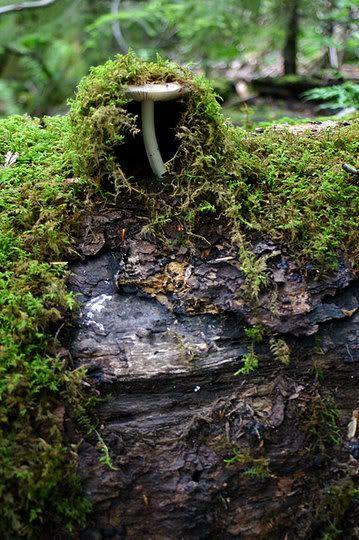

A mushroom cap raises a mossy roof

Similar considerations were on my mind this past week, when I traveled to the Monongahela National Forest, in eastern West Virginia, for some camping, hiking, and herping. I know very little about West Virginia, despite having spent several summers at Camp Greenbrier, situated just outside Alderson, in the southern part of the state. During those summers I learned about kayaking, archery, riflery, rock climbing, and the cruel conduct of boys left unsupervised, but I was too young - just nine or ten years of age - to absorb much about the region save the scenic beauty.

Following those camp years, John Denver's song "Country Roads," a particular favorite of my mother, acquired new significance for me. "West Virginia, mountain momma...take me home," Denver sings. Having appreciated the lush splendor of the Appalachian range for myself, Denver's lyrics imparted an aesthetic association as well as the allusion to a mother's buxom embrace. But Denver's paean doesn't only acknowledge West Virginia's awesome landscape. He refers to the state as the "miner's lady...dark and dusty." Even the state's coat of arms, central on the state flag, pictures a miner, pickaxe slung over his shoulder, standing alongside a farmer. But modern miners have largely abandoned the pickaxe in favor of cranes and bulldozers, and evidence of mountain top removal can be seen from the state's highways. Treeless plateaus neighbor intact peaks and, although geologic time will see these scars support trees and other vegetation anew, one can not help but wonder what has become of the once healthy water supply fed by the decapitated mountain streams.

Happily - some might even say selfishly - I was able to avoid despair during my time in Monongahela. Unlike so much of the state, the mountains of the National Forest have been spared extensive surgery. All the same, the park map is peppered with mine sites, demarcated by a pick and shovel. The stream water I drank - after an iodine pill dosing - seemed safe enough (I didn't get sick), but I couldn't quite shake worries about mercury or heavy metal content. Encouragingly, we found plenty of amphibians in the streams, and this suggests that the water is clean.
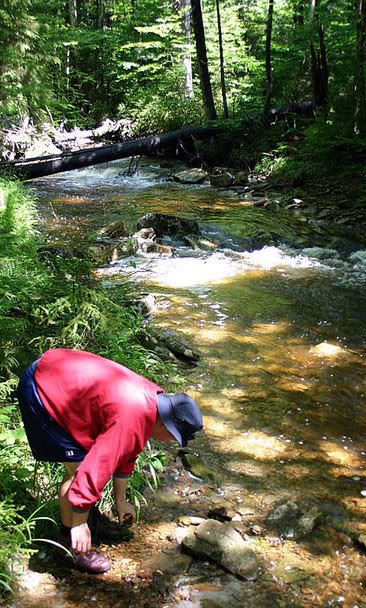

Salamander hunting near Cheat Mountain Camp

* * * * *

Amphibians: We identified four species of salamander; one example of each is pictured below.


Mountain Dusky Salamander (Desmognathus ochrophaeus)

The Mountain Dusky Salamander (Desmognathus ochrophaeus) was the most common, at least according to our crude census. They seemed to flourish alongside streams, under partially submerged rocks, and on the mountain's face, under woodland detritus - bits of rotten limbs or clumps of moss. The coloration of this species is wide-ranging. Some of the individuals we came upon could have passed for the unrelated redback (Plethodon cinereus), while others appeared more yellow, tan, or even chocolate. Fortunately, one of my companions is an avid herper and he was readily able to distinguish the two species by examining the head and nostrils. When in doubt, I defer to his expertise.
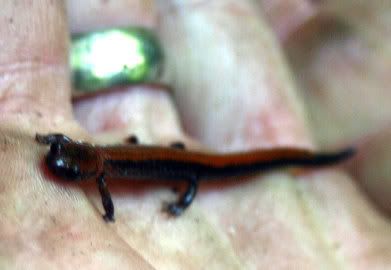

Redback Salamander (Plethodon cinereus)

Comparatively scarce was the redback salamander and, if I'm recalling accurately, we only discovered this species near woodland vernal ponds. Unfortunately, all my photographs of the species turned out poorly. The models, this one included, didn't much take to posing, forcing me to hurry the shots.
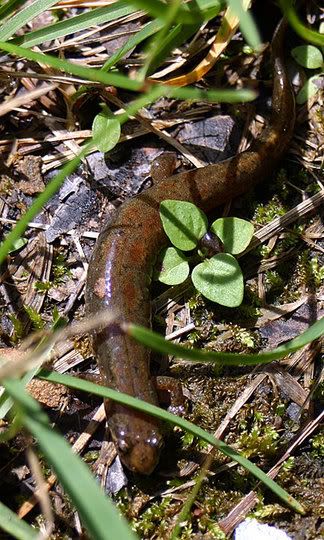

Spotted Dusky Salamander (Desmognathus fuscus conanti)

The most unusual discovery of the trip was a Spotted Dusky Salamander (Desmognathus fuscus conanti). The species is not known to live in the region - according to field guide range maps, anyway - but, nevertheless, we encountered this individual under a flat rock in an insignificant stream and spent some time confirming the ID. Proof, once again, that nature is always throwing curve balls, particularly in this time of accelerating climate change. The patterned salamander was strikingly colored and appeared almost translucent, it's distinctive markings discernible beneath a superficial layer of clear skin.
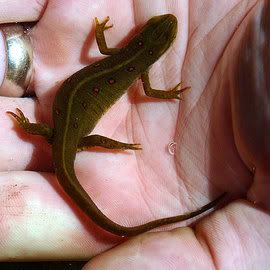

Red-spotted Newt (Notophthalmus viridescens viridescens)

Just up the hill from the Spotted Dusky discovery, we noticed a Red-spotted Newt (Notophthalmus viridescens viridescens) in a puddle of standing water. I was thrilled to see one up close, as it had been the better part of a decade since I last admired this species in person. As it turned out, almost anywhere water pooled in Monongahela, the newts were present. By the time we departed, we'd seen close to a hundred.

Before transitioning into its principally aquatic adulthood, however, the newt spends time on land, as the terrestrial red eft. These attractive little amphibians are perhaps the most charismatic of salamanders. Their stunning outfit is complimented by their not being as retiring as other species. If you find yourself in prime habitat, a keen eye will spot the efts crawling on logs or over leaves, seemingly unperturbed by exposure.
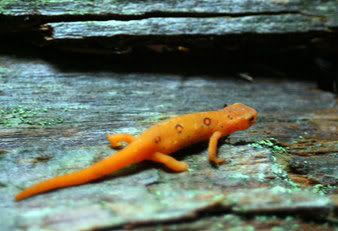

Red-spotted Newt in Red Eft stage (Notophthalmus viridescens viridescens)

Tadpoles, like the newts, could be found in almost every pond or puddle. Although we could not ID the species with certainty, we believe most to be the aquatic larvae of the wood frog (Rana sylvatica), though we did notice a few American bullfrog (Rana catesbeiana) tadpoles. The bullfrog is something of a bully, infamous for out-competing other amphibians and adapting to a wide range of habitats. Biologists designate such a species a trophic generalist. Despite the potential threat to biodiversity, a piece of me admires the pluck of the bullfrog, just as I grudgingly take my hat off to the European starling (Sturnis vulgaris) and the raccoon (Procyon lotor).

Although we saw countless tadpoles, we saw only three adult frogs. One bullfrog, one wood frog, and one upland chorus frog (Pseudacris triseriata feriarum). The upland chorus frog is closely related to, but distinct from, the eastern (or New Jersey) chorus frog (Pseudacris ferairum kalmi), with which I am familiar from my childhood on the Eastern Shore of Virginia.
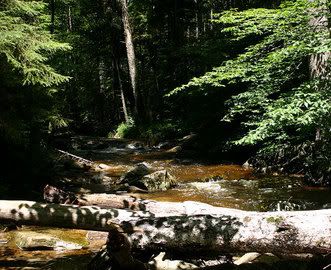

A Monongahela stream

Reptiles: Our snake hunting forays proved less successful. We shined flashlights into crevices and carefully examined sun-lit leaf litter in hopes of revealing a timber rattlesnake (Crotalus horridus) or a northern copperhead (Agkistrodon contortrix), but neither species graced us with an appearance. I was discouraged, but not surprised. Snake hunting is usually a kettle watching exercise and the animals seem to materialize only once you cease searching.

We found two snakes in Monongahela. Sadly, one of these was a DOR (dead on road) eastern garter snake (Thamnophis sirtalis sirtalis), a victim of the automobile. Given the infrequent use of this remote forest road, I decided the unfortunate snake must have accrued some very shitty karma. At least an unidentified land snail was feeding on the dead snake, a welcome reminder of our shared mortality and interdependence.

The identity of the other snake we observed remains in question, but I'm almost certain it was a juvenile eastern milk snake (Lampropeltis triangulum triangulum). It was a very slender snake, not even pencil-thick, wearing alternating bands of red and white. We noticed the snake on the bottom of a shallow, water-filled ditch. It was attempting to feed on small tadpoles. When we clumsily hurried over for a closer look, it retreated into submerged grasses lining the ditch. After a wait of about fifteen minutes, it emerged from hiding and I attempted to ID it as it zigged and zagged across the bottom. I failed, unfortunately, and we did not see the little reptile again. According to field guides, eastern milk snakes are no stranger to stream bottoms. This knowledge, combined with the distinctive markings, leaves me with little doubt of the species, but, as I say, the verdict it still out.


Snake hunting on the southern exposure

Mammals: I hoped to see a black bear (Ursus americanus) or two, but I had to settle for a smattering of tracks. Because we arrived in Monongahela at the tail end of a long wet spell, the trails and back country were muddy and soft. Although the rain made the first night miserable - we rigged a tarp and pitched the tents after dark, in hard rain - the saturation made spotting animal tracks easy, although in some cases the ground was so wet that fresh prints were already partially obscured. White-tailed deer (Odocoileus virgianus) tracks were plentiful, but we saw more deer in the backyards of the houses fringing the National Forest than we did in Monongahela proper. This isn't surprising, as deer are harder to spot in dense forest and, what's more, they thrive in and around human settlement, as so many suburbanites know. Also abundant was the bouncy eastern chipmunk (Tamias striatus).

Birds: We were ill-prepared for bird watching. Although we were careful to pack everything needed for a camping trip - right down to the campfire utensil sets - we somehow neglected to include binoculars. I'm not sure how this oversight occurred, but none of us had a pair in hand, making anything beyond guessing difficult, especially since most of Monongahela's bird species are relatively small. In the shadowed forests, identification is all but hopeless without ocular assistance. Fortunately, one of my friends has a competent ear and some species were identified by their call.

Slate-colored juncos (Junco hyemalis) were innumerable. It seems spring comes late to the upper elevations, as the rhododendrons had yet to bloom and, on the final afternoon, we were scolded by two adult juncos as we hustled past a fledgling perched on a low-hanging branch. The prize for Most Handsome Bird goes to the Blackburnian warbler (Dendroica fusca), a fire-headed fellow with a striking voice. We thought we heard this bird's song in the woods, and our supposition was verified when an individual landed just above us, in the branches of a spruce tree.

Most exciting for me, however, was the family of American woodcock (Philohela minor) that we startled into awkward flight. I'm used to the jump, flutter, and glide behavior of the woodcock in the open, flat fields of coastal Virginia, but in the mountain woods of Monongahela, the woodcocks' comical eruption from among the leaves and ferns betrayed the provenance of the species nickname, the timber doodle. The first bird to take off flapped and jerked and reared and leaned as it moved all of twenty feet in the air, before pitching hard and vanishing into a mess of fallen limbs. Realizing we had disturbed a family group, we made our way downhill at a good clip, so as to allow the birds to regroup.

Plenty of common ravens (Corvus corvax) and cedar waxwings (Bombycilla cedrorum) were about, but we saw only one American blue jay (Cyanocitta cristata) and one turkey vulture (Cathartes aura), species I certainly expected to see more of. Had we been properly equipped (read: not forgotten the $@*&%!! binoculars), I would have more to report, but I was all too happy to concentrate on reptiles and amphibians, as they are particularly exciting to me.

* * * * *

Rising with dawn's birdsong on the final morning, we quickly packed our gear, lowered the bear bag, and began the five hour drive to Washington, D.C., where I was to catch the Chinatown Bus back to New York City. As we headed east, I slouched in the cramped back seat and admired the mountains of West Virginia, even as I again noted signs of resource extraction. My thoughts returned to Reece's "Death of a Mountain" and I made a mental note to reread it upon returning to New York.

Near the end of the article, Reece quotes Aldo Leopold, the famous American ecologist and conservationist. Leopold bemoaned the fact that "one of the penalties of an ecological education is that one lives alone in a world of wounds." I'm not sure that this is still the case. Those of us who are environmentally conscious do not live alone, even if we do remain surrounded by wounds. More than ever before, "green" sentiments are also popular sentiments; many folks share a penchant for preservation. Leopold would argue, however, that most contemporary environmentalists remain blissfully ignorant of ecological pragmatism. He was a conservationist, not a preservationist, and he understood that protectionism alone rarely leads to long-term sustainability.

Keeping this conservation/preservation dynamic in mind, I think it noteworthy that my companions in the forests of Monongahela were a biology professor and a writer. For our purposes here, the biologist might be characterized as a biological determinist and the writer, as a moral idealist. Though these two characterizations are by no means mutually exclusive, it makes for an interesting contrast in perspective, even though both appreciate the outdoors equally. Rereading "Death of a Mountain," I was surprised to find this divide touched on in the closing paragraphs.
"If our species is to make it through [the 21st] century, the forces of science and technology must be tempered by two other forces - ethics and aesthetics. All ethical philosophies, from Aristotle on down, are based on this ecological principle as stated by Leopold: 'The individual is a member of a community of interdependent parts.' And as the cave art at Lascaux makes brilliantly clear, we are a species that has evolved to find beauty in the natural world. This trait serves - or should serve - an evolutionary purpose: we love what we find beautiful, and we do not destroy what we love. A strip job is more than a moral failure; it is a failure of the imagination. It is time we stopped thinking like those who conquer a mountain and started thinking like the mountain itself."
A strip job, as Reece writes, is a moral and imaginative failure, but what does it mean to think like a mountain? It would seem to me that to think like a mountain requires us to abandon morality and imagination, both exceptional human virtues. Is my ambivalence concerning invasive species control an example of mountainous thinking? Moral ambivalence - that is, amorality - is Nature's way. But isn't ambivalence, too, problematic? Is it not cousin to apathy? Humans, at their best, are moral animals; morality necessitates choice and action. Strict environmental controls, then, are moral, pragmatic, and rational, flailing efforts in our human time scale not at all like the geologic contemplation of a mountain. We humans consider a skewed equation and strive to balance it. This calculus comes at some cost. For the sensitive aesthete, slavishly devoted to what Reece calls beauty, the dualistic thinking of a moral pragmatist - right or wrong, good or evil - can seem an ugly, even unnecessary evolutionary holdover. Where, then, can the conscientious among us stand? It's an impossible question, really, more of a koan than a query, but it nags nonetheless.

Something approaching an answer is wrapped up in the lyrics of Denver's "Country Roads," in the fight bruised arms of young boys, in the remarkable persistence of trophic generalists, in the determined antagonism of the coal miner's wife, in the scarred plateaus, and in the slurried bear tracks. Thankfully, when I'm painting, or when I'm appreciating back country settings like Monongahela, I'm reminded that contentment, for me, requires acceptance of a messy, mongrel truth. For my part, it's both necessary and natural to be both an idealistic aesthete and a moralistic number cruncher.
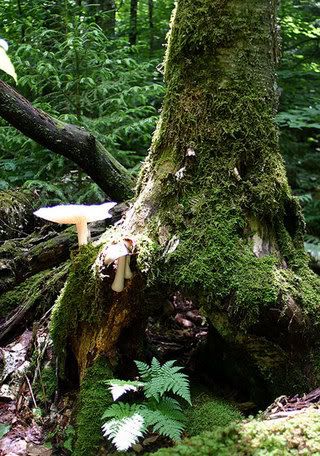

Fungi thrive in the moist, dense forests

Photo credit: all photos, Hungry Hyaena, 2006

Thursday, March 24, 2005

The Expanding Ethical Embrace


In conjunction with the New York Historical Society’s exhibition, "Audubon's Aviary," the NYHS, Nurture New York's Nature, and the NYC Audubon Society partnered to present a series of Audubon-related talks. During the second evening of presentations, entitled “The Fall and Resurrection of Nature in New York,” NYC Audubon Society member Peter Joost spoke of our evolving ethical paradigm. Over the last several hundred years, he argued, humans have become progressively more enlightened. Joost cited the political developments of 20th century America to prove his point: today, we consider every human equal, irrespective of race, sex or religion. (True, but our American “melting pot” is yet pervaded by racism, xenophobia and religious intolerance; I agree with the general thrust of Joost's thesis, but recognize that we must be vigilant if we are to preserve our liberal ethics.)

Mr. Joost also pointed out that, as humans continue to expand our ethical embrace, we are beginning to consider other species, especially our ape relatives, as equals or near equals. He foresees a societal shift towards vegetarianism and the adoption of a moral code which includes an increasing number of species. Presumably this shift won’t guarantee voting rights for horses, but the meat industry, hunting and animal research would all end. Perhaps a future Mosaic code will include the commandment, 'Do unto your neighboring species as you would have done unto you.'

All well and good...sort of. If our ethic/moral code expands to include animals, plants, and eventually bacteria, what role will conservation play? Some degree of manipulation is required to maintain the ecological status quo. Wildlife management works, in part, because we perceive ourselves as stewards of the land, a species situated slightly above the fray. If a US Fish & Wildlife biologist elects to burn a section of forest in order to encourage future growth and habitat restoration, he isn’t condemned. But his actions killed many insects and displaced other species! If every species’ rights are to be considered, management that today is laudable will be controversial; conservation biology would be further burdened by litigation.

But I am a realist, and so don't fret about the possibility of an over-extended ethical embrace. Morality is not born of humanity's existential sameness or some essential, animating goodness. Like all other animal species, humans evolved to survive and propagate; that is, we evolved to be winners. Even our predilection for classification - as seen in the periodic table, clothing labels and taxonomy - is innate, an evolved trait that better equips us to ward off “the other,” to proactively eliminate potential competition. But this us-and-them trait is no longer tenable in our interconnected world. It seems to me that the quickening of our ethical expansion in recent centuries corresponds to a wider worldview. Whereas once we were many, now we are one economy. If this is the case, isn't our extension of human rights to all races, cultures and creeds a victory in our campaign to deny human nature, a requisite improvement to the foundation of global socio-politics?

If this is so, our increasing capacity for compassion creates new problems. An inclusive, caring society, even if inconsistent, is attended by a population boom and longer life expectancy. By embracing one another, then, we also increase our species’ demands on the environment. When even more populations - in Joost's argument, other species - enter our moral peripheral vision, we will find ourselves facing a philosophical and pragmatic dilemma. Will our compassion overload the circuitry?

The idealist in me believes that our concept of conservation will be replaced by one more reconcilable with a Joost's inclusive ethical paradigm. After all, why should we strive to “manage” when we are but part of the environment ourselves? But the realistic answer to that question doesn't jive with Joost's ethics. We are part of the environment; as such, we are creatures adapted to live within a given range of environmental conditions. Sustainable conservation should not reject human needs. To the contrary, it must incorporate them.

Dr. William Cronon, a very intelligent writer and environmental historian writes,
“The nature we carry in our heads is as important as the nature that is all around us, because in fact the nature inside our heads is often the engine which drives our interactions with physical nature, transforming both ourselves and nature in the process….Non-use is not an option: to live in nature is to use and change it by our presence. The choice we face is not to leave no marks – that is impossible – but rather to decide what kinds of marks we wish to leave.”
I look forward to an age when humanity has extended its moral code to the other animals, but where does such a shift take us? The question is hypothetical and abstract. I am content to view it as an imponderable and this, I suppose, is why I am an artist rather than a philosopher or lawyer.

I scribbled notes as I listened to Joost, and I thought of Aldo Leopold. A hunter and conservationist, on the one hand, and a moralist and preservationist, on the other, Leopold embodied the contradiction at the heart of this question. Returning again to Cronon,
“Having spent his entire life as a manager of land and wildlife, [Leopold] knew all too well that wild nature will not long remain in the modern world without an active commitment on the part of human beings to manage it responsibly...and he knew that this task was far from easy….Knowing that he himself was manipulating wildness in the very act of protecting it gave him a powerful sense of the paradoxes such work entailed, and he was clear-eyed and unblinking in acknowledging these paradoxes. ‘All conservation of wildness,’ he wrote, ‘is self-defeating, for to cherish we must see and fondle, and when enough have seen and fondled, there is no wilderness left to cherish.’...His dream was for a world where large tracts of wilderness would be protected, but where wild things would thrive and be honored in many other places as well: in rural wood lots, in humble wetlands, in restored prairies, even in urban parks. Only so would people be reminded, regularly and in the most ordinary ways, of the larger community to which they belonged and on which their own lives depended.”
Will an expanding ethical embrace make Leopold’s dream more possible or will it serve instead to complicate matters, making our search for a sustainable, moral society a more Herculean task?

Wednesday, March 02, 2005

Leopold, Auden & Kimber

"'That land yields a cultural harvest is a fact long known, but latterly often forgotten.' If land is not treated with love and respect for the community of soil, water, plants, and creatures it is, then the land will be degraded and impoverished, and the culture responsible will reap a harvest of degradation and impoverishment. 'A culture,' [WH] Auden wrote in a line that could have been [Aldo] Leopold's as well, 'is no better than its woods.'"
-Robert Kimber, from his tremendous book, "Living Wild and Domestic"