Showing posts with label amphibians. Show all posts

Thursday, August 16, 2012

Platte Clove Residency: Coastal Differences

View of Devil's Path Trail; Catskills; NY; July 2012
Five years ago, while traveling in South America, I met a young woman from the West Coast of the United States. After the trip, we corresponded for a while, and she related news of her move from southern California to New England. An outdoorsy sort, she prioritized exploration of the parks in her new neck of the woods, but she wrote that the eastern forests unnerved her. During the summer months especially, they seemed dense and suffocating, a patchwork of green that closed in around her.

At the time, her observation amused me. Having grown up on the East Coast, I was at home in the mixed deciduous and pine forests of eastern North America. By contrast, the Endor-like redwood and sequoia forests of the Pacific coast and the mixed coniferous forests of the continental divide and the American Southwest, environments in which I'd had little or no experience but with which my friend was very familiar, seemed otherworldly to me.

Thursday, October 22, 2009

Acting Out (Peacefully) Against the Culture of Competition


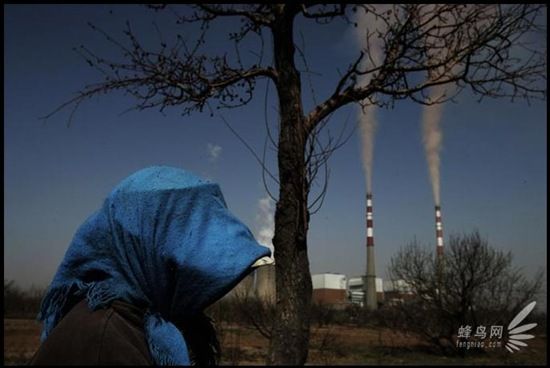
Shizuishan Industrial district in Ningxia. Residents cover themselves against the falling dust when going outside.
April 22, 2006

This Saturday, October 24th, I'll join a mob of peaceful activists and march across the Brooklyn Bridge, from Manhattan to Brooklyn, in hopes of further raising public awareness about the reality of climate change and the need for a comprehensive international climate treaty. The march is associated with 350.org's Day of Action.
"350.org is an international campaign dedicated to building a movement to unite the world around solutions to the climate crisis--the solutions that science and justice demand. Our mission is to inspire the world to rise to the challenge of the climate crisis—to create a new sense of urgency and of possibility for our planet. Our focus is on the number 350--as in parts per million, the level scientists have identified as the safe upper limit for CO2 in our atmosphere. But 350 is more than a number--it's a symbol of where we need to head as a planet. [...] This December, world leaders will meet in Copenhagen, Denmark to craft a new global treaty on cutting emissions. The problem is, the treaty currently on the table doesn't meet the severity of the climate crisis—it doesn't pass the 350 test. In order to unite the public, media, and our political leaders behind the 350 goal, we're harnessing the power of the internet to coordinate a planetary day of action on October 24, 2009. We hope to have actions at hundreds of iconic places around the world - from the Taj Mahal to the Great Barrier Reef to your community - and clear message to world leaders: the solutions to climate change must be equitable, they must be grounded in science, and they must meet the scale of the crisis."
350.org was founded by author and environmentalist Bill McKibben and, although some legitimate philosophical criticisms of the project have been raised, I feel strongly that the organization's mission is vital.


Due to long-term consumption of water contaminated by industrial waste, 50 people have cancer and cerebral thrombosis in Kang village of Linfen City, Shanxi Province..
64-year-old Wang Baosheng has fester wounds all over his body, and must sleep sitting, face down on the edge of the bed each day.
July 10, 2005

Should you doubt the urgent need for an international climate treaty that demands accountability and systemic change, or should you remain skeptical of the human influence on atmospheric carbon levels, I encourage you to take a look at the distressing pictures that ChinaHush recently published. Photographer Lu Guang's series "Pollution in China" is a testament to the cruel realities of the international, industrial market.

In his book-length essay Life Is A Miracle, the author, poet, essayist, and critic Wendell Berry describes the global, capitalist world view as,
"one culture of division and dislocation, opposition and competition, which is to say the culture of colonialism and industrialism. This culture has steadily increased the dependence of individuals, regions, and nations upon larger and larger collective economies at the same time that is has thrown individuals, regions, and nations into a competitiveness with one another that is limitlessly destructive and demeaning."
The "collateral damage" caused by this monstrous steam engine is not limited to elevated carbon levels, and its poisons don't just affect the dispossessed or the politically and economically powerless.

Nicholas Kristoff reminds us, in a recent New York Times OpEd piece, that the staggering number of "deformed frogs and intersex fish [found in or near United States' waters] — not to mention the growing number of deformities in newborn boys — should jolt us."
"In the Potomac watershed near Washington, male smallmouth bass have rapidly transformed into 'intersex fish' that display female characteristics. This was discovered only in 2003, but the latest survey found that more than 80 percent of the male smallmouth bass in the Potomac are producing eggs. Now scientists are connecting the dots with evidence of increasing abnormalities among humans, particularly large increases in numbers of genital deformities among newborn boys. [...] Apprehension is growing among many scientists that the cause of all this may be a class of chemicals called endocrine disruptors. They are very widely used in agriculture, industry and consumer products. Some also enter the water supply when estrogens in human urine — compounded when a woman is on the pill — pass through sewage systems and then through water treatment plants."
Herpetologists have been sounding the alarm for years, but the policy makers are warm in the pockets of the immoral corporations and the populace, by and large, prefers to escape in celebrity pregnancy updates and corporate-owned sporting events. Amphibians were the ignored canary in the coal mine. Now many animal families (ours included) are paying a terrible price, one that we can not yet fully appreciate.


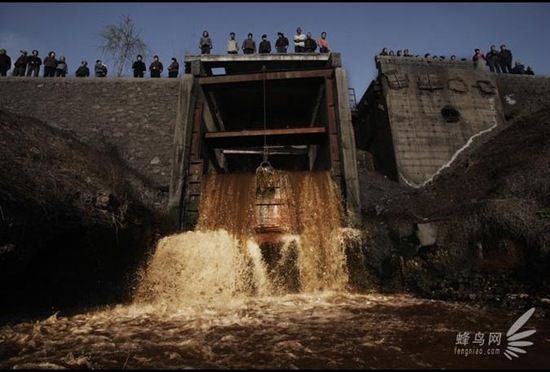
Henan Anyang iron and steel plant’s sewage flowed into Anyang River. March 25, 2008

Still, it's not too late to stand up to the "culture of colonialism and industrialism." Visit 350.org. Find out how to get involved in the effort. If global warming isn't appealing to your still, small voice, get involved with political activism, volunteer at your local homeless shelter, pledge financial support to non-profit activist organizations working for causes that you feel strongly about; it doesn't matter what you do, but it does matter that you do something. Turn off the television, put down the tabloid. I beg this of you.


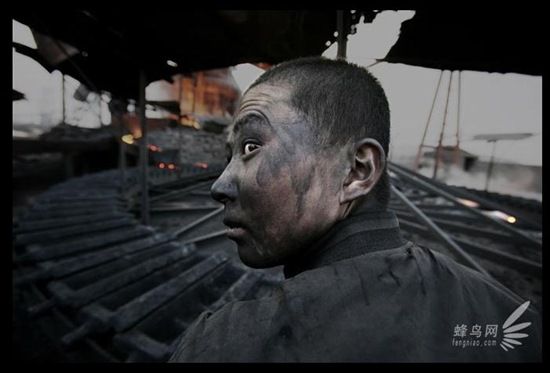
Breathing large amounts of dust into their lungs, people become sick after working here for 1-2 years. Most of these migrant workers come from area of poverty.
April 10, 2005

Photo credits: all photographs, Lu Guang; ripped from ChinaHush

Thursday, August 09, 2007

Back From The Pantanal

Some Pictures and Thoughts

Bird's eye view of the Pantanal (Pantanal, Brasil)

I'm sun burnt, marked by half-healed tick and mosquito bites, and still nursing a few infected cuts on my feet, but I'm back in the New York City harness. Part of me is happy to be home, but I already feel the burden of our frivolous "first-world" pressures and distractions. I've been confirming studio visits and dinner dates, dragging my feet through two weeks of unattended email, catching up with piles of paperwork at the day job, and stressing over how few paintings I've so far completed in '07. By contrast, in the Pantanal my worries were limited to hydration, securely taping shut my pant legs (to discourage ticks), and accurately recording census data. My time there was stress free and I was therefore better able to fully appreciate the experience.


Anchored water hyacinth (Eichhornia azurea) flower near shore of bahia at Pousada Ararauna

It helped, of course, that I was surrounded by people who share my enthusiasm for wildlife and ecology. I was one of eleven volunteers hailing from Ireland, California, Colorado, Ohio, and New York. The researchers we assisted in the Pantanal work on three different projects. "Amphibians and Reptiles of the Southern Pantanal" is headed by Ellen Wang, a Ph.D. candidate at Sao Paulo State University. "Birds and Dynamic Habitat Mosaics" is led by Dr. Reginaldo Jose Donatelli (Sao Paulo State University) and Gustavo Rosa. "Ecology and Conservation of Pantanal Otters" is led by Dr. Helen Waldemarin, but I worked with Manoel Muanis, a M.Sc. candidate at Federal University of Rio de Janeiro. All three projects were of interest to me but, as those familiar with my affection for serpents would assume, I was most excited by the herpetology work.


Clemuso holding cat-eyed snake (Leptophis annulata); this fellow was captured inside Frank and Nicki's toilet; very calm. non-venomous colubrid species, but often mistaken for the venemous and much maligned Fer-de-lance (Bothrops asper) (Pousada Ararauna, Pantanal, Brasil)

The official project abstract describes the Pantanal as follows. "The Middle Rio Negro region of the Brazilian Pantanal, where this research takes place, is a relatively pristine area with high conservation status. Deforestation has been minimal, access via roads is difficult and the main commercial activity is low-impact cattle ranching using native pastures." I don't find that description entirely accurate. Although the Panatal is a UNESCO World Heritage Site and is considered the world's largest tropical wetland, it is not what most of us would deem "pristine." Cattle are ubiquitous, and although the Pantaneiros, the longtime residents and cowboys of the Pantanal, have restricted their cattle-related deforestation, the large herds have a visible impact on the ecology of the wetlands. There are 55 cattle for every 1 person in the Pantanal, an estimated 4.5 million cattle in all.


Contrast of defrested cattle land and "natural" makeup of the Pantanal, as seen from air on flight out to research site

Prior to traveling to Brazil, I imagined the Pantanal to be a relatively virgin area, with few visible human marks. In fact, it more closely resembles a Texas ranch. Barbed wire fences are ubiquitous (fortunately, excepting some large deer, all wildlife species can pass through them without problem) and sandy roads crosshatch the landscape when viewed from above. Horses and canoes are still used as the primary modes of transport on the fazendas, but trucks, tractors, and motorboats are just as, if not more, popular.


Ellen closing one of the many fence gates in the Pantanal; the fences are installed by Pantaneiros to regulate cattle movement (Pantanal, Brasil)

But it behooves us to appreciate that the impacts of ranching are not all negative. Because 95% of the Pantanal, which covers an area comparable to the state of Nebraska, is privately owned (the land is divided among the various ranchers) the fazendas protect the ecology of the region. Industry can not so easily move in on private holdings and, better still, some landowners are now opting to set aside small portions of their land for conservation (in return for tax credits and stipends from the Brazilian government). Florida's tropical cattle ranches are similarly valuable to conservation, preventing residential and industrial development from encroaching on critical habitat and fragile ecosystems.

A more serious threat to the Pantanal is the growing global demand for ethanol. With do-gooder "first-worlders" like myself calling for alternative fuels, cash poor countries see a window of opportunity. Sugarcane is among the most popular crops for ethanol production and Pantaneiros must clear-cut before they can plant cane. The fact that biofuel production isn't a Utopian solution shouldn't come as a surprise. Scientists unaffiliated with industry have criticized biofuels for years. David Pimentel, professor of ecology and agriculture at Cornell University, explains, "Ethanol production requires large fossil energy input...Further, its production and use contribute to air, water and soil pollution and global warming." The Sierra Club's Mr. Green adds emphasis, "If you think the industrialized monoculture that fattens livestock is scary, ponder the gloomy prospect of a couple hundred million automobiles feeding off the land." And, if ranching and agriculture in the Pantanal don't take their toll, pesticide and fertilizer runoff from the surrounding highlands may pick up the slack.


One of the adult spectacled caiman (Caiman crocodilus) disturbed by my wading in pousada bahia (Pousada Ararauna, Pantanal, Brasil)


It's difficult to protect a unique ecosystem like the Pantanal when economic development is the Holy Grail. Brazilian environmental agencies talk of "balancing economic sustainability with conservation." Indeed, given our fanatical embrace of neo-classical economics and the neoliberal paradigm, we must try to balance the equation, but I see no reason why we shouldn't also strive to reeducate ourselves, to find viable alternatives to industrial capitalism. Rebecca Solnit writes,
"we have all been trained as torturers of a sort in this economy and nation that generate a huge array of atrocities while training us not to see or feel them. Enormous violence is all around us, in the brutality of capitalism as it devastates for profit rural landscapes, from Amazon rainforests to Wyoming ranches, produces poverty for more profit, and consigns the resultant poor to incarceration, illness, homelessness, and dead-end jobs."
All "First worlders" are guilty to one degree or another, but this doesn't mean we should throw up our hands and surrender to thoughtless greed and willful ignorance. Individual and local resistance efforts can and do make a difference, especially in terms of cultivating awareness and restructuring value systems.


Manoel and John in canoes on river during afternoon otter census (Pantanal, Brasil)

Pousada Ararauna, the lodge where my team of volunteers stayed, is owned by a private university and is dedicated to ecotourism and ecological research; it is located on Santa Emilia Farm, a 6,450 acre property in the southeastern Pantanal. The details (and focus subjects) of the three projects vary, but they all seek to ascertain how tourism, agriculture, and other developments are impacting the biodiversity of the region. The hope of all such research is that the findings will bring more attention to the ecosystem in question and result in more federal protections and environmental awareness on the part of the local landowners.


A pair of Hyacinth macaws (Anodorhynchus hyacinthinus) perched in "para todos" tree in early morning, with moon behind (Pousada Ararauna, Pantanal, Brasil)

My time in Brazil flew by, as it often does when I find myself physically engaged with (and thinking about) ecology. Rather than write a detailed account of the trip, I've listed a few highlights below and I'll post more captioned pictures in coming days. You can also visit my Flickr Brazil set to view more photos.


Pantanal at dusk (Pantanal, Brasil)

Also, for those readers who are wildlife geeks like myself, identification of some of the spiders, insects, fish, amphibians, and reptiles I came across is challenging. Any help would be greatly appreciated.


Hyla alba treefrog species found by Manoel in kitchen bathroom; no common name I can find (Pousada Ararauna, Pantanal, Brasil)

Pantanal Highlights:


A giant armadillo (Priodontes maximus) - the species is threatened or endangered - near bahia at Pousada Ararauna

- Common though they are in the Pantanal (globally, they are endangered), I was thrilled to see giant armadillos (Priodontes maximus). I fancied myself quite the stalker after I managed to move within a few feet of one during my first afternoon at the pousada, but soon learned that the animals are rather mellow and, in fact, easy to catch. (Oh, my bruised ego.) Still, they're charismatic little guys and I was cheered whenever I saw them bumbling along. (FYI: The "giant" in their name is relative; they're not imposing critters.)


Holding a small Red belly piranha (Pygocentrus nattereri) (Pantanal, Brasil)

- I enjoyed catching piranha. The fishing itself is not challenging; you bait a hook with raw meat, toss it over, feel the tugs, and pull up a fish. The Pantaneiros use either a line with no rod (called handlining, which I've done once before, for sharks in Costa Rica) or a reel-less rod with the line attached to the end. You must use a wire leader to prevent the fish from biting off the hook. Needless to say, you must take care when releasing piranha; their teeth and jaws are truly remarkable. We caught two morphological variants of the Red-bellied piranha (Pygocentrus nattereri), as well as several pitanga (Sp?).

Most of the piranha we caught were released, but a few of the larger ones were kept for piranha soup, a Pantaneiro favorite believed to be an aphrodisiac. Because I caught the fish, my dietary restrictions allowed me to eat some of the soup. It tasted like a very salty lentil soup; I couldn't detect the fish flavor at all (and sadly I didn't have an opportunity to see if the recipe made me particularly virile).

- We only saw four species of snake during my time in the Pantanal, but each of them were a thrill. I love to see and handle snakes; they're magical animals in my estimation. The four species we came upon were all diminutive, and we saw nothing of their enormous relative, the yellow anaconda (Eunectes notaeus). I was disappointed by this conspicuous absence but, after years of looking for snakes, I know well that each and every find is a treat.


Holding young spectacled caiman (Caiman crocodilus) used in Lucio's mosquito vector experiment; mouth is taped to prevent unfortunate nips (Pousada Ararauna, Pantanal, Brasil)

- I enjoyed interacting with the spectacled caiman (Caiman crocodilus). I handled a juvenile (being used in a mosquito vector experiment conducted by a researcher at the pousada), and I swam and waded with the reptiles a couple of times, determined to see how close I could get before spooking them. They are alligators, not crocodiles, and are therefore unlikely to mistake a human for a potential meal, especially given their relatively small size (5 to 7 feet). They were most numerous on the river banks, where they rested during the day, absorbing the sun's energy before heading to the water again for evening hunting.


Teri swimming in the caiman pool (Pousada Ararauna, Pantanal, Brasil)

- One night, while walking the small runway near the pousada (the best way to reach most areas of the Pantanal is by plane) with a headlamp, my beam blinded two orange eyes. Unable to see, the creature remained motionless while I steadily advanced on it. Moments later, I was standing a foot from a resting pauraque (Nyctidromus albicollis), a member of the nightjar family (Caprimulgidae). The nightjars rank just behind the corvids (crows, ravens, and jays) as far as my favorite bird families go, and I was stoked to be so close to the curious fellow (or lady). I learned later that I might have reached down and picked the bird up...if only I'd kept my headlamp trained on those big eyes. Instead, I turned my head to call some other volunteers over and, no longer blinded by my light, the bird was soundlessly gone.


Part of the family group of eleven giant river otter (Pteronura brasiliensis) near den as we drift by; marks on chest are individual (Pantanal, Brasil)

- The giant river otter (Pteronura brasiliensis) family groups were particularly impressive. The largest group we came upon numbered 17 individuals, each distinguished by unique, white markings on their chest. They are inquisitive animals, and when our boat or canoe approached, they repeatedly reared from the water to take a look at the human trespassers, all the while coughing, huffing, and otherwise vocalizing. Sadly, this species is also endangered.


Giant anteater (Myrmecophaga tridactyla) approaches at night; because they do not see or hear well, if you sit very still they sometimes come very close; this individual came within ten feet (Pantanal, Brasil)

- Walking around the pousada grounds at night was always a trat. Giant-anteaters (Myrmecophaga tridactyla), crab-eating foxes (Cerdocyon thous), feral pigs (Sus scrofa), and a grey brocket deer (Mazama gouazoubira) were all seen on these little adventures. Furthermore, tropical nighttime sounds are beautiful and, if I turned off the light and stood still, the marsh and fringe woodland came alive for my ears. It's wondrous.

One evening I walked to the end of the runway, away from the lights of the pousada, and, having had a little too much to drink, sat down to do some half-thinking. Leaves crunched and birds called from the tropical forest to my right and, in front of me, the marsh was alive with frog conversation and the sporadic beacons of fireflies. I sat there in dumb bliss for some minutes...until some of the crunching sounds became more pronounced than I was comfortable with. Imagining an ambitious jaguar, I walked double-time back to the pousada, feeling ridiculously urban and silly. I'm sure that the little armadillo or anteater in the woods was happy to see me depart.

- A few of us were lucky enough to witness a collared forest falcon (Micrastor semitorquatus) as it attempted, twice, to take a grey-necked wood rail (Aramides cajanea). The falcon tore from the trees and swooped on the sprinting rail. It missed, perhaps startled by the presence of four humans so nearby. The rail panicked; rather than flee into the safety of the marsh, it attempted to return to the woods for cover. The falcon took note and attacked again as the rail made the fringe. Again, failure. At last the rail wised up and veered away from the trees, vanishing into the marsh reeds.

The falcon perched in the top of a dead tree and looked down at us contemptuously. Were it not for our being there, the rail may have been the falcon's dinner. I was at once happy for the rail and disappointed for the falcon. Having evolved as predators ourselves, it's only natural that we identify with the hunters.


Ellen showing two different color variations of Paradoxical frog (Pseudis paradoxa); this is the only species to appear with malformation in the Pantanal to date (Pousada Ararauna, Pantanal, Brasil)

- Tedious though it can sometimes be, I thoroughly enjoyed all the herpetology laboratory work. We weighed, measured, and identified all captured individuals before readying them for release. We identified and labelled any "Dead In Trap" specimens that we had retrieved. Unfortunately, there were a great many of the latter, casualties of dehydration or insect attack. (Many ants fall into the pitfall traps and, if they become irked with a fellow inmate, that frog, cockroach, or lizard is likely a goner.)


Leaf-cutter ants at work in evening hours; uncertain of species (Pantanal, Brasil)

- Finally, I very much enjoyed the company of the volunteers and all of the folks at the pousada, researchers, cooks, bridge builders, and Pantaneiros alike. A little music, dancing, and too much cachaca. Puxe meo dedo!


Gino, Gustavo and Ernaldo playing into the night (Pousada Ararauna, Pantanal, Brasil)

Anyway, that's all I'll write for the moment. As always, it takes time to digest a big trip and I'm sure there will be related posts to follow.


Rockstar shades and "safari" garb = ecotourist a$$hole
Late afternoon on the river(Pantanal, Brasil)

Photo credits: all photos this post, Hungry Hyaena

Tuesday, July 11, 2006

Thinking Like A Mountain?


Erik Reece's eloquent essay, "Death Of A Mountain: Radical Strip Mining and the Leveling of Appalachia," was included in the April 2005 issue of Harper's Magazine. The piece examines and responds to environmentally devastating coal mining practices in eastern Kentucky. Appropriately enough, I read the work while standing in an abominably long line at the World Expo, in Aichi, Japan, the first World's Fair dedicated to "green" thinking or, as the Japanese organizers dubbed it, "Nature's Wisdom."

Every pavilion in the Aichi Expo was sponsored by either a nation or a corporation (a sign o' the times), and they all forecast a happy, healthy, and sustainable future for humanity and for the planet. Reece's melancholy report provided a sobering counterpoint. A "green future" is tenable only if the necessary changes in technology and lifestyle generate an altogether different kind of green: cash money. As the wife of a Kentucky coal miner asks Reece, "What use are the mountains to us other than coal? When are you going to start thinking about us instead of the environment?" Until alternative energy cheerleaders assuage the concerns of those citizens dependent on income provided by companies like Leslie Resources Inc., one of the mining outfits indicted in Reece's article, America's hard-working, blue-collar folks will remain united in opposition to the relatively privileged mouthpieces of environmentalism.

In "Death of a Mountain," Reece describes the minutes of a Kentucky hearing addressing an Environmental Impact Statement on mountaintop removal, the principal method of tapping into buried coal seams. The local coalfield citizens in attendance, many of them employed by the region's energy companies, reacted against "outsiders" telling them what was best for them and for their land. They even hinted "at a conspiracy afoot by the rest of the state to keep eastern Kentucky poor." Not surprisingly, such vehement antagonism to "greening" measures were not highlighted at the Aichi Expo. Likewise, they receive scant attention in environmental publications, even those produced by more thoughtful organizations,including The Sierra Club, Natural Resources Defense Council and EarthJustice. It's clear that most environmentalists don't consider the lives of those people displaced by expanding parkland or laid off by companies under siege from environmental legislation. It's little wonder that "Third World" countries and blue-collar workers like the Kentucky miners or the fishermen of the Galapagos islands object to what they consider do-gooder meddling.

In Aichi, I looked up from the magazine and noticed a Japanese teenager in line not far behind me. He was wilting under a sun umbrella, wearing a t-shirt emblazoned with a picture of the popular American hip-hop duo, Outkast. Fond of connecting seemingly unrelated strands, I thought of the Outkast song, "Return of the G." The lyrics of the song begin, "Every time I try to get peace of mind, niggas try to get a piece of mine, so I gotta grab my piece." The song concisely describes an ugly, myopic cycle, but how much easier for me to characterize it as such when I can afford a plane ticket to Japan and enough over-priced, organic vegetables to fill my canvas grocery sacks?

As a proponent of conservation and environmental protection, I'm necessarily guilty of prioritizing the sustainable long-view over the millions of people vying to put food on their plate. I considered this distressing reality as I entered the air-conditioned Hitachi Pavilion in Aichi to watch an animated feature about the catastrophic - nay, apocalyptic - events brought on by humanity's cavalier approach to natural resource consumption.
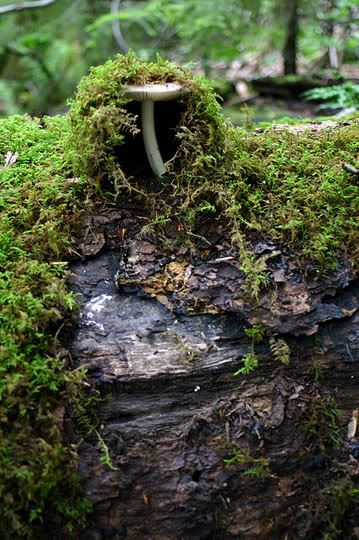

A mushroom cap raises a mossy roof

Similar considerations were on my mind this past week, when I traveled to the Monongahela National Forest, in eastern West Virginia, for some camping, hiking, and herping. I know very little about West Virginia, despite having spent several summers at Camp Greenbrier, situated just outside Alderson, in the southern part of the state. During those summers I learned about kayaking, archery, riflery, rock climbing, and the cruel conduct of boys left unsupervised, but I was too young - just nine or ten years of age - to absorb much about the region save the scenic beauty.

Following those camp years, John Denver's song "Country Roads," a particular favorite of my mother, acquired new significance for me. "West Virginia, mountain momma...take me home," Denver sings. Having appreciated the lush splendor of the Appalachian range for myself, Denver's lyrics imparted an aesthetic association as well as the allusion to a mother's buxom embrace. But Denver's paean doesn't only acknowledge West Virginia's awesome landscape. He refers to the state as the "miner's lady...dark and dusty." Even the state's coat of arms, central on the state flag, pictures a miner, pickaxe slung over his shoulder, standing alongside a farmer. But modern miners have largely abandoned the pickaxe in favor of cranes and bulldozers, and evidence of mountain top removal can be seen from the state's highways. Treeless plateaus neighbor intact peaks and, although geologic time will see these scars support trees and other vegetation anew, one can not help but wonder what has become of the once healthy water supply fed by the decapitated mountain streams.

Happily - some might even say selfishly - I was able to avoid despair during my time in Monongahela. Unlike so much of the state, the mountains of the National Forest have been spared extensive surgery. All the same, the park map is peppered with mine sites, demarcated by a pick and shovel. The stream water I drank - after an iodine pill dosing - seemed safe enough (I didn't get sick), but I couldn't quite shake worries about mercury or heavy metal content. Encouragingly, we found plenty of amphibians in the streams, and this suggests that the water is clean.
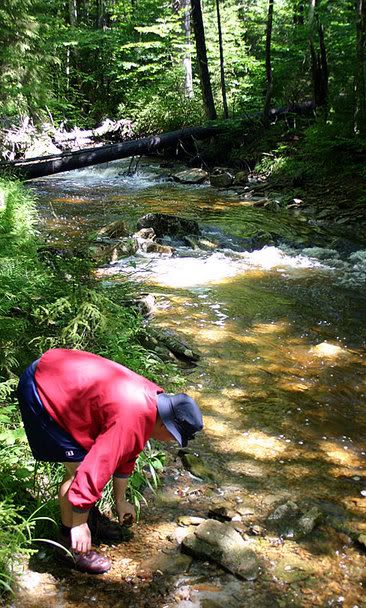

Salamander hunting near Cheat Mountain Camp

* * * * *

Amphibians: We identified four species of salamander; one example of each is pictured below.


Mountain Dusky Salamander (Desmognathus ochrophaeus)

The Mountain Dusky Salamander (Desmognathus ochrophaeus) was the most common, at least according to our crude census. They seemed to flourish alongside streams, under partially submerged rocks, and on the mountain's face, under woodland detritus - bits of rotten limbs or clumps of moss. The coloration of this species is wide-ranging. Some of the individuals we came upon could have passed for the unrelated redback (Plethodon cinereus), while others appeared more yellow, tan, or even chocolate. Fortunately, one of my companions is an avid herper and he was readily able to distinguish the two species by examining the head and nostrils. When in doubt, I defer to his expertise.
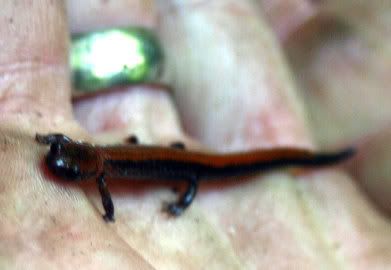

Redback Salamander (Plethodon cinereus)

Comparatively scarce was the redback salamander and, if I'm recalling accurately, we only discovered this species near woodland vernal ponds. Unfortunately, all my photographs of the species turned out poorly. The models, this one included, didn't much take to posing, forcing me to hurry the shots.
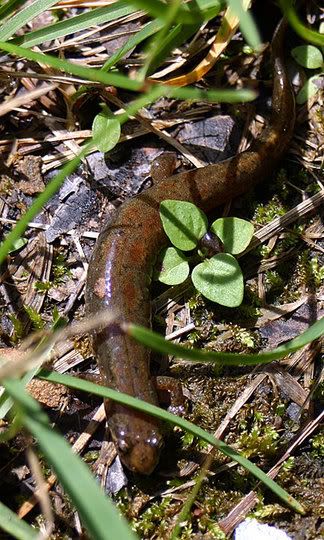

Spotted Dusky Salamander (Desmognathus fuscus conanti)

The most unusual discovery of the trip was a Spotted Dusky Salamander (Desmognathus fuscus conanti). The species is not known to live in the region - according to field guide range maps, anyway - but, nevertheless, we encountered this individual under a flat rock in an insignificant stream and spent some time confirming the ID. Proof, once again, that nature is always throwing curve balls, particularly in this time of accelerating climate change. The patterned salamander was strikingly colored and appeared almost translucent, it's distinctive markings discernible beneath a superficial layer of clear skin.
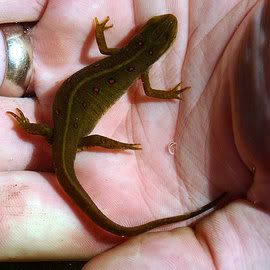

Red-spotted Newt (Notophthalmus viridescens viridescens)

Just up the hill from the Spotted Dusky discovery, we noticed a Red-spotted Newt (Notophthalmus viridescens viridescens) in a puddle of standing water. I was thrilled to see one up close, as it had been the better part of a decade since I last admired this species in person. As it turned out, almost anywhere water pooled in Monongahela, the newts were present. By the time we departed, we'd seen close to a hundred.

Before transitioning into its principally aquatic adulthood, however, the newt spends time on land, as the terrestrial red eft. These attractive little amphibians are perhaps the most charismatic of salamanders. Their stunning outfit is complimented by their not being as retiring as other species. If you find yourself in prime habitat, a keen eye will spot the efts crawling on logs or over leaves, seemingly unperturbed by exposure.
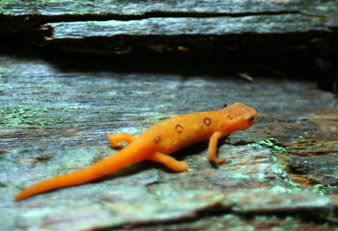

Red-spotted Newt in Red Eft stage (Notophthalmus viridescens viridescens)

Tadpoles, like the newts, could be found in almost every pond or puddle. Although we could not ID the species with certainty, we believe most to be the aquatic larvae of the wood frog (Rana sylvatica), though we did notice a few American bullfrog (Rana catesbeiana) tadpoles. The bullfrog is something of a bully, infamous for out-competing other amphibians and adapting to a wide range of habitats. Biologists designate such a species a trophic generalist. Despite the potential threat to biodiversity, a piece of me admires the pluck of the bullfrog, just as I grudgingly take my hat off to the European starling (Sturnis vulgaris) and the raccoon (Procyon lotor).

Although we saw countless tadpoles, we saw only three adult frogs. One bullfrog, one wood frog, and one upland chorus frog (Pseudacris triseriata feriarum). The upland chorus frog is closely related to, but distinct from, the eastern (or New Jersey) chorus frog (Pseudacris ferairum kalmi), with which I am familiar from my childhood on the Eastern Shore of Virginia.
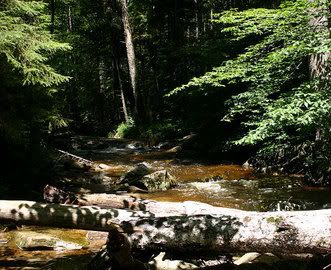

A Monongahela stream

Reptiles: Our snake hunting forays proved less successful. We shined flashlights into crevices and carefully examined sun-lit leaf litter in hopes of revealing a timber rattlesnake (Crotalus horridus) or a northern copperhead (Agkistrodon contortrix), but neither species graced us with an appearance. I was discouraged, but not surprised. Snake hunting is usually a kettle watching exercise and the animals seem to materialize only once you cease searching.

We found two snakes in Monongahela. Sadly, one of these was a DOR (dead on road) eastern garter snake (Thamnophis sirtalis sirtalis), a victim of the automobile. Given the infrequent use of this remote forest road, I decided the unfortunate snake must have accrued some very shitty karma. At least an unidentified land snail was feeding on the dead snake, a welcome reminder of our shared mortality and interdependence.

The identity of the other snake we observed remains in question, but I'm almost certain it was a juvenile eastern milk snake (Lampropeltis triangulum triangulum). It was a very slender snake, not even pencil-thick, wearing alternating bands of red and white. We noticed the snake on the bottom of a shallow, water-filled ditch. It was attempting to feed on small tadpoles. When we clumsily hurried over for a closer look, it retreated into submerged grasses lining the ditch. After a wait of about fifteen minutes, it emerged from hiding and I attempted to ID it as it zigged and zagged across the bottom. I failed, unfortunately, and we did not see the little reptile again. According to field guides, eastern milk snakes are no stranger to stream bottoms. This knowledge, combined with the distinctive markings, leaves me with little doubt of the species, but, as I say, the verdict it still out.


Snake hunting on the southern exposure

Mammals: I hoped to see a black bear (Ursus americanus) or two, but I had to settle for a smattering of tracks. Because we arrived in Monongahela at the tail end of a long wet spell, the trails and back country were muddy and soft. Although the rain made the first night miserable - we rigged a tarp and pitched the tents after dark, in hard rain - the saturation made spotting animal tracks easy, although in some cases the ground was so wet that fresh prints were already partially obscured. White-tailed deer (Odocoileus virgianus) tracks were plentiful, but we saw more deer in the backyards of the houses fringing the National Forest than we did in Monongahela proper. This isn't surprising, as deer are harder to spot in dense forest and, what's more, they thrive in and around human settlement, as so many suburbanites know. Also abundant was the bouncy eastern chipmunk (Tamias striatus).

Birds: We were ill-prepared for bird watching. Although we were careful to pack everything needed for a camping trip - right down to the campfire utensil sets - we somehow neglected to include binoculars. I'm not sure how this oversight occurred, but none of us had a pair in hand, making anything beyond guessing difficult, especially since most of Monongahela's bird species are relatively small. In the shadowed forests, identification is all but hopeless without ocular assistance. Fortunately, one of my friends has a competent ear and some species were identified by their call.

Slate-colored juncos (Junco hyemalis) were innumerable. It seems spring comes late to the upper elevations, as the rhododendrons had yet to bloom and, on the final afternoon, we were scolded by two adult juncos as we hustled past a fledgling perched on a low-hanging branch. The prize for Most Handsome Bird goes to the Blackburnian warbler (Dendroica fusca), a fire-headed fellow with a striking voice. We thought we heard this bird's song in the woods, and our supposition was verified when an individual landed just above us, in the branches of a spruce tree.

Most exciting for me, however, was the family of American woodcock (Philohela minor) that we startled into awkward flight. I'm used to the jump, flutter, and glide behavior of the woodcock in the open, flat fields of coastal Virginia, but in the mountain woods of Monongahela, the woodcocks' comical eruption from among the leaves and ferns betrayed the provenance of the species nickname, the timber doodle. The first bird to take off flapped and jerked and reared and leaned as it moved all of twenty feet in the air, before pitching hard and vanishing into a mess of fallen limbs. Realizing we had disturbed a family group, we made our way downhill at a good clip, so as to allow the birds to regroup.

Plenty of common ravens (Corvus corvax) and cedar waxwings (Bombycilla cedrorum) were about, but we saw only one American blue jay (Cyanocitta cristata) and one turkey vulture (Cathartes aura), species I certainly expected to see more of. Had we been properly equipped (read: not forgotten the $@*&%!! binoculars), I would have more to report, but I was all too happy to concentrate on reptiles and amphibians, as they are particularly exciting to me.

* * * * *

Rising with dawn's birdsong on the final morning, we quickly packed our gear, lowered the bear bag, and began the five hour drive to Washington, D.C., where I was to catch the Chinatown Bus back to New York City. As we headed east, I slouched in the cramped back seat and admired the mountains of West Virginia, even as I again noted signs of resource extraction. My thoughts returned to Reece's "Death of a Mountain" and I made a mental note to reread it upon returning to New York.

Near the end of the article, Reece quotes Aldo Leopold, the famous American ecologist and conservationist. Leopold bemoaned the fact that "one of the penalties of an ecological education is that one lives alone in a world of wounds." I'm not sure that this is still the case. Those of us who are environmentally conscious do not live alone, even if we do remain surrounded by wounds. More than ever before, "green" sentiments are also popular sentiments; many folks share a penchant for preservation. Leopold would argue, however, that most contemporary environmentalists remain blissfully ignorant of ecological pragmatism. He was a conservationist, not a preservationist, and he understood that protectionism alone rarely leads to long-term sustainability.

Keeping this conservation/preservation dynamic in mind, I think it noteworthy that my companions in the forests of Monongahela were a biology professor and a writer. For our purposes here, the biologist might be characterized as a biological determinist and the writer, as a moral idealist. Though these two characterizations are by no means mutually exclusive, it makes for an interesting contrast in perspective, even though both appreciate the outdoors equally. Rereading "Death of a Mountain," I was surprised to find this divide touched on in the closing paragraphs.
"If our species is to make it through [the 21st] century, the forces of science and technology must be tempered by two other forces - ethics and aesthetics. All ethical philosophies, from Aristotle on down, are based on this ecological principle as stated by Leopold: 'The individual is a member of a community of interdependent parts.' And as the cave art at Lascaux makes brilliantly clear, we are a species that has evolved to find beauty in the natural world. This trait serves - or should serve - an evolutionary purpose: we love what we find beautiful, and we do not destroy what we love. A strip job is more than a moral failure; it is a failure of the imagination. It is time we stopped thinking like those who conquer a mountain and started thinking like the mountain itself."
A strip job, as Reece writes, is a moral and imaginative failure, but what does it mean to think like a mountain? It would seem to me that to think like a mountain requires us to abandon morality and imagination, both exceptional human virtues. Is my ambivalence concerning invasive species control an example of mountainous thinking? Moral ambivalence - that is, amorality - is Nature's way. But isn't ambivalence, too, problematic? Is it not cousin to apathy? Humans, at their best, are moral animals; morality necessitates choice and action. Strict environmental controls, then, are moral, pragmatic, and rational, flailing efforts in our human time scale not at all like the geologic contemplation of a mountain. We humans consider a skewed equation and strive to balance it. This calculus comes at some cost. For the sensitive aesthete, slavishly devoted to what Reece calls beauty, the dualistic thinking of a moral pragmatist - right or wrong, good or evil - can seem an ugly, even unnecessary evolutionary holdover. Where, then, can the conscientious among us stand? It's an impossible question, really, more of a koan than a query, but it nags nonetheless.

Something approaching an answer is wrapped up in the lyrics of Denver's "Country Roads," in the fight bruised arms of young boys, in the remarkable persistence of trophic generalists, in the determined antagonism of the coal miner's wife, in the scarred plateaus, and in the slurried bear tracks. Thankfully, when I'm painting, or when I'm appreciating back country settings like Monongahela, I'm reminded that contentment, for me, requires acceptance of a messy, mongrel truth. For my part, it's both necessary and natural to be both an idealistic aesthete and a moralistic number cruncher.
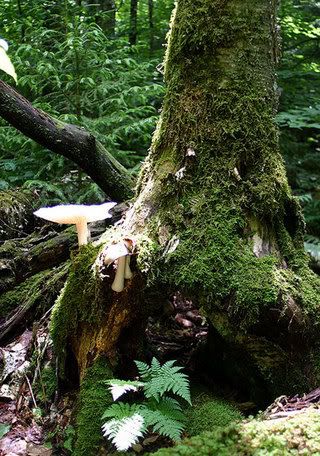

Fungi thrive in the moist, dense forests

Photo credit: all photos, Hungry Hyaena, 2006

Thursday, June 23, 2005

Amphibian Collapse


I recently received an “editorial email” from Tim Halliday, International Director of the Declining Amphibian Populations Task Force (DAPTF). I thought it important enough to paste two selections here.
“The Mission of the DAPTF is to determine the nature, extent and causes of amphibian declines throughout the world, and to promote the means by which declines can be halted or reversed.

Last year’s Global Amphibian Assessment (GAA) brought to the attention of the wider world what those of us concerned with amphibian declines already knew. We are faced with a major extinction event, in the light of which our current mission statement seems increasingly unrealistic…

How should biologists act in response to mass extinction? I suggest that the first thing we should do is put more effort into alerting the wide world to the significance of amphibian declines. The general public, and its political leaders, seem indifferent to amphibians and are unimpressed by statistics on threatened species, however large the numbers. We need to emphasise that amphibian declines are a symptom of a rapid decline in the capacity of the environment, especially its freshwater component, to support life. We face an uphill struggle in getting this message across.”
Most people shrug off news of what appears to be a remarkable, ongoing amphibian extinction. Many individuals believe the extinction is something biologists are predicting, some future worst-case scenario. Futhermore, most folks don't connect the dots; the worldwide amphibian decline and the increasingly publicized global fresh water crisis are related.

Realizing that people are not responding to the alarm, Halliday takes a page from George Lakoff and suggests that a change in framing may be in order.
“A number of commentators have suggested that the public, and its leaders, are in a state of denial about environmental issues. The prospect of environmental collapse is too awesome, and too remote, to think about. I suggest that we biologists engage in our own form of denial by operating within the general area called ‘conservation biology’. This is a comforting, feel-good title but the results of the GAA suggest that we’re not doing a very good job. I now call myself an ‘extinction biologist’ and find that this generates much greater interest in what I do than calling myself a conservationist.”
Whether or not the term "extinction biology" will rouse a somnambulistic public, amphibians are vanishing, and at an incredible rate. As many as 122 species have gone missing - and are presumed extinct - since 1980 and 32% of the remaining species are in danger of imminent extinction.

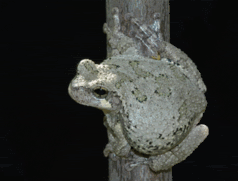
Photo credit: copyright, Virginia Natural Historical Society; image of Cope’s Gray Treefrog (Hyla chrysoscelis)

Tuesday, March 29, 2005

Wood Frogs and Me


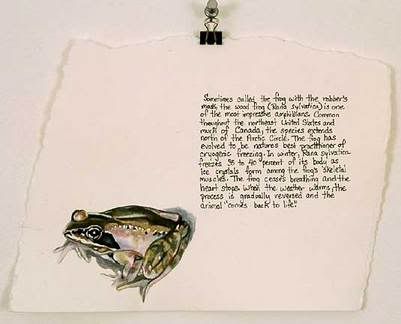
I am impressed by cold-blooded creatures that have adapted to cool climates and the wood frog (Rana sylvatica), one of my favorite amphibians, is such a species.

The watercolor posted above features a wood frog, and is part of a series that I'm currently working on. Comprised of many small watercolor paintings tacked to a wall, the series is basically a bastardized taxonomy. In the picture below, you can see one wall of the series, whereby the various species and individual humans have been grouped according to behavior rather than biological type, physiology,or phylogeny. I hope to make viewers question anthropomorphism while at the same time poking fun at the inadequacy of our taxonomic systems.

Also, while we're on the subject of wood frogs, this short article in National Geographic discusses the ability that has allowed wood frogs to thrive in cold climates. Incredibly, they have mastered the delicate art of cryogenic freezing.


Image credits: Christopher Reiger, 2005

Wednesday, March 23, 2005

UVB, Amphibians, and Alarmism

HerpDigest, an email newsletter which, as the title suggests, deals with reptiles and amphibians, brought the work of Professor Lawrence Licht (York Univeristy, Toronto, Ontario) to my attention. His findings dispute "the hypothesis that increasing levels of [Ultraviolet B radiation are] killing amphibians and [are] linked to global population declines." Despite this supposed culprit receiving "a great deal of attention in websites, radio, television, newspapers, textbooks and curriculum guides used in elementary, high school and university level science courses," Licht carefully picks apart the argument, suggesting that melanin in the amphibian embryos and an enzyme-photolyase possessed by adults and eggs protects them from UVB damage. Most interestingly, he concludes by addressing the issue of alarmist science at large:
"A very important point I am trying to make is that just because a paper has been published in a peer reviewed journal, the merits of the paper should be judged with care and attention to detail. Each paper must be read with a clear objective mindset. This is especially true when the hypothesis being tested has almost become dogma; in such cases, the hypothesis is believed to be true because everyone knows it is true because it has been hyped to a point where no one bothers to question...When a popular, widespread and alarmist hypothesis -amphibians are dying from exposure to sunlight- is found to be erroneous, the public can lose faith in the rigor and worth of scientific statements in general. Another 'cry wolf' story tarnishes the value of ongoing quality efforts and future studies that have real merit."
Given the "Death of Environmentalism" dialogue we've been hearing so much about in the blogosphere, I thought Prof. Licht's study and conclusions pertinent.

Sunday, March 13, 2005

Make Me A Mutt


Every blogger with an interest in sustainability and conservation will certainly be making some reference to Nicholas Kristof’s March 12th op-ed piece in the New York Times. I’m no exception.

Kristof’s conclusion that Michael Shellenberger and Ted Nordhaus, co-authors of “The Death of Environmentalism,” are right, that “modern environmentalism…must die so that something new can live,” is bound to provoke vitriolic response from many folks with “greening” on their mind. (Dave Roberts, the usually thoughtful assistant editor of Grist Magazine, calls Kristof’s article a “lazy, risible piece of sh*t.”)

I’m electing to take the middle road on this one. For every informed environmentalist, there are at least three ignorant screamers. Both sides (if the situation must be reduced to such black-and-white perspectives) know this to be true, and, more importantly, we have all been one of these screamers at some point, no matter how informed we may be otherwise.

Allow me to use myself as an example. I used to rant about the urgent need for blanket prohibitions on the importation of any wild-caught exotic reptiles and amphibians. Further, I insisted that states should require permits, obtained upon completion of a basic training course, for private reptile or amphibian ownership. My reasons were valid: I had grown tired of seeing “pet” reptiles and amphibians improperly cared for and exotic introduction (consider the Burmese pythons currently thriving in Florida’s Everglades) is more likely when dealing with “fad” herp owners, those that think a snake or lizard will be a “cool pet” but soon become bored by a relatively sedentary animal.

Yet, after considering the issue for several years, I no longer think prohibition a wise idea. Economic incentives overseas, in the form of local breeder farms and conservation projects in heavily pressured areas, and restricted foreign breeder partnerships seem a more sound response to the problems caused by the burgeoning interest in herpetoculture. (Of course, this won't prevent a negligent owner from releasing an exotic locally and I still favor a permit system for large or venomous herp ownership.)

So I changed my mind; I still want the same end result, but the means I now think best are notably different. This wouldn’t be a problem if I hadn’t been so eager to hop on the soapbox when I was calling for prohibition. Now, despite my current attitudes being more nuanced and informed, I am what some dub a “flip-flopper.” But flip-flopping is not always bad. It proves one is engaged and considerate. Unfortunately, it can also be cited as a weakness.

What does my flip-flopping have to do with Kristof’s criticism of the environmental movement? In his editorial, Kristof writes,
“The fundamental problem, as I see it, is that environmental groups are too often alarmists. They have an awful track record, so they've lost credibility with the public. Some do great work, but others can be the left's equivalents of the neo-cons: brimming with moral clarity and ideological zeal, but empty of nuance.”
He is right. Too often we opt to bang the table and throw a tantrum, presumably operating on the maxim, “Make enough noise, and they will come.” Jared Diamond, a contemporary hero of mine, correctly suggests that being an alarmist is better than not alerting others to the burning building, but the fact remains, alarmists are annoying. Taking the extreme position - the championing of wind power and denial of related criticism, for example – virtually guarantees you will be deemed wrong in the end. If you tell someone that drunk driving will surely result in their death and they drive off a bridge and nearly drown, they’ve proved you wrong by surviving the terrible accident. Your ultimate point, that drunk driving is stupid, dangerous, and wrongheaded, is true...but, technically, um, you said he would die.

Don’t think for a minute that the “other side” won’t hold us to our word. “Global cooling” is still pilloried by the neo-cons and energy industry spokesmen. If you try to explain that “global cooling” and “global warming” are essentially descriptions of the same phenomenon, you’ll get nowhere fast. The dire forecasts made by meteorologists in the 1970s didn’t materialize. Neither did Paul Ehrlich’s population predictions. Now Kristof cites these as examples of environmentalists crying wolf. Technically, he is correct, but global climate change and population pressures remain serious threats to the health of society and biodiversity.

The challenge that the environmental movement faces now, just as it did thirty years ago, is one of image. The Pew Research Center statistic Kristof cites is encouraging; 3/4 of Americans polled agree that environmental protection is vital. With that sizable majority in mind, it may not be necessary to throw tantrums. Reasonable, determined methods will serve the movement well. In environmentalism, like anything else, contradictions abound. Rather than dogmatically championing every device or idea that comes out of the green camp, we should fully consider each and push for thoughtful action as a diplomat would.

As Garret Keizer writes in his recent essay, “Life Everlasting,”
“We can dare to walk on this ground of dubious footing, because we are holding one another up as best we can, and because it is we ourselves and not some deterministic logic that writes our civil laws…We can sniff out our options and pick and choose among them, a birthright generally less appreciated by a dogmatist than by a dog.”
Photo credit: Superdog Inc, copyright 2003

Wednesday, March 02, 2005

EPA Back To Old Tricks: Atrazine, DDVP and Industry Influence

The Natural Resources Defense Council (NRDC) has filed another lawsuit against the Environmental Protection Agency (EPA). NRDC claims that the EPA “secretly” met with representatives from companies manufacturing Atrazine, a pesticide, and DDVP, an insecticide.

Such behind-the-scenes wheeling and dealing is not unprecedented. As the attached NRDC press release mentions, the EPA committed “widespread violations” under Administrator Ann Gorsuch, during the tenure of President Ronald Reagan.

The EPA is beholden to the sitting administration and, under George W. Bush, we've witnessed a steady corrosion of EPA regulations. Resignations were submitted by the more honest EPA officials, so the news that the agency is making deals with pesticide manufacturers is hardly surprising. The EPA is no longer just a branch of the federal government; it’s also big business. (The EPA's recent mercury regulations, for example, were dubbed a “gift to industry.”)

Atrazine, manufactured by the Swiss-based company, Syngenta, is implicated in an observed spike in the incidence of amphibian feminization. The males of some freshwater fish species, such as the smallmouth bass (Micropterus dolomieu), are also producing eggs. Dr. Tyrone Hayes, a biologist at UCBerkeley, is leading the charge against Atrazine. His experiments suggest a direct correlation between Atrazine levels and amphibian feminization. Unfortunately, because Dr. Hayes believed Atrazine threatened amphibians from the get-go, many other biologists are reluctant to stand with him until further work has been done. Technically, the verdict is still out.

In the meantime, the EPA is working to ensure that Atrazine and other chemicals not only continue to find their way into our water systems, but that they will do so in large quantities. Across the Atlantic, several European countries have banned use of the pesticide, after scientist expressed concern about the potentially negative effects of Atrazine on the human population.