There are a lot of reasons to be baffled by
the renewed attacks on the
theory of evolution(1), but I'm particularly bemused by
the denialists' contention that the theory is a dangerous dogma. It's true that there's no shortage of dull-witted
biologists who can be too stubborn in their pronouncements, as unwilling to consider a dissenting perspective as the loudest denialist
(2), but any scientist worth her salt - or, for that matter, any informed, reasonable individual - realizes that the theory of evolution is, itself, evolving. Sure, some scientists can be dogmatic, but the
theory in question is not a
dogma. It is adaptable.
When most of us hear the word, evolution, crude caricatures of
chimpanzees,
Neanderthals, and walking fish-reptiles come to mind. Sometimes, we may even think of diagrammed
cell division or an
eukaryote propelling itself by means of rudimentary
flagella. Yet rarely, if ever, do we consider change at the molecular level.
Biophysicists Harold Morowitz, of
George Mason University, and
Eric Smith, of the
Santa Fe Institute, do exactly that, suggesting that a "central set of chemical reactions has been in place since life's earliest moments about four billion years ago." Journalist
Joel Achenbach explains the
Morowitz/Smith hypothesis in a recent
National Geographic piece, "
The Origin of Life...Through Chemistry."
"These reactions involve just 11 small carbon molecules, such as citric and acetic acids, very ordinary stuff that would have been abundant on the young Earth. Those 11 molecules could have played a role in other chemical reactions that led to the development of such biomolecules as amino acids, lipids, sugars, and eventually some kind of genetic molecule such as RNA."
What makes the
hypothesis so fascinating, though, is the suggestion that survival of the fittest or, more accurately,
natural selection, occurs at the molecular level. Acenbach clarifies: "Some types of molecular chains outcompeted other molecular chains for the planet's resources, and gradually they led to the type of molecules that life depends upon - all this before the first living thing oozed forth." Wow! It seems obvious, really.
Of course molecules compete in the same way genes do.
Unmentioned in the
Geographic article is the divide between Millerites,
evolutionary biologists who stand by
Stanley Miller's mid-twentieth century hypothesis that life began at surface level, when electricity, atmospheric gases, and water interacted in such a way as to form the oft-mentioned biotic soup, and
ventists, the scientists who feel such a soup was more likely arrived at on the ocean's floor, a by-product of interactions involving pressure and heat near
hydrothermal vents. (I prefer to think of the two perspectives as the
Frankenstein approach (electricity) and the oven hypothesis (hydrothermal) and, although I remain uncertain of which I "support," when the two camps duke it out the Frankenstein approach always seems to be forced back against the ropes.) Morowitz and Smith are ventists. Will their molecular metabolism hypothesis, viable both on the surface and under the sea, come under fire from Millerites because they are "the enemy"?
Such language - "duke it out," "the enemy" - is hyperbolic, but most folks would be shocked by how nasty the debates in the halls of evolutionary biology can become. Whatever impression the more extreme denialists seek to convey (e.g.,
Darwin was a blasphemer who today inspires countless secularists, marching in lockstep, to carry on his unholy work), the theory of evolution is anything but settled. Darwin's theories provide a spring board, an introduction, but are not fast. As with most revolutionary science, Darwin's ideas raise a host of questions.
One of these questions, in particular, has plagued biologists ever since
Darwin's theory was first published. Commonly referred to as the "paradox of evolution," it asks, how can we reconcile
evolutionary variation - all the shapes, colors, sizes, etc. - with the limited number of structures and systems all species share? The two readily observable realities seem contradictory: unlimited diversity produced by a limited system.
Marc Kirschner, chair of the
Systems Biology Department at
Harvard Medical School, recently proposed a novel answer,
facilitated variation. I turn to
Robin Marantz Henig's article, "
Resolving Evolution's Greatest Paradox," in the March/April 2006 issue of
New York Academy of Sciences Update.
"Kirschner used an analogy borrowed from the kindergarten classroom to explain how his and Gerhart's theory differs from evolutionary theory up to this point. Traditionally, he said, biologists have compared life to a lump of modeling clay, 'incredibly plastic, and able—due to the accrual of many small changes—to go in any direction.' But this is the wrong metaphor, he said. In truth, life is more like a bunch of Lego blocks. As with Legos, the basic building blocks of biology are rigid and quite similar to one another, but 'there is a large variety of structures that can be assembled from similar parts.'
Another way of looking at it, Kirschner said, is to try to imagine trying to get a monkey to write the word 'MONKEY.' You could do so by giving the monkey a pen and paper, but that would never work—all you'd get would be 'random lines and scratches.' But if you gave him a typewriter, then you might be getting somewhere. It would take a very long time (Kirschner calculated about ten years, typing at the rate of one keystroke per second round-the-clock), but the monkey would eventually produce all six letters in the right order, because the typewriter restricts the results of his physical actions—always letters instead of scribble-scrabble. 'Letters have at least a chance to be useful,' Kirschner said. 'Most pen scratches do not.'
If, instead of a typewriter, the monkey was pounding on a computer keyboard programmed with an automatic spelling corrector, the time it would take for him to type out the word 'MONKEY' would be reduced dramatically, from ten years to probably less than a single day. 'More constraint equals more useful outcomes,' Kirschner said."
OK. That's clear, but how can the spell checker analogy account for so much complexity and variation?
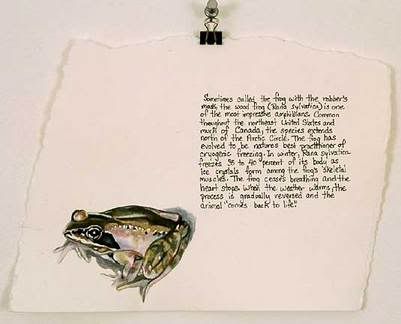
"Complexity in multicellular organisms—changes and refinements in beak shape, pigmentation, jaw structure, limb formation—can be explained, he said, by forces involved in 'changing the time and extent of a process rather than creating a new process.'...[This] helps account for the surprising fact that the human genome isn't much bigger than the genome of a frog or a fruit fly. The vast differences among these organisms are accounted for not by number of genes, he said, but by how the genes are expressed...In other words, the gene itself doesn't have to be different; what changes is the timing or location of the gene's expression."
Beautiful! One need look no further than the
gestation of a
human embryo to get a sense of how facilitated variation works, each step recalled and repeated, generation after generation, the species' genome receiving new information all the while. The same "program" is "running" inside
frog eggs or the
squirrel's womb.
Still, it's important to note that facilitated variation is but a piece of the ever-changing puzzle, no more or less important than
punctuated equilibrium or the notion of
spandrels. Moreover, though a lovely marriage of
genetics and natural selection, Kirschner's theory is less applicable when considering a restricted time line.
"
Global Warming Fuels Speedy Evolution," a piece by
Larrry O'Hanlon (
Discovery News), provides readers with a number of recent, documented cases of dramatic changes in
animal phylogeny. Within the past seven years, the
cane toad (
Bufo marinus) population in
Australia - an
introduced, destructive species - has evolved longer legs, an adaptation that has made the species considerably more mobile, enabling them to more quickly expand away from the introduction point. Longer legs equals more ground covered which, in turn, means access to virgin territory and plentiful food. In short, further colonization. Not surprisingly, some
native Australian snake species viewed the new arrivals as prey. After swallowing the
amphibians, however, these
reptiles would ingest
the toad's toxin and - pardon the pun - croak. Amazingly, in the same seven-year window, these snake species have, via natural selection, developed smaller jaws, thereby preventing them from eating the toads and ingesting the toxin. All this change in seven years and across several unrelated species!
Invasive species aren't the only reason for accelerated, or rapid evolution, as it is officially called. Global warming (better termed climate change) is a prime mover, too.
"Research on toads, frogs, salamanders, fish, lizards, squirrels, and plants are all showing evidence that some species are attempting to adapt to new conditions in a time frame of decades, not eons, say biologists. What's more, one of the biggest reasons for all this evolution right now may be that human-induced changes to climate and landscapes give species few other options....The first known case of a mammal responding genetically to warmer climate warming is the red squirrel of the Yukon Territory. Canadian scientists have discovered that red squirrels are giving birth about 18 days earlier than their great-grandmothers. It's the early squirrel that gets the nut, after all: natural selection in action. 'Climate change is going to be a massive agent of evolution,' said ecologist and rapid evolution researcher David Skelly of Yale University."
Rapid evolution provides more evidence for the
punctuated equilibrium hypothesis, suggesting that, when need be, species have the ability to adapt much more quickly than
paleontologists, geneticists, and evolutionary biologists originally believed possible. The gaps in
the fossil record, so often highlighted by denialists as proof of
evil-ution's failings, are easily accounted for when we observe, in the space of just one decade, significant
phylogenetic changes within a given population.
All of these observations and new hypotheses are very exciting to me, but I realize a portion of the folks reading
Hungry Hyaena, maybe even the majority, find this round-up rather esoteric. I thought it only sensible, then, to wrap up by bringing evolution closer to home or, in this case, closer to man. Biologist
Soojin Yi (
Georgia Institute of Technology,
Atlanta) recently confirmed that both species of chimpanzee (
Pan troglodytes and
Pan paniscus) are more closely related to humans than previously assumed. In fact, as I've argued often, it looks as though the
taxonomy will have to be changed.
Homo sapiens will no longer be alone in the genus;
Homo troglodytes and
Homo paniscus will soon be joining our private party!
I hope this announcement will provide a reality check for our unfathomable human hubris, but, as incredibly happy as I am about it, I'm not altogether satisfied about where it will lead. As I see it, humans should move
genus, not chimpanzees. Our species should be dubbed
Pan sapiens. In other words, we should willingly discard our crown and step down to join the great unwashed, honest at last when regarding our reflection. I'm not alone in feeling this way.
Andrew Rambaut, an evolutionary biologist at
Oxford University, says, "It seems a bit human-centric to want to put chimps into the 'Homo' genus and not reclassify humans as 'Pan.'"
Jared Diamond, the acclaimed author of
Guns, Germs, and Steel and, more recently,
Collapse, wrote an excellent, lesser known book in 1991, titled,
The Third Chimpanzee, in which, among innumerable salient points, he suggested we do away with the arbitrary
Homo delineation. After all, every ape relies on the same damned spell checker.
(1) Some folks refer to
intelligent design as "the fourth wave" of resistance. The first wave of opposition dates back to the 1860s, when the theory was nascent and controversial. The second wave, during the 1920s, culminated with the
Scopes Trial. Then, in 1987, the
Supreme Court ruled against mandatory teaching of
creation science -
Edwards v. Aguillard - effectively putting an end to the third wave.
(2) Reading "
Evolution In Action" (
Sid Perkins,
Science News, Feb. 25, 2006), I was struck by the us-versus-them tone prevalent throughout the article. The reactionary posturing of some scientists - and, in this case, a science journalist - can take on a disturbing tone: "From 2001 through 2003, anti-evolution activity was reported in 40 states." Anti-evolution activity? Reported? The witch-hunt has begun!
Photo credit: Ripped from
brainfuel.tv