Showing posts with label Creationist. Show all posts

Wednesday, February 17, 2010

Evolution Weekend


This past weekend, countless couples the world over celebrated Valentine's Day. Far fewer, however, marked Evolution Weekend 2010 on our calendars. I did not participate in any Evolution Weekend events this year; I hope to rectify that oversight next year, as the goals of the project are worthy and important.

From the project's website:
"Evolution Weekend is an opportunity for serious discussion and reflection on the relationship between religion and science. One important goal is to elevate the quality of the discussion on this critical topic - to move beyond sound bites. A second critical goal is to demonstrate that religious people from many faiths and locations understand that evolution is sound science and poses no problems for their faith. Finally, [...] Evolution Weekend makes it clear that those claiming that people must choose between religion and science are creating a false dichotomy. Through sermons, discussion groups, meaningful conversations and seminars, the leaders [of this effort] will show that religion and science are not adversaries."
To date, roughly 13,000 American Christian, Jewish, and Unitarian Universalist clergy have signed letters stating that evolution and religion are compatible. To some of us, this compatibility is a no-brainer, but for many intractable anti-religionists and literal-minded religious Americans, there can be no comfortable cohabitation. Both extremes are guilty of arrogance, thoughtlessness, or both.

Yet those of us in the middle might do well to take a lesson from the activist extremes. As Rabbi Robert Barr, of Congregation Beth Adam in Loveland, Ohio, said recently,
"It is amazing and disturbing that biblical literalists have been able to successfully challenge the concept of evolution and in doing so change how science is taught in school and [require] congregations and clergy to stand up and endorse an idea that is 150 years old. [...] Perhaps what has made the anti-evolution crowd most successful is their passion. While I disagree with them, I appreciate their energy and their commitment, and I want those of us who embrace science, modernity, and religion to be equally committed to our beliefs."
It's not enough to know that there needn't be conflict between the material and metaphysical. We must also speak truth to bigotry and ignorance.

Image credit: ripped from C95 FM website

Sunday, October 05, 2008

Matthew Day Jackson's Wonderful Artifacts


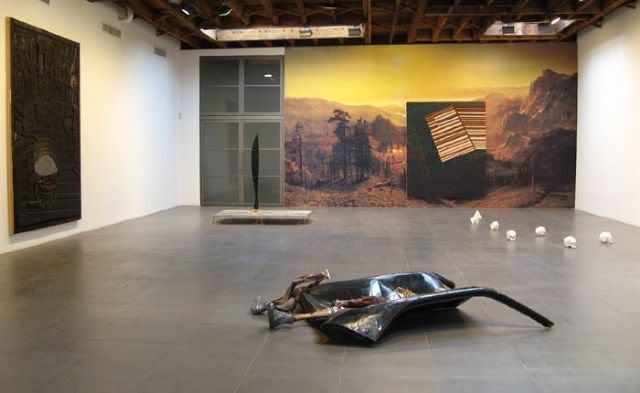
Installation shot of Matthew Day Jackson's "Terranaut," at Peter Blum, Chelsea
Courtesy of Peter Blum Gallery, New York


"The world will not perish for want of wonders,
but for want of wonder."
-J.B.S. Haldane


On the drizzly Wednesday evening past, I attended a ScienceBlogs panel at the SoHo Apple Store. ScienceBlogs bills itself as "a portal to...global dialogue, a digital salon featuring the leading bloggers from a wide array of scientific disciplines." I'm familiar with a number of the blogs hosted by the network; among them is one of my regular blogosphere stops, Bioephemera. Jessica Palmer, the writer, artist and scientist behind Bioephemera, participated in the panel, and I attended with lofty expectations. Unfortunately, the panelists were unable to delve deeply into any of the subjects that most excite them. Instead, they answered humdrum questions that ranged from 'How often do you upload new material?' to 'What was your most popular or controversial post?' (Generally, their responses were similarly unexciting, but they delivered them earnestly and with good humor.)

Addressing that second question, one panelist mentioned the popularity of Pharyngula, a blog written by evolutionary biologist P.Z. Myers. Every day, Myers' blog receives a great many visits, but a sizable minority (perhaps even the majority) of those visitors are religious fundamentalists, Creationists who beset the blog with nasty comments about Myers and the ideas he expounds. In fact, Myers has posted an ever-lengthening list of undesirables, readers now banned from Pharyngula's comment section.

It's no secret that evolutionary biologists and Creationists don't break bread together. Their enmity has a storied history. Yet many people understand the dispute to be more broad, as a fracas between scientists and the religious community at large. And it is not only bystanders that see it this way. Some scientists lend credence to the misconception by assuming that all religious individuals are skeptical of evolutionary biology, in particular, and, more generally, of science as a whole. This simply isn't true. The science/religion dichotomy is false. Only the ignorant, the unimaginative, the misguided or some combination thereof embrace religious fundamentalism, and among the ranks of the religious, there are countless educated, creative and thoughtful individuals. Within this latter group, science and evolution are accepted, even championed.


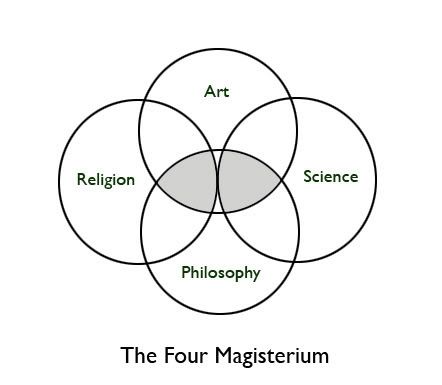
At their respective best, both science and religion (re)awaken or invigorate our capacity for wonder. Each makes use of a different approach, but they are complementary. As Albert Einstein famously said, "Science without religion is lame. Religion without science is blind." The late evolutionary biologist Stephen Jay Gould called the two "nonoverlapping magisteria" because good science trades in facts to explain material phenomena, whereas religion traffics in the unverifiable and the unobservable. Where science seeks to demystify, and to build on each subsequent revelation to learn more, religion aims to make sacred that which is taken for granted, to make the ordinary again extraordinary. Both, however, offer frameworks of engaging our astonishing existence and experience. Both are compelled by curiosity and wonder. As Gotthold Ephraim Lessing, the Enlightenment writer-philosopher, argued, if God held in one hand the Entire Truth and in the other the Eternal Pursuit of Truth, a good man will choose the latter. The same is true of authentic scientists and religious thinkers. The methodology and particulars may differ, but both science and religion are realms of the question. Although the popular conception of the scientist is the white-coated statistician ready to provide any and all answers, the caricature is misleading. It is "normative in science to be not sure," as Jessica Palmer put it doing the ScienceBlogs panel. Science, like religion, is a matryosha doll, a series of questions nested within questions.

Gould considered art and philosophy magisteria unto themselves, but, unlike religion and science, each overlaps the other. Where these two overlapping sections meet, we find ourselves in the realm of what the artist-writer Paul Laffoley calls the mesoteric. In Laffoley's cosmology, the circle of religion, dealing as it does with questions of ultimate meaning, is dubbed the esoteric realm. The circle of science, focused on material truths and the observable world, he labels the exoteric realm. The mesoteric realms. art and philosophy, bridge the esoteric and exoteric. Whereas Gould posits that the magisteria of religion and science are nonoverlapping, I would argue that, where their circles meet, the membrane is permeable. This bleeding of one into the other represents the pinnacle of art and philosophy.


Matthew Day Jackson
"Dymaxion Skeleton"
2008
Wood, lead, Plexi-glas, light, glass mirror, steel
86 x 33 x 22 inches
Courtesy of Peter Blum Gallery, New York


Because Matthew Day Jackson's sculptures draw from this leak, inspired by (and responding to) both science and religion, the very best are imbued with (and exude) hope, curiosity and wonder. Two sculptures, "Dymaxion Skeleton" and "Against the Mythology of Linearity," both included in "Terranaut," Jackson's current exhibition at Peter Blum Gallery, are exceptional artifacts (literally, artful fact), notable for their humor, evocative power and awe-struck humility.

Presented within an illuminated, birch-paneled vitrine, "Dymaxion Skeleton" is a piece-meal assembly: the feet of this skeleton are tree roots; the legs, arms and spine are branches; the rib-cage and pelvis are geodesic triangle lattices (hence the Buckminster Fuller allusion in the work's title). To the guileless viewer, the skeleton could pass for a loan from the American Museum of Natural History, a relic of some lost people, but "Dymaxion" is no archaeological discovery. It, like everything Jackson produces, is a fiction.

But is it fair, really, to call it that? Because Jackson makes no claim that "Dymaxion Skeleton" is archaeology, it can not be dismissed as "junk science." It is contemporary art and, as such, is no less real than any relic released from the lower strata to be studied, interpreted and enshrined. And what can we surmise from Jackson's latter-day reliquary? To use Palmer's words, we're "not sure." "Dymaxion Skeleton" is cryptic and poetic. What are we to make of the connection between those root feet and the geodesic triangles? Or between Jackson's nod to Fuller, a half-baked scientist-engineer fascinated by Utopian machines, and this illuminated dead thing?

Admiring Jackson's skeletal creation, I think of the laudable efforts of David Wilson, the founder and curator of The Museum of Jurassic Technology in Los Angeles. Wilson's museum is an extension of the Wunderkammer, the sixteenth, seventeenth and eighteenth century rooms (or cabinets, as they were then called) devoted to displaying collections of natural specimens, artwork and other miscellany. Today we usually call collections of this sort curiosity cabinets (and, indeed, they more often occupy what we now think of as cabinets). The curator of "Wunderkammer: A Century of Curiosities," currently on exhibit at the Museum of Modern Art, points out that Wunderkammen are "precursors to museums." In the nineteenth century, these general interest collections were divided for display in separate art, natural history and technology museums. This breakup coincided with the shift from generalization to specialization, and although the latter approach allows for a more extensive body of knowledge, it is a less integrated one. An astrophysicist, for example, can tell you a great deal about astrophysics, but will likely contribute very little on the subject of crocodile anatomy. As John Walsh, former director of the Getty Museum, stresses, "in the earlier collections, you had the wonders of [the natural world] spread out there cheek-by-jowl with the wonders of man, both presented as aspects of the same thing, which is to say, the Wonder of God." Embracing the collage-remix instinct of the postmodern artist, Jackson shares much in common with his Wunderkammen forebears; he works to tap into the wonder current.


Matthew Day Jackson
"Against the Mythology of Linearity"
2008
Acrylic, abalone, mother-of-pearl
7 inches tall, dimension variable otherwise
Courtesy of Peter Blum Gallery, New York


"Against the Mythology of Linearity," a seven-stage transmutation, moves from a simple pyramid through five polyhedral forms before "becoming" a human skull. The increasing complexity of each stage seems to confirm linear progression rather than react against it, but Jackson has arrayed the forms on the gallery floor so that they constitute a question mark. The faceted shaping and abalone accents of these polyhedra allude to gem cutting and, with that craft in mind, I think of the Abrahamic Creation story, in which God makes Man and Woman on the sixth day, then puts down his chisel for a rest. By nodding to that story, is Jackson questioning the narrative that evolutionary biologists so vehemently defend? Perhaps, but with each additional facet, a polyhedron moves that much closer to a sphere, a "perfect" form that is emblematic of infinity. The skull, then, the seventh step, is not an end result. God can rest for a spell, but he should continue; his work is incomplete.

The economist and sociologist Max Weber said that the secularization of society and increasing specialization of methodological inquiry had led to a "disenchantment of the world." He was (and remains) correct. A world without magic is a meagre one. Jackson's best sculptures provide us with bread crumbs so that we might find our way back to wonder. They are redemptive works, and I eagerly anticipate more of them.

Photo credits: All Matthew Day Jackson images courtesy Peter Blum Gallery; Four Magisterium diagram, Christopher Reiger, 2008

Thursday, March 23, 2006

Do You Feel Lucky, Pan sapiens?


There are a lot of reasons to be baffled by the renewed attacks on the theory of evolution(1), but I'm particularly bemused by the denialists' contention that the theory is a dangerous dogma. It's true that there's no shortage of dull-witted biologists who can be too stubborn in their pronouncements, as unwilling to consider a dissenting perspective as the loudest denialist(2), but any scientist worth her salt - or, for that matter, any informed, reasonable individual - realizes that the theory of evolution is, itself, evolving. Sure, some scientists can be dogmatic, but the theory in question is not a dogma. It is adaptable.

When most of us hear the word, evolution, crude caricatures of chimpanzees, Neanderthals, and walking fish-reptiles come to mind. Sometimes, we may even think of diagrammed cell division or an eukaryote propelling itself by means of rudimentary flagella. Yet rarely, if ever, do we consider change at the molecular level. Biophysicists Harold Morowitz, of George Mason University, and Eric Smith, of the Santa Fe Institute, do exactly that, suggesting that a "central set of chemical reactions has been in place since life's earliest moments about four billion years ago." Journalist Joel Achenbach explains the Morowitz/Smith hypothesis in a recent National Geographic piece, "The Origin of Life...Through Chemistry."
"These reactions involve just 11 small carbon molecules, such as citric and acetic acids, very ordinary stuff that would have been abundant on the young Earth. Those 11 molecules could have played a role in other chemical reactions that led to the development of such biomolecules as amino acids, lipids, sugars, and eventually some kind of genetic molecule such as RNA."
What makes the hypothesis so fascinating, though, is the suggestion that survival of the fittest or, more accurately, natural selection, occurs at the molecular level. Acenbach clarifies: "Some types of molecular chains outcompeted other molecular chains for the planet's resources, and gradually they led to the type of molecules that life depends upon - all this before the first living thing oozed forth." Wow! It seems obvious, really. Of course molecules compete in the same way genes do.

Unmentioned in the Geographic article is the divide between Millerites, evolutionary biologists who stand by Stanley Miller's mid-twentieth century hypothesis that life began at surface level, when electricity, atmospheric gases, and water interacted in such a way as to form the oft-mentioned biotic soup, and ventists, the scientists who feel such a soup was more likely arrived at on the ocean's floor, a by-product of interactions involving pressure and heat near hydrothermal vents. (I prefer to think of the two perspectives as the Frankenstein approach (electricity) and the oven hypothesis (hydrothermal) and, although I remain uncertain of which I "support," when the two camps duke it out the Frankenstein approach always seems to be forced back against the ropes.) Morowitz and Smith are ventists. Will their molecular metabolism hypothesis, viable both on the surface and under the sea, come under fire from Millerites because they are "the enemy"?

Such language - "duke it out," "the enemy" - is hyperbolic, but most folks would be shocked by how nasty the debates in the halls of evolutionary biology can become. Whatever impression the more extreme denialists seek to convey (e.g., Darwin was a blasphemer who today inspires countless secularists, marching in lockstep, to carry on his unholy work), the theory of evolution is anything but settled. Darwin's theories provide a spring board, an introduction, but are not fast. As with most revolutionary science, Darwin's ideas raise a host of questions.

One of these questions, in particular, has plagued biologists ever since Darwin's theory was first published. Commonly referred to as the "paradox of evolution," it asks, how can we reconcile evolutionary variation - all the shapes, colors, sizes, etc. - with the limited number of structures and systems all species share? The two readily observable realities seem contradictory: unlimited diversity produced by a limited system. Marc Kirschner, chair of the Systems Biology Department at Harvard Medical School, recently proposed a novel answer, facilitated variation. I turn to Robin Marantz Henig's article, "Resolving Evolution's Greatest Paradox," in the March/April 2006 issue of New York Academy of Sciences Update.
"Kirschner used an analogy borrowed from the kindergarten classroom to explain how his and Gerhart's theory differs from evolutionary theory up to this point. Traditionally, he said, biologists have compared life to a lump of modeling clay, 'incredibly plastic, and able—due to the accrual of many small changes—to go in any direction.' But this is the wrong metaphor, he said. In truth, life is more like a bunch of Lego blocks. As with Legos, the basic building blocks of biology are rigid and quite similar to one another, but 'there is a large variety of structures that can be assembled from similar parts.'

Another way of looking at it, Kirschner said, is to try to imagine trying to get a monkey to write the word 'MONKEY.' You could do so by giving the monkey a pen and paper, but that would never work—all you'd get would be 'random lines and scratches.' But if you gave him a typewriter, then you might be getting somewhere. It would take a very long time (Kirschner calculated about ten years, typing at the rate of one keystroke per second round-the-clock), but the monkey would eventually produce all six letters in the right order, because the typewriter restricts the results of his physical actions—always letters instead of scribble-scrabble. 'Letters have at least a chance to be useful,' Kirschner said. 'Most pen scratches do not.'

If, instead of a typewriter, the monkey was pounding on a computer keyboard programmed with an automatic spelling corrector, the time it would take for him to type out the word 'MONKEY' would be reduced dramatically, from ten years to probably less than a single day. 'More constraint equals more useful outcomes,' Kirschner said."
OK. That's clear, but how can the spell checker analogy account for so much complexity and variation?
"Complexity in multicellular organisms—changes and refinements in beak shape, pigmentation, jaw structure, limb formation—can be explained, he said, by forces involved in 'changing the time and extent of a process rather than creating a new process.'...[This] helps account for the surprising fact that the human genome isn't much bigger than the genome of a frog or a fruit fly. The vast differences among these organisms are accounted for not by number of genes, he said, but by how the genes are expressed...In other words, the gene itself doesn't have to be different; what changes is the timing or location of the gene's expression."
Beautiful! One need look no further than the gestation of a human embryo to get a sense of how facilitated variation works, each step recalled and repeated, generation after generation, the species' genome receiving new information all the while. The same "program" is "running" inside frog eggs or the squirrel's womb.

Still, it's important to note that facilitated variation is but a piece of the ever-changing puzzle, no more or less important than punctuated equilibrium or the notion of spandrels. Moreover, though a lovely marriage of genetics and natural selection, Kirschner's theory is less applicable when considering a restricted time line.

"Global Warming Fuels Speedy Evolution," a piece by Larrry O'Hanlon (Discovery News), provides readers with a number of recent, documented cases of dramatic changes in animal phylogeny. Within the past seven years, the cane toad (Bufo marinus) population in Australia - an introduced, destructive species - has evolved longer legs, an adaptation that has made the species considerably more mobile, enabling them to more quickly expand away from the introduction point. Longer legs equals more ground covered which, in turn, means access to virgin territory and plentiful food. In short, further colonization. Not surprisingly, some native Australian snake species viewed the new arrivals as prey. After swallowing the amphibians, however, these reptiles would ingest the toad's toxin and - pardon the pun - croak. Amazingly, in the same seven-year window, these snake species have, via natural selection, developed smaller jaws, thereby preventing them from eating the toads and ingesting the toxin. All this change in seven years and across several unrelated species!

Invasive species aren't the only reason for accelerated, or rapid evolution, as it is officially called. Global warming (better termed climate change) is a prime mover, too.
"Research on toads, frogs, salamanders, fish, lizards, squirrels, and plants are all showing evidence that some species are attempting to adapt to new conditions in a time frame of decades, not eons, say biologists. What's more, one of the biggest reasons for all this evolution right now may be that human-induced changes to climate and landscapes give species few other options....The first known case of a mammal responding genetically to warmer climate warming is the red squirrel of the Yukon Territory. Canadian scientists have discovered that red squirrels are giving birth about 18 days earlier than their great-grandmothers. It's the early squirrel that gets the nut, after all: natural selection in action. 'Climate change is going to be a massive agent of evolution,' said ecologist and rapid evolution researcher David Skelly of Yale University."
Rapid evolution provides more evidence for the punctuated equilibrium hypothesis, suggesting that, when need be, species have the ability to adapt much more quickly than paleontologists, geneticists, and evolutionary biologists originally believed possible. The gaps in the fossil record, so often highlighted by denialists as proof of evil-ution's failings, are easily accounted for when we observe, in the space of just one decade, significant phylogenetic changes within a given population.

All of these observations and new hypotheses are very exciting to me, but I realize a portion of the folks reading Hungry Hyaena, maybe even the majority, find this round-up rather esoteric. I thought it only sensible, then, to wrap up by bringing evolution closer to home or, in this case, closer to man. Biologist Soojin Yi (Georgia Institute of Technology, Atlanta) recently confirmed that both species of chimpanzee (Pan troglodytes and Pan paniscus) are more closely related to humans than previously assumed. In fact, as I've argued often, it looks as though the taxonomy will have to be changed. Homo sapiens will no longer be alone in the genus; Homo troglodytes and Homo paniscus will soon be joining our private party!

I hope this announcement will provide a reality check for our unfathomable human hubris, but, as incredibly happy as I am about it, I'm not altogether satisfied about where it will lead. As I see it, humans should move genus, not chimpanzees. Our species should be dubbed Pan sapiens. In other words, we should willingly discard our crown and step down to join the great unwashed, honest at last when regarding our reflection. I'm not alone in feeling this way. Andrew Rambaut, an evolutionary biologist at Oxford University, says, "It seems a bit human-centric to want to put chimps into the 'Homo' genus and not reclassify humans as 'Pan.'" Jared Diamond, the acclaimed author of Guns, Germs, and Steel and, more recently, Collapse, wrote an excellent, lesser known book in 1991, titled, The Third Chimpanzee, in which, among innumerable salient points, he suggested we do away with the arbitrary Homo delineation. After all, every ape relies on the same damned spell checker.

(1) Some folks refer to intelligent design as "the fourth wave" of resistance. The first wave of opposition dates back to the 1860s, when the theory was nascent and controversial. The second wave, during the 1920s, culminated with the Scopes Trial. Then, in 1987, the Supreme Court ruled against mandatory teaching of creation science - Edwards v. Aguillard - effectively putting an end to the third wave.

(2) Reading "Evolution In Action" (Sid Perkins, Science News, Feb. 25, 2006), I was struck by the us-versus-them tone prevalent throughout the article. The reactionary posturing of some scientists - and, in this case, a science journalist - can take on a disturbing tone: "From 2001 through 2003, anti-evolution activity was reported in 40 states." Anti-evolution activity? Reported? The witch-hunt has begun!

Photo credit: Ripped from brainfuel.tv

Wednesday, April 06, 2005

Oh, Beautiful Vapidity…

A friend sent me this music video today.

The song is composed and performed by Dennis Madalone, a New Jersey stuntman-cum-singer/songwriter who wants the listener to know that his
“compassion for others inspires him to write lyrics and create melodies…to share his feelings so that it may be a reflective comfort in ‘your’ life.”
The message of this single, entitled “America We Stand As One,” is to “carry on, hold on and stay strong for we all are truly one.” Apparently, Madalone’s “we” doesn’t apply to folks born outside our proud city walls. This here song, American brothers and sisters, is for us and us alone.

And this brings me to the video. Rarely do you have a chance to see so many clichés packed into a three-minute clip...unless you’re watching a spoof. The video opens with our blue-collar man, illustrated by his All-American, torn blue-jeans, strolling alone on the beach. Soon Dennis is joined by some twinkly special effects, otherwise known as angels. And, with these divine companions watching his back, Dennis breaks into full-throated, patriotic song.

The lyrics are thoughtless and mundane, belying the claim that Madalone is “truly an artist with power, passion and originality.” Canned passion, I'll grant him, but power and originality are not at all represented.

He stands defiant, holding, alternately, a small stars-and-stripes hanky or a large United States flag, while singing,
“I had to go, but it’s OK, You see I’m with you in a different way…America….USA, We stand as one…and we must carry on.”
The homepage claims that “this new rock anthem fills you with hope and comforts you with a spiritual message from our Loved Ones." In fact, I presume that the majority of US citizens under forty years of age (and a great deal of those above) are too savvy to accept “A.W.S.A.O.” as anything other than the hackneyed crap it is. Yet still I find myself becoming worried about the percentage of the populous that will respond to Dennis Madalone’s “sincerity” and “moral integrity.”

This worry may be in part due to the results of a Gallup Poll conducted November 7-10, 2004. When asked, “Which best describes your views of the origin of life?,” the responses were as follows:
Man developed with God guiding, 38%

Man developed with no help from God, 13%

God created man in present form, 45%
45 percent? Dear God…I think I'll go pump up the volume on Mandalone's "America" and stick my hand in a fu*king blender.

Tuesday, March 22, 2005

Happy, Happy Day!!

This morning, lying in bed listening to news from my radio alarm, I learned that some religious figures are already blaming the school shootings in Minnesota on a lack of faith. Picking up a magazine as I make my way to the bathroom, I scan a brief editorial and learn that the National Park Service is stocking Grand Canyon bookstores with Creationist takes on geology. On the subway, I notice a newspaper headline with the words, "Creationism in the Classroom." Arriving at work, a friend emails to point me in the direction of Slate Magazine and today’s distressing article on the Terri Schiavo situation.

I have come to tolerate and, in some instances, respect religion. (This despite the fact that I believe morality is universal and that the tribalism inherent in religion too often increases the likelihood of immoral action, be it war, murder, or theft.) I am friends with several religious people and we are able to have thoughtful, warm debates without resorting to name-calling. In fact, my views on religion have undergone a dramatic, positive transformation in the last eight years.

This morning's news, though, makes me unsure whether the reconciliation was altogether warranted. Maybe I should still be dressing in black, listening to angst rock, and proclaiming God dead? At eighteen years of age, that seemed the appropriate response to religion and Christianity's authortarian rule. Maybe I should adopt such a posture again?

But I sometimes forget that the secular/fundamentalist divide is not a Christian issue alone. The three sibling religions, Christianity, Judaism, and Islam, all suffer from similar cancers; the growths accompany the maturation of any religion in contemporary society. (An article in the New York Times today touches on book banning in Jerusalem. Rabbi Nosson Slifkin, an accomplished young Orthodox thinker who seeks to "reconcile" religious texts with contemporary natural history, is being publicly denounced as a heretic.)

The Schiavo case is uniquely American, though, because the "religious" pressure is coming from the executive level, not from a minority of the public. The legislation being passed is unprecedented. (See the NY Times article , excerpted below.) I do not consider myself affiliated with either of our major political parties and, on some issues, I trend center-right, so to see the Republican party turned into a mockery of it's former self is more than discouraging. It's criminal.
"Republicans have traditionally championed respect for the delicate balance the founders created. But in the Schiavo case, and in the battle to stop the Democratic filibusters of judicial nominations, President Bush and his Congressional allies have begun to enunciate a new principle: the rules of government are worth respecting only if they produce the result we want. It may be a formula for short-term political success, but it is no way to preserve and protect a great republic."

Monday, March 21, 2005

On The Flip Side

In "Strange Bedfellows," I described the elation I felt when I read of evangelical Christians pushing for environmental responsibility. But this weekend, in a back issue of Harper's Magazine (February 2005), I came across a more typical evangelical perspective.

America's Providential History, a book by Mark A. Beliles and Stephen K. McDowell, states that "You cannot understand history without understanding Divine Providence." It explains that "many modern educators deny the Providential view of history and would have us believe that their promotion of one of several 'secular' views of history is simply the recording of brute facts."

Beliles and McDowell explain that, over the course of my education, I've been a victim of several such "modern educators" (or deviants). I didn't realize, for example, that an omnipotent hand removed General Stonewall Jackson from the American Civil War in order to preserve the Union "of the United States as one whole people." Beliles and McDowell, thankfully, are reeducating us ignorant folk on that history. They also explain that Franklin Roosevelt, leader of a secular, socialist sect, set out to offend the Creator by designing the New Deal, an attempt to prove government more capable of providing for human beings than the good Lord.

Most importantly, though, I've been all wrong on issues of ecology. (I excerpt the following two paragraphs via the Harper's reprinting. I have not read the book.)
"A secular society lacks faith in God's Providence, and consequently men find fewer natural resources. The secular or socialist has a limited-resource mentality and views the world as a pie (there is only so much) that needs to be cut up so that everyone can have a piece. In contrast, the Christian knows that the potential in God is unlimited and that there is no shortage of resources in God's earth.

While many secularists view the world as over-populated, Christians know that God has made the earth sufficiently large, with plenty of resources to accommodate all the people He knew would come into existence. All the 5 billion people on earth could live in the state of Texas in single-family homes with front and back yards and be fed by production in the rest of the United States."
While I seriously doubt that all 6 billion of us could fit into Texas comfortably, especially if you're considering "single-family homes with front and back yards," I suppose I should go repent, just to be on the safe side!

Thank you, Mark and Steve, for lifting the veil and allowing me to see anew. Like "S. Beddo" – read the review they write at Amazon – I'm glad this excellent resource was brought to my attention. It must have been Providence.

Thursday, March 10, 2005

Strange Bedfellows?

Today's New York Times features a brief, but good, article about the growing environmental concerns of some Christian evangelicals. In October of 2004, the National Association of Evangelicals adopted a platform entitled, "For the Health of the Nation: An Evangelical Call to Civic Responsibility." The platform focused on the Christian obligation "to protect God's creation," ensuring future "clean air, pure water and adequate resources," all of which are "crucial to public health and civic order."

This news makes my heart sing! If environmentalists and evangelical Christians (the latter group having influence in many local communities where "greens" couldn't hope to gain an audience) can minimize their differences for the greater good, I'm all for it.

There are some concerns that merit attention, of course. Rich Cizik, vice-president of the NAE, explains that while the NAE is "not adverse to government-mandated prohibitions on behavioral sin such as abortion," they are uncomfortable with the environmentalists' support for government regulation. Cizik must acknowledge the implicit contradiction in such a perspective.

There will be some head-butting, but I would rather have the green evangelicals pushing against the tide of fundamentalists ushering in The Rapture, than have to deal with them myself. Secular environmentalists don't have to speak the language, but they must be willing to sit down at a table and draw up plans with groups like the NAE. Even if we all differ on some critical issues, our shared commitment to protecting the ecosystems that sustain us means enough to allow for a firm handshake and some hard work. Grudgingly, we can work alongside one another.

Note: I grew up on the Chesapeake Bay and, despite their claims (made in the NY Times article linked above) that "faith made them environmentalists," I can tell you that many watermen faced cruel, economic realities when the populations of blue crab (Callinectes sapidus) crashed. It was a combination of hard-times and faith, not just scripture, that made these hard-working men think about cause-and-effect.