Showing posts with label Gould. Show all posts

Tuesday, March 30, 2010

Revisiting Gould's NOMA


On the heels of my exchange with Peter Gabel about the relationship of science and religion, Tikkun Daily intern Sarah Ackley has written an excellent summation of the late evolutionary biologist Stephen Jay Gould's non-overlapping magisteria (NOMA) model, one bolstered by insights from Catholic theologian Hans Kung.

Ackley points out that Gould insisted that "the two magisteria bump right up against each other, interdigitating in wondrously complex ways along their joint border." This observation is of particular interest to me because, until now, I'd mistakingly believed that Gould felt there was no exchange between the two, non-overlapping realms.

As I wrote in "Matthew Day Jackson's Wonderful Artifacts," in October 2008,
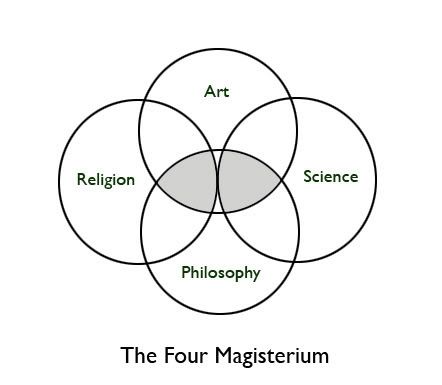
"Whereas Gould posits that the magisteria of religion and science are nonoverlapping, I would argue that, where their circles meet, the membrane is permeable. This bleeding of one into the other represents the pinnacle of art and philosophy.”
It's clear to me now that Gould and I were on the same page all along (or, more accurately, I was on Gould's page)!

Read Ackley's TD piece here. Above, I've included a NOMA diagram that I created for the essay on Matthew Day Jackson.

Thursday, March 11, 2010

Different Takes on the Raw Stuff


Christopher Reiger
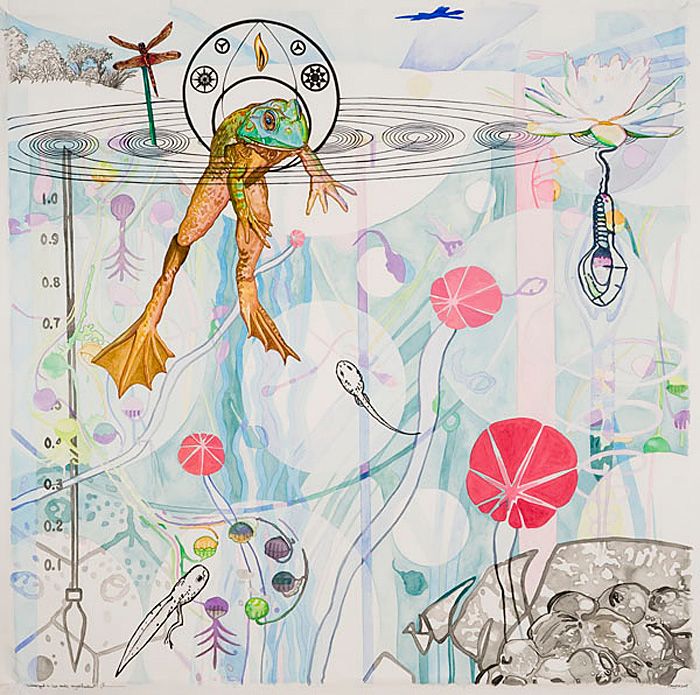
"submerged in his erotic mystification"
2009
Watercolor, gouache, sumi ink and marker on Arches paper
32 x 32 inches

I'm pleased to announce that one of my 2009 paintings, "submerged in his erotic mystification," is reproduced in the March/April 2010 issue of Tikkun Magazine. If you're unfamiliar with Tikkun, it's a west coast-based magazine founded by Rabbi Michael Lerner and dedicated to exploring the intersection of politics, spirituality, and culture. While it has Jewish roots (hence the magazine's name), it is an inter-faith publication with a diverse group of secular and religious contributors. The March/April issue includes a special section entitled "God and the 21st Century," featuring articles by seventeen writers, including the esteemed Rabbi Arthur Green, a scholar whose stripe of mystical panentheism resonates with my theological convictions.

My artwork accompanies one of the many articles included in "God and the 21st Century." Respected law critic Peter Gabel's "A Call For Sacred Biologists" explores the gulf between a strictly rational, scientific world view and that of, for lack of a better description, holistic panentheism. I allude to this same schism in my artist statement.
"[I]ncidentally, we've realized that the divide between the imagination and reason is unnatural. The English poet and critic, John Ruskin, alluded to this schism when he wrote of 'the broken harmonies of fact and fancy, thought and feeling, and truth and faith.' Indeed, although we today learn an increasing number of facts about Nature, we understand ourselves to be apart from it, and our experience of it is therefore less complete. My artwork is born of this apparent opposition."
Gabel's subject is near and dear to me, but his language unfortunately suggests that he has a deep-seated mistrust of, as he puts it, "the so-called 'scientific method'." (Italics mine.)

In the myopic, yet much ballyhooed skirmish between science and religion, I reside in the middle, as frustrated by the rabidly anti-religious as I am disturbed by and opposed to religious literalists and fundamentalists. Gabel, while not a religious literalist, uses language that apparently misunderstands scientific endeavor. For example, he insists that we need evolutionary biologists "who connect the sacred within themselves to the sacred dimension of what they observe." If he means that we need more leading scientists to openly discuss the awe and wonder they experience through their observation of the material world, he needn't worry. Many scientists are more than happy to wax poetic about the wonders of life and the universe; stand outs include Loren Eiseley, Carl Sagan, E.O. Wilson, Thomas Eisner, and Janna Levin. If, however, Gabel is suggesting that evolutionary biologists should champion mysticism, orthogenesis (1), or notions of "a master plan," he is expressing an essentially irrational and anti-scientific bias. Biologists must be vigilant to not allow spirituality to cloud their work. By all means, biologists can be deeply religious or spiritual people, but, for science to remain legitimate, the method and its language must be materialist and reductionist. (If scientific endeavor is mixed with mysticism, it becomes pseudo-science or, put another way, bunk.)

At the article's close, Gabel writes that "the theory of evolution [must] align itself with the truth that spirit and matter form an indissoluble unity." To the contrary, the theory of evolution needn't make any attempt to "align itself" with spirituality; it is its own truth, a scientific truth. As Rabbi Green writes in the same special section,
"I recognize fully and without regret that theology is an art, not a science. We people of faith have nothing we can prove; attempts to do so only diminish what we have to offer. We can only testify, but never prove."
Exactly right!

As I wrote on this blog in late 2008, in an essay about the artwork of Matthew Day Jackson,
"At their respective best, both science and religion (re)awaken or invigorate our capacity for wonder. Each makes use of a different approach, but they are complementary. As Albert Einstein famously said, 'Science without religion is lame. Religion without science is blind.' The late evolutionary biologist Stephen Jay Gould called the two 'non-overlapping magisteria' because good science trades in facts to explain material phenomena, whereas religion traffics in the unverifiable and the unobservable. Where science seeks to demystify, and to build on each subsequent revelation to learn more, religion aims to make sacred that which is taken for granted, to make the ordinary again extraordinary. Both, however, offer frameworks of engaging our astonishing existence and experience. Both are compelled by curiosity and wonder. As Gotthold Ephraim Lessing, the Enlightenment writer-philosopher, argued, if God held in one hand the Entire Truth and in the other the Eternal Pursuit of Truth, a good man will choose the latter. The same is true of authentic scientists and religious thinkers. The methodology and particulars may differ, but both science and religion are realms of the question. Although the popular conception of the scientist is the white-coated statistician ready to provide any and all answers, the caricature is misleading. It is 'normative in science to be not sure,' as Jessica Palmer put it doing the ScienceBlogs panel. Science, like religion, is a matryoshka doll, a series of questions nested within questions.

Gould considered art and philosophy magisteria unto themselves, but, unlike religion and science, each overlaps the other. Where these two overlapping sections meet, we find ourselves in the realm of what the artist-writer Paul Laffoley calls the mesoteric. In Laffoley's cosmology, the circle of religion, dealing as it does with questions of ultimate meaning, is dubbed the esoteric realm. The circle of science, focused on material truths and the observable world, he labels the exoteric realm. The mesoteric realms. art and philosophy, bridge the esoteric and exoteric. Whereas Gould posits that the magisteria of religion and science are nonoverlapping, I would argue that, where their circles meet, the membrane is permeable. This bleeding of one into the other represents the pinnacle of art and philosophy."
Rather than demand that science couch its truths in the language of the sacred or demand that religion dress its Truth in the language of scientist, why not understand each as complementary, distinct practice of awe? In a recent post on NPR's "Cosmos and Culture" blog, astrophysicist Adam Frank writes,
"I believe it is possible, and necessary, to see science and human spiritual endeavor through an alternative perspective. That perspective would acknowledge the truths each can reveal and avoid jealous comparison of those truths. [...] Our elemental encounter with the world, the raw stuff of experience, was just as vivid and strange to our ancestors as it is to us now if we are willing to pay attention. They felt awe and wonder beneath the dark weight of the night sky, in the deep quiet at the forest's edge or in the shock of infant's birth wail. Those experiences drove our ancestors, as [they drive] us, to an all important aspiration, a desire to draw closer to the source of that tremendous awe. That aspiration - what I call the Constant Fire - contains the original and braided roots of science and religion. [...] That aspiration is, for me, a road less traveled in the discussions of science and religion. If we were to follow it and to ask what is common, not in results about the world but in the deeply felt response to it, who knows where we might be led?"
Beautifully stated, Dr. Frank!

My rather particular problems with Gabel's article aside, the March/April issue of Tikkun includes excellent pieces by Rabbi Arthur Green, David Loy, Shaul Magid, and others.

(1) Like Gabel, I'm warm to Pierre Teilhard de Chardin's concept of orthogenesis, the "hypothesis that life has an innate tendency to move in a unilinear fashion," increasing in complexity. When people speak of "the universe becoming aware of itself," they are expressing an essentially teleological sentiment and, while many contemporary scientists will acknowledge that such a notion is possible, it is wholly unquantifiable and therefore not legitimate science. It is best classified as theology. It is important to note, however, that de Chardin was a Jesuit priest as well as a serious paleontologist and geologist. He did not believe the scientific method to be at odds with a sense of belonging, wonder, or, in his words, "the within of things." Rather, de Chardin recognized science as kin to the arts, philosophy, and theology; it is another tool for our species' exploration of the evolving universe we inhabit.

Sunday, October 05, 2008

Matthew Day Jackson's Wonderful Artifacts


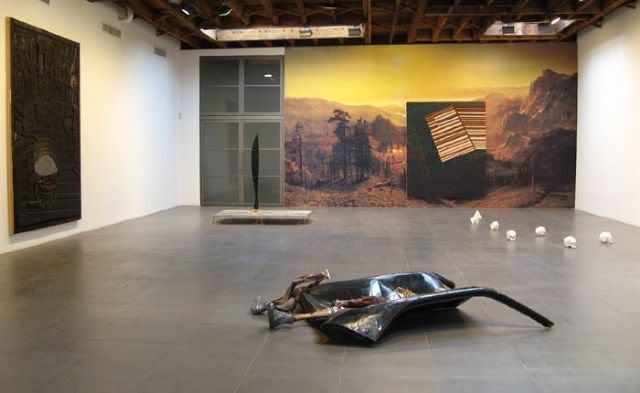
Installation shot of Matthew Day Jackson's "Terranaut," at Peter Blum, Chelsea
Courtesy of Peter Blum Gallery, New York


"The world will not perish for want of wonders,
but for want of wonder."
-J.B.S. Haldane


On the drizzly Wednesday evening past, I attended a ScienceBlogs panel at the SoHo Apple Store. ScienceBlogs bills itself as "a portal to...global dialogue, a digital salon featuring the leading bloggers from a wide array of scientific disciplines." I'm familiar with a number of the blogs hosted by the network; among them is one of my regular blogosphere stops, Bioephemera. Jessica Palmer, the writer, artist and scientist behind Bioephemera, participated in the panel, and I attended with lofty expectations. Unfortunately, the panelists were unable to delve deeply into any of the subjects that most excite them. Instead, they answered humdrum questions that ranged from 'How often do you upload new material?' to 'What was your most popular or controversial post?' (Generally, their responses were similarly unexciting, but they delivered them earnestly and with good humor.)

Addressing that second question, one panelist mentioned the popularity of Pharyngula, a blog written by evolutionary biologist P.Z. Myers. Every day, Myers' blog receives a great many visits, but a sizable minority (perhaps even the majority) of those visitors are religious fundamentalists, Creationists who beset the blog with nasty comments about Myers and the ideas he expounds. In fact, Myers has posted an ever-lengthening list of undesirables, readers now banned from Pharyngula's comment section.

It's no secret that evolutionary biologists and Creationists don't break bread together. Their enmity has a storied history. Yet many people understand the dispute to be more broad, as a fracas between scientists and the religious community at large. And it is not only bystanders that see it this way. Some scientists lend credence to the misconception by assuming that all religious individuals are skeptical of evolutionary biology, in particular, and, more generally, of science as a whole. This simply isn't true. The science/religion dichotomy is false. Only the ignorant, the unimaginative, the misguided or some combination thereof embrace religious fundamentalism, and among the ranks of the religious, there are countless educated, creative and thoughtful individuals. Within this latter group, science and evolution are accepted, even championed.


At their respective best, both science and religion (re)awaken or invigorate our capacity for wonder. Each makes use of a different approach, but they are complementary. As Albert Einstein famously said, "Science without religion is lame. Religion without science is blind." The late evolutionary biologist Stephen Jay Gould called the two "nonoverlapping magisteria" because good science trades in facts to explain material phenomena, whereas religion traffics in the unverifiable and the unobservable. Where science seeks to demystify, and to build on each subsequent revelation to learn more, religion aims to make sacred that which is taken for granted, to make the ordinary again extraordinary. Both, however, offer frameworks of engaging our astonishing existence and experience. Both are compelled by curiosity and wonder. As Gotthold Ephraim Lessing, the Enlightenment writer-philosopher, argued, if God held in one hand the Entire Truth and in the other the Eternal Pursuit of Truth, a good man will choose the latter. The same is true of authentic scientists and religious thinkers. The methodology and particulars may differ, but both science and religion are realms of the question. Although the popular conception of the scientist is the white-coated statistician ready to provide any and all answers, the caricature is misleading. It is "normative in science to be not sure," as Jessica Palmer put it doing the ScienceBlogs panel. Science, like religion, is a matryosha doll, a series of questions nested within questions.

Gould considered art and philosophy magisteria unto themselves, but, unlike religion and science, each overlaps the other. Where these two overlapping sections meet, we find ourselves in the realm of what the artist-writer Paul Laffoley calls the mesoteric. In Laffoley's cosmology, the circle of religion, dealing as it does with questions of ultimate meaning, is dubbed the esoteric realm. The circle of science, focused on material truths and the observable world, he labels the exoteric realm. The mesoteric realms. art and philosophy, bridge the esoteric and exoteric. Whereas Gould posits that the magisteria of religion and science are nonoverlapping, I would argue that, where their circles meet, the membrane is permeable. This bleeding of one into the other represents the pinnacle of art and philosophy.
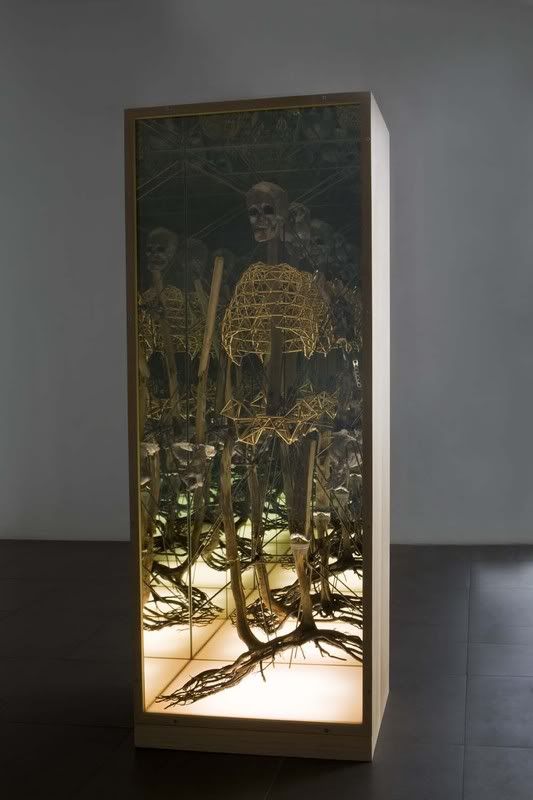

Matthew Day Jackson
"Dymaxion Skeleton"
2008
Wood, lead, Plexi-glas, light, glass mirror, steel
86 x 33 x 22 inches
Courtesy of Peter Blum Gallery, New York


Because Matthew Day Jackson's sculptures draw from this leak, inspired by (and responding to) both science and religion, the very best are imbued with (and exude) hope, curiosity and wonder. Two sculptures, "Dymaxion Skeleton" and "Against the Mythology of Linearity," both included in "Terranaut," Jackson's current exhibition at Peter Blum Gallery, are exceptional artifacts (literally, artful fact), notable for their humor, evocative power and awe-struck humility.

Presented within an illuminated, birch-paneled vitrine, "Dymaxion Skeleton" is a piece-meal assembly: the feet of this skeleton are tree roots; the legs, arms and spine are branches; the rib-cage and pelvis are geodesic triangle lattices (hence the Buckminster Fuller allusion in the work's title). To the guileless viewer, the skeleton could pass for a loan from the American Museum of Natural History, a relic of some lost people, but "Dymaxion" is no archaeological discovery. It, like everything Jackson produces, is a fiction.

But is it fair, really, to call it that? Because Jackson makes no claim that "Dymaxion Skeleton" is archaeology, it can not be dismissed as "junk science." It is contemporary art and, as such, is no less real than any relic released from the lower strata to be studied, interpreted and enshrined. And what can we surmise from Jackson's latter-day reliquary? To use Palmer's words, we're "not sure." "Dymaxion Skeleton" is cryptic and poetic. What are we to make of the connection between those root feet and the geodesic triangles? Or between Jackson's nod to Fuller, a half-baked scientist-engineer fascinated by Utopian machines, and this illuminated dead thing?

Admiring Jackson's skeletal creation, I think of the laudable efforts of David Wilson, the founder and curator of The Museum of Jurassic Technology in Los Angeles. Wilson's museum is an extension of the Wunderkammer, the sixteenth, seventeenth and eighteenth century rooms (or cabinets, as they were then called) devoted to displaying collections of natural specimens, artwork and other miscellany. Today we usually call collections of this sort curiosity cabinets (and, indeed, they more often occupy what we now think of as cabinets). The curator of "Wunderkammer: A Century of Curiosities," currently on exhibit at the Museum of Modern Art, points out that Wunderkammen are "precursors to museums." In the nineteenth century, these general interest collections were divided for display in separate art, natural history and technology museums. This breakup coincided with the shift from generalization to specialization, and although the latter approach allows for a more extensive body of knowledge, it is a less integrated one. An astrophysicist, for example, can tell you a great deal about astrophysics, but will likely contribute very little on the subject of crocodile anatomy. As John Walsh, former director of the Getty Museum, stresses, "in the earlier collections, you had the wonders of [the natural world] spread out there cheek-by-jowl with the wonders of man, both presented as aspects of the same thing, which is to say, the Wonder of God." Embracing the collage-remix instinct of the postmodern artist, Jackson shares much in common with his Wunderkammen forebears; he works to tap into the wonder current.
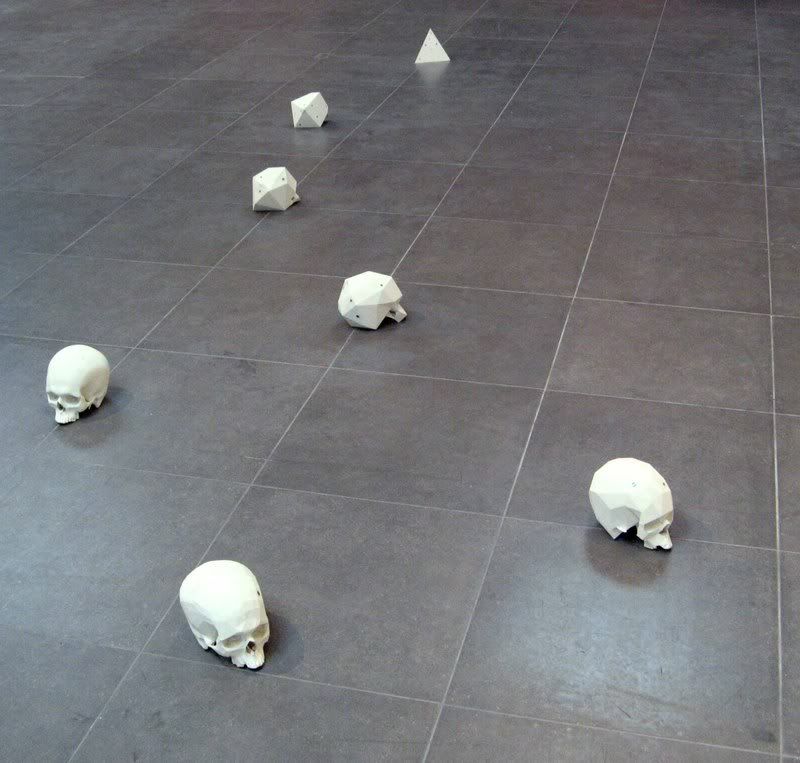

Matthew Day Jackson
"Against the Mythology of Linearity"
2008
Acrylic, abalone, mother-of-pearl
7 inches tall, dimension variable otherwise
Courtesy of Peter Blum Gallery, New York


"Against the Mythology of Linearity," a seven-stage transmutation, moves from a simple pyramid through five polyhedral forms before "becoming" a human skull. The increasing complexity of each stage seems to confirm linear progression rather than react against it, but Jackson has arrayed the forms on the gallery floor so that they constitute a question mark. The faceted shaping and abalone accents of these polyhedra allude to gem cutting and, with that craft in mind, I think of the Abrahamic Creation story, in which God makes Man and Woman on the sixth day, then puts down his chisel for a rest. By nodding to that story, is Jackson questioning the narrative that evolutionary biologists so vehemently defend? Perhaps, but with each additional facet, a polyhedron moves that much closer to a sphere, a "perfect" form that is emblematic of infinity. The skull, then, the seventh step, is not an end result. God can rest for a spell, but he should continue; his work is incomplete.

The economist and sociologist Max Weber said that the secularization of society and increasing specialization of methodological inquiry had led to a "disenchantment of the world." He was (and remains) correct. A world without magic is a meagre one. Jackson's best sculptures provide us with bread crumbs so that we might find our way back to wonder. They are redemptive works, and I eagerly anticipate more of them.

Photo credits: All Matthew Day Jackson images courtesy Peter Blum Gallery; Four Magisterium diagram, Christopher Reiger, 2008