Showing posts with label David Wilson. Show all posts

Sunday, October 05, 2008

Matthew Day Jackson's Wonderful Artifacts


Installation shot of Matthew Day Jackson's "Terranaut," at Peter Blum, Chelsea
Courtesy of Peter Blum Gallery, New York


"The world will not perish for want of wonders,
but for want of wonder."
-J.B.S. Haldane


On the drizzly Wednesday evening past, I attended a ScienceBlogs panel at the SoHo Apple Store. ScienceBlogs bills itself as "a portal to...global dialogue, a digital salon featuring the leading bloggers from a wide array of scientific disciplines." I'm familiar with a number of the blogs hosted by the network; among them is one of my regular blogosphere stops, Bioephemera. Jessica Palmer, the writer, artist and scientist behind Bioephemera, participated in the panel, and I attended with lofty expectations. Unfortunately, the panelists were unable to delve deeply into any of the subjects that most excite them. Instead, they answered humdrum questions that ranged from 'How often do you upload new material?' to 'What was your most popular or controversial post?' (Generally, their responses were similarly unexciting, but they delivered them earnestly and with good humor.)

Addressing that second question, one panelist mentioned the popularity of Pharyngula, a blog written by evolutionary biologist P.Z. Myers. Every day, Myers' blog receives a great many visits, but a sizable minority (perhaps even the majority) of those visitors are religious fundamentalists, Creationists who beset the blog with nasty comments about Myers and the ideas he expounds. In fact, Myers has posted an ever-lengthening list of undesirables, readers now banned from Pharyngula's comment section.

It's no secret that evolutionary biologists and Creationists don't break bread together. Their enmity has a storied history. Yet many people understand the dispute to be more broad, as a fracas between scientists and the religious community at large. And it is not only bystanders that see it this way. Some scientists lend credence to the misconception by assuming that all religious individuals are skeptical of evolutionary biology, in particular, and, more generally, of science as a whole. This simply isn't true. The science/religion dichotomy is false. Only the ignorant, the unimaginative, the misguided or some combination thereof embrace religious fundamentalism, and among the ranks of the religious, there are countless educated, creative and thoughtful individuals. Within this latter group, science and evolution are accepted, even championed.
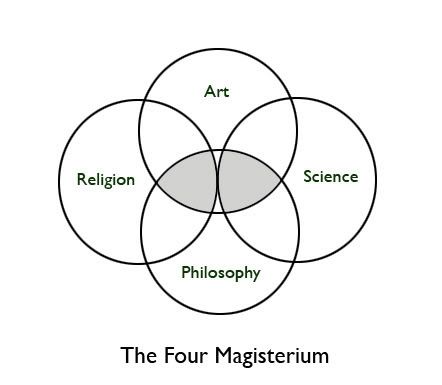


At their respective best, both science and religion (re)awaken or invigorate our capacity for wonder. Each makes use of a different approach, but they are complementary. As Albert Einstein famously said, "Science without religion is lame. Religion without science is blind." The late evolutionary biologist Stephen Jay Gould called the two "nonoverlapping magisteria" because good science trades in facts to explain material phenomena, whereas religion traffics in the unverifiable and the unobservable. Where science seeks to demystify, and to build on each subsequent revelation to learn more, religion aims to make sacred that which is taken for granted, to make the ordinary again extraordinary. Both, however, offer frameworks of engaging our astonishing existence and experience. Both are compelled by curiosity and wonder. As Gotthold Ephraim Lessing, the Enlightenment writer-philosopher, argued, if God held in one hand the Entire Truth and in the other the Eternal Pursuit of Truth, a good man will choose the latter. The same is true of authentic scientists and religious thinkers. The methodology and particulars may differ, but both science and religion are realms of the question. Although the popular conception of the scientist is the white-coated statistician ready to provide any and all answers, the caricature is misleading. It is "normative in science to be not sure," as Jessica Palmer put it doing the ScienceBlogs panel. Science, like religion, is a matryosha doll, a series of questions nested within questions.

Gould considered art and philosophy magisteria unto themselves, but, unlike religion and science, each overlaps the other. Where these two overlapping sections meet, we find ourselves in the realm of what the artist-writer Paul Laffoley calls the mesoteric. In Laffoley's cosmology, the circle of religion, dealing as it does with questions of ultimate meaning, is dubbed the esoteric realm. The circle of science, focused on material truths and the observable world, he labels the exoteric realm. The mesoteric realms. art and philosophy, bridge the esoteric and exoteric. Whereas Gould posits that the magisteria of religion and science are nonoverlapping, I would argue that, where their circles meet, the membrane is permeable. This bleeding of one into the other represents the pinnacle of art and philosophy.


Matthew Day Jackson
"Dymaxion Skeleton"
2008
Wood, lead, Plexi-glas, light, glass mirror, steel
86 x 33 x 22 inches
Courtesy of Peter Blum Gallery, New York


Because Matthew Day Jackson's sculptures draw from this leak, inspired by (and responding to) both science and religion, the very best are imbued with (and exude) hope, curiosity and wonder. Two sculptures, "Dymaxion Skeleton" and "Against the Mythology of Linearity," both included in "Terranaut," Jackson's current exhibition at Peter Blum Gallery, are exceptional artifacts (literally, artful fact), notable for their humor, evocative power and awe-struck humility.

Presented within an illuminated, birch-paneled vitrine, "Dymaxion Skeleton" is a piece-meal assembly: the feet of this skeleton are tree roots; the legs, arms and spine are branches; the rib-cage and pelvis are geodesic triangle lattices (hence the Buckminster Fuller allusion in the work's title). To the guileless viewer, the skeleton could pass for a loan from the American Museum of Natural History, a relic of some lost people, but "Dymaxion" is no archaeological discovery. It, like everything Jackson produces, is a fiction.

But is it fair, really, to call it that? Because Jackson makes no claim that "Dymaxion Skeleton" is archaeology, it can not be dismissed as "junk science." It is contemporary art and, as such, is no less real than any relic released from the lower strata to be studied, interpreted and enshrined. And what can we surmise from Jackson's latter-day reliquary? To use Palmer's words, we're "not sure." "Dymaxion Skeleton" is cryptic and poetic. What are we to make of the connection between those root feet and the geodesic triangles? Or between Jackson's nod to Fuller, a half-baked scientist-engineer fascinated by Utopian machines, and this illuminated dead thing?

Admiring Jackson's skeletal creation, I think of the laudable efforts of David Wilson, the founder and curator of The Museum of Jurassic Technology in Los Angeles. Wilson's museum is an extension of the Wunderkammer, the sixteenth, seventeenth and eighteenth century rooms (or cabinets, as they were then called) devoted to displaying collections of natural specimens, artwork and other miscellany. Today we usually call collections of this sort curiosity cabinets (and, indeed, they more often occupy what we now think of as cabinets). The curator of "Wunderkammer: A Century of Curiosities," currently on exhibit at the Museum of Modern Art, points out that Wunderkammen are "precursors to museums." In the nineteenth century, these general interest collections were divided for display in separate art, natural history and technology museums. This breakup coincided with the shift from generalization to specialization, and although the latter approach allows for a more extensive body of knowledge, it is a less integrated one. An astrophysicist, for example, can tell you a great deal about astrophysics, but will likely contribute very little on the subject of crocodile anatomy. As John Walsh, former director of the Getty Museum, stresses, "in the earlier collections, you had the wonders of [the natural world] spread out there cheek-by-jowl with the wonders of man, both presented as aspects of the same thing, which is to say, the Wonder of God." Embracing the collage-remix instinct of the postmodern artist, Jackson shares much in common with his Wunderkammen forebears; he works to tap into the wonder current.
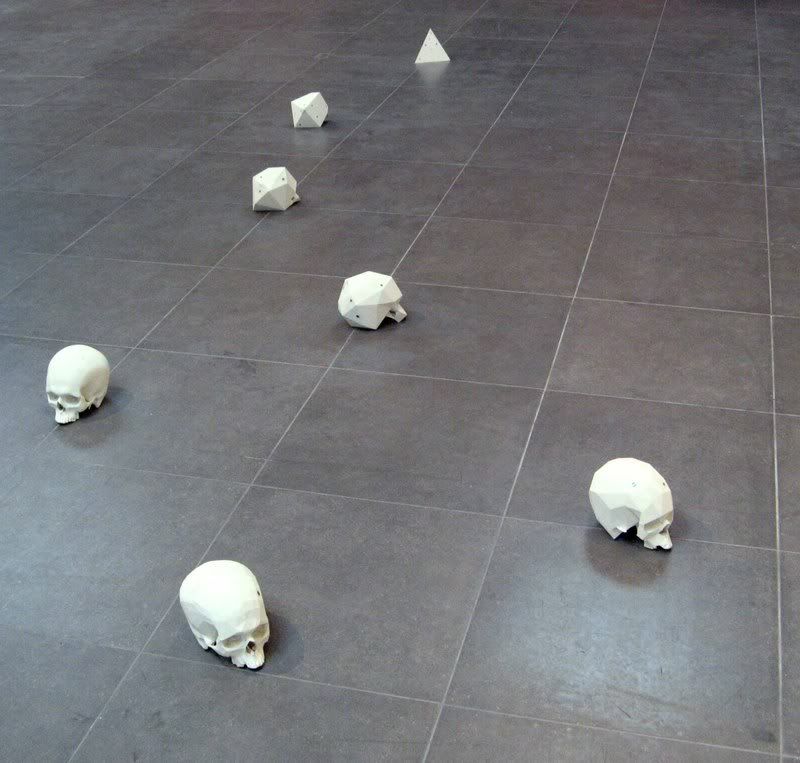

Matthew Day Jackson
"Against the Mythology of Linearity"
2008
Acrylic, abalone, mother-of-pearl
7 inches tall, dimension variable otherwise
Courtesy of Peter Blum Gallery, New York


"Against the Mythology of Linearity," a seven-stage transmutation, moves from a simple pyramid through five polyhedral forms before "becoming" a human skull. The increasing complexity of each stage seems to confirm linear progression rather than react against it, but Jackson has arrayed the forms on the gallery floor so that they constitute a question mark. The faceted shaping and abalone accents of these polyhedra allude to gem cutting and, with that craft in mind, I think of the Abrahamic Creation story, in which God makes Man and Woman on the sixth day, then puts down his chisel for a rest. By nodding to that story, is Jackson questioning the narrative that evolutionary biologists so vehemently defend? Perhaps, but with each additional facet, a polyhedron moves that much closer to a sphere, a "perfect" form that is emblematic of infinity. The skull, then, the seventh step, is not an end result. God can rest for a spell, but he should continue; his work is incomplete.

The economist and sociologist Max Weber said that the secularization of society and increasing specialization of methodological inquiry had led to a "disenchantment of the world." He was (and remains) correct. A world without magic is a meagre one. Jackson's best sculptures provide us with bread crumbs so that we might find our way back to wonder. They are redemptive works, and I eagerly anticipate more of them.

Photo credits: All Matthew Day Jackson images courtesy Peter Blum Gallery; Four Magisterium diagram, Christopher Reiger, 2008


Friday, February 10, 2006

The Art of the Con


"February 26, 2000

Dear Mr. Van Strad,

Please excuse me if I have misspelled your name. It was difficult to understand on our answering machine.

Unfortunately, [the painting you expressed interest in acquiring] has been sold.

I have been trying to reach you since we received your first call regarding [the piece in question]. I tried to contact you continually, at different times of the day, but the number you left on the machine was one that never rang through. All I would get is a recording of a woman's voice saying that the 'number you have reached is either busy or you have entered an incorrect number.' This always happened before it rang.

I am faxing this reply to you now because the number you left this time doesn't seem to take a voice message.

If I can be of any further assistance, please do not hesitate to call me.

Best regards,

[X], Co-director of SoHo Gallery"
+++++


In the fall of 1999, when I first moved to New York City, I found work as a preparator and jack-of-all-trades in an art gallery that I'll call SoHo Gallery. I liked the job well enough, but the daily routine lost its luster by the five month mark. No matter how many paintings I framed, crates I packed, or lights I changed, the job seemed ever more tedious. Something had to be done.

The answer to my work woes presented itself on a typical Saturday night in early 2000. I was hanging out at a friend's apartment in the East Village, drinking beer and bullshitting, when conversation turned to my SoHo Gallery job and the exhibition then on display. Knowing how frustrated I'd been with work, a friend suggested that we prank call the gallery.

Enter Alexander von Stradtt, an eccentric, European art collector. This impressive man, known for his generous spirit and colorful presentation, stopped by SoHo Gallery during an art buying trip to New York City and Los Angeles. One of the paintings on display - by a now well-known artist/illustrator who shall remain anonymous here - caught his eye. von Stradtt was enamored of the work, but felt that it was missing that special something, that je ne sais quoi. Distracted, or perhaps lost in thought, he left the gallery without introducing himself to the dealers. He didn't even sign the registry.

One week later, on a particularly blustery Saturday evening, von Stradtt attended a grand party at a mansion in Prague, Czech Republic. Still preoccupied with the painting he had seen at SoHo Gallery, he made his way to an alcove, where he could only just be heard over the din, and placed a call to information. Moments later, he was connected with the gallery. Because it was such a late hour, even in New York, von Stradtt was forced to leave a message identifying himself and conveying his interest in the piece. Though I do not recollect von Stradtt's exact wording, the thrust of the message is below.
"Hello, this is Alexander von Stradtt calling. I am an established collector and I recently saw a painting in your gallery which I am very interested in acquiring. [Here, von Stradtt named and described the piece.] I do, however, have one request...a request that may initially seem rather unorthodox. I would gladly pay twice the asking price, maybe more, but I will need your staff, or the artist himself, to spray paint a purple 'Q' on the center of the painting. I will be in touch. Good evening to you."
And so a drunken goof, a prank call with a brief back story, was the beginning of the Alexander von Stradtt saga.

On Monday morning, when I arrived at work, the gallery staff were already abuzz with talk of a mysterious caller and his absurd request. I stood alongside the gallery owners/dealers as they replayed the message for me, repeatedly, exchanging baffled looks and shaking their heads slowly. Fighting the urge to double over in laughter, I mustered a passable performance as Surprised Gallery Preparator #1. (Requisite to being a good liar is first convincing everyone that you're a terrible one.)

There were so many questions. Why had von Stradtt left no telephone number? Why had he not called during gallery hours? What in the world was the significance of the letter "Q"? And so it went...but it seemed clear to me that the dealers wanted to believe in von Stradtt. I decided that the calls should continue.

And so, over the next couple of months, Alexander von Stradtt was rendered more distinct. A website was produced, featuring a photograph of the collector and art aficionado giving one of his "impromptu, guided tours of the Louvre" along with a narrative biography and a listing of his many honors. His pseudo-celebrity was made clear: according to the site's text, numerous magazines had lauded von Stradtt with praise, "most notably Paris Match." (The choice of this "notable" magazine was the brainchild of a good friend; it still makes me chuckle.)

An assistant named Gunter (pronounced: goon-ta) was also invented. This short, excitable German placed calls to SoHo Gallery on two occasions. The painter of the piece von Stradtt expressed interest in was contacted at his California studio, drawing him into the hoax's orbit and resulting in a hilarious exchange between the artist and the gallery directors. ("Who in the hell is this guy? Is he for real? You can't do that to my painting!")

The fax that heads this post was sent after Gunter "mistakenly" provided the gallery with a fax number instead of a working phone. The gallery's response, above, resulted provoked an incensed message from von Stradtt, assuring the gallery that "the incompetent Gunter," had been "dealt with" and that, furthermore, he was unaware of any trouble with his phone service.

The highlight of the project, for that is what it had become for my friends and me, was a casual remark von Stradtt dropped in the midst of yet another late-night voice message. "I'll call you when I next head to New York, but I've been just crazy as of late. I'm in Munich, of course. A-huh...I think you know why." Upon receiving this message, the gallery owners frantically began searching the Internet, looking for information on current events in Munich. Was von Stradtt attending some sort of bacchanal? An insider only art fair? Why didn't the gallery know about this event? Desks were pounded, feathers ruffled and, me....well, I no longer found the work day so tedious.

Frankly, I don't recall why the project ended. I suppose my friends and I started socializing more, and our lives filled with commitments and concerns other than beer, ladies and juvenile entertainment. The painting was finally sold to a collector who didn't demand a purple "Q" and, not long thereafter, von Stradtt quietly faded into the background. Even the URL of his publicity website provided only a broken link.

While the von Stradtt project was in its prime, however, many people suggested we document our chicanery. In the eyes of some, particularly those folks familiar with the art world, von Stradtt represented an exhibition opportunity. The leavings of the hoax - phone calls, photographs of involved parties, writings, web sites, news clippings, etc. - could easily be presented in a gallery context, a performance history of sorts. The notion was tempting, but in the end I thought better of it.

Having never intended the affair to be more than a lark, my friends and I hadn't created a fully formed character. Furthermore, we had already turned von Stradtt's eccentricity into over-the-top silliness - the verbal abuse he dealt Gunter, for example. It would be difficult, if not impossible, to marry the messages on SoHo Gallery's answering machine to the humanitarian celebrated in Paris Match and elsewhere. Most importantly, to make the hoax believable we would need to enlist the services of others; a crackerjack production team would need assembling if we intended to work up convincing news articles and presentable magazine layouts. With what little material we had, our mischief didn't warrant a show. Or did it?

Six years later, the art world has proven to be a rather undiscerning arena when it comes to von Stradtt-like experiments. The truly successful hoaxes - I'm thinking particularly of The Museum of Jurassic Technology (though this is a more loving, complex enterprise and something truly special), Andy Kaufman's antics, or Jose Alvarez's "Carlos" - are those that "go all the way." The artists involved in such hoaxes are intimately tied to their asserted realities; the hoax, in effect, consumes them, at least for a time. As Lawrence Weschler suggests in his book, Mr. Wilson's Cabinet of Wonder, the critical component of a successful hoax is the perpetrator's willingness to abandon irony. A hoax is only believable when those confronted with the fiction believe that the bluffer is sincere. In such cases, even those in the know will second-guess themselves.

Keeping this in mind, what are we to make of the recent Binary show at Postmasters Gallery? (See my earlier remarks on the show here.) Sincerity plays no part in the creation and marketing of "United We Stand," a fictional "Hollywood-style blockbuster." I hope Eva and Franco Mattes, the artists behind the 1s and 0s, are having fun with their fake promotional campaign, but, ultimately, "United We Stand" is a lazy, puerile project, a Grade D, acerbic response to the state of the world. Standing in Postmasters, I felt expected to nudge other viewers in a self-congratulatory manner. The message conveyed: "We cognoscenti should be proud of our clever artist friends...and of ourselves. Why? Because we're educated and in on the joke."

But it's not only Binary's superior, acrid message that rubs me the wrong way. I also react against the show because I'm a product of our replacement culture. Philosophically, the global zeitgeist resides somewhere between embracing tradition - to a fault, in the case of the strengthening fundamentalist streak - and tearing down existing foundations. Most of us pay lip service to tradition and revolution, but our day-to-day actions reflect our consumerism and our willingness to render obsolete products and ideas that are still valuable, all in the name of progress.

Advertising does this better - or worse, depending on your perspective - than any other industry, although technology and fashion don't lag far behind. A hip commercial is considered tired two months after it first airs. As a result, advertisers constantly tweak their approach to make certain their product appeals to the younger demographic. Ad companies one-up one another by injecting dialogue even more barbed than the competiting spot or randomness even more "clever" (the Sony PSP television spots airing now, for example: "It's cheese you can listen to outside!").

Living and performing in front of our individual blue screens, we're eager to see what improvements will be made to our existing background. "What's next, man? C'mon. Let me see it. Cycle it! Now!" It's a sad state of affairs, and one the smart kids, Binary included, comment on. Unfortunately, their brand of arch critique - the self-assured, fuck-all posturing of hipsters and matriculating English majors - no longer sits well with me. Like nerd rock, I'm so totally over it.

I want the irony turned down and the crooked smiles pried open into gaping wonder. I don't want to deal with the hoax as wry commentary, rather I want - and I think the world needs - the lines blurred, I seek experiential abandonment.

I was twelve the first time I watched the 1984 film satire, "This Is Spinal Tap," and I believed it. I didn't laugh much; for most of the movie I just stared, dumbfounded. What's wrong with these morons?, I thought. After it was over, I asked friends of mine if they had ever heard of the band; this provided them with quite a few laughs at my expense. There are plenty of clues in the film; even at twelve, I should have recognized it as satire, but like the owners of SoHo Gallery, bent over the office answering machine, I wanted to believe. Christopher Guest provided the actors with a screenplay they could immerse themselves in and the rest is history. It's no surprise that a cult of Spinal Tap blossomed following the film's release. The movie doesn't ridicule its subjects, rather it endears their stupidity and arrogance to the viewer. Even if Guest didn't intend his "mockumentary" as a proper hoax - at least not in the same way that Orson Welles intended his 1938 radio "play," "War of the Worlds" - the ingredients were all present and the art persists.

So where are these competent con artists in the contemporary art world? There are clowns and jesters aplenty, but the working magicians, the cultural alchemists, are hard to find. Maybe they're just quiet for now? I'm hoping this is because we're not supposed to hear them. After all, if the con artist is uncertain of where commentary or character ends and reality begins, then the rest of us should be unsure, too. Perhaps, like David Wilson (of the MJT), the best con artists are those who have ceased conning, those who have entered into, or been consumed by, their own creations. As Wilson writes on the MJT Membership page, "Here at the Museum we feel a strange affinity for these first exceptional, earth-born creatures to leave our planet. Like the dogs, we feel ourselves to be lonely vanguards in a rarefied and unknown atmosphere." Amen. All hail the space cadet and a toast to those who keep our day jobs interesting.

Photo credit: image of Andy Kaufman, www.bodyslamming.com