Showing posts with label Bioephemera. Show all posts

Wednesday, March 18, 2009

Cooperation through opposition

"Joints are and are not parts of the body. They cooperate through opposition, and make a harmony of separate forces. Wholeness arises from distinct particulars; distinct particulars occur in wholeness."

- Herakleitos, circa 500 B.C.E.
I announced last week that biologist, writer and artist Jessica Palmer contributed a short essay about one of my 2008 drawings to SEED Magazine's Culture Section. In her article, "Seeing Antlers, Feeling Dendrites," Palmer asserts that good art acts as a vehicle of consilience.

Palmer has a more recent, related post on her tremendous blog Bioephemera. In it, she riffs on the complementary relationship of art and science.
"Basically, I think that good art prompts the viewer to find meaningful connections between things that seem unrelated, to draw parallels that previously went unnoticed. Art can be a springboard to insight. Science, which can so easily become insular and near-sighted, needs that springboard, even if - like a shared birthday - it's just a hook to get the story started.

It's worth noting that Darwin was a great scientist precisely because he could make meticulous, minute observations of a single species - he wrote a whole book about earthworm digestion, for heaven's sake! - while also seeing the grand, universal, far-reaching forces that shape finch beaks, beetle shells, poodles and pigeons. It's not easy to make those linkages, in history or in science; sometimes art, literature, or music can give the roving mind a nudge in the right direction. As Gopnik notes in his book, 'there is no struggle between science and art': both are ways of understanding the world, and their strengths are complementary."
I agree heartily, though I would widen the scope of such "linkages" further.

There need not be struggle between science and any of the humanities, including - and this is the controversial inclusion - imaginative theology. The x-factor in these relationships is dogmatism. A rigid mindset stultifies ideology, and when science, philosophy or religion become dogmatic, they retard the human imagination and, with it, possibility.

Tuesday, February 17, 2009

False Divisions

I recommend Bioephemera posts often enough to be mistaken for that blog's unofficial spokesperson, but I'll continue to do so, and without reservation. It's an exceptionally well-written and thoughtful blog...plus it has a lot of really cool things to look at!

I encourage HH readers that are interested in the ongoing debate between science and religion to read Jessica Palmer's recent essay, "Taking Darwin's name in vain." Jessica offers a reasonable take on a complicated, fraught issue. I include her particularly quotable conclusion below.
"There's danger in thinking that just because something is or was evolutionarily adaptive, it is good for us. Science can shed great light on why humans might perceive things as good or bad, but it can't tell us what is good or bad. That's a question with which we have to constantly struggle, just as Darwin struggled with the existence of God.

One of the difficult realities evolutionary theory has made clear to us is that the human mind is not optimized for truth. It's optimized for survival. We routinely embrace adaptive fictions. If we want to use our understanding of evolutionary processes to improve society, we must accept that evolution did not bestow upon us a dispassionate, non-spiritual, strictly evidence-based worldview. We're passionate, spiritual, emotional, irrational, subjective creatures who are poorly equipped to imagine incremental change taking place at an invisibly tiny scale over millions of years - because we evolved this way! Getting the human mind to run the scientific method as its primary OS is a bit like getting a Nintendo to run Linux: we should be impressed that it can be done, not complaining that it's hard. And when people express deep spiritual reservations or conflicted feelings about the religious implications of evolutionary theory, just as Darwin did, scientists have to understand that it's not just because they're ignorant or obstinate. It's because they're human."
Read the essay here.

Thursday, February 05, 2009

The Wonderful Worms


Jessica Palmer
is an artist, scientist and writer. Her blog Bioephemera combines these three vocations to consistently excellent effect. Her current series on the sometimes fractious relationship between art and science (or, more precisely, between artists and scientists) is worth checking out. (Part 1 is here. Part 2 is here. More posts in the series will follow.)

As regular HH readers know, I believe that the human animal depends on wonder and awe for psychological sustenance. These complicated, overlapping emotions impel curiosity, creativity and reverence and, in my estimation, science and religion "(re)awaken or invigorate our capacity [to experience] wonder."

Unfortunately, many thoughtful contemporaries disagree, often vehemently. They worry that we're losing wonder, and they accuse science (they often call it "scientism") of demystifying experience. These thinkers fear that science elucidates so thorough an explanation of the material world that scientists (and, in turn, society at large) believe only in the observable and the quantifiable. Metaphysics and transcendentalism are thus relegated to the intellectual dustbin, realms traveled only by the deranged, the fey or the weak-minded.

This worry is unfounded. Wonder can't be extinguished by revealing "the workings" of observed phenomena. Quite to the contrary! Even the most Cartesian of scientific explanations enhances our conception of the material world. In turn, that advanced understanding enriches our imaginative experience of both the material and the metaphysical.

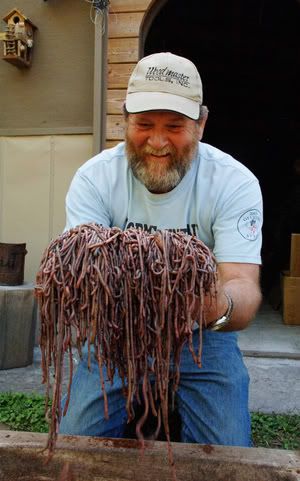
To this point, a blurb in a recent issue of National Wildlife magazine entitled "The Science Behind 'Worm Grunting'" explains the once mysterious cause-and-effect relationship manipulated by "grunting."
"As recently as the 1960s, hundreds of people in the southeastern United States earned a living through a curious practice known as 'worm grunting': driving a stake into the ground, then rubbing the stake with a long piece of steel in order to produce a sound that, for reasons unknown, would drive hundreds of earthworms to the surface where they could be collected for bait. Now biologist Ken Catania of Vanderbilt University has found an explanation for the technique’s efficacy. Without realizing it, worm grunters were imitating the sounds made by worm-hungry moles digging through the earth. By observing both earthworms’ reactions to grunting and their response to the presence of eastern American moles, Catania found that the invertebrates rapidly pop to the surface when they detect the presence of a mole—or a grunter."
I've never gone grunting, but as a child of the southeastern United States, I've done my fair share of earthworm digging in preparation for afternoon pond fishing. I wish I'd known about grunting those years ago, and I'm very glad that I know about it now. I still fish every now and again, so I may yet have practical use for grunting. More importantly, I might also have occasion to educate children about grunting; a vital part of that teaching will be the astonishment the kids experience upon witnessing the worms' emergence. It ain't magic, but it's surefire enough to make this adult shake his head in believing disbelief. Another word for that? Wonder.

For more on grunting, check out this blog post.

Photo credit: Discovery blogs

Sunday, October 05, 2008

Matthew Day Jackson's Wonderful Artifacts


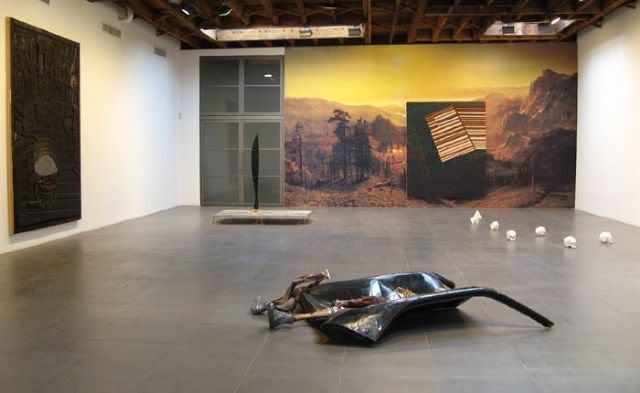
Installation shot of Matthew Day Jackson's "Terranaut," at Peter Blum, Chelsea
Courtesy of Peter Blum Gallery, New York


"The world will not perish for want of wonders,
but for want of wonder."
-J.B.S. Haldane


On the drizzly Wednesday evening past, I attended a ScienceBlogs panel at the SoHo Apple Store. ScienceBlogs bills itself as "a portal to...global dialogue, a digital salon featuring the leading bloggers from a wide array of scientific disciplines." I'm familiar with a number of the blogs hosted by the network; among them is one of my regular blogosphere stops, Bioephemera. Jessica Palmer, the writer, artist and scientist behind Bioephemera, participated in the panel, and I attended with lofty expectations. Unfortunately, the panelists were unable to delve deeply into any of the subjects that most excite them. Instead, they answered humdrum questions that ranged from 'How often do you upload new material?' to 'What was your most popular or controversial post?' (Generally, their responses were similarly unexciting, but they delivered them earnestly and with good humor.)

Addressing that second question, one panelist mentioned the popularity of Pharyngula, a blog written by evolutionary biologist P.Z. Myers. Every day, Myers' blog receives a great many visits, but a sizable minority (perhaps even the majority) of those visitors are religious fundamentalists, Creationists who beset the blog with nasty comments about Myers and the ideas he expounds. In fact, Myers has posted an ever-lengthening list of undesirables, readers now banned from Pharyngula's comment section.

It's no secret that evolutionary biologists and Creationists don't break bread together. Their enmity has a storied history. Yet many people understand the dispute to be more broad, as a fracas between scientists and the religious community at large. And it is not only bystanders that see it this way. Some scientists lend credence to the misconception by assuming that all religious individuals are skeptical of evolutionary biology, in particular, and, more generally, of science as a whole. This simply isn't true. The science/religion dichotomy is false. Only the ignorant, the unimaginative, the misguided or some combination thereof embrace religious fundamentalism, and among the ranks of the religious, there are countless educated, creative and thoughtful individuals. Within this latter group, science and evolution are accepted, even championed.
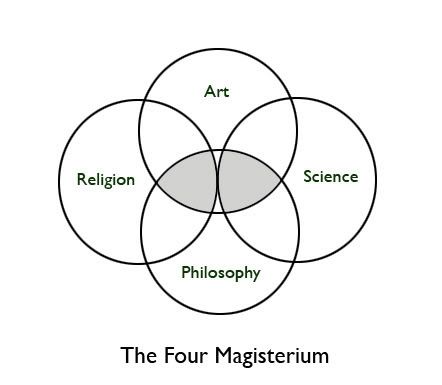


At their respective best, both science and religion (re)awaken or invigorate our capacity for wonder. Each makes use of a different approach, but they are complementary. As Albert Einstein famously said, "Science without religion is lame. Religion without science is blind." The late evolutionary biologist Stephen Jay Gould called the two "nonoverlapping magisteria" because good science trades in facts to explain material phenomena, whereas religion traffics in the unverifiable and the unobservable. Where science seeks to demystify, and to build on each subsequent revelation to learn more, religion aims to make sacred that which is taken for granted, to make the ordinary again extraordinary. Both, however, offer frameworks of engaging our astonishing existence and experience. Both are compelled by curiosity and wonder. As Gotthold Ephraim Lessing, the Enlightenment writer-philosopher, argued, if God held in one hand the Entire Truth and in the other the Eternal Pursuit of Truth, a good man will choose the latter. The same is true of authentic scientists and religious thinkers. The methodology and particulars may differ, but both science and religion are realms of the question. Although the popular conception of the scientist is the white-coated statistician ready to provide any and all answers, the caricature is misleading. It is "normative in science to be not sure," as Jessica Palmer put it doing the ScienceBlogs panel. Science, like religion, is a matryosha doll, a series of questions nested within questions.

Gould considered art and philosophy magisteria unto themselves, but, unlike religion and science, each overlaps the other. Where these two overlapping sections meet, we find ourselves in the realm of what the artist-writer Paul Laffoley calls the mesoteric. In Laffoley's cosmology, the circle of religion, dealing as it does with questions of ultimate meaning, is dubbed the esoteric realm. The circle of science, focused on material truths and the observable world, he labels the exoteric realm. The mesoteric realms. art and philosophy, bridge the esoteric and exoteric. Whereas Gould posits that the magisteria of religion and science are nonoverlapping, I would argue that, where their circles meet, the membrane is permeable. This bleeding of one into the other represents the pinnacle of art and philosophy.


Matthew Day Jackson
"Dymaxion Skeleton"
2008
Wood, lead, Plexi-glas, light, glass mirror, steel
86 x 33 x 22 inches
Courtesy of Peter Blum Gallery, New York


Because Matthew Day Jackson's sculptures draw from this leak, inspired by (and responding to) both science and religion, the very best are imbued with (and exude) hope, curiosity and wonder. Two sculptures, "Dymaxion Skeleton" and "Against the Mythology of Linearity," both included in "Terranaut," Jackson's current exhibition at Peter Blum Gallery, are exceptional artifacts (literally, artful fact), notable for their humor, evocative power and awe-struck humility.

Presented within an illuminated, birch-paneled vitrine, "Dymaxion Skeleton" is a piece-meal assembly: the feet of this skeleton are tree roots; the legs, arms and spine are branches; the rib-cage and pelvis are geodesic triangle lattices (hence the Buckminster Fuller allusion in the work's title). To the guileless viewer, the skeleton could pass for a loan from the American Museum of Natural History, a relic of some lost people, but "Dymaxion" is no archaeological discovery. It, like everything Jackson produces, is a fiction.

But is it fair, really, to call it that? Because Jackson makes no claim that "Dymaxion Skeleton" is archaeology, it can not be dismissed as "junk science." It is contemporary art and, as such, is no less real than any relic released from the lower strata to be studied, interpreted and enshrined. And what can we surmise from Jackson's latter-day reliquary? To use Palmer's words, we're "not sure." "Dymaxion Skeleton" is cryptic and poetic. What are we to make of the connection between those root feet and the geodesic triangles? Or between Jackson's nod to Fuller, a half-baked scientist-engineer fascinated by Utopian machines, and this illuminated dead thing?

Admiring Jackson's skeletal creation, I think of the laudable efforts of David Wilson, the founder and curator of The Museum of Jurassic Technology in Los Angeles. Wilson's museum is an extension of the Wunderkammer, the sixteenth, seventeenth and eighteenth century rooms (or cabinets, as they were then called) devoted to displaying collections of natural specimens, artwork and other miscellany. Today we usually call collections of this sort curiosity cabinets (and, indeed, they more often occupy what we now think of as cabinets). The curator of "Wunderkammer: A Century of Curiosities," currently on exhibit at the Museum of Modern Art, points out that Wunderkammen are "precursors to museums." In the nineteenth century, these general interest collections were divided for display in separate art, natural history and technology museums. This breakup coincided with the shift from generalization to specialization, and although the latter approach allows for a more extensive body of knowledge, it is a less integrated one. An astrophysicist, for example, can tell you a great deal about astrophysics, but will likely contribute very little on the subject of crocodile anatomy. As John Walsh, former director of the Getty Museum, stresses, "in the earlier collections, you had the wonders of [the natural world] spread out there cheek-by-jowl with the wonders of man, both presented as aspects of the same thing, which is to say, the Wonder of God." Embracing the collage-remix instinct of the postmodern artist, Jackson shares much in common with his Wunderkammen forebears; he works to tap into the wonder current.


Matthew Day Jackson
"Against the Mythology of Linearity"
2008
Acrylic, abalone, mother-of-pearl
7 inches tall, dimension variable otherwise
Courtesy of Peter Blum Gallery, New York


"Against the Mythology of Linearity," a seven-stage transmutation, moves from a simple pyramid through five polyhedral forms before "becoming" a human skull. The increasing complexity of each stage seems to confirm linear progression rather than react against it, but Jackson has arrayed the forms on the gallery floor so that they constitute a question mark. The faceted shaping and abalone accents of these polyhedra allude to gem cutting and, with that craft in mind, I think of the Abrahamic Creation story, in which God makes Man and Woman on the sixth day, then puts down his chisel for a rest. By nodding to that story, is Jackson questioning the narrative that evolutionary biologists so vehemently defend? Perhaps, but with each additional facet, a polyhedron moves that much closer to a sphere, a "perfect" form that is emblematic of infinity. The skull, then, the seventh step, is not an end result. God can rest for a spell, but he should continue; his work is incomplete.

The economist and sociologist Max Weber said that the secularization of society and increasing specialization of methodological inquiry had led to a "disenchantment of the world." He was (and remains) correct. A world without magic is a meagre one. Jackson's best sculptures provide us with bread crumbs so that we might find our way back to wonder. They are redemptive works, and I eagerly anticipate more of them.

Photo credits: All Matthew Day Jackson images courtesy Peter Blum Gallery; Four Magisterium diagram, Christopher Reiger, 2008

Thursday, July 31, 2008

I Got Fever

Jessica Palmer, the thoughtful blogger, artist and scientist responsible for Bioephemera, one of my favorite blogs, wrote a generous post about my work yesterday.

She may be biased by our friendship, but I'm all too happy to have my work described as "feverish."

Find the full post here.

Tuesday, March 25, 2008

Christy Rupp; Bioephemera follow-up

In mid-February, I reviewed Christy Rupp's exhibition, "Extinct Birds Previously Consumed by Humans (From the Brink of Extinction to the Supermarket)," at Frederieke Taylor. Last week, one of my favorite bloggers, Jessica Palmer, of Bioephemera, responded to both Rupp's work and my assertion that the work, though admirable, is a victim of its own intent. Jessica is a gifted, clear writer and intelligent person; her thoughts are always worth a read.

Tuesday, March 11, 2008

Elephant art?

No, I'm not referring to art incorporating elephant dung.

Bioephemera considers the claim that some animal species - elephants, chimpanzees, and others - are producing artwork. Her perspective is well presented, but the verdict is open to interpretation; like most "arty" debates, this one is fuzzy.

A few floaters:
What distinguishes the trained elephant from the trained violinist (performing a composer's opus)? Elephant X might use a more fluid stroke than Elephant Y; is that the makings of style? And what, really, is the role of ego in art? Is self-consciousness the fulcrum in this conversation?

Read the post here.

Thursday, May 31, 2007

Old Mud Blood at the Banshee

"And I do not want anymore to be useful, to be docile, to lead
children out of the fields into the text
of civility, to teach them that they are (they are not) better
than the grass."

-Mary Oliver, excerpt from Rain, originally published in "New Poems"(1991 - 1992)
A year or so ago I met a friend for drinks at The Banshee on Manhattan's Upper East Side. Sitting next to us at the bar was a poet, in his early fifties, who had recently moved to New York from Los Angeles. Feeling uncharacteristically social (after sufficient lubrication), I got into a conversation with the man. He had experienced some critical success within west coast poetry circles but had grown frustrated with "the scene," and opted to try on NYC for size.

After a half-hour of talking, he announced, "Well this is really great. You're the first person I've met since moving that's really got me feeling like there is that creative pulse you always hear about New York." He insisted on giving me his card and asked for information on my website and future exhibitions. I've lived in New York long enough to view his gushing with some skepticism; still, I'd enjoyed the chat and exchanged information with him agreeably enough.

As the gentleman prepared to depart, he paused, cocked his head quizzically, and asked, "So who are your favorite contemporary poets?"

It was an easy question to answer. "At the moment I'm enjoying collections by Mary Oliver and Galway Kinnell. I've always..."

I couldn't finish my reply; the poet broke into a peal of laughter. I was understandably taken aback by this reaction. After regaining some semblance of self-control, he exclaimed, "And the whole time you had me thinking you knew good poetry from bad poetry. Mary Oliver is garbage. Kinnell is little better." I stared at him blankly. He laughed a little more, shook his head, and continued, "I mean, that's like me telling you that my favorite painters are Edward Hopper and Norman Rockwell. You'd be appalled. That's not even art! That's illustration!"

I wasn't quite sure what to say. I shrugged and finally said, "Well, I read a fair amount of poetry, so my landing on those two isn't just chance. I think they're good."

He appeared genuinely crestfallen. It was as though my bad taste sapped New York of the intellectual and creative energy he believed he had just become acquainted with. He may have pegged me for an appreciator of mundane poetry (guilty as charged, I suppose), but his explosive dismissal of Oliver and Kinnell, both gifted and rewarding poets, and his use of Hopper and Rockwell as parallels reveals inherited (or adopted) prejudice.

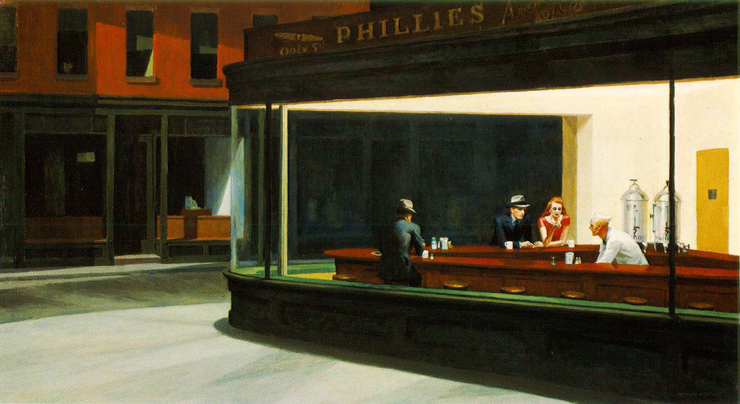
Hopper and Rockwell painted with reproduction in mind and, indeed, both worked as professional illustrators for a time; this being the case, labelling them illustrators isn't entirely inaccurate but, as Peter Schjeldahl wrote recently, "If 'Nighthawks' is an illustration, a kick in the head is a lullaby." Hopper and Rockwell aren't favorite artists of mine, but their work is not deserving of the lambasting it receives from so many art world experts. (The unintentionally comical Thomas Hoving, former director of the Metropolitan Museum of Art, comes to mind here. In the documentary, "Who The $#%& Jackson Pollock?," Hoving dismisses the opinion of someone outside the art establishment by wagging a finger and saying, “She knows nothing. I’m an expert. She’s not.”)

The truth is, many critics and connoisseurs build upon the existing scaffold of criticism and connoisseurship to such a degree that, generations down the line, their tower of opinions is an esoteric curiosity, shaky and too tall to be buttressed by the masses. I'm not suggesting that experts don't have a place nor that populist art is superior to "high" art, but merely that it is unfortunate that so many members of creative communities are eager to demonstrate their "expert" status by espousing those ideals or ideas most removed from the general consensus.

I sometimes struggle to explain Mary Oliver's value to non-believers. One acquaintance described Oliver as "the Thomas Kinkade of poetry." The comparison is ludicrous. Oliver writes of the "live animal," of a becoming with the natural world that impregnates experience with a meaning distinct from reason. Kinkade is the master of commodifying kitsch. They are worlds apart.

At any rate, I was all too happy to read Bioephemera's recent toast to Oliver. Cicada observes, "Some critics grumble that [Oliver] is insufficiently challenging or unsurprising, but she leans so heavily on the sense of wondrous recognition fed by nature, I wonder if a failure to be moved isn’t primarily a failure of that wonder-sense." Or, in the words of Oliver herself,
"I don't want you just to sit down at the table.
I don't want you just to eat, and be content.
I want you to walk out into the fields
where the water is shining, and the rice has risen.
I want you to stand there, far from the white tablecloth.
I want you to fill your hands with the mud, like a blessing."
-from Rice, "New Poems" (1991 - 1992)
Later in her post, Cicada describes the sense of belonging, if you will, that an Oliver poem provides. "...her poems make me feel rooted in humanity, grounded in my own body, aware of this lumpy, piecemeal tangle of cells which is somehow, miraculously, taking pleasure in language. Oliver’s poems are spiritual experiences for those who would not necessarily describe themselves as spiritual." But why take her word for it?

The Fish
The first fish
I ever caught
would not lie down
quiet in the pail
but flailed and sucked
at the burning
amazement of the air
and died
in the slow pouring off
of rainbows. Later
I opened his body and separated
the flesh from the bones
and ate him. Now the sea
is in me: I am the fish, the fish
glitters in me; we are
risen, tangled together, certain to fall
back to the sea. Out of pain,
and pain, and more pain
we feed this feverish plot, we are nourished
by the mystery.
-from "American Primitive" (1983)


I guess it's true that one man's "garbage" is....

Photo credit: Hungry Hyaena, 2002

Thursday, February 08, 2007

Pollock, Monsters and Poorwills


Today, links and recommendations.

From Bioephemera:

- Folks who regularly troll art blogs will have read plenty about the ongoing dispute over the authentication of paintings attributed to Jackson Pollock. Some of the posts have been very good, even provocative, but I hadn't seen any posts highlighting an unspoken, but central debate, one between the humanities and the scientific method. Read it here.

- A good friend of mine, Michael McDevitt, used to spend hours assembling bones, found utensils, toys, bits of plastic detritus, and what have you, creating marvelous hybrid creatures in the process. Although he concentrates on painting these days, I fondly recall college afternoons spent hanging out in Michael's studio/ laboratory /bedroom with his old black lab, Loki (RIP), while he worked away on those sculptural amalgamations. That work came to mind when I was introduced to Jessica Joslin's sculptures (via Bioephemera).

From Rigor Vitae:

- An excellent, informative post from Carel Pieter Brest Van Kempen, this one discussing the ability (and inability) of different bird species to regulate metabolism or enter torpor. Happily, one of my favorite bird families, the nightjars (Caprimulgidae), includes a real pro, the Common Poorwill (Phalaenoptilus nuttallii).

Also skilled in metabolic regulation are hummingbirds and, on that note, I recommend this recent article/photo feature in a recent issue of National Geographic.

Photo credit: WhipPoorWill -Plate LXXXII, by John James Audubon, circa 1827