Showing posts with label humility. Show all posts

Friday, August 10, 2012

Platte Clove Residency: John Muir and the View From the Precipice

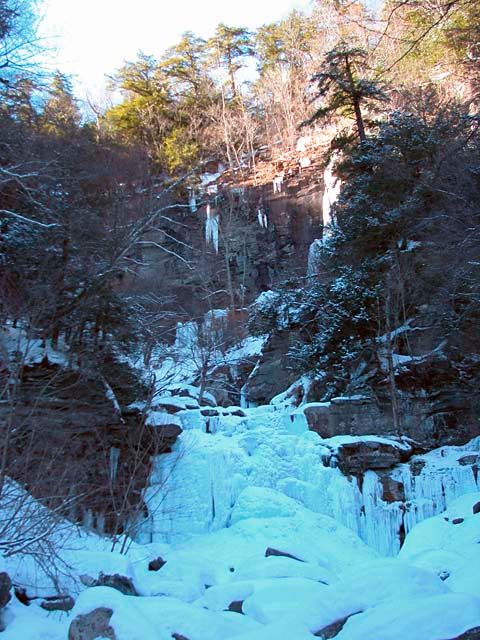
Winter view of Platte Clove's Bridal Veil Falls;
Catskills; NY
“Many people have been killed after falling and sliding off the edge. Especially in areas where there are pine needles. Dangerous conditions exist in many locations. The number of deaths over the years is staggering. Be overly cautious when in this region, and do not take un-necessary risk.”

- “Upper Platte Clove” page of Catskill Mountaineer website
I hesitated before deciding to investigate the unmarked spur of the Platte Clove Nature Preserve's Plattekill Falls Trail. Having recently read a bit about the geology and topography of the Catskill Escarpment, I knew that the preserve is located near the top of a deep ravine that tumbles suddenly down and eastward to meet the Hudson Valley (clove is the Dutch word for a mountain gorge). I’d also learned that each year a handful of foolhardy or unlucky hikers fall to their deaths on Platte Clove area trails. An online trail guide I’d browsed prior to the residency urged hikers to be “overly cautious.” Nevertheless, once I’d stepped off the main path and advanced a few steps down the spur, I was self-assured; I wouldn’t be one of 2012’s casualties. Prudent types like me don’t fall off cliffs.

Tuesday, May 01, 2012

"Giving Witness"

Common Snapping Turtle; Main Road; Everglades National Park; October 2011
I originally posted the above photograph of a common snapping turtle at the edge of the main road in Everglades National Park in October 2011, while I was an AIRIE program participant.

I thought of the turtle portrait when I read Ted Levin's informative and compelling "The Staying Power of Snapping Turtles," published in the March/April 2012 issue of Audubon Magazine.

The selection below emphasizes the fact that Chelydra serpentina is an elder member of our extended fauna family.
"The snapping turtle family, Chelydridae, evolved in North America and has haunted our wetlands almost unchanged for nearly 90 million years. Ancestors spread to Eurasia about 40 million years ago and then disappeared from that continent in the late Pliocene, about two million years ago. Chelydrids have been sequestered in the Western Hemisphere ever since, which makes them among our truest and oldest turtles. They were present when dinosaurs lived and died, and had been laying round, white, leathery eggs in sandy loam and glacial till for millions of years when the first Amerindians wandered over the Bering Land Bridge. Snapping turtles have witnessed the drift of continents, the birth of islands, the drowning of coastlines, the rise and fall of mountain ranges, the spread of prairies and deserts, the comings and goings of glaciers."
When I think in terms of the life of a species (rather than that of an individual representative), my pulse slows and I'm suddenly calm....and deeply appreciative to be a part of so grand an experience.

Photo credit: Hungry Hyaena (Christopher Reiger), 2011

Friday, February 10, 2012

Chris McCaw: Drawing Time

Chris McCaw
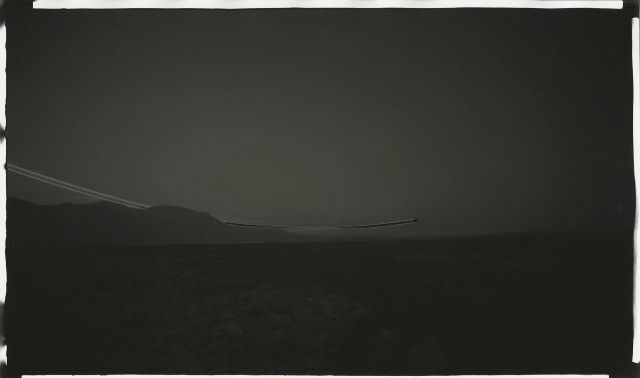
"Sunburned GSP#420 (Arctic Circle, Alaska)"
2010
Unique gelatin silver paper negative
12 x 20 inches
Chris McCaw created the arresting pictures on view in "Ride Into the Sun," the artist's winter 2011 solo show at Stephen Wirtz Gallery (San Francisco, CA), using an unconventional technique. The artist loads handcrafted view cameras as large as 30 x 40 inches with expired silver gelatin photographic paper, tilts the camera lenses skyward, and opens the shutters for hours. Even on cloudy days, the photo paper is soon overexposed. As time wears on, however, the light-sensitive chemicals that coat the paper are solarized, and the prints' tones are transmuted in curious ways. In many of McCaw's works, the sun appears as a dark, arcing streak and the landscape and sky as shades of grey. During some of McCaw's longer exposures, the sun's brilliance, laser-like, burns through the paper, tracing its progress as a charred tear.

Friday, January 13, 2012

Big Sky Country

Christopher Saunders
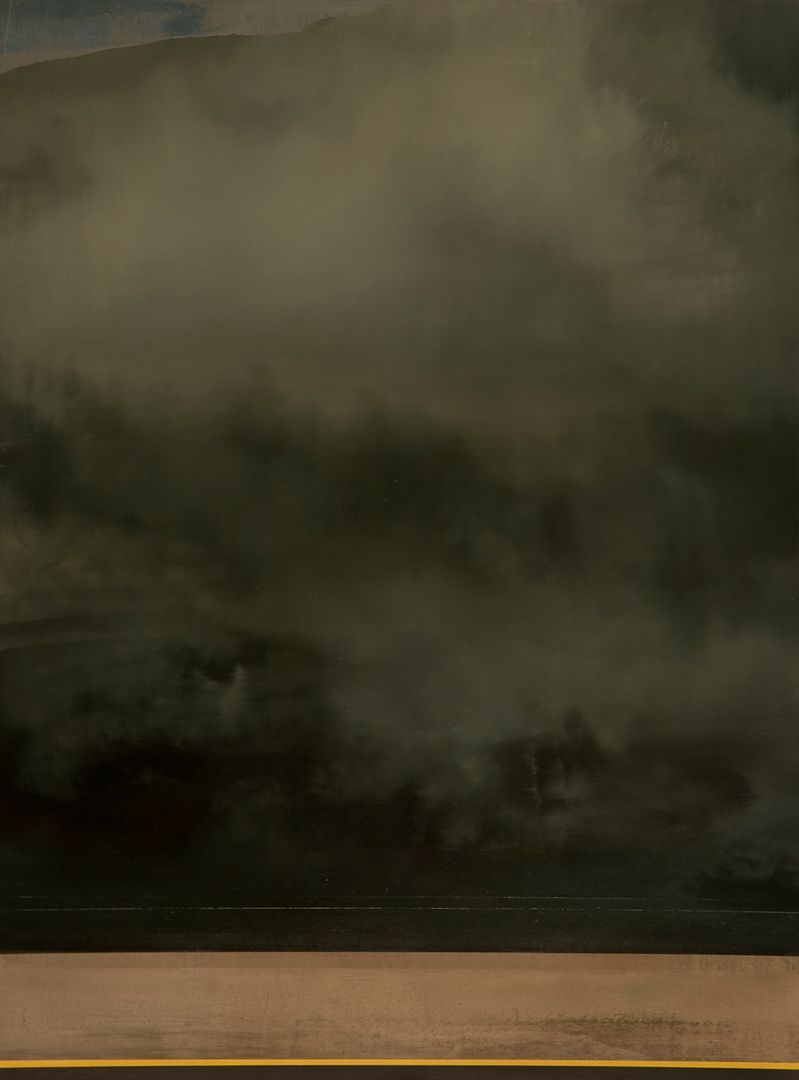
"Whitenoise no. 1"
2008
Oil on linen
24 x 18 inches

In a 2009 post about painter Christopher Saunders' "Whitenoise" series, I recounted philosopher Arthur Schopenhauer's hierarchy of aesthetic experience and connected it to Saunders' work.
"In his volume The World As Will and Representation (1818), Schopenhauer elucidated a scale of aesthetic experience. At one end of this spectrum, he described the 'Feeling of Beauty' as 'Light...reflected off a flower. (Pleasure from a mere perception of an object that cannot hurt [the] observer.)' At the other end of the spectrum, the philosopher positioned the 'Full Feeling of Sublime' and the 'Fullest Feeling of Sublime.' These categories are described, respectively, as 'Overpowering turbulent Nature. (Pleasure from beholding very violent, destructive objects.),' and 'Immensity of Universe's extent or duration. (Pleasure from knowledge of observer's nothingness and oneness with Nature.)'

Thursday, October 13, 2011

ROA's Ark


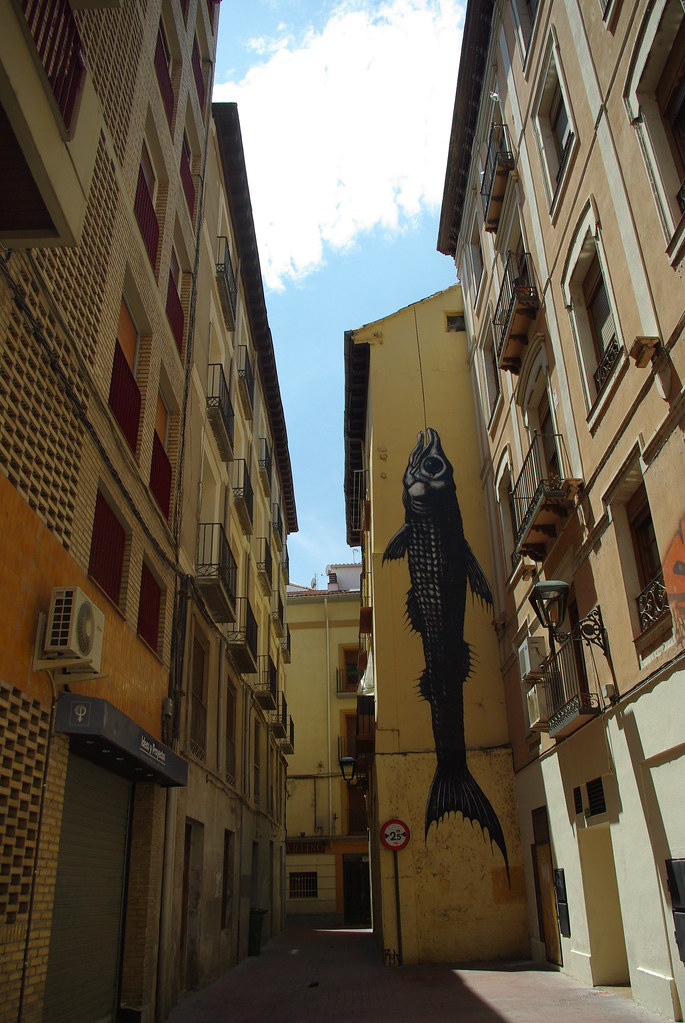
ROA
2010
East Village, New York City

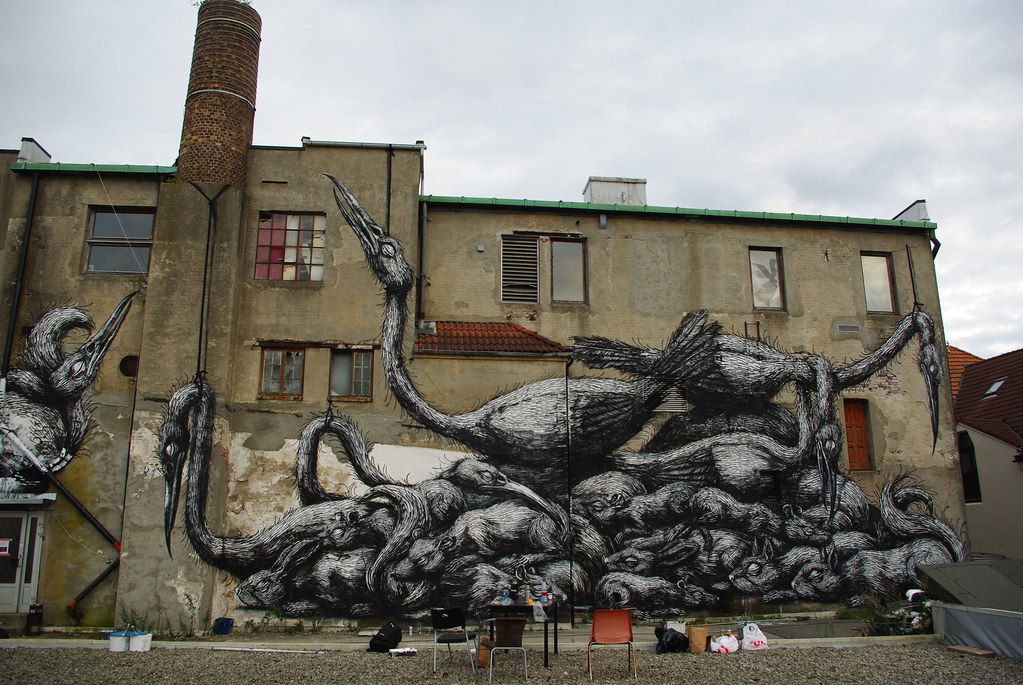
I admire skillful street art, but I rarely feel compelled to photograph it. In early 2010, however, when I came upon the starling mural pictured above, I immediately reached for my camera. At the time, I didn't know anything about the artist; months later, I recognized the muralist's hand in an image I came across online. ROA, a Belgian artist whose animals adorn structures on four continents, is a rising star among street art aficionados.


ROA
2010
London, England

Admittedly, my love of natural history and enthusiasm for animal imagery predispose me to ROA fandom, but the artist's bold, black-and-white technique is distinct and compelling, and most of his mural projects exhibit a clever site-specificity. This attention to location is most often compositional -- for example, the neck of a Limpkin-like bird passes between two windows on a building in Brooklyn, New York, with the bird's body below and the head above -- but ROA's strongest pieces are also conceptually playful: in Ancona, Italy, he painted a disheveled cormorant, a type of water bird, on the side of a large boat; elsewhere, a mole emerges from a pile of bricks; and a desiccated fish is painted on the side of a trailer near California's Salton Sea, a large salt lake in which most fish species are unable to survive. An enthusiastic amateur naturalist, I appreciate the context-appropriate nature of these works.


ROA
2010
Zaragoza, Spain

Unfortunately, ROA doesn't always paint his creatures in or near their natural habitat. I love his giant anteater, pictured trotting along the side of a single-story building in the Mexican state of Guanajuato, but I wonder if the artist realizes that the species is extirpated north of Honduras. Still, because giant anteater fossils have been found in northern Mexico, let's give the artist the benefit of the doubt and interpret this piece as an observation about ecological change. A stylized blue whale rising from a sea of grass outside an abandoned factory in Moscow, Russia, however, is too far from an ocean to be rationalized. Its incongruity is amusing and the image is beautifully crafted, but the piece lacks the impact of ROA's more considerate efforts. No worries. ROA's terrific Virginia opossum in downtown Los Angeles, its prehensile tail wrapped around a stretch of the building's brickwork, more than makes up for the misplaced whale!

While my fondness for natural history makes me an unusually nit-picky viewer, it also means that I'm especially excited by the urban and exurban placement of ROA's rats, squirrels, starlings, herons, raccoons, cormorants, and skunks. These animals are hardy and adaptable, and have proven able to thrive in ecosystems dominated by human habitation. Many people dismiss these creatures as pests, but their presence in our lives is of significant value. As we become an evermore urban species, they are our most immediate connection to the undomesticated, non-human world. In this respect, ROA's murals are portraits of our closest neighbors.


ROA
From the "NUART Landmark Series"
2010
Stavanger, Norway

Some of ROA's more elaborate murals depict great piles of dead animals. These call to mind the tables laden with rotting fruit, hunted game, and skulls that appear in many 15th century Northern European vanitas ("emptiness"), memento mori ("remember your mortality"), and ars moriendi ("art of dying") still life paintings. As their names suggest, all of these allegorical works were created as nods to death's inevitability. It seems these themes preoccupy ROA, too. One of his best memento mori works is located in Stavanger, Norway. Lifeless squirrels, rats, rabbits, and herons are heaped at the foot of an old warehouse, with the limp necks of the herons apparently tied to cords on the wall's face (should we call this reverse trompe l'oeil?) In Mexico City, ROA adds a raccoon, armadillo, and skunk.


ROA
2011
Mexico City, Mexico

These murals will seem grotesque and bleak to some viewers, but they aim to inspire by reminding us that life is transitory. The sentiment was expressed well by Steve Jobs during his 2005 Stanford University commencement address, a speech that, in the wake of Jobs' untimely death from cancer, has been making Internet rounds. Jobs said,
"Remembering that I'll be dead soon is the most important tool I've ever encountered to help me make the big choices in life. Because almost everything — all external expectations, all pride, all fear of embarrassment or failure - these things just fall away in the face of death, leaving only what is truly important. Remembering that you are going to die is the best way I know to avoid the trap of thinking you have something to lose."
In many respects, ROA's works are the less refined kin of Walton Ford's paintings. Both artists address mortality and the relationship of humanity to other animal species with humor and finesse, but ROA's pictures are less layered with art historical and natural history references; as a result, they're more accessible and immediately gratifying.

Based on the images he shares on his Flickr photostream, the talented 30-something has at least five murals in San Francisco. Let's hope that he returns to the Bay Area and contributes more of his handiwork to our landscape.

Thursday, September 22, 2011

Kija Lucas' Stars & Pillows


NASA and the European Space Agency
"Hubble Ultra-Deep Field"
2004

Glow-in-the-dark star stickers dotted the ceiling of my childhood bedroom. Every night, before sleep, I marveled at the phosphorescent firmament. Over time, however, the stickers' charge diminished and the ceiling's constellations grew dim. Likewise, the burgeoning egocentrism of adolescence dulled my capacity for wonder; for years, I gave little consideration to the night sky. By the time I'd matured enough to be awed anew, adult life had carried me from rural locales to the electric glow of New York City, where all but the brightest celestial bodies were swallowed by our species' illumination.

Today, whenever I find myself in sparsely populated areas at night, I'm startled and humbled by the brilliance of the stars and my relative insignificance. The famous Hubble Ultra-Deep Field (HUDF) image evokes a similar awe. The HUDF was produced by compositing visual data from the Hubble Space Telescope, and the colorful result provided astronomers with a 13.2 billion-year-old picture of our universe. The orange, yellow, blue, and purple marks that spot the HUDF are primordial galaxies that formed shortly after the Big Bang. The photograph is attractive, but it appeals more to our imagination; it's capable of elating a viewer as much as the heavens can an enthusiastic amateur astronomer or glow-in-the-dark star stickers can a child. The incomprehensible grandeur of the cosmos is intoxicating.


Kija Lucas
"Origin Story No. 4"
2011
Silver gelatin prints, tape
30 x 40 inches

The HUDF came to mind as I admired Kija Lucas' "Origin Story No. 4," a photogram collage included in Root Division's "Introductions 2011" exhibition, the non-profit's annual survey of a dozen Bay Area emerging artists. Although the abstract imagery of "Origin Story" appears cosmic, the galaxies and gases of Lucas' picture are more earthly. The artist gathered dust from her studio floor, placed it on light-sensitive photo paper, and then exposed the paper. Afterward, she cut the resulting photograms into 2x2 inch squares and rearranged them; the seams of the collage create an unsteady grid, adding to the impression of an extraterrestrial survey. But the white-specks and smears might also be construed as microscopic lifeforms near the deep-sea floor, the products of a particle accelerator's "God-particle" collision, or documentation of activity in another sphere invisible to the human eye. The photogram's easy transition between the unfathomably vast (i.e., the universe) and the subatomic speaks to the mystical notion that scale is Ouroboros-like, that infinite travel "inward" (i.e., moving ever smaller) eventually leads to the infinitely large.


Kija Lucas
"Pillow No. 4"
2011
Archival pigment print
23 x 30 inches

Does Lucas intend "Origin Story No. 4" as a rumination on such matters? I don't know. But the artist also includes another body of work in "Introductions 2011" that invites a complimentary interpretation: a series of photographs of old pillows, presented specimen-like on black backgrounds. The pillows' patterned fabric, stained with mold and sweat, is testimony to their years of service. In the context of "Origin Story," it's hard not to think of these well-used pillows cradling the craniums of people transitioning between waking life and dream, a liminal state conducive to contemplative insight into the incomprehensible. Yet the beautiful photographs are also anthropological documents; Lucas treats mundane pillows as artifacts worthy of sustained consideration. What do they tell us about ourselves? What do the patterns mean: the fleur-de-lis, the crop of diamonds? Specific answers will be provided by viewers, but Lucas' overarching project attests to the human inclination to collect and interpret, to grope for understanding.


Kija Lucas
"Pillow No. 6"
2011
Archival pigment print
23 x 30 inches

Image credits: HUDF, courtesy of NASA; Kija Lucas images, courtesy the artist

Thursday, September 15, 2011

The Beautiful / Palace Prayers

OLD MOONS

Old moons now are dried and crusty
Brittle and as uninteresting as history is
To my fingers and lips.

And yet also, it cannot be denied
That each man
King of his home-throne
Misses something of eternity
When he chomps down on lamb chops
(Which are his reward
For winning the bread)

Each of us misplace the universe
And lose the word
When we get our desires
On plates before us.

There is a grain of rice on the table.
Around it, oil has bled
And spreads

In this way does our egodeath
Halo around us
  And puncture the beauty
    Of clouds
- Yusuf Misdaq

Two years ago this month, I highlighted the poet, musician, artist, and author Yusuf Misdaq's Palace Prayers project. August 21st - September 19th, 2009, was Ramadhan, and Misdaq, a practicing Muslim who, as I noted at the time, "shares my universalistic mystical inclination," created a new work of art for every day of the month-long fast and period of Muslim introspection.

Some months later, Misdaq invited me to contribute a forward to a book of his poetry, prose, and lyrics. That book, The Beautiful / Palace Prayers, was published this year. Visit Misdaq's website for more information.

+++++
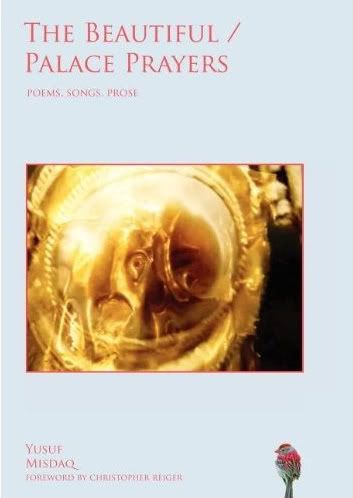
"Dissolution Is The Whole Show"

When Yusuf invited me to contribute a foreword to The Beautiful / Palace Prayers, I was at first surprised. Although I enjoy reading poetry, my education in literature is wanting, and my tastes run to work that most "serious" critics and scholars deem pedestrian. Who am I to comment on this young artist's latest collection? With characteristic enthusiasm, however, Yusuf's invitation quelled my self-doubt, insisting that The Beautiful is made up of poems "for normal people who do not normally read poetry." Well, in that case, it is a privilege and a joy for this normal person to introduce a collection of poems, verse, and prose written "for normal people"!

        They are a good species.
        Clean and caring;
        Made mostly of water and forgiveness
              - from "The Beautiful"

Normal people are very much in need of poetry, and perhaps especially so today, when the art is generally neglected. Words are powerful entities, every one an invocation, yet we too often use them carelessly. Poetry, like prayer, can serve as a corrective, reminding us that words conjure meaning and that they have a felt, physical component. As critic and philosopher George Steiner writes, "the meanings of poetry and the music of those meanings...are also of the human body." Appropriately, Yusuf refers to the italicized and apparently random words that he includes in some of his poems as "body echoes." "Carbunkle. Crellis. / Pulse-if. peaces." or "Que Que" are not intelligible formulations but, when read aloud, they aren’t exactly jibberish either. They supply somatic meaning, as do the poems’ rhythms. Yusuf's strongest poetry or verse has a perceptible pulse; in some cases, I notice my head slowly bobbing as I read. This is not insignificant. Beat and rhythm are primal properties, manifestations of the infinite, unfathomable being within which we reside and of which we are composed.

        Echoes
        of the original
        Voice
        From the original
        Breath
              - from "Ramadhan 26"

Ludwig Wittgenstein insisted that earnest philosophers should "descend into primeval chaos and feel at home there" if they expect to produce worthy work. I extend the same requisite to artists. Yusuf draws pictures, makes films, and writes poems, novels, and songs, but he is, above all, a mystic. And mysticism, in its quest to directly experience elemental truths, necessitates Wittgenstein's appreciation of the primeval and the chaotic; ancient disorder is at the root of everything. In most cases, the mystical perspective is merely an uncommon one; mystics survey and respond to the same earthly, material realm that the rest of us do. But they disregard accepted classifications and train themselves to mindfully observe and reinterpret their surroundings. They locate the extraordinary in the mundane. As Henry David Thoreau, a 19th century mystic, lamented, "All this [splendor] is perfectly distinct to an observant eye and yet could easily pass unnoticed by most." Mystics reawaken their capacity for reflective wonder and, in doing so, experience a kind of rebirth into a vaster dimension of human experience.

        On perfect Spring mornings
        God puts a clear blue sky in our pockets
        Pats us a few times and says
        'On your way!'
              - from "The Merciful Cheerful"

So reborn into sublime beauty, mystics strive toward the transcendent. Both Wittgenstein and Thoreau can be described as transcendentalists; Yusuf qualifies, too. Like the two philosophers, he finds in his observations of the world cause for a fundamental optimism. Unlike them, his writing is generally informal and devoid of pretension. His poems give readers the impression of a devout Sufi Muslim happy at play in our waking, sensual dream. In the collection's title poem, Yusuf writes "Awake in this dream / Where abstract clouds calmly keep us. / Where birds secretly make love in public and / Give voice to the current of joy which / Slices through us in a day." Again, in "Back Amongst Men (Drowned)," he references this dreamed life: "Or as I have also interpreted it / .God is a laughing dream." No doubt, the poems’ author, laughing, singing, eyes wide and sparkling, would appear mad to many of his fellows. This is to their discredit. They have forgotten (or failed to learn) how to look. Mystics, like many philosophers and artists, are too easily dismissed as lunatic or eccentric. Yusuf's ability to see through the veil of our cultural forgetfulness informs his aesthetic imagination and invigorates his art.

        Silk veils, dark and weightless
        Are being removed from her countenance
        Time after Time

        Each day I ready myself to know her better
        Each day, closer
              - from "Wahad"

But not all that Yusuf observes is felicitous. The most biting poem included in The Beautiful, "Ramadhan 23: Only To Be With You And No-one Else," is a reaction against the politicization of Islam and a celebration of his intimate relationship with Allah. After rejecting the "bloody bridge builders / Shmoozers or politicians" and others who "come to the Mosque smiling in your suit," Yusuf writes, "I wish to be alone / And serious / And deeper in love / With the only one who ever matters." The striking seriousness of his personal communion with G-d is important; discipline is one of the central currents running through the poems included in The Beautiful. In “Waiting (A Song for Guitar),” Yusuf writes, “I do believe in magic but first you gotta work at it.” Hope and love, he reminds readers, are nurtured through dedicated ritual and practice.

        Understand, thee
        That tenderness comes not of softness
        But of a firmness
        And of a discipline

        Understand that of discipline
        -Say, the discipline of prayer-
        Comes an enjoyment of that same thing.
        Discipline to run breeds a love for running
        Discipline to practice ones instrument brings forth a love
        for playing it
        Discipline to speak good breeds a love of horses
        And love of all refined things
        Whatever you may find them to be.
              - from "Ramadhan 12: The Vows Revolve"

A visual artist, I appreciate the centrality of discipline in a life committed to aesthetics. Like Yusuf, though, I am also mystically inclined. Paintings, sculptures, and other hand-crafted objects are among my adored icons but, if I work at it, I can find occasion for worship in every place, in every form, in every moment. The European starling that paraded on the sidewalk in front of me this morning warranted exaltation. In his iridescent dream coat and brilliant yellow bill, I see cause for startling, smiling celebration. For some other pedestrians, the bird, a representative of a despised species, may be ignorable or irrelevant. For others, my viewing the starling as a manifestation of the Divine amounts to idolatry. So, too, might the dirty, discolored Queens sidewalk be deemed a cement calf by unimaginative or close-minded "believers." Yet, striding on such a sidewalk today, my thoughts range through eons of geologic time to consider the ancient rock and mud, precursors to and components of the concrete that I now tread upon, from which our kind eventually emerged on crude limbs as a gasping, fish-reptile thing.

        The salt-pepper sugar mills on this table look like planets.
        I want to know the word for planet in as many different
        languages as possible.
              - from "Celestial"

Doubtless some of those who consider themselves religious don't share my enthusiasm for our scaled, long-snouted ancestors. But I'm not concerned with narrow definitions of religion. I believe that humility, wonder, gratitude, and communion are the four pillars of genuine religious practice, and the mental stretching engendered by the work of scientists, philosophers, and artists is an integral part of any intellectually rigorous, honest religious life. And, love, too, is a bit like religion. The same four pillars are fundamental to it. As Douglas Thorpe writes, "[love] demands of us a new way of being in our old world." Religious mysticism is a love affair with The All. It's not always easy, but religious attunement can turn each day, each hour, or each instant, into "a new way of being." Reading Yusuf's poetry, I'm reminded that every step is a psalm, every directed gaze is a prayer.

        Dot-Dot-Purple and Palaces
        Says the starling in approximate translation.
        Star-Star-Chandeliers and
        Bread on the wind-ind-ind.
              - from "The Beautiful"

I'm also reminded that we both enjoy watching starlings.

- Christopher Reiger, May 1, 2010

Sunday, June 20, 2010

Moving Notice


HH will be quiet for a couple of weeks. In a few days, Elizabeth and I begin the drive west; as of July, I'll be a Californian resident.

I haven't known so heightened a degree of nervous anticipation since I sat on my hands in the passenger seat of my dad's Ford F-150 and, wide-eyed and gape-mouthed, emerged from the Holland Tunnel into Manhattan.

That New York City birth occurred more than ten years ago, but I recalled it earlier this week, as I bounced a four-and-a-half month old baby on my lap. Whenever the two of us made eye contact, the baby would smile toothless at me and drool on the chest of his Snagglesaurus onesie. Each time, though, his eyes would soon drift away from mine, his smile would open into an imperfect "O," and he'd stare, head lolling, at some other object of wonder.

I've got thirty-two years on the little guy, but I don't believe that my appreciation of the world is altogether dissimilar. Certainly, I slip into self-conscious, myopic modes (say, when I'm packing for a major move!), but much of each day is spent squinty-eyed happy or struck dumb by wonder. I don't drool as much as I used to, but the stupidly sublime fact of being wows and humbles me no less than it did way back when.

Despite the long hours and the relative monotony of Interstate driving, I look forward to crossing this spectacular land. Along with books on tape and downloaded lectures, Elizabeth and I will have a road trip playlist to listen to. I added Liz Phair's "Go West" to the tracks last night.
"Safe on the interstate
New York is 3,000 miles away [...]
I've closed my eyes and my bank account
And gone west, young man

Take off the parking brake
Go coasting into a different state
And I'm not looking forward to missing you."
And I'm not looking forward to missing you New York, but life rolls on and I keep on smiling.

Image credit: State flag of California, ripped from Wikipedia

Wednesday, December 02, 2009

Christopher Saunders' "Whitenoise"


Christopher Saunders
"Whitenoise no.8"
2009
Oil on linen
24 x 18 inches

A regular passenger on New York City's subway system, I'm grateful for the Metropolitan Transit Authority's "Poetry in Motion" and "Train of Thought" programs, efforts that repurpose subway advertising space as a showcase for poetry or significant quotations. This week, I noticed the German philosopher Arthur Schopenhauer's quotation, "Every man takes the limits of his own field of vision for the limits of the world." I appreciate the substance of Schopenhauer's cynical observation, but I would amend his statement. Certainly, too many men do take the limits of their field of vision for the limits of the world, but the truly reverent man does not mistake the two for the same. As the critic, author, poet, and essayist Wendell Berry describes it, "to feel reverence, to be reverent, is exactly to surrender the 'precious self.'" In surrendering the self, we accept our insignificance, we recognize the infinitesimal reach of our individual vision. And yet, counter intuitively, this same surrender of self also opens our field of vision to the infinite variety and scope of being; through negation, liberation.

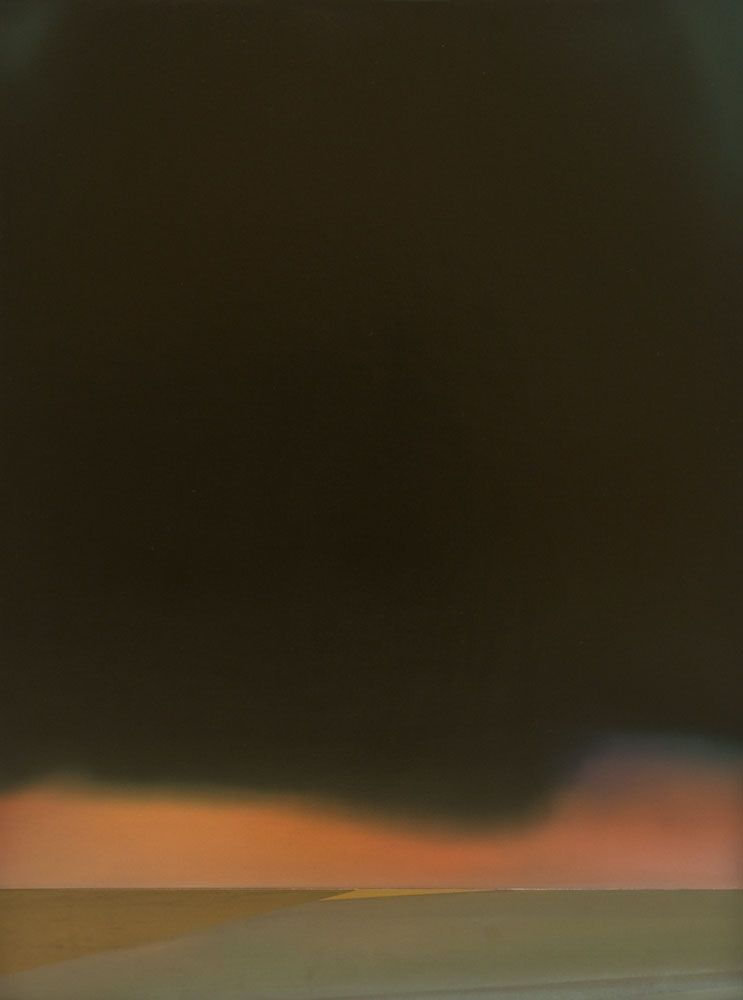
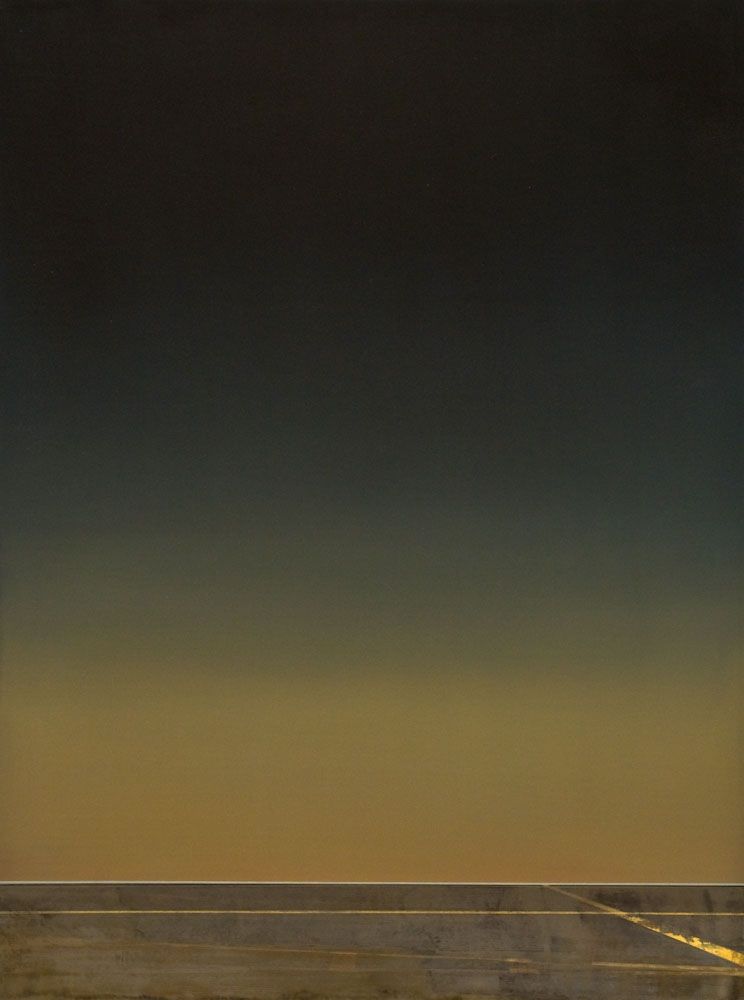
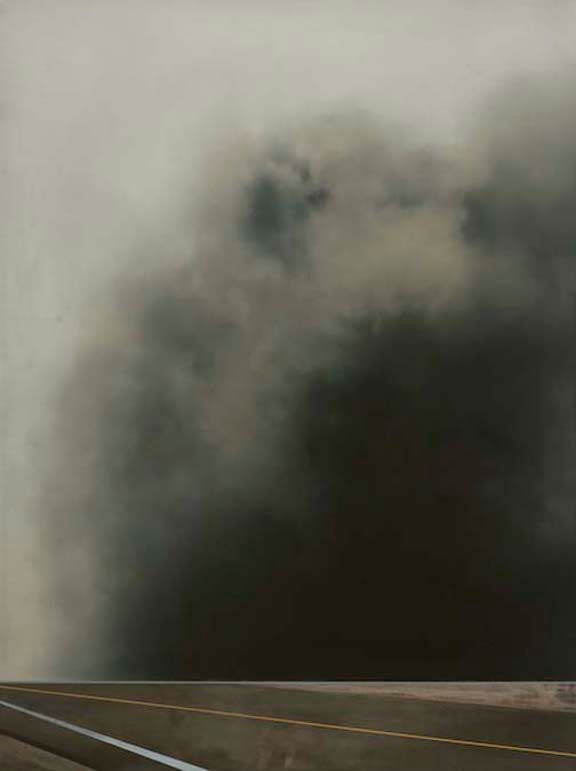
Schopenhauer and Berry again came to mind as I contemplated Christopher Saunders' "Whitenoise" paintings in LaViolaBank Gallery's group exhibition "Outside In." (1) Dark and cloudy skies dominate Saunders' vistas, and the horizon in these flatland pictures draws a conspicuous boundary between sky and earth. In "Whitenoise Suite no.4," an ominous storm front moves over a lonely stretch of highway; a pitch veil chases away a sunset in "Whitenoise Suite no.8"; and in "Whitenoise Suite no.9," a brooding twilight settles above a tarmac. There are echoes of Mark Rothko's luminous melancholy in Saunders' work, but his atmospheric paintings seem most akin to the Romantic landscapes of the 17th, 18th, and early 19th centuries.


Christopher Saunders
"Whitenoise no.9"
2009
Oil on linen
24 x 18 inches

Caspar David Friedrich is perhaps the most celebrated painter of the Sublime, and his "Wanderer above the Sea of Mist" (1818) is among the best known examples. The work pictures a well-dressed, solitary gentleman, his back to the viewer, positioned confidently atop a rocky crag as he surveys a vast, mountainous landscape that is mostly obscured by fog. Concurrent with Friedrich's work on the famous painting, his friend Carl Gustav Carus described Sublime experience in a passage that could well have been written in response to "Wanderer."
"Stand then upon the summit of the mountain, and gaze over the long rows of hills. Observe the passage of streams and all the magnificence that opens up before your eyes; and what feeling grips you? It is a silent devotion within you. You lose yourself in the boundless spaces, your whole being experiences a silent cleansing and clarification, your I vanishes, you are nothing. God is everything."
Carus' experience of the Sublime is, like Berry's reverence, a reduction or erasure of the self-conscious individual and a simultaneous opening of the individual to the wilderness within. His dramatic description brings us back to the moody Schopenhauer, who prescribed the Sublime as a remedy to his every man limits. In his volume The World As Will and Representation (1818), Schopenhauer elucidated a scale of aesthetic experience. At one end of this spectrum, he described the "Feeling of Beauty" as "Light...reflected off a flower. (Pleasure from a mere perception of an object that cannot hurt [the] observer.)" At the other end of the spectrum, the philosopher positioned the "Full Feeling of Sublime" and the "Fullest Feeling of Sublime." These categories are described, respectively, as "Overpowering turbulent Nature. (Pleasure from beholding very violent, destructive objects.)," and "Immensity of Universe's extent or duration. (Pleasure from knowledge of observer's nothingness and oneness with Nature.)" At the amplitude of "Fullest Feeling," then, Schopenhauer's aesthetic philosophy is reconciled with that of Carus and Berry.

Most modern humans (especially modern humans in the First World) are insulated from inclement weather. We fret over a rained-out ball game or beach party, but we rarely tremble before dark cloud heads; our appreciation of the elements is principally one of admiration, an aesthetic experience that resides near the middle of Schopenhauer's scale. But Saunders' landscapes provide viewers with a vantage point that repairs the reverent awe that we once felt before the expansive firmament. He does not include the rugged, mountainous imagery familiar to most artistic depictions of the Sublime. Instead he portrays clouds pushing over a featureless land, the violent potential of atmospheric flux readily observable at a distance. The clouds, vast, magnificent, menacing, dominate Saunders' compositions; they are the rough mountains of our inner wilderness. Despite the "Whitenoise" paintings' relatively small size, their effect is formidable. Before the strongest in the series, I stood quiet.


Christopher Saunders
"Whitenoise no.4"
2008
Oil on linen
24 x 18 inches

(1) Although Saunder's oil paintings preoccupied my imagination, related ideas are addressed by the work of other artists included in the "Outside In" exhibition. I also admired Diane Carr's fluid and evocative landscape paintings, Leighton Pierce's hypnotic video of a woman underwater, and Mira O'Brien's photographic floor installation.

Imaged credits: all Christopher Saunders' works, courtesy of the artist

Monday, September 14, 2009

Kimmel Harding Nelson Residency: Day 8


1884 Button steam engine; Museum of FireFighting; Nebraska City

Appreciating Varieties of Evolution

"Life," writes Loren Eiseley, Nebraska's latter day Thoreau, "is multitudinous and emergent in the stream of time." Considering the evolution of flowering plants, Eiseley explains,
"The true flower - and the seed that it produced - was a profound innovation in the world of life. In a way, this event parallels, in the plant world, what happened among animals. Consider the relative chance for survival of the exteriorly deposited egg of a fish in contrast with the fertilized egg of a mammal, carefully retained for months in the mother's body until the young animal (or human being) is developed to a point where it may survive. The biological wastage is less - and so it is with the flowering plants. [...] The true flowering plants (angiosperm itself means 'encased seed') grew a seed in the heart of a flower, [...] but the seed, unlike the developing spore, is already a fully equipped embryonic plant packed in a little enclosed box stuffed full of nutritious food. [..] The ramifications of this biological invention were endless. Plants traveled as they had never traveled before. [...] The well-fed, carefully cherished little embryos raised their heads everywhere."
Reading Eiseley, I'm struck by how applicable the language he uses to elucidate plant evolution - innovation, wastage, development, invention - is to the maturation and proliferation of human technology. Our machines of steel and plastic are, like the angiosperms, natural and transient shapes of life's eternal striving; they are imperfect adaptations of the moment.


Antique Tractor; Mayhew Historical Village; Nebraska City

We humans are foolishly arrogant, and often conceive of ourselves as the zenith of physical evolution. The sacred books of our species' major religions claim that we are "made in God's image," and, because most folks are literal-minded, unimaginative, or loathe to admit their own cosmic insignificance, that claim is usually understood to mean that God looks like us, and that we look like God. That's a shame, because the claim's power is metaphorical; humanity is "made in God's image," as is the flower or the carpenter bee or the black bear. For all of these species and, indeed, for God, evolution rolls on.

Humans are unable to outwardly observe our continuing development because we are too close to it, and too short-lived a species. Nevertheless, it is happening. Our technological shifts are the most apparent evidence of this ceaseless process. And what technological transitions each modern human is witness to! Like the growth of a child to a parent, the metamorphosis appears a slow, steady progression, but a retrospective survey reveals an astonishing pace. I periodically marvel at the evolution of computer and video games in (roughly) my own lifetime, from the home version of "Pong" to "Halo," but what of the computers themselves or, for that matter, the Internet?

Consider, for a moment, the technological, political, and social revolutions undergone by our country during Mike Bauer's tenure with the Nebraska City Fire Company #1 and the Great Western Fire Company #1. Bauer joined the company in 1865, at the close of the American Civil War. At that time, "bucket brigades," lines of volunteers passing leather buckets from hand to hand, were the primary way of combating blazes. Bauer climbed the fire fighter ranks, from engineer, to foreman, to chief, and served the growing town through the Spanish-American War, the First World War, and the federal introduction of Prohibition and women's suffrage, in 1920. During this time, the fire department's methods evolved from the "bucket brigade," to horse-drawn pumps, to steam-powered pump engines (like the Button engine; pictured above), to, finally, gasoline-motor pumper trucks (like the 1926 Seagrave pumper; pictured below). All of this change, in Bauer's 67 years of active service! It's a happy wonder to contemplate!


1926 Seagrave Pumper Engine; Museum of FireFighting; Nebraska City

Photo credits: all photos, Hungry Hyaena, 2009

Sunday, September 13, 2009

Kimmel Harding Nelson Residency: Day 7


The Ten Commandments on the front lawn of Otoe County Courthouse; Nebraska City

Attunement on a Sunday Morning

I'm a generalist. As such, I'm inclined to connect the dots between purportedly distinct realms of inquiry. It's impossible, of course, to conduct a truly holistic survey, but my crude efforts have led me to conceive of life - what we know of it, at least - as a component part of a vast, even infinite superorganism. I freely admit to finding value in mysticism, and this superorganism notion is readily dismissed by some scientists and scholars as mystical metaphysics, but science itself speaks to an integrity beyond human comprehension.

As Loren Eiseley describes it,
"[This is] one of life's strangest qualities - it's eternal dissatisfaction with what is, its persistent habit of reaching out into new environments and, by degrees, adapting itself to the most fantastic circumstances."
Eiseley was an anthropologist, and he claimed to be a man of "no religion." That may be so, but Eiseley's writing offers humility, wonder, gratitude, and communion in abundance. As I see it, those are the four pillars of religious practice. The fourth of these vital practices, communion, is alluded to by the very word "religion," from the Latin religare, meaning "to bind" or "to tie." Religious action aims to bind the individual to society and, in turn, to the greater whole.

For a decade, I proudly identified as an atheist and, by the measure of most religious people, my cosmology and metaphysics still qualify me as such. It occurs to me, on this Sunday morning, with Nebraska City's church parking lots at capacity, that many of this town's good Christians would reject my claim of religiosity, and not only because my practice rests on a Jewish foundation. My doctrine-less faith appreciates the stories of the Hebrew Tanakh, the Christian New Testament, and the Muslim Koran as parables, poetry, and anthropological artifacts. I read these books in the same way that I do the Tao Te Ching or Herakleitos; they are annotated, analyzed, interpreted, digested, then, in the fullness of time, returned to for a new understanding. But these collections are not my sacred texts. In the eyes of most religious believers, that disqualifies me from tribal membership. Thank G-d.


First Baptist Church; Nebraska City; September 2009
Sign reads, "Faith Removes Mountains Or Tunnels Through"

Still, I am a religious believer, in my way. My holy books are written by biologists and physicists, naturalist poets and essayists, as well as rabbis, ministers, and theologians. None of them is the word of an interventionist, judging god, even though all of them are necessarily part of a greater, unknowable whole, the aforementioned superorganism.

It doesn't matter what you call this organism. As essayist and literature professor Doug Thorpe writes in Rapture of the Deep, "Call it the sublime, call it the Tao, Om, or I AM; still the names don't hold." I most often call it The All, The No-thing, or Hashem, literally "The Name." In the Tanakh, when Moses asks the name of the Presence he has discovered in the burning bush, It replies, "Ehyeh asher ehyeh." "I will be who I will be," or "I will be that I will be." You can call It whatever you will, for It is you. It is also me. It is the sidewalk; It is the grass of the Otoe County courthouse lawn, on which Nebraska City authorities have installed a carved monument to the Ten Commandments, an act that approaches violation of Thomas Jefferson's shrewd "separation of Church and State"; and It is the ether connecting all of these.


Lutheran Church facade; Nebraska City; September2009

If the faith that has grown in me is dogmatic in some way, it is in its insistence on universalism. Literally translated, "universe" means "one turning." Our universe is just that, one breath, one round, one cycle. All that we know and all that we don't know, everything that we can imagine, is but an infinitesimal sliver of The All, one note of an eternal symphony. Even Herakleitos, ancient proponent of reason and science, turned to poetics when he contemplated ultimate meaning; "Nature loves to hide," he wrote. Interestingly, the Hebrew word for universe is olam, a derivative of alam, meaning "to conceal." Jewish mystics, like many of their Hindu, Sufi, and Christian counterparts, believe that God is hidden in the universe, an ineffable force that pervades every dimension, known and unknown.

Theoretical astrophysicists
now suggest that our universe is but one component part of a multiverse, requiring of us another Copernican shift; yet again, the superorganism is re-conceived. In that stretch of the mind are humility, wonder, gratitude, and communion. Science and philosophy, it seems, can also be religious.


Water tower; Nebraska City

So, yes, I'm a religious believer. Paintings, sculptures, and other hand-crafted objects are among my adored icons, but I find occasion for worship in every place, in every form, in every moment. The Monarch butterfly that flapped yoyo-like this morning in front of the KHN Center's kitchen window is worthy of exaltation. I recognize that, for some other viewer, the insect may be ignorable or irrelevant. For others, it is an idol. So, too, might the weathered brick of a downtown Nebraska City building be deemed a clay calf by unimaginative or close-minded "believers." Placing my palm on this brick today, though, my thoughts range through eons of geologic time to consider the primeval mud from which, eventually, we emerged as a gasping fish thing.

Doubtless some of the folks singing inside the walls of the Lutheran, Episcopalian, Catholic, Baptist, Presbyterian, and Methodist churches this morning don't share my enthusiasm for our scaley ancestors. But I'm not concerned with their narrow definition of religion or their selfish understanding of "truth." Although I no longer consider myself a materialist, I'm an unremitting idolater. To those that would condemn that impulse as sacrilegious, I offer Eiseley's reaction.
"People have occasionally written me harsh letters and castigated me for a lack of faith in man when I have ventured to speak of [..] some greater unity that lay incalculably beyond us. [...] They distrust, it would seem, all shapes and thoughts but their own. They would bring God into the compass of a shopkeeper's understanding and confine Him to those limits, lest He proceed to some unimaginable and shocking act - create perhaps as a casual afterthought, a being more beautiful than man. As for me, I believe nature capable of this, and having been part of the flow of the river, I feel no envy."
And I feel no envy, either. There is only dumbfounding, smiling celebration.

Love is, I think, a bit like religion. Humility, wonder, gratitude, and communion are requisite in both, and, as Thorpe puts it, love "demands of us a new way of being in our old world." Religion might be construed as a love affair with The All. It's not always easy, but religious attunement can turn each day, each hour, or each instant, into "a new way of being." Every step is a psalm, every directed gaze is a prayer. Truly, on the streets of Nebraska City this morning, I am an exuberant, enthusiastic mystic.

Photo credits: all photos, Hungry Hyaena, 2009

Friday, September 11, 2009

Kimmel Harding Nelson Residency: Day 5


Chicken coop breed variation display; River Center Nature Center; Nebraska City

What accounts for the amplified patriotism that I feel? This American ardor is not specific to my time in Nebraska City. Over the course of the last year, my national pride has swelled, even as I'm daily disappointed by the reactionary ignorance of so many fellow citizens. Still, in this smallish, midwestern town, I am acutely aware of my American identity.

Perhaps Nebraska City's abundant reminders of our nation's meteoric, messy, and astonishing history forefront my appreciation for my peoples' achievements? Or perhaps it is the love of place reflected in the town's twelve museums, each one a heartfelt labor?


Upstairs annex; River Center Nature Center; Nebraska City

Consider, for example, Joe Voges' River Country Nature Center. Voges, born 96 years ago in Nebraska City, began learning the craft of taxidermy in 1933, at 20 years of age. 47 years later, in 1975, he opened the Nature Center, a collection of mounted wildlife - 90 percent of the taxidermy on display is his handiwork - grouped into natural history dioramas and educational exhibits. In 2005, the museum expanded and moved from Nebraska City's old fire hall to a spacious, street level location nearby.

The taxidermy is by turns amateurish and professional, but the information presented is up-to-date and effectively communicated. The best of the Nature Center exhibits are of American Museum of Natural History quality, and, throughout, one senses Voges' driving desire to educate subsequent generations about the importance of preserving biodiversity and conserving natural resources.


Albinism display; River Center Nature Center; Nebraska City

Perhaps Voges' tellurian impetus is part of the reason I feel a particularly "American" pride in Nebraska City? Like our national history, we're a contradictory, complicated lot, but we fundamentally remain a people that identify the "great outdoors" as a reflection of our values and beliefs, and vice versa. Certainly, there is myth involved in that association, but there is some truth, too.

The contemporary character of this American identification with the land is both Romantic and Utilitarian; it incorporates a self-conscious brand of rugged individualism that, on the one hand, allows for George W. Bush's popular appeal, and, on the other, has made the United States an international wellspring of conservation efforts and environmental philosophy. Despite the previous presidential administration's willingness to bend to the will of extractive industry, the United States remains uniquely positioned to foster among the international community a conservation ethic. Indeed, an overwhelming number of internationally active organizations working for preservationist and conservationist causes are American in origin or base; we are yet the vanguard in the environmental arena.

But even - nay, especially - on the streets of Nebraska City, on the banks of the great Missouri River, at the head of the Oregon Trail, I must inoculate my healthy patriotism against the virus of nationalism. I sometimes wish that "America the Beautiful," Katherine Lee Bates' celebratory hymn, were our country's national anthem, instead of Francis Scott Key's "Star Spangled Banner."

Whereas the "Star Spangled Banner," set to the tune of a popular British drinking song, extols military valor and revolution in the name of freedom, Bates' "America" is both a celebration of our vast American landscape and a plea for social justice, pragmatic politics, and humility. Hers is the United States of America that fills my breast with pride; hers is the clay that I am made of.
"O beautiful for patriot dream
That sees beyond the years [...]
America! America!
God mend thine every flaw,
Confirm thy soul in self-control,
Thy liberty in law!"
In 1930, then Secretary of Agriculture Henry Wallace stated, "There is as much need today for a Declaration of Interdependence as there was for a Declaration of Independence in 1776." I agree, and we're overdue, but I'm starting with the anthem. The Brits can take back their drinking and fighting tune.


Missouri River display; River Center Nature Center; Nebraska City

Photo credits: all photos, Hungry Hyaena, 2009

Tuesday, August 25, 2009

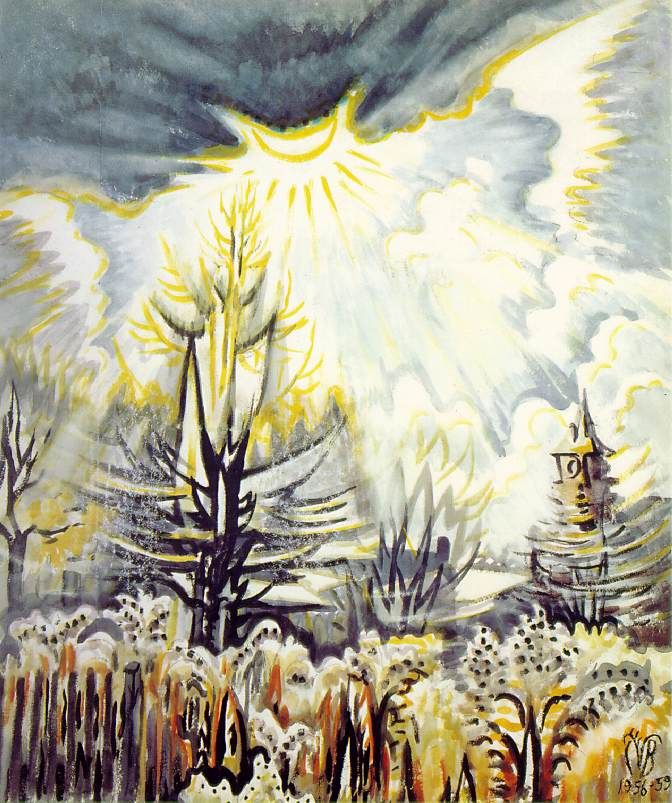
The Most Fundamental Form of Passion


Charles Burchfield
"November Sun Emerging"
1956-59
Watercolor on paper
37 3/4 x 31 7/8 inches
"[How] can we account for that irresistible instinct in our hearts which leads us towards unity whenever and in whatever direction our passions are stirred? A sense of the universe, a sense of the all, the nostalgia which seizes us when confronted by nature, beauty, music - these seem to be an expectation and awareness of a Great Presence. [...] Resonance to the All - the keynote of pure poetry and pure religion. Once again: what does this phenomenon, which is born with thought and grows with it, reveal if not a deep accord between two realities which seek each other; the severed particle which trembles at the approach of 'the rest'?

We are often inclined to think that we have exhausted the various natural forms of love with a man's love for his wife, his children, his friends and to a certain extent for his country. Yet precisely the most fundamental form of passion is missing from this list, the one which, under the pressure of an involuting universe, precipitates the elements one upon the other in the Whole cosmic affinity and hence cosmic sense. A universal love is not only psychologically possible; it is the only complete and final way in which we are able to love."

- excerpt from The Phenomenon of Man, by paleontologist, geologist, philosopher, and Jesuit priest Pierre Teilhard de Chardin
Image credit:Burchfield image ripped from Mark Harden's Artchive

Thursday, July 16, 2009

Other Peoples' Lives: The Sundurbans


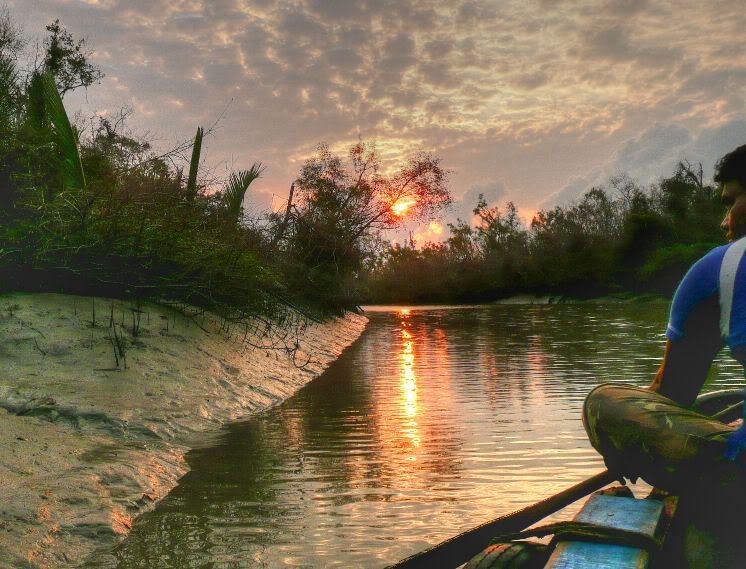
Sundarbans National Park, Bangladesh
"From time to time, we passed solitary women trudging through the water near the shoreline, pulling nets behind them as they trawled for prawn seed. This practice, introduced in the past twenty years or so, has disastrously reduced prawn and other fish populations, and the constant pacing along the fragile shore by the women and children who drag the nets has contributed to erosion. In their flowing saris, the women presented picturesque silhouettes that belied the danger of their work, up to ten hours a day waist high in the murky water. As many as ten fatal crocodile attacks are documented each year, and, I was told, too many shark attacks to report. The most common are by dog sharks, which take a bite of soft tissue—a leg or buttock—but do not kill. 'They are considered minor hazards,' Dr. Sanyal said, with a sympathetic grimace. The Sundarbans's occupational hazards—crocodiles, sharks, cobras, kraits, swimming tigers, and cyclones—make it one of the most dangerous places in the world."
-Caroline Alexander, "Tigerland" (The New Yorker, April 21, 2008)

Photo credit: ripped from joiseyshowaa's Flickr photostream

Saturday, April 18, 2009

Corey Arnold's Sea


Corey Arnold
"Gulf Crossing, Bering Sea, Alaska"
2007
Chromira C-print


Curiously, Sara Tecchia Roma's press release for Corey Arnold's solo exhibition, "Fish Work," describes the artist as "an Alaskan crab fisherman animated by a life long artistic project." I wonder, does Arnold identify as a fisherman first and a photographer second? Or perhaps the two occupations are inextricably tangled? Whichever designation Arnold prefers, his pictures evidence a daring spirit - an attribute I associate with Bering Sea fisherman, but rarely with fine art photographers - and an expert eye.

Arnold's photographs capture northern ocean landscapes and document the lives of men that harvest its depths. Most of his working fishermen pictures are handsome records of an uncommon life style, but they are undistinguished as works of art. Not so for Arnold's strongest images; when the photographer turns his lens on the water, he provides viewers with a glimpse of sublime wonder. His pictures humble us.

As the gallery press release states, viewers are reminded "not only of the beauty but also of the undeniable power that Nature holds against mankind." I'd amend that statement slightly. Nature doesn't work against mankind; its staggering violence is ambivalent, and humanity is a vital part of it.


Corey Arnold
"Bering Sea Birthday, Bering Sea, Alaska"
2006
Chromira C-print

Thursday, January 15, 2009

Coasts


Steep Ravine Trail, Mount Tamalpais, December 29th, 2009
"The deepest level of communication is not communication, but communion."
Elizabeth and I devoted the afternoon of my thirty-first birthday to striding down (and then huffing back up) the aptly named Steep Ravine Trail in Mount Tamalpais State Park. During our descent, we paused for a few minutes on a stocky wood footbridge spanning a shallow gully stream. I leaned against the bridge's handrail and appreciated the subtle play of sunlight on the forest's understory, then tilted my head far back to admire the towering canopy. A bird call punctuated the stream's casual susurration.

The impressive montane forest brought to mind a quotation I copied into one of my commonplace books some years ago. In his account of an interview with a Venezuelan native, the celebrated 19th century German naturalist Alexander von Humboldt claims that the Indian critiqued the Christian God of the European explorers and conquerors, observing, "Your god keeps himself shut up in a house as if he were old and infirm. Ours is in the forest and in the fields and on the mountains when the rain comes." Although no rain graced Mount Tamalpais this December 29th, the Indian's god was also mine.


Steep Ravine Trail, Mount Tamalpais, December 29th, 2009


Mount Tamalpais is located in southern Marin County, California, just north of San Francisco. The lush Douglas fir and redwood forests of the region are magical places. They served as inspiration for George Lucas's forested moon Endor and they call to mind the epic majesty of J.R.R. Tolkien's Middle-earth. (In fact, some "Star Wars" fans reasonably suggest that Lucas named his verdant moon in homage to Tolkien. Tolkien, a celebrated linguist and scholar, invented languages for his fantasy fiction and in the Quenya tongue, one of the elvish languages he created, the word for Middle-earth is Endor.)

Of all Tolkien's creatures, the elegant and noble elves of Lothlorien especially appealed to me when I first read "The Hobbit" and "The Lord of the Rings." The elves are wise, fair and gracious beings, but also wild, intimately attached to the world of the hunter and to Nature's ambivalent magic. Twenty years after my first reading of Tolkien's fantasy epic, I still proudly characterize myself as a Nature worshiper.

The economist and sociologist Max Weber famously said that the secularization of society and increasing specialization of methodological inquiry had led to a "disenchantment of the world." Indeed, they have, but Baruch Spinoza's brand of naturalistic pantheism allows for a happy marriage of the material and metaphysical worlds. The two spheres, like the taijitu's yin and yang, are complementary parts of a whole. Necessarily, then, exclusion or disparagement of one of these two realms is limiting.

Although the Enlightenment's separation of reason and imagination, and of science and religion, has yielded exemplary human achievements, it also alienates us from the integrated aggregate. We no longer conceive of the universe (or our experience of it) as coherent or unified; since at least the 17th century, the prevailing philosophical current is Cartesian, depicting the universe as a random assemblage of disparate parts. As a result, those individuals who, like the brilliant 19th century critic John Ruskin, strive to reconcile "the broken harmonies of fact and fancy, thought and feeling, and truth and faith" are considered naive or fey. Even Gershom Scholem, the renowned historian of Jewish mysticism, described his philosopher friend Walter Benjamin's work as "an often puzzling juxtaposition of the two modes of thought, the metaphysical-theological and the materialistic." I align myself with the philosophical dissidents because, like Ruskin and Benjamin, I feel that the material and metaphysical realms are locked in a harmonious, reciprocal relationship. Framed another way, I believe that the mundane is the sacred; I deny the divisive "and."
"My dear brothers and sisters, we are already one. But we imagine that we are not. So what we have to recover is our original unity."

Steep Ravine Trail, Mount Tamalpais, December 29th, 2009


That December evening, Elizabeth and I motored along Grizzly Peak's ridge line and, as the Pacific horizon took the sun, we admired the colorful strata deposited over San Francisco's hills, city lights and bay. Later, after a lovely dinner in Berkeley, we returned to Elizabeth's home and relaxed with her parents and brothers. It was a superlative day. Yet because I'm accustomed to spending my birthday in brooding solitude, it was also an exceptional one, and therefore I wasn't surprised when, driving to Grizzly Peak, I felt a twinge of regret.

To be sure, the day was nearly perfect, but I had to ignore the call issued by the deep blues and purples of twilight, an invitation to submerge myself in the gathering darkness. I remarked to Elizabeth that it felt very strange to observe my birthday without making space for rumination. We turned onto Grizzly Peak Boulevard. I watched the car's headlights rake across a stand of trees, frightening back the dark.


View of Berkeley and San Francisco Bay, December 29th, 2009


The Trappist monk Thomas Merton described his contemplative practice as "death for the sake of life." Merton may be guilty of rhetorical flourish, but one of contemplation's principal goals is the erasure of self or the death, if you will, of the self-conscious individual. I consider myself lucky; I once experienced release from the first-person, a rare gift in our culture of consumption and distraction. I consider those exceptional moments an ecstatic opening to The All, a glimpse of the integrated, infinite universe.

The word ecstasy is derived from the Greek word for "to stand out of place." On the dike at Heron's Foot, my conscious being was literally outside (or at least without) the self. For a time, the atoms, molecules, cells and organs that comprise "me" were undifferentiated from the greater web. Religious mystics usually refer to this variety of fundamental experience as "seeing God." That name bothers me less than it did in my militantly atheistic adolescence, but I prefer The All (or an apophatic counterpart, The Nothing) because the name possesses majesty and mystery but none of the unfortunate authoritarian baggage. Furthermore, the rituals of institutionalized religion and its "under God" subjects are no more or less valuable than the rituals of the heathen mystic. John Dewey's "live animal" might just as easily be awakened in the gropings of sex as in penitential prayer, and God is just as easily found in the forests of Mount Tamalpais as in the acolyte's cathedral. After all, there is nothing supernatural about ecstasy; it is only a mode of hyper awareness, a more immediate connection to the universe, or at least as much of one as our limited vessels can perceive.

Now, January already half gone, I sit at my day-job desk and look out on Manhattan's East River. The late afternoon sun's angled glow paints the 59th Street Bridge in peach-yellow and refracts off the west face of Citibank's glass obelisk in Queens. A herring gull flaps over Roosevelt Island and the river runs slack as it awaits the pull of outgoing tide. In "Rewriting Nature," an essay published in The New Yorker, Adam Gopnik wrote "[Charles] Darwin disenchanted believers in Heaven, but he reenchanted lovers of Earth."

I concur.
"What we have to be is what we are."

Office window view; East River, Roosevelt Island and Queens, January 2008


Note: all indented quotations, Thomas Merton

Photo credits: all images, Hungry Hyaena, 2008

Monday, September 08, 2008

The Benefits of Flight-induced Relativism


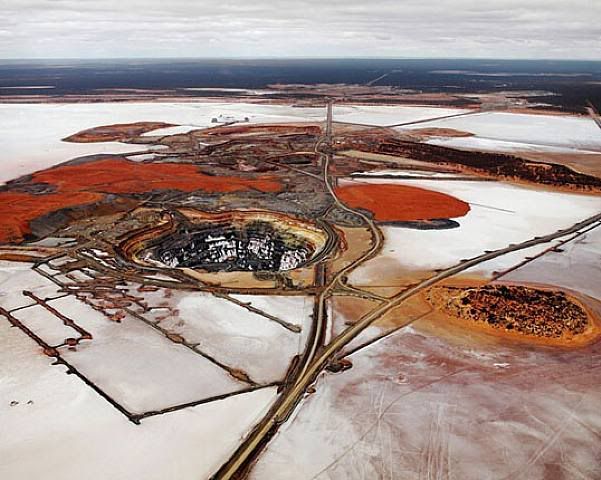
Edward Burtynsky
"Silver Lake Operations #2, Lake Lefroy, Western Australia"
2007
Digital chromogenic print
Dimensions variable

"From the height of ten thousand feet, the earth appears to the human eye as it appears to the eye of the camera; that is to say, all history is reduced to the accidents of nature. This has the salutary effect of making historical evils, like national divisions and political hatreds, seem absurd.
...
If the effects of distance between the observer and the observed were mutual, so that as the objects on the ground shrank in size and lost their uniqueness, the observer in the airplane felt himself shrinking and becoming more and more generalized, we should either give up flying or create heaven on earth."
-W.H. Auden

For more thoughts on altitude granted relativism, read my post, "The Absurd Whole," a response to an exhibition of Michael Light's photographs.

Photo credit: Burtynsky photograph ripped from artnet

Friday, June 27, 2008

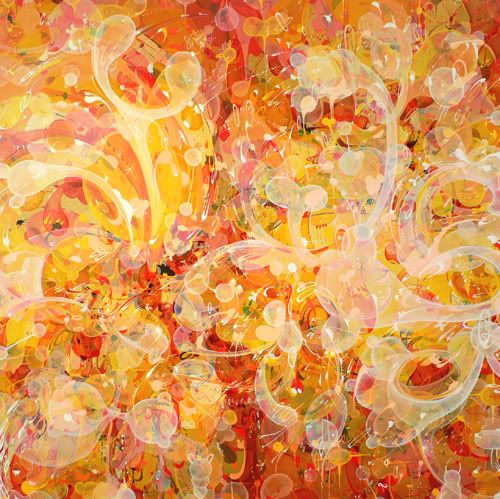
Aurora Robson's "Shebang"


Aurora Robson
"Shebang"
2007
Oil on panel
36 x 36 inches


There are at least seven strong works included in Gallery Satori's "Unreal City" exhibition (on view through July 27th). Among others, I was engaged by Jeremiah Teipen's basement smoke and light show ("Nothing, and everything"), Carlos Roque's aural-sculpture ("Sonic Architecture"), and two of Ha Rhin Kim's acrylic on mylar works, but Aurora Robson's "Shebang" resonated intensely.


Aurora Robson
"Polaris"
2007
Oil on panel
36 x 36 inches


The saturated color, layered surface and energetic, sensuous arabesques bring to mind the work of Brazilian painter Beatriz Milhazes, but where Milhazes is content to dwell in decoration, Robson embraces a more experiential magic, one that springs from an awareness of the ether.


Aurora Robson
"47 Society"
2006
Oil on panel
24 x 24 inches


Hers is a physicist's sensiblity; the exuberance I felt in the presence of "Shebang" is the same I feel when I think hard on spacetime or abiogenesis.

Standing with the painting, I recalled something I'd recently read in Harper's Magazine. The following text is excerpted from "The Devil's Delusion: Atheism and Its Scientific Pretensions," by David Berlinksi.
"'Faith' it is said in Hebrews 11:1, 'is the substance of things hoped for, the evidence of things not seen.'...If religious belief places the human heart in the service of an unseen world, the serious sciences have since the great revolution of the seventeenth century done precisely the same thing....

The universe in its largest aspect is the expression of curved space and time. Four fundamental forces hold sway. There are black holes and various infernal singularities. Particles pop out of quantum fields. Elementary particles appear either as bosons or fermions. The fermions are divided into quarks and leptons. Quarks come in six varieties, but they are never seen, confined as they are within hadrons by a force that perversely grows weaker at short distances and stronger at distances that are long. There are six leptons in four varieties. Depending on just how things counted, matter has as its fundamental constituents twenty-four elementary particles, together with a great many fields, symmetries, strange geometrical spaces, and forces that are disconnected at one level of energy and fused at another, as well as at least a dozen different forms of energy, all of them active.

This is not an ontology that puts one in mind of a longshoreman's view of the material world. It is remarkably baroque, and it is promiscuously catholic."

Such baroque catholicism is the stuff of theoretical science, but it is also the stuff of good art.


Aurora Robson
"Diasporalia"
2006
Oil on canvas on panel
72 x 108 inches


Note: David Berlinski is a proponent of Intelligent Design. I made clear my stance on his position in an earlier post, but I see no reason to dismiss all of his ideas because we disagree with specifics.

Photo credits: Aurora Robson images ripped from her website