Showing posts with label ritual. Show all posts

Thursday, September 15, 2011

The Beautiful / Palace Prayers

OLD MOONS

Old moons now are dried and crusty
Brittle and as uninteresting as history is
To my fingers and lips.

And yet also, it cannot be denied
That each man
King of his home-throne
Misses something of eternity
When he chomps down on lamb chops
(Which are his reward
For winning the bread)

Each of us misplace the universe
And lose the word
When we get our desires
On plates before us.

There is a grain of rice on the table.
Around it, oil has bled
And spreads

In this way does our egodeath
Halo around us
  And puncture the beauty
    Of clouds
- Yusuf Misdaq

Two years ago this month, I highlighted the poet, musician, artist, and author Yusuf Misdaq's Palace Prayers project. August 21st - September 19th, 2009, was Ramadhan, and Misdaq, a practicing Muslim who, as I noted at the time, "shares my universalistic mystical inclination," created a new work of art for every day of the month-long fast and period of Muslim introspection.

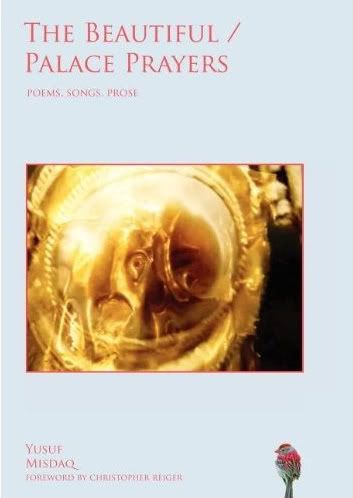
Some months later, Misdaq invited me to contribute a forward to a book of his poetry, prose, and lyrics. That book, The Beautiful / Palace Prayers, was published this year. Visit Misdaq's website for more information.

+++++
"Dissolution Is The Whole Show"

When Yusuf invited me to contribute a foreword to The Beautiful / Palace Prayers, I was at first surprised. Although I enjoy reading poetry, my education in literature is wanting, and my tastes run to work that most "serious" critics and scholars deem pedestrian. Who am I to comment on this young artist's latest collection? With characteristic enthusiasm, however, Yusuf's invitation quelled my self-doubt, insisting that The Beautiful is made up of poems "for normal people who do not normally read poetry." Well, in that case, it is a privilege and a joy for this normal person to introduce a collection of poems, verse, and prose written "for normal people"!

        They are a good species.
        Clean and caring;
        Made mostly of water and forgiveness
              - from "The Beautiful"

Normal people are very much in need of poetry, and perhaps especially so today, when the art is generally neglected. Words are powerful entities, every one an invocation, yet we too often use them carelessly. Poetry, like prayer, can serve as a corrective, reminding us that words conjure meaning and that they have a felt, physical component. As critic and philosopher George Steiner writes, "the meanings of poetry and the music of those meanings...are also of the human body." Appropriately, Yusuf refers to the italicized and apparently random words that he includes in some of his poems as "body echoes." "Carbunkle. Crellis. / Pulse-if. peaces." or "Que Que" are not intelligible formulations but, when read aloud, they aren’t exactly jibberish either. They supply somatic meaning, as do the poems’ rhythms. Yusuf's strongest poetry or verse has a perceptible pulse; in some cases, I notice my head slowly bobbing as I read. This is not insignificant. Beat and rhythm are primal properties, manifestations of the infinite, unfathomable being within which we reside and of which we are composed.

        Echoes
        of the original
        Voice
        From the original
        Breath
              - from "Ramadhan 26"

Ludwig Wittgenstein insisted that earnest philosophers should "descend into primeval chaos and feel at home there" if they expect to produce worthy work. I extend the same requisite to artists. Yusuf draws pictures, makes films, and writes poems, novels, and songs, but he is, above all, a mystic. And mysticism, in its quest to directly experience elemental truths, necessitates Wittgenstein's appreciation of the primeval and the chaotic; ancient disorder is at the root of everything. In most cases, the mystical perspective is merely an uncommon one; mystics survey and respond to the same earthly, material realm that the rest of us do. But they disregard accepted classifications and train themselves to mindfully observe and reinterpret their surroundings. They locate the extraordinary in the mundane. As Henry David Thoreau, a 19th century mystic, lamented, "All this [splendor] is perfectly distinct to an observant eye and yet could easily pass unnoticed by most." Mystics reawaken their capacity for reflective wonder and, in doing so, experience a kind of rebirth into a vaster dimension of human experience.

        On perfect Spring mornings
        God puts a clear blue sky in our pockets
        Pats us a few times and says
        'On your way!'
              - from "The Merciful Cheerful"

So reborn into sublime beauty, mystics strive toward the transcendent. Both Wittgenstein and Thoreau can be described as transcendentalists; Yusuf qualifies, too. Like the two philosophers, he finds in his observations of the world cause for a fundamental optimism. Unlike them, his writing is generally informal and devoid of pretension. His poems give readers the impression of a devout Sufi Muslim happy at play in our waking, sensual dream. In the collection's title poem, Yusuf writes "Awake in this dream / Where abstract clouds calmly keep us. / Where birds secretly make love in public and / Give voice to the current of joy which / Slices through us in a day." Again, in "Back Amongst Men (Drowned)," he references this dreamed life: "Or as I have also interpreted it / .God is a laughing dream." No doubt, the poems’ author, laughing, singing, eyes wide and sparkling, would appear mad to many of his fellows. This is to their discredit. They have forgotten (or failed to learn) how to look. Mystics, like many philosophers and artists, are too easily dismissed as lunatic or eccentric. Yusuf's ability to see through the veil of our cultural forgetfulness informs his aesthetic imagination and invigorates his art.

        Silk veils, dark and weightless
        Are being removed from her countenance
        Time after Time

        Each day I ready myself to know her better
        Each day, closer
              - from "Wahad"

But not all that Yusuf observes is felicitous. The most biting poem included in The Beautiful, "Ramadhan 23: Only To Be With You And No-one Else," is a reaction against the politicization of Islam and a celebration of his intimate relationship with Allah. After rejecting the "bloody bridge builders / Shmoozers or politicians" and others who "come to the Mosque smiling in your suit," Yusuf writes, "I wish to be alone / And serious / And deeper in love / With the only one who ever matters." The striking seriousness of his personal communion with G-d is important; discipline is one of the central currents running through the poems included in The Beautiful. In “Waiting (A Song for Guitar),” Yusuf writes, “I do believe in magic but first you gotta work at it.” Hope and love, he reminds readers, are nurtured through dedicated ritual and practice.

        Understand, thee
        That tenderness comes not of softness
        But of a firmness
        And of a discipline

        Understand that of discipline
        -Say, the discipline of prayer-
        Comes an enjoyment of that same thing.
        Discipline to run breeds a love for running
        Discipline to practice ones instrument brings forth a love
        for playing it
        Discipline to speak good breeds a love of horses
        And love of all refined things
        Whatever you may find them to be.
              - from "Ramadhan 12: The Vows Revolve"

A visual artist, I appreciate the centrality of discipline in a life committed to aesthetics. Like Yusuf, though, I am also mystically inclined. Paintings, sculptures, and other hand-crafted objects are among my adored icons but, if I work at it, I can find occasion for worship in every place, in every form, in every moment. The European starling that paraded on the sidewalk in front of me this morning warranted exaltation. In his iridescent dream coat and brilliant yellow bill, I see cause for startling, smiling celebration. For some other pedestrians, the bird, a representative of a despised species, may be ignorable or irrelevant. For others, my viewing the starling as a manifestation of the Divine amounts to idolatry. So, too, might the dirty, discolored Queens sidewalk be deemed a cement calf by unimaginative or close-minded "believers." Yet, striding on such a sidewalk today, my thoughts range through eons of geologic time to consider the ancient rock and mud, precursors to and components of the concrete that I now tread upon, from which our kind eventually emerged on crude limbs as a gasping, fish-reptile thing.

        The salt-pepper sugar mills on this table look like planets.
        I want to know the word for planet in as many different
        languages as possible.
              - from "Celestial"

Doubtless some of those who consider themselves religious don't share my enthusiasm for our scaled, long-snouted ancestors. But I'm not concerned with narrow definitions of religion. I believe that humility, wonder, gratitude, and communion are the four pillars of genuine religious practice, and the mental stretching engendered by the work of scientists, philosophers, and artists is an integral part of any intellectually rigorous, honest religious life. And, love, too, is a bit like religion. The same four pillars are fundamental to it. As Douglas Thorpe writes, "[love] demands of us a new way of being in our old world." Religious mysticism is a love affair with The All. It's not always easy, but religious attunement can turn each day, each hour, or each instant, into "a new way of being." Reading Yusuf's poetry, I'm reminded that every step is a psalm, every directed gaze is a prayer.

        Dot-Dot-Purple and Palaces
        Says the starling in approximate translation.
        Star-Star-Chandeliers and
        Bread on the wind-ind-ind.
              - from "The Beautiful"

I'm also reminded that we both enjoy watching starlings.

- Christopher Reiger, May 1, 2010

Friday, January 07, 2011

Jeffrey Simmons' Sacred Circles


Jeffrey Simmons
"Apparent Horizon VI"
2010
Watercolor on paper
12.5 x 9 inches

If you're in the Bay Area this January, I encourage you to visit "Apparent Horizons," Jeffrey Simmons' solo show of watercolor paintings at Baer Ridgway. Most of the works on view feature "semi-transparent concentric circles [...] with subtle color variations between each light-hued ring." That description, taken from the gallery's press release, is perfectly accurate, but it fails to convey the other-worldly experience of Simmons' pictures. Radiant and diaphanous, the circles vibrate and murmur on the paper's surface. Calling to mind minimalist Buddhist mandalas or Hindu yantras, the paintings could well serve as objects of sacred utility, focal points for meditation and, for those who dabble in mysticism, gateways into the sublime.


Jeffrey Simmons
"Apparent Horizon I"
2010
Watercolor on paper
15.75 x 11.25 inches

The Bear Ridgway press release describes Simmons' work as "painstakingly engineered." Indeed, like those of the mandala-making monk, the artist's processes require meticulous control. To produce the paintings, Simmons uses a rotating easel, situating his brush hand so that it remains stationary while the paper moves, turntable-like, beneath it. I get a kick out of knowing this; artists like to peer over one another's shoulders because we're as curious about the 'how' as we are enthused by the 'what.' When appreciating artwork, however, technique should be a secondary concern; if the machinations of the man behind the curtain are more important than the smoke and light show he endeavors to produce, he won't wear the wizard mantle for long. Happily, Simmons' shimmering, ethereal pictures prove him an adept; I look forward to seeing more of his work.


Jeffrey Simmons
"Apparent Horizon III"
2010
Watercolor on paper
15.75 x 11.25 inches

Imaged credits: all images, courtesy Baer Ridgway Exhibitions

Sunday, July 20, 2008

Catharsis


Fourth of July Fireworks; Viewed from Red Hook, Brooklyn; July 2008

"Catharsis is properly effected not by works of art but by religious rites. It is also effected, less properly, by bullfights, professional football matches, bad movies, military bands, and monster rallies at which ten thousand Girl Guides form themselves into a living flag."
- W.H. Auden

Photo credit: Hungry Hyaena, 2008

Friday, October 14, 2005

Image hosted by Photobucket.com
Temple brooms; Kyoto, Japan, 2005

Photo credit: Hungry Hyaena, 2005

Wednesday, October 05, 2005

Selling Atheism and Myth

Image hosted by Photobucket.com
When transferring from the A/C/E subway line to the N/R/W at 42nd Street in Manhattan, passengers must walk down a long, underground tunnel. If they happen to look up at the tunnel's low ceiling, they'll notice three or four word excerpts on signs mounted to the ceiling reinforcements. If one reads the signs as he walks the length of the tunnel, he'll realize that each sign is a "piece" of a poem. The subject matter is mundane, literally, and the poem rather bleak. In short, the uncredited writer asks why we wake and go to work, day after day, our lives spiritually empty and dull. In the context of the smelly, humid subway tunnel, crowded with commuters, the poem resonates.

This past Saturday afternoon, as I made the E to W transfer, a group of teenage girls walked just behind me. Half listening to their conversation, I realized they were discussing the poem. They mocked it. "It's so stupid," one of them giggled. "What the fuck? I mean...," another girl trailed off. To some extent, I can sympathize with their reaction; the poem doesn't convey the most original sentiment. "You know what I don't get?," said a third girl. "What's it even advertising?"

Oh...my...God.

What is it advertising?! What is this MTA commissioned public poetry advertising?! Burma Shave, this ain't, babe.

I should know better than to be surprised. These girls, roughly seventeen years of age, are plugged into consumer culture. Theirs is the generation of the spectacle and the billboard. They were thirteen when the World Trade Center fell (on television, again and again and again) and they represented America's youngest consumer demographic, parental parasites, during the economic bubble of the late nineties. The third girl's question is, from their perspective, a fair one. Why isn't this poem an advertisement?

I didn't know whether to laugh or shudder. I slipped into a brooding mood. These are dark times, I thought.

But it's not enough to criticize, break down, and dismiss. Even constructive criticism, that much celebrated will-o-the-wisp, which can be invaluable to the artist, politician, and athlete, provides little reward for the critic himself. He may be able to pinpoint a conceptual contradiction, a fatal weakness in policy, or an unfortunate quirk in form, but how useful is his ability to notice the negative? Is the critic able to turn his judgment inward to correct his own failings?

I enjoy reading good criticism, be it social, literary, or aesthetic, but even the most capable wordsmiths can't make criticism complete unless they prescribe some balm. A batter who has fallen into a slump will not be helped by a coach who only cites what the batter does wrong. The good coach - the complete coach - recognizes the failing and attempts to correct it, explaining to his player not just what is wrong, but also what might work.

Incomplete though most criticism may be, negative noise must be made before there exists any serious striving for improvement. I regularly talk with people who share my sense of disillusionment and betrayal. I see folks shake their heads when reading the day's newspaper headlines and I often hear folks complaining about the administration or about the passing of a particular bill, but our overall complacency is noteworthy. There is some noise being made, of course, but the majority of protests lack focus - people shout 'No blood for oil!' while wearing PETA sweatshirts - and the political plays made by those brave politicians - republicans, in the traditional sense of the word - resisting the red tide are far too esoteric for most of America to rally behind. (Thoughtful, politically savvy bloggers may seem ubiquitous, but they remain a tiny fraction of the general populace.)

Why are we so quiet? Has the barrage of bad news made toadies of us all? When I do get worked up about the "general state of things," I feel as though my outrage is excessive. Perhaps vehement rants about the current administration are considered passe, but does this make them any less vital? Is resistance possible in the current culture of distraction and fear? What does it take to reach "every man" in the era of spectacle?

Ronald Aronson has a good review in the most recent Bookforum, entitled, "Faith No More? Against the Rising Tide of Rejuvenated Religion, A Number of Writers Make the Case for Disbelief." In it, he suggests our contemporary apathy results from the unrealized promises of a better future.
"It's safe to say that the future didn't turn out as anyone expected. Scientific and technological progress has been relentless, but its promises of liberation have gone flat. Few still believe that their children's world will be better than theirs. We live after Marxism, after progress, after the Holocaust - and few imaginations are stirred, few hopes raised by our world's long-range tendencies. Indeed, the opposite is happening as terrorism becomes the West's main preoccupation. In countries like the United States, Britain, and France, there has been a turning away from improving societies and toward improving the self."
Aronson, reviewing seven recent books dealing with the decline of atheism, convincingly argues that the return to God and otherworldly authority figures increases the power of those who already hold the reins, and therefore represents a weakening of The Republic, a collapse of democratic ideals. Near the end of his piece, he writes,
"The rational and constantly self-questioning and self-correcting world view is essential to democracy and its ongoing public discussion about everything under the sun. Those disasters of history not explicitly tied to religion in fact still reflect starting points of authority and unquestionable dogma. Democracy, after all, is congruent with freedom, which is in turn congruent with the world view that presupposes little and questions everything. 'Democracy proceeds by one set of principles. Religion by the opposite.' Atheism is 'one of the natural allies' of democratic societies."
As an atheist, I agree with Aronson and the writers of most of the books he reviews. (To feel as I do, you must believe that moral living is better served by non-believers who recognize that an ethical core is "part of the furniture of the universe," as Plato put it. Moral acts or laws - the Ten Commandments, for example - designed to ingratiate a believer to their respective God or gods are necessarily less virtuous and, above all, self-serving.) However, Aronson needs to ask himself why so many atheists are content to revile religion without offering a thoughtful alternative. Such alternatives do exist, but atheists have a hard time making them attractive to the majority because the absence of an afterlife is too troubling for most people to accept. Unhappy in their own narrative, disappointed by the once promising future, they place their trust in a different sort of "future," an altogether supernatural one.

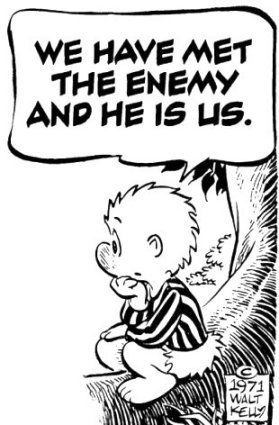
The recent surge in popular interest in aliens, ghosts, supernatural storms, elementals, and any number of other vaguely mystical beings - check the local TV listings if you don't know what I'm referring to - is proof enough that we are a culture living in fear of ourselves. As Pogo, Walt Kelly's philosophical cartoon opossum, said decades ago, "We have met the enemy and he is us." Aronson, trying to salvage some sense of hope, concludes his review with a recipe for a happy, secular society.
"A new atheism must absorb the experience of the twentieth century and the issues of the twenty-first. It must answer questions about living without God, face issues concerning forces beyond our control as well as our own responsibility, find a satisfying way of thinking about what we may know and what we cannot know, affirm a secular basis for morality, point to ways of coming to terms with death, and explore what hope might mean today."
Given the current climate, accomplishment of the goals set forth by Aronson seems highly unlikely at the societal level, though it remains possible for individuals. More importantly, listing what must be done without addressing how it can be done is, like negative criticism, altogether easy and almost pointless.

Underlying the fear and the increasingly fascist feel of the United States is an absence of myth. This is not new. Mark Rothko, the twentieth century painter, wrote extensively on our search for a "master narrative." He was convinced that the loss of myth, so much a part of the Middle Ages and the Renaissance, was responsible for the violence and break-down that led to both World Wars. Though Rothko glossed over some of the more repugnant realities of both these eras - and ugly they could be - the loss of myth, of a central story and purpose - did contribute to what so many have deemed the "decline of Western civilization." Religious fundamentalists argue that this decline occurred as a result of loosening morals and a "turning away" from god worship, but the corruption and violence of the first half of the twentieth century is more accurately moored to the industrial revolution and the myriad temptations of free-market capitalism, both of which forced societies to become more focused on the individual good. I agree with Rothko; a myth is needed where a god is not. Star Wars is a myth - this is only true of the first trilogy, before Lucas introduced the idea of genetic superiority via metachlorion count - and so is The Lord of the Rings. Both sagas weave together the universal myths, those elements that can be found in all theology and everyday life, to create timeless narratives of self-worth and social obligation, reminding us that the little man can make a difference and that good can and will triumph over evil, but not without a lot of heart and courage. The philosophical problems with the concept of "good" and "evil" aside - postmodernism and relativism must take a back seat here - myths rarely grant power to a very few and, when this does occur, the powerful are inevitably overthrown and made examples of.

Without livable myths, most of us turn to the Abrahamic God, abandoning mythical narrative to the realms of science fiction and fantasy. But that god, at least as it is usually conceived of, is a pale shadow of myth for "He" is without practice, only ritual and faith. Faith is a virtue, but it is too easily coopted and dubbed loyalty. Scared by the world we inhabit, we turn to television in the hopes of being frightened further by spectres, aliens, and possessed girls. Dissatisfied with our "little" lives, we celebrate garish displays of wealth, influence, and sexuality, turning all three into absurd caricatures of themselves - reducing them in the process, which ultimately makes them that much more easily abused. But wait! There exists a narrative we can all identify with, a truth all contemporary Americans can rally behind.

"Overworked
So Tired.
If Late
Get Fired.
Why Bother?
Why the Pain?
Just Go Home
Do It Again."

But I don't get it. What's it selling?

Photo credit: 1971, Walt Kelly, "Pogo"