Showing posts with label Michael McDevitt. Show all posts

Tuesday, April 23, 2013

When It All Comes Together

Christopher Reiger
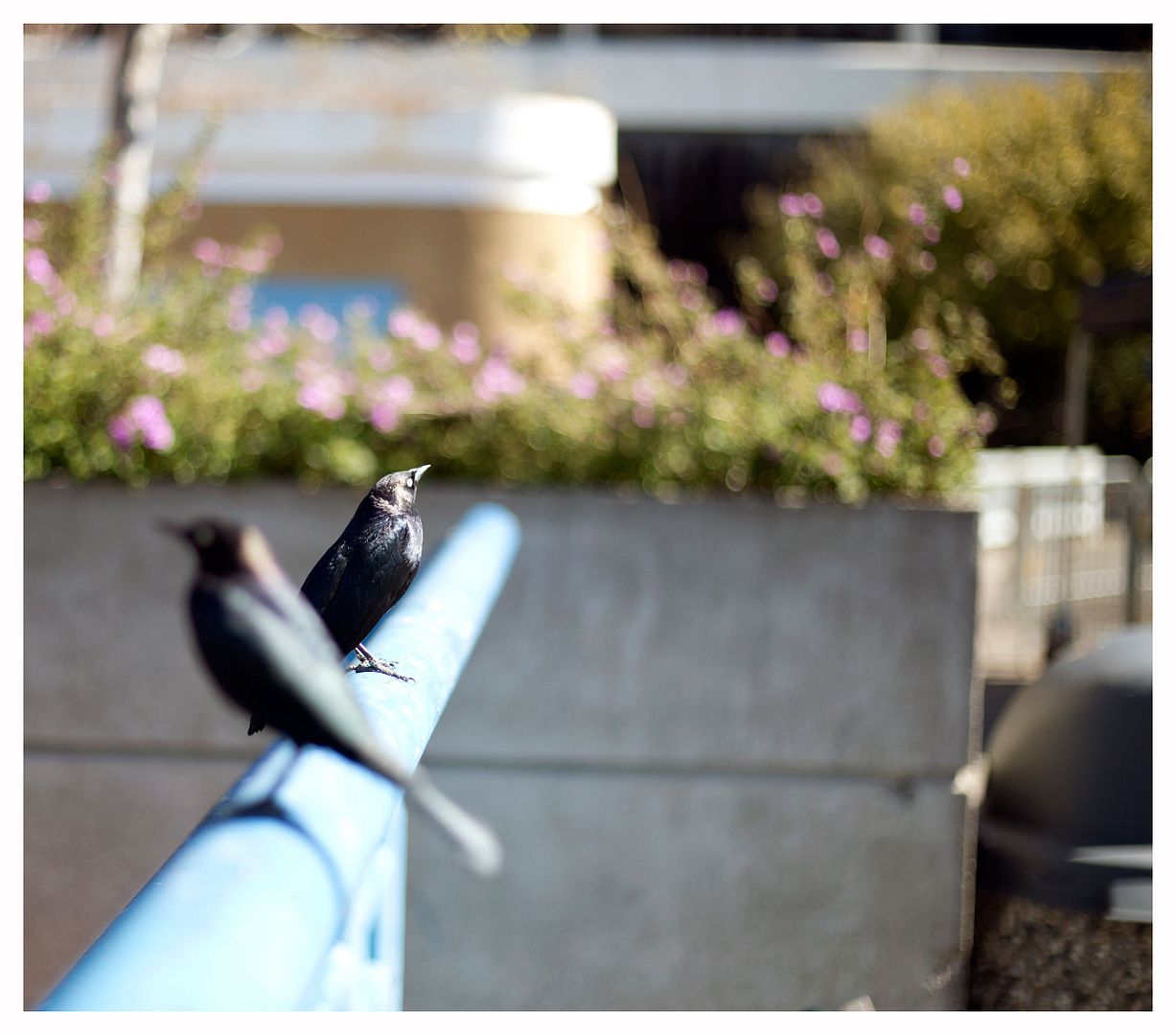
"Brewer's blackbirds"
2013
I recently promised this blog's monthly email digest subscribers that I would begin sharing updates about BAASICS (Bay Area Art & Science Interdisciplinary Collaborative Sessions), the non-profit organization that I co-founded and co-direct. Indeed, most of April's Hungry Hyaena posts are synopses of conversations had with some of the artists and scientists participating in BAASICS.3: The Deep End, our upcoming program on neurodiversities, mental illness, and creativity. (Readers can expect more of these vignettes in advance of the Monday, May 6 event.)

I've come to regard BAASICS as an important arm of my creative endeavor; it's a long-term project that provides me with a platform to help make contemporary art and science relevant and exciting to a broad audience. In many respects, BAASICS is a descendant of Synoddity, the cross-disciplinary organization I co-founded with my friend Michael McDevitt during our undergraduate years at The College of William & Mary. Synoddity made a case for conversation and interaction across professional boundaries and was, like BAASICS, animated by curiosity and wonder, something both Michael and Selene Foster, my BAASICS collaborator and co-founder, have in spades. Working on a project you're passionate about is invariably a good thing, but it's a particular pleasure when you team up with fantastic people.

Sunday, March 27, 2011

"Chewing On Tinfoil"

As a follow-up to my recent essay, "Communicating Art's Relevance (Or Not)," and the ongoing discussion that it's engendered, I thought it appropriate to post artist, writer, and all-around keen mind Michael McDevitt's response to the language that dominates art world discourse.

"Reading it," Michael says, "feels like chewing on tinfoil."

It's an unfortunately apt analogy, especially with respect to gallery press releases and most of the writing included in Art Forum. That certainly doesn't help with the communication challenge!

I'd like to have more voices contribute to the conversation below.

Monday, June 23, 2008

Letters From The Inquisition


Michael McDevitt, friend and fellow artist, recently created a second blog project, Letters From The Inquisition.

Feel Free To Wander, Michael’s extant Blogger venture, remains active, but focuses on art updates and images of works produced in Michael’s Pioneer Square, Seattle, studio.

Letters, by contrast, is chock-a-block with gems like “Adventures In Tiny Land,” a post in which Michael muses on the awesome magic of cellular engineering.

I look forward to reading many more such “letters.”

Tuesday, May 20, 2008

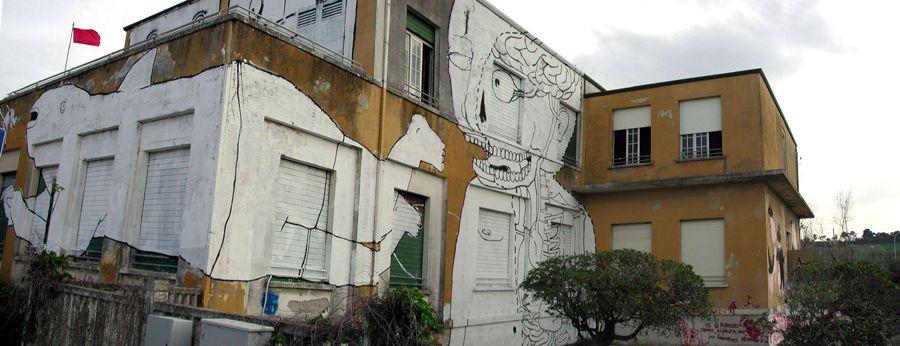
BLU's "MUTO"


Michael McDevitt and Boyce Cummings both forwarded this brilliant video to me.

Michael described BLU, the Italian artist responsible for the film, as "a perfect example of a true graffiti artist... not a tagger or vandal, but an artist whose medium is paint on buildings. It's like William Kentridge rolled up a big joint of Bansky and smoked it while he worked." Indeed, and the joint was sprinkled with some of Keith Haring's sympathetic sensibility, too.

BLU's resulting film, "MUTO," is wonderfully surreal. Watching it, I consider time (with regard to the artist's process, and to the temporality of art, architecture and our species), scale and even magic.

"MUTO" is also uplifting; after a viewing, I feel good about urban living, and about the balance of humanity's prospects with all of our serious shortcomings. It ends, as all things must, in death...but there is joy even in that.

Were Voyager 1 launched today, I'd petition for the inclusion of the video.

(Personally, I prefer to watch "MUTO" without sound.)

Watch it here. Check out more work by BLU here. Read BLU's blog here.

Photo credit: image ripped from BLU's website

Tuesday, April 29, 2008

A Trip West

PART I : SEATTLE, THE CITY PROPER


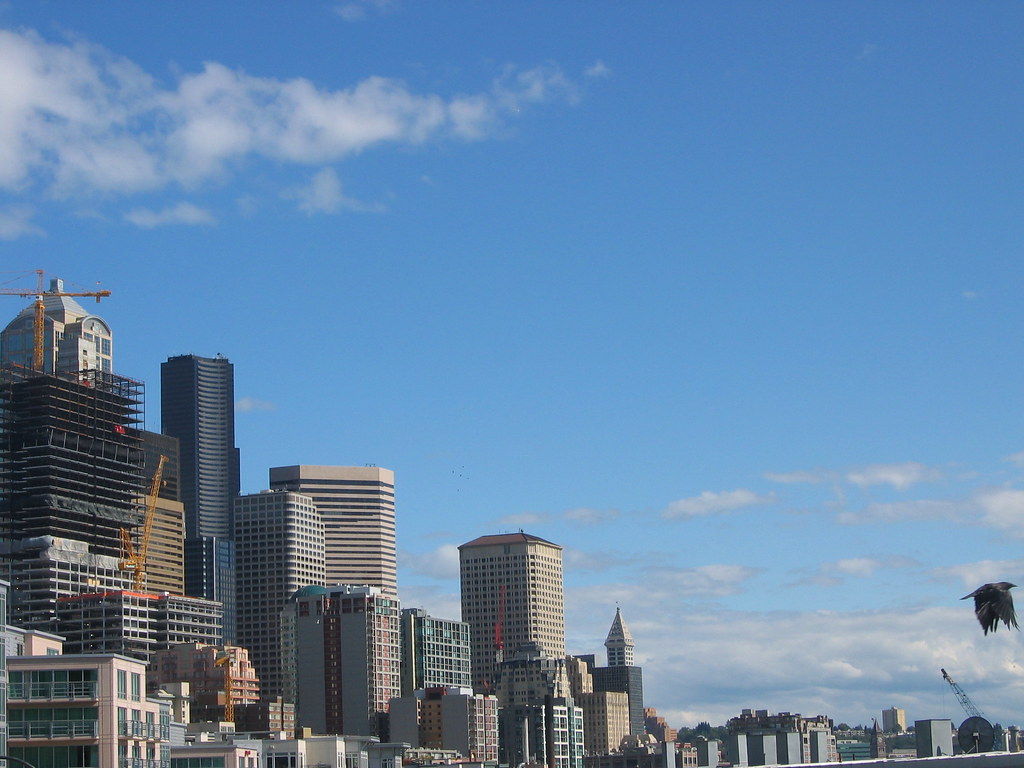
Growing downtown Seattle, Washington (with American crow)


The first thing I noticed about Seattle was the crows. The region has not yet been ravaged by West Nile virus, and the American crow (Corvus brachyrhynchos) population remains robust. The birds flapped heavily over Interstate 5 as Michael, Jocelyn and I headed north from Sea-Tac Airport. A lover of all things Corvidae, I interpreted the birds' greeting as a good omen.


Approaching Seattle on Interstate 5


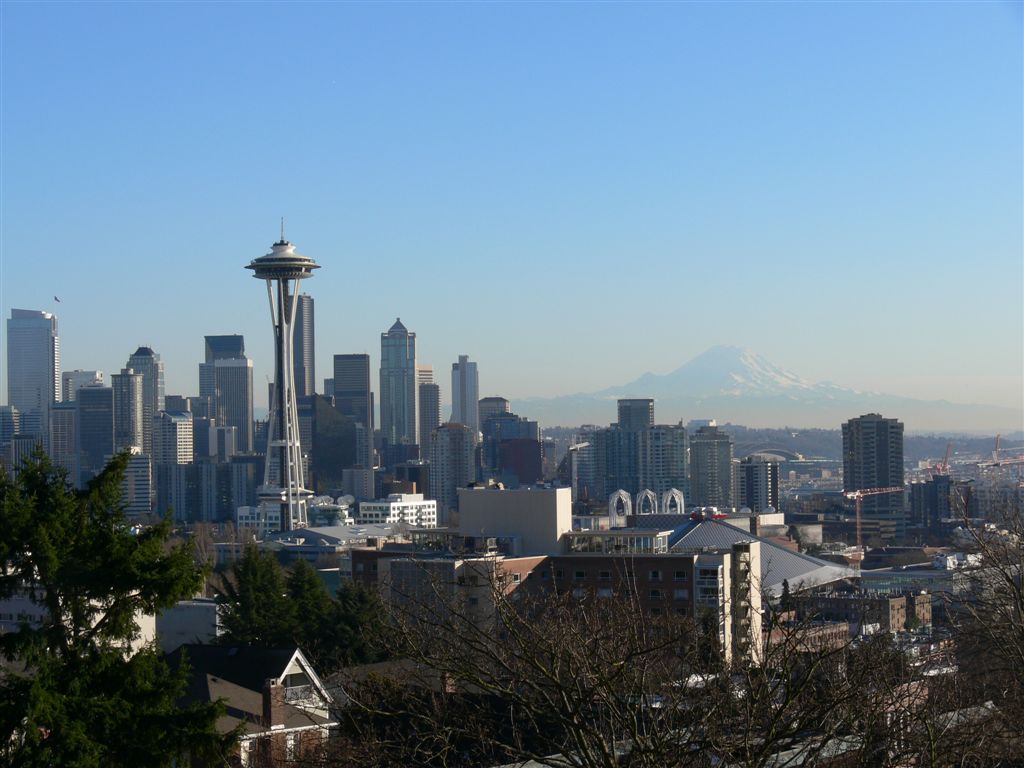
The red gods also granted me exceptional weather. The morning that I arrived in Washington, the low ceiling characteristic of Seattle's seven-month wet season dissipated. Even Mount Ranier, 54 miles southeast of the city, was visible from downtown. Clear skies, sunshine and mild temperatures are not uncommon during the summer months, but they are rare in early April, and the balmy conditions were the subject of much happy conversation among Seattlites.


View of downtown Seattle and Mt. Ranier


Another oft-raised topic was the supposedly passive-aggressive disposition of the Emerald City's residents. I don't doubt that it exists - few stereotypes are baseless - but either I happened upon a rare breed of Seattlite or the rumors of poor behavior are greatly exaggerated.

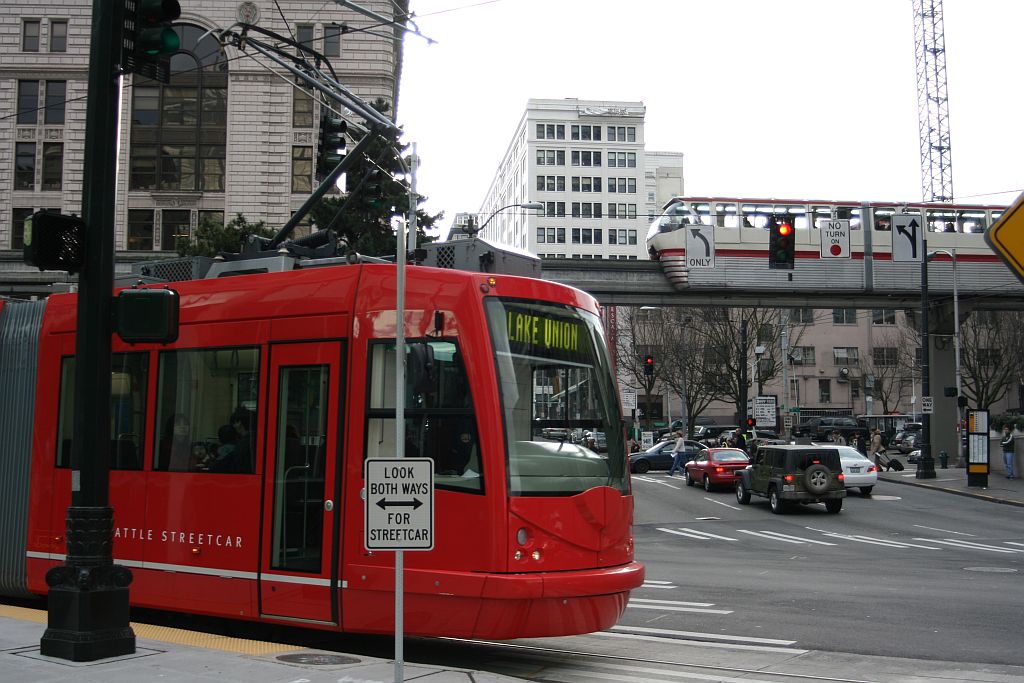
In fact, I found very little about Seattle unfavorable. The only notable drawback is a relative one; Metro Transit, Seattle's public transportation network, leaves much to be desired. (I've been spoiled by New York's first-rate transit options.) Seattle's bus routes are comprehensive enough, so the principal grievance regarding Metro Transit service is one of infrequency. Bus stops are visited at 30-minute intervals, on average, and a missed bus can mean a missed appointment. On the other hand, it's hard not to love the city's proposed streetcar system, especially since the completed, functioning section is called the South Lake Union Trolley, or S.L.U.T.. ("Ride the SLUT" t-shirts are a popular novelty item.)


S.L.U.T. line in foreground, with (little used) Seattle monorail behind


Generally, Seattle strikes me as a terrific place to live, and it now ranks at the top of my post-NYC shortlist. Not surprisingly, the viability of the local art community is an important criterion for any city on that ballot. Though I've heard some negative things Seattle's art scene - it isn't New York or Los Angeles, after all - I was generally impressed by what I saw. Gallery hopping during the First Thursday Art Walk, I visited several decent shows but, more importantly, observed ample (and good-natured) enthusiasm, a variety of work and a number of familiar names. The galleries that Michael, Jocelyn and I visited were all within easy walking distance of one another, and several were housed in Seattle's more interesting (because older) buildings, located in Pioneer Square. (The dominant architectural modes in the neighborhood are Victorian and Romanesque Revival, a result of the latter's popularity in the late 19th-century; the city was rebuilt following 1889's Great Seattle Fire.)


Pioneer Square, Seattle


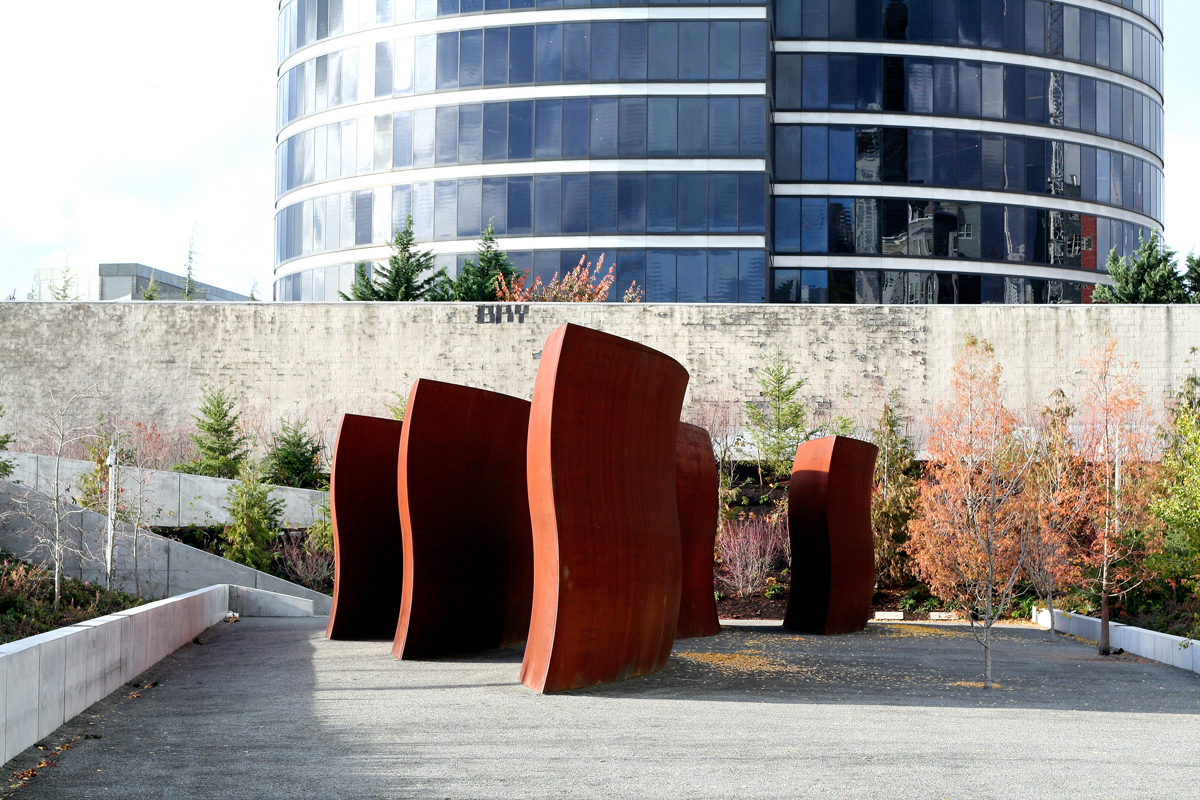
The city itself, like the Sea-Tac Airport, suffers no shortage of public art. I saw more such work during my three days in Seattle proper than I've noticed in almost a decade of NYC living. Mind you, I'm not usually excited by public sculpture. Most of it is insipid, but the "right" setting allows some works to thrive. It was a treat to see Richard Serra's "Wake" at the Olympic Sculpture Park, with the Space Needle rising to the east, Mount Ranier to the south, and Puget Sound behind me, to the west. (By contrast, Claes Oldenburg's "Typewriter Eraser, Scale X" looked as ridiculous in this context as his works do anywhere else.)


Serra's "Wake," at the Olympic Sculpture Park


(An art blogging aside: I finally met artist Amy Ross, after having corresponded with her for months and having a 3-person show, "Animus Botanica" - Amy, Boyce Cummings and myself - slated for this coming September, at Denise Bibro Gallery. She was participating in a 2-person show, "Animal Spell," with Justin Gibbens, at Punch Gallery. I'm happy to report that her collages and paintings looked fantastic.)

Photo credits: Seattle crow, PDX503; Interstate 5, Hungry Hyaena; Skyline with Ranier, Bill Rose; S.L.U.T., Brian Bundridge; Pioneer Square, Vincos; "Wake," Cascadeguy

(More pictures of my trip can be found here. Also, although none of the photographer's work was included in this post, Seattle Daily Photo is an excellent resource for terrific photos of the city. Finally, a thank you to the photographers who I've ripped from for this post. More posts about the trip will follow.)

Monday, March 17, 2008

Sunday, February 25, 2007

Michael's Project

Friend and artist Michael McDevitt is working to answer questions that haunt every artist. What happens to my work after it is sold? What does my painting look like in its new home? What is it hanging next to? McDevitt put out a call to all of his collectors:
"If you own some of my art, please help me by emailing me an image showing the piece as it exists today. I am interested in the space in which the art resides and how it interacts with your life. Also, please tell me if you'd prefer to remain anonymous. I greatly appreciate your help."
As it happens, I own five artworks by McDevitt, and I dutifully photographed each of them. To see them (and other of McDevitt's work in collectors' homes), check out three related posts on Michael's blog. No surprise; my collection is under the heading "Queens, New York."

Two related notes:

- One of McDevitt's paintings, an orange "Beastie," hangs next to an Alice Neel lithograph. I like some of Neel's work a great deal. In my early undergraduate days, the figure paintings of Neel and Egon Schiele excited me and I continue to admire both artists. Unfortunately, like most of us, I don't have enough money to afford her prints and, given her present condition (dead and famous), I can't very well email her to propose a trade...so how did I come to be in the possession of one?

At the risk of getting myself into some trouble here, I should come clean. I stole the lithograph. Or, rather, I saved it. Six years ago, in a former job as a gallery preparator, I was asked to destroy a number of lithographs that had developed slight foxing on verso. I was horrified by the request. I asked if I might have the prints instead of attacking them with a box cutter. The answer was a definitive, "Absolutely not." Try as I might, I didn't understand the gallery's reasoning. Sure, a serious collector probably won't want to buy a slightly damaged print, but why destroy them?

Upset, I nevertheless began hacking and slicing through the print pile, feeling badly for the artists and the unfortunate fate of their art. When I came to this particular Neel print, however, I just couldn't do it. I rolled the print up, slipped it into a cardboard tube and stashed it under a tool bench for later retrieval. A few days later I headed to work with a portfolio of my drawings, supposedly for a curatorial visit that evening; before leaving the gallery at closing time, I added a new piece to the portfolio.

If the gallery owners should stumble upon this blog and read the above admission, I'd only have them know, as I'm sure they must (since our relationship was always a good one despite my constant pranks and general mischief), that the theft wasn't meant as a personal slight or a sign of any dissatisfaction in my job. I just couldn't kill a print I so liked...and, yes, coveted. (If you must, please contact me and we can work something out. Although, really.....if you're only going to reclaim it to destroy it, please consider how happy and settled it appears next to McDevitt's "Beastie.")

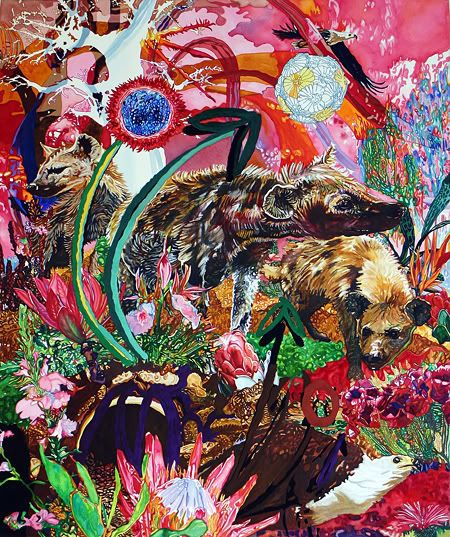
- In another photograph on Michael's blog, a drawing of a Barred owl (Strix varia) by McDevitt hangs just outside the door to my studio. Through that door, you glimpse an in-progress painting that has since then been finished, just last week in fact. I thought I'd post it here...after all, it features three spotted hyenas, as well as a pair of African fish eagles (Haliaeetus vocifer).


Christopher Reiger
"a cruel and beautiful faraway place"
2007
Watercolor, gouache, sumi ink and marker on Arches paper
32 x 27 inches


It is part of the Hysterical Transcendentalism series that I began last year, but it is, by far, the most visually assaultive - in terms of palette and composition - of those works to date. I quite like it, but I've now begun work on two paintings that are more subdued. I needed an interlude after the relentless all-overness of "a cruel and beautiful faraway place."

Thursday, February 08, 2007

Pollock, Monsters and Poorwills


Today, links and recommendations.

From Bioephemera:

- Folks who regularly troll art blogs will have read plenty about the ongoing dispute over the authentication of paintings attributed to Jackson Pollock. Some of the posts have been very good, even provocative, but I hadn't seen any posts highlighting an unspoken, but central debate, one between the humanities and the scientific method. Read it here.

- A good friend of mine, Michael McDevitt, used to spend hours assembling bones, found utensils, toys, bits of plastic detritus, and what have you, creating marvelous hybrid creatures in the process. Although he concentrates on painting these days, I fondly recall college afternoons spent hanging out in Michael's studio/ laboratory /bedroom with his old black lab, Loki (RIP), while he worked away on those sculptural amalgamations. That work came to mind when I was introduced to Jessica Joslin's sculptures (via Bioephemera).

From Rigor Vitae:

- An excellent, informative post from Carel Pieter Brest Van Kempen, this one discussing the ability (and inability) of different bird species to regulate metabolism or enter torpor. Happily, one of my favorite bird families, the nightjars (Caprimulgidae), includes a real pro, the Common Poorwill (Phalaenoptilus nuttallii).

Also skilled in metabolic regulation are hummingbirds and, on that note, I recommend this recent article/photo feature in a recent issue of National Geographic.

Photo credit: WhipPoorWill -Plate LXXXII, by John James Audubon, circa 1827

Monday, May 15, 2006

Hyaena Holmes


Artist and good friend Michael McDevitt was so offended by the quality of my original spotted hyena image (see here), that he whipped up the above piece. This noir Hyaena Holmes is a definite improvement over the unforgivably primitive mouse work in the original. Thanks, Michael!

Tuesday, April 11, 2006

Richmond Weekend

Art, Neighborhoods, and Michael McDevitt's Solo Show

I spent New Year's Eve 2003 in Richmond, Virginia, toasting the arrival of mid-winter and catching up with a few college buddies.  Over the course of that rainy, celebratory evening, a number of proud locals raved about the Richmond art scene.  At times, their exaltation was extreme. Two artists proclaimed Richmond's cultural milieu superior to that of New York or Los Angeles.  I recall one particularly drunk young man telling me that Richmond was the best place to be making art and that, even if money were no object, he wouldn't want to work anywhere else.  All of this self-congratulation seemed inflated and defensive and, although I only listened that night, I returned to New York feeling certain the Richmonders were deluding themselves.

This past Thursday, I returned to Virginia's capital. I'm happy to report that my impression of the city's art community is much improved.  The upbeat energy and sense of camaraderie enthused me.  Walking down Broad Street on Friday night felt little different than a Thursday in Chelsea: throngs of gallery goers crowded the sidewalks and mingled in gallery spaces sipping wine, eating crackers, and generally having a grand ol' time.  Gone completely is the sense that the Richmond art community has a chip on its shoulder.

My earlier, negative assessment was colored by the insecurity underlying the claims made that New Year's Eve, but it was also influenced by the naive notion that the art universe revolves around New York City.  Three years ago that was easier for me to believe.  I was just out of graduate school, at the time, and full of beans.  More importantly, though, I better recognize now just how fluid and subjective the art world is.  It isn't a question of what city is "the best place to be making art," but rather, what city, town, or deserted island is the best place for you to make art and, apparently, Richmond suits a lot of folks just fine.
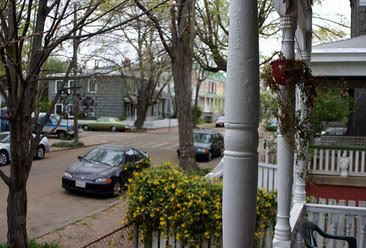

The Chinatown Bus arrives in Richmond around midnight and local bars close at 2:00 AM, so after a couple of quick drinks on Thursday night, we returned to my friend's house in Oregon Hill, the neighborhood pictured above.  Most of Friday was spent wandering around Oregon Hill and The Fan, both attractive neighborhoods on the northern bank of the picturesque James River.  Oregon Hill is celebrated as one of the few surviving working class neighborhoods in the United States, but it might not be deserving of this mantle any longer.  Virginia Commonwealth University, a college known for its excellent art program, has campus buildings scattered throughout the area and, as a result, the one-time working class stronghold is now "up-and-coming."  A growing population of college students and artists is displacing those working class families that remain; soon, Oregon Hill will be thoroughly gentrified, like The Fan before it.  Working class or not, however, I saw no black folks, young or old, in the area.  Apparently, this is not a recent phenomenon.  Oregon Hill has been considered the domain of "white trash" for some time.

High real estate prices (by Richmond standards) aside, The Fan is a beautiful area.  The architecture is lovely and the back alleys are inviting.  It's also nice to see so many bikes; Richmond is considered a very bike-friendly town and there are many trails in the city's plentiful parks.  Like Williamsburg, Brooklyn, trucker hats and tattoos abound in these neighborhoods.  I have no problem with caps or tats, but an "essential mass of human sameness" always bothers me, whether you're considering suburban sprawl or hipster havens.  Here, too, I was aware of how segregated Richmond is; no black hipsters made an appearance.  (In fact, with the exception of the Friday night gallery scene, I don't recall seeing many black folks on the north side of town.  On Saturday morning, however, when we drove to the south side to pick up a painting, I realized the James River serves as an unofficial race/class divide.)

On Friday afternoon, I took a nap on the floor of my friend's studio and enjoyed watching trees sway in the wind through the window.  If it didn't get so damned hot and muggy in the summer, I mused, this wouldn't be such a terrible place to live.
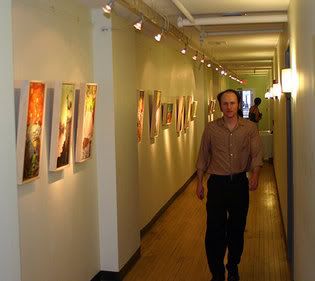

That night, I attended the solo debut of Michael McDevitt.  Michael is an energetic and prolific artist.  At any one time, a dozen or more paintings are strewn about his studio, in various states of completion. His willingness to experiment is unconscious; should he ruin a painting in the process, so be it.  Given the demands of the flooded art market these days, Michael's incautious approach is rare and commendable.  (I look forward to his putting up a proper website soon - one is rumored to be in the works - but for the time being, you can see some of his wide-ranging work at Feel Free To Wander, a blog where he posts images of recent prints, drawings, and paintings.)
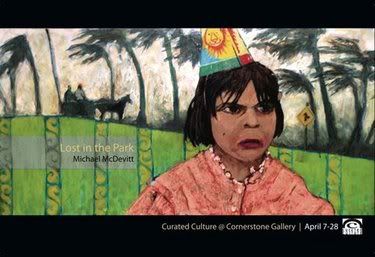

Michael's solo show at Cornerstone Gallery, "Lost In The Park: Tiny Tales of Stasis and Apocalypse," is comprised of nineteen acrylic paintings, all measuring 23 1/2 inches by 11 1/2 inches. The majority of these relatively small works are vertical in orientation and, although I heard other viewers describe them as landscapes, I see them as allegorical vignettes. The viewer is presented with the principal player (or players) - a figure, usually a child, is fore-grounded in most of the pieces - and is then left to draw his own conclusions. For example, "Is One Feather Enough?" pictures an adolescent boy holding an enormous feather in his left hand. He sits at the edge of what appears to be a playground, but the grass is dry and yellow and the boy's right arm ends in a stump. His face is sorrowful, imploring. Wallflowering near this painting, I sipped my wine and listened to the reactions of gallery goers. Invariably, they created a back-story or explanation for the picture. For some, the boy is Icarus, post sun exposure. For others, he is a zombie or a "mechanical boy." My personal favorite: upon noticing the arm stump, one young lady said, "Oh, my God...he's a freak. That's just depressing." (War heros and survivors of thresher accidents everywhere, do you love it?)

Despite Michael's use of bold, bright color - the intense yellow of the grass in "Is One Feather Enough?," for example - the prevailing mood of "Lost In The Park" is foreboding, even apprehensive. The humans and animals featured in the series are isolated and frail, if not physically, then emotionally. Even when characters confront or embrace one another, a melancholy remains. In "A Great Deal Of Time Passed While They Established The Rules," a wolf stares down a determined little boy. Between them, a ball rests on the ground. Initially I found the scenario - and the title - funny, but the ambivalence of the painting complicated my reaction. There is no moral point of view; there is only time passing; there are only rule changes. This conclusion may sound bleak, but given the contemporary state of things, it is perfectly fair. (What's more, it makes sense that Michael is concurrently exhibiting work in "Richmond Represents: Grimm Fairytales," at the Richmond Public Library.)


Michael McDevitt
"Autohagiography"
2006
Acrylic on Panel
23 1/2 x 11 1/2 inches

For personal reasons, I'm also fond of "Autohagiography," a painting of a boy hugging a hyena in a Hellish setting. Ignoring technicalities - like the number of included heads - one of my friends said, "This one could have been titled, 'Even Cerberus Needs A Hug.'" Indeed. Both of these animals, boy and hyena, are in need of affection, but the boy seems to go through the motions. His eyes are narrowed, his mouth tight and his posture nonchalant; there is nothing committed about his embrace. On the other hand, the hyena seems to relish the contact, leaning into the boy's shoulder. Again, we are left unsettled. What is their relationship? What is this green-eyed heathen planning to do to the affectionate hyena? Considering the painting's title, I fear the worst.
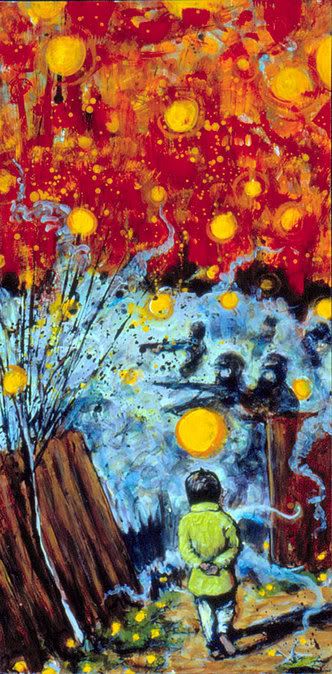

Michael McDevitt
"Samsara"
2006
Acrylic on Panel
23 1/2 x 11 1/2 inches

But I know Michael to be someone who puts a great deal of stock in the magic of both imagination and nature. Where, then, is the hope in this series? Granted, these are dark times, but my spirits are always buoyed by the sheer wonder of the universe, whether at the micro or macro level, and I know Michael also accesses this variety of joy. There are two paintings in "Lost In The Park" that reveal as much, that offer viewers some optimism. The stronger of these two is titled "Samsara," the Buddhist term for the infinite cycle of birth, suffering, death, and rebirth. In the painting, a young girl strolls away from us, hands casually linked behind her back. She approaches an opening in a wooden fence, beyond which lies a riot of experience. There's the hope: Take a walk. Look around.

Photo credit: Oregon Hill photograph, Cornerstone hanging w/ artist photograph, Hungry Hyaena, 2006; Photographs of original acrylic paintings by Michael McDevitt, 2005, 2006 by artist and Hungry Hyaena, 2006