Showing posts with label suburbia. Show all posts

Tuesday, April 11, 2006

Richmond Weekend

Art, Neighborhoods, and Michael McDevitt's Solo Show

I spent New Year's Eve 2003 in Richmond, Virginia, toasting the arrival of mid-winter and catching up with a few college buddies.  Over the course of that rainy, celebratory evening, a number of proud locals raved about the Richmond art scene.  At times, their exaltation was extreme. Two artists proclaimed Richmond's cultural milieu superior to that of New York or Los Angeles.  I recall one particularly drunk young man telling me that Richmond was the best place to be making art and that, even if money were no object, he wouldn't want to work anywhere else.  All of this self-congratulation seemed inflated and defensive and, although I only listened that night, I returned to New York feeling certain the Richmonders were deluding themselves.

This past Thursday, I returned to Virginia's capital. I'm happy to report that my impression of the city's art community is much improved.  The upbeat energy and sense of camaraderie enthused me.  Walking down Broad Street on Friday night felt little different than a Thursday in Chelsea: throngs of gallery goers crowded the sidewalks and mingled in gallery spaces sipping wine, eating crackers, and generally having a grand ol' time.  Gone completely is the sense that the Richmond art community has a chip on its shoulder.

My earlier, negative assessment was colored by the insecurity underlying the claims made that New Year's Eve, but it was also influenced by the naive notion that the art universe revolves around New York City.  Three years ago that was easier for me to believe.  I was just out of graduate school, at the time, and full of beans.  More importantly, though, I better recognize now just how fluid and subjective the art world is.  It isn't a question of what city is "the best place to be making art," but rather, what city, town, or deserted island is the best place for you to make art and, apparently, Richmond suits a lot of folks just fine.
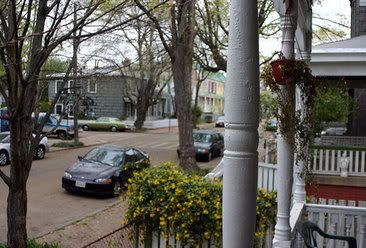

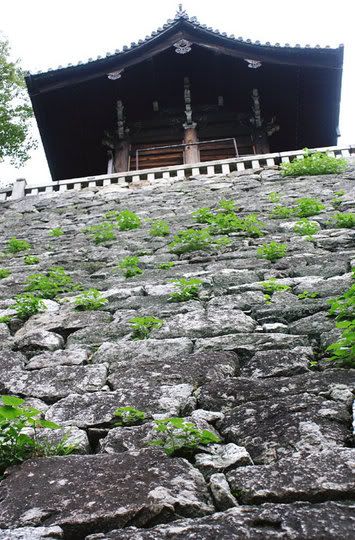
The Chinatown Bus arrives in Richmond around midnight and local bars close at 2:00 AM, so after a couple of quick drinks on Thursday night, we returned to my friend's house in Oregon Hill, the neighborhood pictured above.  Most of Friday was spent wandering around Oregon Hill and The Fan, both attractive neighborhoods on the northern bank of the picturesque James River.  Oregon Hill is celebrated as one of the few surviving working class neighborhoods in the United States, but it might not be deserving of this mantle any longer.  Virginia Commonwealth University, a college known for its excellent art program, has campus buildings scattered throughout the area and, as a result, the one-time working class stronghold is now "up-and-coming."  A growing population of college students and artists is displacing those working class families that remain; soon, Oregon Hill will be thoroughly gentrified, like The Fan before it.  Working class or not, however, I saw no black folks, young or old, in the area.  Apparently, this is not a recent phenomenon.  Oregon Hill has been considered the domain of "white trash" for some time.

High real estate prices (by Richmond standards) aside, The Fan is a beautiful area.  The architecture is lovely and the back alleys are inviting.  It's also nice to see so many bikes; Richmond is considered a very bike-friendly town and there are many trails in the city's plentiful parks.  Like Williamsburg, Brooklyn, trucker hats and tattoos abound in these neighborhoods.  I have no problem with caps or tats, but an "essential mass of human sameness" always bothers me, whether you're considering suburban sprawl or hipster havens.  Here, too, I was aware of how segregated Richmond is; no black hipsters made an appearance.  (In fact, with the exception of the Friday night gallery scene, I don't recall seeing many black folks on the north side of town.  On Saturday morning, however, when we drove to the south side to pick up a painting, I realized the James River serves as an unofficial race/class divide.)

On Friday afternoon, I took a nap on the floor of my friend's studio and enjoyed watching trees sway in the wind through the window.  If it didn't get so damned hot and muggy in the summer, I mused, this wouldn't be such a terrible place to live.
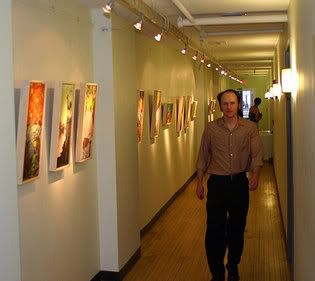

That night, I attended the solo debut of Michael McDevitt.  Michael is an energetic and prolific artist.  At any one time, a dozen or more paintings are strewn about his studio, in various states of completion. His willingness to experiment is unconscious; should he ruin a painting in the process, so be it.  Given the demands of the flooded art market these days, Michael's incautious approach is rare and commendable.  (I look forward to his putting up a proper website soon - one is rumored to be in the works - but for the time being, you can see some of his wide-ranging work at Feel Free To Wander, a blog where he posts images of recent prints, drawings, and paintings.)


Michael's solo show at Cornerstone Gallery, "Lost In The Park: Tiny Tales of Stasis and Apocalypse," is comprised of nineteen acrylic paintings, all measuring 23 1/2 inches by 11 1/2 inches. The majority of these relatively small works are vertical in orientation and, although I heard other viewers describe them as landscapes, I see them as allegorical vignettes. The viewer is presented with the principal player (or players) - a figure, usually a child, is fore-grounded in most of the pieces - and is then left to draw his own conclusions. For example, "Is One Feather Enough?" pictures an adolescent boy holding an enormous feather in his left hand. He sits at the edge of what appears to be a playground, but the grass is dry and yellow and the boy's right arm ends in a stump. His face is sorrowful, imploring. Wallflowering near this painting, I sipped my wine and listened to the reactions of gallery goers. Invariably, they created a back-story or explanation for the picture. For some, the boy is Icarus, post sun exposure. For others, he is a zombie or a "mechanical boy." My personal favorite: upon noticing the arm stump, one young lady said, "Oh, my God...he's a freak. That's just depressing." (War heros and survivors of thresher accidents everywhere, do you love it?)

Despite Michael's use of bold, bright color - the intense yellow of the grass in "Is One Feather Enough?," for example - the prevailing mood of "Lost In The Park" is foreboding, even apprehensive. The humans and animals featured in the series are isolated and frail, if not physically, then emotionally. Even when characters confront or embrace one another, a melancholy remains. In "A Great Deal Of Time Passed While They Established The Rules," a wolf stares down a determined little boy. Between them, a ball rests on the ground. Initially I found the scenario - and the title - funny, but the ambivalence of the painting complicated my reaction. There is no moral point of view; there is only time passing; there are only rule changes. This conclusion may sound bleak, but given the contemporary state of things, it is perfectly fair. (What's more, it makes sense that Michael is concurrently exhibiting work in "Richmond Represents: Grimm Fairytales," at the Richmond Public Library.)


Michael McDevitt
"Autohagiography"
2006
Acrylic on Panel
23 1/2 x 11 1/2 inches

For personal reasons, I'm also fond of "Autohagiography," a painting of a boy hugging a hyena in a Hellish setting. Ignoring technicalities - like the number of included heads - one of my friends said, "This one could have been titled, 'Even Cerberus Needs A Hug.'" Indeed. Both of these animals, boy and hyena, are in need of affection, but the boy seems to go through the motions. His eyes are narrowed, his mouth tight and his posture nonchalant; there is nothing committed about his embrace. On the other hand, the hyena seems to relish the contact, leaning into the boy's shoulder. Again, we are left unsettled. What is their relationship? What is this green-eyed heathen planning to do to the affectionate hyena? Considering the painting's title, I fear the worst.
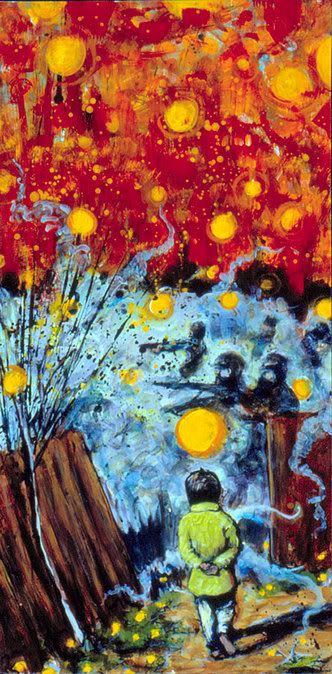

Michael McDevitt
"Samsara"
2006
Acrylic on Panel
23 1/2 x 11 1/2 inches

But I know Michael to be someone who puts a great deal of stock in the magic of both imagination and nature. Where, then, is the hope in this series? Granted, these are dark times, but my spirits are always buoyed by the sheer wonder of the universe, whether at the micro or macro level, and I know Michael also accesses this variety of joy. There are two paintings in "Lost In The Park" that reveal as much, that offer viewers some optimism. The stronger of these two is titled "Samsara," the Buddhist term for the infinite cycle of birth, suffering, death, and rebirth. In the painting, a young girl strolls away from us, hands casually linked behind her back. She approaches an opening in a wooden fence, beyond which lies a riot of experience. There's the hope: Take a walk. Look around.

Photo credit: Oregon Hill photograph, Cornerstone hanging w/ artist photograph, Hungry Hyaena, 2006; Photographs of original acrylic paintings by Michael McDevitt, 2005, 2006 by artist and Hungry Hyaena, 2006

Tuesday, September 20, 2005

Notes on Japan


It’s difficult to summarize a first visit to another country. The challenge is compounded when the country in question is culturally and geographically "on the other side of the world." Any thoughts that I put down on paper are too neat. They're in no way comparable to the messy musings of this traveler when I was still abroad.

Unfortunately, if I do not write about such trips, my experiences quickly become vague, fading to the point of inapplicability or cocktail party conversation – “Oh, Christopher went to Japan a couple of years ago, didn’t you?” For me, the best trips are an education (as opposed to a vacation) and I'd rather risk forwarding an especially obvious observation than abandon the memory.

I’ve long been fascinated by Japanese culture and was therefore eager to see the country and the people for myself. Many of my assumptions proved accurate – no great feat in the age of globalization – but it would be disingenuous of me to claim that everything I was presented with - custom, food, place - was unsurprising or even to my liking.


Cleanliness:

Japan is a very clean country populated by a very clean people. Several times, I saw loose paper or plastic chased down and pocketed, presumably for proper disposal. The first time that I saw a subway employee scraping discarded gum off the sidewalk, I was struck by two things.

1) This was the first "litter" that I'd seen in Japan.

2) A foreigner must have dropped the gum. (This isn't necessarily true, of course, but the idea of a Japanese person carelessly dropping garbage on the ground is anathema.)

The relative absence of litter is that much more impressive when one realizes how few public trash receptacles are readily available in Japanese cities. Granted, I'm used to New York City, where most street corners are home to a trash bin. In Tokyo, on the other hand, I sometimes carried empty cans or plastic trash for hours before spotting a receptacle.

That said, plastic drink bottles are easy to dispose of. Most vending machines - the usual source of the bottles - have a recycling container positioned nearby. I was also impressed by the recycling ethic; I rarely saw a receptacle that was for "general" rubbish. Most bins are labelled; plastic bottles, steel cans, plastic, combustibles, and paper all find separate homes.

Timeliness:

An unsurprising confirmation of an established stereotype: many Japanese people adhere to a strict schedule. Lateness is unacceptable. While I find this altogether refreshing, it isn't necessarily a social good. Two of my Japanese friends, both of whom have also lived in the United States, view the timeliness obsession with ambivalence. A friend told me of a recent accident involving an agitated, young subway conductor. Having fallen behind schedule (by just a minute or two), this conductor attempted to make up the difference by racing the train to the next stop. In doing so, he gained enough speed to derail the train, which then crashed through the basement of an apartment building. A number of the commuters on board were killed. According to some recent studies, schedule related stress also takes a toll on Japanese city dwellers. (Of coruse, I assume that the effects of stress on urbanites everywhere are similarly negative.)

Convenience Stores:

Daily Yamazaki, Family Mart, AM/PM, Sunkus and Circle K all became regular stops for me. In these one-stop shops, you can buy just about anything you need. These stores are not your standard-issue 7-Elevens, another chain which has colonized Japan.

The "combini," as they are called, offer more variety than their American cousins, even though the total stock is equivalent in size. In the States, convenience stores usually allow us to choose between junk food, junk food and, well, junk food. At combini, I could buy junk food, fresh sushi, or balanced box lunches which would cost a pretty penny here in the States. And buy them I did. When I wasn't eating at a restaurant, combini offered an inexpensive, healthy option.

True vegetarian dishes were hard to find, unfortunately. I would buy a rice wrap, for example, thinking it was simply rice wrapped in seaweed, only to be surprised by the salmon hidden in the middle. As a result, I several times (unwittingly) broke my dietary restrictions.


Population and Sprawl:

The Japanese have devised aesthetically pleasing ways of dealing with concentrated population, but the small living spaces and stacking necessary for such a feat often strike Westerners as curious. For my part, I like small houses and small rooms, but the notion of a "back yard" doesn't seem to exist in the suburban sprawl surrounding Nagoya or Tokyo. In fact, "front yards" are absent, too. You do see small, immaculate gardens, however, which make the neighborhoods quite inviting despite their similarity to our own American brand of suburbia. Strip malls, chain stores and unnecessary traffic signals are also common.

Cities like Kyoto and Nagoya felt no more crowded than Boston or Atlanta, but Tokyo is a nightmare for those folks, myself included, who don't care to find themselves set down in a sea of humanity sans greenery.

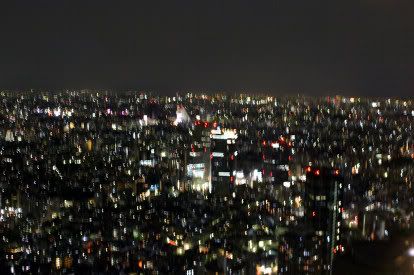
From the viewing tower of the Tokyo Municipal Government Building I realized just how large Tokyo is; it dwarfs New York City both in population and area. Tokyo, with an area of about 2200 square kilometers, has 8 million full time residents and, during the workday, a total population of 12 million. The workday population of New York City, having an area of just 1200 square kilometers, tops out around 8 million.

"Ticket Punchers":

A good friend describes the Japanese as a “nation of pointers” and the stereotype of the Japanese tourist/photographer suggests that my friend is not alone in his assessment. I prefer the term "ticket puncher." During each of my trips to Central America, I met compulsive birders on a quest for certain species they "needed" to add to their "life list." I enjoy birding immensely, but I've never appreciated this competitive, cataloging approach, as it lessens the likelihood for real learning and substantive communion. Whatever the case, there are many birders of this stripe; some of them actually call themselves "ticket punchers." They'll say, for example, "Well, I finally saw a Resplendent Quetzal today...got my ticket punched on that one. Gonna head to the coast tomorrow and see about knocking off a Magnificent Frigatebird."

The Japanese experience isn't so much different. Whether "knocking off" a monument with a photograph or pointing excitedly at a zoo animal, they seem to take very little interest in any signage or prolonged observation. Point, click, shuffle on to the next "sight." Once there, it's point, pose, peace sign, click, shuffle on to the next "sight." And so on. Of course, this approach is largely shared by contemporary Westerners, too, especially in our global culture of distraction, but I condemn it in us and therefore see no reason not to condemn it in the Japanese. It's fundamentally thoughtless and incurious.


Telephone Lines:

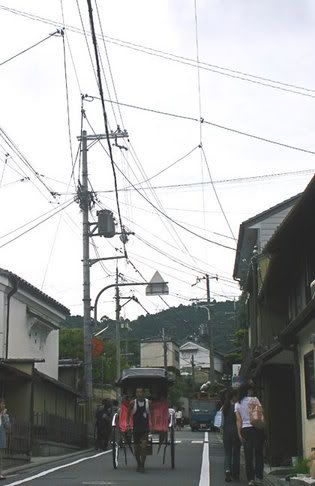
One sometimes hears recent travelers to Japan remarking on the oddity of the country's above ground telephone system. In a country as technologically advanced as Japan, it seems strange that so much land should be covered with a haphazardly constructed spider-web of communications lines.

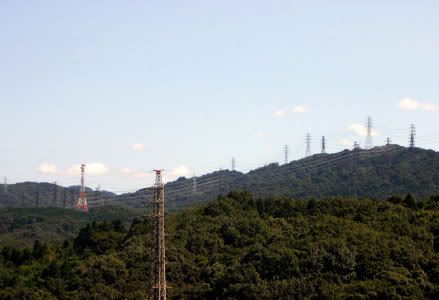
This arrangement contrasts sharply with the United States and most of Europe, where communications lines are usually buried, especially in urban locales. Looking up, one doesn't see dangling wires and lines crisscrossing the blue canyons of New York City, for example. In Japan, even lounging in an outdoor onsen in the small mountain town of Toei, I gazed up at tall, steel telephone towers. Wires are strung tightly from one tower to the next, and these towers march over and around the country's mountains.

Surprisingly, I didn't find Japan's above-ground communications system aesthetically troubling. (In some areas, it's even attractive!) But I believe I'm in the minority. Furthermore, aesthetics aside, the installation and maintenance of all these towers plays havoc with the already stressed mountain slopes.


Erosion of hillsides/mountains:

It seems that every mountain and hill in Japan - with the exception of Fuji - has been manhandled. The principal culprits are road construction and the ever-expanding communications network. The activity causes the mountainsides to erode at an alarming rate. In response, trees are cut down and stacked to serve as barriers. When these barriers fail, as they eventually do, local engineers cover the eroding slope with wire mesh or spray it with a plaster-like mixture to halt further subsidence.

Japan's equivalent to U.S. "pork barreling" results in a lot of federal funding for local works projects, devised to inject money into rural economies and keep constituents happy. Not surprisingly, many of these projects are thoroughly unnecessary and only further degrade sensitive areas.

Hybrid/Bio-diesel and the Marketed Greening Revolution:

While I can't confirm (and don't believe) that all Japanese cities have taken the same steps that Kyoto has, all buses and taxis in Kyoto are either hybrid or biodiesel vehicles. I saw some evidence of a similar transition in Tokyo and Nagoya, but I'm not sure implementation is "across the board" in these cities. Though encouraging, I hope Japan won't rest on it's laurels; it has an opportunity to lead the world in this arena.

Throughout the country, the "green" PR spin was in effect. Signs announcing the dawn of a ecologically harmonious age dotted city blocks. This may be the result of the 2005 World Expo, currently being held in Nagoya. The Expo's theme is the environment. At the Expo, I visited several corporate pavilions ostensibly devoted to "green" research and technology. Not surprisingly, Toyota led the pack, featuring new fuel-cell vehicles alongside their robots and walking human carriers, but other companies also championed the push for "green" reform. One couldn't help but be suspicious. I fear such doubts are well founded; the pavilions stunk of snake oil.

Vending Machines, Panties and Porn:


With some sorrow, I have to relate that one of my favorite Japanese peculiarities is either true no longer or altogether apocryphal. Vending machines selling used panties were nowhere to be found! While you can buy a great many things from Japanese vending machines, I found none of the items offered particularly surprising. Sure, it's unusual for an American to see beer and cigarettes available so readily - insert Yen and out pops a brew - but it's not exciting. I asked several people - guys and girls both - about the rumored "pantie machines." Everybody laughed off the notion as a popular myth. Alas, that photo I so wanted to take will have to remain unrealized.

In any case, I'm sure it would have been a short-lived thrill. The first time that I noticed a Japanese business man looking at a porn magazine next to me on Tokyo's public transit system, I thought only, "Huh...well there you have it."


Proximity of Suburbia and Localized Agriculture:

On my first evening in Japan, I took a stroll with my friend Ben in his Nagoya suburb, Seto. The landscape's most striking feature were the many rice paddies, everywhere butting up against apartment buildings and roads. We walked along dikes that divided broad fields surrounded by houses, restaurants and combini stores.

This sort of localized agriculture is very much a part of the Japanese landscape, whether urban or rural. Excepting city centers, it is not uncommon to see planted fields and vegetable gardens throughout Japan, even in areas dominated by commercial ventures. In the United States, an equivalent scenario would set corn and wheat fields amidst suburban population centers like Alexandria, Virginia, Westchester County, New York, Cambridge, Massachusetts or Berkeley, California.

Because of this comfortable relationship between "cultured" human settlement and agriculture, the nighttime noises of suburban Japan are not that much different from those of the countryside. Many species of amphibian, bird and insect frequent the edges of Japanese cities and suburban neighborhoods. While some readers may feel the same can be said of the United States, our brand is absent the biodiversity I observed in Seto.

Bad teeth:

"British people have terrible teeth." We've all heard it said and most of us (especially Americans) agree with the generalization. Most Brits counter that Americans have an unhealthy, frivolous obsession with the cosmetic. In other words, we're all vain fools.

Despite having had braces briefly as a young boy, my wisdom teeth (still intact) shoved several of my front teeth out of place. Though it may be considered unsightly by some, I couldn't care less...so long as I have clean, healthy gums and no cavities. Admittedly, I'm not a good example of your everyday American; many of us are obsessed with cosmetic concerns.

Still, most dentists, British or otherwise, agree that much of the British oral "problem" is due to negligence. In the States, a dental visit every six months is considered normal, almost mandatory, whereas many older Brits pride themselves on having gone for a cleaning only a few times in their lives.

Well, the Brits ain't got nothing on the Japanese. Crooked teeth and odd bridges - crude looking metal installations - are considered "cute" in Japan. This is an understandable reaction to an unfortunate reality. Japanese children often experience extensive tooth decay and, while medical care in Japan is very good, the same can not be said of the country's dental care. I was shocked by the gross crowding, discoloration and fillings I observed. Having traveled to several very poor countries, I've spent time with people who have received no dental care in their lives; their teeth were healthier than many, if not most, of the Japanese people I saw.

Halitosis is also a serious problem in Japan, owing to the poor oral care. As Dr. Kazumi Ikeda, a practicing orthodontist in Tokyo, puts it, "The Japanese have much poorer oral conditions than not only westerners but people in less economically developed nations."

Thankfully, this is changing. Future generations of Japanese will have increasingly healthy teeth. Go, go globalization!

Trust:

The Japanese are a trusting, honest people. As evidence, I submit the following examples.

I rarely had my JR Railpass (Japan's equivalent to a EuroRail Pass) inspected by train conductors or station personnel - even when I mistakenly boarded the reserved "super express" train - and when I couldn't locate my friend's keys after he left for work, he suggested I just leave the apartment door unlocked when I left.

The crime rate in Japan is very low and "good faith" stories abound. For example, a wallet forgotten on a restaurant table is usually in the same place when the panicked owner returns. More noteworthy still, a couple from Singapore I met told me that a Japanese woman had covered their station locker storage fee ($5.50) when the first locker machine they tried had proven faulty. Without another 600 Yen between them, they didn't know what to do. As I understood it, the Japanese woman intervened because she realized the couple was planning to leave the country that afternoon. They wouldn't have time to straighten things out with the locker company, so she payed for a new locker and gave them her address! Then she was on her way.

Interestingly, I several times found myself in a position where I could have elected to "pull one over on the man." Often in New York City one feels good about finding a five dollar bill on the sidewalk or getting a free subway ride. In Japan, though, I did not feel like taking advantage of such situations. (Of course, I did keep my mouth shut about the "super express" train, because had I been caught I would have been out a considerable sum and my transgression was totally innocent, a result of my poor Japanese.)


Photo credits: all images, Hungry Hyaena, 2005

Monday, July 18, 2005

Long Island


I spent this past weekend in Northport, Long Island, visiting friends. It was a pleasant getaway. Like my recent trip to Washington, D.C., however, this weekend escape made my dissatisfaction with New York City living more acute.

My father spent a good deal of his youth on Long Island. In the 1940s and 1950s, when the island peninsula's many small towns were buffered by undeveloped land, he would break down his shotgun, place it in his bike basket and pedal his way to the local landing. He hunted ducks in the tidal marshes and fished in the sound.

Today, little of Long Island remains undisturbed and few residents are philosophically or professionally attached to the land. Like northern New Jersey and southwestern Connecticut, suburban sprawl has claimed much of the island. The effects of sprawl extend beyond habitat destruction, perverting the perspective of everyone who grows up among the 7-11s, subdivisions and cinema multiplexes.

My friends and I crashed a party comprised mostly of born-and-bred Long Islanders. Several of the guests talked excitedly about real estate, property taxes, SUVs and Florida retirement. I felt as though I'd walked into a Todd Solondz film.

When I commented to the host that the view from her second story patio, surrounded on three sides by tall trees, was pleasant, she replied, “I hate nature. Pave it all over and the world will be a better place.” I smiled at her and waited for a knowing wink or some other signal that she was joking. None came. After some long seconds she resumed the cheerleading conversation she was having with an old friend. “Be Aggressive! B-E-Aggressive!,” they shouted between laughs. Shocked into a brooding, drunken silence, I excused myself. “Material Girl” was playing on the stereo and the host’s sleepy five-year old daughter was half-watching ”Finding Nemo” on the television.


Fortunately, suburban ugliness has not claimed everything on Long Island. I enjoyed my visits to area parks. On Saturday morning, my friend Philip and I wandered around a salt water estuary near King’s Park. I was happy to see great egrets (Casmerodius albus), snowy egrets (Egretta thula), herring gulls (Larus argentatus), killdeer (Charadrius vociferous) and bank swallows (Riparia riparia). Even the invasive mute swans (Cygnus olor) were a welcome sight (though I still advocate extensive control measures given their destructive tendencies). A striper (Morone saxatilis) fisherman crossed over a small island as he waded to shore, sending several unidentifiable plovers scurrying. On a nearby mudflat, clams and mussels betrayed their location by shooting geysers of water high into the air as they burrowed beneath the surface to feed. Taking all this in, I felt good about life.

After an hour spent walking the beach, Philip and I moved inland and entered King’s Park, proper. This park was, until 1996, a psychiatric facility. Wandering the abandoned grounds is eerie but pleasant. There is a strict prohibition on photography (made explicit by a grounds keeper), but Philip and I did peek through some broken windows to study the buildings’ interiors. One can’t help but imagine these decaying rooms as they once were, filled with patients, many of them shell-shocked members of the “greatest generation."

In a few years, these buildings will all be destroyed and King’s Park turned into a luxury condominium development. No longer will area teenagers slip into the abandoned buildings at night to drop acid, smoke pot and spray-paint “Get Blunted” on the walls. Such is progress.


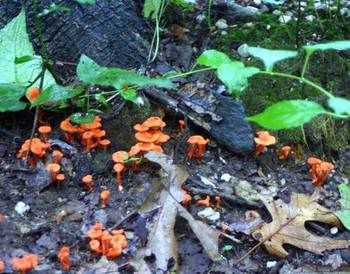
Cinnabar-red Chanterelle (Cantharellus cinnabarinus);
identified by Garrett Herth


Sunday morning, walking on a trail closer to my friends’ apartment, we came across some grape vines that were infected by two different types of parasite. One parasite I later identified as grape phylloxera (Daktulosphaira vitifoliae), a common parasite that leaves circular, whitish-green galls, a type of sore or growth, on the leaves, but only rarely does serious damage to the plant. The other parasite is pictured below. It was later identified [by Garrett Herth in February 2008] as a Grape Tube Gallmaker (Cecidomyia viticola).


On the Long Island Rail Road return trip, I had the misfortune of sitting in a car with a screaming baby. The mother was determined to ignore the baby's wails, a technique I usually advocate, but after five minutes of uninterrupted howling, I began wishing that she'd adopt a new tactic. Fifteen minutes later, I abandoned my efforts to read and instead studied the passing towns, each of them indistinguishable from the last excepting the name on the water tower.

I recalled the spike-like parasite on the grape leaf. How remarkable the evolution and success of such creatures! How admirable, if disturbing, is the lifecycle of a nematode or tick! The baby continued to cry. As we neared New York City the buildings grew taller and the advertisements larger.

Photo credit: all images, Hungry Hyaena, 2005

Wednesday, May 18, 2005

Predators in Penang...and elsewhere


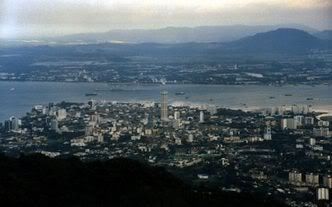
The short missive below was brought to my attention by HerpDigest, an email newsletter devoted to herpetology. Originally, the article was published in a newspaper printed in Penang, Malaysia (pictured above). I can find no link to the article, so I've pasted the text below.
“Breeding Ground For Snakes”
Monday, May 09, 2005, Penang, Malaysia

A vacant piece of land in Penang has turned into a breeding ground for pythons and cobras, endangering people's lives.

The site, at the junction of Perak Road and Macalister Road, is now covered with bushes and weeds and the residents nearby are now living in fear. Resident Teh Boon Seng, 42, said the owner who used to come yearly to clear the weeds failed to do so this time around. He said he had seen pythons and cobras in the area.

“Recently, I called the Fire and Rescue Services department to catch a huge python which crawled out from the site,” he said. “A few days ago, a cobra crawled into my house. We are now having sleepless nights,” he said at a press conference arranged by Komtar state assemblyman Lim Goon Soon recently. Lim said he had told the landowner four years ago to put up proper enclosures at the site, adding that the vacant land was once a haven for drug addicts.

“We want the landowner to clear up the mess fast before the snakes bite people,” he said.

There were at least 35 parcels of idle land in his constituency, he said. He urged the owners to rent out the land as parking lots.
Such situations are not uncommon in Southeast Asia, but the last sentence of this article set it apart. I’ve never been a big fan of Joni Mitchell’s song, “Big Yellow Taxi,” in which she suggests we will "pave over paradise to put up a parking lot," but the explicit parallel is jarring. (I prefer a more contemporary damning tribute to sprawl, Modest Mouse’s “Convenient Parking,” off their 1997 EP, Lonesome Crowded West.) What does an increasingly urban demographic mean for green space in our larger cities and towns? More to the point, what does such green space mean for the city's inhabitants, human and otherwise?

Yesterday, I received in the mail a plea for support from The Trust for Public Land. An attached questionnaire was comprised of questions designed to provoke ‘Yes’ replies, thereby encouraging you to pledge money. “Do you appreciate our national park system and wildlife refuges?” “Do you think it important to have wilderness areas in which you and your family can recreate?” “Do you feel our cities and towns should include more public parks and greenways?”

For the past three years, I have considered myself a champion of the wildlife corridor concept, a worldwide conservation measure trumpeted by the so-called “deep ecology” groups; the terrific Wildlands Project is an example. The “deep ecology” movement, and the wildlife corridor push with it, is often dismissed as a pipe dream but, as I see it, the only valid critique is one which focuses on the “inordinate” amount of time needed to construct this “network of networks.” Protecting and connecting all the ecosystems of the United States, much less the world at large, is an undertaking which promises to take years – perhaps centuries – of ugly courtroom battles and litigation. As Stephen Meyer writes in his excellent article, “The End of the Wild,”
“In theory this strategy could reduce the slide of ghosts and relics into oblivion if it could be implemented immediately and universally. It would be a form of global ecological zoning that would significantly lessen the influence of human selection in the excluded regions. Wildlands would enable species and populations to adapt to climate change. As an ecologically centered strategy it is most likely the only approach that could truly reduce the scale and scope of the biotic collapse that is already underway.

Yet the notion that upwards of seven billion people could live hobbit-like with nature is hard to accept. With the right social framework we might have been able to do it modestly in 1304, but not in 2004 and certainly not in 2104. Global society is moving rapidly and inexorably in the opposite direction.

To be fair, advocates of wildlands acknowledge that, owing to enormous social, political, and economic hurdles, their vision would be at minimum a 100-year undertaking. The problem, of course, is that the end of the wild will already be complete.”
There is a more specific and more interesting question, however. Where the towns and cities “touch” the wildlife corridors, how much connection is to be allowed? For example, if species are able to make their way from a designated wildland to a city park, we suddenly face potential threats from unknown invasive species and a surplus of prey species “hiding out” downtown.

I turn here to Reed F. Noss, a biologist closely associated with The Wildlands Project. The following excerpt is taken from his paper, “Can Urban Areas Have Ecological Integrity?” (I can no longer locate this paper online, but it was published in conjunction with the 4th International Symposium on Urban Wildlife.)
"There are 2 potential problems with this 'network of networks' design. One, corridors leading from the more developed zones of the network might funnel exotics and other opportunistic, weedy species into wildland areas. We know that roads and roadsides, for example, are frequent avenues for the invasion of these pests. I predict, however, that the wildlife corridor network is unlikely to facilitate weedy species invasion of wildlands beyond that already facilitated by roads. In fact, well-designed corridors, especially if wide, may provide habitat for predators of these weedy species. In addition, corridor bottlenecks could be used to trap weedy species and possibly reduce their spread.

A potentially more serious concern is that of corridors connected to wildlands or rural areas funneling problematic large mammals into suburban and urban areas. This is already a problem with deer....Following the deer into suburban areas, however, may be a natural predator of deer - mountain lions. Unfortunately, these predators sometimes also attack joggers and other people. Wildlife corridors have been implicated in bringing both deer and lions into Boulder, Colorado which has created some problems."
And so, at long last, I come back to the Lim Goon Soon comment about the need for more parking lots in Penang. Though Malaysian cities are not surrounded by anything resembling the wildlife corridors advocated by the deep ecology movement, the rural and the urban do butt up against one another in a more explicit fashion than they generally do in the western world. The boundaries blurred, predators passing through a town or city are that much more likely to take up residence in the vacant lots.

So what is to be done? Is their a solution that allows for all parties to be represented or must we “pave over paradise” to quell our fears? For my part, I feel that predators (whether lions, bears, or cobras), living in close proximity to humans need not be a problem. If people were more willing to live alongside other species – a tolerance developed over several generations – safety precautions and sensible behavior would result in less conflict between man and beast. If a mountain lion (Puma concolor) has been frequenting your backyard, bring your dog indoors at night rather than allowing Buster to romp unattended. If a large Great White shark (Carcharodon carcharias) has been repeatedly spotted just beyond the breakers, don’t paddle your board out. Unfortunately, less conflict doesn’t mean a cessation of mawlings or snakebites and so the primal fear of predators will remain an issue for many more generations of man. When and if it does vanish, odds are there will no longer be any predators remaining. Modern man continues to repeat the mistakes of the preceding generations: pave it, mine it, milk it, and propagate, propagate, propagate. The recent boom and bust seizures of the economy are merely a time-lapse film of human history.

Photo credit: Penang, Malaysia, Copyright Chris Rouch. 1999-2005

Wednesday, May 11, 2005

Miscellany

1) Bill Maher has a short interview transcript posted at the Sierra Club's newsletter, "Planet." Maher's precious perspectives and anti-rural bias often find him championing anti-management stances and making fun of "country boys," neither of which ingratiate him to someone like me. In this interview, though, we are on common ground. He boils down the lack of American environmental responsibility to the following observation, "People are just going to have to wake up."

2) In another interview transcript, Grist Magazine sits down with Edward Norton to talk about environmental activism. I respect Norton a great deal, both for some of his more impressive acting turns and for his intelligence. Unfortunately, he sometimes comes across as an arrogant prick - listen to the "Fight Club" commentary if you want to realize just how very much this guy loves waxing poetic about his own abilities - but some of his arrogance confidence is warranted.

3) James Howard Kunstler forecasts extremely dire futures for the First World, particularly our own country (and parts of neighboring Canada), but this recent adaptation of the introduction to his new book, The Long Emergency, is a very important read. It can be married to the excellent Stephen M. Meyer article (about extinction and wildlife conservation) to make you feel really good about the 21st century. I try to remain as optimistic as I can, but I find myself agreeing with Kunstler when he writes,
"It has been very hard for Americans - lost in dark raptures of nonstop infotainment, recreational shopping and compulsive motoring - to make sense of the gathering forces that will fundamentally alter the terms of everyday life in our technological society. [...] Suburbia will come to be regarded as the greatest misallocation of resources in the history of the world."
Kunstler predicts, as the Pentagon did in their 2003 forecast, a complete economic collapse of the United States by 2050. The result will be a country in which train travel is the only economically feasible option and the southern 1/2 is torn apart by drought, disease, and racism. He thinks the northern half of the United States will fare better, but he neglects to address the "white flight" that would surely follow such a "long emergency."
Read it here.