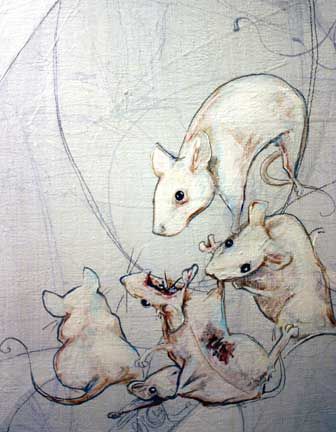
Searching for inspiration in one of my old commonplace books, I came upon the following text. I assume that it was composed in a fit of anger and pessimism but, reading it this evening, years after it was written, the bleak statement doesn't seem so extreme. In fact, despite the dramatic flourish, I feel that it is fairly accurate.
“If we are so linked to Nature, one might ask, why then do we continue to overlook environmental degradation? Why wouldn’t we, as the most powerful players present, do something to curtail our abuses?
The answer is simple, but troubling. Our exuberant abuse itself is natural. Like any other animal, we are driven to reproduce. If you put five mice (four females and one male) in a clean, large enclosure and take care to feed them and supply clean water, they will thrive. In a few months, you will have twenty or so mice on your hands and the cage cleaning will become increasingly challenging. Allow another few months to pass and you will be unable to count the mice without first removing them from the enclosure. Before long, the cage cleaning is a nightmarish chore. The enclosure must be cleaned daily, sometimes more often. As the mice become more overcrowded, the males begin to vie for females. They bully and bite one another, often targeting one individual and biting at his rump or lower back until they open a wound. The enclosure now becomes bloody. Adult males steal newborns from the squirming "nests," kill them and leave the dead bodies strewn, partially eaten, on the now filthy floor. The once clean coats of the rodents are now grimy and matted, their backbones seen easily under their sagging, unhealthy skin. Moments after giving birth, hungry mothers fall on their young, devouring them. If left as is, the urine stench will soon be mixed with the smell of rot and, within a year, all the animals will be dead. Humanity’s enclosure has afforded us more time and more transitions, but the situation is similar.”
In college, I bred mice in order to feed the snakes I kept. I was an irresponsible mouse owner - though a responsible snake owner - and the beginning stages of the above description were witnessed several times, though I never let things get so far out of hand.
While I accept the fatalistic text as an essentially fair assessment, it ignores humanity's potential. Our complex brains allow us to strive to balance
nature with nurture. This desire, I believe, is what makes conservation a moral undertaking; good stewardship is good living.
Painting: detail of "untitled," by Boyce Cummings, 2003