Showing posts with label etymology. Show all posts

Friday, February 19, 2010

Originality and (Re)cognition


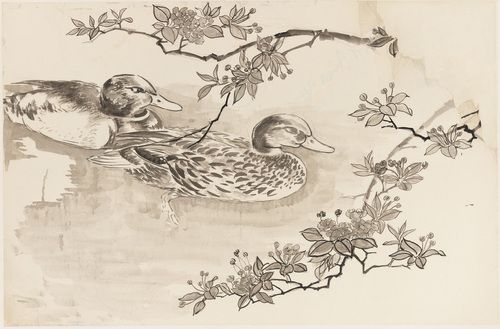
Xie Zhiliu (Chinese, 1910–1997)
"Ducks and Blossoming Branches"
Pencil and ink on paper
20 1/2 x 30 3/4 inches

In his recent review of the Metropolitan Museum of Art's exhibition of works on paper by the late Chinese artist Xie Zhiliu ("Tracing the Path to Chinese Finesse," New York Times, February 14, 2010), art critic Ken Johnson reminds readers that imitation is often a prerequisite for originality. Johnson's piece begins with a Western commonplace,
"Copying is bad; originality is good. That’s what we learn from toddlerdom on. In art as in life, be yourself. Don’t pretend. Nobody likes phonies, fakes or frauds. Forgery is illegal. Authenticity is holy.

But wait. Copying and imitating have been the rule for most of the history of human civilization. In the West artists from Raphael to Picasso have profited from copying the works of others. In art there is no such thing as pure originality."
Or is there?

I suppose it depends on one's definition of originality. Having recently come under the intellectual sway of George Steiner, I wholeheartedly endorse the philosopher-critic's distinction between originality and novelty, detailed in his book Real Presences.
"Originality is antithetical to novelty. The etymology of the word alerts us. It tells of 'inception' and of 'instauration,' of a return, in substance and in form, to beginnings. In exact relation to their originality, to their spiritual-formal force of innovation, aesthetic inventions are 'archaic.' They carry in them the pulse of the distant source."
Put another way, novelty is self-conscious invention or difference for the sake of invention or difference (that is, mere newness), whereas originality is an individual's expression of a primordial and universal resonance.

What better way to absorb the lessons of your predecessors (to better prepare yourself for originality) than by reproducing the work of those artists? More from Johnson's article:
"Maxwell K. Hearn, the exhibition’s organizer and a curator of Chinese painting and calligraphy at the Met, explained in an interview that the show’s main significance is in what it reveals about methods used by traditional artists. It turns out that the kind of graceful naturalism that Xie achieved in his best works came not from extensive study of nature but by tracing over and over the works of other artists on sheets of semitransparent paper. [...] Repeatedly tracing the works of old masters as Xie did might be compared to a pianist practicing a composition by Bach. This may sound suffocating for a modern artist, but it is not unlike how many young artists learn to draw: by copying their favorite comic-book characters over and over."
I was no exception. I spent countless teenage hours copying comic strips and, later, comic book characters. The graphic line and compositional sense that I learned from emulating those comic artists significantly informs my artwork today.

Johnson is correct, however; these ideas "may sound suffocating for a modern artist." That copying (a casual form of apprenticeship) might offend contemporary sensibilities is further evidence of the excesses of modernism and postmodernism. Too much was purged in the revolution of modern aesthetics; the rabble is today without coherence.

Fortunately, the art world is undergoing a sea change. The majority of artists under 40 years of age (and an increasing number of those over 40) do not mistake novelty of expression for originality, and they will readily acknowledge the value of copying, especially for the young artist. In fact, we realize the genuineness of Steiner's insistence that such activity is vital in all aesthetic disciplines.
"To learn by heart is to afford the text or music an indwelling clarity and life-force. Ben Johnson's term, 'ingestion,' is precisely right. What we know by heart becomes an agency in our consciousness, a 'pace-maker' in the growth and vital complication of our identity.

[...] Accurate recollection and resort in remembrance not only deepen our grasp of the work: they generate a shaping reciprocity between ourselves and that which the heart knows. As we change, so does the informing context of the internalized poem or sonata. In turn, remembrance becomes recognition and discovery (to re-cognize is to know anew)."
Image credit: Metropolitan Museum of Art

Friday, August 21, 2009

A Practice of Naming


Christopher van Donkelaar
"Adam Naming the Animals"
Handmade pigments and mixed media
2008
"Praise to the first man who wrote down this joy clearly, for we cannot remain in love with what we cannot name."

- Robert Bly
A lover of etymology and taxonomy, one of my most cherished reference books is Arthur Frederick Gotch's Latin Names Explained: A Guide to the Scientific Classification of Reptiles, Birds and Mammals. In it, Gotch catalogs and dissects the scientific names of some 4,000 animal species. That number appears relatively insignificant when we consider that biologists estimate 25,000 species of bird, mammal, and reptile currently exist on Earth, but Gotch's record is so far unparalleled. Each entry provides the animal's common and scientific names, followed by an explication of the Latin and Greek and, sometimes, a blurb about the species' range and habitat.

For example, consider Gotch's entry on one of my very favorite North American snake species:
Copperhead Agkistrodon contortrix
agkistrodon (Gr) a fish-hook; odon (Gr) a tooth; a reference to the curved fangs, though of course they are not barbed; contorqueo (L) I twist, turn; contortus (L) full of turns, twisted; contortrix (L) one that is able to turn, twist. Inhabiting the south-eastern part of the USA including Florida. The top of the head is reddish brown.
Although the range information suggests that the copperhead is more confined to the southeastern United States than the species and subspecies actually are - they thrive in New York State, for example - Gotch's entry informs readers that the snake commonly called a copperhead is universally and technically named Fish-hook shaped tooth twister or, if you prefer, The Twisting One With Hook Shaped Teeth. Knowledge of this name allows me to appreciate the beautiful reptile from another angle.

But what's in a name, really?

Although I'm generally baffled by Biblical literalism, I appreciate the Genesis accounts of creation for their gratifying metaphor. In particular, I'm drawn to rabbinic and Jewish mystics' interpretations of the conjoined, aboriginal narratives. More so than their Christian counterparts, Jewish theologians and mystics endow language and names with ontological significance. The Hebrew alphabet is understood as a powerful code: the written word is creative potential, and the spoken word, procreative. The god of Genesis 1 creates neither with a wave of the hand nor by shaping raw material, but by speaking the world into being; annunciation and incantation are the means of creation. Because of the vocative nature of naming, observant Jews place great value on words and speech. (They are even prohibited utterance of the tetragrammaton, the four-letter Hebrew name of God, transliterated as Yahweh. Appropriately enough, the colloquial name for God is Hashem, or "the word.")

In Genesis 2, the creator god is anthropomorphized and physically involved with creation, shaping man and the other animals from earth. Yet the power of language and names remains significant in this account. God asks Adam, the first naked ape, to name all of the other animal species. That's no mean task, and apparently Adam died before he finished the job. His descendants, at least the taxonomists among them, are still working at the task of naming.

But even those individuals who do not share my affection for taxonomy will find value in a practice of observation and naming. As Carol Kaesuk Yoon writes in her recent New York Times paean to taxonomy, "Reviving the Lost Art of Naming the World,"
"Even when scads of insistent wildlife appear with a flourish right in front of us, and there is such life always — hawks migrating over the parking lot, great colorful moths banging up against the window at night — we barely seem to notice. We are so disconnected from the living world that we can live in the midst of a mass extinction, of the rapid invasion everywhere of new and noxious species, entirely unaware that anything is happening. Happily, changing all this turns out to be easy. Just find an organism, any organism, small, large, gaudy, subtle — anywhere, and they are everywhere — and get a sense of it, its shape, color, size, feel, smell, sound. Give a nod to Professor Franclemont and meditate, luxuriate in its beetle-ness, its daffodility. Then find a name for it. Learn science’s name, one of countless folk names, or make up your own. To do so is to change everything, including yourself. Because once you start noticing organisms, once you have a name for particular beasts, birds and flowers, you can’t help seeing life and the order in it, just where it has always been, all around you."
Beautiful. Let's name something.

See also "The Plant Whisperer," another brief HH essay considering similar ideas.

Image credit: van Donkelaar painting ripped from the Nurturing Faith website

Tuesday, April 21, 2009

Bring out your dead!


Walking to work this morning, I noticed for the first time that the Department of Sanitation New York City (DSNYC) logo features the caduceus, a symbol that depicts two snakes entwined about a staff. The DSNYC website explains that the caduceus, "the traditional medical symbol," is incorporated "to promote the idea that sanitation can affect the health of the City."

Indeed, sanitation is one of the most revolutionary inventions of mankind, but somebody at the DSNYC didn't do their homework. The "traditional medical symbol" is not the caduceus, but the rod of Aesculapius, an image that features just one snake wrapped around a staff or branch.

As I wrote here (almost exactly) four years ago,
"No bastardization of a symbol, however, is so glaring as the misuse of the caduceus by medical professionals. The familiar image of two snakes entwined about a winged staff is used by a slight majority of medical practitioners and groups. The caduceus, though, has nothing to do with medicine! It is the staff of Hermes.

'…Hermes was also considered to be the god of commerce and wealth, which in turn implies a sense of personal self-interest along with the possibility of stretching the truth to meet one’s own needs. Hermes was known as the patron god of thieves due to his many tricks and lies. The quality of dishonesty is not one that most people want to see in their physician, therefore a symbol that is traced back to representing trickery and deceit should not be used to represent a profession as highly regarded in trust as medicine. Additionally, Hermes is also said to have used his caduceus staff to lead the souls of those who passed away to the underworld, which is the opposite idea than that stated in the Hippocratic Oath that a physician is charged with.'

The symbol of medicine is actually Aesculapius’s staff...Aesculapius, appropriately, was the God of Medicine.

'The son of Apollo, god of health, Aesculapius is said to have been pulled from the womb as his mortal mother was dying, which came to symbolize a physician’s ability to turn death into life. Throughout his life, Aesculapius used medicinal herbs and surgical procedures to heal the sick and dying, with his culmination of the art being the ability to bring the dead back to life. In one episode of mythology, Aesculapius was said to have been inside a temple when a serpent came to him and wound itself up and around his walking staff. He killed the serpent, only to have a second slither in and use an herb to bring its dead comrade back to life. This brings forth the explanation for the revered symbol of Aesculapius’s staff, with this herb being the major discovery of his life. The snake was seen as a servant to Aesculapius in his healing, and was worshiped as such.'

Clearly, the two symbols became confused at some point. Kim Scott wrote a short history of the confusion, 'The History and Confusion of the Caduceus symbol and the Staff of Aesculapius in Medicine,' from which the above selections [in italics] are drawn. Scott dates the initial mix-up to circa 1500. Apparently, the symbolic SNAFU led to twentieth century medical [professionals regularly using the wrong staff.]"
And the DSNYC, too, made the same mistake.

But perhaps I'm too quick to condemn the DSNYC decision to adopt the caduceus? Maybe the folks behind the logo intended to reference the popular maxim, "One man's trash is another man's treasure." With that in mind, the DSNYC workers might be understood as Hermetic treasure thieves. Or, if that's too much of a stretch, we can consider Hermes' role as a conveyor of the dead to Hades. NYC's trashmen, then, can be thought of as leading the souls of the discarded to the Underworld. The latter interpretation gets my vote!

Wednesday, April 20, 2005

You Say Caduceus, I Say Aesculapius


I value symbols and language highly and, though I don't deny that both are subject to evolution, I do feel there should be a reasonable limit to the degree of abstraction or change. If anything goes, a great deal of the so-called evolution is instead de-evolution.

No one, to use a far-fetched example, would accept the word “sun” being used to denote the moon. The two celestial bodies are not opposites, but they are nonetheless distinct; the earth orbits the sun while the moon orbits the earth. If a lover were to gesture at the pale orb above and proclaim, “What a beautiful night.! The sun is full and the stars are bright,” you'd likely balk.

Some language picadillos are specific to our field or area of expertise. Few of my friends are galled by the catch-all term “seagull.” But birders and wildlife biologists recognize that there are 27 known species of gull in North America alone, and many of these gulls have little association with the “sea.” An equivalent misnomer, then, would be our calling all humans “watermen,” though only a small minority of Homo sapiens still eke out a living from the ocean.

Some vocabulary hang-ups of mine are, like "ATM machine," shared by many other people. Examples are the recently popular “irregardless” and the New York City MTA's “momentarily”/”in a moment” confusion. More extreme than I, my father has raged against the use of the word “bathroom” for years. He points out that most public restrooms contain no bath. He prefers “toilet,” “water closet” or “head.” Because I so frequently use the word “restroom,” he chides me by asking if I intend to sleep or lie down on the tile floor. Perhaps, then, a late night of drinking makes the term "restroom" accurate?

The meaning or significance of a symbol is more steadfast. A change in attributed meaning is most often due to outright misuse. Some hipsters wear East German military insignia as an ironic or “hip” gesture but, despite the changed context, the marking still retains its original meaning. Or does it? Typically, the teenagers and twenty-somethings that don military decoration do not know what the medals mean. Even Hollywood costume designers treat these medals and ribbons as general signifiers of military do-gooding. Rarely do they take the time to learn what each medal represents. As a result, Hollywood often presents audiences with an Army officer whose chest is covered in Navy and Air Force ribbons! To a certain segment of the movie-going audience, this is a major "Whoops!"

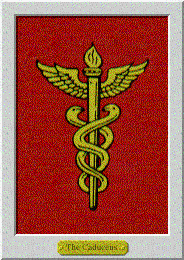
No bastardization of a symbol, however, is so glaring as the misuse of the caduceus by medical professionals. The familiar image of two snakes entwined about a winged staff is used by a slight majority of medical practitioners and groups. The caduceus, though, has nothing to do with medicine! It is the staff of Hermes.
“…Hermes was also considered to be the god of commerce and wealth, which in turn implies a sense of personal self-interest along with the possibility of stretching the truth to meet one’s own needs. Hermes was known as the patron god of thieves due to his many tricks and lies. The quality of dishonesty is not one that most people want to see in their physician, therefore a symbol that is traced back to representing trickery and deceit should not be used to represent a profession as highly regarded in trust as medicine. Additionally, Hermes is also said to have used his caduceus staff to lead the souls of those who passed away to the underworld, which is the opposite idea than that stated in the Hippocratic Oath that a physician is charged with.”
The symbol of medicine is actually Aesculapius’s staff, which features ONE snake curled around a rod. Aesculapius, appropriately, was the God of Medicine.
“The son of Apollo, god of health, Aesculapius is said to have been pulled from the womb as his mortal mother was dying, which came to symbolize a physician’s ability to turn death into life. Throughout his life, Aesculapius used medicinal herbs and surgical procedures to heal the sick and dying, with his culmination of the art being the ability to bring the dead back to life. In one episode of mythology, Aesculapius was said to have been inside a temple when a serpent came to him and wound itself up and around his walking staff. He killed the serpent, only to have a second slither in and use an herb to bring its dead comrade back to life. This brings forth the explanation for the revered symbol of Aesculapius’s staff, with this herb being the major discovery of his life. The snake was seen as a servant to Aesculapius in his healing, and was worshiped as such.”
Clearly, the two symbols became confused at some point. Kim Scott wrote a short history of the confusion, "The History and Confusion of the Caduceus symbol and the Staff of Aesculapius in Medicine," from which the above selections are drawn. Scott dates the initial mix-up to circa 1500. Apparently, the symbolic SNAFU led to twentieth century medical newsletters using the word caduceus in their titles!

The conservative commentator in me feels that our educational system is in need of a visit from Aesculapius, too.