 |
| "Marsh near Chesconessex Creek; Eastern Shore of Virginia; December 2013" |

Showing posts with label fish. Show all posts
Showing posts with label fish. Show all posts
Sunday, February 23, 2014
Striped Bass Fishing On the Chesapeake Bay
This past December, when Elizabeth and I visited my parents on the Eastern Shore of Virginia, I got out on the Chesapeake Bay for some striped bass fishing and sight seeing with Elizabeth, my friend, Edward, and my father. We didn't catch any stripers we could keep -- all were under the minimum regulation size -- so it was a catch-and-release trip, but being on the water was a treat, as it almost always is.

Thursday, March 18, 2010
Mixed Environmental News
In HH's early days, I often wrote about the health of marine ecosystems and the urgent need for more sustainable fisheries. While I no longer address these issues as frequently as I did at the project's outset, I'm every bit as invested in environmental and conservation causes. Thus, I find today's New York Times piece "UN Rejects Export Ban on Atlantic Bluefin Tuna" discouraging...but also slightly promising.
It's discouraging to read, because the news is generally bad:
Note: This post also appears on the Endangered Species Print Project blog.
It's discouraging to read, because the news is generally bad:
"A U.S.-backed proposal to ban the export of Atlantic bluefin tuna prized in sushi was rejected Thursday by a U.N. wildlife meeting, with scores of developing nations joining Japan in opposing a measure they feared would devastate fishing economies. It was a stunning setback for conservationists who had hoped the 175-nation Convention on International Trade in Endangered Species, or CITES, would give the iconic fish a lifeline. They joined the proposal's sponsor Monaco in arguing that extreme measures were necessary because the stocks have fallen by 75 percent due to widespread overfishing.The report is also slightly promising, however, because the United States has again positioned itself as a proponent of conservation measures.
'Let's take science and throw it out the door,' said Susan Lieberman, director of international policy with the Pew Environment Group in Washington. 'It's pretty irresponsible of the governments to hear the science and ignore the science. Clearly, there was pressure from the fishing interests. The fish is too valuable for its own good.'"
"Only the United States, Norway and Kenya supported the proposal outright. [...] The tuna defeat came hours after delegates rejected a U.S. proposal to ban the international sale of polar bear skins and parts, suggesting that economic interests at this meeting were trumping conservation.The end result, then, is by no means a happy one...but what a welcome policy change from the days of Bush & Company!?
The Americans argued that the sale of polar bears skins is compounding the loss of the animals' sea ice habitat due to climate change. There are projections that the bear's numbers, which are estimated at 20,000 to 25,000, could decline by two-thirds due by 2050 due to habitat loss in the Arctic."
Note: This post also appears on the Endangered Species Print Project blog.
Friday, June 12, 2009
An Ocean Ethic
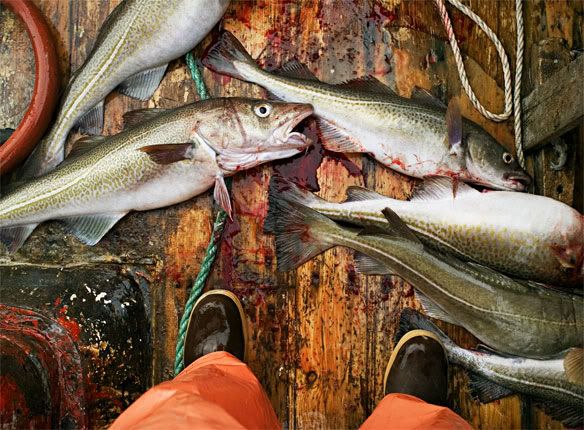
"Torsken"
2007
Chromira C-print
The son of an avid saltwater fisherman, many of my summer days were spent offshore. Departing the Wachapreague, Virginia, docks at 5 AM, the sky broke pink as my father carefully piloted his Boston Whaler through the salt marsh channels. Upon reaching the ocean inlet, we'd begin a thirty or forty mile run toward the sun-soaked eastern horizon. By 8 AM, we'd be trolling for yellowfin and bluefin tuna, dolphin ("mahimahi"), amberjack, or various mackerel species. If that technique proved unsuccessful (or if my father's fishy hunches proved wrongheaded), we'd move west, closer to shore, so that we could bottom-fish for black sea bass, spot, and weakfish over scuttled World War II ships and defeated German U-boats.
Compared to my father, I was unenthusiastic about salt-water fishing. I much preferred fishing on a pond, fly or spin casting into "honey holes," those storied pockets where the giant largemouth bass, perch and bluegill dwell. The relative solitude and meditative character of freshwater fishing appeals to my temperament. I associate the leisurely activity with the soft-spoken stroke of the canoe paddle; the rhythmic, almost ritualized casting of a fly or lure; the temperate spring breezes that lick my bare forearms as they do the banks' willow and maple trunks; the ecstatic chatter of a kingfisher. Above all, I associate it with a sense of universal benevolence. This, in stark contrast to fishing offshore, where Nature's benevolence is tempered by ambivalent and awesome forces.
Still, I enjoyed being on the open ocean. I loved the bounce and glide of my father's Whaler as it motored over the Atlantic chop, and I was delighted by the otherworldliness of ocean life: shadowy hammerheads passing through depth-piercing sun rays; dolphins propelling themselves skyward to get a better look at us; the surprising company of terns and gulls so far from land; loggerhead sea turtles basking on the ocean's surface; hundreds of cownose rays flying just beneath the water's surface. These images, and many others, stay with me. The ocean is a mysterious, thrilling place.
Sadly, it is also a threatened place. The most dire reports forecast that the ocean's fish species will be depleted by mid-century. If that should come to pass, the commercial seafood industry will no longer be viable and, more seriously, our world's biodiversity and ecological integrity will have been dealt an awful blow. Because of my latter day hunter-gatherer approach to fish and meat consumption, the only shellfish I consume are those few blue crabs and clams that I pull from the Eastern Shore's tidal estuaries. I rarely fish these days, so fish species are off my menu altogether.
Food writer Mark Bittman would likely approve of my vegetarian-unless-I-kill-or-catch-it ethic. In a recent New York Times article, "Loving Fish, This Time With the Fish in Mind" (June 9, 2009), Bittman argues for a more conscientious approach to seafood.
"In the meantime, I'm careful. I don’t make excuses, like 'There's cod in the market, so someone is catching it somewhere,' or 'If I don't buy it, someone else will,' or 'This chef serves local food, so he must serve sustainable fish.' If I’m going to eat fish, it must be consciously and thoughtfully.Every educated eater should do the same, and each of us should strive to educate ourselves further. It's the ethical thing to do.
My approach - which I readily admit is a work in progress and is as imperfect as my approach to all foods - goes something like this:
- I don’t buy or order the common fish I can easily keep in mind as being super-troubled — most cod, for example, or bluefin tuna, most species of shark and skate. When in doubt, I move on.
- With rare exceptions, I don't buy or order farm-raised fish, except clams and oysters. Farmed mussels and shrimp don’t seem to come with egregious environmental consequences, but neither tastes like much, either.
- I don’t eat fish as often as I once did. (I don’t promote eating it as I once did, either.)
- And I keep re-evaluating these 'rules,' and thinking about them. The 'safe' lists are difficult to understand, impossible to remember and change frequently. When the fishing of a species is well managed, it can recover and become sustainable. When it's not, the stocks of that fish disappear, sometimes quickly.
I’m probably not going to stop eating fish. And fortunately I don’t have to, since there are species that have never been depleted - squid and mackerel, for example - and those that have recovered, like haddock and Maine lobster.
It’s improbable that I’ll eat in a perfectly sustainable manner, even though I probably eat one-third as much fish as I did a few years ago. I’m trying not to let perfect become the enemy of good, and I’m trying to find a place that feels comfortable. That place is to see eating fish as a treat. I won’t eat it daily or in huge quantities, but occasionally, with appreciation. The days of 'see it/eat it' are gone."
Time and evolution will march on, heedless of our nostalgic and preservationist impulses, but their ambivalence doesn't mean we've license to shrug and capitulate to the selfish wonts of the average consumer. Future generations should bear witness to the wonderful abundance that we have known and, to a lesser degree, still know. If we eat with an open mind and heart, perhaps that can be so.
Image credit: photograph by Corney Arnold; ripped from the artist's website
Thursday, August 09, 2007
Back From The Pantanal
Some Pictures and Thoughts

Bird's eye view of the Pantanal (Pantanal, Brasil)
I'm sun burnt, marked by half-healed tick and mosquito bites, and still nursing a few infected cuts on my feet, but I'm back in the New York City harness. Part of me is happy to be home, but I already feel the burden of our frivolous "first-world" pressures and distractions. I've been confirming studio visits and dinner dates, dragging my feet through two weeks of unattended email, catching up with piles of paperwork at the day job, and stressing over how few paintings I've so far completed in '07. By contrast, in the Pantanal my worries were limited to hydration, securely taping shut my pant legs (to discourage ticks), and accurately recording census data. My time there was stress free and I was therefore better able to fully appreciate the experience.

Anchored water hyacinth (Eichhornia azurea) flower near shore of bahia at Pousada Ararauna
It helped, of course, that I was surrounded by people who share my enthusiasm for wildlife and ecology. I was one of eleven volunteers hailing from Ireland, California, Colorado, Ohio, and New York. The researchers we assisted in the Pantanal work on three different projects. "Amphibians and Reptiles of the Southern Pantanal" is headed by Ellen Wang, a Ph.D. candidate at Sao Paulo State University. "Birds and Dynamic Habitat Mosaics" is led by Dr. Reginaldo Jose Donatelli (Sao Paulo State University) and Gustavo Rosa. "Ecology and Conservation of Pantanal Otters" is led by Dr. Helen Waldemarin, but I worked with Manoel Muanis, a M.Sc. candidate at Federal University of Rio de Janeiro. All three projects were of interest to me but, as those familiar with my affection for serpents would assume, I was most excited by the herpetology work.

Clemuso holding cat-eyed snake (Leptophis annulata); this fellow was captured inside Frank and Nicki's toilet; very calm. non-venomous colubrid species, but often mistaken for the venemous and much maligned Fer-de-lance (Bothrops asper) (Pousada Ararauna, Pantanal, Brasil)
The official project abstract describes the Pantanal as follows. "The Middle Rio Negro region of the Brazilian Pantanal, where this research takes place, is a relatively pristine area with high conservation status. Deforestation has been minimal, access via roads is difficult and the main commercial activity is low-impact cattle ranching using native pastures." I don't find that description entirely accurate. Although the Panatal is a UNESCO World Heritage Site and is considered the world's largest tropical wetland, it is not what most of us would deem "pristine." Cattle are ubiquitous, and although the Pantaneiros, the longtime residents and cowboys of the Pantanal, have restricted their cattle-related deforestation, the large herds have a visible impact on the ecology of the wetlands. There are 55 cattle for every 1 person in the Pantanal, an estimated 4.5 million cattle in all.

Contrast of defrested cattle land and "natural" makeup of the Pantanal, as seen from air on flight out to research site
Prior to traveling to Brazil, I imagined the Pantanal to be a relatively virgin area, with few visible human marks. In fact, it more closely resembles a Texas ranch. Barbed wire fences are ubiquitous (fortunately, excepting some large deer, all wildlife species can pass through them without problem) and sandy roads crosshatch the landscape when viewed from above. Horses and canoes are still used as the primary modes of transport on the fazendas, but trucks, tractors, and motorboats are just as, if not more, popular.

Ellen closing one of the many fence gates in the Pantanal; the fences are installed by Pantaneiros to regulate cattle movement (Pantanal, Brasil)
But it behooves us to appreciate that the impacts of ranching are not all negative. Because 95% of the Pantanal, which covers an area comparable to the state of Nebraska, is privately owned (the land is divided among the various ranchers) the fazendas protect the ecology of the region. Industry can not so easily move in on private holdings and, better still, some landowners are now opting to set aside small portions of their land for conservation (in return for tax credits and stipends from the Brazilian government). Florida's tropical cattle ranches are similarly valuable to conservation, preventing residential and industrial development from encroaching on critical habitat and fragile ecosystems.
A more serious threat to the Pantanal is the growing global demand for ethanol. With do-gooder "first-worlders" like myself calling for alternative fuels, cash poor countries see a window of opportunity. Sugarcane is among the most popular crops for ethanol production and Pantaneiros must clear-cut before they can plant cane. The fact that biofuel production isn't a Utopian solution shouldn't come as a surprise. Scientists unaffiliated with industry have criticized biofuels for years. David Pimentel, professor of ecology and agriculture at Cornell University, explains, "Ethanol production requires large fossil energy input...Further, its production and use contribute to air, water and soil pollution and global warming." The Sierra Club's Mr. Green adds emphasis, "If you think the industrialized monoculture that fattens livestock is scary, ponder the gloomy prospect of a couple hundred million automobiles feeding off the land." And, if ranching and agriculture in the Pantanal don't take their toll, pesticide and fertilizer runoff from the surrounding highlands may pick up the slack.

One of the adult spectacled caiman (Caiman crocodilus) disturbed by my wading in pousada bahia (Pousada Ararauna, Pantanal, Brasil)
It's difficult to protect a unique ecosystem like the Pantanal when economic development is the Holy Grail. Brazilian environmental agencies talk of "balancing economic sustainability with conservation." Indeed, given our fanatical embrace of neo-classical economics and the neoliberal paradigm, we must try to balance the equation, but I see no reason why we shouldn't also strive to reeducate ourselves, to find viable alternatives to industrial capitalism. Rebecca Solnit writes,

Manoel and John in canoes on river during afternoon otter census (Pantanal, Brasil)
Pousada Ararauna, the lodge where my team of volunteers stayed, is owned by a private university and is dedicated to ecotourism and ecological research; it is located on Santa Emilia Farm, a 6,450 acre property in the southeastern Pantanal. The details (and focus subjects) of the three projects vary, but they all seek to ascertain how tourism, agriculture, and other developments are impacting the biodiversity of the region. The hope of all such research is that the findings will bring more attention to the ecosystem in question and result in more federal protections and environmental awareness on the part of the local landowners.

A pair of Hyacinth macaws (Anodorhynchus hyacinthinus) perched in "para todos" tree in early morning, with moon behind (Pousada Ararauna, Pantanal, Brasil)
My time in Brazil flew by, as it often does when I find myself physically engaged with (and thinking about) ecology. Rather than write a detailed account of the trip, I've listed a few highlights below and I'll post more captioned pictures in coming days. You can also visit my Flickr Brazil set to view more photos.

Pantanal at dusk (Pantanal, Brasil)
Also, for those readers who are wildlife geeks like myself, identification of some of the spiders, insects, fish, amphibians, and reptiles I came across is challenging. Any help would be greatly appreciated.

Hyla alba treefrog species found by Manoel in kitchen bathroom; no common name I can find (Pousada Ararauna, Pantanal, Brasil)
Pantanal Highlights:

A giant armadillo (Priodontes maximus) - the species is threatened or endangered - near bahia at Pousada Ararauna
- Common though they are in the Pantanal (globally, they are endangered), I was thrilled to see giant armadillos (Priodontes maximus). I fancied myself quite the stalker after I managed to move within a few feet of one during my first afternoon at the pousada, but soon learned that the animals are rather mellow and, in fact, easy to catch. (Oh, my bruised ego.) Still, they're charismatic little guys and I was cheered whenever I saw them bumbling along. (FYI: The "giant" in their name is relative; they're not imposing critters.)

Holding a small Red belly piranha (Pygocentrus nattereri) (Pantanal, Brasil)
- I enjoyed catching piranha. The fishing itself is not challenging; you bait a hook with raw meat, toss it over, feel the tugs, and pull up a fish. The Pantaneiros use either a line with no rod (called handlining, which I've done once before, for sharks in Costa Rica) or a reel-less rod with the line attached to the end. You must use a wire leader to prevent the fish from biting off the hook. Needless to say, you must take care when releasing piranha; their teeth and jaws are truly remarkable. We caught two morphological variants of the Red-bellied piranha (Pygocentrus nattereri), as well as several pitanga (Sp?).
Most of the piranha we caught were released, but a few of the larger ones were kept for piranha soup, a Pantaneiro favorite believed to be an aphrodisiac. Because I caught the fish, my dietary restrictions allowed me to eat some of the soup. It tasted like a very salty lentil soup; I couldn't detect the fish flavor at all (and sadly I didn't have an opportunity to see if the recipe made me particularly virile).
- We only saw four species of snake during my time in the Pantanal, but each of them were a thrill. I love to see and handle snakes; they're magical animals in my estimation. The four species we came upon were all diminutive, and we saw nothing of their enormous relative, the yellow anaconda (Eunectes notaeus). I was disappointed by this conspicuous absence but, after years of looking for snakes, I know well that each and every find is a treat.

Holding young spectacled caiman (Caiman crocodilus) used in Lucio's mosquito vector experiment; mouth is taped to prevent unfortunate nips (Pousada Ararauna, Pantanal, Brasil)
- I enjoyed interacting with the spectacled caiman (Caiman crocodilus). I handled a juvenile (being used in a mosquito vector experiment conducted by a researcher at the pousada), and I swam and waded with the reptiles a couple of times, determined to see how close I could get before spooking them. They are alligators, not crocodiles, and are therefore unlikely to mistake a human for a potential meal, especially given their relatively small size (5 to 7 feet). They were most numerous on the river banks, where they rested during the day, absorbing the sun's energy before heading to the water again for evening hunting.

Teri swimming in the caiman pool (Pousada Ararauna, Pantanal, Brasil)
- One night, while walking the small runway near the pousada (the best way to reach most areas of the Pantanal is by plane) with a headlamp, my beam blinded two orange eyes. Unable to see, the creature remained motionless while I steadily advanced on it. Moments later, I was standing a foot from a resting pauraque (Nyctidromus albicollis), a member of the nightjar family (Caprimulgidae). The nightjars rank just behind the corvids (crows, ravens, and jays) as far as my favorite bird families go, and I was stoked to be so close to the curious fellow (or lady). I learned later that I might have reached down and picked the bird up...if only I'd kept my headlamp trained on those big eyes. Instead, I turned my head to call some other volunteers over and, no longer blinded by my light, the bird was soundlessly gone.

Part of the family group of eleven giant river otter (Pteronura brasiliensis) near den as we drift by; marks on chest are individual (Pantanal, Brasil)
- The giant river otter (Pteronura brasiliensis) family groups were particularly impressive. The largest group we came upon numbered 17 individuals, each distinguished by unique, white markings on their chest. They are inquisitive animals, and when our boat or canoe approached, they repeatedly reared from the water to take a look at the human trespassers, all the while coughing, huffing, and otherwise vocalizing. Sadly, this species is also endangered.

Giant anteater (Myrmecophaga tridactyla) approaches at night; because they do not see or hear well, if you sit very still they sometimes come very close; this individual came within ten feet (Pantanal, Brasil)
- Walking around the pousada grounds at night was always a trat. Giant-anteaters (Myrmecophaga tridactyla), crab-eating foxes (Cerdocyon thous), feral pigs (Sus scrofa), and a grey brocket deer (Mazama gouazoubira) were all seen on these little adventures. Furthermore, tropical nighttime sounds are beautiful and, if I turned off the light and stood still, the marsh and fringe woodland came alive for my ears. It's wondrous.
One evening I walked to the end of the runway, away from the lights of the pousada, and, having had a little too much to drink, sat down to do some half-thinking. Leaves crunched and birds called from the tropical forest to my right and, in front of me, the marsh was alive with frog conversation and the sporadic beacons of fireflies. I sat there in dumb bliss for some minutes...until some of the crunching sounds became more pronounced than I was comfortable with. Imagining an ambitious jaguar, I walked double-time back to the pousada, feeling ridiculously urban and silly. I'm sure that the little armadillo or anteater in the woods was happy to see me depart.
- A few of us were lucky enough to witness a collared forest falcon (Micrastor semitorquatus) as it attempted, twice, to take a grey-necked wood rail (Aramides cajanea). The falcon tore from the trees and swooped on the sprinting rail. It missed, perhaps startled by the presence of four humans so nearby. The rail panicked; rather than flee into the safety of the marsh, it attempted to return to the woods for cover. The falcon took note and attacked again as the rail made the fringe. Again, failure. At last the rail wised up and veered away from the trees, vanishing into the marsh reeds.
The falcon perched in the top of a dead tree and looked down at us contemptuously. Were it not for our being there, the rail may have been the falcon's dinner. I was at once happy for the rail and disappointed for the falcon. Having evolved as predators ourselves, it's only natural that we identify with the hunters.

Ellen showing two different color variations of Paradoxical frog (Pseudis paradoxa); this is the only species to appear with malformation in the Pantanal to date (Pousada Ararauna, Pantanal, Brasil)
- Tedious though it can sometimes be, I thoroughly enjoyed all the herpetology laboratory work. We weighed, measured, and identified all captured individuals before readying them for release. We identified and labelled any "Dead In Trap" specimens that we had retrieved. Unfortunately, there were a great many of the latter, casualties of dehydration or insect attack. (Many ants fall into the pitfall traps and, if they become irked with a fellow inmate, that frog, cockroach, or lizard is likely a goner.)

Leaf-cutter ants at work in evening hours; uncertain of species (Pantanal, Brasil)
- Finally, I very much enjoyed the company of the volunteers and all of the folks at the pousada, researchers, cooks, bridge builders, and Pantaneiros alike. A little music, dancing, and too much cachaca. Puxe meo dedo!

Gino, Gustavo and Ernaldo playing into the night (Pousada Ararauna, Pantanal, Brasil)
Anyway, that's all I'll write for the moment. As always, it takes time to digest a big trip and I'm sure there will be related posts to follow.

Rockstar shades and "safari" garb = ecotourist a$$hole
Late afternoon on the river(Pantanal, Brasil)
Photo credits: all photos this post, Hungry Hyaena

Bird's eye view of the Pantanal (Pantanal, Brasil)
I'm sun burnt, marked by half-healed tick and mosquito bites, and still nursing a few infected cuts on my feet, but I'm back in the New York City harness. Part of me is happy to be home, but I already feel the burden of our frivolous "first-world" pressures and distractions. I've been confirming studio visits and dinner dates, dragging my feet through two weeks of unattended email, catching up with piles of paperwork at the day job, and stressing over how few paintings I've so far completed in '07. By contrast, in the Pantanal my worries were limited to hydration, securely taping shut my pant legs (to discourage ticks), and accurately recording census data. My time there was stress free and I was therefore better able to fully appreciate the experience.

Anchored water hyacinth (Eichhornia azurea) flower near shore of bahia at Pousada Ararauna
It helped, of course, that I was surrounded by people who share my enthusiasm for wildlife and ecology. I was one of eleven volunteers hailing from Ireland, California, Colorado, Ohio, and New York. The researchers we assisted in the Pantanal work on three different projects. "Amphibians and Reptiles of the Southern Pantanal" is headed by Ellen Wang, a Ph.D. candidate at Sao Paulo State University. "Birds and Dynamic Habitat Mosaics" is led by Dr. Reginaldo Jose Donatelli (Sao Paulo State University) and Gustavo Rosa. "Ecology and Conservation of Pantanal Otters" is led by Dr. Helen Waldemarin, but I worked with Manoel Muanis, a M.Sc. candidate at Federal University of Rio de Janeiro. All three projects were of interest to me but, as those familiar with my affection for serpents would assume, I was most excited by the herpetology work.

Clemuso holding cat-eyed snake (Leptophis annulata); this fellow was captured inside Frank and Nicki's toilet; very calm. non-venomous colubrid species, but often mistaken for the venemous and much maligned Fer-de-lance (Bothrops asper) (Pousada Ararauna, Pantanal, Brasil)
The official project abstract describes the Pantanal as follows. "The Middle Rio Negro region of the Brazilian Pantanal, where this research takes place, is a relatively pristine area with high conservation status. Deforestation has been minimal, access via roads is difficult and the main commercial activity is low-impact cattle ranching using native pastures." I don't find that description entirely accurate. Although the Panatal is a UNESCO World Heritage Site and is considered the world's largest tropical wetland, it is not what most of us would deem "pristine." Cattle are ubiquitous, and although the Pantaneiros, the longtime residents and cowboys of the Pantanal, have restricted their cattle-related deforestation, the large herds have a visible impact on the ecology of the wetlands. There are 55 cattle for every 1 person in the Pantanal, an estimated 4.5 million cattle in all.

Contrast of defrested cattle land and "natural" makeup of the Pantanal, as seen from air on flight out to research site
Prior to traveling to Brazil, I imagined the Pantanal to be a relatively virgin area, with few visible human marks. In fact, it more closely resembles a Texas ranch. Barbed wire fences are ubiquitous (fortunately, excepting some large deer, all wildlife species can pass through them without problem) and sandy roads crosshatch the landscape when viewed from above. Horses and canoes are still used as the primary modes of transport on the fazendas, but trucks, tractors, and motorboats are just as, if not more, popular.

Ellen closing one of the many fence gates in the Pantanal; the fences are installed by Pantaneiros to regulate cattle movement (Pantanal, Brasil)
But it behooves us to appreciate that the impacts of ranching are not all negative. Because 95% of the Pantanal, which covers an area comparable to the state of Nebraska, is privately owned (the land is divided among the various ranchers) the fazendas protect the ecology of the region. Industry can not so easily move in on private holdings and, better still, some landowners are now opting to set aside small portions of their land for conservation (in return for tax credits and stipends from the Brazilian government). Florida's tropical cattle ranches are similarly valuable to conservation, preventing residential and industrial development from encroaching on critical habitat and fragile ecosystems.
A more serious threat to the Pantanal is the growing global demand for ethanol. With do-gooder "first-worlders" like myself calling for alternative fuels, cash poor countries see a window of opportunity. Sugarcane is among the most popular crops for ethanol production and Pantaneiros must clear-cut before they can plant cane. The fact that biofuel production isn't a Utopian solution shouldn't come as a surprise. Scientists unaffiliated with industry have criticized biofuels for years. David Pimentel, professor of ecology and agriculture at Cornell University, explains, "Ethanol production requires large fossil energy input...Further, its production and use contribute to air, water and soil pollution and global warming." The Sierra Club's Mr. Green adds emphasis, "If you think the industrialized monoculture that fattens livestock is scary, ponder the gloomy prospect of a couple hundred million automobiles feeding off the land." And, if ranching and agriculture in the Pantanal don't take their toll, pesticide and fertilizer runoff from the surrounding highlands may pick up the slack.

One of the adult spectacled caiman (Caiman crocodilus) disturbed by my wading in pousada bahia (Pousada Ararauna, Pantanal, Brasil)
It's difficult to protect a unique ecosystem like the Pantanal when economic development is the Holy Grail. Brazilian environmental agencies talk of "balancing economic sustainability with conservation." Indeed, given our fanatical embrace of neo-classical economics and the neoliberal paradigm, we must try to balance the equation, but I see no reason why we shouldn't also strive to reeducate ourselves, to find viable alternatives to industrial capitalism. Rebecca Solnit writes,
"we have all been trained as torturers of a sort in this economy and nation that generate a huge array of atrocities while training us not to see or feel them. Enormous violence is all around us, in the brutality of capitalism as it devastates for profit rural landscapes, from Amazon rainforests to Wyoming ranches, produces poverty for more profit, and consigns the resultant poor to incarceration, illness, homelessness, and dead-end jobs."All "First worlders" are guilty to one degree or another, but this doesn't mean we should throw up our hands and surrender to thoughtless greed and willful ignorance. Individual and local resistance efforts can and do make a difference, especially in terms of cultivating awareness and restructuring value systems.

Manoel and John in canoes on river during afternoon otter census (Pantanal, Brasil)
Pousada Ararauna, the lodge where my team of volunteers stayed, is owned by a private university and is dedicated to ecotourism and ecological research; it is located on Santa Emilia Farm, a 6,450 acre property in the southeastern Pantanal. The details (and focus subjects) of the three projects vary, but they all seek to ascertain how tourism, agriculture, and other developments are impacting the biodiversity of the region. The hope of all such research is that the findings will bring more attention to the ecosystem in question and result in more federal protections and environmental awareness on the part of the local landowners.
A pair of Hyacinth macaws (Anodorhynchus hyacinthinus) perched in "para todos" tree in early morning, with moon behind (Pousada Ararauna, Pantanal, Brasil)
My time in Brazil flew by, as it often does when I find myself physically engaged with (and thinking about) ecology. Rather than write a detailed account of the trip, I've listed a few highlights below and I'll post more captioned pictures in coming days. You can also visit my Flickr Brazil set to view more photos.

Pantanal at dusk (Pantanal, Brasil)
Also, for those readers who are wildlife geeks like myself, identification of some of the spiders, insects, fish, amphibians, and reptiles I came across is challenging. Any help would be greatly appreciated.

Hyla alba treefrog species found by Manoel in kitchen bathroom; no common name I can find (Pousada Ararauna, Pantanal, Brasil)
Pantanal Highlights:

A giant armadillo (Priodontes maximus) - the species is threatened or endangered - near bahia at Pousada Ararauna
- Common though they are in the Pantanal (globally, they are endangered), I was thrilled to see giant armadillos (Priodontes maximus). I fancied myself quite the stalker after I managed to move within a few feet of one during my first afternoon at the pousada, but soon learned that the animals are rather mellow and, in fact, easy to catch. (Oh, my bruised ego.) Still, they're charismatic little guys and I was cheered whenever I saw them bumbling along. (FYI: The "giant" in their name is relative; they're not imposing critters.)

Holding a small Red belly piranha (Pygocentrus nattereri) (Pantanal, Brasil)
- I enjoyed catching piranha. The fishing itself is not challenging; you bait a hook with raw meat, toss it over, feel the tugs, and pull up a fish. The Pantaneiros use either a line with no rod (called handlining, which I've done once before, for sharks in Costa Rica) or a reel-less rod with the line attached to the end. You must use a wire leader to prevent the fish from biting off the hook. Needless to say, you must take care when releasing piranha; their teeth and jaws are truly remarkable. We caught two morphological variants of the Red-bellied piranha (Pygocentrus nattereri), as well as several pitanga (Sp?).
Most of the piranha we caught were released, but a few of the larger ones were kept for piranha soup, a Pantaneiro favorite believed to be an aphrodisiac. Because I caught the fish, my dietary restrictions allowed me to eat some of the soup. It tasted like a very salty lentil soup; I couldn't detect the fish flavor at all (and sadly I didn't have an opportunity to see if the recipe made me particularly virile).
- We only saw four species of snake during my time in the Pantanal, but each of them were a thrill. I love to see and handle snakes; they're magical animals in my estimation. The four species we came upon were all diminutive, and we saw nothing of their enormous relative, the yellow anaconda (Eunectes notaeus). I was disappointed by this conspicuous absence but, after years of looking for snakes, I know well that each and every find is a treat.

Holding young spectacled caiman (Caiman crocodilus) used in Lucio's mosquito vector experiment; mouth is taped to prevent unfortunate nips (Pousada Ararauna, Pantanal, Brasil)
- I enjoyed interacting with the spectacled caiman (Caiman crocodilus). I handled a juvenile (being used in a mosquito vector experiment conducted by a researcher at the pousada), and I swam and waded with the reptiles a couple of times, determined to see how close I could get before spooking them. They are alligators, not crocodiles, and are therefore unlikely to mistake a human for a potential meal, especially given their relatively small size (5 to 7 feet). They were most numerous on the river banks, where they rested during the day, absorbing the sun's energy before heading to the water again for evening hunting.

Teri swimming in the caiman pool (Pousada Ararauna, Pantanal, Brasil)
- One night, while walking the small runway near the pousada (the best way to reach most areas of the Pantanal is by plane) with a headlamp, my beam blinded two orange eyes. Unable to see, the creature remained motionless while I steadily advanced on it. Moments later, I was standing a foot from a resting pauraque (Nyctidromus albicollis), a member of the nightjar family (Caprimulgidae). The nightjars rank just behind the corvids (crows, ravens, and jays) as far as my favorite bird families go, and I was stoked to be so close to the curious fellow (or lady). I learned later that I might have reached down and picked the bird up...if only I'd kept my headlamp trained on those big eyes. Instead, I turned my head to call some other volunteers over and, no longer blinded by my light, the bird was soundlessly gone.

Part of the family group of eleven giant river otter (Pteronura brasiliensis) near den as we drift by; marks on chest are individual (Pantanal, Brasil)
- The giant river otter (Pteronura brasiliensis) family groups were particularly impressive. The largest group we came upon numbered 17 individuals, each distinguished by unique, white markings on their chest. They are inquisitive animals, and when our boat or canoe approached, they repeatedly reared from the water to take a look at the human trespassers, all the while coughing, huffing, and otherwise vocalizing. Sadly, this species is also endangered.

Giant anteater (Myrmecophaga tridactyla) approaches at night; because they do not see or hear well, if you sit very still they sometimes come very close; this individual came within ten feet (Pantanal, Brasil)
- Walking around the pousada grounds at night was always a trat. Giant-anteaters (Myrmecophaga tridactyla), crab-eating foxes (Cerdocyon thous), feral pigs (Sus scrofa), and a grey brocket deer (Mazama gouazoubira) were all seen on these little adventures. Furthermore, tropical nighttime sounds are beautiful and, if I turned off the light and stood still, the marsh and fringe woodland came alive for my ears. It's wondrous.
One evening I walked to the end of the runway, away from the lights of the pousada, and, having had a little too much to drink, sat down to do some half-thinking. Leaves crunched and birds called from the tropical forest to my right and, in front of me, the marsh was alive with frog conversation and the sporadic beacons of fireflies. I sat there in dumb bliss for some minutes...until some of the crunching sounds became more pronounced than I was comfortable with. Imagining an ambitious jaguar, I walked double-time back to the pousada, feeling ridiculously urban and silly. I'm sure that the little armadillo or anteater in the woods was happy to see me depart.
- A few of us were lucky enough to witness a collared forest falcon (Micrastor semitorquatus) as it attempted, twice, to take a grey-necked wood rail (Aramides cajanea). The falcon tore from the trees and swooped on the sprinting rail. It missed, perhaps startled by the presence of four humans so nearby. The rail panicked; rather than flee into the safety of the marsh, it attempted to return to the woods for cover. The falcon took note and attacked again as the rail made the fringe. Again, failure. At last the rail wised up and veered away from the trees, vanishing into the marsh reeds.
The falcon perched in the top of a dead tree and looked down at us contemptuously. Were it not for our being there, the rail may have been the falcon's dinner. I was at once happy for the rail and disappointed for the falcon. Having evolved as predators ourselves, it's only natural that we identify with the hunters.

Ellen showing two different color variations of Paradoxical frog (Pseudis paradoxa); this is the only species to appear with malformation in the Pantanal to date (Pousada Ararauna, Pantanal, Brasil)
- Tedious though it can sometimes be, I thoroughly enjoyed all the herpetology laboratory work. We weighed, measured, and identified all captured individuals before readying them for release. We identified and labelled any "Dead In Trap" specimens that we had retrieved. Unfortunately, there were a great many of the latter, casualties of dehydration or insect attack. (Many ants fall into the pitfall traps and, if they become irked with a fellow inmate, that frog, cockroach, or lizard is likely a goner.)

Leaf-cutter ants at work in evening hours; uncertain of species (Pantanal, Brasil)
- Finally, I very much enjoyed the company of the volunteers and all of the folks at the pousada, researchers, cooks, bridge builders, and Pantaneiros alike. A little music, dancing, and too much cachaca. Puxe meo dedo!

Gino, Gustavo and Ernaldo playing into the night (Pousada Ararauna, Pantanal, Brasil)
Anyway, that's all I'll write for the moment. As always, it takes time to digest a big trip and I'm sure there will be related posts to follow.

Rockstar shades and "safari" garb = ecotourist a$$hole
Late afternoon on the river(Pantanal, Brasil)
Photo credits: all photos this post, Hungry Hyaena
Wednesday, May 04, 2005
Tuna Country
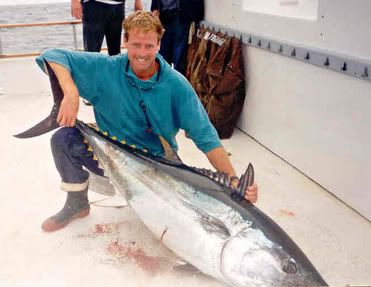
Last night I attended a friend's rooftop barbecue in Brooklyn. As often happens in such a setting, I drank a little too much and stayed a little too late.
Early in the evening, another guest recommended this NY Times article (printed Tuesday, May 3rd) discussing the current tuna fishery crisis. I had not yet read the piece and I made a mental note to find it online today.
Later, after the remaining guests made our way downstairs to the host's loft apartment, I found myself in a discussion about a Pacific sailfish (Istiophorus platypterus) mount. One of my friends purchased the mount in a New York City thrift store several years ago. It's seen better days; the fish's bill is torn away from the upper mouth and the tail is only a stump. Damage aside, I admired the fish and explained to some other guests what a living sailfish looks like, bill and tail intact. I also explained that this was a fish distinct from other billed fishes, such as the marlin or swordfish species, and described what made the Pacific sailfish distinguishable from its Atlantic relatives (even though they are usually considered one species, there are “racial” differences).
An Austrian in his mid-thirties seemed genuinely interested in the information and asked me how I knew so much about the fish. I explained that my father is a conservationist and writer who is particularly knowledgeable about marine species. Although most of my knowledge of “game” fish is hand-me-down material, in my teens I spent a few days catching Pacific sailfish off Costa Rica. All in all, I was feeling pretty good about the exchange. The people listening seemed to enjoy learning a little bit about the sailfish.
Evidently, though, this was not the case. As I was saying my goodbyes, the Austrian fellow introduced me to a girl friend of his. “This is the guy who knows about the fish.” She laughed and said, “Oh, yeah? That’s interesting.” “Well, I guess it’s sort of ‘interesting’. I mean, it’s just a fish,” the Austrian guy replied. Ugh.
I couldn't care less what some random Austrian transplant thinks of me, but I always get a little excited when I come across an urbanite that seems to take an interest in natural history. As we become an increasingly urban species, the need for knowledge of the world outside our city walls will also increase. I'd assumed that my fellow partygoer was taking a real interest in the sailfish. In fact, he had been listening only because he thought it novel that I was talking about such esoteric subject matter; I was, I suppose, his circus monkey.
Realizing this, I was offended - unnecessarily so. I responded, “Well, I'm fascinated by the ‘natural’ world; it's vital to me and I don't think it's 'just a' fish.” I didn’t say this rudely or in a patronizing tone because, the truth is, most people feel the same way he does. Nevertheless, I headed home brooding, temporarily convinced that E.O. Wilson’s biophilia is not a gift inherited by all humanity, but a rare disorder.
The sailfish incident brings me back to the NY Times tuna article by Andrew Revkin. Revkin discusses at length the pressure exerted by longline fishing (see also the related post at Organic Matter), but he only touches on an essential part of the puzzle: demand. Tuna remain one of the most widely consumed fishes, whether canned, steaked, or stripped with a side of wasabi. In 1999, I ate toro sushi once or twice a week; one of my roommates, who later moved west to become a sushi chef in Los Angeles, practiced preparing sushi in our cramped NYC kitchen and I was the lucky beneficiary of both his successes and mistakes. I also went out to cheap sushi restaurants as often as my budget would allow. Tuna, tuna, tuna…I couldn’t get enough of it. As with any other meat, I no longer eat tuna unless I catch it myself. Trouble is, I can’t even rationalize tuna fishing these days. Tuna, like swordfish or shark species, has been added to the list of fish I will likely never eat again. The fishery simply isn’t sustainable given the present demand. As Revkin suggests, new limits must be imposed and accepted, but the only sure way to encourage lawful observation of such limits is a decrease in market demand. Just as a move away from oil consumption makes conservation and sustainable living more feasible, so does a decrease in demand for meats, particularly the large pelagic fish. Unfortunately, SUVs continue to fly off car lots and most sushi lovers can't imagine eating Sushi Combo B without toro!
Photo credit: John W. Mykkanen
Wednesday, March 30, 2005
Protect Native Species...Or Die!

“Once caught never returned” is the motto of the Exotic Fishing Tournament hosted by the Native Fish Conservancy (NFC). Participating anglers are encouraged to keep all the "invasive" fish species they catch. The team with the greatest number of exotics wins the $200.00 grand prize. How the angler opts to use the fish is of no interest to the NFC. The organization's press release reads,
“We encourage everyone to treat exotics with reckless, fishing exuberance. If you catch exotics, aquarium-keep them, grill them, feed them to your pets, turn them into fertilizer. Do anything except return them to their former homes.”Wow.
I believe that the human contribution to the contemporary, epic loss of biodiversity is a sin (of a decidedly secular variety). Fewer species translates into less genetic, dietary and behavioral variety, making it that much more difficult for Nature to adapt in the future.
Nevertheless, when I first read about the Exotic Fishing Tournament, I cast nervous glances at my fellow subway commuters, worried that they might notice the, um, "material" in my hands.
As Timothy Burke (Easily Distracted) writes,
“I do wonder about that attitude a bit, not just in the context of fishing, but as a whole. When I read some of the material on the dangers of invasive species, its rhetoric and tropes sometimes seem uncannily familiar, reminding me very much of ideas about race, miscegenation and nativism in modern colonialism, in post-colonial nationalism, and in identity politics. There’s some similar desire to stop the forward motion of change, to fix environments (human or natural) in their tracks, the same suspicion of dynamism. What is particularly striking to me is that the arguments against 'invasive species' even from scientists sometimes seem not so much technical or scientific (when they are, they usually rest on the relatively weak assertion that there is a burning necessity for general biodiversity that trumps all other possible principles of ecological stewardship) but mostly aesthetic.”Excepting my belief that greater biodiversity does make for a healthier ecosystem, I am in total agreement. Strangely, I do not find it uncomfortable to occupy such an ambivalent position. I argue stridently for both sides of the coin, perfectly content in my hypocrisy. To better explain myself, I turn to the conclusion of an old artist statement.
“My own opinions and arguments are flawed, of course. Nature is not a comprehensible entity; she is indifferent to humanity. Given the burgeoning world population and our reluctance to consider serious action, it is naïve of me to think it possible for humanity to live in a truly sustainable fashion. Simply because an ideal is unattainable, however, one need not abandon it. In fact, acknowledging contradiction can better serve the individual; in a world increasingly consumed by ambivalence and captivated by cleverly marketed distractions, we must accept some degree of contradiction in order to further progress. We can aim for sustainability only if we accept the complexity of the task. In essence, this is the stuff of art – a flawed platform with no up or down, no east or west, on which to build the self and, in turn, shape objects to explain the proposed self. Art reveals the private obsessions of the psyche and better expresses the individual’s inner fragmentation, a consequence of the ideal being at odds with the real.”As the quote suggests, the flawed platform is as applicable to conservation as it is to art making. Some degree of relativism is necessary when considering invasive species. For example, zebra mussels (Dreissena polymorph) and European carp (Cyprinus carpio) are greater threats to biodiversity than multiflora rose (Rosa multiflora). All three are exotic/invasive species, but we need not raise an uproar about the latter species.
I hope many of the anglers participating in the Exotic Fishing Tournament treat their quarry with respect. Throwing away or otherwise mistreating fish of any species is wrong but, given the nature of this affair, the celebrated waste would be that much more unsettling.
Photo credit: WorldWar2History.info
Monday, March 21, 2005
The Toll of Overfishing
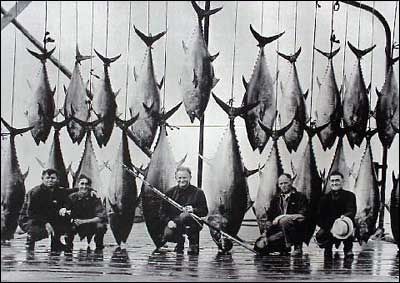
Some curious studies on the long-term impact of commercial fishing by David O. Conover (University of New York, Stonybrook) were covered in a recent Science News.
"Fish are becoming smaller and growing more slowly in response to pressures introduced by fishing, scientists say. That shift, which new data suggest is hard to undo, creates populations of fish that are poor at reproducing and inefficient at bulking up.National Public Radio covered this story couple of years ago, but at that point the science was based on record keeping, not laboratory observation. This link to a transcript of a 2003 "All Things Considered" report, is distressing.
Conover suggests one tactic to counteract such trends: Require that fleets throw back the largest fish as well as the smallest ones, thereby preserving fast-growing fish in any population."
As someone who has spent many hours offshore fishing for bluefin and yellowfin tuna, I am myself witness to the dwindling numbers. It isn't just migratory fish species that are declining in numbers, though. If these were animals of the sky or land, we would be able to observe the slaughter more easily, and perhaps then a sound conservation policy would be implemented. As is, we seem to feel that what we can't see doesn't matter.
Photo credit: Ed Pritchard, AntiqueFishingReels.com
Wednesday, March 02, 2005
Do Fish Feel Pain? (And, if so, what of it?)
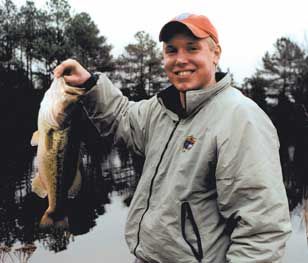
"Fish do feel pain, scientists say" was published by the BBC in April 2003. More involved research on the subject of pain perception in fish has been carried out since 2003, but the BBC article was forwarded to me only yesterday. Two years after publication, the story is making blog and email rounds.
Frankly, I'm not sure why the subject is still generating debate. Fish do feel pain; this is the scientific consensus.
A more complex question, however, is how the fish interpret the sensation of pain. In animals with a more highly developed brain - mammals and birds - pain describes a local problem, prompting the animal to act with this information in mind. For example, if you fall and break your leg, you experience terrible pain where the bone is broken, thus alerting you to the serious nature of the injury.
Fish, reptiles and amphibians possess only a simple brain, similar in construction and function to the human brain stem. Researchers question if pain serves any function in these more basic brains. Because mammalian fear and flight-or-fight reactions have been shown to originate in the amygdala, an organ of the limbic system, and because fish, reptiles and amphibians lack a limbic system, I assume that they understand pain only as an immediate sensation (and do not experience pain-related stress as mammals do).
Living in New York City, I no longer get to do much fishing. Happily, this past summer I traveled to Alaska and caught several large Pacific halibut (Hippoglossus stenolepis) and both silver (Oncorhynchus kisutch) and pink salmon (Oncorhynchus gorbuscha). I eagerly consumed these fish, but I wonder about the stress (if any) that game fish are put through in the process of being caught.
Depending on what scientists determine, catch-and-release fishing, long considered an eco-friendly option, may be deemed controversial by both biologists and animal rights groups in the coming years.
Photo credit: Hungry Hyaena, 2001
Subscribe to:
Posts (Atom)