
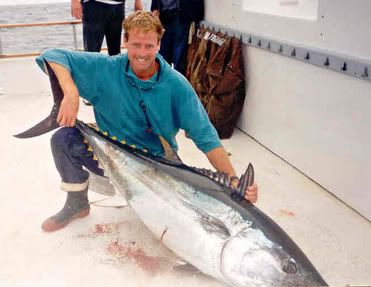
Last night I attended a friend's rooftop barbecue in Brooklyn. As often happens in such a setting, I drank a little too much and stayed a little too late.
Early in the evening, another guest recommended this NY Times article (printed Tuesday, May 3rd) discussing the current tuna fishery crisis. I had not yet read the piece and I made a mental note to find it online today.
Later, after the remaining guests made our way downstairs to the host's loft apartment, I found myself in a discussion about a Pacific sailfish (Istiophorus platypterus) mount. One of my friends purchased the mount in a New York City thrift store several years ago. It's seen better days; the fish's bill is torn away from the upper mouth and the tail is only a stump. Damage aside, I admired the fish and explained to some other guests what a living sailfish looks like, bill and tail intact. I also explained that this was a fish distinct from other billed fishes, such as the marlin or swordfish species, and described what made the Pacific sailfish distinguishable from its Atlantic relatives (even though they are usually considered one species, there are “racial” differences).
An Austrian in his mid-thirties seemed genuinely interested in the information and asked me how I knew so much about the fish. I explained that my father is a conservationist and writer who is particularly knowledgeable about marine species. Although most of my knowledge of “game” fish is hand-me-down material, in my teens I spent a few days catching Pacific sailfish off Costa Rica. All in all, I was feeling pretty good about the exchange. The people listening seemed to enjoy learning a little bit about the sailfish.
Evidently, though, this was not the case. As I was saying my goodbyes, the Austrian fellow introduced me to a girl friend of his. “This is the guy who knows about the fish.” She laughed and said, “Oh, yeah? That’s interesting.” “Well, I guess it’s sort of ‘interesting’. I mean, it’s just a fish,” the Austrian guy replied. Ugh.
I couldn't care less what some random Austrian transplant thinks of me, but I always get a little excited when I come across an urbanite that seems to take an interest in natural history. As we become an increasingly urban species, the need for knowledge of the world outside our city walls will also increase. I'd assumed that my fellow partygoer was taking a real interest in the sailfish. In fact, he had been listening only because he thought it novel that I was talking about such esoteric subject matter; I was, I suppose, his circus monkey.
Realizing this, I was offended - unnecessarily so. I responded, “Well, I'm fascinated by the ‘natural’ world; it's vital to me and I don't think it's 'just a' fish.” I didn’t say this rudely or in a patronizing tone because, the truth is, most people feel the same way he does. Nevertheless, I headed home brooding, temporarily convinced that E.O. Wilson’s biophilia is not a gift inherited by all humanity, but a rare disorder.
The sailfish incident brings me back to the NY Times tuna article by Andrew Revkin. Revkin discusses at length the pressure exerted by longline fishing (see also the related post at Organic Matter), but he only touches on an essential part of the puzzle: demand. Tuna remain one of the most widely consumed fishes, whether canned, steaked, or stripped with a side of wasabi. In 1999, I ate toro sushi once or twice a week; one of my roommates, who later moved west to become a sushi chef in Los Angeles, practiced preparing sushi in our cramped NYC kitchen and I was the lucky beneficiary of both his successes and mistakes. I also went out to cheap sushi restaurants as often as my budget would allow. Tuna, tuna, tuna…I couldn’t get enough of it. As with any other meat, I no longer eat tuna unless I catch it myself. Trouble is, I can’t even rationalize tuna fishing these days. Tuna, like swordfish or shark species, has been added to the list of fish I will likely never eat again. The fishery simply isn’t sustainable given the present demand. As Revkin suggests, new limits must be imposed and accepted, but the only sure way to encourage lawful observation of such limits is a decrease in market demand. Just as a move away from oil consumption makes conservation and sustainable living more feasible, so does a decrease in demand for meats, particularly the large pelagic fish. Unfortunately, SUVs continue to fly off car lots and most sushi lovers can't imagine eating Sushi Combo B without toro!
Photo credit: John W. Mykkanen
