Showing posts with label celebrity. Show all posts

Tuesday, November 27, 2012

Heide Hatry's Provocative Flowers

Heide Hatry is not a household name, but the New York-based German artist's reputation is blossoming. She has smartly positioned herself at the intersection of the art world and popular culture and, as a result, is of particular interest to me, convinced as I am that the fine arts need mass reach (if not necessarily mass appeal -- see Thomas Kinkade) in order to play the vital cultural role they're intended to.

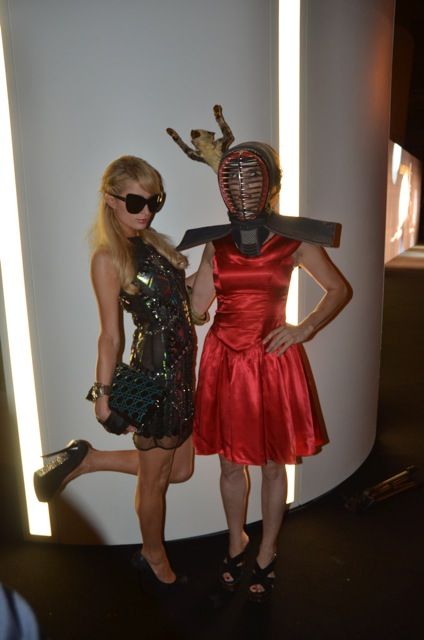
Heide Hatry, right, with Paris Hilton at the Guggenheim Museum
In September, Hatry performed "Schrodinger's Cat" at Lady Gaga's Guggenheim Museum perfume launch. Although Gaga's arty public appearances and carefully cultivated persona evidence how readily pop culture co-opts and/or draws inspiration from the fine arts, most people view Gaga as a pop star, not an artist. Hatry, on the other hand, is always identified as the latter, so when she is photographed rubbing shoulders with the likes of Paris Hilton or her work is written about by the scientist and popular writer Steven Pinker, I'm heartened. The art world isn't usually so accessible.

Naysayers might dismiss Hatry as the art world equivalent of a shock jock, insisting the popular attention she has received is only the result of her pushing our buttons. Certainly provocation plays a part, but Hatry has so far managed to balance titillation with thoughtful questions. (Arguably, Damien Hirst managed to do the same for a time...before he jumped the preserved shark.)

Sunday, October 10, 2010

Winner Take All?


My father recently sent me a clipping from the Hampton Roads Daily Press that highlighted some curious research presented at my alma mater, the College of William & Mary.

Biologists have determined that "the maximum length of a duck's penis depends not on genetics but rather [on] the males he keeps company with." Dr. Maydianne Andrade, of the University of Toronto Scarborough, explained that ducks "are essentially engineering their own phallus in response to social challenges." This is fascinating evolutionary biology, to be sure, but I find it remarkable that ducks have penises at all, given that most birds do not. (Apparently, a cloaca just won't cut it in duck world!) Dr. Patricia Brennan, of Yale University, believes that the heightened intensity of male-male competition among waterfowl has resulted in the development and size fluctuation of their sex organs.

The evolving duck penis battle came to mind when I read Ashley Mears' article about Coco Rocha, the popular fashion model. Early in his piece, Mears summed up the competitive dynamics of creative industries revealingly.
"Rocha is what economists would call a winner in a 'winner-take-all market,' prevalent in culture industries like art and music, where a handful of people reap very lucrative and visible rewards while the bulk of contestants scrape together meager livings before they fade into more stable and far less glamorous careers."
As with the bulk of would-be daddy (or uncle) ducks, most artists, designers, musicians, writers, and other creatives will not be prolific and celebrated. There are many intangibles in play, of course, but, like the drake duck whose penis twists to extraordinary lengths to impregnate a hen, "winning" in a creative industry often depends on who you're keeping company with.

Once vetted, however, the successful creative becomes, like Coco Rocha, a known label; his or her career is likely to be a fruitful one. That label is what the blog "Is It Art or Fart?" trades on. As the blog's co-founders explain,
"The blog began as a conversation between two friends living on opposite coasts who shared an undying passion for contemporary art. Both friends have the habit of seeing as much contemporary art as they possibly can, and this habit has uncontrollably spilled over into the recognition of 'fart'--coincidental moments in everyday life that, when isolated and [attached to the name of an] artist, bear uncanny resemblance to art seen in museums and galleries around the globe. Back and forth the two friends would point to the 'fart' that seemed to be just about everywhere. Now the humor of their findings is for all to enjoy. Remember, the world is your readymade!"
Part of the humor of their project is that the "fart" is often as good as or better than the "art" it might be confused with. Unfortunately, for the "fart," as for many drake ducks and coulda-been-a-contender creatives, it's a winner-take-all world.

Image credit: Scrooge McDuck, copyright Walt Disney Company

Thursday, August 21, 2008

Hype and fashion

First, there was Courbet. Now, there is Emin.

"Courbet 'paved the way for modernism in art,' Chu writes in the last sentence of her book...[Courbet] 'demonstrated that controversy need not be harmful to an artist’s reputation, as it was just another form of publicity.'

Hooray? Variations on those terms, often employing the shorthand 'hype and fashion,' pop up perennially both in conservative denunciations of new wrinkles in art and in leftish critiques of capitalist culture. Baudelaire[, by contrast]...saw that the fate of true artists would henceforth involve forms of internal exile, even in bright circles of cosmopolitan fame. That sort of compunction was lost on Courbet, and it is hard to imagine, let alone detect, in the conduct of the art world today...Dirty laundry has become the emperor’s new clothes."

-Peter Schjeldahl, "Painting by Numbers," The New Yorker, July 30, 2007


"This may explain why the [Emin retrospective at the Scottish National Galleries] is already proving hugely popular. Many visitors probably expect a voyeuristic thrill; others look forward to confessional, titillating outpourings by a damaged victim/beneficiary of dysfunctional contemporary society. That is why Emin is, after all, noteworthy. What gives her work its consequence is what she unwittingly reveals of the world we inhabit. There, celebrity is more important than real achievement, self-revelation more gripping than anything created by talent and a considerable imagination. For the artist herself, the chief purpose of art is as a means of achieving fame. God help us."

-Frank Whitford, "Fame Academician," The Sunday Times, August 10, 2008


"Hooray?," indeed.

Writing in The New Yorker in 1967, Pauline Kael hailed the arrival of "trash cinema." "Bonnie and Clyde" served as the prototype, a titillating film rife with violence and produced to appeal to viewers on a visceral level. At the time of the film's theatrical release, Kael rightly celebrated the movie as a populist challenge to critical snobbery. Late in life, however, she would bemoan the changing face of Hollywood's offerings. "When we championed trash culture we had no idea it would become the only culture," she said.

I share Kael's distaste for the typically self-conscious, intellectually defensive work of the avant garde, but Tracey Emin's crude publicity stunts are equally distasteful.

Celebrity alone is meaningless and empty...but, depressingly, it seems that just ain't actually so.

Friday, March 02, 2007

Gallery Report; February 23rd, 2007

With most of the New York art world flocking to one or all of the art fairs that opened in the city last week, I assumed that the Chelsea galleries would be relatively uncrowded. Such circumstances make for good art viewing; I can engage work for a longer period of time if I am undistracted by familiar faces or the appeal of people watching.

A chilly wind blew strong off the Hudson River, energizing me further, and I visited almost thirty shows. I had planned to mention more than the five below but, as I've written here often of late, "my energies are directed toward the studio," and writing about other artists' work only makes me want to work on mine that much more.

+ + + + +
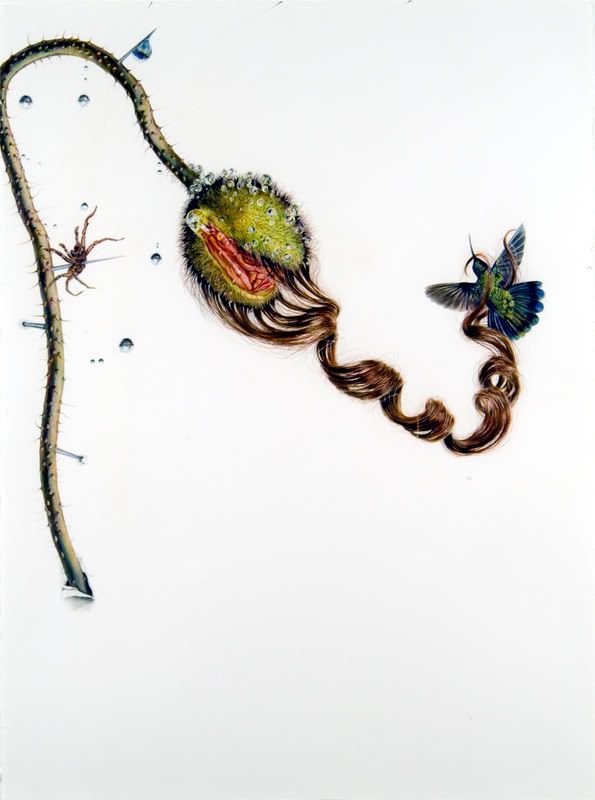


Julia Randall
"Decoy #8"
2006
Colored pencil on paper
30 x 22 inches

Jeff Bailey Gallery: "Decoys and Lures," Julia Randall's sophomore outing at Jeff Bailey Gallery, is impressive. Randall's works on paper showcase her sensitive technique. Her craft is impeccable, rivaling that of the finest botanical illustrators (of this or any other day), and she uses her superior skills to create contemporary artworks that are as beautiful as they are violent, and as whimsical as they are erotic.

Randall's "Lures" series is aptly titled; these sensuous colored pencil drawings focus on human lips. Viewers glimpse a bit of tongue here, some teeth there, but we're preoccupied with the moist flesh. It's generally difficult to take a long look at lips without becoming at least the slightest bit libidinous and, as I looked at "Lure #1," my own lips involuntarily parted in anticipatory wanting. That doesn't often happen when I contemplate artwork; for that matter, it doesn't usually happen when I look at fashion photography or any other medium that appeals to our id by focusing on organs associated with sexual signaling. Randall's "Lures," though, isolate the lips, making them a spectacle unto themselves. This is effective enough, but my appreciation of the "Lures" doesn't go much deeper, and I found myself considering the "Lures" conceptual studies for the "Decoys."
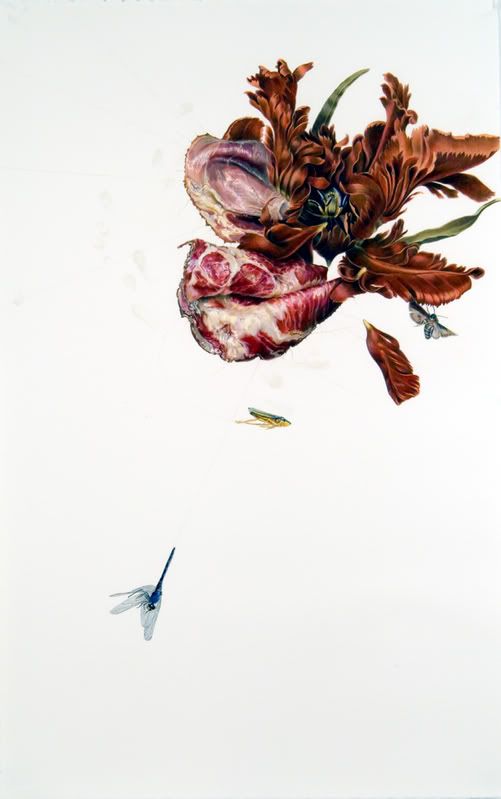

Julia Randall
"Decoy #4"
2006
Colored pencil on paper
41 x 26 inches

The "Decoys" are, as the gallery's press release states, drawings of "strange flowers and plants hybridized with human and animal traits." Indeed, many of Randall's creations are surreal riffs on carnivorous plants like the well known Venus Flytrap (Dionaea muscipula). The depicted hybrids are decoys in the sense that they bait or seduce other life forms into approach, and then devour or ensare them. Given the curious combinations seen in the series - pitcher plants meld with electrical cords; dental scrapers act as floral supports; belts and chains secure petals to stem - the work does, as the press release puts it, "hint at the perils of human meddling with the natural world," but there is still more visceral and complex content. The works warn of the practical, philosophical, and moral risk involved in genetic mutation and other biotechnology, but they also remind us that scientific exploration (indeed, our very curiosity) is instinctual and as natural as the rest of creation.

Randall's "Decoys" are celebrations of all Nature's orifices, physical and metaphysical, and of our natural desire to enter into and emerge from these orifices time and again. Viewers glimpse starry skies through several of Randall's flowers, an allusion to the scalar continuum. Further, the artist draws trompe l'oeil tears, holes, and sliced strips on her grounds, thus "implicating the viewer" in the ambivalent dissection and probing of her pictures. The human hand belts, cuts, pokes; it acts as an erotic investigator, at once involved in sex play, scientific exploration, and an ambivalent, feline violence. We can't help ourselves! The medical equipment and the metal thorns emerging from organic stems are fetish items and talismans of industrialized scientific inquiry. As Camille Paglia writes, "sex is probings, plumbing, secretions, gushings...the bloody open mouth of mother nature." But where Paglia would argue that science, the product of the male, or Apollonian mind, with its right angles and projections, is in opposition to sex, Randall's decoys remind viewers that things are rarely so dualistic. The lines drawn between male and female, man and animal, and science and art are increasingly indistinct.

Paglia has also written that "art is form struggling to wake from the nightmare of nature." Julia Randall's art, however, is form that embraces the "nightmare," celebrating the awesome sensuality of our apparently amoral universe. Paglia is correct to imply art's moral imperative, but moral and ethical actions are themselves an outgrowth of Nature, consciousness having evolved from morally blind, yet sensate material. Randall's works play with this ambivalent relationship. I left the gallery grinning, eager to find something to poke, in one way or another.
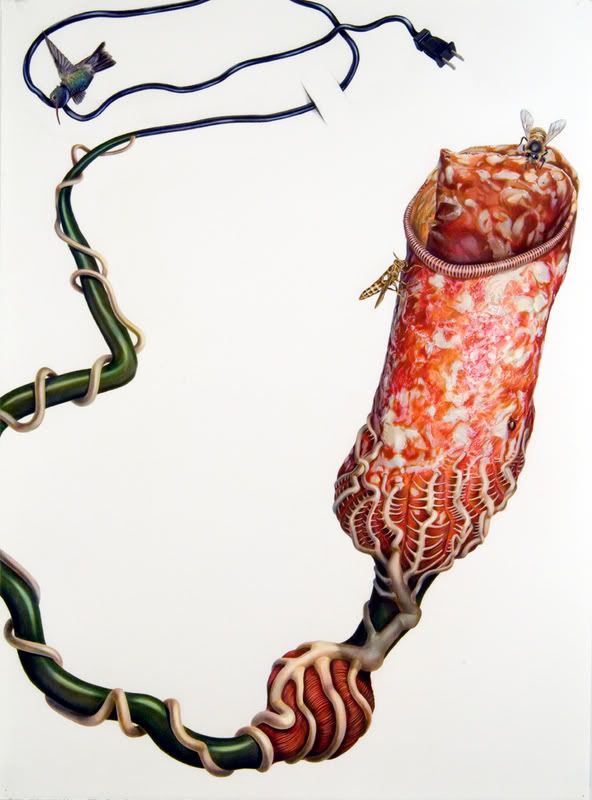

Julia Randall
"Decoy #6"
2006
Colored pencil on paper
46 x 34 inches

+ + + + +


Eva and Franco Mattes
"Harpo Jedburgh"
2006
Digital print on canvas
36 x 48 inches

Postmasters Gallery: Binary, the artist duo of Eva and Franco Mattes (aka 0100101110101101.org), is back. I was disappointed by their last outing at Postmasters. "United We Stand," a media campaign/send-up of "a Hollywood-style blockbuster," was, like most of Binary's work to date, an "incomplete, lazy affair that never really [got] off the ground." I was hopeful, though, when I learned the duo was working within (and presumably making work about) Second Life, the growing virtual community and market that is so much in the news these days.

Consider just a sampling of "real world" stories about Second Life in recent months.
- "First-Rate Art in Second Life" (Regarding the launch of the first "real world" magazine dedicated exclusively to the art scene in Second Life)

- "Second Life opens for business: Toyota, Circuit City, Dell, Sears and Adidas have set up shop in the S.L. virtual world"

- "Terrorists mock-bomb Second Life shops: Home-grown terror group wants democracy in the virtual world"
I assumed that after "living in the virtual world...for over a year" Binary would riff on some of these fascinating goings-on. Second Life, currently occupied by over 4 million inhabitants from all over the "first" globe, is a microcosm of our contemporary social and political geography. As such, it is a valuable mirror, ripe for rumination, dissection, or parody. Many of the artist groups and communities living and interacting in Second Life are aware of this. I salute them for it. (Second Life is the contemporary MUD (multi-user dungeon) and to better understand the value and psychological significance of these worlds, I recommend reading Julian Dibbell's terrific article "A Rape In Cyberspace: How an Evil Clown, a Haitian Trickster Spirit, Two Wizards, and a Cast of Dozens Turned a Database Into a Society," originally published in The Village Voice in 1993.)

So what does Binary bring back to us after a year's sojourn in Second Life? 13 portraits of the most popular and good looking Second Life celebrities. That's right, folks...surrounded as they must have been with so many fascinating socio-political happenings in that world, Binary opts to present gallery visitors with shots of Second Life's equivalent of Justin, Lindsey, and Paris! I suppose one could argue that rendering our culture of distraction and celebrity in this fashion is meritorious, but I fear the end result is as forgettable as the lion's share of our superstars.

Also irksome is the patronizing tone Binary takes in the gallery's press release. They refer to their time in Second Life as a "flanerie," and they (or the gallery) characterize the inhabitants of the virtual world as "peculiar." So once again, Binary, I thumb my chin and leave." This duo has a knack for turning promising ideas into stupid and vapid art. I have little hope left for these two. The art world should be embarrassed by Binary's lowest common denominator appeal.


Eva and Franco Mattes
"Nyla Cheeky"
2006
Digital print on canvas
36 x 48 inches

+ + + + +


Allison Hawkins
"Ink Blanket"
2006
Ink and graphite on paper
12 x 11 inches

The Proposition: "Spiderwort," Allison Hawkins' second solo effort at The Proposition, reads like an unfinished poem. One gets the sense that this accumulation of fragments will add up to something interesting (maybe even something powerful) as the artist matures. Hawkins' most potent ink and watercolor works - "Ink Blanket" or "Your Skin Is A Quilt," for example - hint at a rich interior universe of magic and essential mystery. Much of the artist's imagery seems born of our hypnagogic moments, those seconds immediately preceding sleep, when our thought processes are as defined by the denied, interior animal as by our conscious experience.
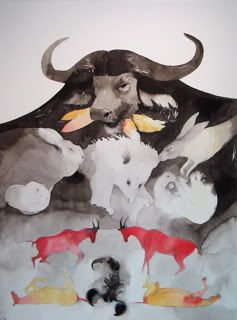

Allison Hawkins
"Your Skin Is A Quilt"
2006
Ink, watercolor and graphite on paper
30 x 22 inches

The gallery's press release suggests that Hawkins "[speaks] from a place where nostalgic memories and fanciful visions merge." True enough, but works like "Ink Blanket," celebrate a particular brand of nostalgia, one fundamental to the unabridged Homo sapien experience, one that spans millennia. Perhaps we could call it a longing for essential being, for the "live animal"? Hawkins doesn't merely reference the hands on the walls at Lascaux; she presents us with some of her own transfigurations. What the press release characterizes as "a youthful longing to retreat to...refuge, where one can explore quietly without taming," is not, in fact, a retreat at all, but rather a heroic attempt at the whole truth.

Unfortunately - at least in "Spiderwort" - the artist intersperses afterthoughts, unrealized experiments, and flights of fancy among her successes. I wouldn't encourage anyone to stop playing or to limit themselves to one clearly defined body of work, but I do wish Hawkins had been more selective in deciding what works to include in this show. The exhibition would be stronger, more of a piece, I feel, if half of the twenty-one works were excluded.
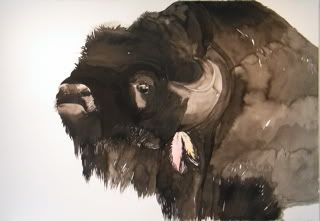

Allison Hawkins
"Goofball"
2007
Ink and watercolor on paper
41 x 60 inches

+ + + + +


Colin Cochran
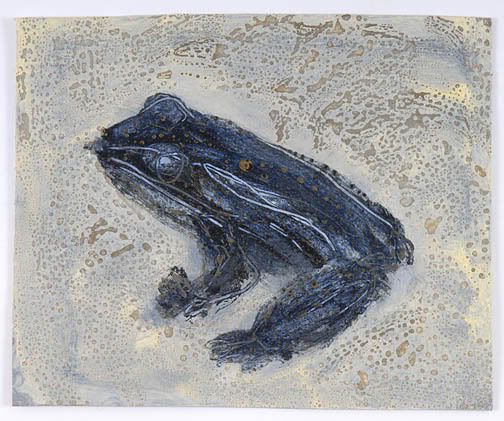
"Frog"
2006
Mixed media with oil on gessoed board
8 x 9 5/8 inches

Andre Zarre Gallery: Two blocks south of The Proposition, at Andre Zarre Gallery, another artist has tapped into the same deep vein as Hawkins, drawing from the well of existential associations attached to the animal form. Colin Cochran's small mixed media paintings of crows, beetles, cows, dingos, and other animals are straightforward exercises in composition, contour, and color, but the artist's confidence and command of the medium(s) make these humble, even "primitive" paintings special. Indeed, in some cases the little works possess an air of monumentality.
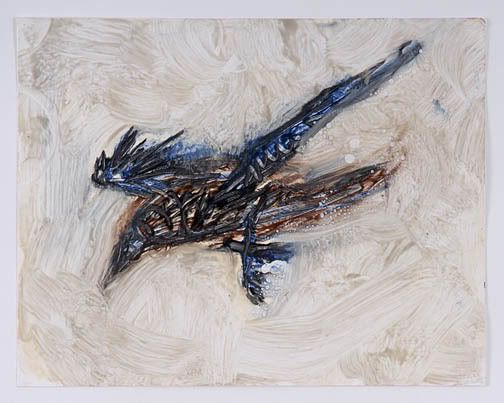

Colin Cochran
"Crow Magnon"
2006
Mixed media with oil on gessoed paper
11 x 14 inches

Interestingly, Cochran's animal subjects are largely anonymous. Although the surfaces of his paintings are rich in texture, distinguishing markings are absent; viewers must recognize the cast of characters in silhouette. In the case of an elephant or even a raven, this process is unconscious and immediate, but what kind of mole or beetle are we looking at? Enthusiastic about wildlife biology as I am, such details are important.
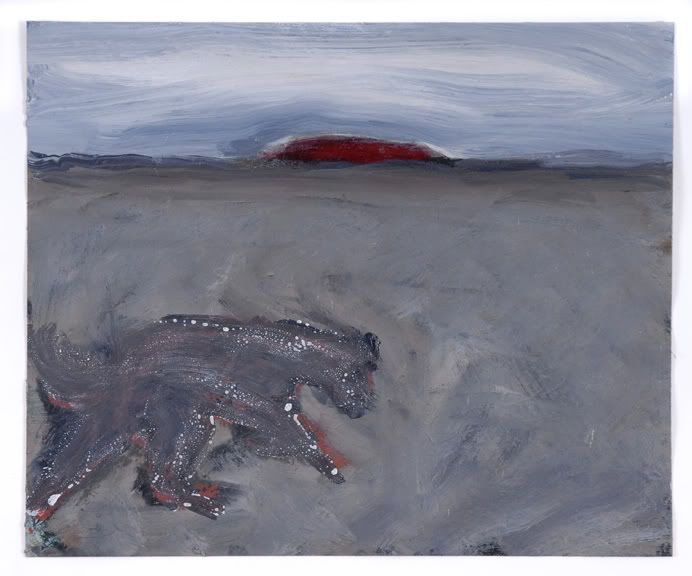

Colin Cochran
"Dawn and the Dingo"
2006
Mixed media with oil on gessoed paper
14 x 17 inches

After spending a few minutes with Cochran's work, however, it occurs to me that his subjects do not want to be identified in this way. I recalled a conversation I had a few years ago while paddling down the Colorado River. I had become pleasantly frustrated in my efforts to determine if I had just spotted a female Wilson's Warbler (Wilsonia pusilla) or a male Yellow Warbler (Dendroica petechia), species which are almost identical, when a friend pointed out that many "primitive cultures" did not distinguish between species in a family. Coyote and Wolf were given separate billing, but often a hawk, no matter the species, is Hawk and a sparrow is just Sparrow, or maybe even just Bird. My friend feels that there is something to be said for this imprecise classification scheme. If behavior across a family is similar, why should we create distinctions based on our own criteria? Does it really matter that the back and head of the female Wilson's Warbler should be a bit more olive than that of her cousin, the Yellow Warbler? Of course, the wildlife biologist in me disagreed (and still does); after all, how can one comprehend or track adaptation and evolution unless some system is in place, albeit a system necessarily in constant flux? But this was beside the point for my friend. Essential experience of the other animal does not need classification or specificity, he insisted. In fact, the experience is likely that much more rich and immediate when the trimmings have been dispensed with. Bird, he felt, was good enough.

And so it is with Cochran's paintings. Beetle and Frog are good enough...and so they are.
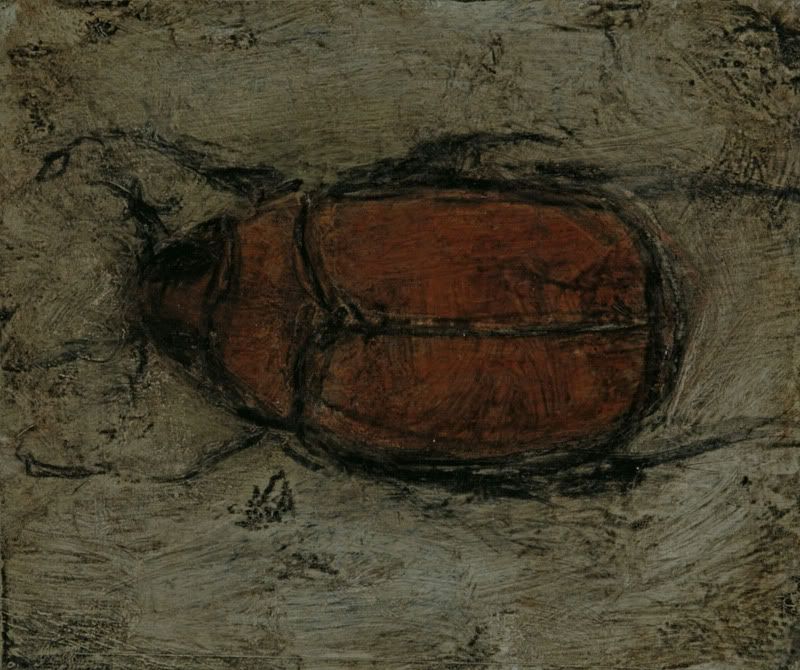

Colin Cochran
"Beetle"
2006
Mixed media with oil on gessoed board
8 x 9 1/2 inches

+ + + + +


Robyn O'Neil
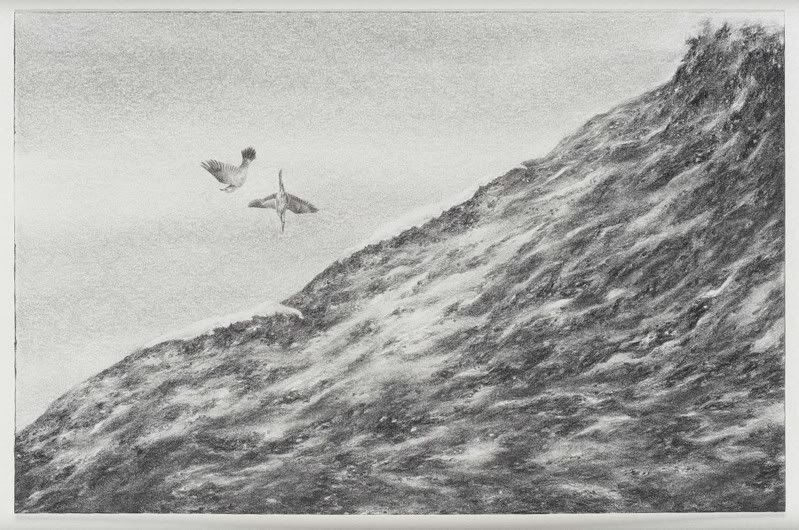
"The Fall"
2007
Graphite on paper
6 1/2 x 10 inches

Clementine Gallery: Since seeing her first solo show at Clementine in 2003, my admiration for Robyn O'Neil's drawings has been tentative. The spare, even desolate landscapes and lonely human figures (even when gathered in a group, O'Neil's cloaked nomads seem isolated and fearful) of her New York solo debut appealed to me, but I felt that the work was still gestating. The drawings she produced in 2004 and 2005 were more consistently satisfying. In many, the lonely humans were replaced by statuesque moose or humble pine trees; O'Neil seemed to be imbuing her world with more magic, but I still wasn't sold. Perhaps I resisted because O'Neil's vocabulary is so close to my own? Whatever the case, "This is a descending world," the artist's third solo show at Clementine, proves my initial supposition correct; O'Neil's work is now showing signs of real maturity and confidence, both with respect to technique and content.

Robyn O'Neil
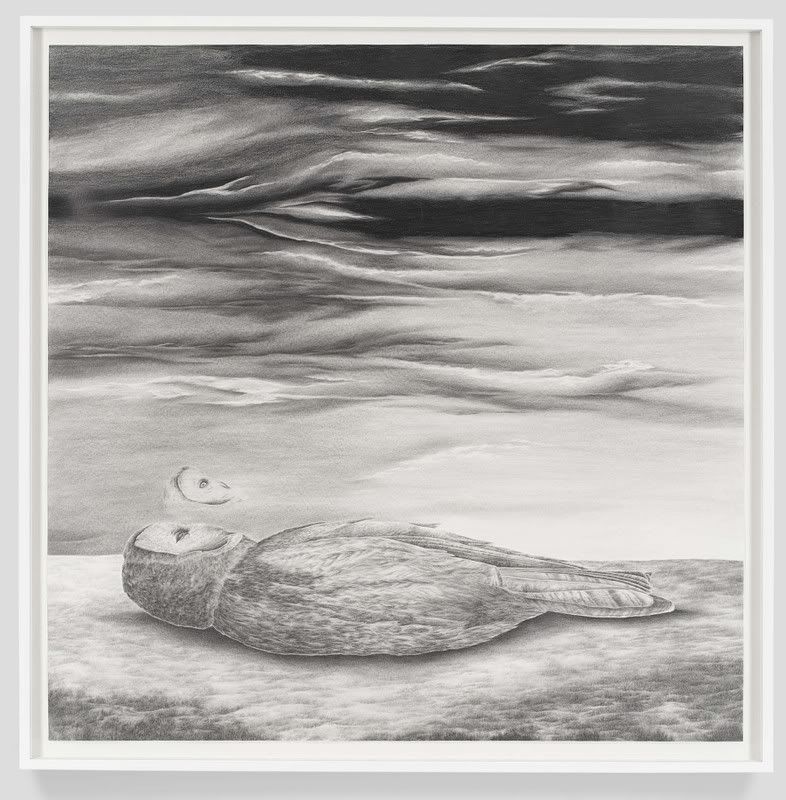
"The Passing"
2006
Graphite on paper
66 x 66 inches

In the front gallery, O'Neil shows four large works on paper. "The Ruin" and "The Passing" are the strongest of these. The melancholic landscapes are less complex than those of O'Neil's previous outings, and their relative simplicity allows viewers to more easily appreciate the power of O'Neil's element (and elements). The ocean is rendered superbly in "The Ruin." Its unfathomable volume is majestic and frightening and, like the branch suspended above it, the sea seems sentient, a wise observer of time's passage. The owl that lays rigid in "The Passing" is as dead as its eyes suggest. While the spirit's energy seems to rise phantom-like away from the raptor's head, the ground gently settles as it prepares to take the corpse. These are the first of O'Neil's works I've seen that merit sustained meditation; they breathe with a mystical intensity that I associate with the work of Charles Burchfield.

Robyn O'Neil
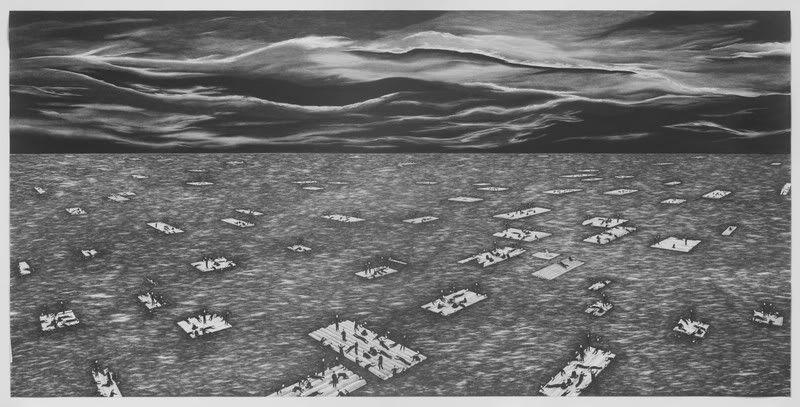
"Masses and masses rove a darkened pool; never is there
laughter on this ship of fools"
2007
Graphite on paper
79 x 161 1/8 inches

Also hanging in the front room is the exhibition's centerpiece, "Masses and masses rove a darkened pool: never is there laughter on this ship of fools." Over six feet tall and thirteen feet wide, O'Neil's "...ship of fools" can not be ignored. It is impressive both in scale and technique. Any artist familiar with graphite immediately comprehends the feat of patience (and perhaps endurance) this picture represents. Unfortunately, the formality of the piece - the ocean and rafts read as a perspectival grid, effectively flattening the plane and reminding us of vanishing point exercises in high school art class - prevents it from being the show standout. It is worth noting, though, that O'Neil's interpretation of the old allegory is distinctly contemporary. The medieval understanding of the allegory was that each person has his or her vices and sins; from person to person these behaviors can be ignored or laughed at but when considered together, as symptoms of the whole, such individual folly becomes sinister and dangerous. Earlier artists who depicted the "Ship of Fools" - most notably those of the Northern European Reformation, such as Bosch or Durer - portrayed the "fools" as individuals on board one overfull craft. Each face was distinct, each pursuit ridiculous, self-serving, or plain stupid. O'Neil, however, draws faceless men, all clad in suits, clamoring about on so many rafts. The shared vessel is no longer one boat; here it has become the ocean (or even the world) itself, with the occupants not so much sinning as mooning after mirages. My minor quibbles with O'Neil's execution aside, it is an appropriately distressing work; considering the large drawing, I find myself reminded that we live in the Age of Ennui, Aimlessness, and Distraction. Even our sainted celebrities aren't safe for long.

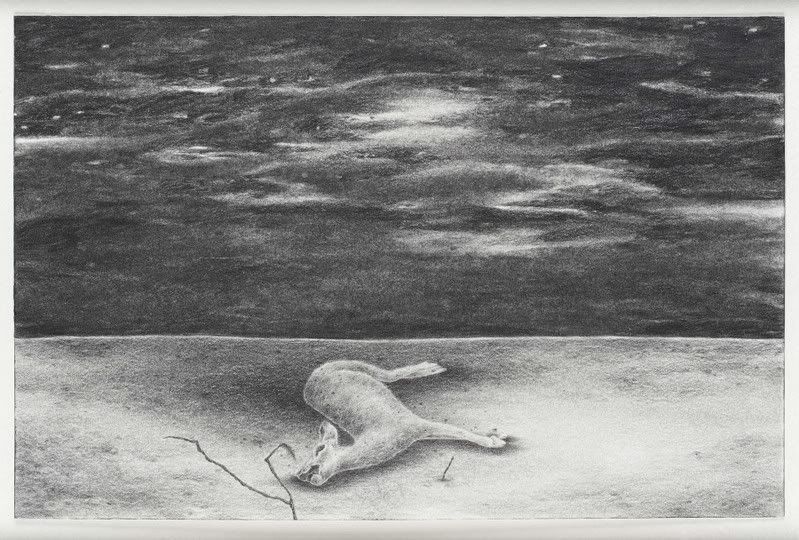
The small works displayed in the back gallery make for a mixed bag, but are generally rewarding. Drawings like "The Silence" and "The Abandon" are forgettable, but "The Fall," "The Growth," "The Fade," and "The Loss" are lyrical, moving, or a bit of both. I'm biased by her subject matter, but I feel that O'Neil is capable of becoming one of our generation's important artists. I eagerly await more work.

Robyn O'Neil
"The Growth"
2007
Graphite on paper
6 1/2 x 10 inches

+ + + + +


Photo credits: Julia Randall images courtesy Jeff Bailey Gallery; Binary images ripped from the Postmasters website; Allison Hawkins images courtesy The Proposition Gallery; Colin Cochran images courtesy Andre Zarre Gallery and Joyce Goldstein Gallery; Robyn O'Neil images courtesy Clementine Gallery

Wednesday, March 08, 2006

Thomas Kinkade, Painter of...Bears?

Image hosting by Photobucket
Just when my estimation of Thomas Kinkade, America's most beloved, bestselling artist, hit what I assumed was rock bottom, this LA Times article crosses my desk. Though Kincade denies the numerous allegations being made against him in various courts, judges usually disagree. Legal battles aside for the moment, the highlight of the article bears - bad pun - quotation.
"And then there is Kinkade's proclivity for 'ritual territory marking,' as he called it, which allegedly manifested itself in the late 1990s outside the Disneyland Hotel in Anaheim.

'This one's for you, Walt,' the artist quipped late one night as he urinated on a Winnie-the-Pooh figure, said Terry Sheppard, a former vice president for Kinkade's company, in an interview."
Years ago, my father, an ardent Disneyphobe, stood up in a movie theater after viewing "Bambi" and proclaimed, "Thank God Walt Disney's dead!" Not surprisingly, many fellow movie goers were horrified. Fortunately, now that I know Kinkade, God's #1 brush man, waves his wand over Walt's creations, I feel a little better about my pops' chances of getting past St. Peter at the pearly gates.

Anyway, the article is fascinating if you are at all interested in a contemporary American icon. For my part, as someone who grew up on a Virginia farm, I admire Kinkade's Pooh defense.
"In a deposition, the artist alluded to his practice of urinating outdoors, saying he 'grew up in the country' where it was common. When pressed about allegedly relieving himself in a hotel elevator in Las Vegas, Kinkade said it might have happened.

'There may have been some ritual territory marking going on, but I don't recall it,' he said."
Let's call it the Rural Reagan Defense. I'll use it next time the fuzz catches me pissing in the subway.

Photo credit: lifted from www.piersidegallery.com

Thursday, December 08, 2005

Inside Out

Image hosted by Photobucket.com
If you're familiar with the contemporary art world, you've heard the term, Outsider Art. Grandma Moses, Henry Darger and Adolf Wolfi all qualify as outsiders because they lack formal training or because they produced their work in isolation from the art community of their day. Wikipedia tells us,
"[Outsiders are] self-taught or naive art makers who were never institutionalized.[1] Typically, those labeled as Outsider Artists have little or no contact with the institutions of the mainstream art world, they often employ unique materials or fabrication techniques; much Outsider Art illustrates extreme mental states, unconventional ideas, or elaborate fantasy worlds."
Given the above interpretation, many grandmothers - not just Moses - can be dubbed Outsider Artists. Their choice of subject matter need not be fantastic. Their professional psychiatric evaluation need not be damning. In fact, as defined above, the term is rather nebulous; we can safely lump together the uncredentialed, the insane, the fey and the fringe.

Some critics argue for a return to a more refined definition, one more closely associated with Adolf Wolfi and Jean Dubuffet, the prominent 20th century artist who championed Art Brut. Dubuffet defined Art Brut as "those [art]works created from solitude and from pure and authentic creative impulses...where the worries of competition, acclaim and social promotion do not interfere." Dubuffet's Art Brut rubric can not then be extended to Grandma Moses, who after being discovered experienced a meteoric rise in the art world. Henry Darger, however, by day steady in his janitorial routine and by night immersed in his violent and voluptuary fairy world, passes muster.

Despite potential confusion, I prefer the more open-ended use of the term, Outsider Artist, because the barrier between Outsider and Insider, if you will, is semi-permeable. In my opinion folk artists, renowned decoy carvers, wildlife artists, Sunday painters and unrecognized "street" artists are all Outsiders. But there is another, less acknowledged class of art world outsider. This caste is part of the art world, but, unwilling to participate in reindeer games, they are the Insider Outsider Artists.

In "Homer's Wars," (The New Yorker, October 31, 2005) Adam Gopnik suggests that Winslow Homer's reputation suffered because the artist "withdrew from the world." In fact, Homer did not flee the world. He only moved to Prout's Neck, Maine, so that he could spend more time outdoors. But by leaving New York City, the artist left art world social circles behind. Elsewhere in the article, Gopnik makes clear this tie between locale and art world relevance. "If [the contemporary art world is] to return [Homer] to the command of American art, it might be as a more urbane and cosmopolitan figure than he is usually allowed to be, an artist first and an American second." In other words, Gopnik feels that it's high time the art world admit Homer into the pantheon of beloved artistic forefathers, the painter's rural transgressions forgiven, his proclivity for "outdoor scenes" overlooked. For most of the nearly one hundred years since his death, Winslow Homer has been an Insider Outsider and now, at last, he is being considered for full-scale embrace.

Lee Bontecou is a similar, but more recent example. After achieving prominence in the 1960s, she moved from New York City to rural Pennsylvania and soon vanished from the art world radar. Until the recent MOMA-QNS retrospective, she was happy in obscurity, teaching and making art away from the noise, the parties and the intrigue.

And so I finally arrive at the inspiration for this post, David Rimanelli's "On The Ground: New York" article in the December 2005 issue of ArtForum. Rimanelli is a gifted writer; I enjoyed reading his thoughts on the New York art world, circa 2005. Unfortunately, the "sceneterism" he celebrates is easy to abhor. Rimanelli identifies Gavin Brown, the now prominent New York dealer, and the gallery scene Brown built, as an impetus for sea change. "[Gavin] Brown, who moved to New York from London in 1988, succeeded in delivering to New York more than another neutral exhibition space; he created a situation that encouraged partying, louche behavior, and fuck-you antics." Rimanelli admits that "much of [the Gavin Brown's Enterprise] scenester mayhem was inescapably juvenile, and you probably met more assholes than charmers," but he still seems enthused, even energized, by the current rebirth of art world sceneterism. He writes, "Live Through This: New York in the Year 2005...is without doubt my favorite art book of the year...[though] the enterprise inevitably fictionalizes its subjects. That's why the extensive party pics and fucked-upness pics - dirty, sexy, fashionable, stupid, drunk, druggy - serve the overall project as much as the sections devoted to individual artists."

In the past two years, I attended several openings at Rivington Arms, the upstart gallery on the Lower East Side, where, as Rimanelli puts it, "there was no shortage of [Lower East Side] hipster mayhem...as the crowds of would-be beautiful-and-damned kids spilled out of the exceedingly modest space and into the street, leading to frequent visits from the police." Kicking off an evening of excess with an opening can be fun, but these events, like the evenings themselves, blend together; if you've been to twenty LES openings, you've been to them all. Openings are parties for the artists and their friends but, as any art world player will tell you, they are principally opportunities to network. For some artists, however, the social component of an art career is tedious and even painful. After six years of New York thrills, I admire most (and identify with) the artist who tells me she plans to skip out on an opening to get work done in the studio.

Unfortunately, staying close to the studio is not the preferred way to make it in the art world today. You're as likely to be "discovered" ripping rails off the shirtless bodies of passed out mates in LES bathrooms as you are via shows and word of mouth. Again turning to Rimanelli, "Deitch Projects, on Grand Street in SoHo, remains the grandest thoroughfare for the transmission of young scenesterism to collectors, curators, and museums...Deitch's critics usually suggest that he is the avatar of the vampire-dealer leeching the energies of young, untried, even unworthy artists and repackaging them as chattels for the demon market." I don't know Jeffrey Deitch. I doubt I'd even recognize him. I've had my arm throttled by excited friends as they whisper-shout into my ear, "Oh, there's Deitch! Jeffrey Deitch is just behind you!," but who gives a shit, really? In those situations it's all I can do to focus on my beer and breathe through any emerging social anxiety. I don't know enough about the man to agree or disagree with the critical characterization of Deitch that Rimanelli describes, but the "demon market," attended by myriad pressures, is very real.

Several artist-teachers in graduate school told me that I'm the sort of artist who "makes it" - if ever; better knock on wood, here - only after the bottom of the art market falls out, when the scenesters have returned to 9-to-5 jobs and the fashion magazines cease featuring young painters in designer labels. Perhaps they are right. Perhaps the financial excess of the moment - at least in the art world - led to our consumptive, fuck-all posturing. Perhaps the slow-burn artists will reappear after the art world stops flocking south to Miami or north to Skowhegan for sex, drugs, good gossip and cash money. But I doubt it. After all, "making it" is forever a combination of talent, luck and working it (or good connections). This recipe remains constant, true even in the financially lean times or those oft-cited "good ol' days." Furthermore, contrary to so much popular opinion, the slow-burn artists are with us today; some of them are cleverly disguised as scenesters, perhaps, but they are there.

Until you actually start down the road to art world embrace, then, you remain an Insider Outsider, no matter the parties you go to or the company you keep. Honestly, I don't consider it an altogether unattractive position. Then again, we all want to make a living at what we enjoy - or what we've been burdened with - so the desire of the Insider Outsider to be an Insider can work against her desire to remain self sufficient, unencumbered by the latest art world bullshit. After all, too much jockeying for position, as opposed to art making, can turn everything inside out.

Photo credit: photograph by Dash Snow, represented by Rivington Arms

[1] Given that we also associate mental instability with the term institution, I find it amusing that Outsider Artists are those "who were never institutionalized," particularly because those of us who have survived educational institutions can make a convincing argument that it is itself damning. Frances Stark's description of the graduate school situation in Los Angeles is exemplary. "We have no fewer than nine art schools in the region with competitive MFA programs, meaning that every year an average of about 180 (mostly) young artists complete their studies. So every two years LA churns out 360 degreed individuals - and that makes for a massive circle. That vastness doesn't even account for the city's cadre of legendary artist-teachers, who are in the business of exhaling those circles like so many dissipating smoke rings...Who can deny that fits of nostalgia occasionally prompt us to long for smaller circles, for times when connecting and creating ties was somehow more organic?"

Thursday, May 26, 2005

Player Haters?


Last Sunday, sick and frustrated, I watched the deciding game of the May "Subway Series" on television. Some weeks earlier, a friend had offered me a ticket to the game and I had eagerly anticipated the afternoon ever since. But instead of animatedly talking baseball on a beautiful Sunday at Shea Stadium, I was feverish and pouting on my bedroom floor in a sweat-drenched t-shirt and boxer shorts. That the afternoon had turned rainy and cold, thereby making things less than ideal for those fans who were able to make the game, did little to make me feel better; I'd been betrayed by my immune system. Even the run of unfortunate errors by the young Mets' players, and the resulting Yankees rally (which whipped me into a frenxy of anguish despite my fugue-like state) could not quell my frustration at having not been able to be there.

Fortune sometimes smiles on all of us, though, and another friend offered me a ticket to a Wednesday night Yankees/Tigers game in the Bronx. So yesterday, in now familiar cold and rainy New York weather, I headed up to the Bronx after work. Despite having lived in New York City for nearly six years, this would be my first game in Yankee Stadium! The seats were the best I have had since attending a Baltimore Orioles/Cleveland Indians game at Camden Yards in the early 1990s. Directly behind home plate, just this side of the "gated" boxes, I found my spot moments after the first out of the game. I love baseball stadiums almost as much as I love the game, and I spent the better part of the first inning studying the stadium itself. By the end of the third inning, though, it was neither the game nor the stadium that demanded the bulk of my attention, but the fans. One pair, sitting four rows behind my left shoulder, was especially difficult to ignore. Early in the evening, during a relatively quiet moment in the stands, one of them yelled out, very loudly, "F*ck you, Detroit! You f*ckin' suck, you pieces of sh*t!" Unfortunately, this was only a warm-up.

I've been to a number of baseball games in the last decade - though only a small number of cities: Baltimore, MD; Philadelphia, PA; New York, NY - but I have never before heard such hateful taunting. Granted, I have a chip on my shoulder. I don't hate the Yankees, as a team, but I do loathe most Yankees fans. They represent the worst kind of spoiled royalty. As I see it, the fans who support the richest and winningest team in all of American sport should be proud and charitable. To point fingers and scream "You suck" at the rest of the field is akin to a member of the aristocracy leaning out of his carriage to call a toiling peasant a loser. But my desire for the average Yankees fan to inherit some humility and grace is not the matter at hand.

While watching that Sunday "Subway Series" television broadcast, I could hear New York Mets fans boo Kaz Matsui, the struggling Japanese import, when he approached home plate to bat up. Each time I heard these jeers, I shook my head; after all, the Mets are one of my favorite teams (second only to the Chicago Cubs) and the heckling that Matsui was dealt incensed me. The commentators noticed the booing, too, and mentioned how difficult such treatment had proven for Matsui. In the Japanese equivalent of our major league (Puro Yakyu), fans never heckle their own players. In fact, they don't boo or berate players on opposing teams either! Kaz Matsui (not to be confused with the more successful Hideki Matsui, currently playing across town for the New York Yankees) emerged a superstar from a league in which players receive only support. Today, he finds himself centerstage in a much tougher arena, one in which fan regard is fickle and their bite is often terrible.

The friend who had given me the ticket is married to a Japanese man and I decided to ask him, as we quietly sat among the ruckus at Yankees Stadium, what he made of Major League Baseball. While he isn't a big baseball fan, he immediately commented on the difference in the stadium experience. In Japan, he explained, each player has a song or a dance associated with them and Puro Yakyu stadiums are filled with fans ritualistically celebrating their team, even when they lose. The whole experience, he said, "is about having fun."

When the Yankees next scored on a two RBI double by Jorge Posada, the fans in our area went crazy. The first few seconds were fun, with lots of high fives and wild cheering, but then the chorus of, "F*ck you, Detroit!" and "Who's your Daddy?" began anew. A crippled man seated in front of me grabbed at his wrist crutches and struggled to his feet. He attempted an awkward high five with a buddy of his who was screaming something to the effect of, "We own you, Detroit!" Perhaps wrongly giving him the benefit of the doubt, I imagined that this crippled fellow, a casualty of genetics or circumstance, couldn't move quickly enough to ditch his sh*thead friends. I suppose he, too, could have been slandering the mothers of the Detroit Tigers, but I couldn't hear his more quiet ejaculations over the rest of the din. The crowd "celebration" was a curious mix of happy excitement, vitriolic fervor, and entitlement. I turned back to Koh and said with a smile, "Just like Japan, huh?" He shrugged and shook his head, half laughing. He appeared bemused. We sat in our seats among the standing, screaming Yankee fans and tried to take it all in.

By the time that exchange took place, the Yankee duo sitting behind us had elected to up the ante. Below are just a few of the many things screamed over my shoulder. Some of these were repeated many times.

"F*ck you, you f*ckin' f*ggots!"
"Hit the mother f*cker in the face with the pitch....Yeah, hurt 'em!"
"You fat piece of sh*t, there's a cheeseburger on second...can you make it, fatboy?"
"Detroit sucks! Boston sucks, too! F*ggots live in Boston!"
"Let's Go Jankees! Yeah....Jankees!"
"You suck, Detroit! Why bother trying?"

Occasionally, these fans even opted for a little abuse of their own boys.

"Hey, Giambi, you f*ckin' juice head! You're a potato head, you sh*t!"
"Hey, Matsui, hit the ball to China or wherever you come from!"
"Hey, Posada, if you had good knees you could run better! Shoulda been on second with that hit, you putz!"

In between such outbursts, the pair talked about beer, cell phones, and their pursuit of women. On beer, for example, one announced, "I don't drink Heineken...it's just too dark and thick, ya know?" Heineken is way too dark and thick? Um...okay.

Anyway, while these two "characters" were certainly the loudest around, they were not alone. Cries of "Detroit sucks!" could be heard anywhere you moved and every time a Yankee player failed to make a play or get a hit, no matter how difficult, the fans voiced their displeasure. Most distressing of all, though, was the encouragement given the loudest idiots in the stadium. Even those folks who seemed more inclined to clap and cheer than berate and boo egged on Tweedledum and Tweedledee. A girl noticed me staring over my shoulder at the pair of jackasses and she laughed. "They're awesome, aren't they?," she asked, with a smile. No, they're reprehensible and offensive, in fact. Shamefully, I said nothing.

I don't want to give the impression that I never cheer on my teams - I've jumped up and down at games and screamed obscenities at the television more than once - and I can't claim to be above booing a bad call. (A clear bad call is legitimately angering, but I won't boo close ones, even if disappointed in the result; after all, I'd hate to make a judgment mistake on the field, and I trust that the referees and umpires want to do as good a job as they can.) Yet I have absolutely no urge to call anyone on the other team a "piece of sh*t," even if I dislike them. What little I know of Alex Rodriguez, for example, makes me disinclined to like him, but I've never booed him (though I have wished for a strike-out or a botched bit of fielding). Shaquille O'Neal drives me mad with his dominating play and arrogant attitude, but I don't hope for a broken knee or a torn ACL.

The point is, I'm distressed by the prevalence of negativity in American sports. I'd like to think that it hasn't always been this way, but the truth is I'm not so sure. The nostalgia one feels for "the good ol' days" is largely a result of edited history; Ken Burns need only add a sepia tint and a banjo track to his "Baseball" footage and everything seems that much better. Even Barry Levinson's "The Natural," considered by many to be the pinnacle of "sports movies," hints at the venomous sting of the fan base. Is our culture really this willing to become the ignorant mob? If, as many folks say, contemporary athletes and celebrities are elevated to sainthood, their experience is equal parts transcendence and martyrdom. We love 'em, we hate 'em. We love to hate 'em, we hate to love 'em. It all seems a little schizophrenic to me. While I champion complexity, I guess I just prefer Southern hospitality and reserve at the ball park.

Making my way out of the stadium, a few drunken Yanks fans decided to make comments about my Cubs hat. Fortunately, they were not particularly nasty. "Look at this guy with the Cubs hat. What the f*ck is that about?," and "Hey, a Cubbies fan is here tonight, bro," weren't intended to insult. These drunks just wondered what I was "all about," and there's nothing wrong with that. Nevertheless, I left the stadium thinking highly of baseball, but none too highly of the species that showed so much promise back when games were first being invented, when we were discovering ways of channeling our competitive aggression into an afternoon of fun.

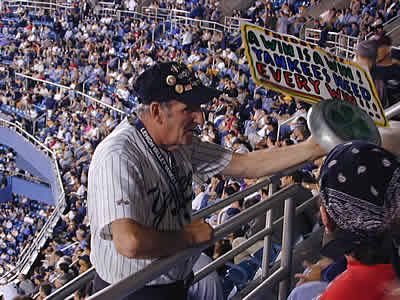
Photo credit: unknown source; image of Freddy, an old-timer who attends every Yankees home game and bangs on his pot with a spoon. On Wednesday night, his spoon and pot were so abused by some fans that he reclaimed them, then opted to hold them out of reach for a while.

Thursday, April 28, 2005

Pam v. J-Lo


I have mixed feelings about people wearing animal fur. I have a beautiful red fox (Vulpes vulpes) skin displayed in my apartment. The skin belonged to a fox culled at Heron Hill during a time when the predator population had exploded, resulting in a decline in duck, quail, and rabbit populations. A number of foxes were trapped and a balance was again achieved.

Yet, despite my acceptance of predator control as a pragmatic conservation technique, I am generally turned off by trapping. I am not anti-trapping per se, and I appreciate the fact that its practitioners learn a great deal about the natural world, but a bullet represents a more humane death. I also find it troubling that urbanites, most of whom have only a vague, Disney-fied appreciation of wildlife, account for the majority of fur buyers. Excepting the far north, where the climate demands extra layers, it is not the trappers who don dead animals. Like diamonds, fur is but one more luxury in a world already too freighted with frivolous commodities that have hidden moral and environmental costs. (Though, lest we forget, cotton, the principal material in clothing worldwide, is far more destructive to animal species than the fur trade. If animal rights groups really want to help the rest of creation, they should consider targeting the cotton industry to demand more sustainable practices.)

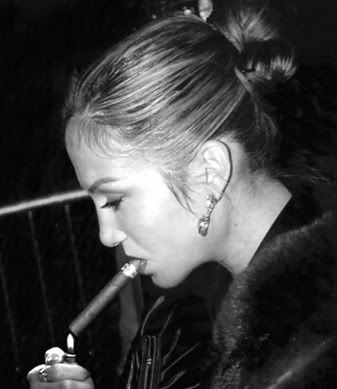
But, while I find myself in the grey zone on the fur issue, Pamela Anderson does not. Everyone’s favorite "Baywatch" babe and rock-star sex toy is currently campaigning against Jennifer Lopez and other celebrities who wear fur. Anderson called Lopez an “idiot” in the press and asked People for the Ethical Treatment of Animals to “step up” its anti-fur campaigning by targeting J-Lo in particular. I hope Lopez likes paint.

Lopez has repeatedly demonstrated that she has no understanding of the natural world and little to no respect for animals, but Anderson knows only what "Bambi" and "The Bear" have taught her. A precious, willfully ignorant understanding of Nature is only marginally preferable to having none at all. Most troubling, though, is the sense that neither celebrity could be educated about wildlife because its reality is deemed boring by people like J-Lo or cruel by precious types like Anderson.

Photo credit: j-lo.net

Tuesday, April 05, 2005

Clothed Porn Stars

Image hosted by Photobucket.com
Photographer Timothy Greenfield-Sanders is best known for his images of celebrities. Over the course of three decades, he has presented us with photographs of “rock stars…presidents, literary figures…actors, not to mention pretty much everyone in the blue-chip art world.” Frankly, I've long considered him to be a star-fu*ker and, accordingly, I’ve never been much interested in his work. But the most recent Greenfield-Sanders exhibition, “XXX: 30 Porn Star Portraits,” at Mary Boone Gallery, won me over.

When the show's conceit was first described to me – “The photographer shoots porn stars, clothed and naked, in the same pose and hangs the photographs alongside one another.” – I didn’t think much of it. Nudity doesn't titillate me and I’m skeptical of artists who traffic in it. I assumed that Greenfield-Sanders was banking on some sensational press, so the project seemed like a cheap shot.

In fact, the diptychs are curiously unsettling. So accustomed to nudity, the subjects appear uncomfortable when clothed. Curiously, they also seem more youthful, even naïve. Once stripped, they wear guarded, seductive looks and knowing smiles.

Most remarkable, though, is the genuine likeability exuded by the photographed porn stars. How did Greenfield-Sanders manage to make these individuals, professionals caricatured for their bad behavior and insecurity, such perfect stand-ins for the rest of us? Perhaps because we all suffer from existential and vocational anxieties, or perhaps because the images remind us that porn stars and prostitutes are flesh-and-blood people, too. (A couple of Greenfield-Sanders' subjects are exceptions to this rule; Chad Hunt, for example, seems more intent on displaying his impressive anatomy than being himself.)

I didn’t expect to be at all drawn to these photographs, but not only would I love to own one of Greenfield-Sanders' diptychs, I'd like to display it alongside an Audubon print or a Walton Ford watercolor, an anthropological and ethological pairing. Lacking sufficient funds, I’ll have to settle for the coffee table book, and place it alongside a Walton Ford monograph.

An excellent article/review of the show was published in the April 2005 issue of Art in America. "Body Double," by Sarah Valdez, is worth reading.

Photo credit: book cover image, Amazon.com

Wednesday, March 30, 2005

Celebrity Campin' With Cameron


This frothy New York Times piece is basically an "advertorial" for Cameron Diaz’s new MTV program, "Trippin." Because I don’t have a cable subscription, I probably won’t ever see the show; I’m actually a little disappointed.

Cameron Diaz’s sex appeal is rooted in her dorkdom. A gangly girl with an overgrown head and a Texas-sized smile, Diaz gets away with more than do other celebrities because she actually seems to be enjoying herself. Many people claim that Diaz, who, at 32, doesn’t hesitate to use words like “frontin’,” is just plain stupid, that ignorance is bliss and Diaz is simply enjoying the ride. I wouldn’t suggest that Diaz comes across as intelligent or even well-informed, but I’m not so sure that she’s your typical ditz. Her it's-all-good-in-the-hood posturing is an affectation. Perhaps her dumb blonde routine is exaggerated, too? With this foray into the world of television production, Diaz may be revealing some depth.

"Trippin," its ridiculous name aside, may get through to that much sought after 18-to-29 year old demographic. Watching DMX on a camping trip with Diaz sounds more campy than compelling, but the rapper-actor's camping foray just might ignite a spark of environmental consciousness in a young, urban DMX fan. As the article puts it,
“If young viewers' appetite for scientific knowledge is limited, Ms. Diaz is betting that their interest in celebrities will draw them to the show and help them [understand] a world beyond the exurbs and XBoxes.”
Perhaps what ultimately makes me willing to give "Trippin" a tentative thumbs-up is Diaz’s fascination with feces.
“In every episode, she dwells on excrement, both for laughs and for edification. She notes, in her Nepal trek, how the copious manure of rhinoceroses restores nutrients to grasslands, how birds disperse seeds through their droppings and how cow dung is used as plaster in village huts.”
Score one for those of us who spend way too much time thinking about basic bodily functions!

If anyone has the time and the means to watch an episode, I would love to hear a report. Fortunately, I will be able to watch another television program mentioned in the same New York Times article. “Strange Days On Planet Earth,” hosted by Edward Norton, the exceptionally talented and intelligent, if egotistical, young actor, deals with some contemporary, environmental hot topics. Fortunately, this program airs on PBS and my television, if I fiddle with the reception, can pick up PBS with reasonable clarity.

Photo credit: AP/Scanpix

Wednesday, March 02, 2005

Brad Pitt's CO2 dues

In this month's (March 2005) Harper's Index:
Number of saplings that Brad Pitt paid to have planted in Bhutan last year to counteract his personal CO2 production: 1,700
That's one of the more bizarre ways of minimizing an individual ecological footprint, but it still deserves attention (and praise).