Showing posts with label Peter Schjeldahl. Show all posts

Friday, February 11, 2011

The Authority of the Museum


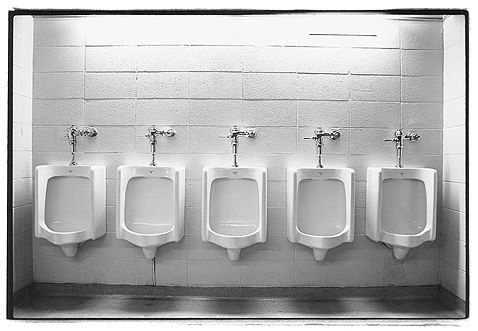
Marcel Duchamp
"Fountain"
1917
(Photo by Alfred Stieglitz)
"The traffic of the readymade is one-way; a urinal that becomes art [...] can't escape to be a urinal again. The authority of the museums forbids it."

-Peter Schjeldahl, "Between the Lines," The New Yorker, November 29, 2010
Schjeldahl's observation is insightful. I'll take it one step further.

By submitting itself to "the authority of the museum," the urinal becomes something lesser than any of those in a public toilet. Presented as art, it is form without function; as Schjeldahl contends, it ceases to be a urinal.

But even though the urinal-cum-artwork can't escape this new identity, it might inspire museum visitors to reconsider the aesthetic merit of mundane, functional objects. If the visitor carries that perspective out of the museum doors, the readymade's meme has "escaped" the institution. In other words, the urinal trapped in the museum aggrandizes free and functional urinals the world over precisely because it has been stripped of its utility!

Why does the art world understand aesthetics and utility to be mutually exclusive?

Image credit: courtesy, Wikimedia Commons

Thursday, August 21, 2008

Hype and fashion

First, there was Courbet. Now, there is Emin.

"Courbet 'paved the way for modernism in art,' Chu writes in the last sentence of her book...[Courbet] 'demonstrated that controversy need not be harmful to an artist’s reputation, as it was just another form of publicity.'

Hooray? Variations on those terms, often employing the shorthand 'hype and fashion,' pop up perennially both in conservative denunciations of new wrinkles in art and in leftish critiques of capitalist culture. Baudelaire[, by contrast]...saw that the fate of true artists would henceforth involve forms of internal exile, even in bright circles of cosmopolitan fame. That sort of compunction was lost on Courbet, and it is hard to imagine, let alone detect, in the conduct of the art world today...Dirty laundry has become the emperor’s new clothes."

-Peter Schjeldahl, "Painting by Numbers," The New Yorker, July 30, 2007


"This may explain why the [Emin retrospective at the Scottish National Galleries] is already proving hugely popular. Many visitors probably expect a voyeuristic thrill; others look forward to confessional, titillating outpourings by a damaged victim/beneficiary of dysfunctional contemporary society. That is why Emin is, after all, noteworthy. What gives her work its consequence is what she unwittingly reveals of the world we inhabit. There, celebrity is more important than real achievement, self-revelation more gripping than anything created by talent and a considerable imagination. For the artist herself, the chief purpose of art is as a means of achieving fame. God help us."

-Frank Whitford, "Fame Academician," The Sunday Times, August 10, 2008


"Hooray?," indeed.

Writing in The New Yorker in 1967, Pauline Kael hailed the arrival of "trash cinema." "Bonnie and Clyde" served as the prototype, a titillating film rife with violence and produced to appeal to viewers on a visceral level. At the time of the film's theatrical release, Kael rightly celebrated the movie as a populist challenge to critical snobbery. Late in life, however, she would bemoan the changing face of Hollywood's offerings. "When we championed trash culture we had no idea it would become the only culture," she said.

I share Kael's distaste for the typically self-conscious, intellectually defensive work of the avant garde, but Tracey Emin's crude publicity stunts are equally distasteful.

Celebrity alone is meaningless and empty...but, depressingly, it seems that just ain't actually so.

Friday, August 08, 2008

An Inner Untidiness Too Vast...

...to be tamed by secular means


Most professional art critics accept modernism's conceit that art progresses linearly, movement begetting movement. Their promulgation of this outmoded precept is surprising and disappointing.

Art, as with all other forms of cultural development, moves in random hiccups and circles. It resembles more the wanderings of a drunken homebody than modernism's straight line ideal.

In "Feeling Blue" (The New Yorker, August 4, 2008), Peter Schjeldahl's recent review of "After Nature," a group show currently installed at The New Museum, the critic observes "something...happening in artists' studios: a shift of emphasis, from surface to depth, and a shift of mood, from mania to melancholy, shrugging off the allures of the money-hypnotized market and the spectacle-bedizened biennials circuit." He goes on to declare that younger artists are assuming "a backward crouch preceding a forward leap" because "[a]bruptly, once-settled views and values have unsettled themselves and stalk the mind."

His suggestion that a loosely defined trend is indicative of imminent sea change is tidy and exciting but, like the notion that avant-gardism is central to a healthy culture, it is misguided. Many artists - including some of those participating in "After Nature" - have been making deep, melancholic work for years. The shift of emphasis is not in their studios, but instead on the curatorial front, where the administrators of the arts industry, themselves unable to shake off the modern canon and dreams of Life magazine covers, are responding to the media frenzy around all things "eco-": ecology and economy. How many open-calls for "green-themed" group shows have we seen of late? And how many new gallery or non-profit side-projects devoted to addressing "issues of the environment"? I'm buoyed by these developments, but the impetus is managerial and directorial; the artists embraced by these new shows and venues have, for the most part, been there all along.

Near the article's end, Schjeldahl calls for a hero. "What we want now is a major artist - a Manet, Picasso, Pollock, Warhol, or Beuys - who will manifest durable truths at the core of inevitable hypes and hyperboles. If none such appears, that will be a valuable datum. It will help us adjust to the happenstance that, once and finally, our particular civilization is spent." Ignoring the rhetorical overstatement, I appreciate the anxiety that Schjeldahl and other intellectuals feel. Amos Oz describes globalization as "a sort of infantilization of the entire human race." The prominent cultural historian Morris Berman argues in his book "The Twilight of American Culture" that most of what ails the contemporary world - social and economic inequality, xenophobia, declining resources and literacy, and a debilitating spiritual void - grows from our pandemic culture of superficiality and postmodern dullardism. Both Berman and Oz are right but they're also wrong. To characterize an inevitable process as infantile is itself infantile, and although the Enlightenment and it's fascist successor modernism both allowed for the championing of reason and so-called progress, the shrinking world is simply too complex for a strictly left-brained approach. It's proving difficult for our dualistic brains to accept that the good guys don't necessarily wear white.

But if Schjeldahl and the arts industry insist on a standard bearer for this flood of anxious melancholy, they needn't wait for one to appear. Werner Herzog, whose 1992 film "Lessons of Darkness" is included in "After Nature," is an influential hero to a great many younger artists, myself included. The German director and writer combines Manet's keen observation and social sensitivity with Pollock's violent, self-destructive embrace of the chthonian and Beuys' playful intellect and deep faith in the spiritual value of art. He is the "major artist" Schjeldahl calls for.

When I feel the poison mercury of misanthropy rise in me, I revisit this clip from the 1982 film "Burden of Dreams." Though Herzog's language is harsh, his observations are essentially celebratory. Sometimes, his comments are laughably bleak: "There is some sort of harmony; it is the harmony of overwhelming and collective murder." Even so, his tone, posture and face betray a wounded sensitivity.


Watching the excerpt, I'm reminded that other people are emotionally stirred by the terrible, indifferent beauty of nature's doings. I want to embrace Herzog and his complicated mess of a mind...and I'd wager that a great many other artists do, too.

Note: The title of the post is stolen from another contributor to The New Yorker: Don Chiasson wrote of T.S. Eliot possessing "an inner untidiness too vast to be tamed by ordinary secular means" in "Fire Down Below," a review of Les Murray's poetry in the June 11, 2007 issue.

Photo credit: Still from "Lessons of Darkness," 1992, Werner Herzog; Excerpt from "Burden of Dreams," 1982, Les Blank

Thursday, August 04, 2005

Peter Schjeldahl on Winslow Homer

Image hosted by Photobucket.com
Winslow Homer
"Right and left"
Oil on canvas
1909

Peter Schjeldahl is one of the most respected American art critics. He served for years as the Village Voice's chief critic, but when The New Yorker hired him in the nineties, his readership expanded and he won much acclaim.

Schjeldahl's criticism is curious, often barely qualifying as such; he tends to write free-form essays about artists and exhibitions that he appreciates, saving invective for misguided art world fads. When a writer is as intelligent and creative as Schjeldahl is, this approach often results in a generous, beautiful essay.

Schjeldahl's latest New Yorker offering, "Telling Stories," is a review of the Winslow Homer exhibition at the National Gallery in Washington, D.C. Whereas most critics would discuss a few paintings, focusing on formal elements and the art historical significance of the work, Schjeldahl instead analyzes the difference between "reportage and art" and confronts his bias against Homer.

At one point in "Telling Stories," Schjeldahl suggests that the recent surge of collector and curatorial interest in Winslow Homer is revealing.
"Homer's storytelling put him on the losing side of modern art. Alfred Stieglitz denigrated his work, though with an odd note of respect, as 'nothing more than the highest type of Illustration.'...Homer is improving at present because the banishment of illustration from canonical modern painting, after Manet, has worn out. We like stories, and important painting of the past forty years, from Gerhard Richter to John Currin, has become ever more illustrative, and enamored of the one-off image."
Well, to that, this proud one-offer can only say, "Amen."

Photo credit: "Left and Right," oil painting by Winslow Homer

Wednesday, June 08, 2005

Of Fairy Tales and Flights of Fancy

“The show suggests that artists are connected to events in the outside world but have little sense of what to do about them, other than to create artworks that incorporate their frustration, rage, apprehension or sense of the absurdity of contemporary life.”
- Eleanor Heartney, Art in America, review of “Greater New York, 2005
Who would condemn a child for having an active imagination? In contemporary western culture, most parents celebrate the fantasy lives of their children (or at least tolerate them), no matter how consuming they may be. This is for the good; a rich, imagined world often leads to greater curiosity about the world we inhabit. There are, however, some legitimate concerns for those children who appear to withdraw into fantasy too much, those who exhibit a tendency for escapism. These kids can be spotted at an early age. I should know.

As an only child who grew up in a rural farming village, my interaction with other children was limited to the school day and the rare overnight visit to a friend's house. My father, an unabashed workaholic, kept me occupied with field chores and wildlife conservation projects on most weekends. Our house had no television, the upshot of which was that I won most every reading competition until I reached 6th grade (the year -- holy of holies! -- a television arrived). I turned to books and invention for entertainment. The fields and forests were places of extraordinary mystique, vast plains teeming with bison and Indians or thick, dangerous woods with thieves and bizarre creatures lurking behind every tree. The pond shoreline represented a potential aquatic dinosaur attack, forcing me to walk just so to avoid detection.

But the fun didn’t stop at nightfall. No, if anything, the level of “make-believe” only increased once I was forced indoors. I would stage plays in my bedroom, becoming the voice of a stuffed animal perched on the windowsill and that of the angry, invisible dinosaur, the evil step-mother, the diminutive Lego man on the shelf, and so on and so on. (For some reason, many of these epic plays resulted in a raccoon puppet ripping open my throat. Of course, I was then re-animated as a rabid monster that would stalk the room’s perimeter, hunting imagined company.)

Despite my protests, it wasn’t at all inappropriate then that some kids called me Christopher Robin. I was tremendously uncomfortable in most social situations and I really didn’t trust any of my peers. During recess, I was the kid who retreated to a corner of the playground and talked to myself or played with blades of grass, imagining I don’t know what. It was also not surprising that cartoons, comic books, and drawing soon dominated my life outside of chores and schoolwork. I was every elementary school teachers’ dream, the quiet kid who scores well and gets placed in all the advanced classes, but shows no sign of ego or contempt. In fact, I was just oblivious to most of what was happening around me. I had no idea what interested most of my classmates. I didn’t listen to popular music until the sixth grade and most of my pop culture understanding was garnered from the pages of MAD Magazine. I knew what a phenomenon Michael Jackson was, but I'd never heard his music.

None of this mattered to me, however. I remained an essentially happy kid. I just shut out everything except my drawing, reading, and my fantasies. I'd learned how to tune out without ever having tuned in. Fortunately, the years have been kind to me and, rather than go the way of the Unabomber, I’ve become a reasonably well-adjusted member of society, if still something of a loner who likes to draw, read, and write.

It is with increasing urgency, though, that I view so much art produced by my contemporaries, artists in their twenties and thirties. An uncredited New Yorker writer describes this work as, “gloomy, craft-spun, fairy-tale escapism endemic among young East Coast artists.” A visit to Greater New York, 2005, a survey of artists living or working in New York City at P.S.1, will illustrate just how prevalent this mode has become. Fully 40% of the work on display fits the bill, and while the majority of these are paintings or drawings, a number of videos and installations belong to the same impetus. We are a generation uncertain and intimidated. Rather than engage and participate, we have opted to wear the escapist smile, retreating into the worlds of Alice and the Little Prince. Is it enough to express ourselves in this way? Do these cryptic fairy-tales or self-abusive efforts communicate anything more than immediate frustration? After all, it was largely my social incompetence which drove me to chase monsters around dark living rooms. How much different is this display?

These currents aren't isolated to the eastern seaboard of the United States, though. Admittedly, the majority of young West Coast artists still seem to be preoccupied with abstraction and pretty pictures, but the dystopian fairy-tales are being createed by artists not just from across the United States, but also via imports from Japan, Europe, Iceland, and elsewhere. Peter Schjeldahl recently wrote of Takashi Murakami’s curatorial effort, “Little Boy: The Arts of Japan’s Exploding Subculture,”
“[The included work] suggests a certain pathology: rapturous defeatism, perhaps, that justifies youths who don’t grow up.”
It seems as though an entire generation -- global, not just Japanese -- has been forced into perpetual adolescence by the atom bomb that is our modern condition?

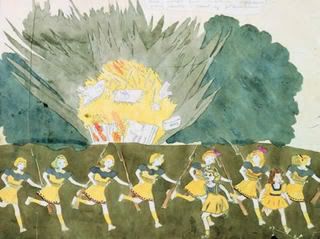
At the turn of the century, very few people knew anything about Henry Darger, the reclusive painter/janitor from Chicago who spent the bulk of his solitary life working on a series of collage-like, narrative drawings depicting the history of the Vivian Girls. The currents of the art world, circa the late 1990s, were such that Darger was considered an “outsider” when this term still meant, “Hold him at arm’s length, please.” By 2002, the year I graduated from art school, “outsider” was no longer a bad word. Books on Henry Darger could be found in the window of any Barnes & Noble in town and my own fantasical paintings were receiving admiring attention from curators and dealers. In fact, in 2004, two of my paintings were included in a group show with works by Henry Darger and a number of other contemporary painters who can readily be lumped into the "fairy-tale escapism" camp, including Inka Essenhigh or the currently red-hot Dana Schutz.

This shift in art world tastes had little to do with curatorial sensibility. There were simply too many young artists working in this vein for the movers and shakers to ignore the trend. The compulsive, “outsider” approach of Darger had become, long after his obscure death, standard issue gallery fare. Whether or not one would call it a “movement,” as I have heard some people discuss, is irrelevant. It happened and is continuing to gain momentum. The meaning and the value are for time, the critics, and the public, if they ever come back to contemporary art, to determine.

One has to wonder, though, what sort of work we are dealing with. Darger, as I mentioned above, was almost completely solitary. He attended church daily, made his income as a janitor, and returned to a cramped, disaster of an apartment to continue work on his epic Vivian Girls saga and the associated paintings. He never received any artistic training to speak of. This stands in stark contrast to most of the artists on hand at P.S.1. Not only are we dealing with a return to youthful escapism, but the return is a conscious decision, one being made by folks who have Master’s degrees, iPods, and Friendster accounts. Would Darger have been eager to discuss the latest EP or hit up the late night bar scene? The main difference between those lost souls like Darger and the average art world fantasist of today is a conscious decision. I decided to work as though I were an advanced child, turning inward and looking for my own little haven via the painting process. Darger just did it; for him there was no asking "What happens if I do it this way?"

Despite my enjoying much of the work I see at P.S.1 and throughout Chelsea, I have moved on from such preoccupations in my own studio. Perhaps I felt the room was too crowded with escapists, but most of the decision is a result of my tiring of helplessness. Sure, shit sucks right now, but I don’t feel I can just turn on the rock n’ roll and drift away. I'm excited about my current body of work, even though it has thus far received only lukewarm response; everyone points to the work of two years ago and says, “Now that was really something.” Yes, it was “something” and I still enjoy the paintings, but it ain’t what I’m making now and there are over three thousand other artists, if not many more, weaving similarly self-absorbed fairy-tales out there. Every week, I learn of another terrific young artist working in this vein; I’m rooting for all of them. For my part, though, I’ll head off to my studio and make paintings about the relationship between man and beast, or as some academics call it, anthrozoology. There aren’t as many rocket ships, dinosaurs, or indians populating these works, but I’m still smiling, even if no longer blonde.

Photo credit: Painting by Henry Darger, circa 1960s

Saturday, March 05, 2005

To Be Art Or Not To Be Art

Image hosted by Photobucket.com
As I approached the door of Matthew Marks Gallery this afternoon, three young women walked out, laughing. As they passed me, one of them exclaimed, "That was, without a doubt, the worst of the worst! I've never seen something that bad."

The gallery is currently exhibiting recent work by Robert Gober. Upon entering, the first "sculpture" I saw was rather simple. Resting on its side, on top of a simple concrete slab, was an unopened package of diapers. As I recall, they were Huggies brand. That was the artwork; Gober purchased a package of Huggies and placed it on a concrete slab in a New York art gallery.

In his recent review of "The Gates," The New Yorker art critic, Peter Schjeldahl, writes, "Art used to mean paintings and statues. Now it means practically anything human-made that is unclassifiable otherwise." Reading this, I recalled a comment I overheard a tourist make last year. He was looking at TRANSMOTION, a multi-media, roving installation constructed on the flatbed of a tractor-trailer, and he said to his wife, "Well, if you don't know what it is, it must be art."

This afternoon, looking at Gober's diapers, I considered both of those definitions. Because I could identify the object at my feet as diapers, Gober's "sculpture" failed to pass the tourist test. Gober doesn't make the diapers, but they are "human-made." Will this sculpture pass the Schjeldahl test? No. I'm looking at a package of Huggies, for God's sake! Huggies are classifiable as, well, diapers. They hold baby shit. They're not art.

In the rear of the gallery, I studied a lactating, crucified Christ. This Christ, though, has been beheaded or perhaps he never had a head. The water-milk coming from Christ's nipples fountains out away from his hanging body and enters a small, rough pit in the floor of the gallery. Now this, I'm sure, is art! I'm momentarily pleased, but then realize that it is bad art.

Gober gives me Huggies and a headless, lactating Christ. Feeling the same way the three young ladies had, I quickly exited the gallery.

Tuesday, March 01, 2005

Night Gates


In the February 28, 2005 issue of The New Yorker, Peter Schjeldahl writes that Christo and Jeanne-Claude's "The Gates" project offers little aesthetic value. Excepting fleeting seconds of "beauty" when the late afternoon sun backlit the orange hangings, Schjeldahl finds the work "charm-free, synthetic...something you would wear only in the woods during deer season."

The critic does, however, notice a "drowsy contentment" on the faces of his fellow Central Park visitors and he "give[s himself] a nice scare imagining 'The Gates' magically removed, and leaving the people looking as they looked - a goofball 'Night of the Living Dead.'"

If I consider only my daytime "Gates" experience, I agree with Schjeldahl, but my “Night of the Living Dead” moment occurred, appropriately enough, at night. After dark, the sunny backlight Schjeldahl describes is similarly effected by bright spotlights and park lamps.

On the second Saturday night of the installation, gusting wind worked in combination with the lighting to create an eerie, magical feel, one augmented by the relative emptiness of the park and the three glasses of red wine I'd just consumed.

Photo credit: Hungry Hyaena, 2005