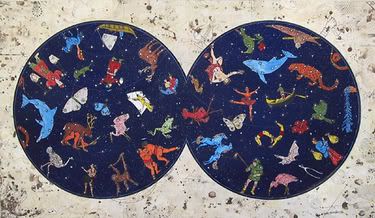
 Jane Hammond
"My Heavens!"
2004
Twelve-color lithograph with silver mylar and collage on Amate paper
30 x 51 inchesThis past Saturday I visited
AXA Gallery, a pleasant exhibition space affiliated with
AXA Financial, Inc. Judging by the company's profile (they specialize in "wealth management"), one might assume that AXA gallery exhibitions would be dull and uninspired. Not so. "
Imagined Worlds: Willful Invention and the Printed Image, 1470 - 2005," a joint venture between AXA and the
International Print Center New York, is a treat.
I'm biased, however; a number of adored artists are included in the show's all-star lineup. Among my personal favorites are
Jane Hammond,
Tsukioka Yoshitoshi, and
Hendrick Goltzius, but works by
William Blake,
Albrecht Durer, and
Pieter Van Der Heyden (after Pieter Bruegel the Elder, as most of his prints are) also stand out. (What a thrill for Hammond to be included in this company!)
The press release describes the exhibition as follows:
"Imagined Worlds...comprises fine art prints, books, and maps from many cultures, spanning five hundred years. Included are images of remote places and imaginary realms, real and fictional scientific investigations, and serious and comic inventions. What each work has in common is that it was created from an unknown, partially known, or completely unseen subject. Whether based on direct observation or pure fantasy, these prints illustrate the power of imagination and subjectivity in the creation and interpretation of images."
Fantasy and "imagined worlds" are
en vogue in the contemporary art world, particularly among younger, "emerging" artists. Somewhat reluctantly, I include myself in this camp, and the AXA exhibition is a must-see for those of us producing work that deals with invented cosmologies. To elaborate, I've excerpted some of my own thoughts from an older
Hungry Hyaena post, "
Of Fairy Tales and Flights of Fancy."
"It is with increasing urgency [...] that I view so much contemporary art produced by my contemporaries [...] in their twenties and thirties. An uncredited New Yorker review writer describes this work as, 'gloomy, craft-spun, fairy-tale escapism endemic among young...artists.' A visit to "Greater New York, 2005," a survey of artists living or working in New York City at P.S.1, will illustrate just how prevalent this mode has become. [Much] of the work on display fills the bill, and while the majority of these are paintings or drawings, a number of videos and installations belong to the same impetus. We are a generation uncertain and intimidated. Rather than engage and participate, we have opted to wear the escapist smile, retreating into the worlds of Alice and the Little Prince. Is it enough to express ourselves in this way? Do these cryptic fairy-tales or self-abusive efforts communicate anything more than immediate frustration? After all, it was largely my [childhood] social incompetence which drove me to chase monsters around dark living rooms. How [...] different is this display?"
What distinguishes the work on display in AXA's "Imagined Worlds" from most of the artwork at P.S.1 is the artists' knowledge of history and mythology, which is conspicuous in all included works (with a very few exceptions). For example, the works of Goltzius and Blake are grounded in shared, substantial narratives, even if they interpret the tales differently. Most contemporary fairy-tale artworks, on the other hand, are comprised of disparate, personal symbols; these are carelessly collaged onto a flimsy narrative armature, be it social, political, scientific or religious. iCulture is our
zeitgeist and it's unsurprising, then, that young artists elect to celebrate themselves rather than addressing more wide-reaching social narratives. This should give us pause. The armatures need to be reinforced and the classical (maybe "established" is the better word here?) narratives on display at AXA are a terrific inspiration.
Jane Hammond's "My Heavens!" was a pleasant surprise. I was already familiar with Hammond's paintings but I knew little of her ongoing collage series. Those collages that I
had seen were not particularly memorable, but after being impressed with "My Heavens!" I did some
Googling and discovered a number of beautiful pieces by Ms. Hammond. I am enamored of the
system of limitations she has set for herself and I covet many of works in the series.
Tsukioka Yoshitoshi, who lived from 1839 - 1892, was one of the last great
ukiyo-e printmakers. He is renowned for his weak constitution - he was prone to debilitating depression - and violent imagery as much as he is for his outstanding craft. Contemporary graphic designers (not to mention artists at large) can learn a lot from the
Japanese master's command of composition and color.
Though "The Lucky Tea Pot of Morin Temple" was not included in "Imagined Worlds," I showcase it because the principal player is a
tanuki, a Japanese character/animal that I find especially curious.
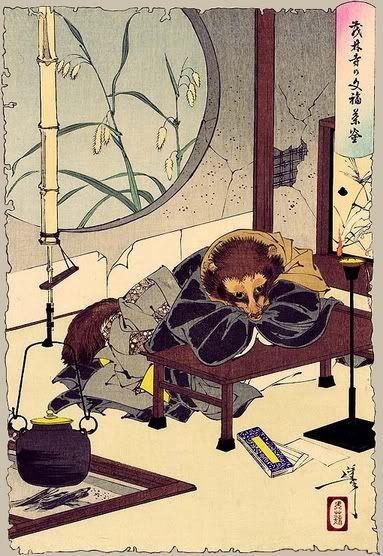 Tsukioka Yoshitoshi
"The Lucky Tea Pot of Morin Temple"
1889-1892Although Hendrick Goltzius' imagery is not as exciting as that of
Hieronymus Bosch or Bruegel the Elder, two of his regional predecessors, his handling is exquisite, particularly in his engravings. His paintings are also impressive, though they are too often dismissed by art historians as second-rate.
I can't recommend the exhibition enough. Go check it out if you can.
Photo credits: "My Heavens!" ripped from
Jane Hammond's website; "The Lucky Tea Pot of Morin Temple" ripped from
SinisterDesigns.com