Silly Love Songs: Singing longer doesn't always mean you get the girl.
Among song sparrows, the most tuneful males often win over the females -- but their vocal expertise may come at a cost. Biologists at Duke University counted up songs in male song sparrows' repertoires and then tested the birds' memories. Every day for eight days the researchers hid a mealworm in one of several shallow wells, some of which had lids. The mealworms' location remained the same, so the scientists could observe how deftly the sparrows remembered where to find their treat. Over time all of the birds improved, but the males that sang the fewest songs learned the quickest, while the birds with more expansive repertoires struggled. Kendra Sewall, now at Virginia Polytechnic Institute and State University, explains that the difference could reflect a trade-off during mental development -- the birds develop one ability or the other. The finding also suggests that females may be able to detect a potential mate's weaknesses in his songs. Although many pick males that sing lots of songs, Sewall notes that every male in their study found a mate. It's possible, she says, that certain females are aware of the trade-off and prefer a partner with spatial smarts to pass on to their young. -- Daisy Yuhas
Maybe I was cheered by the report because I a) have a terrible singing voice, b) struggle to remember song lyrics (even simple tunes), c) am fond of poring over maps, and d) have an innately good sense of direction? Like the song sparrow test subjects, it seems I was afforded one ability and not the other.
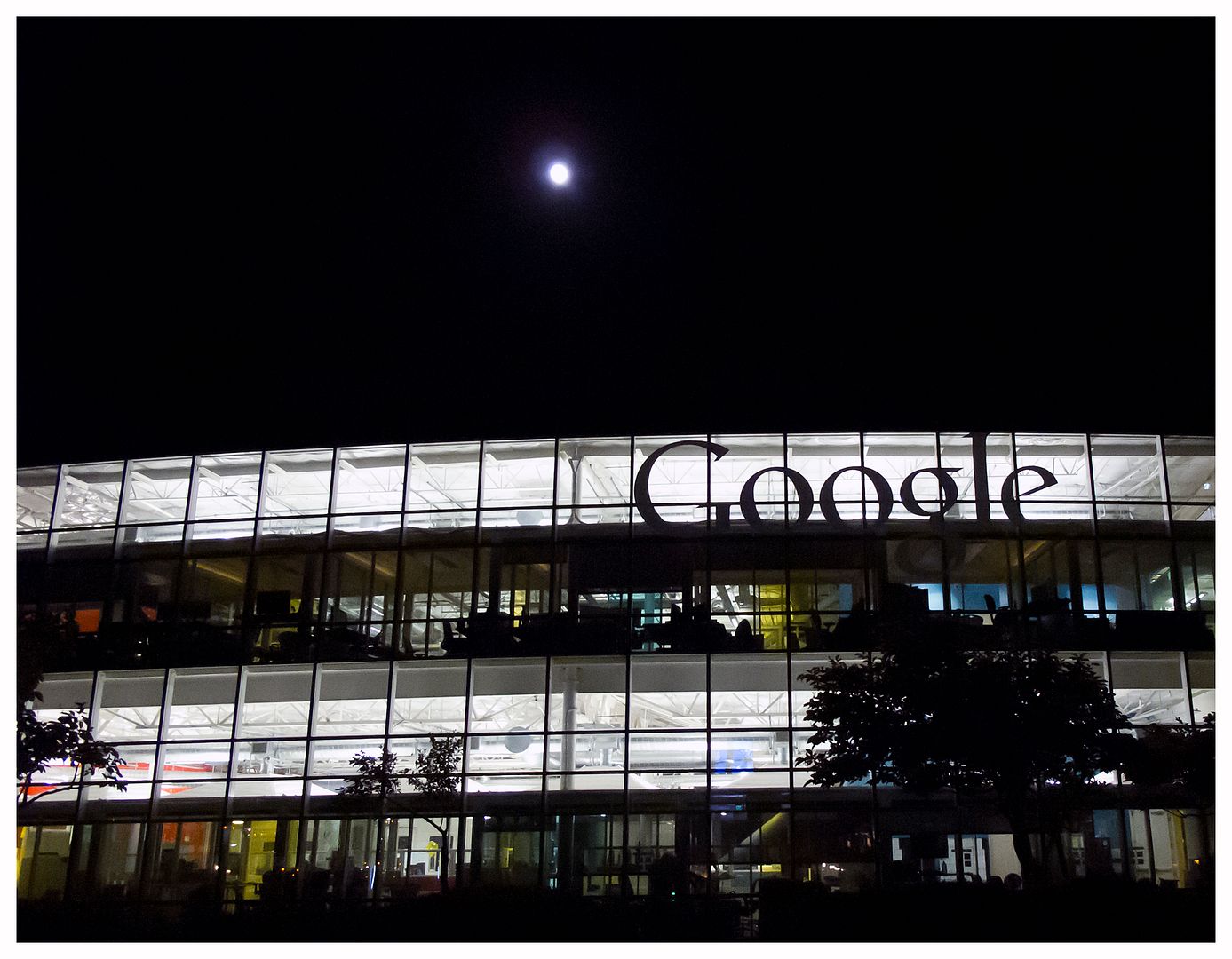
Summer solstice moon over the Googleplex; Mountain View, CA; June 2013
My father-in-law is a glass-half-full kinda guy. In the midst of any conversation about science, medicine, or technology, it's not uncommon for him to proclaim, "This is an exciting time to be alive." Indeed, it is. But when I fell into bed early on Sunday morning, my head giddy with ideas from the first full day of Sci Foo Camp, my father-in-law's optimism seemed understated. Spend 48 hours with -- to list just a few of the approximately 250 participants -- a computer scientist studying machine learning and music, a theoretical physicist turning the idea of gravity on its head, a marine biologist eager to solve the mysteries of whale sharks, a genomic epidemiologist intent on elucidating outbreak transmission dynamics, and a national security strategist currently implementing the White House's terrorism-related information sharing priorities and...well, you come away with much to ruminate on and a lot of notes to parse. In short, Sci Foo Camp made for an extraordinary weekend!
As I often insist, there is a lot of beautiful and compelling artwork produced and exhibited today, but it generally lives apart from popular culture. We -- that is, those of us active in the fine arts -- are complicit in this ghettoization because we're content to carry on a conversation among ourselves. Moreover, because we've come to preference our tribe's voices over others, there is a surplus of insider commentary and critique passed off as art. Almost all of this work and wordiness is irrelevant to the world outside the ghetto walls and, because young artists are educated in this context, with little or no pedagogical emphasis on disciplines other than art theory, the art and commentary become, over time, increasingly provincial. The wellspring of this contemporary predicament is as old as modernism.
On the heels of co-curating "A Live Animal" with Selene Foster, I've been rereading John Dewey's brilliant Art & Experience essays (1934). Dewey writes, and I quote him at length because he articulates the crux of the problem so eloquently:
" [Art is today] isolated from the human conditions under which it was brought into being and from the human consequences it engenders in actual life experience. [...] Art is remitted to a separate realm, where it is cut off from that association with the materials and aims of every other form of human effort, undergoing, and achievement. A primary task is thus imposed upon one who undertakes to write upon the philosophy of the arts. This task is to restore continuity between the refined and intensified forms of experience which are works of art and everyday events, doings, and sufferings that are universally recognized to constitute experience.
[...] So extensive and subtly pervasive are the ideas that set Art upon a remote pedestal, that many a person would be repelled rather than pleased if told that he enjoyed his casual recreations, in part at least, because of their esthetic quality. The arts which today have most vitality for the average person are things he does not take to be arts: for instance, the movie, jazzed music, the comic strip, and, too frequently, newspaper accounts of love-nests, murders, and exploits of bandits. For, when what he knows as art is relegated to the museum and gallery, the unconquerable impulse towards experiences enjoyable in themselves finds such outlet as the daily environment provides.
[...] For the popular notion comes from a separation of art from the objects and scenes of ordinary experience that many theorists and critics pride themselves upon holding and even elaborating. The times when select and distinguished objects are closely connected with the products of usual vocations are the times when appreciation of the former is most rife and most keen. [...] Theory can start with and from acknowledged works of art only when the esthetic is already compartmentalized, or only when works of art are set in a niche apart instead of being celebrations, recognized as such, of the things of ordinary experience. Even a crude experience, if authentically an experience, if more fit to give a clue to the intrinsic nature of esthetic experience than is an object already set apart from any other mode of experience. [...The] trouble with existing theories is that they start from a ready-made compartmentalization, or from a conception of art that 'spiritualizes' it out of connection with the objects of concrete experience. The alternative, however, to such spiritualization is not a degrading and Philistinish materialization of works of fine art, but a conception that discloses the way in which these works idealize qualities found in common experience. Were works of art placed in a directly human context in popular esteem, they would have a much wider appeal than they can have when pigeon-hole theories of art win general acceptance.
[...] The sources of art in human experience will be learned by him who sees how the tense grace of the ball-player infects the onlooking crowd; who notes the delight of the housewife in tending her plants, and the intent of her goodman in tending the patch of green in front of the house; the zest of the spectator in poking the wood burning on the hearth and in watching the darting flames and crumbling coals."
Amen, Mr. Dewey...though I'd add that the "primary task" to "restore continuity between" works of art and the everyday is not only the obligation of the art writer; it is also incumbent upon the conscientious artist. Artists need to make art that connects to common human experience, and both artists and art writers need to communicate more effectively with the general audience.
I thought of Dewey's argument when watching a video of Scottish cyclist Danny MacAskill that was recently shared by a friend on Facebook. The video offers a more visceral (and therefore meaningful) aesthetic experience than most of the contemporary art I've viewed in the last weeks. An acrobat with his bike, Macaskill is Dewey's "live animal," "fully present, all there" because of he has honed his craft and is, as we often hear athletes put it, "in the zone."
Can contemporary fine art inspire people to exclaim, as one person did in the comments under my friend's Facebook posting of the Macaskill video, "That's crazy & beautiful!"? Can artists again enthuse the general audience?
I believe that we can, and I hope that I can one day have an opportunity to design (or help to design) an undergraduate or graduate art curriculum that prioritizes generalism and social responsibility.
Biologist, artist and writer Jessica Palmer discusses "Synesthesia #1," one of my 2008 watercolor and ink drawings. Palmer is a gifted and insightful writer, and her short essay is fantastic.
I also encourage further exploration of the newly redesigned SEED site. It is a remarkable publication. The "Culture" section, in particular, is interesting to generalists excited by science and all of its ramifications.
"It is perhaps an inescapable part of the human condition to 'divide up the world' into mental categories. The categories may be immensely useful, but they are also partial and misleading. Philosopher and scientist Jacob Brownowski has described the process of science—the process by which we gain empirical knowledge—as that of decoding a 'completely connected world.' This decoding requires dividing that completely connected world into what is relevant and what is not relevant to the matter at hand, in order to create a meaningful context for study. But this division, Bronowski warned, does violence to the actual, organic nature of the real world. We must always bear in mind that we are 'certainly not going to get the world right, because the basic assumption that [we] have made about dividing the world into the relevant and irrelevant is in fact a lie.'"
Beatty portrays the contemporary American socio-political and socio-economic landscapes with more originality than I did in my recent post "Absolutely Relative,", though he, too, turns to Alexis de Tocqueville for then-and-now perspective. de Tocqueville offers readers a wealth of valuable material, but I hadn't before read anything as prescient as the below.
"Ideology - everything will work out for the best in the long run - sustains inevitability. But mass trances cannot be counted on to hold. The spell of inevitability has been broken before."
"Should Americans lose their capacity for self interest, Tocqueville feared, American individualism would produce a society of post-political strangers who stay 'enclosed in their own hearts,' beyond collective anger, and laiable to pacification by the 'immense tutelary power' of a soft despotism."
Only a devoted scholar of history and culture could have so accurately predicted our current American condition...over 160 years ago! de Tocqueville's observations stand as a challenge to those bottom-line thinkers that deny the vitality of the humanities or the importance of a grounding in history. A world of specialists is a world of "post-political strangers."
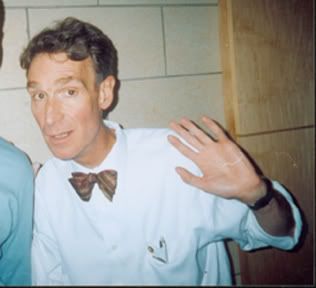
“As a child, I would stand with my father on the beach in Delaware and stare at my shadow as the sun went down, watching it get longer and longer, infinitely long. When you understand how many stars are out there, more stars than there are grains of sand on the beach, you can think you’re just a speck orbiting a speck in the middle of specklessness. But there’s another way to look at it, which is that we have brains, and can use them to understand the universe. And I thought then that if I were out in space I could look back and see my shadow, the long shadow of little Bill.”
I grew up two states south of Bill Nye, “The Science Guy,” and I less often considered sand on beaches than water molecules in the ocean, but I did spend many hours contemplating little things, real or imagined, awed by my relative enormity and, in turn, by my relationship to the greater, infinite expanse.
Some professional scientists poo-poo Nye. If pressed, these scientists admit that their disregard is rooted in his popular appeal and his “dumbing down” of science for mass consumption. I prefer to celebrate Nye for the same reasons.
My parents didn’t have a television when I was growing up, but when I visited a neighbor’s house and saw shows like "Sesame Street" or the "Electric Company," I was enthralled. Had “Bill Nye, The Science Guy" been aired when I was young, I'm sure that I would have loved it, and I'm sure that he would have further inflamed my love of science.
Interestingly, underneath Nye’s infectious excitement, he seems complicated. I find myself wondering what he thinks about after the studio lights are turned off. Is he defensively optimistic? Deeply pessimistic? What questions does he ask of himself? Of others? Does he avoid questions of personality or psychology, concentrating instead on that which he can safely externalize?
In the most recent issue of Wired, Nye is featured in "The Science Guy Grows Up," a short, five-question interview. When asked, "Science and comedy seem like strange bedfellows. How do you make serious science funny?," Nye responds:
“How can you make it not funny? Humor is everywhere, in that there’s irony in just about anything a human does. There’s all this PB&J: passion, beauty, and joy. But there’s also the futility of the whole thing. We’re just humans on this dying planet, and it doesn’t much matter what we do. We’re always setting up expectations, whether scientific or otherwise, and failing to meet them. That creates comedic tension. The more you find out about the world, the more opportunities there are to laugh it.”
Underneath all of his infectious excitement, then, Nye is something of a nihilist. Perhaps the lessons of science always reduce the human by presenting us relative to the rest of the mess. Maybe this, in part, contributes to the trend towards scientific specialization over generalism, allowing the scientist to avoid looking at the whole and thereby protecting her from potential crackup.
The range maps and brief habitat descriptions found in field guides – most people will be familiar with a "bird book" and the colorful diagrams explaining where the different species winter, summer, and breed – are not gospel; there are always exceptions to the rule. Unfortunately, even wildlife biologists sometimes forget this.
Some years ago my father, a conservationist and writer, observed a Trumpeter Swan (Cygnus buccinator) on our Virginia farm. He called some ornithologist friends to report the unusual sighting, but the scientists scoffed at the notion of a Trumpeter visiting a coastal Virginia pond. Undeterred, my father photographed the bird, had the film developed, and sent them all images, at which point they changed their tone and agreed that this was a remarkable occurrence. Thanks to my father's documentation, this story ended happily, but I remain frustrated that the ornithologists, who all know my father to be an excellent birder (he's written books on the subject), doubted him.
For years, I bemoaned the "intellectual arrogance" of wildlife biologists, caricaturing them as stern bureaucrats more concerned with establishing reputations than expanding what we know of a species. By my early twenties, though, I realized that some degree of skepticism on the part of biologists is necessary. Dubious sightings are reported all the time: a wild grizzly bear in Florida; a crazed grey wolf in Massachusetts; a "poisonous black snake" chasing Maggie Ann across the yard. So many of these erroneous claims are relayed to biologists, especially at the local level, that they are forced to install a "junk" filter. Unfortunately, reports of real interest are lost in the process.
The scientists' skepticism also discourages people from reporting their observations in the first place. Several times I've suggested someone report an interesting sighting and the typical reaction is something like, "I'm not a scientist. What am I gonna tell them? Um, so I saw a mountain lion in West Virginia... They'll think I'm an idiot." In the age of the digital camera, though, some of the more far-fetched accounts may garner professional attention. (On the other hand, maybe the age of the digital manipulation automatically makes all documentation suspect?)
At any rate, this article serves as an encouraging counter-point. Diane Peterson, a remarkable elementary school teacher in Washington, hasn't just turned her students on to science, she has allowed them to produce valuable data, which will now be used (by the initially skeptical biologists) to expand our knowledge of short-horned lizards (Phrynosoma douglasi). If more educators were this innovative, the world would be a better place.
Debates about the evolutionary history of autism rage on. What sort of adaptive advantage is offered by autism? Some sociologists and biologists argue it can serve certain individuals well, given the right environment and social structure. Others contend that it is strictly maladaptive. The neuroscience of the condition - the role of the left and right hemispheres and the enhanced or retarded activity in various brain modules - is also curious: much advantage is gained, but at a substantial cost.
Simon Baron-Cohen, director of the Autism Research Center at Cambridge University, has designed a test to determine your Autism Quotient. The higher the number, the more likely you are to be autistic. With a score of 27, I'm apparently approaching the autistic range, but as Baron-Cohen reminds us, even those who score above a 32 - the assigned autistic marker (the average score is 16.4) - can function normally in society.
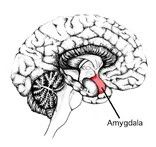
The test, writes Steven Johnson (author of the very readable Mind Wide Open), is more of a measure of your amygdala sensitivity. As I mentioned in the "Do Fish Feel Pain and What Of It?" post, the amygdala is responsible for the flight-or-fight response and empathy. The higher the number, the more dulled the influence of the amygdala.