Jennifer Dalton
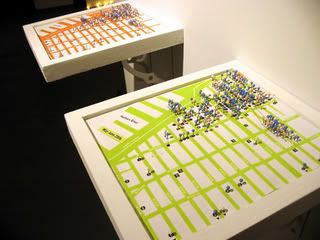
"Art Guide"
2006
Map, colored pins, painted wooden frame
9 1/2 x 10 1/2 x 1 1/4 inchesOf late, there's been a lot of protest,
commentary, and debate concerning the shamefully low percentage of women showing in the art world. It's true; the contemporary art world is dominated by men. Furthermore, I'm assuming that the majority of these men are heterosexual Caucasians, meaning the art world, reflecting the 20th century American teenagers read about in their high school textbooks, is white, male, and straight.
The art blogging community, ever expanding, has fed well on a steady diet of relevant posts, especially following the publication of
Jerry Saltz's recent "
Where The Girls Aren't" piece in
The Village Voice. I generally enjoy Saltz's writing, and this piece is no exception. Saltz writes, "According to the fall exhibition schedules for 125 well-known New York galleries—42 percent of which are owned or co-owned by women—of 297 one-person shows by living artists taking place between now and December 31, just 23 percent are solos by women." Wow; that's astonishing and embarrassing, especially when I note that 60 percent or more of my artist friends are women, and I feel this number representative of the working artist population in New York, if not the United States at large. We have reason to take stock of the situation; there is no ignoring the numbers.
And yet, I can't help but feel the subject itself a bit, well, dated. Is the sex (or sexual preference) of an artist still so important? I mean, sure, most folks across our great, prudish nation are
very concerned with sex and sexuality. Debates rage about female golfers on the
PGA tour and the sexuality of politicians. But we're not talking about the general public here (no matter how much I'd like the art world to expand it's reach). The voices involved belong to a relatively small, very progressive group of educated individuals.
The question may sound a bit naive, but why are we still "seeing" skin, sex, or sexuality in art that doesn't focus on these issues? Frankly, most art that does take on these issues is didactic, a breed of intellectual illustration which, while worthy of consideration, fades from memory and relevance in much the same way an excellent piece of journalism does. By contrast, most artwork I see these days, whatever the medium, lacks an overt agenda. Until I see the name or, in some cases, until I read the press release, I don't know much about the maker's makeup. Frankly, I don't care to. The art will either ring my bell or it won't. If I later learn about the artist's background and find that these details inform the work further, hooray, but until I want to peel back that layer, I don't need to know hooey. Art, I feel, is a beast best viewed
apart from the artist.
At times I feel like shrugging off the issue. Shouldn't we be concerned with the product as opposed to the personality or biography? Yet the imbalance of the sexes
is real, and it mustn't go ignored. I'm proud to be friends with ambitious artists and curators who are devoting energy and thought to addressing and, hopefully, rectifying the problem. Still, I can't shake the longing for that day, a millennium or more on, when miscegenation and a dissatisfaction with ol' time fundamentalism will result in our
wearing one skin and being more tolerant of varied beliefs. Maybe then we can set to the business of real - meaning global - humanitarian and environmental progress...and artists can expend more energy thinking about art rather than who made what and why.
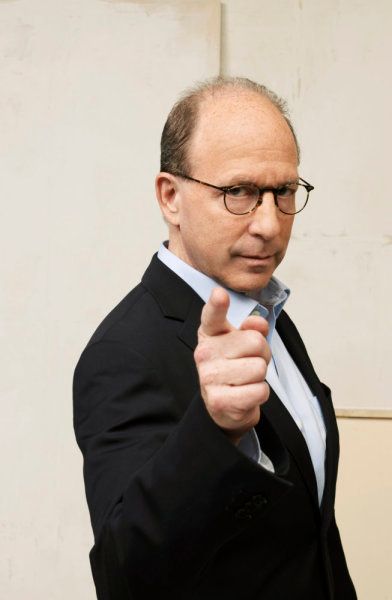
Photo credit: ripped from
Winkleman Gallery; Normally, I would have asked Edward for permission, but he's
out of the country and without frequent Internets access...and I'm compulsive.