Friday, October 26, 2012

The Mystics Downtown

Due to time constraints, I've provided only brief remarks about three terrific, tangentially related downtown shows. All three are on view for just one more day, so rush out to see them, if you can.

+++++

"Uncharted," a handsome group show of works on paper at Cain Schulte Gallery, "explore[s] the concept of mapping as the visual and conceptual categorization and organization of relationships, systems, and interactions." Remarkably, the works included in "Uncharted" all relate well to one another (rare for a group show with such a broad theme), and the exhibition is compelling both visually and conceptually, but a few artists' contributions stand out.


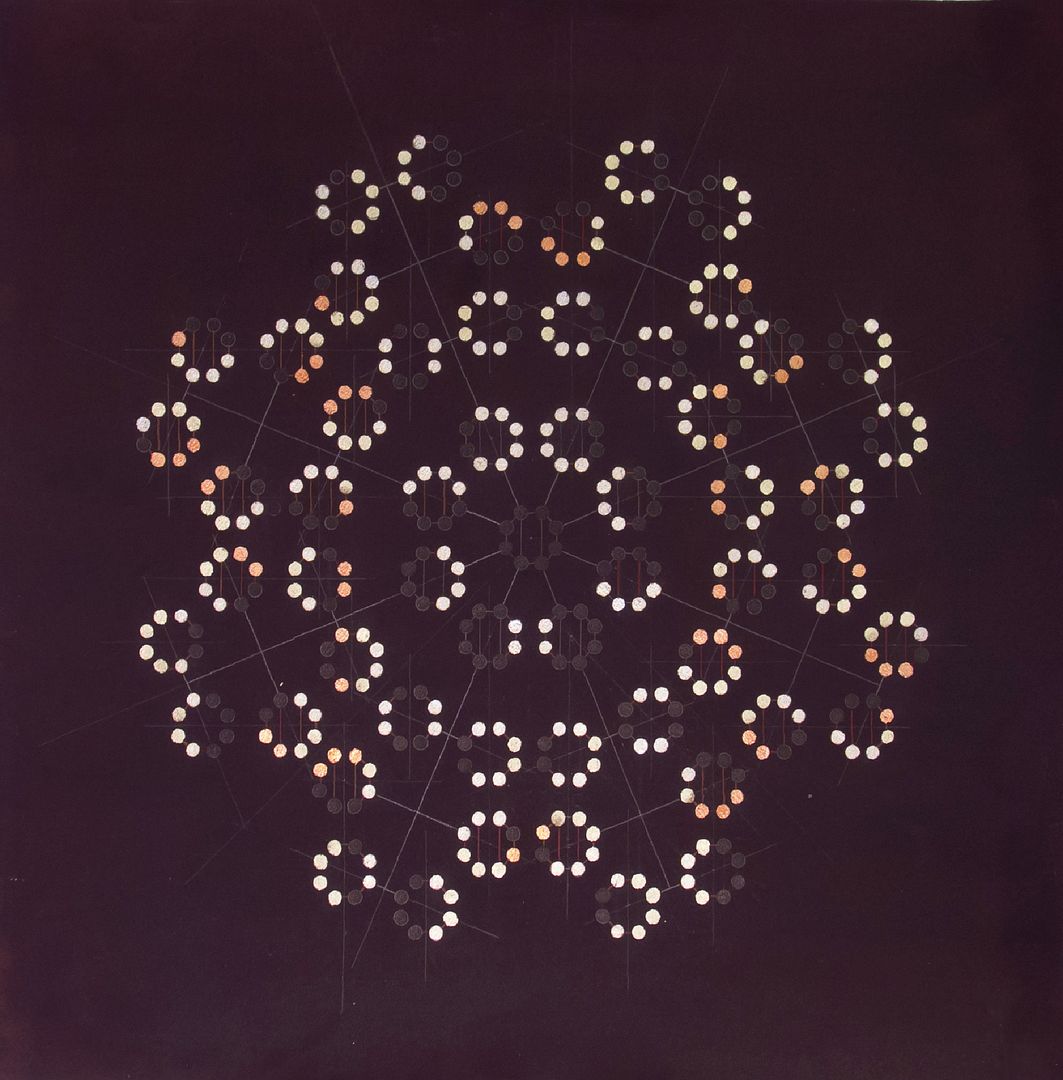
Owen Schuh
"Two Folds"
2012
Graphite, gold copper and silver leaf, and sumi ink on paper
32 x 32 inches

Owen Schuh's "Two Folds" is an elegant diagram illustrating all of the possible ways a piece of paper can be folded in two. Schuh is a precise craftsman, and his circles and lines add up to a kind of mathematical sublime. Without the aid of the press release, I wouldn't have recognized what it is that Schuh has mapped, but that isn't necessarily a problem. "Two Folds" also works as an arcane design, calling to mind the complicated but specific hierarchies of, say, a Kabbalist. That Schuh has produced an image that is as readily associated with mathematics as it is esoteric mysticism shouldn't surprise; just ask your neighborhood theoretical astrophysicist to discuss notions of beauty.

Amber Stucke
"Survival Relationships No. 2 (Symbiosis State)"
2011
Graphite, gouache, and ink on stonehenge paper
50 x 38 inches

Amber Stucke's two large drawings, "Survival Relationships [Symbiosis State]," Numbers 1 and 2, inspire a similar sense of wonder, but, unlike Schuh's more abstract and Apollonian investigation, Stucke's subjects are bulbous and oozy, lacking right angles and hard lines. Her project focuses on the curious and often complex relationships of simple organisms. Her richly detailed work elicits obvious comparison to the celebrated German biologist and artist, Ernst Haeckel (whose intricate prints are collected in Art Forms Of Nature, a book that regularly appears in artists' libraries), but whereas most contemporary works that manifest Haeckel's influence are relatively feeble, Stucke's drawings delight every bit as much as those of the famous naturalist. Moreover, as Stucke's works' titles suggest, she is less concerned with the biological forms per se than she is in their interaction.


Katie Holten
"Shadow Drawing"
2012
Graphite on paper
9 x 12 inches

Katie Holten's shadow drawing series is less visually exciting than the aforementioned works by Schuh or Stucke, but her small pictures, artifacts of her mapping the movement of shadows in a given space, are restrained reminders of the value of taking note of that which typically goes unnoticed.


Charles Burchfield
"White Picket Fence"
c. 1965
Watercolor, chalk, and charcoal on joined paper
53 x 40 inches

A block south, at the Fraenkel Gallery, works by another perceptive observer of the everyday are on view. The title of Charles Burchfield's "White Picket Fence" evokes bourgeois banality, but the striking picture makes it plain that Burchfield was a modern mystic, an artist who saw (or recognized) the extraordinary in the mundane.

In the painting, just beyond the eponymous fence (which is positioned at the base of the image, its wooden slats between us and Burchfield's vision), a tree heaves heavenward like a pyre, radiant with heat and light. Admiring the piece, I thought of the biblical story of Moses and the divine revelation he experienced in the form of a burning bush. According to one popular interpretation of the story, Moses broke with the mundane when he choose to observe the ordinary world (the bush) through extraordinary eyes (the bush as burning). Revelation, in this reading, is experienced by those who are willing to truly open themselves to the wonder of this world. Similarly, Burchfield observed that "the artist must paint not what he sees in nature, but what is there."


Charles Burchfield
"Heat Lightning (Landscape with Grey Clouds)"
c. 1962
Watercolor, charcoal, and white chalk on joined paper
58 x 45 inches

Consider the artist's "Heat Lightning (Landscape with Grey Clouds)," also included in the Fraenkel Gallery exhibition. The painting possesses a hallucinatory grandeur that reminds us why our ancestors felt compelled to populate the sky with god-driven chariots and angelic hordes, but Burchfield's beaming cloud towers and oxbow channels are the raw stuff of myth, the awe-inspiring inspiration sans any fantasy spawn. Myth is vital to our species, but Burchfield's work reminds us that the unadulterated real, if looked at with keen eyes, is itself astonishing.

Critic Jerry Saltz described Burchfield as "the mystic, cryptic painter of transcendental landscapes," but it's important to remember that, like his American transcendentalist predecessors, Burchfield's work is merely an enthusiastic response to the world as it is; mystics are not lunatics.


Chris Fraser
“Eidolon, Sylvania 120PAR/CAP/SPL/FL30, 2012”
2012
Light Installation
Exterior View

Just around the corner from Fraenkel, at Highlight Gallery, a contemporary transcendentalist is exhibiting. Unlike Burchfield, Chris Fraser is not a painter -- nor is he a poet like Walt Whitman, whose "Eidolons" provides the title of Fraser's solo show -- but his work reveals for us "not what [we see] in nature, but what is there."

Fraser's background in photography led him to work with light as a primary medium. All of the artist's recent projects play with our perception of light's movement through space; in the process, Fraser, makes the ethereal almost tangible. "Eidolon, Sylvania 120PAR/CAP/SPL/FL30, 2012," the strongest work in "Eidolons," is also among the most beautiful of Fraser's pieces to date. Fraser's artwork titles ground his project in the mundane (the letters and numbers are the manufacturer code information associated with the bulbs Fraser uses), but by directing the bulb's illumination through a tiny hole in a wall (and into an otherwise unlit room), Fraser focuses our attention on the astonishingly intricate pattern cast by the ordinary flood light. The effect is transformative.

Alone in the dark interior space with the floating impression of the bulb's face projected in front of me, I move between scales, alternately considering the subtly pulsing pattern in front of me as a particle accelerator collision, a sunflower's floret pattern, and a representation of the cosmos. Highlight Gallery's press release defines an eidolon as "a phantom or an image of the ideal." In combination, those two things -- a phantom and the ideal -- flow into the notion of the numinous, and I believe that is Fraser's aim, to provide his viewers with experiences that might open them to awe.


Chris Fraser
“Eidolon, Sylvania 120PAR/CAP/SPL/FL30, 2012”
2012
Light Installation
Interior View


Image credits: Owen Schuh, Amber Stucke, and Katie Holten images, courtesy the artists and Cain Schulte Gallery; Charles Burchfield images, courtesy the Fraenkel Gallery; Chris Fraser images, courtesy the artist and Highlight Gallery

Thursday, October 25, 2012

Announcing "Animalier" Exhibition

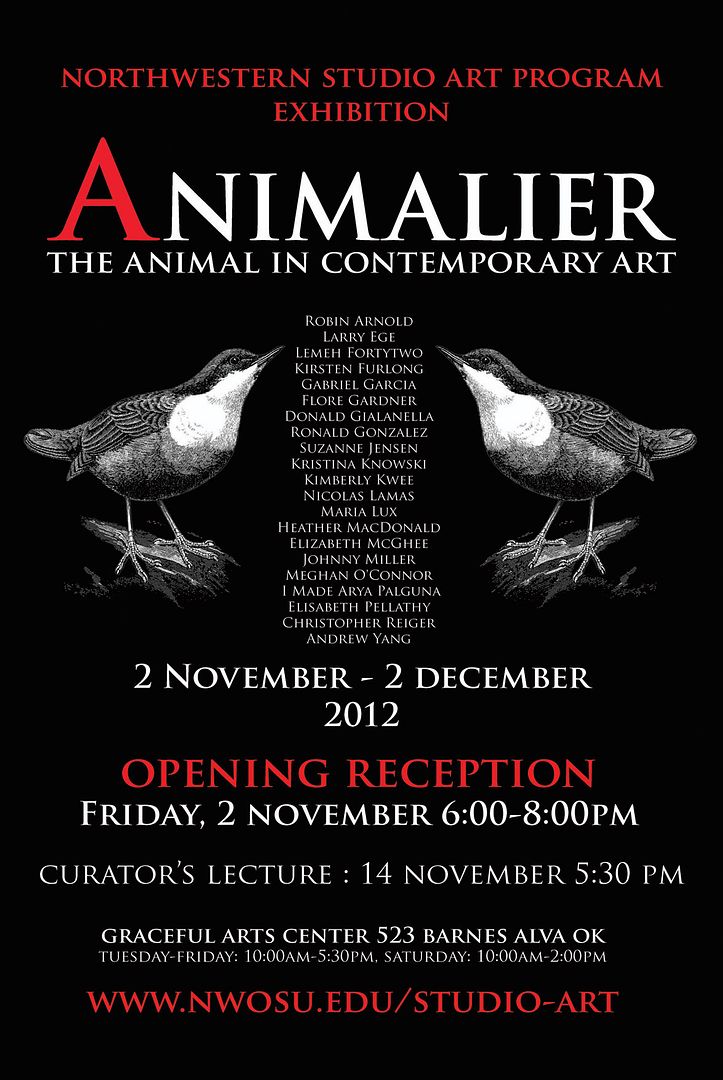
I'm pleased to announce that two of my watercolor drawings are included in "Animalier: The Animal in Contemporary Art," an exhibition put on by Northwestern Oklahoma State University.

While I know most of Hungry Hyaena's readership resides on the US coasts, if you happen to find yourself near Alva, Oklahoma, in November, please check out the exhibition!

Wednesday, October 17, 2012

David Tomb's "Grand Birds"


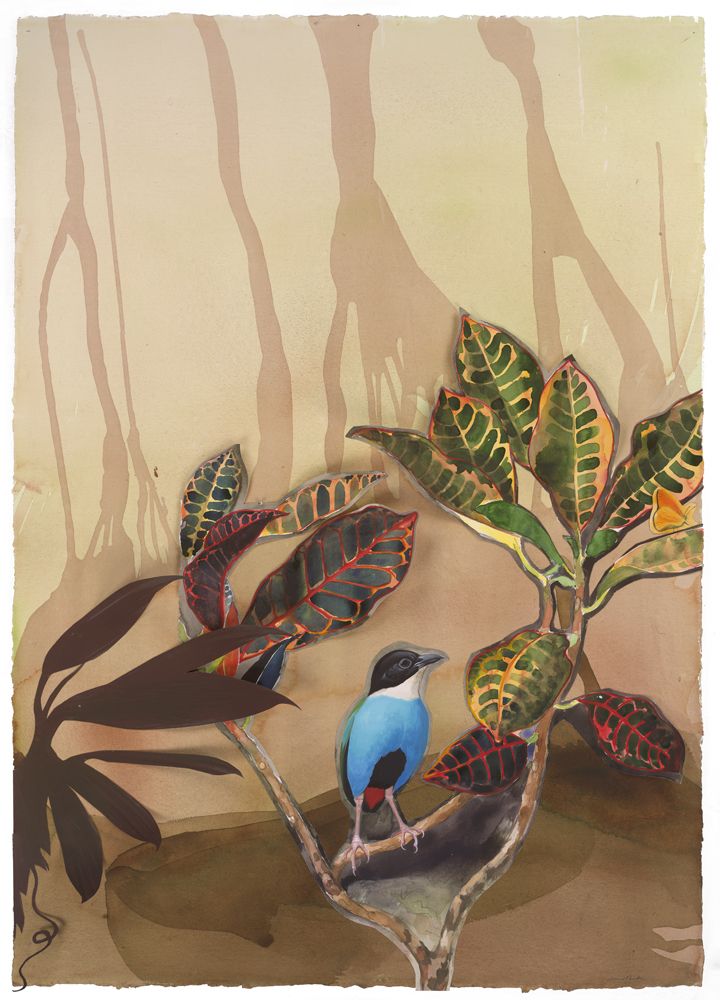
David Tomb
"Azure-breasted Pitta"
2012
Painted papers with mixed media and partially pasted and or completely pasted on paper with mixed media
42 x 30 inches

"Grand Birds of the Philippines," David Tomb's current solo show at Electric Works, is deserving of a thoughtful review. Disappointingly, my writing time is limited this month and I can provide only a few observations.

+++++


David Tomb
"Mindanao Wattled Broadbill and Swift"
2012
Painted papers with mixed media and partially pasted and or completely pasted on paper with mixed media
42 x 30 inches

Birds have been the principal protagonists of David Tomb's colorful watercolor and gouache paintings for the last six or seven years, but "Grand Birds of the Philippines" sees the artist pushing the construction of his works in exciting ways. Tomb builds the new pictures by pinning and pasting select fragments of various paintings and drawings onto larger paper grounds or directly onto the gallery walls. Viewers will spot numerous pin holes in the exhibited assemblages, evidence of earlier permutations; an orchid was moved to a different branch, perhaps, or a swift's dark silouhette adjusted so that it chases another gnat. Here and there, a vine or butterfly wing is left unfixed, protruding from the picture's surface and lending a sculptural effect to the work.

Tomb's approach, which calls to mind Judy Pfaff's "sculptural painting," is a surprisingly effective technique for a wildlife artist (or, more accurately in the case of Tomb, a contemporary artist working at the fringe of that genre). The assemblages have a playful and provisional feel to them that is satisfyingly fresh, but the technique also heightens the sense of space and, in some of the works on display (most notably, the show's pièce de résistance, "Great Philippine Eagles") supplies a verisimilitude normally lacking in natural history art and illustration. As in the field, our eyes dart around the impressive image, and the 3-dimensional elements cause the lenses of our predatory eyes to subtly flex and relax, bringing different subjects or areas into focus. Tomb smartly exaggerates this effect by painting soft watercolor wash backgrounds that fall suddenly away where they come up against a pinned down hard edge.


David Tomb
"Great Philippine Eagles"
2012
Painted papers with mixed media pinned to wall surface
130 x 180 inches

Of the smaller works in "Grand Birds," "Azure-breasted Pitta" and "Mindanao Wattled Broadbill and Swift" are the most compositionally engaging and successful, but this writer, a bird and snake nut, also reserves a special place for Tomb's exuberant "Mindanao Hornbill, Wagler's Pit-Viper, and Collared Kingfisher."

If David Tomb's work appeals to you but, like me, you're operating on a lean budget, you can support the artist's conservation non-profit, Jeepney Projects, by purchasing benefit prints and, in a few weeks, note cards on the Jeepney website store. 100% of the print and card sales proceeds support bird conservation efforts in Mexico and the Philippines.


David Tomb
"Mindanao Hornbill, Wagler's Pit-Viper, and Collared Kingfisher"
2012
Painted papers with mixed media and partially pasted or completely pasted on paper with mixed media
42 x 30 inches

Image credits: copyright, David Tomb, 2012; courtesy David Tomb and Electric Works

Tuesday, October 02, 2012

Picturing Awe


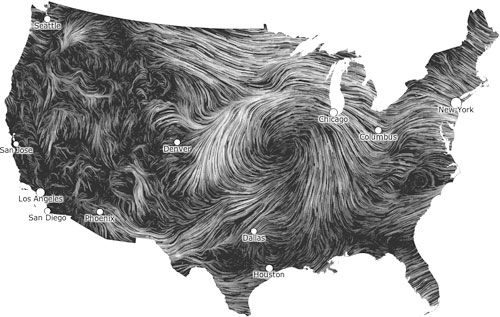
Frame from "Wind Map"
Martin Wattenberg and Fernanda Viegas

Last night, I attended the second presentation in this season's Art, Technology, and Culture Colloquium series at UC Berkeley. Martin Wattenberg and Fernanda Viegas, artists and researchers who often work as a team, presented "Visualization and the Joy of Revelation," an engaging survey of their greatest hits (to date) supplemented by tidbits about their process and working philosophy.

From the ATC listing:
"Fernanda Viegas and Martin Wattenberg explore the joy of revelation: the special electricity of seeing a city from the air, of hearing a secret, of watching a lover undress. Their medium is data visualization, a technology developed by computer scientists to extract insights from raw numbers. They'll show what happens when this technology is aimed at data sets that range from tropical storms to social networks, from arguments on Wikipedia to expressions of carnal desire."
As Wattenberg and Viegas showcased some of their work -- "Fleshmap" and "Wind Map" are perhaps the best known of their collaborations -- I found myself thinking about one of the books I'm currently reading, astrophysicist Adam Frank's The Constant Fire. In the book, Frank critiques the current relationship (or lack thereof) between science and religion, arguing that the spiritual impulse is at the root of both religion and science (i.e., that religion is a kind of proto-science). Riding BART to Berkeley from San Francisco, I was struck by the passage below and Wattenberg and Viegas' presentation called it to mind.
"Science […] makes life's sacred character apparent to us. Science creates hierophanies through the act of careful observation and consideration. Science makes even the smallest thing - the gnat, the flea, the dust mote - sacred. This transformation comes about when the observer cares enough to notice the world's details. The experience […] comes in the moment when we encounter a new image or recognize the key patterm in a new dataset. It comes whenever the patheways of science make the world stand out, illuminated and luminous. […] It is a result of an encounter with the world when it is allowed to speak for itself. In hearing its voice we see the world as new and worthy of awe. […] If, as a culture, we do not identify this moment as an encounter with the world's sacred character, as a hierophany, it is because we have been taught not to. Instead we call it 'amazement,' 'wonder,' or simply 'awe.' We should not be fooled. Rudolf Otto would not be fooled. In The Idea of the Holy he named 'awe' as nothing less than the principal experience of the numinous."
Wattenberg and Viegas exhibit a curiosity and enthusiasm (it's worth exploring the etymology of the second word) that is shared by many of the strongest artists, scientists, and thinkers. All the ink spilled about the intersection of art and science notwithstanding, the seed from which both sprout is watered by amazement, wonder, and awe. Individually, most of us prefer to experience those emotions in either a sacred or a profane arena, but Frank's point is that the arenas themselves are constructions; in this respect, sacred and profane are functionally the same.

The projects Wattenberg and Viegas have created hammer that point home. Explore some of them below.

The Wind Map

Fleshmap
(For a good chuckle, visit the musical genres breakdown of this project.)

Flickr Flow

History Flow


Frame from "Flickr Flow"
Martin Wattenberg and Fernanda Viegas

Image credits: both images ripped from Martin Wattenberg's website, visualizations by Wattenberg and Viegas