"Is it that by its indefiniteness it shadows forth the heartless voids and immensities of the universe, and thus stabs us from behind with the thought of annihilation, when beholding the white depths of the milky way? Or is it, that as in essence whiteness is not so much a color as the visible absence of color; and at the same time the concrete of all colors; is it for these reasons that there is such a dumb blankness, full of meaning, in a wide landscape of snows- a colorless, all-color of atheism from which we shrink?...And of all these things the Albino whale was the symbol. Wonder ye then at the fiery hunt?
- Herman Melville, Moby-Dick
In a post entitled,
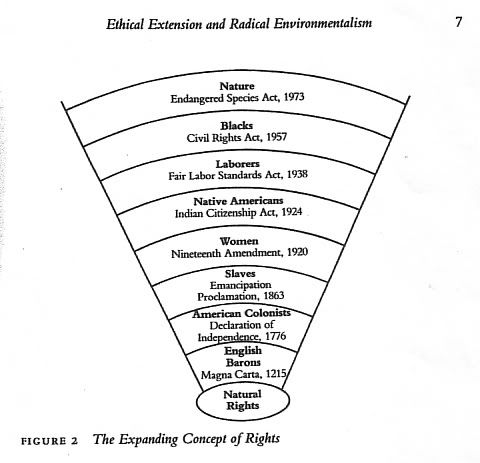
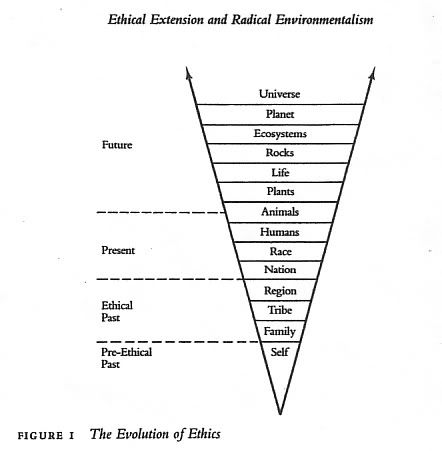
"The Expanding Ethical Embrace" (March 2005), I expressed skepticism regarding
Peter Joost's argument that humanity will adopt a moral code that grants other
mammals,
birds,
reptiles, and even, eventually,
bacteria, the same natural rights that we now reserve for ourselves (supposedly irrespective of
race, sex,
sexuality, or
religion). I did not doubt the plausibility of Joost's prediction, but rather his assertion that this ethical evolution portended only happy returns. I wondered, if humans
were to transcend the cruel machinations of
biological determinism, wouldn't we, in effect, be killing ourselves with kindness? In Joost's neo-
Eden, the human population would explode; the increased resource demands would inevitably lead to collapse (that is, if we didn't first find it in our reptilian spines to loathe "the other" as passionately as we have for time immemorial). Attractive though Joost's notion was, I remained ambivalent about the prospect.
Joost's prediction was recently called to mind when, reading
Grist, an online environmental news journal, I stumbled upon a provocatively titled
Gristmill thread initiated by
Jason Scorse. Many challenging questions are advanced in the dialogue generated by Scorse's
"So, environmentalists support whaling?" Notable among them are:
- Is an environmentalist morally obligated to support animal rights?
- Are regulated, luxury hunts that fund conservation projects ethically or morally defensible?
- Are free enterprise and sustainable development mutually exclusive?
- Should the conservation and preservation camps be distinct from one another, promoting different agendas, or should they work together toward a compromised, common goal?
Scorse's answers to the above questions are 'Yes,' 'No,' 'Yes,' and 'Yes/No,' respectively. Yet any approximation of a complete answer to these questions requires some degree of ambiguity, and even contradiction. Normally I find contradiction and ambivalence agreeable, because they edge closer to objective "truth" than any
ideology might; in matters of environmental policy, however, the grey areas trouble me. Apparently, they trouble Scorse, too, as he jettisons nuance in favor of ideological certainty. Prompted to choose between ideology and reasonable pragmatism, I'm tempted to follow Scorse up the moral high road; the ideological path appears straight and true. But while moral certitude, the black hat/white hat conception of life and thought, is the path favored by activists and fundamentalists, I am made uncomfortable by it, particularly when it informs legislation.
Reasonable pragmatism, the preferred approach of post-Enlightenment thought, has its own problems, however. As
Benjamin Franklin wrote of his
vegetarian experiment
(1), "so convenient a thing it is to be a reasonable creature, since it enables one to find or make a reason for everything one has a mind to do." Franklin's observation at once celebrates and skewers
reason, revealing it to be a wholly relative enterprise. This chink in reason's armor is worrisome.
So what will it be? Are the complications and sacrifices of reasoned compromise better or more effective than ideology? Or do we have clearly defined "good guys" and "bad guys"?
Craig Nelson's
recent biography of
Thomas Paine serves as my subway reading these days, and I find the following observation relevant.
"Beginning with Franklin and Washington, every successful American leader would balance the pragmatic with the Utopian. Where Franklin the master politician would be almost entirely pragmatic, Paine would be too fervidly Utopian in ways that would not just damage him financially, but imperil him physically... Paine would...always be too ardent with his religion of the lights, a Savonarola of reason and liberty, and as inept a political operator as any fervid Christian saint...The success or failure of any leader in U.S. history can be judged through his of her successes or failures at reaching the pragmatic Utopian paradox that remains at the heart of the American experiment."
Nelson's words ring true. "The pragmatic Utopian paradox" is not uniquely American, but it is central to the American experience. For confirmation, we need look no further than the glut of contemporary, progressive American politicians striving to develop a decidedly centrist track record, even as they contradict themselves (and their conscience) in doing so. By contrast, it's easy to discard compromise and contradiction if you are a committed revolutionary, an
individual willing to die for your cause, or a monkish loner operating in an intellectual/philosophical vacuum, as did
Theodore Kaczynski. Outside the
D.C. beltway, ideologues are a dime a dozen, but exceptionally gifted ideological rhetoricians like Paine or
King, Jr. make a sociopolitical impact only rarely.
Not surprisingly, many environmental activists are ideologues, Jason Scorse included. To be fair, Scorse, a professor of
environmental economics at the
Monterey Institute, is not so much making a stump speech as he is asking a provocative question. From his "So, environmentalists support whaling?" post:
"I have tried to make what is essentially a straightforward case that environmentalism at its core is about respecting life and that separating this from our behavior towards individual living beings doesn't make much sense. Since many environmentalists reject this notion and insist that environmentalism only includes preserving biodiversity and promoting resource sustainability, this suggests that one of the defining elements of environmentalism no longer holds: an opposition to whaling...So are those who argue for the minimalist view of environmentalism willing to go on record in support of whaling and the killing of other advanced mammals?"
Money can do a lot in the way of protecting individual species and imperiled ecosystems. Regulated hunting operations and animal farms, worldwide, generate substantial revenue, a healthy percentage of which is used to fund conservation measures. For example, a buyer pays a
tiger rancher (yes,
they exist) an impressive sum - $40,000, say, sometimes much more - to obtain tiger parts for use in
traditional Chinese medicines. A substantial percentage of that price is then used for habitat preservation, conservation education, and tiger breeding programs. It's a simple ethical equation; one animal's death results in improved species survival rates in the long-term (assuming that the habitat can be protected from the trespasses of our burgeoning human population). My short answer to Scorse's question, then, is 'Yes.' The more complete and complicated answer, though, leads down a rabbit hole of uncertainty.
To begin with, I find Scorse's moral framework - do unto your neighboring
species as you would have done unto yourself - fundamentally agreeable. I'm troubled by the
scalae naturae and other moral or physiological hierarchies. Because human life is, in my estimation, no more or less valuable than that of an earthworm (and, lest you mistake that statement for hyperbole, my inner ideologue assures you otherwise), the farming and killing of a tiger, no matter the result, is immoral. So, too, is the farming and killing for food of any animal species. In a truly enlightened world, then, we would witness a continued shift toward vegetarianism, sustainable consumption, and the extension of natural rights to other species. But the rate at which such values are adopted is of critical importance, and I feel Scorse is not at all pragmatic in his consideration of the real-world application of his moral imperative. I fretted about this in the earlier post:
"From a strictly pragmatic perspective, morality is a denial of our existential [and by this I meant all species, not just human] sameness; like all other species, our principal drive is one of survival and propagation. Even our human urge to classify, as seen in the periodic table, clothing labels, and taxonomy, is a violent instinct, evolved to make us better able to ward off 'the other' and to flourish as hunter-gatherers, a lifestyle no longer suitable for our global, industrial species. [Therefore], it could be argued that [the] extension of human rights to all races, cultures, and creeds was but one more victory in our campaign to deny human nature.
But an inclusive, caring society, even if inconsistent, results in a population explosion and exaggerated life expectancies. Moreover, as our species’ requirements are increased, so are our demands on the environment. By embracing one another, we in fact make it more difficult for future generations to survive. When even more populations (in this case, other species) enter our moral and ethical peripheral vision, we will find ourselves facing a very interesting philosophical and pragmatic dilemma. Are we overloading of the circuitry?"
It seems clear that we
would be "overloading of the circuitry," but there is a more immediate concern, one that does not bode well for Joost's expanding ethics: we have proven incompetent in our attempts to achieve parity among humans.
In the course of the
Gristmill conversation, Scorse writes, "Thank goodness...humans aren't treated with the same level of abstract notions about 'sustainability' that you advocate that we subject every other living thing to." Oh, but how we are! One need look no further than the morass of muddled litigation generated by today's vitriolic debates over
abortion,
civil rights, or
assisted suicide to comprehend just how reluctant we are to treat fellow humans with the respect we reserve for ourselves and for our loved ones. As I wrote in March 2005, "one can barely imagine the ensuing cacophony when considering similar issues for
sharks,
birds, and
turtles."
Ever since
Homo sapiens adopted an
agrarian lifestyle, we've been a top-down animal, a pyramid ladder of the very few haves and the countless have-nots. I'm not altogether opposed to the felling of this pyramid in the name of populism and moral ideology (although, let's not kid ourselves punkers,
anarchy ain't Utopia), but when similar tinkering and protest is extended to Nature, an entity of which we, as a species and complex-compound social beast, are but an insignificant part, we're not
only risking collapse on a
Mayan or
Roman scale. We're also gambling with the fate of the human species at large and, importantly, that of the many hundreds of thousands of species inextricably attached to us. Those who herald the imminent expansion of our ethical embrace would do well to think on this.
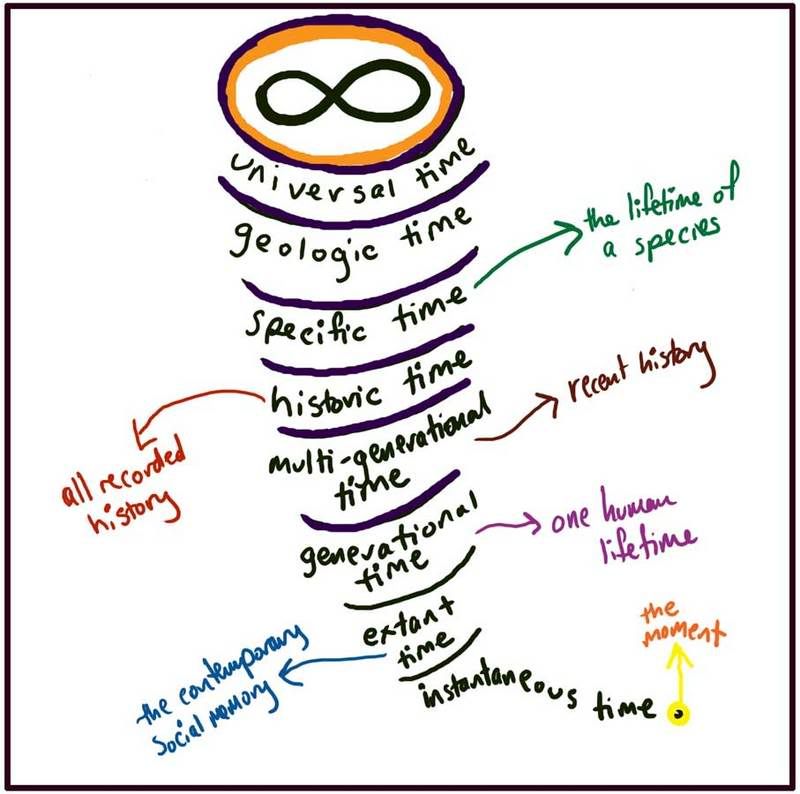
The natural algebra can not evolve apace with our ethical code. Believing this to be true, I suppose I'm something of a determinist. I don't doubt that
Earth's
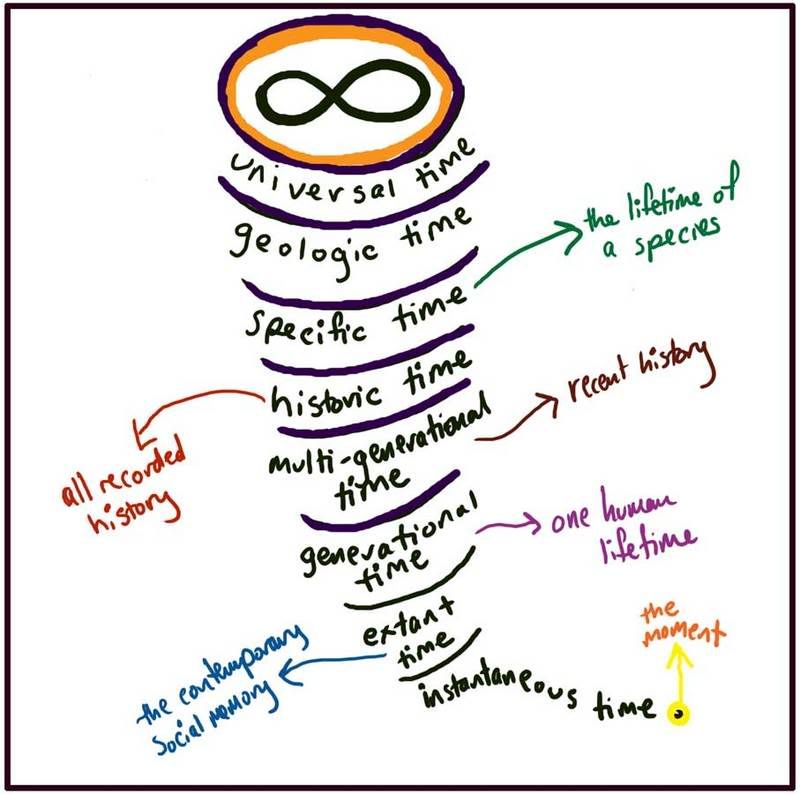
carrying capacity will increase as we adopt more sustainable lifestyles, but such a change occurs in geologic time, not generational or historic time.
E.O. Wilson, the celebrated
Harvard entomologist, makes a similar, if distinct case in his landmark book,
On Human Nature.
"Can the cultural evolution of higher ethical values gain a direction and momentum of its own and completely replace genetic evolution? I think not. The genes hold culture on a leash. The leash is very long, but inevitably values will be constrained in accordance with their effects on the human gene pool. The brain is a product of evolution. Human behavior - like the deepest capacities for emotional response which drive and guide it - is the circuitous technique by which human genetic material has been and will be kept intact. Morality has no other demonstrable ultimate function."
I'm inclined to agree...to a point. But what hand really holds the leash? Wilson assigns control to
genes, our evolutionary chaperones. Genetics is indeed powerful, but the brain is as much a product of cultural evolution as it is physiological evolution. Therefore, I believe nurture can outpace nature at the societal level. In other words, genes have less control over moral and ethical evolution than Wilson would have us accept. In fact, it is the "eco," the greater whole - the Everything and the No-thing, from which we are inseparable - that grasps the leash. I trend toward the mystical here, but the skeptical scientists in the room can call this leashing by holistic natural law (as opposed to Wilson's evolutionary imperative).
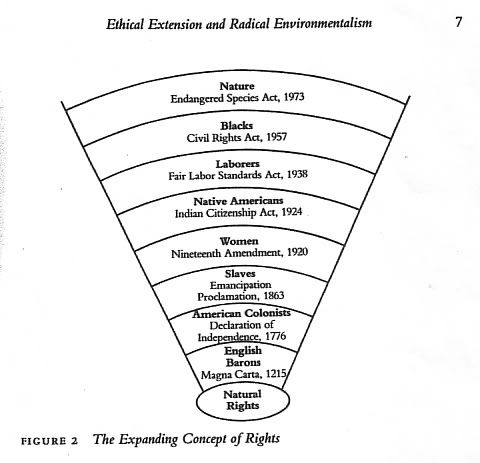
Despite my attraction to the moralistic, and my belief that our ethical purview
will inevitably expand, I must conclude that is necessary to distinguish between long-term aspiration and present policy. The
American Civil Rights Movement may be portrayed as a historical artifact in high school text books, but racial prejudice and bigotry are no more history than is the
Cold War. Our aims are ahead of our practice, and we should take care not to neglect incomplete cultural "mutations." Today being the anniversary of his death, take another listen to
John Lennon's "
Imagine." The words and images of artists are vital. Without them, our shared cultural imagination (or our
memes) would be starved, but we shouldn't ride the moral high horse if it means we won't reach our destination. This is the critical distinction between morality and ethics.
Progress - if loosely defined as our stumbling effort toward the betterment of humanity and the world we belong to - is best served by pragmatic rationalism and a conservative code of ethics. As my father stressed to me from a young age, good economics - literally translated, "management of the household" - begins with good ecology - "study of the household." A promising future awaits humanity if we are imaginative enough to forge our ethics from the moral, the aesthetic, the ecological, and the pragmatic.
Turning to
Bill Cronon's writing, as I so often do, and did when considering these ideas before:
"The choice we face is not to leave no marks – that is impossible – but rather to decide what kinds of marks we wish to leave."
So to Jason Scorse, and all ideologues: my heart is with you, but things simply aren't so clear as might like them to be.
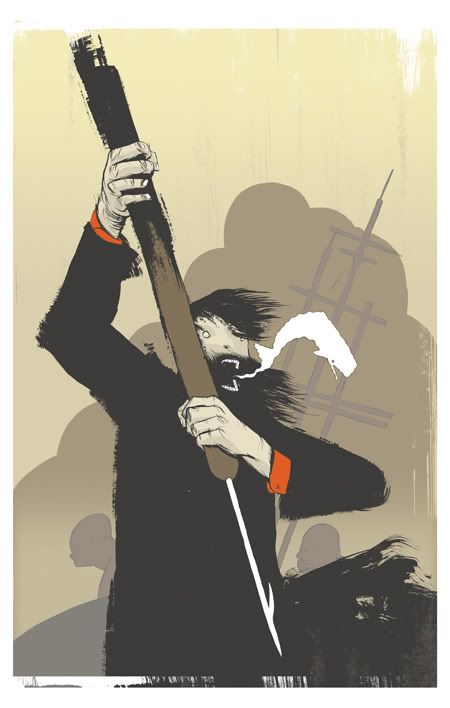
Image credits: Ahab illustration by
Sam Weber; ethics diagrams from Peter Joost's March 2005
New York Historical Society lecture; timeline diagram by
Hungry Hyaena(1) Franklin abandoned the diet eventually, as the smell of cooked seafoods, particularly fish, proved too much for his dietary resolve. No problem, though, as he was able to use reason to account for why fish were a viable exception!