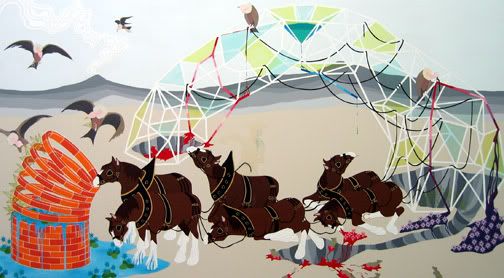
"The Endless Outpouring Of Support"
2008
Acrylic, ink and pencil on paper
57 7/8 x 70 7/8 inches framed
For a number of years, friends have recommended that I read Lewis Hyde's The Gift. I'm finally getting around to doing so and, just forty pages into the text, I see why friends thought the book would so appeal to me. Hyde picks apart the contemporary market, particularly as it relates to commerce in art objects and other creative "commodities." In the introduction, he writes,
"A work of art is a gift, not a commodity. [...] Every modern artist who has chosen to labor with a gift must sooner or later wonder how he or she is to survive in a society dominated by market exchange. And if the fruits of a gift are gifts themselves, how is the artist to nourish himself, spiritually as well as materially, in a age whose values are market values and whose commerce consists almost exclusively in the purchase and sale of commodities?Reading the last bit of the above excerpt, I couldn't help but think of my charitable sales model. The income that I receive from the sale of art objects I've produced is fundamentally no different from the tribe representative's "money for the children that God has given me." In this respect, it is not merely ethical, but also natural that some significant percentage of each sale be passed on, invested in turn in the good works of a non-profit organization or another conscientious individual.
Every culture offers its citizens an image of what it is to be a man or woman of substance. There have been times and places in which a person came into his or her social being through the dispersal of his gifts, the 'big man' or 'big woman' being the one through whom the most gifts flowed. The mythology of the market society reverses the picture: getting rather than giving is the mark of the substantial person, and the hero is 'self-possessed, 'self-made.' So long as these assumptions rule, a disquieting sense of triviality, of worthlessness even, will nag the man or woman who labors in the service of a gift and whose products are not adequately described as commodities.
[...]
A man in another tribe that [anthropologist] Wendy James has studied says, in speaking of the money he was given at the marriage of his daughter, that he will pass it on rather than spend it himself. Only, he puts it this way: 'If I receive money for the children that God has given me, I cannot eat it. I must give it to others.'"
Hyde points out that this pass-it-on approach is in keeping with the cycles of nature. Indeed, the words "ecology" and "economy" are etymologically connected for good reason. As I explained in an HH post in August of 2005,
"'Ecology' translates as 'study of the household' and 'economy' as 'management of the household.' Any good scientist (or thoughtful citizen, for that matter) should study the household before managing it. Thanks in no small part to my father's influence, I began to see many ecological issues as economic concerns (and vice versa). Given my environmentalist leanings, I suppose my [engagement] with economic theory was inevitable. It was also inevitable, or at least quite likely, that I would become disenchanted with our current boom-and-bust paradigm."Moreover, Hyde points out that "the language of gift exchange has procreation at its root. Generosity comes from genere (Old Latin: beget, produce), and the generations are its consequence, as are the gens, the clans." Indeed, by damming wealth in concentrated pools, the demon market of our capitalistic culture halts the cycle of generations. The natural flow stopped, dispossessed peoples are condemned to hunger for physical nourishment and the wealthy are condemned to hunger for nourishment of the soul.
As Hyde stresses, "what is given away feeds again and again, while what is kept feeds only once and leaves us hungry." Or, as my mom always puts it, "Love and live with an open hand."
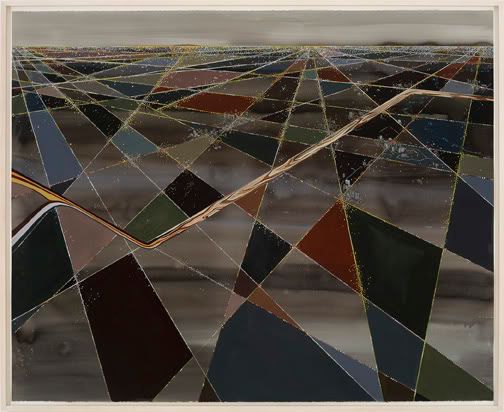
Image credit: Jason Middlebrook image ripped from the Sara Meltzer Gallery website