A duck, cooked rare and partially carved, sat on the oval serving platter in front of me. Underneath the bird, blood mingled with the yellow-white fatty oils released during the roasting. As I half listened to my parents' conversation, the two secretions danced a slow-motion
Rorschach ballet. I was intrigued, content to admire the interplay for what it was, the meeting of two immiscible liquids, when suddenly the interaction ceased abstraction.
There, under the dark stump of the drake
mallard's neck, the blood and oil limned a perfect silhouette...of a duck. I was rendered speechless.
This is more incredible than a moldy Wonderbread Elvis or some dust bunny Jesus!, I thought excitedly. The initial shock absorbed, I brought the minor miracle to the attention of my parents. They didn't share in my enthusiasm. My mother was disgusted - "Oh, for goodness sake!" - and my father, baffled - "Ummmmm." They resumed eating.
A few minutes later, the three of us discussed my need to drive to a friend's house to pick up my digital camera, forgotten there the night before, following a lengthy battle with some delicious
mulled wine. Thinking it likely that my friends - or their parents - would check out the pictures saved in the camera's memory, I winced. Along with some shots of their Christmas party - happy, mother-daughter poses - they would find some photographs of dead rat pups; not your standard Yuletide fare. (I had obtained the rat pups, already dead, to feed one of my snakes, but upon opening the cloth they were wrapped in, I found their arrangement curious and decided to treat the tiny rodents as a peaceful, rolling landscape; the pictures may or may not work their way into a painting.) I told my parents about the possibility of these photos being discovered. My father looked up from his plate. I swear I could almost read his mind:
Duck blood silhouettes...Dead rat pup portraiture....Duck blood silhouettes...Dead rat pup portraiture."You know," he finally said. "You seem to be fascinated by death."
"I am," I replied.
"I wonder where that comes from. For me, death is inevitable...so there's no reason to think about it. The end comes and that's that. Why waste time worrying about that which you can't control?"
"Alright, sure...but I don't
worry about death...and it isn't the end in my estimation. I don't mean that in a supernatural sense...just that when our bodies rot, our energy continues.
E=MC2. Nothing can be subtracted from the weave...
only reconstituted. That's exciting, and that's why I'm fascinated by death. It's nothing to be afraid of. It's release from one form...a changing of vessels and a loss of consciousness."
I paused, realizing this wasn't the whole truth. I also find death calming, even beautiful, when it is unencumbered by ceremony or histrionics. I didn't know how to explain such a notion, though, so I didn't continue.
"Hmmm....it seems you have a little
Latin in you," my father finally said.
Whatever you want to call it - morbid, macabre, melancholy - I am charmed by that which many folks find grotesque. In my case, though, this quality is certainly not a product of Latin blood; rather, I believe it is closely linked to
the region and climate of my childhood. It's difficult to grow up in a small, southern town and not become acquainted, even comfortable, with death and decay. The stereotypes are well established: cars resting on cinder blocks alongside occupied houses with rotting porches and peeling paint; toppled headstones, uncut grass, and strewn beer bottles in backyard cemeteries; butchered deer carcasses and full garbage bags dumped on the road berm; abandoned furniture and household appliances in the middle of the woods (how do they get there?); the derelict house with
kudzu, raccoons, and snakes in residence.
Many American scholars and authors have considered
the Southerner's cozy relationship with decline and decay, trying to better understand its genesis. Some folks suggest it is the product of a deep-seated, defeatist attitude, borne of the
Civil War - alternatively known as The War of Northern Aggression - while others feel it has more to do with the southern climate, an often oppressive blend of high humidity and heat. As with most anything, a combination of factors is responsible, but I believe that climate is the critical component. The
Southern Gothic literary tradition, for example, shares much in common with the
magic realism of
Mexico and
Central America.
Texans of
European ancestry may not celebrate
Dia De Los Muertos, but most of them appreciate it; the holiday finds even more advocates in the
bayous of
Louisiana and the
bald cypress swamps of
Arkansas. The "Latin blood" that my father referenced may, in fact, have little to do with blood. Dia De Los Muertos is of
Latin American origin, not
Spanish; its history is indigenous to the region, and the Spanish colonizers were horrified by the macabre ceremonies of the pagan natives. They did manage to force
Catholicism upon this indigenous population, but they could not replace the established rituals entirely.
Centuries later, those mores continue to inform the culture of the American South, Mexico, and Central America. Inhabitants are caricatured as moving more slowly than their northern neighbors - "laid back" on a good day, "lazy" on a bad - and caring a great deal less about progress and modernization, usually to a fault. Family and religion are central to daily life in these parts, and marriage and death captivate the Southern/Latin American imagination. Having grown up in the rural, American South, I view the
Northeastern (and
Midwestern), tight-lipped approach to blood-and-guts reality with suspicion - this despite my deep appreciation of
New England's landscape and culture. Returning to
Virginia's
Eastern Shore this
Christmas, I saw much that touched me and reminded me that, at heart, I remain relatively Southern, even though the accent and the religion were long ago discarded.
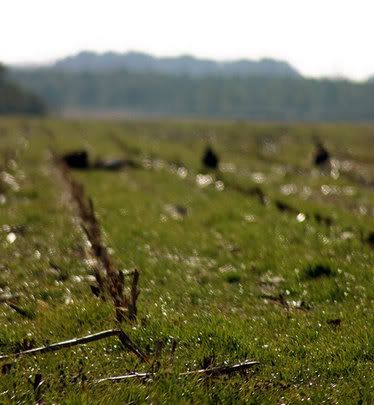 Photo credit:
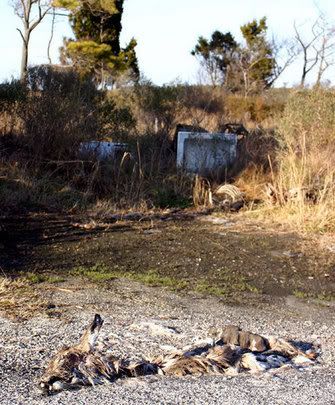
"Love Seat in Marsh, Bull's Landing, 2005," "Deer Carcass and Dryer, 2005," "Vultures on Deer Carcass, Burton's Shore, 2005," all photos, Christopher Reiger, 2005