Monday, September 18, 2006

Something in the AIR

"AIR is a public, social experiment in which people are invited to use Preemptive Media's portable air monitoring devices to explore their neighborhoods and urban environments for pollution and fossil fuel burning hotspots.

Participants or 'carriers' are able to see pollutant levels in their current locations, as well as simultaneously view measurements from the other AIR devices in the network. An on-board GPS unit and digital compass, combined with a database of known pollution sources such as power plants and heavy industries, allow carriers to see their distance from polluters as well. The AIR devices regularly transmit data to a central database allowing for real time data visualization on this website."
If you're based in or around New York City, I encourage you to participate in this terrific project. I just signed up myself, and I really hope that someone will pass along one of the devices. I'm eager to carry it back to my Queens stomping grounds where, so far, it appears no participants have headed.

Although the binocular sized device that Preemptive Media is distributing only measures carbon monoxide and nitrogen oxide levels, these gases are two of the fivemajor airborne pollutants listed by the Environmental Protection Agency. As such, they are regulated by the Clean Air Act - not to be confused with the dubious, industry-friendly Clean Skies Act of 2003 - along with ground-level ozone, particulate matter (or PM) and sulfur dioxide.

Most human-produced aerosol pollution - as opposed to particulate matter that occurs naturally - concentrates downwind of urban areas and major industries. The AIR initiative, then, will not be a fair assessment of the reach or magnitude of New York's aerosol influence, but the results will surely be of interest to anyone concerned about pollution and, more generally, global warming.

But the numbers aren't what I find so exciting about AIR. The greatest boon of this project is its appeal to a demographic that must become more invested in environmental and political issues. When air pollution or water quality measurements are made "hip" - I can envision an AIR advertising campaign riffing on the ubiquitous iPod posters and commercials - and accessible, an opportunity is provided for individual investigation of fields that most of us comprehend only in an abstract and limited way. In this case, the invisible world is made pertinent and, in turn, the individual made part of the greater organism.


Photo credit: both images ripped from the AIR website

Thursday, September 07, 2006

March of the Chaplinesque Lovebirds

Photobucket - Video and Image Hosting
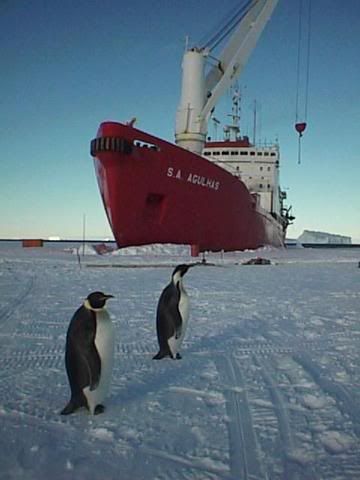
Made cautious by all the fuss surrounding Luc Jacquet's 2005 documentary, "March of the Penguins," I elected to avoid the film during its theatrical run. Even the assurances of my co-workers - "Oh, you'll absolutely love it! It's right up your alley since you're so into animals." - only served to strengthen my sanction. When a film generates excessive buzz, especially of a vaguely politicized variety - in this case, much ink was spilled debating the socially conservative subtext of the documentary - I prefer to wait out the media storm, to let the reviews fade from my mind before heading to the rental store.

And so, on a blustery, wet Saturday, over a year after the film's release, I scanned the shelves of Astoria Video Express and settled on the image of an Emperor penguin looking down at its hungry chick. I sighed, thought about it for a moment and decided that I'd waited long enough. I did want to the see the film, after all, and even the blurbs boldly printed on the DVD case, snippets I usually ignore as creative collage work on the part of the studio, further whet my appetite. "Astonishing!," proclaimed David Ansen in Newsweek. "Riveting!," promised Stephen Holden, of the New York Times. And so, that evening, as Ernesto soaked the Tri-State area, I popped in "March of the Penguins," turned up the volume on my home stereo, and prepared to be riveted, astonished, and generally engaged.

Encouragingly, the film opens with some stunning aerial photography of Antartica's otherworldly landscape. (In fact, the film work throughout "March of the Penguins" is exceptional and cinematographers Laurent Chalet and Jerome Maison have been justly lauded.)

But then, not two minutes in, the first sign of trouble: "Based Upon the Story by Luc Jacquet," the credits read. Wait. Isn't this a documentary? What "story" are the credits referring to? There is, after all, a significant difference between documentary and fiction, even fiction inspired by real events. Shortly thereafter, Morgan Freeman's dulcet voice begins to describe the harsh conditions at the bottom of the world. After hearing only a few lines of Freeman's narration, I realize this is a film best suited to children. Freeman's genial reading brings to mind the cliche of the old, patriarch storyteller. There isn't necessarily anything wrong with this, but Freeman's lilting delivery too often sounds condescending.

But these issues are forgivable, minor faults. If National Geographic and Jacquet can produce an intelligent nature documentary that engages young viewers by framing the penguins' annual journey as a children's epic, then so be it. The world needs more children interested in the well-being of other species and the health of ecosystems at large.

Unfortunately, "March of the Penguins" is not an intelligent story pitched at a young audience. Jacquet supplies Freeman with an appalling script, one that manages to patronize both viewers of the film and the bird it ostensibly celebrates. A minute or so into the narration, Freeman says, "So, in some ways, this is a story of survival, a tale of life over death, but it's more than that really. This is a story about love." Sentimental clap-trap of this stripe is a staple of Disney-style animal documentaries(1), but I am surprised to see National Geographic associated with it. Why must so much natural history writing, particularly film narration, reduce the wonders of the natural world to cartoon significance, clumsy or cute approximations of human behavior? Whatever their reasons, the team behind "March of the Penguins" feeds viewers a canned narrative, replete with emotive musical selections and conservative film editing, tricks and techniques not foreign to an editor of daytime television or Hollywood romances. If we were to transplant ourselves to Antarctica and, in person, observe the mating ritual of an Emperor penguin pair, would we find the vaguely violent frenzy romantic? Would we "see it" in slow-motion, accompanied by a soothing a New Age soundtrack? When the chicks take their first, tentative steps, would we giggle as they stumble about the ice and hear in our heads some sweet, doodling tune? Probably not. These actions aren't funny or romantic for the participants and, unedited, they would not likely be so for us. Why not honor the arduous, annual journey of Aptenodytes forsteri and the marvel of the chick's birth and maturation without attaching our own assumptions and moral framework?

Before I'm written off by some readers as one more proponent of cold, hard science, I should point out that I am no less guilty of anthropomorphizing animals than anyone else.(2) The attribution of human characteristics and emotions to other species is an altogether natural activity. What's more, it is an important, even vital one. Zoomorphism and animal-human relationships, often sexual, are central to the myths of many cultures and religions, and, for time immemorial, we've understood the world via other animals just as we understand those species through ourselves. Lest we forget, we too are animals, and the words we use to describe our more abstract and profound emotions - love and grief, for example - are merely qualifications of deeply rooted drives, behavior observed in different measure throughout the animal kingdom. In other words, the temporary bond experienced by a mated Emperor penguin pair may not be entirely irrelevant to human marriage (or any other romantic union), but we should take care not to confuse the two. It's well and good to talk of love when considering a human couple - if not always accurate - but to project this word, our word, and all that we associate with it, onto another species is problematic. Firstly, it confuses viewers who know no better. Secondly, doing so is no different than projecting the assumptions and practices of one culture onto another. In short, it's ignorant, and reflects a laziness or a woeful lack of curiosity.

Again, I'm not advocating a prohibition of anthropomorphism. Disney - and other studios, particularly those specializing in animated features - has made a fortune appealing to our desire to anthropomorphize, both for laughs and pathos. Clearly, most people appreciate these sentimental takes and, although I feel such fictions more often reduce than celebrate, I don't want to get sidetracked attacking Disney. Disney doesn't claim that "Bambi" is an accurate portrayal of white-tailed deer (Odocoileus virginianus) behavior, nor do they argue that "The Lion King" provides a lesson in lion (Panthera leo) pride dynamics. Luc Jacquet, however, does claim that Emperor penguins are in love.

Curiously, when asked about the "family values" subtext of the film, the director balked, telling the San Diego Union Tribune that he intended no such message and that "it [is] intellectually dishonest to impose this viewpoint on something that's part of nature....You have to let penguins be penguins and humans be humans." I agree completely, but "March of the Penguins," whatever its stance on family values and gay marriage, does not "let penguins be penguins." In fact, the French version of the film - the original script Jacquet produced - goes so far as to include "dubbed" voices for different penguin characters. Charles Berling, Romane Bohringer, and Jules Sitruk speak as if they are father penguin, mother penguin, and chick. Instead of attaching Morgan Freeman's soothing narration about "family time" to a shot of a mated pair huddled about a young chick, Jacquet prefers to present the adult penguins whispering sweet nothings to one another and cooing approvingly of the product of their "lovemaking." That certainly isn't my idea of letting penguins be penguins!

As I sat through the closing credits of "March of the Penguins," I found myself recalling the emotional reaction I had to Werner Herzog's "Grizzly Man," a powerful film that wrestles with man's complicated relationship to other species and our own species' coping mechanisms. "Grizzly Man" was overlooked by the Academy Awards - indeed, the documentary was not even nominated - the same year "March of the Penguins" was awarded the golden statue. In fact, in terms of revenue, the French production is the second most popular documentary ever made. But I suppose I shouldn't be entirely surprised by the Academy's choice or any of the excessive praise lauded on Jacquet's "documentary." Most people prefer animals as cartoon proxies and are uncomfortable understanding them as flesh-and-blood relatives. Luc Jacquet threw out the slop - he is guilty of making a weak, if pretty film - but the rest of us marched to the trough to feed.

Photo credit: image ripped from the homepage of South African scientist, Neil Malan

(1) The most notable of these series, and the one most often subjected to academic consideration, is Disney's True-Life Adventure Series, which aired in the late 1940s.

(2) If you were a fly on the wall of my studio or apartment, you would witness lengthy conversations - note the word choice, as though they are two-sided - between my cat, Mister Misi, and myself. The same is true for my three snakes, Zuri, Sefu, and Kali. Given the rudimentary brain of a snake, the pythons certainly aren't engaged in any way with my rambling, but what matters is my involvement with them and my interpretation of their movements. The exchange is only as valuable as I make it, the communication abstract at best, but not absent. The relationship between pets and caretakers is largely defined by human projection and is one of many examples of healthy anthropomorphism. Lines can be crossed, however. When humans begin to clothe their dogs, for example, they cease relating to the animal as a fundamentally different creature and, in my opinion, do it a great disrespect. Each to his or her own, I suppose.

Tuesday, September 05, 2006

A Few Opening/Exhibition Announcements

September heralds more than a few openings and other art events in New York. There are hundreds of opportunities to see art while mingling with the beautiful (and not so beautiful) people during the fall kick off of another art season. This time 'round, my paintings and drawings are included in the mix.

If you find yourself in this neck of the woods and you're looking to see some art - even if you're just in the mood for a fine Dixie cup of gallery wine - then join me at one of the evening events detailed below. If, on the other hand, you prefer to see art sans socializing - I appreciate that sentiment - the solo show will be up through October 15th.

+++++

Photobucket - Video and Image Hosting
Christopher Reiger
"a painfully ordinary bliss"
2006
Watercolor, gouache, sumi ink and marker on stretched Arches paper
25 x 20 inches

Friday, September 8th
"Mongrel Truth," my first solo show, opens at AG Gallery, in Williamsburg, Brooklyn. I'm very pleased with several of the paintings included, as well as a number of the small drawings and washes. If you miss the opening on the 8th, there is an encore on Friday, September 15th. I'll be on hand both nights, all dolled up.

"Mongrel Truth"
Christopher Reiger: Solo Exhibition

September 8, 2006 - October 15, 2006
Opening Reception: 9/8, Friday, 7-10pm
Encore Reception: 9/15, Friday, 7-10pm

Gallery Hours: Sun. ‐ Tue. 12-8pm, Wed.-Sat. 12-10pm
For further information, please contact the gallery at 718-599-3044 or visit the website

Photobucket - Video and Image Hosting
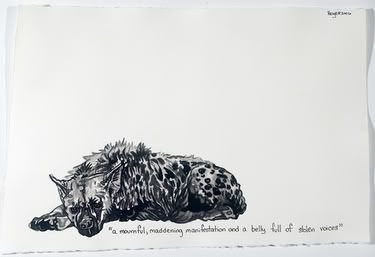
Christopher Reiger
"Crocuta crocuta (unknown, saffron-colored wild animal)"
2006
Sumi ink on Arches paper
9 1/8 x 14 inches

+++++


Wednesday, September 13th
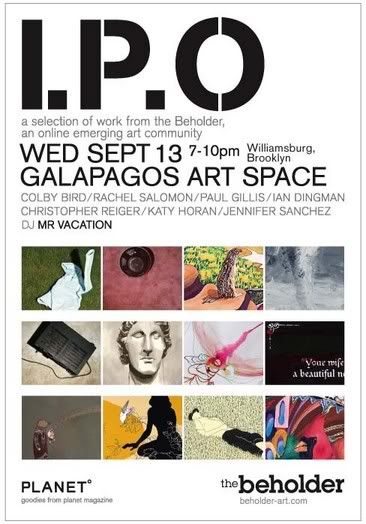
The Beholder, an online art gallery based in San Francisco, is dedicated to offering art to people who are intimidated by (or just unfamiliar with) the gallery system/art market. I think their mission is important and I was therefore delighted to join their stable of artists a few months back.

On Wednesday, September 13th, The Beholder is landing in Williamsburg, Brooklyn, at Galapagos Art Space. Two of my paintings will be on display, along with works by a number of other talented Beholder artists.

On a related note, I'm the current artist feature on The Beholder site. Check out this link for an interview and toothy grin.

Monday, August 21, 2006

Although I second Bill Gusky's observation that these sorts of psychology "quizzes" are little more than fun time wasters, I did enjoy this one. Somehow, it's nice to know that I'm a "spiritual" person, if only because I so shrink and hiss at the mere mention of the modifier.
You scored as Cultural Creative. Cultural Creatives are probably the newest group to enter this realm. You are a modern thinker who tends to shy away from organized religion but still feels as if there is something greater than ourselves. You are very spiritual, even if you are not religious. Life has a meaning outside of the rational.

Cultural Creative

94%

Postmodernist

75%

Romanticist

56%

Idealist

50%

Modernist

44%

Fundamentalist

38%

Materialist

38%

Existentialist

38%

What is Your World View?
created with QuizFarm.com

Tuesday, August 15, 2006


Hungry Hyaena updates aren't appearing regularly of late. This lull in posting can be attributed, in part, to my renewed efforts in the studio - preparation for September shows - but I've also found myself with little to say or, at least, little desire to say anything.

As I've observed before, my more productive painting periods are usually marked by a turn from prose to poetry. As I drift into the more abstract, emotional medium, I also become relatively inarticulate. In this mode, I more closely resemble the hackneyed artist stereotype, a dreamy, emotionally guided beast.

Perhaps I'm more sensitive, too. In fact, I fear I'm a little afraid. I'm afraid of squandered potential, of what a forgotten writer once described as "the long, melancholy roar" that is a life devoid of hope. I'm not afraid for myself, really; I've been blessed with a steady disposition and the ability to adapt, happily enough, to almost any circumstance. I'm afraid for us, the global populace. What incentive do we have to strive for betterment if we lack faith and hope, which are inextricably bound to one another?

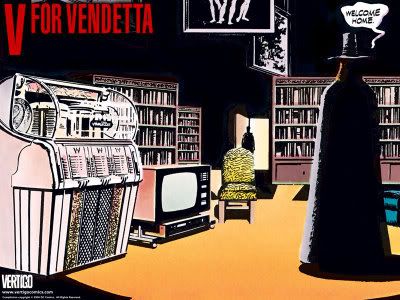
In Cat Power's lovely cover of the Velvet Underground song, "I Found A Reason," she sings, "Oh, I do believe in all the things you say. What comes is better than what came before." The song is included in the Wachowski's brothers' recent movie, "V For Vendetta." Hunched over his jukebox, listening to the song, the film's protagonist, V, a silver-tongued, impassioned terrorist (cough, freedom fighter) who lives alone in an underground bunker cum library of antiquities, comments that he has listened through his music collection hundreds of times, but has never danced to it. This seemingly straightforward observation betrays V's waning faith in the moral superiority of his cause.(1) It also indicates how much life experience V has sacrificed to pursue his ostensibly noble, if murderous ambition. An idea remains just that, a notion, until it is made manifest through action. Similarly, listening to music is merely appreciation, an intellectual activity. To fully experience the songs, V will need to move with the music.

The filmmakers' choice of "I Found A Reason" interests me. The lyrics suggest that a lover has provided the speaker/singer with a reason to go on and, indeed, the romantic subplot of "V For Vendetta" echoes this theme, but the title of the song could just as easily be "I Found Reason." Reason itself represents a sort of intellectual romance; she is the bedmate of most idealism and revolution. Humanity has repeatedly emerged from dark and troubled times by placing faith in Enlightenment values, then striving to implement them. Reason, in essence, is hope which is, as I said above, bound to faith. This is why so many religious fundamentalists shrink from science and why so many moral, rational idealists - Galileo, Spinoza and their ilk - are excommunicated or persecuted. The moral and ethical considerations are relevant, to be sure, but modern man's faith in progress is viewed as competing with his faith in God (even though the two are not mutually exclusive). Through reason, we gather the conviction to believe that what comes can be better than what came before.

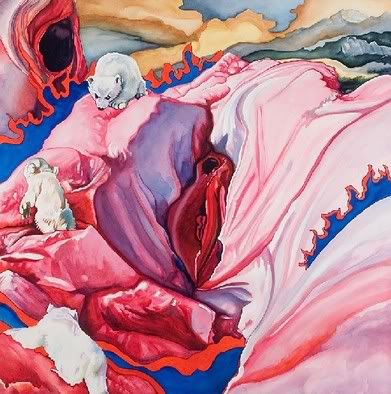
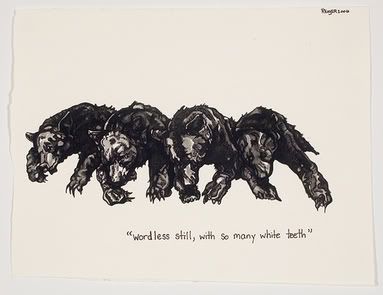
As my own paintings, themselves responses to our curious, unsettling times, turn more to magic realism, to the realm between natural and supernatural, I ask myself, if we're to right the myriad wrongs of our day, should we not be turning in the other direction? There is, of course, no simple answer...certainly not a satisfying one, anyway. In the meantime, I'll continue to turn over the issue in my work. I've included images of two recent pieces. The painting, "This Now, Like The Beginning, Again And Again," is currently on display in Cleveland, Ohio, at exit (a gallery space). It will also be included in my solo show, "Mongrel Truth," at AG Gallery next month. This show will feature a number of drawings, too, one of which is pictured here.

Photobucket - Video and Image Hosting
Christopher Reiger
"this now, like the beginning, again and again"
2006
Watercolor, gouache and marker on stretched Arches paper
25 x 25 inches


Photobucket - Video and Image Hosting
Christopher Reiger
"Ursus americanus (American bear)"
2006
Sumi ink on Arches paper
7 1/4 x 9 1/2 inches


I hope everyone is doing well and perhaps, sometime soon, I'll enter again into a mode where writing is more central to my practice.

(1) The film manages to raise some pertinent questions about progress and morality despite the Wachowskis' stubborn devotion to a red pill-blue pill, good guy-bad guy approach.

Image credit: "V For Vendetta" image ripped from DC Comics website

Friday, July 28, 2006

Deborah Simon

A month ago, the artist Deborah Simon and I wandered through the American Museum of Natural History. We both adore the museum and were excited to be there. After admiring the impressive dioramas in the Hall of North American Mammals, we rounded a corner and found ourselves in the Hall of Northwest Coast Indians. Though by no means dismissive of anthropology, Deborah and I share a bias for all things zoological, and our pace quickened accordingly. We paused, though, to admire a group of striking ceremonial masks suspended in a vitrine. With a smile, Deborah remarked, “I’m almost embarrassed to admit it, but I’m most attracted to the animal masks.”

As regular readers know, I've been writing profiles of emerging artists for the now defunct (or perhaps hibernating) ezine, Scrawled. The piece that follows, an essay about Deborah Simon's paintings, was scheduled to run in Scrawled's June 2006 issue, but the publication never materialized.

+++++


Deborah Simon
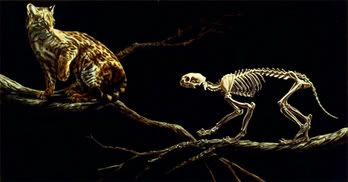
"Memento mori: Ocelot and ocelot skeleton"
2001
Oil on wood
36 x 68 inches


“If I had to tell what the world is for me
I would take a hamster or a hedgehog or a mole
And place him in a theater seat one evening
And, bringing my ear close to his humid snout,
Would listen to what he says about the spotlights,
Sounds of the music, and movements of the dance.”
-Czeslaw Milosz


Reading Milosz's lovely poem, I picture the poet hunched over, head cocked so as to position his ear close to a confused, sausage-shaped insectivore. The man concentrates on the light, rapid breathing and the occasional scritch of the mole’s long claws on the seat’s velvet lining. The little burrower tentatively senses its surroundings but remains totally unprepared – and unable - to describe the auditorium. Here, in so vast a space, it is terrified. It would prefer to be elsewhere, digging in substrate for an earthworm or a tasty grub.

But most readers of the above poem will imagine a very different mole, a chatty, colorful fellow wearing soda bottle spectacles who sits upright in the theater seat, his hands just achieving the armrests. In honor of his famous Disney relative, we might call this cartoon caricature Mickey Mole.

The anthropomorphized mole is the more popular of the two. Unfortunately, the Mickey Mole rendering undermines Milosz’s point. The poem is moving only if the poet relates to the animal as exactly that, an animal. He must overcome the temptation to project human qualities onto the creature. Only diligent observation of the “real” organism, rather than the caricature, will equip the poet “to tell what the world is for” him. Careful “listening” to the displaced animal on the theater seat reminds the poet that he, too, is animal, representative of just one species among many. Thus, the “essential conditions of life”(1) are recognized: human nature is nature.

But today we live in an age of mediated interaction. It is increasingly difficult to perceive a mole as a mole. The world’s rural population is dwindling and the urban experience of wilderness and wildlife revolves around television, animated features, photographs published in National Geographic, and the bars and reinforced plexi-glass of zoo enclosures. In his 1980 essay, “Why Look At Animals?,” John Berger critiqued this contemporary relationship (or lack thereof), focusing particularly on the “imperfectly-met gaze.” Just as servants were once prohibited from making eye contact with aristocratic employers, so too is meaningful ocular exchange between animal and human avoided. Animals are not aware of this prohibition. As a result, it is the supposedly superior party that must ignore, pillory or avoid their gaze. Berger argues that humans possess animals by visual means; we look at them, but do not allow the animal to look back “across ignorance and fear.” The human peering through a viewfinder objectifies the animal, reducing it to an icon.(2)

Zoos make this objectification more explicit; visitors feel superior to the caged creatures, often literally looking down on them. In both examples, the scalae naturae is made manifest; man is granted dominion over the beasts. Berger writes, “The fact that [the animals] can observe us has lost all significance. They are the objects of our ever-extending knowledge. What we know about them is an index of our power, and thus an index of what separates us from them.”(3)

But what of painting? Animals are central to the work of innumerable contemporary artists(4), but the majority of these paintings betray an indifference to natural history and the corporeal nature of the animal represented. The otters, bears and tigers that populate these pictures are crudely rendered in the favored style of the day – broad, slapdash brush strokes and bold, electric color – and they are removed from their natural habitat or, if not, their habitat is turned into a world of flat, cartoon significance. These are not animals, but shallow proxies more closely related to stuffed toys and Saturday morning cartoons. As such, they are given license to look back at the viewer; their fiction has made them impotent.

Wildlife art, a more "realistic" - if sometimes naïve and much maligned - genre, is as popular today as it was a century ago. Susan Orlean wrote that to be good at taxidermy you “have to be a little bit of a zoology nerd” and “you have to love animals.”(5) The same requisites could be applied to wildlife art. The best artists of this kind celebrate the animal through naturalistic depiction.(6) Though technical virtuosity and compositional sensibility varies greatly, all wildlife painting is in the business of illustrating reality and, in doing so, of honoring the animal pictured. Curiously, very little wildlife art depicts an animal (or animals) making eye contact with the viewer.(7) As with television wildlife documentary and magazine photographs, the gaze remains one-sided; even in admiration, man possesses the animal.


Deborah Simon
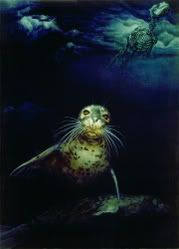
"Phoca vitulina: Harbor seals under pack ice"
2003
Oil on wood
66 x 48 inches


Deborah Simon claims she “has no interest in traditional wildlife painting.” To be sure, her paintings and sculptures can not be fairly classified as wildlife art, for reasons I’ll explain in a moment, but she does share the desire of wildlife artists to present the animal as dignified and real. The animals she paints are not anthropomorphized; they exist on their own terms and the viewer has no choice but to relate to them as such. Simon’s work is distinguished, however, by the met gaze, the completed ocular exchange John Berger eulogized in “Why Look At Animals?”.

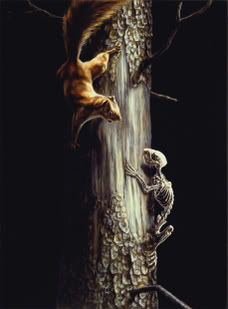
In Simon's Memento Mori series, animals either look directly at the viewer, as in “Enhydra lutris: Sea Otter Raft” and “Phoca vitulina: Harbor Seals Under Pack Ice,” or confront their own, skeletal visage, as in “Memento mori: Ocelot and ocelot skeleton” In both cases, the potency of the visual exchange is restored. Gone is "Mr. Otter," the cute and cuddly companion. Present, instead, is the powerful and curious Enhydra lutris, consumer of crabs, fish and molluscs. To lock eyes with this sea otter is to possess the animal, but also to be possessed. This two-way gaze allows for the erasure of both individual and special (as in "species") autonomy. Furthermore, the skeletal apparitions that surround the painted otter are reminders of its mortality and, in turn, of our own. The exchange provides a one-two punch. “You, too, are animal," the paintings say. "You, like me, will die.”


Deborah Simon
"Enhydra lutris: Sea Otter Raft"
2002
Oil on wood
35 x 48 inches


Were we to actually have this encounter with a sea otter, in the cold, coastal waters of the northern Pacific, it would be brief. For a moment we lock eyes with the animal and stare transfixed. Then, abruptly, the otter returns his attention to devouring the abalone grasped in his dexterous paws. Because the eye contact is fleeting, its significance is more likely recognized by those of us who already question the scalae naturae. Simon’s painting, by contrast, grants the viewer no release; both the otter and its skeletal counterparts stare us down, unrelentingly. (“One of us. One of us.") Even Berger’s urbanite, that lover of Disney, is left with no recourse; he must confront the fragility of self and see in himself the “other.” What Simon’s work accomplishes, then, is rare and wonderful. In celebrating other species, she humanizes our own.


“Tired from understanding
life, the animals approach man
to be mystified.”

-from “3 Poems,” by Les Murray


Deborah Simon
Memento Mori: Red Squirrel and Skeleton"
2001
Oil on wood
31 x 23 inches


+++++

(1) John Dewey, “The Live Creature,” Art As Experience, 1934

(2) “That’s why a couple of weeks out in Nature doesn’t make it anymore…you will virtualize everything you encounter anyway, all by yourself. You won’t see wolves, you’ll see ‘wolves.’ You’ll be murmuring to yourself, at some level, ‘Wow, look, a real wolf, not in a cage, not on TV, I can’t believe it.’ That’s right, you can’t. Natural things have become their own icons.”
-Thomas de Zengotita, “The Numbing of the American Mind,” Harper’s Magazine, April 2002

(3) John Berger, “Why Look At Animals?”, About Looking, 1980

(4) Contemporary artworks concerned with ecology, natural history, and zoology are, more often than not, American in origin and, if not, they are almost always Western. There are many different arguments as to why this is so, but the answer, I feel, is bound to the unique relationship early Americans – and I’m thinking of both Native Americans and the European settlers – had with the expansive wilderness around them. The concept of “wilderness” is borne of Romanticism and colonialism and, what's more, is limited to those countries/regions with vast, undeveloped tracts: North America, Australia, Africa, eastern Russia. As much as I embrace it myself, wilderness is a Romantic, fraught ideal, one equally capable of protecting and harming the species that live away from human settlement. Increasingly, this Romantic idealization of the "wild" is spreading into the East, via China and Indonesia, but the concept there remains an introduced one.

(5) Susan Orlean, “Lifelike”, The New Yorker

(6) Walton Ford, Alexis Rockman and their ilk are not of this camp, although some art world cognoscenti may disagree. This isn't to say that Ford and Rockman aren't deeply invested in their subject matter (wildlife, natural history, ecology), but rather that their work is as grounded in satire and critique as it is in celebration and admiration.

(7) When eye contact is made, the artist is often painting what I'll call the “dramatic encounter.” For example, an angry bull African elephant (Loxodonta africana) charging the viewer or a Great horned owl (Bubo virginianus) interrupted mid-meal.

Monday, July 24, 2006

Gallery Report, 07/19/2006

It's never bad for an artist to have a lot on his plate, but for a compulsive planner like myself, a mess of deadlines and events can become rather daunting. To cope with the commitments and the promises, I a) make myself scarce on the social scene and b) make lots of lists. This past Wednesday I headed off to Chelsea with a lineup of shows in hand. I usually prefer to snake east and west through the gallery district, wandering in and out of galleries at whatever pace I feel appropriate. Wednesday, however, more closely resembled a surgical strike; there could be no distraction, no collateral damage. I started at 28th Street and made my way south, hitting only the thirteen spaces on the docket, narrowed down from twenty-seven shows of possible interest. It was laughable - I couldn't help but chuckle at myself as I hustled down the sidewalk, all business-like - but necessary. I had alloted only two and a half hours for art contemplation and it was tough enough to fit in the thirteen shows.

I must admit to some rubber-necking. It proved impossible to walk into a gallery building without peeking into *gasp* unlisted spaces. Whether reacting to works included in the thirteen targeted shows or the incidental pop-ins, one question kept cropping up: What's with all the "lazy" art? Many, if not most, of the paintings I viewed included self-consciously crude mark-making and muddy washes. Much of the sculpture appeared physically weak and haphazardly fashioned, in some cases already showing signs of damage. The videos were rough-hewn collages, not markedly distinct from the toss-off Flash sketches precocious teens make and upload onto YouTube. Have we reached a point where artists feel the need to highlight their existential doubt by sabotaging their technique, or is this instead indicative of a real decline in craft and an increase in carelessness? Are young artists responding to fleeting celebrity and the culture of expected obsolescence by making work that appears temporal or even disposable, or are they just more humble than their predecessors? The reasons are surely many, but whatever the justification, a lot of what I saw looked plain shoddy.

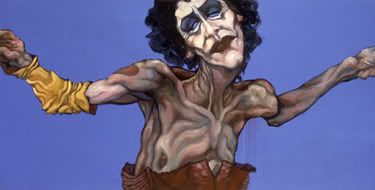
At the other end of spectrum are those young artists who have embraced technique, but have few, if any, good ideas. Though not as common as their slacker counterparts, they show in good number. Chad Marshall's show of large oil paintings at Priska C. Juschka Fine Art is representative of this group. To some extent, I admire Marshall's painting, but his grotesque, angst-ridden figures (presented on backgrounds of flat color, no less) remind me of the sort of thoughtless, fashion advertisement inspired figure painting so many of us produced when we were starting undergrad. This critique is harsh - perhaps too much so - but my vitriol is the product of my feeling the artist capable of much better work. There is promise in these works, particularly in Marshall's attractive works on paper.
Photobucket - Video and Image Hosting
Chad Marshall
"Painting #6"
2002
Oil and flashe on MDF
24 x 48 inches


Marshall's was one of the few solo efforts I saw visited on Wednesday. Summer, after all, is the season of the group show. With one or two exceptions, I wasn't impressed with the curatorial thrust of the shows I visited and I've been skeptical of most every show description I've see online or in print. This is not to suggest that the included artwork is poor, only that the themes and groupings seem consistently arbitrary, if not patently absurd and unnecessary.

Case in point: "Tabletop," the exhibition on display at Josee Bienvenu Gallery. All works in the show, some of which are very nice, are placed on low tables, under glass. The press release justifies the unusual presentation in two ways. Firstly, we should all take a load off. "The world deserves a break. A table and chair help resist the summer heat in Chelsea...an invitation to slow down and take a seat." Fair enough, I suppose, but I'm not sold. Secondly, the table top approach allows viewers to experience the artwork as the creators do. "...a show of horizontal drawings, the negation of the tablecloth. Passing from table to table, one experiences the intimate relationship between the paper and the artist as the works are seen from the perspective they were made at." OK, even if this is true for the majority of the included artists - many produced work specifically for "Tabletop" - why display the work in this way? It does nothing to enhance the drawings and paintings. Why not present the same group of artists without the "clever" twist? As is, I feel like a Hollywood producer hearing a gimmicky pitch. It stinks. Let the pictures do the talking, not some half-baked curatorial umbrella.

Over at Galeria Ramis Barquet, the curators dubbed their ill-considered effort "Better Than Sex, Better Than Disneyland." Explaining their choice of title, the press release reads, "The wide gamma of works in [the exhibition] recreate the pleasure that the artists attain from completing a simple musical or drawing exercise, and therefore elicit an immediate response from the viewer." What's with the psycho-sexual silliness? Doesn't
all artwork "elicit an immediate response from the viewer," even if it's only a bored shrug?

Although I thought little of the exhibition overall, I was drawn to the watercolors of Alejandra Alarcon, a Bolivian born artist living in Mexico City. Her work - sexualized, bloody riffs on the "Little Red Riding Hood" story - fit the show's theme better than that of her counterparts. Two pieces were particularly captivating. I would have liked to include images of "Caperucita con abrigo de piel, sangre y barriga" ("Little Red Riding Hood with fur coat, blood and belly") and
"Capa con colas de lobo," ("Cape with wolf tails") but, unfortunately, I could not locate these works online.

+++++

Sara Meltzer: With discouraging daily news from the Middle East and unusual, monsoon-like conditions affecting the tri-state area, I find myself using two of my father's favorite words, bleak and melancholy, more frequently as of late. Standing outside a bar on Tuesday night, three sheets to the wind, a friend demanded to know why educated Americans aren't up in arms, actively engaging policy and community. A passerby heard her
query and responded, lifting his arms above his head as he laughed, "See. I am up in arms. I'm up in arms!" My friend looked back at me, exasperated. "Seriously. Why aren't we?"

The press release for "Prevailing Climate," the summer group show at Sara Meltzer Gallery, tells visitors that the show "examines the tragedy, fear and distrust that connects our history, politics, consumerism and mass media." For the most part, curators Rachel Gugelberger and Jeffrey Walkowiak succeed, although the exhibition provokes in me the same resigned, baffled shrug my friend's drunken question did. It's too easy to attribute western apathy to the decline of the American Empire - although the liberal rhetoricians' parallels between the United States and Rome are apt - and it's undeniably selfish to ignore the troubling circumstances altogether. Most of us toil away somewhere in the middle, muttering about the bleak outlook, riding bikes in symbolic protest, writing letters to politicians, but generally feeling as though things are out of our hands. Why get up in arms if there is nothing to lift, or if the opposition is a phantom?

Photobucket - Video and Image Hosting
Karina Aguilera Skvirsky
"Blowback"
2005
DVD
Running time: 4:30 minutes
Edition 1 of 5


An answer of sorts can be found in Karina Aguilera Skvirsky's video, "Blowback." Although the piece can be filed under the Flash collage aesthetic I grumble about above, Skvirsky manages to do a lot with very little. The hypnotic video is four and a half minutes long, but it seems much shorter (always a good sign). On screen, figures appear in brief, clipped loops, taking a few steps toward you before jerking back to what appears to be their original position. Almost
imperceptibly, though, these figures approach, in a cut-and-paste version of "for every three steps forward, two steps back." As the figures near, the landscape grows darker and more menacing, an effect complimented by the accompanying music. Eventually, the background is blocked from view by the now pixelated, fractured figures. They are upon us. The soundtrack bangs and grates. We've been consumed, assimilated, obliterated. To black. The video starts over...and again, I'm hypnotized.

"Blowback" serves as a wake-up call of sorts, a plea for all to participate rather than merely observe. If we do nothing - if we just watch the machinations from our couches - we will all fall victim to the darkening tide. As Thomas Jefferson famously said, "Eternal vigilance is the price of freedom." And apathy is a form of bondage.

I later searched for "Blowback" on YouTube. Unfortunately, I couldn't find it. I wish more video artists would take advantage of the incredible distribution resource presented by the web. The DVD of "Blowback" may or may not sell to some wealthy collector who can gamble on an investment, but what of the thousands of media hungry minds clicking through YouTube every day? Why not turn video art into viral video?
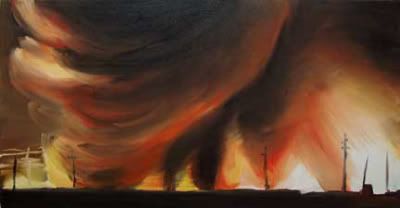
Photobucket - Video and Image Hosting
Joy Garnett
"Plume 2 (Strange Weather series)"
2005
Oil on canvas
26 x 46 inches


The rest of "Prevailing Climate" is relatively strong. Works by Joan Linder, Joy Garnett, Jason Middlebrook and Anna von Mertens standout. Attractive - indeed, almost decorative - the two oil paintings included by Garnett are deceptive. Her subject matter, garnered from online news media, is associated with warfare, be it images of prisoners, war machines, military officers or torn landscapes. The two pieces included in "Prevailing Climate" belong to this last group. Calling to mind work by the Romantic painters, Turner and Friedrich, Garnett's burning, red-and-orange vistas are as disturbing as they are beautiful. In this sense, they are sublime, in the traditional sense, inspiring awe and a little fear. Looking at the work, particularly the smaller of the two, "Plume 2 (Strange Weather Series)," I find myself wondering what effect the super abundance of such images in our media has on our moral response. Have we, as a society, learned to cope by abstracting these violent, troubling scenes, ignoring the documented wrongs by treating them as we do a friend's postcard from abroad?
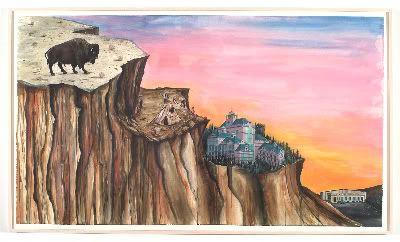
Photobucket - Video and Image Hosting
Jason Middlebrook
"How the West Was Won"
2004
mixed media on paper
46 X 80 inches


Jason Middlebrook's painting, "How the West Was Won," is sprawling, raw and ambitious, if a little obvious. The gradual descent in elevation, from the bison pictured on the tall plateau to the convenience store in the lower-right of the painting, needs no explanation, but Middlebrook's strong sense of color carries the painting. Although I liked the piece, I feel much of Middlebrook's work is superior.

+++++

Morgan Lehman: "Flight Plan" initially feels of a piece - due to the thoughtful presentation, the viewer flows comfortably from work to work in this attractive gallery space - but the exhibition never takes off as a cohesive whole. Happily, there are enough individual successes to satisfy. The wording of the press release suggests participating artists supplied the gallery with work specifically produced for the show: "Each artist brings his/her own interpretation to the show's name sake, with some literally addressing the concept of flight, while others explore the metaphoric possibilities of the subject." Jeffrey Milstein is representative of the literal camp; he contributes four handsome, straightforward photographs of airplanes seen from below. Two pleasing ink and watercolor works by painter Franklin Evans, on the other hand, are only loosely connected to the exhibition's theme. To make pegs fit, I'll call these colorful, abstract works "flights of fancy." They suggest a process comprised of sequential reactions to what came before; constructed in this episodic manner, they are a painter's picaresque.
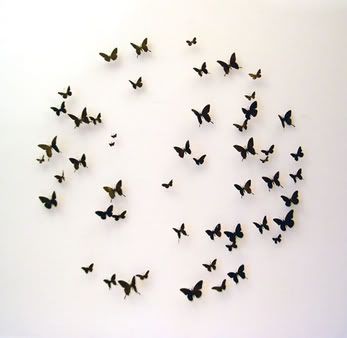
Photobucket - Video and Image Hosting
Paul Villinski
"Departure"
2006
Found aluminum, wire, lead, soot
48 inch diameter, 52 elements, Variable edition of 3


I was most intrigued by the work of Amy Ross and Paul Villinski. Both artists include pieces that border on the precious. Villinski's "Departure," a circular grouping of 52 delicate, wall-mounted butterflies, risks being dismissed as a one-note, kitsch celebration of reincarnation or transformation. But spend a few moments with the piece and you just might find yourself asking what's wrong with a little peace, love and understanding. Villinski cuts butterflies of different shapes and sizes out of flattened, aluminum beer cans and paints these recyclable insects in an uneven black wash. A close look reveals that Villinski's favored brands - or at least the cans he collects most often - are Coors Light and Tecate. I'm only too happy to see these watered-down beers turned into art that shamelessly embraces simple, beautiful gestures.
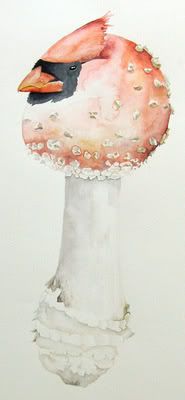
Photobucket - Video and Image Hosting
Amy Ross
"Birdshroom #22"
2006
Watercolor on paper
20 x 17 inches


Amy Ross creates delicate watercolors of hybrid bird-mushrooms, all of which come precariously close to cute irrelevance. In fact, upon first consideration, I responded negatively, categorizing Ross as an artist who wants to produce naturalistic images, but feels compelled to morph and tweak her subjects just enough to be considered distinct from - and presumably superior to - traditional natural history illustration. Who knows? This might be the case...but I doubt it. Admiring "Amanita Tanager #2" and "Stropharia verdin," the strongest of the pieces, I accepted the work at face value; these are well-crafted, lovely renderings of species one might discover in Wonderland. They aren't the most inspired paintings I saw on Wednesday, but they possess a sincere integrity largely absent in the work of young, contemporary artists.

Note: Despite the help of Morgan Lehman staff and some determined Internet trawling, I can't supply an image of either of the two Ross paintings mentioned above. Instead, I've pictured another of the works on display in "Flight Plan."

+++++

RARE: I'm not sure how I feel about galleries including the curator's name in the exhibition title. "Diamonds Cut Diamonds: Curated by Johnston Foster," the group sculpture show at RARE, is the first example I've come across, and I'm tempted to call the choice arrogant, but questions about the nature of the curator's role generate a lot of ink these days - artist or academic; guiding light or cataloger - and, to some extent, it seems
sensible to marquee the name. (What's more, Foster is a working artist who exhibits at RARE. The gallery may just be taking advantage of an opportunity to further promote one of it's own.)

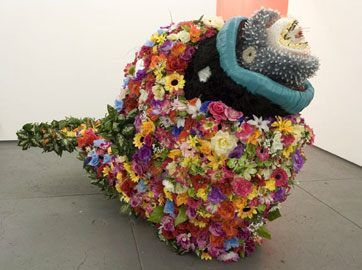
Foster has assembled a group of five emerging sculptors who all use "mundane materials." Kate Horne's animated horse heads, fashioned out of paper grocery bags and other miscellany, are whimsical enough, but fleeting, and Morgan Herrin's "untitled (Reclining Woman)," carved out of polystyrene and foam, has me fretting about Herrin's use of a respirator when I should be considering the art. More successful are Ryan Kitson's witty works - his "Tusk
Sculpture" is at once lovely and biting - and Dave Choi's clusterfuck creations.
Photobucket - Video and Image Hosting
Dave Choi
"Jumbo"
2006
Plexiglas, epoxy, hot glue, foam, mixed media
56 x 88 x 32 inches


I want to like Choi's work more than I do. Exuberant, grotesque and shockingly colorful, his sculptures will please most any fan of Industrial Plastics (the mecca of kitsch, on Canal Street, in NYC) but their synthetic makeup can be a bit distracting. "Jumbo," the best of the bunch, is a celebration of pulsing life, at once calling to mind Jonah and the whale, Russian dolls, leeches, Ridley Scott's Alien, and a number of other associations, but the shiny, dead materials betray the organic feel of the beast. This is stilled life; I'm left cold. Still, Choi could do terrific things. He's close already.
Photobucket - Video and Image Hosting
Jeff Lutonsky
"Nowhere Road (Ramblin' Fever)"
2006
Magic marker and pencil on paper
30 x 40 inches


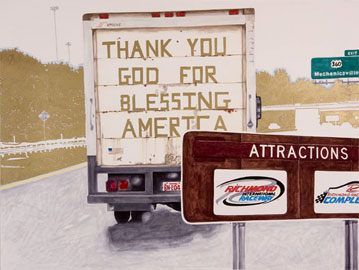
In the back room of RARE, painter Jeff Lutonsky presents "Ain't Livin' Long Like This," a group of magic marker and pencil drawings celebrating the sub-cultures of NASCAR and the rodeo. All well and good - "Business and Pleasure" and "Slippers" are both nicely worked drawings - but I'm thrown by the press release. "Confronting the strict stereotypes attached to the 'red neck' ideal, the viewer ultimately finds beauty and peace in the toughness of rural living." Um, this ain't necessarily rural living and it certainly ain't "tough." Having grown up in a Virginian town of ninety-nine people, I'm familiar with the culture of rural areas, and the iconographic images Lutonsky offers are more closely associated with southern suburban sprawl. The most representative work, and the best of the bunch, is
"Nowhere Road (Ramblin' Fever)," but this road isn't nowhere. The road sign gives away the location as a particularly ugly stretch of I-64's loop around Richmond, Virginia, an area I associate more with WalMarts and strip malls than hardscrabble, rural life.

+++++

Yancey Richardson Gallery: One gets the sense that the folks behind "Arcadia" wanted to present a very general survey of nature-themed artwork, but felt compelled to provide a more specific focus. Thus, they describe the exhibition as one in which "artists present the relationship between nature and man as either idyllic, threatening or diminished." This is open-ended, to say the least; they might as well write "good, bad or
ambivalent," which pretty much covers all the bases and brings us back to square one. Whatever my rather petty faults with the gallery's word choice, I had high hopes for the exhibition. Sadly, the show is something of a dud overall, not because the included work is bad, per se, but because it is too similar. Ten minutes after having left the space, I had forgotten most of what I'd seen.

David Spero and Joel Sternfeld, both photographers I respect, include works that are lost among the many pleasant landscapes on display. One could argue that this betrays a failing of their pictures, but in this instance I feel it says more about a group exhibition that drowns in sameness. Anthony Goicolea, whose attractive drawings and paintings are captivating, here includes a boys-back-to-nature photograph that is imminently forgettable and
rather obvious (in case there is any doubt, the press release name drops Lord of the Flies).

Photobucket - Video and Image Hosting
Clare Richardson
"Sylvan, Untitled XX"
2002
Chromogenic print, Edition of 9
24 x 30 inches


Clare Richardson's photograph, "Slyvan," is used on the show's promotional material. A young field worker is pictured from the back, pitchfork slung over his shoulder, as he contemplates a rolling, bucolic European landscape. Looking at the picture, I feel a reactionary longing, a la Thoreau. Ah, the simpler life - hard, manual labor, good sleep and few questions - and a sustainable relationship with land, flora and fauna: is this not better than today's destructive, anxiety-ridden capitalist mess? This is Romanticism at it's most effective and, as such, it borders on propaganda. Perhaps this is why I couldn't imagine living with the print; it celebrates an uncomplicated, beautiful lie.
Photobucket - Video and Image Hosting
Jeff Whetstone
"Two Boys and Water Snake"
Gelatin silver print, Edition of 5
24 x 30 inches


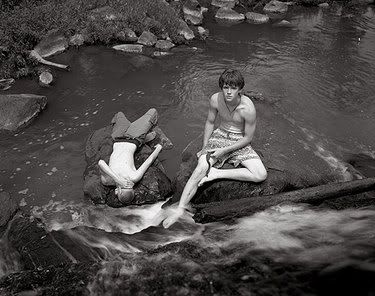
The strongest piece in "Arcadia" is Jeff Whetstone's "Two Boys and Water Snake." Straight-forward and unremarkable, the picture features two shirtless boys, brothers possibly, in swim trunks, resting on river stones. A water snake is gently grasped in hands of the older boy. The boy gazes up at the camera carelessly; the snake flexes it's mid-section as it moves toward freedom. The photograph succeeds where Richardson's does not, precisely because it acknowledges Nature's indifference. The snake's will to live is little different from that of his captor. We are all brutes, transcendence and intellect be damned. Where Golding's Lord of the Flies seeks to remind readers of this existential truth, "Two Boys and Water Snake" subtly documents it.

+++++

Cheim and Reid: "Soutine and Modern Art" presents gallery visitors with what must be the most impressive non-museum lineup in New York. Every participating artist, whether dead or alive, is of all-star caliber: de Kooning, Pollock, Dubuffet, Guston, Freud, Auerbach, Baselitz, Mitchell, Diebenkorn, Bourgeois and more. Many of these heavy-hitters have only one work included in the exhibition; Soutine, however, has around fifteen paintings hanging. Now, I really like Soutine, but I
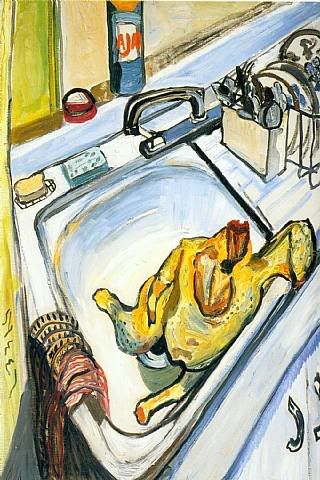
was still surprised by my relative disinterest in the other work at Cheim and Reid. I spent a minute with the Pollock, the Dubuffet and the Guston, but even these paintings seemed dull, self-conscious and labored alongside the best of the works by Soutine. Only two works, Alice Neel's "Thanksgiving" and a large painting by Susan Rothenberg (annoyingly, I've forgotten the title), provoked in me anything resembling the pleasure derived from the their Jewish, Franco-Russian elder.
Photobucket - Video and Image Hosting
Alice Neel
"Thanksgiving"
1965
Oil on canvas
30 x 34 inches


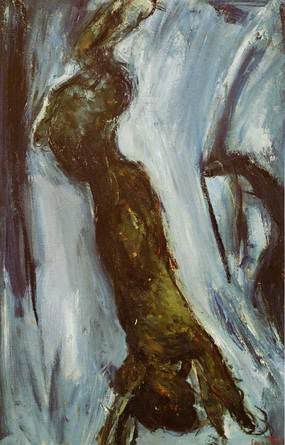
Soutine is among the finest examples of a painter's painter. That is to say, he uses oil paint in a visceral manner, pushing and spreading it around the canvas with the intensity of El Greco or Rembrandt. There is as much excitement in his paintings' surfaces as there is in the caricatured movement and contours he depicts. My favorite work in the show, "The Rabbit" pictures a dead animal, hung by the rear legs and awaiting butchering. Soutine strips the composition down and yet I
spend five minutes with the painting, stepping in close, scanning from top to bottom, bottom to top, and then stepping away again. It's rare that I have such a physical interaction with so small a painting. Rare and very, very cool.
Photobucket - Video and Image Hosting
Chaim Soutine
"Rabbit"
Circa 1925
Oil on canvas
30 x 18 1/2 inches


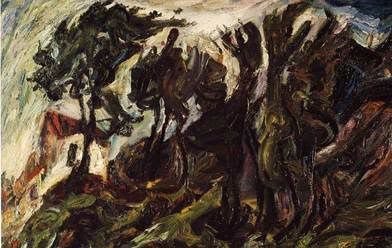
There are other brilliant works at Cheim and Read. Also making my shortlist: "Landscape at Ceret," "Rabbit with Forks," and "Great Pheasant." I coveted all of these, the only sure sign that I'm in the presence of an artwork I truly love.
Photobucket - Video and Image Hosting
Chaim Soutine
"Landscape at Ceret"
1922
Oil on canvas
28 x 41 inches


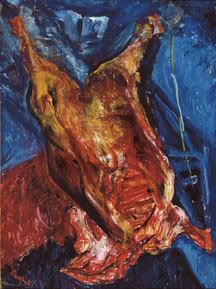
Finally, "Carcass of Beef" deserves a mention. Looking at it, I remembered a funny, possibly apocryphal story I'd heard about Soutine. Apparently, he actually suspended a cow carcass in his studio and, as he continued to work on the painting, it began to stink, causing the neighbors to confront the painter in protest. After listening to their complaints, Soutine explained that art is more important than health or cleanliness, and that he had no choice but to keep the carcass until the painting was finished. Apparently, several slightly different versions of this tale are passed around - the one on Wikipedia has the police involved - but I'd like to think it's based on real events, and that Soutine was as committed to his painting as he was responsible to his medium.
Photobucket - Video and Image Hosting
Chaim Soutine
"Carcass of Beef"
Circa 1925
Oil on canvas
55-1/4 x 42-3/8 inches


Photo credits: Chad Marshall image ripped from Priska C. Juschka Fine Art; Paul Villinski and Amy Ross images courtesy Morgan Lehman Gallery; Karina Aguilera Skvirsky, Joy Garnett and Jason Middlebrook images courtesy Sarah Meltzer Gallery; Dave Choi and Jeff Lutonsky images ripped from RARE Gallery site; Clare Richardson and Jeff Whetstone images ripped from Yancey Richardson site; all Soutine images ripped from artunframed.com; Neel image ripped from artnet.com


Thursday, July 20, 2006

Photobucket - Video and Image Hosting
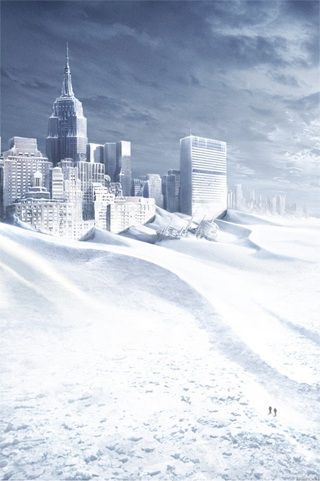
Whether or not he has seen "The Day After Tomorrow," any self-respecting environmentalist is familiar with the doomsday scenario posited in Roland Emmerich's 2004 Hollywood blockbuster. But, in case you aren't a card-carrying member of club green or a fan of big-budget summer fare, I'll provide a brief summary. Global warming leads to a stoppage of the thermohaline circulation, also known as the ocean conveyor belt. The halted transfer of warm waters from equatorial regions toward the poles results in dramatic climate change, plunging the northern latitudes into another ice age. In the film, this transition happens unbelievably rapidly; just days after the current stops, the Statue of Liberty is buried in snow and many millions of displaced United States citizens flee south to Mexico in search of a hospitable climate. (1)

Most viewers realize that "The Day After Tomorrow" is over-the-top, but this didn't stem the tide of green endorsements surrounding the film's theatrical release. Al Gore, along with other prominent political and popular figures, trumpeted the movie as an important way to heighten people's awareness of the serious threat posed by global warming. Not long after seeing it, I wrote, "It’s not a triumph of cinema, but it does make the viewer ask some tough questions about how we spend our days here." And so it does, but what I didn't know then was how completely off-base the science behind the scenario was. After all, the thermohaline circulation has been big news in the international media for at least five years, and most articles connect the currents with our relatively temperate global climate. It didn't strike me as alarmist, then, when environmentalists voiced concern about the dangers of a slowed or dead circulation. In fact, this threat seemed to be one of the principal worries of global warming.

Not so, according to Richard Seager's fascinating essay in the July/August issue of American Scientist. Apparently the greens - myself included - have been crying wolf...yet again. This time, though, it's not entirely our fault. The hypothesis was based on accepted fact, after all, but Seager exposes this fact as myth. "The Day After Tomorrow" won't happen because it is not the Gulf Stream that keeps Europe 's climate temperate, as the screenplay suggests and so many of us have long believed. Instead, the trade winds are responsible. That is to say, winds moving from west to east blow in air from the Atlantic, warming Europe in the winter and cooling the pseudo-continent in the summer. The Pacific equivalent is observed on the west coast of the United States. In the case of the southeastern U.S., warm air from the Gulf of Mexico and the warm southwest blows over Florida, Georgia and the Carolinas, heating up the summers but keeping winters temperate. As you move northward along the east coast of the U.S., the much cooler, "continental" winds affect climate, keeping summer temperatures relatively cool, but resulting in cold winters.

As Seager explains it:

"The effect of differing heat capacities is augmented by the fact that the Sun's heat is stored within a larger mass in the ocean than on land. The heat reservoir is bigger because, as the Sun's rays are absorbed in the upper several meters of the ocean, the wind mixes that water downward so that, in the end, solar energy heats several tens of meters of water. On land, the absorbed heat of the Sun can only diffuse downward and does not reach deeper than a meter or two during a season. The greater density of soil and rock (which ranges up to three times that of water) cannot make up for this difference in volume of material that the Sun heats and for the difference in heat capacity of water compared with soil or rock.

Because sea-surface temperatures vary less through the seasonal cycle than do land-surface temperatures, any place where the wind blows from off the ocean will have relatively mild winters and cool summers. Both the British Isles and the Pacific Northwest enjoy such "maritime" climates. Central Asia, the northern Great Plains and Canadian Prairies are classic examples of "continental" climates, which do not benefit from this moderating effect and thus experience bitterly cold winters and blazingly hot summers. The northeastern United States and eastern Canada fall somewhere in between. But because they are under the influence of prevailing winds that blow from west to east, their climate is considerably more continental than maritime."


Seager does not, however, dismiss the very real possibility that a stoppage of the thermohaline circulation will result in marked global cooling. He believes this will, in fact, occur, but he argues that global warming itself would serve to mitigate the cooling.

"The germ of truth on which such hype is based is that most atmosphere-ocean models show a slowdown of thermohaline circulation in simulations of the 21st century with the expected rise in greenhouse gases. The conveyor slows because the surface waters of the subpolar North Atlantic warm and because the increased transport of water vapor from the subtropics to the subpolar regions (where it falls as rain and snow) freshens the subpolar North Atlantic and reduces the density of surface waters, which makes it harder for them to sink. These processes could be augmented by the melting of freshwater reserves (glaciers, permafrost and sea ice) around the North Atlantic and Arctic.

But from what specialists have long known, I would expect that any slowdown in thermohaline circulation would have a noticeable but not catastrophic effect on climate. The temperature difference between Europe and Labrador should remain. Temperatures will not drop to ice-age levels, not even to the levels of the Little Ice Age, the relatively cold period that Europe suffered a few centuries ago. The North Atlantic will not freeze over, and English Channel ferries will not have to plow their way through sea ice. A slowdown in thermohaline circulation should bring on a cooling tendency of at most a few degrees across the North Atlantic—one that would most likely be overwhelmed by the warming caused by rising concentrations of greenhouse gases. This moderating influence is indeed what the climate models show for the 21st century and what has been stated in reports of the Intergovernmental Panel on Climate Change. Instead of creating catastrophe in the North Atlantic region, a slowdown in thermohaline circulation would serve to mitigate the expected anthropogenic warming!"


Some die-hard greens may be reluctant to consider Seager's conclusions, but they should keep in mind that he is neither a denialist nor a recipient of industry monies. He is a senior research scientist at Columbia University's Lamont-Doherty Earth Observatory and even if his ideas are too nuanced for environmental fund raising efforts, it's always best to acknowledge complexity over simple slogans. As I wrote in "Make Me A Mutt," my response to Nicholas Kristof’s March 12, 2005 op-ed piece in the New York Times,

"The Pew Research Center statistic Kristof cites is encouraging; 3/4 of Americans polled agree that environmental protection is vital. With that sizable majority in mind, it may not be necessary to throw tantrums. Reasonable, determined methods will serve the movement well. In environmentalism, like anything else, contradictions abound. Rather than dogmatically championing every device or idea that comes out of the green camp, we should fully consider each and push for thoughtful action as a diplomat would.

As Garret Keizer writes in his recent essay, "Life Everlasting," 'We can dare to walk on this ground of dubious footing, because we are holding one another up as best we can, and because it is we ourselves and not some deterministic logic that writes our civil laws…We can sniff out our options and pick and choose among them, a birthright generally less appreciated by a dogmatist than by a dog.'"


Photo credit: ripped from "The Day After Tomorrow" promo website; 20th Century Fox

+++++

(1) The movie should be spared a critique of it's Americentrism, if only because the international coverage of climate change is similarly biased. Most every report, whether published in a newspaper or broadcast on television (not to slight magazines and radio, my favorite media), focuses on the Gulf Stream, the oceanic current that draws water from the Gulf of Mexico to Europe, passing along the eastern coast of the United States as it does so. If this current should cease to be, countless white Europeans on both sides of the Atlantic would be adversely affected. By contrast, the Kuroshio Current, the Pacific equivalent of the Gulf Stream, receives only passing mention, and even then only in regards to California's fair shores. Siberia, Japan, Africa or any other place is of much less concern to the media. Frankly, Roland Emmerich at least included some shots of Japan being pelted by enormous hail chunks.