Thursday, March 26, 2009

"Greening" Your Home

When Hungry Hyaena was in its infancy, a great many of the blog's posts dealt with environmental conservation issues. This environmental vein is still present in the art writing and rambling essays presented here, but environmentally themed websites or non-profit projects aren't so often highlighted.

The two recommendations below are, I hope, the beginning of a renewed HH commitment to promoting worthy environmental education and activism.

1) The Sierra Club recently launched "Green Home," an educational website that offers an excellent introduction to ecologically conscious home improvements.
"Sierra Club Green Home was developed with a simple mission in mind: to help Americans make their homes more energy efficient, environmentally sustainable and healthy. We do not sell products or services. Instead, we provide great education to help you have a more sustainable home and make it easy for you to find local green businesses."
If you don't own the apartment or house that you live in, some of the site's suggestions won't be sensible investments, though you might consider introducing the Green Home ideas to your landlord. But if you're fortunate enough to own your residence, the site offers many terrific resources that will get you rolling on lifestyle "greening" (and, in the long run, saving another kind of green).

Green Home is the latest Sierra Club initiative that I've been impressed by. Loyal HH readers know that I'm particularly encouraged by the environmental group's efforts to bridge the "sportsmen" and environmentalist divide.

2) More immediately practical is this non-toxic home cleaning guide by Annie Bond.
"Most modern synthetic cleaning products are based on age-old formulas using natural ingredients....Going back to the original naturally derived ingredients is a way to make cleaning products that work, don’t pollute and save you money. Most are found in your kitchen cupboards. Mix and match with well-chosen and environmentally friendly green cleaning products found in health food stores, and you can easily and simply transform your home into a non-toxic and healthy haven."
I'll definitely be taking advantage of the window cleaner and all-purpose spray cleaner recipes.

Tuesday, March 24, 2009

Subjective Takes

On Paul Klee and Ali Banisadr

Paul Klee
"Ancient Sound, Abstract on Black"
1925
Oil on cardboard
15 x 15 inches
"The work probes me, reads me, asks me questions, makes demands. If we see and acknowledge this connection between ourselves and works of art, art isn't merely a distraction, it is a means by which we begin to understand ourselves. Marcel Proust wrote, 'In reality, every reader is, while he is reading, the reader of his own self.'"

-Dr. Alan Jones, Reimagining Christianity
This weekend, I pulled G. Di San Lazzaro's biography of Paul Klee off my bookshelf, hoping to draw some inspiration from reproductions of the artist's paintings and drawings. As I thumbed through the book, however, various passages caught my eye, and I ended up reading much of Lazzaro's account.

Lazzaro stresses Klee's desire to achieve a "purity of expression." The artist apparently characterized his art-making as a relationship with "the very heart of the Universe," and Lazzaro provides quotations from art historians and personal associates of Klee that further elucidate the artist's mystical motivation.
"For Klee art was always cast 'in the image of creation'...The artist rummages in Creation's property box. There is nothing which does not serve him, nothing which does not come into his game - art and its oldest remnants such as inscriptions, mosaics, Assyrian tablets, cracked pottery, imaginary ideograms, graffiti; nature with its various processes and chance effects - its striations, strata and maculations, the slow wear of time which in the thinnest fragment of rock imitates the work of the human hand. The hand, in its turn, Klee said, must be 'the instrument of a distant past.'"
-Pierre Volboudt, Kandinsky

"Klee's world is [not] grotesque but mystical...For Klee, as he said to me in 1919, art was not there to reproduce the visible but to render visible what lay hidden beyond the visual world. He remained faithful to this doctrine and brought its deep meaning to fruition until, after passing through many intermediary stages, he achieved in his pictorial world...essential beauty."
-Carola Giedion-Walker
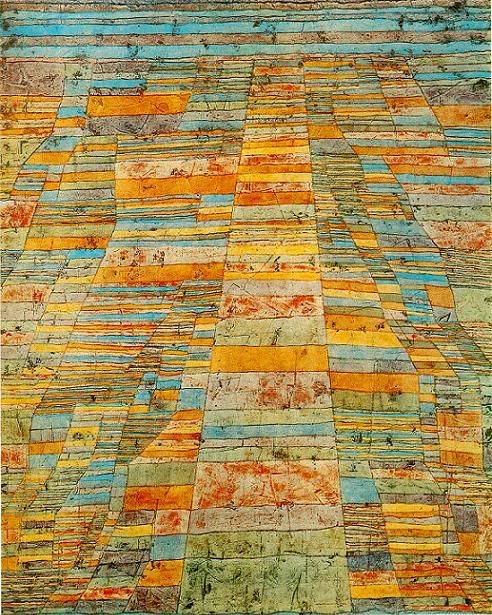
Yet, of the many 20th century artists that heroically championed the unconscious and the archaic, Paul Klee is perhaps the only one that your grandmother loves. Why? Because his paintings are colorful and inoffensive and, when not abstract, feature charming hieroglyphs, animals and stick figures.

Art writers most often describe Klee's work as "whimsical," "precious," even "child-like," but Klee disdained such mundane interpretations of his work. He dismissed "the legend of the childishness of my drawings" as the result of his attempts to "show man [not] as he is but as he might be."


Paul Klee
"Highways and Byways"
1929
Oil on canvas
32 5/8 x 26 3/8 inches


Contemplating the disparity between Klee's stated intention and the general reaction of his viewers, I recalled something that I wrote in the comments section of a recent post.
"Art is subjective...and I feel that a viewer's experience and interpretation of an artwork is as informative and vital as the intention and creation of the artist. It's a conversation."
In short, the viewer plays a substantiative role in the life of an artwork.
Does this mean that Klee was wrong to assert his mystical motivation in the face of popular resistance? Not necessarily. Many artists sense Klee's profound striving. Undoubtedly, Klee would have approved of Bridget Riley's assessment of his paintings as "the process of things coming into being" and, in my art taxonomy, he is more closely related to the mythically-inclined Mark Rothko than he is to the playful Alex Calder.

Nevertheless, the popular response to Klee's work can not be overlooked. Art is a conversation and, in the dialogue generated by Klee, the perspective of artists like myself or Riley is representative of a small minority.


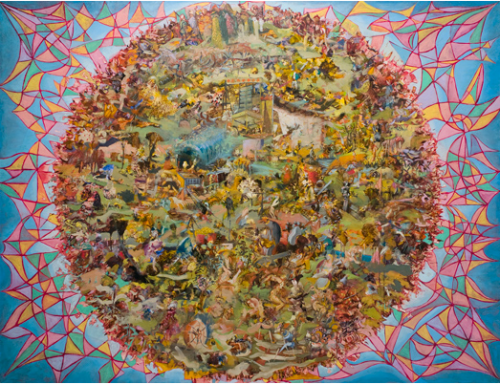
Ali Banisadr
"Target"
2008
Oil on linen
60 x 78 inches


A few months ago, I encountered the young painter Ali Banisadr's artwork for the first time. His riotous pseudo-abstractions compellingly communicate the distortions of violent conflict, yet the artist's all-over compositions also manage to effect a meditative state. Indeed, some of the works are mournfully elegiac. (His 2008 painting "Target" is perhaps the most obvious example; the picture acts as a Yantric focal point despite being dominated by a feral garden scene.)

Banisadr was born in Tehran, Iran, in 1976. His family lived in the city during the Iran-Iraq War and he states that "vivid memories of the bombings that...regularly occurred throughout his childhood" are a principal inspiration for the recent paintings. Banisadr's 2008 solo exhibition at Leslie Tonkonow Gallery received critical praise in a number of outlets, including The Brooklyn Rail, The New York Times, and jameswagner.com. Reviewers usually cited the same forebears and inspirations that the artist lists in the exhibition catalog.
"I want the viewers of my paintings to see history and human behavior at a macro level, by combining a great variety of influences that you can see close-up. Bosch, Brueghel, Persian minatures, memories, literature, history - I want to combine all of these things in my work. When you put all of this in the pot and stir, you create your own mythology."
Indeed, Banisadr combines these ingredients to excellent effect. Looking at the paintings, Banisadr's indebtedness to and admiration for the Dutch masters is immediately apparent, but so, too, is a great heave of ideological love and madness.
But one of Banisadr's paintings provoked an unexpectedly powerful association in this viewer, one that I'm sure Banisadr did not intend to stir into his eclectic pot. I'm fortunate to have neither fought in nor lived in the midst of war. Yet having grown up in the American South, I still identify the American Civil War as "my family's war." That association may seem disingenuous - the war was fought 150 years ago - but my homeground is marked by that terrible conflict in a way that the rest of the country is not. Gravestones in the small cemetery in the front yard of my childhood home speak to the pride Southerners had in their cause. Stonewall Jackson Kellam is among the dead buried in that cemetery. Kellam was a five-month-old baby when he died on October 3, 1868, just a few years after the close of the Civil War. His name honored Thomas "Stonewall" Jackson, the prominent Confederate general.

The Civil War colors Southern identity, and I am not immune. Although my paternal great-grandparents were a Hungarian Jew and Catholic seeking refuge and opportunity in Brooklyn, New York, the other seven branches of my family tree have deep roots in the United States, mostly Scots and Brits who immigrated in the 1600s. At least two of my great-great-grandfathers fought in the Civil War (one for the Confederacy, one for the Union), along with several of their brothers, and the records of their service are rather stirring. My great-great-grandfather Wesley Mayes Dance was fatally wounded several hundred yards away from the site of the "Crater" at Petersburg, Virginia. Wesley fought with The South of Dan Rebels, one of two Virginia regiments that held the Union advance at Petersburg until Southern reinforcements arrived. With bitter pride, I consider the fact that he and his fellow Confederates sealed the defeat of the Union attack on that day, thereby prolonging the war for many months.


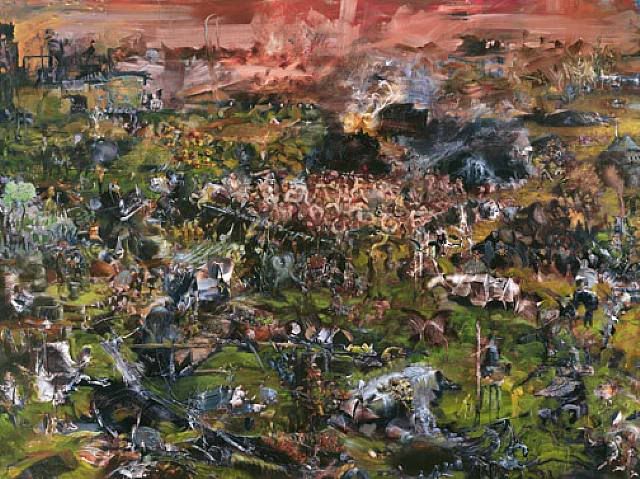
Ali Banisadr
"Amen"
2008
Oil on linen
50 x 66 inches


I don't often think about the Civil War, or even about my Southern identity, but in Leslie Tonkonow's gallery space, Ali Banisadr's painting "Amen" resonated for me, above all, as a picture of that history. I conceived of Banisadr's picture as a depiction of the Battle of Chancellorsville, one of the bloodiest, most frenzied contests in the war. The painting hums with electric life, yet is also a sad testament to our darker inclinations. I responded to the work with unsettling emotion; taking it in, my eyes stung with restrained tears.

As I departed the gallery, it occurred to me that I would be unable to write about the exhibition without raising my Civil War associations. I worried that this was too personal an experience to discuss, too private an interpretation to inform Banisadr's paintings for readers. If the artist didn't intend his paintings to conjure up Chancellorsville, how could I, in good faith, write about storied recollections of my great-great-grandfathers?

But as Proust reminds us, "in reality, every reader is, while he is reading, the reader of his own self." Artworks compel every viewer differently. More vitally, each individual comprehension of the artwork completes the piece anew. Klee's mystical intentions and Banisadr's Iranian memories are only part of the exchange. Art is, after all, a conversation, and a deeply satisfying one at that.

Image credits: Paul Klee reproductions ripped from Peplum and WebMuseum; Ali Banisadr reproductions ripped from artnet and Joann Kim's UpDownAcross

Sunday, March 22, 2009

Tree of Life


I learned of artist Tania Kovats' "TREE" project via RSA Arts & Ecology. Kovat's installation was commissioned by the British Natural History Museum to honor Charles Darwin's bicentenary. Her "cross section" of a 200-year-old oak tree was installed on an angled ceiling inside the museum. The work appears quite impressive.

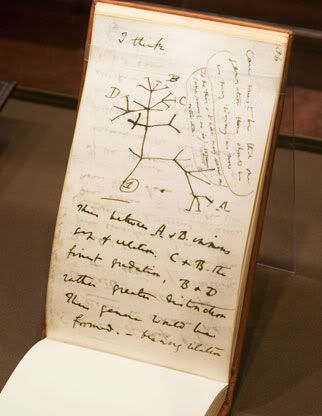
Particularly magical, however, is Kovats' inspiration, Darwin's famous phylogenetic tree diagram, an early representation of the "tree of life" included in one of his notebooks. Just above the sketch, Darwin wrote, "I think." Given the cultural and scientific ramifications of Darwin's grand idea, the page would have the aura of sacred scripture even without the text, but the hastily written "I think" suggests, as Kovats puts it, "a moment of conception...an exchange between thought and the mark that [he] made." Thus, the moment of revolutionary conception is recorded, caught for contemplation.

Darwin's notebook page is, like the Voyager 1 record, both an artifact and a profoundly moving work of art, testament to the promise of humanity and Aristotle's eudamonia.

Photo credit: ripped from RSA Arts & Ecology

Saturday, March 21, 2009

The Fertile Crescent


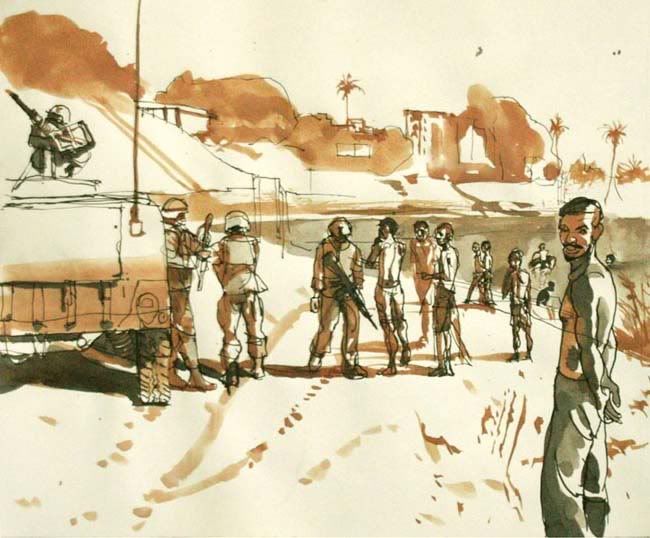
Steve Mumford
"Soldiers and Bathers, Tigris River, 2003"
2003
Ink on paper
From Mumford's Baghdad Journal


What a marvel to consider the historical and global reverberations of human activity in the Fertile Crescent! Few regions of the globe remain untouched by the profound ideologies and prejudices birthed between the rivers...

...and still the fighting continues.

Photo credit: Artwork reproduction ripped from artnet

Friday, March 20, 2009

Hungry Hyaena email and RSS feeds

Recently, a number of people have suggested that HH offer email and RSS feeds so that individuals who like reading the blog but don't visit the site regularly will receive notification of new content. Because I post sporadically (4 - 10 a month), the suggestion is an excellent one.

I invite you to subscribe to either of these services. The relevant links are positioned on the right-hand side of the page, just above the "Post Archive By Subject" section.

Wednesday, March 18, 2009

Cooperation through opposition

"Joints are and are not parts of the body. They cooperate through opposition, and make a harmony of separate forces. Wholeness arises from distinct particulars; distinct particulars occur in wholeness."

- Herakleitos, circa 500 B.C.E.
I announced last week that biologist, writer and artist Jessica Palmer contributed a short essay about one of my 2008 drawings to SEED Magazine's Culture Section. In her article, "Seeing Antlers, Feeling Dendrites," Palmer asserts that good art acts as a vehicle of consilience.

Palmer has a more recent, related post on her tremendous blog Bioephemera. In it, she riffs on the complementary relationship of art and science.
"Basically, I think that good art prompts the viewer to find meaningful connections between things that seem unrelated, to draw parallels that previously went unnoticed. Art can be a springboard to insight. Science, which can so easily become insular and near-sighted, needs that springboard, even if - like a shared birthday - it's just a hook to get the story started.

It's worth noting that Darwin was a great scientist precisely because he could make meticulous, minute observations of a single species - he wrote a whole book about earthworm digestion, for heaven's sake! - while also seeing the grand, universal, far-reaching forces that shape finch beaks, beetle shells, poodles and pigeons. It's not easy to make those linkages, in history or in science; sometimes art, literature, or music can give the roving mind a nudge in the right direction. As Gopnik notes in his book, 'there is no struggle between science and art': both are ways of understanding the world, and their strengths are complementary."
I agree heartily, though I would widen the scope of such "linkages" further.

There need not be struggle between science and any of the humanities, including - and this is the controversial inclusion - imaginative theology. The x-factor in these relationships is dogmatism. A rigid mindset stultifies ideology, and when science, philosophy or religion become dogmatic, they retard the human imagination and, with it, possibility.

Tuesday, March 17, 2009

Art Connect "Extraordinary Art Blog" Series

I'm honored to report my selection as the third interviewee for Art Connect's "Extraordinary Art Blog" series. Read my interview with Managing Director Peter Cowling here.

Art Connect is a relatively new website that provides the valuable service of reviewing and cataloging art blogs. The blog reviews are terrifically helpful and the interview series is so far excellent. From the Art Connect site:
"In the process of compiling over 100 art blog profiles, and starting what will be an ongoing survey of the art blog scene, we accumulated a whole range of questions we wanted to investigate further. As a part of this series, we have explored the extraordinary growth of an art blog with Ruben Natal-San Miguel, from ARTmostfierce, how to produce extraordinary art critique with Catherine Spaeth, and providing extraordinarily cohesive coverage with Christopher Reiger from Hungry Hyaena."
The interview with Catherine Speath is of particular interest to me, given her defense of accessible, yet rigorous art writing. She writes,
"I do, however, take very strong objection to what you are referring to as 'dumbing down' when it is relied upon as uncritical fodder for the market. For this reason there is a very important role for the academy and the museum to uphold a place for scholarly research. But I have also seen some atrocious academic writing, produced by galleries especially, that relies upon a history of philosophical thought to dress something up for the market."
Ms. Spaeth also discusses the issue of online plagarism, particularly as it relates to bloggers. This issue is very important, and I hope that it will engender more conversation.

I encourage readers to check out the Art Connect interview series.