Wednesday, July 13, 2005

Individual and Collective

Reading through the posts at Sustainablog's "Blogging Round the Clock" event, I came across this entry by Dave Roberts, of Gristmill renown. "Hold the Misanthropy" is worth a read; Roberts rightly highlights some of the weaknesses inherent in the ecological footprint concept.

The concept of an ecological footprint is most useful as just that, a concept. Roberts reminds us that the "science" of determining an individual's score is vague, but as a general marker the score will serve its purpose, giving each of us an idea of where we stand relative to the world at large. Like Dave Roberts, my score is a 16 and, barring cessation of plane travel and my swearing off any packaged food products, I doubt I could lower it. (When I last took the ecological footprint quiz, my score was 9, but I have since discovered that my apartment is over 500 square feet; that makes my score jump significantly.) But so what? The fact that I am conscious of my footprint and approaching life with sustainability in mind is a good beginning. If I can become more involved in local conservation projects, I will be well on my way to making a difference, however small it may be.

I find the thrust of Roberts's post agreeable, but one statement didn't ring true.

"Matter of fact, as I'm fond of arguing, individual environmental virtue is at best a curiosity, at worst a distraction."


Most of us have come across at least one loud-mouth egomaniac on a Napoleononic eco-crusade. This breed of environmentalist is a distraction and, though there are not many of them, they garner a disproportionate amount of news time. When I see such people on television or read something they have written, "individual environmental virtue" doesn't spring to mind so much as "insecure publicity hound."

On the other hand, I know plenty of folks who are taking simple, quiet steps to lessen their negative impact. Is the individual who uses canvas tote bags at the grocery store really missing the point? What about the person who swears off automobiles and relies on public transportation or my own vegetarian-unless-I-kill-it-myself diet? I believe such choices should be celebrated; they give individuals something to do other than cheerlead by sending money to conservation and environmental organizations.

Roberts's statement is not entirely inaccurate, though. Individual choices can be (and often are) deemed overly important by those who wish to feel better about themselves. How many times have I left the grocery store feeling superior to the "plastic baggers" all around me? Such a feeling is regrettable, but not uncommon given the "inklings of the divine," as writer Jack Hitt puts it, associated with the environmental movement. Furthermore, the environmental impact of one individual is, as Roberts makes clear, relatively minimal.
"If I could remove my ecological footprint entirely, the earth would endure 0.000000000000167% less insult (or assuming I have five times the average footprint, 0.000000000000667%)....Big whoop."

"Despite the near-obsessive focus of some environmentalists on "what you can do," it is collective action that will make or break our future. Changing group behavior -- through advocacy, activism, politics, research, however -- is our calling."
Taking these considerations into account, the personal choices can seem vain, even irrelevant, when compared to "deep structural changes in our material and social milieu," but individuals can and do change/lead by example. If Seinfeld taught me anything, it's that eating a candy bar with a fork and knife can become the socially accepted norm, even a sign of sophistication. The structural changes that Roberts calls for are aided by "individual environmental virtue," not hindered.

Tuesday, July 12, 2005

The Purple Line

Image hosted by Photobucket.com
The nation is polarized, red and blue, heartland and coasts, small town and city. Not a day goes by without a talking head making mention of the “growing cultural divide.” A few commentators respond angrily to such an assessment, pointing out that the populace has more in common than the media would have us believe. About the time you begin to think this may be the case, some other war of words is reported and the purple line appears anew. Having grown up in a small, southern village, I find myself loyal to many “red state” values and sensibilities, but my politics and philosophy – not to mention my living in New York City – make me very much a “blue stater.” This push-pull relationship weighs on me, but one aspect of the “us versus them” context is particularly vexing: hunter versus environmentalist.

Firstly, I should state that I do not believe hunters and environmentalists occupy opposing poles. As outdoor writer Ted Williams put it in his excellent 1996 Sierra Magazine article, “Natural Allies,” “Hunters and anglers have a long history of protecting and restoring fish, wildlife, and habitat.” Unfortunately, most environmentalists and hunters view one another as the enemy. One of my good friends - a proponent of animal rights – points out that “there is such stridency on both sides of the aisle that it’s virtually impossible to fashion an argument that either side couldn’t cram into their rubric.”

Many members of the Sierra Club were outraged by Williams’s suggestion that environmentalists should work with hunters to protect the ecosystem. Letters poured in to Sierra Magazine, condemning Williams for his “Neanderthal form of recreation,” and stating that “no matter how politically correct you portray the mind of the hunter, killing for pleasure is sick.” Comments like these miss the point. Killing for pleasure is sick, but I know hunters who view the kill as an unfortunate part of the experience, myself included. (The Neanderthal comment is just plain ignorant; Homo sapiens out-competed our extinct relatives, in part a result of our superior aptitude for hunting.)

“Hunter is a term that can include everyone from the fire-power yahoo who is simply out to kill something to what Stephen Kellert calls the “Nature Hunter,” who knows a great deal about wildlife and wildlife habitat and is deeply conscious of the paradox inherent in killing these creatures he loves and respects. Indeed, many of the most vocal and articulate critics of hunting abuses are hunters themselves.”
-Robert Kimber, Living Wild & Domestic


For many anti-hunting environmentalists, though, the "Nature Hunter" is a lie. To kill is to be subhuman and disrespectful.(1) Such an attitude is common at the extremes of the animal rights movement. Longtime People for the Ethical Treatment of Animals (PETA) spokesperson, Cleveland Amory, was influential in this regard. He believed that “all animals should be protected – not only from people but as much as possible from each other. Prey will be separated from predator, and there will be no overpopulation, because all will be controlled by sterilization or implant.” Amory’s utopian ideal is an expensive exercise in futility and it betrays his God complex, albeit one birthed of good intentions. In 1990, U.S. News & World Report published a cover story entitled, “Should Hunting Be Banned?” The two dissenting “voices” were that of Cleveland Amory and my father, George Reiger. Their debate was a familiar one. My father argued that hunting is not about “pleasure killing” and that “sportsmen” – a term I loathe – foot the bill for most United States conservation programs. Amory argued that hunters are barbarians who should be locked away. The truth lies somewhere in the middle.

Hunting proponents like to cite the excise tax on hunting equipment, be it guns or ammunition, and the revenue from hunting licenses, pointing out that hunting and fishing continue to pay for more conservation projects than all environmental groups combined. Anti-hunters respond by suggesting that similar taxes on binoculars and camping equipment would make up for money lost if hunting were prohibited. Such back-and-forth bickering is unproductive and unfortunate, but Ted Williams sensibly suggests that the marriage of these two forms of taxation could do a world of good in the meantime, providing many more millions of dollars “a year for ecosystem management.”

Returning to Williams’s 1996 plea in the pages of Sierra Magazine, I realize how incredibly vital his message is. In fact, it is more pertinent today than it was nine years ago.

“More than 50 million Americans fish, and 15 million hunt, yet environmentalists have made scant effort to forge any lasting alliance with them to protect land and water that sustain wildlife. ‘Environmentalists don’t reach out to sportsmen,’ says Chris Potholm, a professor of government and legal studies at Bowdoin College in Maine. ‘If they did, they’d be invincible. Whenever sportsmen combine with environmentalists, you have 60 to 70 percent of the population, an absolutely irresistible coalition.’”


In case the relevance of Potholm’s point is missed, he continues:

“The biggest mistake enviros make is they always look to the Democrats first. If I can get the sportsmen on board, then I get them to bring the Republicans.”


Bingo. In a country divided, bringing both political parties to the same table, in support of the same agenda, is a rarity. Backroom “nuclear” avoidance discussions aside, bi-partisan legislation has been the exception to the rule in the last six years. When it has occurred, it has often been the result of Republican voters, particularly “red staters,” calling on their representatives to act in the interest of the environment.

“Cowboys Are Their Weakness,” another Sierra Magazine article (Marilyn Berlin Snell, July/August 2005), tells the story of Karl Rappold, a Montana cattleman who traveled to Washington, D.C. to demand better protections for the Montana Rocky Mountain range when it was under threat of development for natural gas exploration. Rappold hasn’t had an easy time of it. At home, he is viewed with ambivalence. On one hand, Rappold is from a long line of traditional cattlemen and he is widely respected in the community. On the other, he has put much of his ranch into conservation easements and he freely associates with folks from the Nature Conservancy and other environmentalist groups. “He notes that in Montana ‘the word wilderness sends fear through people’ because they worry that it’s just land seizure by the federal government.” Such red state distrust of environmentalism will die hard, but Rappold’s involvement, and that of others like him, is cause for celebration. When he met with his representative in Washington, he was heard out because of who he is.

“’We were his people,’ says Rappold. ‘We weren’t environmental people. We were grassroots people from the Montana Rocky Mountain Front, the people who live and work there.’”

Why is it, though, that so many red staters distrust environmentalism? It goes beyond their states’ rights concerns. Ted Williams describes how hunters, fishermen, ranchers, farmers and rural folk alike have been wooed by developers and the energy industry.

“While environmentalists have been ignoring or alienating sportsmen, developers and their hirelings within the wise-use movement and Congress have been seducing them by dressing up in camouflage and flouncing around at photo-ops with borrowed shotguns. For example, the 50 senators and 207 representatives of the Congressional Sportsmen’s Caucus loudly profess to defend fish, wildlife, and sportsmen but consistently vote to destroy habitat….These voting records make perfect sense when you check some of the funders of the caucus’ money-raising tentacle: Alabama Power, Alyeska Pipeline Service, Dow Chemical, International Paper, Weyerhaeuser, Champion International, Mead, American Forest and Paper Association, National Cattlemen’s Association, Olin and Phillips Petroleum.”


Even some of the “sportsman” publications have been turned into mouthpieces for the moneyed development interests. Leading up to the 2004 election, Outdoor Life published a “Voting Guide” for hunters and fishermen. Not surprisingly, it recommended voting for George W. Bush. The Texan would fight to protect your right to hunt and own firearms, whereas New Engalnder John Kerry would “take your guns away.” The accusation is patently false; though Kerry did support gun control legislation, none of it dealt with shotguns or bolt-action rifles, the primary firearms used by hunters – and we all know just how beholden Bush is to the energy industry. More than any other United States president, George W. Bush has rolled back the clock on environmental progress. Whether either group wants to admit it, this means he is adversely affecting both hunters and environmentalists.

It’s high time the purple line becomes the purple core, bringing together rather than dividing.

Photo credit: uplink.space.com

(1)Many of my friends think a conservationist who chooses to hunt is a hypocrite. How can you kill animals if you want to protect them, they ask? I distinguish between preservation and conservation. A preservationist who choices to hunt is a hypocrite in my mind, but a conservationist is not. Many environmentalists advocate the extermination of invasive or “alien” species in order to better conserve biodiversity. A preservationist believes this is wrong, and that Nature will right any wrongs in due time. The preservationist is right, if considering only the geologic clock, but conservation is about making the world suitable for the greatest variety of life now, not long after humanity and countless other species have expired.

Monday, July 11, 2005

Home Again, Home Again...ppfffffttttttt

Image hosted by Photobucket.com

I returned from Washington, D.C. last night. The trip was a good one. It featured a baseball game - Mets and Nationals - and a trip to the National Botanic Garden, but the highlight was a leisurely hike in Prince William Park. In the course of the hike, we came upon many different species of plant and animal, but an eastern box turtle (Terrapene carolina), a young beaver (Castor canadensis) and a pair of yellow-billed cuckoos (Coccyzus americanus) particularly excited me. The box turtle was male - the plastron depression and red eye coloration communicate as much - and the yellow of his skin was so startling that I was able to spot him in the forest shadows. He was about ten feet off the trail, ambling by a small birch tree. I reverted to little-boy-mode and scrambled over some downed limbs to photograph and observe the handsome fellow. He was very cooperative (see below).

Image hosted by Photobucket.com

Though I kept my eyes open for copperheads (Agkistrodon contortrix), one of my favorite North American snake species, I didn't see any. More disappointing still, I found no snakes and few amphibians, even near stream banks. I rolled quite a few fallen trunks in my search, taking care to return them to their original position, but found little of note save some curious insects. I didn't have my insect field guide with me and I wouldn't be surprised if many of the species are absent from the book anyway. One day, perhaps, a truly comprehensive insect field guide will be available.

Frustratingly, I was unable to fight off a familiar sinking feeling on the train ride back to New York. Whenever I escape to rural areas, I find my spirit buoyed. I must extricate myself from the Tri-State area or risk early onset madness. Whereas I once imagined living in New York City until my late thirties, I no longer have much interest in doing so. I do want my art career to be stable before I flee to New England (or wherever I end up), but I don't think I can put in many more years here. This is not to say that I don't appreciate the city, with its spectacular electricity and intellectual energy...I just don't much appreciate living here.

Photo credit: both images, Hungry Hyaena, 2005

Wednesday, July 06, 2005

Hiatus


I’m off to Washington, D.C. tonight and I won’t be back until late Sunday afternoon, so no new posts until then.

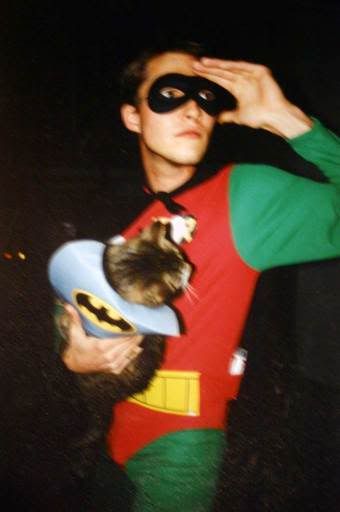
I thought I’d sign off with the picture above. My friend James (a.k.a., Robin), a very talented photographer, and my boy, Mr. Misi (a.k.a. The Bat Cat), team up to take back the streets. I’ve no idea why this seemed like the thing to post, but there you have it. Take care.

Photo credit: Hungry Hyaena, 2003

Tuesday, July 05, 2005

Perpetually Lost

I feel a twinge of shame when reacting negatively to an animal rights mailing. After all, I generally find the perspective agreeable and think that some of the movement’s voices are exceptionally articulate and sensible. The fact remains, however, that most animal rights activists and environmental extremists are young, confused idealists. There is nothing wrong with youth or idealism, but when one combines such naive energy with an ignorance of reality, the result is senseless noise. The “manifestos” written by kids who count themselves among the movement’s disciples are often troubling documents.

Recently, an animal rights advocate, who is also a member of a conservation group I support, sent out a group email detailing the plight of Chris McIntosh, a twenty-two year old activist who set fire to a McDonald’s restaurant in Seattle. The action was jointly “claimed by” the Animal Liberation Front and the Earth Liberation Front. The email sent to me included a note written by McIntosh, excerpted below.
“I am a Green Anarchist who believes in freedom for all life, by any means necessary, and a return to the "old way". There should be no compromise with a system that has no respect for nature, that worships shiny metal and green paper instead of the mother from whose womb we are sustained. I no longer see the use or satisfying results of petitions and demonstrations. The truth is the crunch has come, and it's time for a feral rampage in everyone's heart! Whether its wreaking drunken havoc upon the civilized pillars of society or some other way that gets you off, we are the barbarian hordes. Let's sack Rome!

When I was 16, I dropped out of and took off into the unknown to discover a life of freedom (until the pigs interfered). It had its hardships, but the good outweighed the bad. I have been educating myself with real knowledge since then.”

“What I'm into reading is anti-civilization theory, stuff about early european pagan beliefs. Anything along those lines or a simple letter goes a long way too.

Thank you and no compromise in the fight for the earth and animals!”
Reading this pedestrian rhetoric, I recall “Notes From Underground: Among the radicals of the Pacific Northwest,” an article by David Samuels, published in the May 2000 issue of Harper’s Magazine. Samuels addresses the surreal combination of energetic commitment, disillusionment and boredom endemic in extremist groups. How can we take seriously the well-intentioned kids dressed in Adidas track suits and Nike sneakers as they pry off the sign at Seattle’s Niketown to protest capitalism's cruel dominion?
“What the pictures from Seattle captured was an anger whose true sources had less to do with Nike’s treatment of its labor force or other objectionable practices than with a broader, more unreasoning sense of being trapped in a net…the more general principle that someone should be held responsible for the feelings of absence and compulsion that overwhelm us all at some point or another in our lives and that are not our fault, or even the fault of our parents, but are rather the products of the addictive vacuum that has manifested itself through the combined karmic energies of millions of cathode-ray tubes and digital cables.”
The “objectionable practices” do provoke anger, but I think that what separates the quiet activists – those that concentrate on changing their own lifestyles to lessen impact – from the Chris McIntosh variety is the ability to consider one’s actions thoughtfully, recognizing that personal choices do matter and that arson attacks, for example, only further misunderstanding and backlash.

Monday, July 04, 2005

Celebrate America! Buy Now!


When painting, I listen to one of three things. I tune in to National Public Radio, shuffle the tunes on my iPod or, during the summer months, turn on the television and “half-watch” baseball games. This Fourth of July long weekend, I have been doing the latter, enjoying meetings of the New York Mets and Florida Marlins (loss) and, today, the Mets and the Washington Nationals (win). Unfortunately, I must suffer through the commercials; by the end of your average ballgame I've reached the saturation point. The various corporate slogans – “I’m Lovin’ It.” – are stuck in my head and, in some cases, I can recite the commercial voiceovers long after the television is been turned off.

This holiday weekend, the commercials were especially irritating. “Hurry to IKEA for the Summer Sale, ending July 4th!” “Come to P.C. Richard & Son by the 4th to receive big discounts!” “Buy a new Verizon phone by Independence Day and save big!” If I judged the holiday by the television commercials, I would be forced to conclude that the Fourth of July, like Memorial Day, is just another national spending day, or “Freedom Sale,” as one particularly shameless company puts it.

Taking in the commercial frenzy, I feel fortunate that my idea of a good weekend is confined to the studio or a day-trip somewhere relatively unsettled; this way I can avoid the crowds and the angry frustration that sweeps over me when I watch people excessively consume.

A month or so ago, I purchased a scanner at a mid-town Best Buy. While standing in line to swipe my credit card, I watched music videos on televisions hung tactically above the switchback checkout line. Some angry young rockers dressed in grotesque costumes thrashed around on screen – I think this was Slipknot – and I found myself considering our culture's disillusionment. It occurred to me that it wasn’t so very long ago that I stomped around a college campus in combat boots, pierced and angry, listening to Tool and Nine Inch Nails on over-sized headphones.

My gaze drifted from the televisions. On a nearby rack of video games, a display intended to provoke impulse buys, there were more options than I'd had in the early days of Nintendo. Roses, the rural department store near my hometown, usually presented me with four or five gaming options and I would carefully compare each before deciding how to spend my lawn mowing money. Today, by contrast, I’m overwhelmed by the array of choices.

I looked back up at the screaming rock band. Too many options, I thought, have resulted in existential dissatisfaction. The man-children acting out above my head were representative products of the consumer culture. There was a term for this, something I’d learned in Macroeconomics 101, but it escaped me. “Next on line, please.”

The term I had in mind remains a mystery to me, even after many Google searches. What I did find instead was a wealth of similar phrases or terms, such as “the tyranny of choice” or the “choice paradox.” Swathmore College psychologist Barry Schwartz argues that society is sick as a result of the expanding choices.

Whereas the average super-market in the 1950s had around 3,000 items in stock, today the average number is 30,000 items. Ultimately, more choices lead to lost time and confusion for the consumer, as well as impatience and a lack of brand loyalty. These days, video games have limited lasting power and we change toothpaste and fabric softener brands every few months.

Some companies defend themselves by pointing out that “American consumers love to try new things.” The spokespeople use this “fact” to justify the creation of new product lines. Actually, the American “taste test” approach is a result of the plethora of products, not the reverse. Given only three options, consumers will typically pick one and stick with it. Given one hundred options, we’re bound to “try out” different products and we're less likely to stick with any one in particular. Our satisfaction is more difficult to measure. Yet most Americans still believe variety is a good thing, mistaking more choices for better choices and more price points for savings.

I recently requested a free trial subscription to Vitals magazine, just to see what it was all about – I can always use style help – and was horrified by what I found in my mailbox. At once pretentious and superficial, the magazine is a condemnation of both consumer culture and the American upper middle class (the apparent target audience).

In the summer 2005 issue, Daniel Chun, a “humor writer,” includes a silly piece about online shopping, entitled “Shipping & Handling is Stupid and Horrible.” The editorial is meant to be funny, so I won’t suggest that Chun is, in fact, a stupid and horrible man, but one line jumped out at me.
“I’ve gladly forgotten the days when ‘Amazon’ meant a river teeming with wildlife and not a website teeming with value.”
Chun intends to poke fun at the consumer mentality, but his line is only funny because it’s true for most people, if not also for him!

Harper’s Magazine published a round-table discussion between several leading economists in the June 2005 issue. (“The Iceberg Cometh: Can a Nation of Spenders Be Saved?”) Peter Peterson, former U.S. Secretary of Commerce and the current chairman of the Council on Foreign Relations, had this to say of American consumer obliviousness and the corporate atmosphere of the day.
“We’re somehow in a political system that is all gain and no pain, all get and no give. Anybody who suggests that we should give up something is immediately attacked. So first, the American people must be told a lot of hard truths so that they understand what the problem is.”
His recipe for successful change? Higher taxation, less corporate control and “major cuts in entitlement spending.” Of course, mere mention of such “fixes” will see you branded an unpatriotic socialist. Paul Krugman, economist at Princeton University, called for a politician brave enough to take the heat, one willing to tell Americans what their rampant consumerism and willful political ignorance portends.
“[...] To solve our deficit problems, there would have to be a politician grown-up enough to sacrifice something.”
One day...maybe?

Photo credit: www.jimsbigthings.com

Sunday, July 03, 2005

Still Playing In The Sandbox

Image hosted by Photobucket.com
“Historical parallels are slippery,” Karl E. Meyer observes. These days, casual comparisons of the United States, circa 2005, to Nazi Germany are commonplace. Conscientious citizens note the zealous nationalism, political bullying and corporate control present in our great nation and perhaps see in this combination the seeds of fascism, but to suggest that the United States is becoming - much less has become - an entity as diseased and confused as Nazi Germany is premature. Why then are so many liberals eagerly embracing the comparison, lampooning themselves as reactionary alarmists in the process?

Meyer realizes the dangers of making such explicit parallels, but his “Forty Years in the Sand: What happened the last time freedom marched in Iraq” (Harper’s Magazine, June 2005), makes clear how remarkably similar Britain’s position in Iraq at the turn of the last century is to that of the United States, one hundred years later. The “quagmire” that the Brits found themselves in – both in the Middle East and in India - precipitated the recession of their colonial reach and, in turn, their imperial status. “Why did it all end so badly?,” Meyer asks. His answer: governance proved impossible.

A few months ago, I watched “Lawrence of Arabia” for the first time in a decade. As a child I had been impressed by T.E. Lawrence’s ability to, for lack of a better word, understand the Arabs – played by western actors covered in dark makeup – and lead them to victory. Watching it today, though, I felt very differently about his role. This is no champion of the Arabs, I realized; Lawrence is just another colonial engineer, concerned principally with obtaining control of the region for Britain. After the movie ended, I wrote, “Whatever the reality of T.E. Lawrence’s life may be, this film presents us with an egomaniac who accomplished little for the Arabs he so urgently wished to lead to freedom.”

Karl Meyer condemns Lawrence further, merely by including selections from Lawrence’s journals.

“I could see that if we won the war the promises to the Arabs were dead paper. Had I been an honourable adviser, I would have sent my men home, and not let them risk their lives for such stuff.”

“…our immediate aims, the break-up of the Islamic ‘bloc’ and the defeat and disruption of the Ottoman Empire…The Arabs are even less stable than the Turks. If properly handled they would remain in a state of political mosaic, a tissue of small jealous principalities incapable of cohesion, and yet always ready to combine against an outside force.”


In other words, with British guidance the former Islamic “bloc” could be made into an oil reservoir, albeit one requiring colonial babysitters. Lawrence of Arabia charged across the desert with his Arab army at a time when World War I was reaching its zenith. It wasn’t but a decade earlier that Britain sent their military men into the Middle East (Persia) to begin prospecting for oil. The British empire needed the oil because they were switching from “coal-burning ships to faster, oil-fueled vessels” and were already too dependent on “scattered coaling stations.” That the fight against Turkey could be combined with Lawrence’s “break-up of the Islamic ‘bloc’” served the empire all too well. It was of little surprise, then, that 1918 saw “The Big Three” – President Woodrow Wilson, Prime Minister David Lloyd George, and French Prime Minister Georges Clemenceau – parcel the Middle East into various countries, Iraq being the most curious (and ill-considered) of provincial marriages.

“The British created Iraq in 1918, confident it would become a beacon of enlightenment unto the Middle East, that it would nurture moderate Arab regimes, that its monarchs would serve as peacemakers between Zionists and Arabs in Palestine, and that it would anchor the region in the wider interests of a far-flung empire.”


This is beginning to sound familiar, but Meyer makes the comparison more explicit still. George Nathaniel Curzon, a leading British political figure of the late nineteenth century and later the foreign secretary and viceroy of India, described Britain’s work overseas as God’s will. “The Empire was ‘under Providence, the greatest instrument for good the world has seen.’ Speaking in Crawford, Texas, in August 2002, President George W. Bush inadvertently echoed Lord Curzon: ‘Our nation is the greatest force for good in history.’”

Britain spent 40 years trying to make Iraq into all that they had hoped for. Eventually, they were forced to pull out and the country collapsed, allowing the Ba’ath Party to rise and install Saddam Hussein. But Meyer closes his excellent piece with a reminder that historical parallels are only that. The failure of the Brits does not mean the United State's future in Iraq has already been written. “The United States is not bound by destiny to fail in Iraq. But to repeat British strategies and expect better results is the essence of folly…That is the promise of history.”

Note: all selections included in this post are taken from the Meyer article.

Friday, July 01, 2005

Memed....again

Birthday boy, Recon, of Monkeys for Helping fame, "infected" me with this meme. In honor of his 28th year, I will agreeably respond to the questions...then I will pray for no further meme infections.

1. What were three of the stupidest things you have done in your life?

I'm not sure if these are really the three stupidest things I have done; I've done some profoundly stupid things in the last 27 years, as we all have, and many are perhaps more stupid than the three below, but these are at least amusing.

1) Four or Five years old: Zipping up my foreskin in Winnie the Pooh one-piece pajamas. Shocked and awed, I decided screaming and tearing at the fabric made more sense than unzipping. I still shudder when I think of the experience.
2) Ten or eleven years old: Missing the bell jar top with the knife, instead plunging the blade in one side of my hand and having it emerge on the other. I was making a temporary home for catepillars. Hell....it was worth it and, frankly, I wish the little scar was more pronounced.
3) Seventeen years old: Electing to change the trajectory of an orange launched from my window via three-man slingshot. Instead of sending the fruit far out over Noxontown pond, I aimed it down into a crowd of teens playing volleyball, striking a large football player squarely in the back of the head. His baseball hat lept forward as he fell, unconscious and tree-like, onto his face. Within minutes, every spectator knew where the orange had come from and who had aimed it.

2. At the current moment, who has the most influence in your life?


No one person is profoundly influencing me "at the current moment." Instead, I would have to post a long list of all the individuals who continue to have an impact on me, whether through prose, painting, actions or friendship. I'm too lazy to do so.

3. If you were given a time machine that functioned, and you were allowed to only pick up to five people to dine with, who would you pick?

This is a tough question. I fear that many of my dead heros wouldn't be as interesting in person as I prefer to believe. Their written, remaining thoughts are those that have been filtered and more carefully considered. For all I know, if I sat down to dine with Benjamin Franklin, much of the visit would be spent discussing the cooking skills of his staff or his having vomited on his most recent trans-Atlantic crossing. As a result, I'm changing the question. Below are five people I would like to interact with, but in different settings.

1) Adolf Hitler - for observational purposes. I want to sit quietly in the corner and study him as he paints or writes, prior to his move toward politics and the terrible performance art that is his legacy. I'm fascinated by people consumed by ambition, particularly those willing to do whatever it takes to achieve fame, even if it may be infamy. (I know some readers will suddenly think I'm a racist Nazi, but I assure you this is not the case. I may be guilty of a macabre and off-center sensibility, however.)
2) Vladmir Nabokov - to assist him in his butterfly studies, whether on the mountainsides of Europe or indoors with his cataloged collection.
3) Charles Darwin - to assist him in the Galapagos, sharing in his passion and excitement.
4) Either a male or female Homo erectus - just as they transition into Homo sapien, I want to observe them for several weeks; I assume this gives me a window of several hundred thousand years.
5) Edward Hoagland - dinner and a lengthy conversation would be fine.

4. If you had three wishes that were not supernatural, what would they be?


1) I'd like to say that I'm above wishing for riches, but if we're avoiding the supernatural here, I can't very well wish for multiple lives or "all the time in the world." So money will have to buy me time in which to focus on painting, traveling and writing. Also, if wealthy enough, I could pour a lot more money into social and environmental projects than I do now.
2) This will sound super-cheesy, but it is something I have actually wished for many, many times. I wish that all those people I care about and respect will have fruitful, productive lives which ultimately make them happy...the sort of happiness I imagine one feels as death approaches and you consider your accomplishments and choices.
3) Finally, and most importantly, I wish the species Homo sapien would learn how to live sustainably, focusing on the betterment of all species and our shared home.

5. Someone is visiting your hometown/place where you live at the moment. Name two things you regret your city not having, and two things people should avoid.

1) Public bicycles and plentiful bike racks, Netherlands style. Sadly, I fear we Americans would just steal all the bicycles.
2) Better recycling. As is, there is no way to confirm that what I put in the paper recycling bin gets recycled, either at work or at home. In fact, I often see the superintendent's crew throwing all the bags into one big pile on pick-up day and the university custodian dumping the contents of my paper bin into the bigger trashcans. This drives me crazy. I would prefer the city install special dumpsters for recyclables throughout each neigborhood, just as many rural communities do. That way, I can sort the glass, paper and metals myself, ensuring these items find their way to the appropriate place...even though I still can't be sure they will make it to the recycling plant.

1) Raccoons that amble through Central Park during daylight hours.
2) Mid-town Manhattan.

6. What was the last movie you saw?

"Dodgeball: A True Underdog Story." I had to cat sit for a friend when he left town for a wedding and, while playing with his cat, I noticed the DVD in his collection. In lieu of money, I accepted a borrowed DVD. Not surprisingly, it wasn't very good - I haven't enjoyed any of the recent comedies that Stiller, Wilson, Vaughn and company have produced or performed in, even though I enjoy all of their personalities in the abstract. There were some very funny moments, though, and the first fifteen minutes had me chuckling consistently.

7. Name one event that has changed your life.


There have been several events which left me notably changed in some way. Some of them I don't feel like discussing in this venue; they are better left for conversations with close friends and loved ones. Others I have touched on in previous posts, particularly those dealing with the emotional impact of killing. I'll only mention one event here, though, as it was very formative. In the interest of time, I've "cut and pasted" the text below from a comment I made over at The Vitriolic Monkey months ago.

For me, those lessons sank in when I was visiting Nicaragua, just after the Iran-Contra excitement. I was around twelve years of age, accompanying my father and a group of journalists up the San Juan river to Managua. The country was hoping to alleviate some of the financial and political fallout of the recent conflict by building an eco-tourism industry. Our trip upriver introduced this young American to many new things - though I had already spent some time in Central America, this was my first taste of real poverty and subsistence living - but my profound transformation occurred mid-way through the trip. On one of our side treks, we came out of a jungle path and approached an open, unplanted field. A farmer living near the field explained that it was a live minefield. One of our translators asked if we could send a cow ahead of our group. The farmer informed us that his cattle were too valuable, but that he would send one of his children. And so I found myself nervously walking through a minefield with a little Nicaraguan boy walking ahead of me. If he blew up, no big deal. If the little American blows up, big deal. Had I been less shy back then, I would have embraced him once we were safely through the field and back in the jungle. My embrace would not have been meant as a thank you, but as a horrified apology and repentance.

8. If you had to be one character from Bill and Ted's excellent adventure, who would you be and why?

This will upset some people I know - maybe even a lot of people I know - but I've only seen "Bill and Ted's Excellent Adventure" once. I was twelve years old at the time. I used to go to a summer camp in Greenbrier, West Virginia and on rainy days they would show movies. I was annoyed that I couldn't practice archery that morning and devoted only half of my attention to the movie and the other half to the clouds, hoping for a break in the front. None came.

9. Tag 5 people.


Na gon' do-it. Despite my love of biological and cultural memes, I'm not sure the blogosphere/email variety counts. Here's what I'll do instead. If you want to grab this meme and run with it, please do. You can say you were voluntarily infected.