

Sunday, June 07, 2009

Friday, June 05, 2009
Ocelots at the Gate!
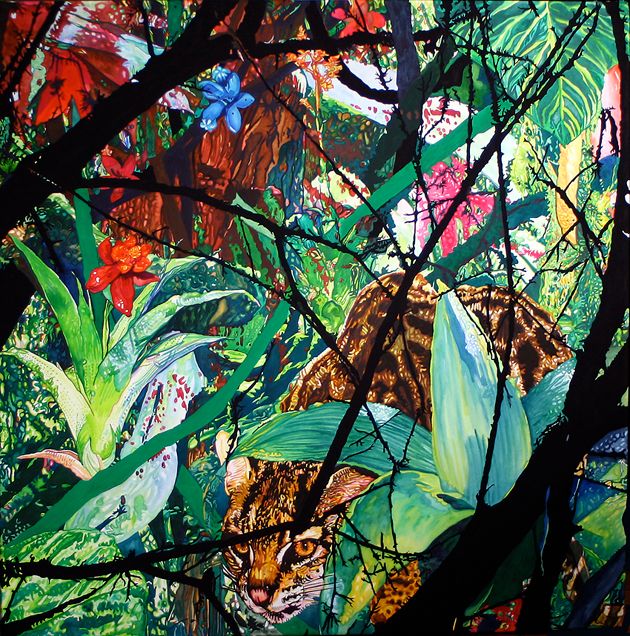
Christopher Reiger
"between meaning and material (h.H.R.)"
2007
Watercolor, gouache, graphite and marker on Arches paper
32 x 32 inches
Diminutive yet captivating, the ocelot (Leopardus pardalis) is my favorite cat species. I've only appreciated the beautiful feline on film and in photographs, but am nonetheless impressed to near reverence. I delight in the animal; I marvel at his dappled coat as he passes through dense foliage and I am humbled by her grace and cunning gaze.
Years ago, when working at a eco-tourism tent camp on Costa Rica's Osa Peninsula, I had the privilege of tracking an ocelot's nighttime doings along a Pacific beach that abuts a steep jungle mountain. I didn't discover the cat, but I took great pleasure in tracing the cat's movements, and I was deeply grateful for the opportunity to commune with the creature, even in so simple a fashion.
It is with great distress, then, that I consider the plight of the ocelot and other species in the Lennox Foundation Southmost Preserve, a 1,034-acre preserve located at the southern tip of Texas. As proposed by the United States Department of Homeland Security, the Mexico-U.S. border fence will pass through the center of this preserve, up to a mile-and-a-half north of the actual border. Three quarters of the preserve will thereafter be inaccessible by employees of the Nature Conservancy, the organization that currently manages the property. Because the Nature Conservancy refused the USDHS buy out, they are being sued by our federal government.
In her Nature Conservancy Magazine article "Don't Fence Me Out," Jennifer Winger writes:
"Once known as the Wild Horse Desert, south Texas may support more wildlife per acre than any other habitat in North America. And although the Rio Grande Valley itself has lost more than 95 percent of its wildlife habitat, Southmost Preserve is a shining exception: Its lands and waters provide habitat for endangered species such as jaguarundis and ocelots, as well as indigo snakes, Texas tortoises and migratory birds.Contemplating the myopic vision of the USDHS, I recalled an earlier HH post that questioned that morality of building a border fence. In light of this recent news from Texas, I've decided to republish "Border (Bio)diversity (of opinion)" today.
But recently, this valuable habitat has been threatened by an 18-foot-tall concrete and steel fence proposed by the Department of Homeland Security. Most of the proposed 670-mile-long border fence, with segments from California to West Texas, has already been constructed, but the section slated to cut through the Conservancy’s land is on hold, pending the outcome of a legal battle.
...If the fence is built, nearly 700 acres — 75 percent of the preserve — would be trapped in a no-man’s-land between the fence and the Rio Grande, including all preserve facilities and the home of the preserve manager. The proposed fence would effectively cut off access to the native plant nursery, which is critical to reforestation efforts throughout south Texas. Additionally, the fence would sever a critical corridor for wildlife, as it could block animals from accessing protected areas to the north and freshwater resources to the south."
+++++

The Robert Smithson in me is bemused by international borders, particularly those boundaries that are not physically demarcated, lines that exist only in cartography and our collective political imagination. Last night, I contemplated a striking black-and-white photograph of the Mexico-U.S. border. The image was dominated by a rural "vehicle barrier" fence (similar to the one shown above), far removed from an official border checkpoint or crossing. In the desert of the American Southwest, this fence draws an arbitrary line in wire and steel.
It struck me as an emblem of humanity's absurdly tenuous existence, a reminder that our species is an insignificant mote in an incomprehensibly tremendous weave. As the artist Carl Buell wrote in the comments section of a recent HH post,
"With every change in sea level and shoreline, with the raising or eroding of every mountain range, with every changing weather pattern, life spreads out as it can and comes into contact with new environments, opportunities and hazards...As I get older (than dirt), I find myself starting to think like the hills themselves. Some day after eroding and washing out to sea, I’ll be a hill again."Indeed, each of us (and, eventually, our species) will be reconstituted, and our arbitrary borders, those lines in the mud of space-time, will be erased. In this respect, the border fence is a healthy reminder of our existential folly, but it also reveals humanity's darker inclinations. We build fences, after all, to divide "us" from "them," the demonized "other."
The photograph that inspired this post was printed in the most recent issue of Wildlands Connection, the Wildlands Project newsletter. It accompanied an article about wildlife bottlenecks at the Mexico-U.S. border. The Wildlands Project's mission is to create vast, uninterrupted linkages, known as wildlife corridors, that will extend from Canada into Mexico (on the Rockies spine) and from Canada into Florida (on the Appalachian spine). The U.S.-Mexico border fence is a major obstacle to the organization's first goal.
Yet physical barricades are but one of the obstacles that ambitious conservationists face. Consider wildlife trade legislation that protects species in one country, but not another, adjacent nation. If strict laws prohibit the trapping or hunting of a species in China, for example, but not in neighboring Mongolia, is the Chinese legislation effectively addressing species welfare (particularly when Chinese citizens are paying top dollar to have the killed contraband imported)? Similar issues haunt conservation efforts the world over.
The humanitarian and social concerns that ethically-minded conservationists must take into account present a more nuanced hurdle. Environmental groups in the European Union are warring with one another about how best to create the legislative and physical infrastructure necessary for sustainable energy development. How can you raise thousands of wind turbines without hindering bird migration, ruining aesthetics, or plopping towers in the backyards of folks too poor and disenfranchised to protest?
If the various interest groups in the EU, one of the most environmentally progressive governing bodies in the world, are at odds, is it realistic to expect conservation to become a truly supra-national affair? After all, the EU's concerns are petty alongside those of the southern hemisphere. Whereas Europe is a sprawl of cultivated landscape relatively lacking in biodiversity, the "Third World" represents the usually disastrous meeting of remarkable biodiversity and an exploding human population. Impressed by our terrible example, the citizens of these nations emulate the unsustainable behavior of the "First World." In order to counter the detrimental environmental effects of Third World industrialization, international legislation will face increasingly substantial challenges. The supra-national bodies can create laws, but can we enforce these laws without wielding the colonial sceptre? More critically, can we conserve biodiversity and healthy ecosystems without subjugating the rights of the humans that call the Third World home?
These questions bring me to "Climate of Fear," a recent book by the eloquent Nigerian poet, essayist and Nobel Laureate, Wole Soyinka. Though Soyinka is writing about humanity's attempt to cope with terrorism, his political thrust is applicable to all realms, and his message is clarion.
"The gray zones of moral definitions where relativity reigns and remote cause are evoked to justify the abhorrent will continue to haunt certain casts of mind. The rest will insist on the primacy of an ethical will, one that dictates that some deeds demand to be judged within an identifiable and shared moral universe, however restricted...The ethical will is the redeeming assertion that, even when all other considerations of social conduct are subjected to the fortuitous, one, an ethical core, remains inviolate."All of our fences fail. Perhaps we should recognize in that certainty both an entropic truth and an implicit morality. Within the context of this "shared moral universe," we are impelled to remove artificial barriers, whether they are constructed to stem the natural tide of human migrations or to protect us from our enemies. No matter the justification for the boundaries we draw, they are immoral inventions. And man, it is said, is the moral animal.
Photo credit: ripped from Kris Eggle's website
Thursday, June 04, 2009
A Decade On

"My friend told me that story about waiting in line for the Village Voice to come out so he could see what jobs were available. I thought that was really striking because it really wasn’t that long ago, and it’s so different from the way we do things today."I moved to New York City in October of 1999. Through a friend, I'd secured a basement bedroom on East 7th Street, but I hadn't found a job. Like many other unemployed New Yorkers, on Wednesday mornings, the day of the paper's weekly printing, I poured over the classifieds section of the Village Voice, circling any interesting job listings in red or green ink. Three weeks after I arrived in the East Village, I enthusiastically accepted a position as an art gallery preparator.
- Elizabeth Goodman
This morning, while reading Rachel Brodsky's Flavorpill interview with Elizabeth Goodman, I recalled those uncertain, early weeks in NYC. I also marveled, like Goodman, at how very differently we conduct job searches a decade later.
Photo credit: ripped from WhoIsStan's Flickr photostream
Monday, June 01, 2009
Fogged Clarity
My artwork is included in the June issue of Fogged Clarity: An Arts Review. The Michigan-based literary and arts journal is published monthly online; print versions are released three times a year.
Executive Editor Benjamin Evans writes of the June issue,
Executive Editor Benjamin Evans writes of the June issue,
"But for now it is the beginning of summer, so open a window and an ale and enjoy our June offering. I sit down with Joe Meno to discuss his eloquent and sensitive new novel, 'The Great Perhaps.' Jascha Kessler’s essay 'A Modest Proposal' is licentious and brilliant. Lewis and Clarke’s Lou Rogai sings about the passage of time. Poet Chris Hosea debuts and reads two dynamic new poems. Author Richard Cassone explores a day in the life of a blind child. Chicago artist Damara Kaminecki stretches form and function. And many other gifted people interpret the world, examine their heads, and make magic in multiple mediums."The direct link to my Fogged Clarity contribution is here, but I recommend that you take time to enjoy the rest of the June issue.
Saturday, May 30, 2009
New limited edition prints
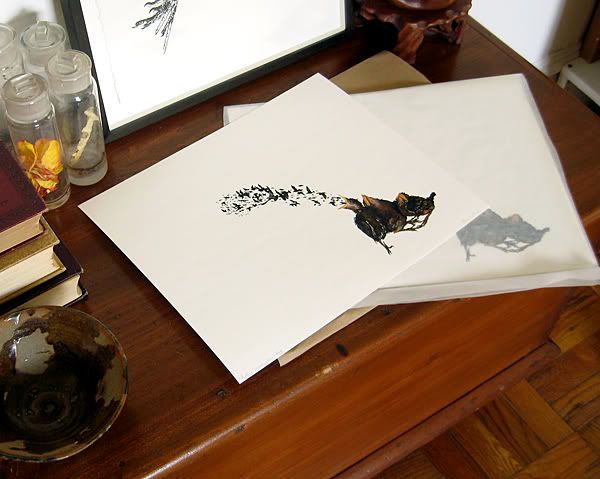
"further murmuration"
Archival Pigment Print on Acid Free Cotton-Rag Paper
Limited edition of 25
11 x 14 inches
It gives me great pleasure to announce the release of limited edition prints of two of my 2008 drawings, "further murmuration" and "Synesthesia #1." I worked with the terrific printer Gabe Greenberg, of Greenberg Editions, to produce the prints. I'm thrilled with the handsome results.
View more detailed photographs of the prints here and here.


In accordance with my charitable sales model, 50% of every print sale will be donated to one of the four non-profit organizations I am currently partnered with. For more information on how this works, please visit the charitable sales model page of my website.
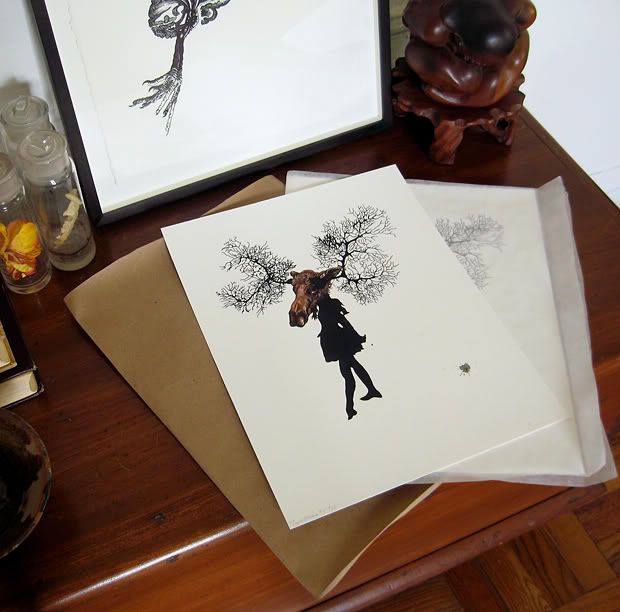
"Synesthesia #1"
Archival Pigment Print on Acid Free Cotton-Rag Paper
Limited edition of 25
14 x 11 inches
Photo credits: Hungry Hyaena, 2009
Tuesday, May 26, 2009
Ward Shelley at Pierogi

"Autonomous Art, ver.1"
2007 - 2009
Oil and toner on mylar
24 1/4 x 36 inches
"Who Invented the Avant Garde - and other half-truths," Ward Shelley's recent solo exhibition at Pierogi, is comprised of striking schematic paintings that anatomize the development of intellectual and social streams within the humanities. The artist describes them as "attempts to use real information to depict our understandings of how things evolve and relate to one another, and how this develops over time."
In spirit as well as in appearance, then, Shelley's paintings are cousin to phylogenetic trees, the taxonomic diagrams that biologists use to denote evolutionary relationships among species. But, though Shelley's genealogies look like mappings of biological exuberance, the subjects of his brightly colored, illustrative works are not so scientific: Frank Zappa; Beat Generation writers; nodes of postmodern philosophy; modern art movements.
Importantly, even as Shelley strives to elucidate these cultural begats (whether a seed that becomes a trunk or an ill-fated offshoot), the artist acknowledges that a subjective filtering of "the facts" is central to his paintings. He writes,
"[...] We know this content is mediated in a thousand ways before it takes shape in our awareness. Moreover, content is also shaped by the receiving mind which, as a pre-existing form itself, exerts a strong shaping influence."Unfortunately, although Shelley's project is intelligent and the stylized diagrams he produces are visually remarkable, his subject matter will appeal to a narrow band of viewers. The afternoon that I visited the Pierogi space, a thirty-something couple contemplated each of the works at length, earnestly discussing an array of topics including the career trajectories of obscure members of Andy Warhol's entourage, Francois Truffaut's filmography, and Nixon-administration flunkies. Their exchange was more a trivial cataloging than a conversation and, in style and substance, they struck me as a sendup of the well-educated hipsters that populate Williamsburg, Brooklyn.
There are far more interesting things to discuss than the 20th century's pop-political canon and Shelley's most rewarding pieces - "Autonomous Art, ver.1" and "Counter Culture, ver.1," for example - consider significant, sweeping lineages. I hope that his lens continues to broaden.

"Autonomous Art, ver.1"
2007 - 2009
Oil and toner on mylar
24 1/4 x 36 inches
Image credits: copyright, Ward Shelley
Monday, May 25, 2009
To Philosophize

"a mode of becoming"
2008
Watercolor, gouache, pen and sumi ink on Arches paper
16 x 12 inches
"To philosophize is to articulate and express our personal reactions to the mystery which we call life, both with regard to the nature of that mystery and with regard to its meaning and purpose.
My answer to the question 'Why do we philosophize?' is as follows. We philosophize for the same reason that we move and speak and laugh and eat and love. In other words, we philosophize because man is a philosophical animal. We breathe because we cannot help breathing and we philosophize because we cannot help philosophizing. We may be as sceptical as we please. Our very scepticism is the confession of an implicit philosophy. To suppress the activity of philosophizing is as impossible as to suppress the activity of breathing."
-John Cowper Powys, "The Complex Vision"
Saturday, May 23, 2009
Inside the Yankees' Compost
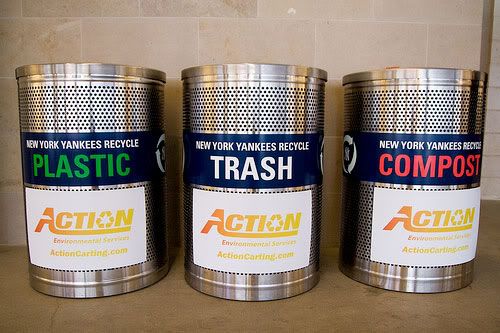
Although this Cubbies fan isn't fond of the New York Yankees, I spent an enjoyable May afternoon at a ball game in the new Bronx stadium. I was pleased to see that the stadium management team is making an earnest effort to be environmentally progressive. The stadium's food containers are bio-degradable, and separate waste bins for trash, plastic and compost are stationed throughout the ballpark. These bins are labelled clearly and usually positioned next to one another.
Unfortunately, your average baseball fan doesn't know what "compost" is. I snapped the below picture of a Yankees fan throwing balled-up napkins into a "compost" receptacle, and witnessed similar mistakes all afternoon. Depressingly, the "plastic" bins fared little better.
Perhaps Yankee Stadium management needs to station waste educators near the bins? The ticket prices are surely high enough to cover the cost!

Photo credits: Yankees waste bins image, ripped from SeriousSeats.com; fan abusing compost picture, Hungry Hyaena
Subscribe to:
Posts (Atom)