Wednesday, January 13, 2010

"Vision Quest"


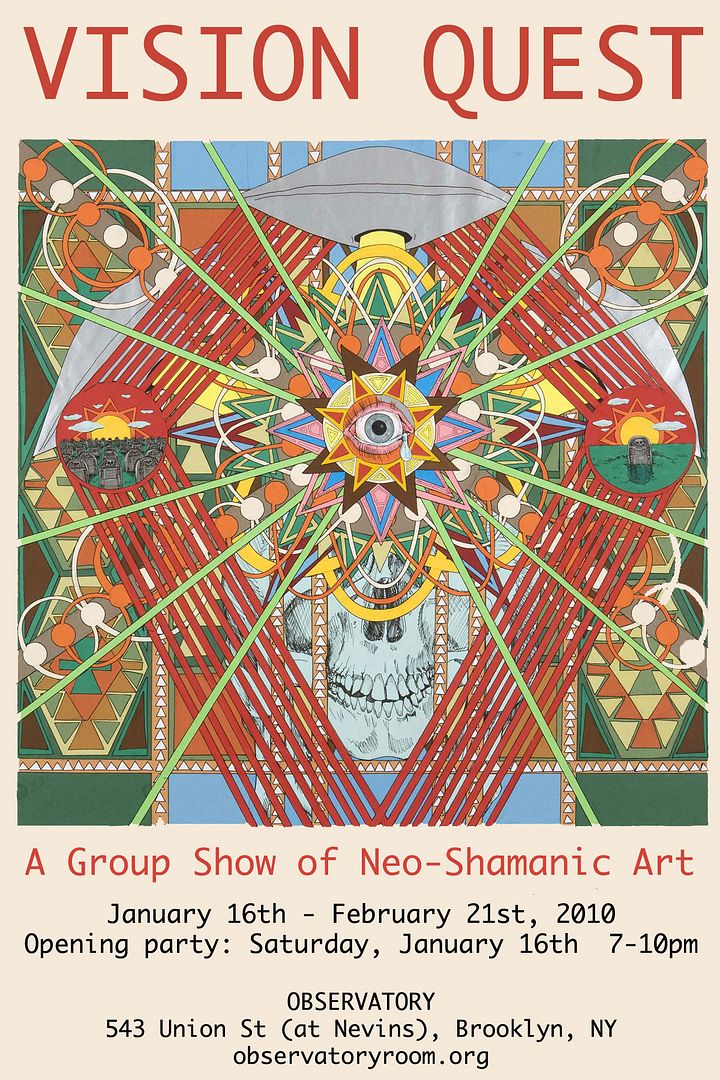
I am delighted to announce that one of my 2007 paintings, "a cruel and beautiful faraway place," is included in "Vision Quest,' a group show curated by the celebrated artist/art blogger/musician Pam Grossman. The exhibition will be on view at Observatory, in Gowanus, Brooklyn, NY.

The opening is this coming Saturday, January 16th, from 7-10pm. The reception will surely be a lovely way to start your Saturday evening, but if you can't make it, I hope that you'll have an opportunity to visit the show while it's on view (through February 21st). Full exhibition details and the press release follow.

+++++

"VISION QUEST – A Group Show of Neo-Shamanic Art"

Observatory
543 Union Street (at Nevins)
Brooklyn, NY 11215

On View: January 17th– February 21st, 2010
Opening: Saturday, January 16th, 2010, 7-10pm

Gallery Hours: Thursdays & Fridays 3-6pm; Saturdays & Sundays 12-6pm

OBSERVATORY and Phantasmaphile's Pam Grossman are proud to kick off 2010 with VISION QUEST, a group show of neo-shamanic art, on view from January 16th through February 21st.

A healer, a medicine (wo)man, a guide: the shaman is a figure who interfaces with nature magic and the invisible world at large, for the betterment of the tribe. Fluent in the language of symbols, and a perennial student of plant wisdom, the shaman is also a translator – bringing back messages from a place veiled thick with leaves, bones, smoke, ghosts.

This journey to the other side – to the innerside – is not just a flowery promenade of song and trance; of friendly animal spirits and ancestral reunions. For while this land is rife with vibrant, variegated beauty, it can also be a danger zone. Images of decapitation and dismemberment abound - though ultimately act as portents for personal transformation and rebirth. This shadowy terrain is trod only by those brave enough to encounter whatever may be found along the way, as each sojourn is mysterious, thoroughly unpredictable, and entirely individual. However, the results of the trip often prove invaluable, as the traveler returns armed with knowledge that will in turn illuminate and repair the community, and fortify his or her own soul.

While the role of the shaman has traditionally been fulfilled by experienced elders in indigenous groups spanning culture and time, VISION QUEST posits that our artists fit the bill as well. Today, with more of us living in an urban jungle rather than a real one, it has become all the more important to figure out ways to internalize the lessons of nature: its growth, its brilliant bloom, its death. And in an age of digitization and distraction, of wire vines and humming screens, it’s no wonder we long for deeper, more sensory experiences of self - with all of its darkness and divinity.

As such, each piece in VISION QUEST explores the archetype of the shamanic voyage, using the tools of paint, pencil, or paper in lieu of fire, flower, feather. Taken together this work represents a full spectrum of what it means to go underground and out of body; to go there and come back again, perhaps just a little bit wiser or, at the very least, more wide awake.

PARTICIPATING ARTISTS
Jesse Bransford
William Crump
Scott Gursky
Juliet Jacobsen
Ashley Lande
Adela Leibowitz
Jason Leinwand
Christopher Mir
Joe Newton
Herbert Pfostl
Christopher Reiger
Christine Shields
Erika Somogyi
Jessie Rose Vala

Image credit: Jason Leinwand "Accepting Fear Rather Than Trying to Understand It"

Saturday, January 09, 2010

The Art Community and Common Sense


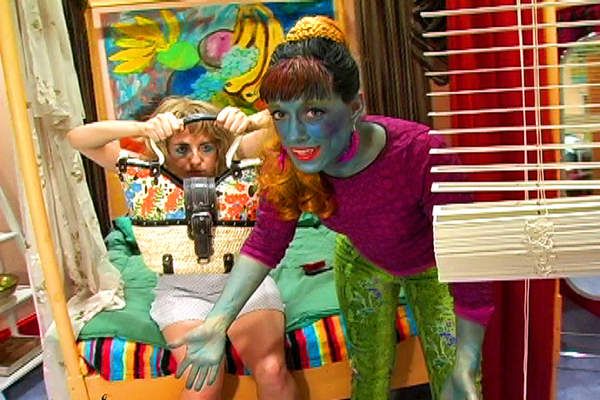
Ryan Trecartin
"I-BE AREA"
2007
"Everybody gets so much information all day long that they lose their common sense."

- Gertrude Stein
We're a week-and-a-half into 2010, and I'm hoping that the din produced by so much fin-de-decade media will soon die down. It's no secret that we citizens of the United States (and all other essentially "Americanized" peoples) are principally defined by our consumption. What's more, after decades of adaptation to the consumer role, we've become so fond of the talk surrounding our consumer products that the consumer reviews themselves have become another kind of consumable. Regrettably, this is no less true in the arts.

I've made a contrarian effort this year to avoid most of the "Top" lists and their Op-Ed equivalents, but I've not been totally chaste. The diviners of social, political, or cultural trends have been working furiously to meet their deadlines, and the surplus of art-related stock-taking is in large part responsible for the dearth of new HH content. Anything that I write here will only add to the pervasive and stupefying hubbub; it is further distraction from the business of life well-lived.

And yet, here I sit, writing this post. Like all the other commentators, I'm guilty of editorializing and contextualizing that which is better meditated upon individually or mulled over with our loved ones. And I'm guilty of adding one more perspective to the countless millions already vocalized, furthering the unfortunate and wrong-headed belief that subjectivity reigns. What I'm engaging in, then, is dangerous. While post-modern notions of relativism are valid and philosophically valuable, our globalized culture must strive to sort, such that we can, the wheat from the chaff. That is to say, in a time of increasing cross-cultural interaction, the need for some consensus, some agreed upon hierarchy of moral, ethical, and aesthetic value, is acute. It is a dangerous and exciting era; as such, it is a good time to be a artist.

I agree with Roberta Smith's contention that "the years 2000 to 2009 saw the emergence of a tremendous number of really good, interesting, promising artists." My list of "really good" artists, however, is very different from hers, and Ryan Trecartin, one of the artists that the New York Times' critic celebrates in her recent article, "Make Room for Video, Performance and Paint," is definitely not on it. I don't know Trecartin personally, and he may be a well-meaning, pleasant enough person, but his artwork is poisonously self-absorbed. In this respect, at least, Smith is right to assert that he is an important representative of the decade past. The art world, and especially that of New York City, the community to which I'm most attached, has seen an explosion of navel gazing.

To be fair, most artists engage in some level of narcissism. At the end of the 1990s, when I was in my early twenties, I had puerile aspirations to produce "art videos" of my ejaculating penis (paging Sterling Ruby), and my paintings were dominated by angst-ridden self-portraits and hyper-sexualized imagery. The few paintings of that period that survive are today stacked in my parents' Virginia garage, partly covered by a plastic tarpaulin and years of accumulated mouse shit and winter-killed wasp corpses. Such is the fate of personal history. Serpent-like, we periodically shed our skins and move on, hopefully a little more wise. Some of us, however, put our sheddings and bruises on display, mistaking personal exposure for bravery. Indeed, in some contexts it is brave, but when the sharing is marshalled in service of a cult of personality, it is a celebration of individual dysfunction. And when such exhibitionism is mistaken for art, it is an indication of critical and cultural dysfunction.

Believing that art is fundamental to humanity, and that it is transformative and sacred, I don't accept Freud's famous contention that the artist is a neurotic who seeks to attenuate or postpone confrontation of his or her mature psyche. In fact, for most of our species' tenure, the role of the artist was precisely the opposite; we were called upon to ground our brethren is real experience, be it material or metaphysical. Yet Freud's categorization accurately describes much of the juvenalia that passes for contemporary art. Certainly, we artists should be embarrassed by this trend, but you can't kill the messenger, as the saying has it; Trecartin and others creating hysterical or megalomaniacal artworks are reflections of the dominant (and apparently yet ascendant) iCulture. It is instead the critics and the gallerists, the purveyors of taste, that should be most ashamed of themselves.

Essayist, critic, and philosopher George Steiner is far more intelligent and incisive than I, so I include a pastiche of pertinent excerpts from his 1989 book, Real Presences.
"The usages and values predominant in the consumer societies of the West today [are] the secondary and the parasitic[...]. Literate humanity is solicited daily by millions of words, printed, broadcast, screened, about books which it will never open, music it will not hear, works of art it will never set eyes on. A perpetual hum of aesthetic commentary, of on-the-minute judgments, of pre-packaged pontifications, crowds the air. Presumably, the greater part of art-talk or literary reportage, of music reviews or ballet criticism, is skimmed rather than read, heard but not listened to. None the less, the effect is antithetical to that visceral, personal encounter[...]. There is little 'ingestion'; it is the 'digest' that prevails.

[...]

The journalistic vision sharpens to the point of maximum impact every event, every individual and social configuration; but the honing is uniform. Political enormity and the circus, the leaps of science and those of the athlete, apocalypse and indigestion, are given the same edge. Paradoxically, this monotone of graphic urgency anaesthetizes. The utmost beauty or terror are shredded at close of day. We are made whole again, and expectant, in time for the morning edition.

[...]

Two principal impulses energize the American spirit: immanence and egalitarianism. The crux of American time is now. The past matters in direct reference to its usability in and by the present. [...] No other culture has so dignified the immanent. [...] Poets, novelists, choreographers, painters of the most derivative or passing interest, are made the object of seminars and dissertations, of undergraduate lectures and post-doctoral research. The axioms of the transcendent in the arts of understanding and of judgment [...] are invested in the overnight."
Steiner, I presume, frowns on the Top Ten lists and "best of the decade" summaries as much as I do. I also believe that he would dismiss as "derivative or [of] passing interest" most (though not all) of the artists that Smith praises in her article. The cultural longevity of most on Smith's list is questionable, certainly alongside the likes of Alec Soth, Bill Viola, Matthew Day Jackson, Omer Fast, or Tom Uttech, all contemporary artists crafting intelligent and soulful artworks.

Smith writes, at the article's close, "In all, we are confronted with the distinct possibility that quantity and quality may not be so mutually exclusive after all. More means more better." That's very true. But more also means more bad, of course, which is why we today have an urgent need for critics, curators, and gallerists who, like Steiner and Donald Kuspit, are willing to reside outside the community, to avoid political entanglements, and to judge, sometimes harshly. To those critics, artists, and gallerists already plugged in, let's begin this decade, this arbitrary but useful marker in our human journey, with a renewed commitment (a resolution, if you prefer) to be more rigorous, contemplative, and socially committed. The art world, like the world at large, needs fixing, and responsible action is the only thing for it.

Happy Twenty-Ten. Here's hoping that it's healthy and auspicious.

Image credit: Ryan Trecartin, 2007

Tuesday, December 29, 2009

A Birthday Gift


Shell Beach; Sea Ranch, CA

On the morning of my 32nd birthday, I am sitting on the northern California coast, watching a great egret balance on a raft of dead sea grass. The grasses are held in suspension on the Pacific Ocean's surface by submerged kelp beds, and the white bird rises and falls atop the coastal surge, otherwise motionless as it awaits potential prey. A pair of brown pelicans glides north, just over the waves.

32 years on this Earth, and still I feel like I am opening my eyes for the first time.

Photo credit: Hungry Hyaena, 2009

Monday, December 21, 2009

Or A Falcon


Peregrine falcon (Falco peregrinus); New York City

"I am no more lonely than a single mullein or dandelion in a pasture, or a bean leaf, or sorrel, or a horse-fly, or a bumblebee. I am no more lonely than the Mill Brook, or a weathercock, or the north star, or the south wind, or an April shower, or a January thaw, or the first spider in a new house."

- Henry David Thoreau
Image credit: ripped from Pete.Mac's Flickr photostream

Wednesday, December 16, 2009

Global Climate Justice Fast


350 Candle Vigil; Washington Square Park, NYC; December 2009

"How well we control our numbers, our appetites, and the efficiency with which we satisfy those appetites will ordain just how desperate the situation becomes. They are the battles for our time, as morally compulsory as the battles for civil rights or against totalitarianism."

- Bill McKibben, The End of Nature

The group gathered at the northern entrance of Washington Square Park last Friday evening was smaller than I'd anticipated. We were assembled for a candle vigil in conjunction with the United Nations Climate Change Conference in Copenhagen, Denmark, and 350.org, environmental activist Bill McKibben's project to increase global awareness of the environmental (and status quo) threats posed by the exacerbation of climate change due to anthropogenic influence.

The New York City vigil was one of hundreds of similar events happening around the world on December 11th. Given the date, the vigil was also a satisfying way to bring in Hanukkah, a holiday that, despite its complicated history, is essentially about standing up for the causes that you feel most strongly about, even in the face of overwhelming odds. Small though our Washington Square Park group may have been, then, I was upbeat and hopeful.

Tomorrow (Thursday, December 17th), there is more cause for hope. I'll be one of thousands (hopefully one of many thousands) of true cosmopolitans forgoing food as part of the Global Climate Justice Fast. Bill McKibben's organization is trying to spread the word from Copenhagen, but the easiest place to sign up is at the Climate Justice Fast website. The official statement of the fast participants reads:
"We will fast voluntarily, for one day on Thursday, in solidarity with the millions who have and could lose their lives to preventable and involuntary hunger, disease and conflict resulting from climate change.

We call on world leaders for a real climate deal now--a deal grounded in science and strong enough to get us back to 350 [parts per million]."
I urge HH readers to take action this season. The specifics of your engagement matters less than its spirit. As I wrote not long ago,
"If global warming isn't appealing to your still, small voice, get involved with political activism, volunteer at your local homeless shelter, pledge financial support to non-profit activist organizations working for causes that you feel strongly about; it doesn't matter what you do, but it does matter that you do something. Turn off the television, put down the tabloid. I beg this of you."
If you have the energy and spirit to take action in multiple ways, so much the better, but every little bit helps. We're all in this marvelous mess together.

Monday, December 14, 2009

Turn That Frown Upside Down


Olaf Breuning wall drawing; Metro Pictures Gallery; November 2009

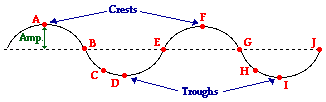
In "Riding the Waves," a post that I wrote in August 2005, I described the creative process as a wave of crests and troughs. I recalled the post recently, when viewing Olaf Breuning's Metro Pictures exhibition, "Small Brain Big Stomach." One of Breuning's amusing wall drawings depicts passengers aboard small boats, smiling when atop a crest, and frowning when at a trough's bottom.

From the original post:
"The creative process has much in common with a wave. When the artist finds herself atop a crest (Points A and F in the above wave diagram), life is grand. This peak is short-lived, however, and plateaus are rare; the bow of the artist's little boat begins to nose downward soon enough. Heading downslope is not all bad; during the descent, the artist is generally content, busy producing work associated with her last creative crest. But as the boat's bow nears the base line (Points B and G), she begins to fret...about everything.

[...]

Generally, I'm an upbeat individual. Despite some seemingly pessimistic attitudes regarding long-term ecological health, not a day goes by that I don't appreciate being here. The world is an amusement park of ideas and discoveries, and I simply can't understand how anyone could be bored or uninspired. That said, the creative troughs do pull me very low. I become self-absorbed, distracted, pessimistic, and argumentative. In short, I'm not a pleasant person to be around.

There are two ways for an artist to ride out a creative slump. I might opt to stop producing work for a spell, hoping that a break will sort things out. Alternatively, I can work wildly, embracing whatever inspiration compels me. More often than not, the latter, active approach is the one I choose. Something useful may come of the mess."
In some respects, I'm in a trough presently, and have been since October. This particular trough, however, hasn't made me unpleasant "to be around," and I'm happily plugging away on studies for new paintings and drawings, even if my pace has been adversely affected. Maybe I'm just getting better at contending with creative highs and lows? I hope so!

Image credit: (oddly) "The Lord's Daily Way" Bible Study at keyway.com

Saturday, December 12, 2009

Sunset, Sunrise


Heron Hope sunset; November 2009

"Our destiny, our being's heart and home,
Is with infinitude, and only there;
With hope it is, hope that can never die,
Effort and expectation, and desire,
And something evermore about to be."

- William Wordsworth, The Prelude


"Indeed, from within the murkiness of human knowledge and experience, we rightly wonder, is there any room for theology as such - or has it gone the way of all heavenly things? Perhaps all that remains is some mode of natural piety, such as the shudder before the mortal mysteries (with Goethe), or the felt ecstasies of springtime (with Wordsworth). Surely this is a lot, and unsettles the mind from its human habitudes. But is there more?

[...] Like all matters human, theology must be grounded in earthly experience and understood from within its forms. The phenomenal world is all that we have. This is the sphere that lies before us in our everyday existence; it conditions the products of aesthetic perception; and it provides the sphere for theological experience and reflection.

[...] As natural beings we are, in the most elemental sense, coextensive with this realm: our bodies are composed of it, our stomachs take in and digest its matter, and we traffic with this world all our days until we die and are decomposed into its elements. [...] To more properly sense [the] unfolding of the Godhead into world-being, so to speak, or to perceive or intuit its penetrations therein, we must first return to our ordinary experiences."

- Michael Fishbane, Sacred Attunement: A Jewish Theology


Sunrise at Heron Hope; November 2009

Happy Hanukkah, folks.

Photo credits: Hungry Hyaena, 2009

Tuesday, December 08, 2009

"Two Degrees of Separation"


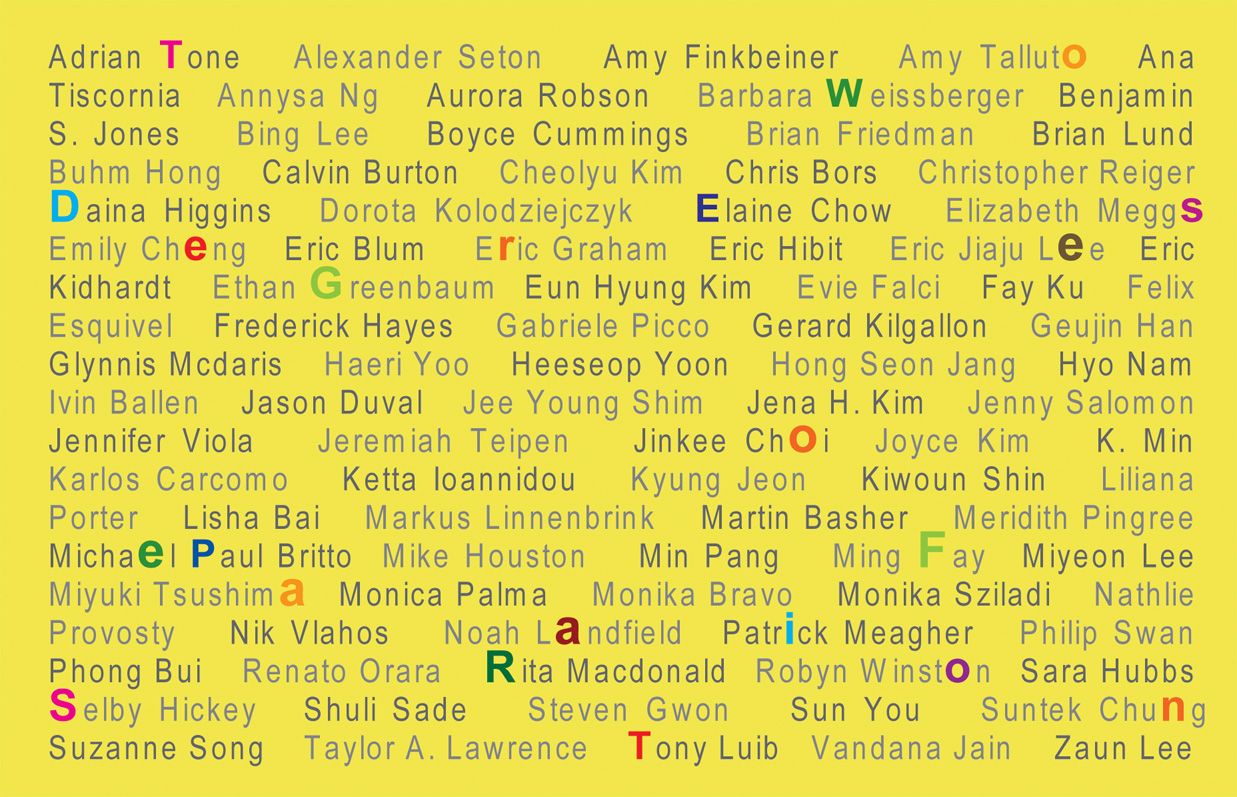
One of my drawings is included in "Two Degrees of Separation," a well-populated group show that opens this Thursday at Gallery SATORI.
"Gallery SATORI is pleased to present 'Two Degrees of Separation,' a group exhibition with ninety artists to be held in the Project Space and Lounge at Gallery SATORI. The artwork ranges widely from intimate paintings to delicate paper sculptures to videos on minute monitors to a ceramic soccer ball. The show investigates the web-like interrelationship between many of the artists working in New York as well as a few artists working in London, Seoul, Tel Aviv, and Sydney who have connections to the artists based in New York.

The relationships may include friends, colleagues, partners, lovers, spouses, studio-mates, room-mates, friends of friends to shared experiences in educational programs, residency programs, artist panels, and exhibitions. Some may not remember how or when they have met or why they know the person but when asked if they know him/her the answer is 'yes.'"
If you're in NYC, please stop by Thursday evening to say 'Hello'...assuming you can find me in what's sure to be a very crowded gallery!

++++

"Two Degrees of Separation"
December 9, 2009 - January 24, 2010
Opening reception: Thursday, December 10th, 6 - 8 PM

Gallery SATORI
164 Stanton Street
New York, NY