Zena el-Khalil, an artist friend of mine from graduate school days, lives and works in Beirut, Lebanon. This past week she has been sending regular email updates to family, friends and acquaintances. These missives are now being collected online at Beirut Update.
Whatever your feelings about the region's hellish situation, I recommend a read. Zena's voice vacillates from that of an anxious hysteric to a relatively calm observer. Any perspective or agenda, be it that of the BBC, ABC, NPR, the Jerusalem Post, or Addiyar, will be regarded as biased. Rightly so! Such subjectivity, then, demands vigilance on the part of the participating global citizen. The more sources considered, the more complete the picture, terrible and indistinct though it may still remain.
Let us hope that some sense is made of this mess, and that the killing ends soon. What's more, let us remember that faraway conflicts are, in this day and age, immediately relevant to each and every one of us.

Wednesday, July 19, 2006

Tuesday, July 11, 2006
Thinking Like A Mountain?

Erik Reece's eloquent essay, "Death Of A Mountain: Radical Strip Mining and the Leveling of Appalachia," was included in the April 2005 issue of Harper's Magazine. The piece examines and responds to environmentally devastating coal mining practices in eastern Kentucky. Appropriately enough, I read the work while standing in an abominably long line at the World Expo, in Aichi, Japan, the first World's Fair dedicated to "green" thinking or, as the Japanese organizers dubbed it, "Nature's Wisdom."
Every pavilion in the Aichi Expo was sponsored by either a nation or a corporation (a sign o' the times), and they all forecast a happy, healthy, and sustainable future for humanity and for the planet. Reece's melancholy report provided a sobering counterpoint. A "green future" is tenable only if the necessary changes in technology and lifestyle generate an altogether different kind of green: cash money. As the wife of a Kentucky coal miner asks Reece, "What use are the mountains to us other than coal? When are you going to start thinking about us instead of the environment?" Until alternative energy cheerleaders assuage the concerns of those citizens dependent on income provided by companies like Leslie Resources Inc., one of the mining outfits indicted in Reece's article, America's hard-working, blue-collar folks will remain united in opposition to the relatively privileged mouthpieces of environmentalism.
In "Death of a Mountain," Reece describes the minutes of a Kentucky hearing addressing an Environmental Impact Statement on mountaintop removal, the principal method of tapping into buried coal seams. The local coalfield citizens in attendance, many of them employed by the region's energy companies, reacted against "outsiders" telling them what was best for them and for their land. They even hinted "at a conspiracy afoot by the rest of the state to keep eastern Kentucky poor." Not surprisingly, such vehement antagonism to "greening" measures were not highlighted at the Aichi Expo. Likewise, they receive scant attention in environmental publications, even those produced by more thoughtful organizations,including The Sierra Club, Natural Resources Defense Council and EarthJustice. It's clear that most environmentalists don't consider the lives of those people displaced by expanding parkland or laid off by companies under siege from environmental legislation. It's little wonder that "Third World" countries and blue-collar workers like the Kentucky miners or the fishermen of the Galapagos islands object to what they consider do-gooder meddling.
In Aichi, I looked up from the magazine and noticed a Japanese teenager in line not far behind me. He was wilting under a sun umbrella, wearing a t-shirt emblazoned with a picture of the popular American hip-hop duo, Outkast. Fond of connecting seemingly unrelated strands, I thought of the Outkast song, "Return of the G." The lyrics of the song begin, "Every time I try to get peace of mind, niggas try to get a piece of mine, so I gotta grab my piece." The song concisely describes an ugly, myopic cycle, but how much easier for me to characterize it as such when I can afford a plane ticket to Japan and enough over-priced, organic vegetables to fill my canvas grocery sacks?
As a proponent of conservation and environmental protection, I'm necessarily guilty of prioritizing the sustainable long-view over the millions of people vying to put food on their plate. I considered this distressing reality as I entered the air-conditioned Hitachi Pavilion in Aichi to watch an animated feature about the catastrophic - nay, apocalyptic - events brought on by humanity's cavalier approach to natural resource consumption.
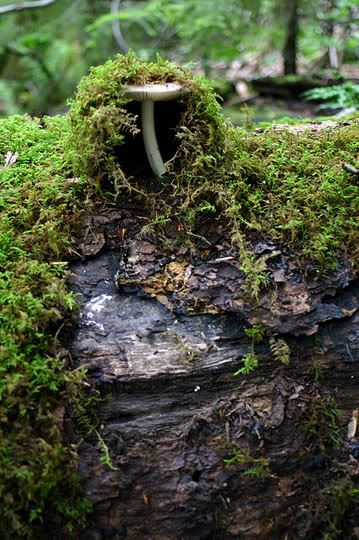
Similar considerations were on my mind this past week, when I traveled to the Monongahela National Forest, in eastern West Virginia, for some camping, hiking, and herping. I know very little about West Virginia, despite having spent several summers at Camp Greenbrier, situated just outside Alderson, in the southern part of the state. During those summers I learned about kayaking, archery, riflery, rock climbing, and the cruel conduct of boys left unsupervised, but I was too young - just nine or ten years of age - to absorb much about the region save the scenic beauty.
Following those camp years, John Denver's song "Country Roads," a particular favorite of my mother, acquired new significance for me. "West Virginia, mountain momma...take me home," Denver sings. Having appreciated the lush splendor of the Appalachian range for myself, Denver's lyrics imparted an aesthetic association as well as the allusion to a mother's buxom embrace. But Denver's paean doesn't only acknowledge West Virginia's awesome landscape. He refers to the state as the "miner's lady...dark and dusty." Even the state's coat of arms, central on the state flag, pictures a miner, pickaxe slung over his shoulder, standing alongside a farmer. But modern miners have largely abandoned the pickaxe in favor of cranes and bulldozers, and evidence of mountain top removal can be seen from the state's highways. Treeless plateaus neighbor intact peaks and, although geologic time will see these scars support trees and other vegetation anew, one can not help but wonder what has become of the once healthy water supply fed by the decapitated mountain streams.


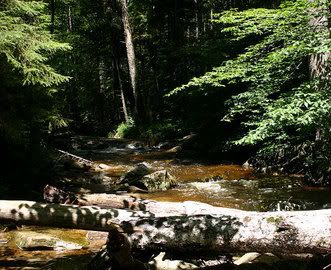
Happily - some might even say selfishly - I was able to avoid despair during my time in Monongahela. Unlike so much of the state, the mountains of the National Forest have been spared extensive surgery. All the same, the park map is peppered with mine sites, demarcated by a pick and shovel. The stream water I drank - after an iodine pill dosing - seemed safe enough (I didn't get sick), but I couldn't quite shake worries about mercury or heavy metal content. Encouragingly, we found plenty of amphibians in the streams, and this suggests that the water is clean.
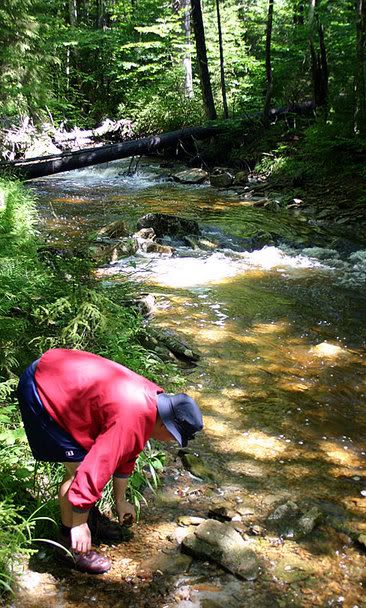
Amphibians: We identified four species of salamander; one example of each is pictured below.

The Mountain Dusky Salamander (Desmognathus ochrophaeus) was the most common, at least according to our crude census. They seemed to flourish alongside streams, under partially submerged rocks, and on the mountain's face, under woodland detritus - bits of rotten limbs or clumps of moss. The coloration of this species is wide-ranging. Some of the individuals we came upon could have passed for the unrelated redback (Plethodon cinereus), while others appeared more yellow, tan, or even chocolate. Fortunately, one of my companions is an avid herper and he was readily able to distinguish the two species by examining the head and nostrils. When in doubt, I defer to his expertise.
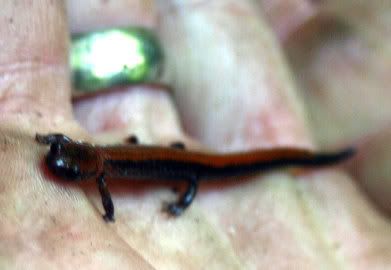
Comparatively scarce was the redback salamander and, if I'm recalling accurately, we only discovered this species near woodland vernal ponds. Unfortunately, all my photographs of the species turned out poorly. The models, this one included, didn't much take to posing, forcing me to hurry the shots.
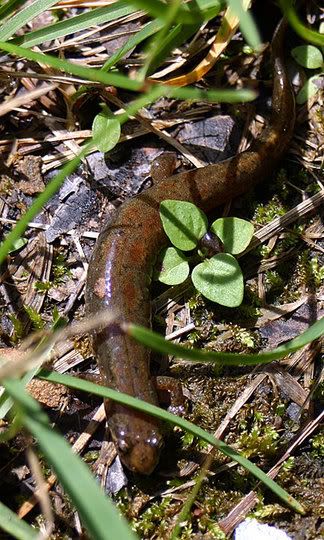
The most unusual discovery of the trip was a Spotted Dusky Salamander (Desmognathus fuscus conanti). The species is not known to live in the region - according to field guide range maps, anyway - but, nevertheless, we encountered this individual under a flat rock in an insignificant stream and spent some time confirming the ID. Proof, once again, that nature is always throwing curve balls, particularly in this time of accelerating climate change. The patterned salamander was strikingly colored and appeared almost translucent, it's distinctive markings discernible beneath a superficial layer of clear skin.
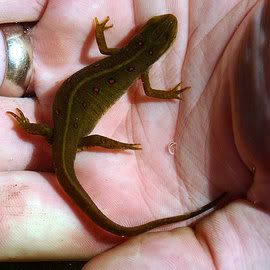
Just up the hill from the Spotted Dusky discovery, we noticed a Red-spotted Newt (Notophthalmus viridescens viridescens) in a puddle of standing water. I was thrilled to see one up close, as it had been the better part of a decade since I last admired this species in person. As it turned out, almost anywhere water pooled in Monongahela, the newts were present. By the time we departed, we'd seen close to a hundred.
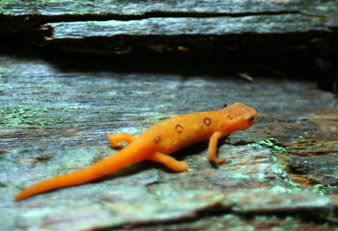
Before transitioning into its principally aquatic adulthood, however, the newt spends time on land, as the terrestrial red eft. These attractive little amphibians are perhaps the most charismatic of salamanders. Their stunning outfit is complimented by their not being as retiring as other species. If you find yourself in prime habitat, a keen eye will spot the efts crawling on logs or over leaves, seemingly unperturbed by exposure.
Tadpoles, like the newts, could be found in almost every pond or puddle. Although we could not ID the species with certainty, we believe most to be the aquatic larvae of the wood frog (Rana sylvatica), though we did notice a few American bullfrog (Rana catesbeiana) tadpoles. The bullfrog is something of a bully, infamous for out-competing other amphibians and adapting to a wide range of habitats. Biologists designate such a species a trophic generalist. Despite the potential threat to biodiversity, a piece of me admires the pluck of the bullfrog, just as I grudgingly take my hat off to the European starling (Sturnis vulgaris) and the raccoon (Procyon lotor).
Although we saw countless tadpoles, we saw only three adult frogs. One bullfrog, one wood frog, and one upland chorus frog (Pseudacris triseriata feriarum). The upland chorus frog is closely related to, but distinct from, the eastern (or New Jersey) chorus frog (Pseudacris ferairum kalmi), with which I am familiar from my childhood on the Eastern Shore of Virginia.
Reptiles: Our snake hunting forays proved less successful. We shined flashlights into crevices and carefully examined sun-lit leaf litter in hopes of revealing a timber rattlesnake (Crotalus horridus) or a northern copperhead (Agkistrodon contortrix), but neither species graced us with an appearance. I was discouraged, but not surprised. Snake hunting is usually a kettle watching exercise and the animals seem to materialize only once you cease searching.
We found two snakes in Monongahela. Sadly, one of these was a DOR (dead on road) eastern garter snake (Thamnophis sirtalis sirtalis), a victim of the automobile. Given the infrequent use of this remote forest road, I decided the unfortunate snake must have accrued some very shitty karma. At least an unidentified land snail was feeding on the dead snake, a welcome reminder of our shared mortality and interdependence.
The identity of the other snake we observed remains in question, but I'm almost certain it was a juvenile eastern milk snake (Lampropeltis triangulum triangulum). It was a very slender snake, not even pencil-thick, wearing alternating bands of red and white. We noticed the snake on the bottom of a shallow, water-filled ditch. It was attempting to feed on small tadpoles. When we clumsily hurried over for a closer look, it retreated into submerged grasses lining the ditch. After a wait of about fifteen minutes, it emerged from hiding and I attempted to ID it as it zigged and zagged across the bottom. I failed, unfortunately, and we did not see the little reptile again. According to field guides, eastern milk snakes are no stranger to stream bottoms. This knowledge, combined with the distinctive markings, leaves me with little doubt of the species, but, as I say, the verdict it still out.

Mammals: I hoped to see a black bear (Ursus americanus) or two, but I had to settle for a smattering of tracks. Because we arrived in Monongahela at the tail end of a long wet spell, the trails and back country were muddy and soft. Although the rain made the first night miserable - we rigged a tarp and pitched the tents after dark, in hard rain - the saturation made spotting animal tracks easy, although in some cases the ground was so wet that fresh prints were already partially obscured. White-tailed deer (Odocoileus virgianus) tracks were plentiful, but we saw more deer in the backyards of the houses fringing the National Forest than we did in Monongahela proper. This isn't surprising, as deer are harder to spot in dense forest and, what's more, they thrive in and around human settlement, as so many suburbanites know. Also abundant was the bouncy eastern chipmunk (Tamias striatus).
Birds: We were ill-prepared for bird watching. Although we were careful to pack everything needed for a camping trip - right down to the campfire utensil sets - we somehow neglected to include binoculars. I'm not sure how this oversight occurred, but none of us had a pair in hand, making anything beyond guessing difficult, especially since most of Monongahela's bird species are relatively small. In the shadowed forests, identification is all but hopeless without ocular assistance. Fortunately, one of my friends has a competent ear and some species were identified by their call.
Slate-colored juncos (Junco hyemalis) were innumerable. It seems spring comes late to the upper elevations, as the rhododendrons had yet to bloom and, on the final afternoon, we were scolded by two adult juncos as we hustled past a fledgling perched on a low-hanging branch. The prize for Most Handsome Bird goes to the Blackburnian warbler (Dendroica fusca), a fire-headed fellow with a striking voice. We thought we heard this bird's song in the woods, and our supposition was verified when an individual landed just above us, in the branches of a spruce tree.
Most exciting for me, however, was the family of American woodcock (Philohela minor) that we startled into awkward flight. I'm used to the jump, flutter, and glide behavior of the woodcock in the open, flat fields of coastal Virginia, but in the mountain woods of Monongahela, the woodcocks' comical eruption from among the leaves and ferns betrayed the provenance of the species nickname, the timber doodle. The first bird to take off flapped and jerked and reared and leaned as it moved all of twenty feet in the air, before pitching hard and vanishing into a mess of fallen limbs. Realizing we had disturbed a family group, we made our way downhill at a good clip, so as to allow the birds to regroup.
Plenty of common ravens (Corvus corvax) and cedar waxwings (Bombycilla cedrorum) were about, but we saw only one American blue jay (Cyanocitta cristata) and one turkey vulture (Cathartes aura), species I certainly expected to see more of. Had we been properly equipped (read: not forgotten the $@*&%!! binoculars), I would have more to report, but I was all too happy to concentrate on reptiles and amphibians, as they are particularly exciting to me.
Rising with dawn's birdsong on the final morning, we quickly packed our gear, lowered the bear bag, and began the five hour drive to Washington, D.C., where I was to catch the Chinatown Bus back to New York City. As we headed east, I slouched in the cramped back seat and admired the mountains of West Virginia, even as I again noted signs of resource extraction. My thoughts returned to Reece's "Death of a Mountain" and I made a mental note to reread it upon returning to New York.
Near the end of the article, Reece quotes Aldo Leopold, the famous American ecologist and conservationist. Leopold bemoaned the fact that "one of the penalties of an ecological education is that one lives alone in a world of wounds." I'm not sure that this is still the case. Those of us who are environmentally conscious do not live alone, even if we do remain surrounded by wounds. More than ever before, "green" sentiments are also popular sentiments; many folks share a penchant for preservation. Leopold would argue, however, that most contemporary environmentalists remain blissfully ignorant of ecological pragmatism. He was a conservationist, not a preservationist, and he understood that protectionism alone rarely leads to long-term sustainability.
Keeping this conservation/preservation dynamic in mind, I think it noteworthy that my companions in the forests of Monongahela were a biology professor and a writer. For our purposes here, the biologist might be characterized as a biological determinist and the writer, as a moral idealist. Though these two characterizations are by no means mutually exclusive, it makes for an interesting contrast in perspective, even though both appreciate the outdoors equally. Rereading "Death of a Mountain," I was surprised to find this divide touched on in the closing paragraphs.
"If our species is to make it through [the 21st] century, the forces of science and technology must be tempered by two other forces - ethics and aesthetics. All ethical philosophies, from Aristotle on down, are based on this ecological principle as stated by Leopold: 'The individual is a member of a community of interdependent parts.' And as the cave art at Lascaux makes brilliantly clear, we are a species that has evolved to find beauty in the natural world. This trait serves - or should serve - an evolutionary purpose: we love what we find beautiful, and we do not destroy what we love. A strip job is more than a moral failure; it is a failure of the imagination. It is time we stopped thinking like those who conquer a mountain and started thinking like the mountain itself."A strip job, as Reece writes, is a moral and imaginative failure, but what does it mean to think like a mountain? It would seem to me that to think like a mountain requires us to abandon morality and imagination, both exceptional human virtues. Is my ambivalence concerning invasive species control an example of mountainous thinking? Moral ambivalence - that is, amorality - is Nature's way. But isn't ambivalence, too, problematic? Is it not cousin to apathy? Humans, at their best, are moral animals; morality necessitates choice and action. Strict environmental controls, then, are moral, pragmatic, and rational, flailing efforts in our human time scale not at all like the geologic contemplation of a mountain. We humans consider a skewed equation and strive to balance it. This calculus comes at some cost. For the sensitive aesthete, slavishly devoted to what Reece calls beauty, the dualistic thinking of a moral pragmatist - right or wrong, good or evil - can seem an ugly, even unnecessary evolutionary holdover. Where, then, can the conscientious among us stand? It's an impossible question, really, more of a koan than a query, but it nags nonetheless.
Something approaching an answer is wrapped up in the lyrics of Denver's "Country Roads," in the fight bruised arms of young boys, in the remarkable persistence of trophic generalists, in the determined antagonism of the coal miner's wife, in the scarred plateaus, and in the slurried bear tracks. Thankfully, when I'm painting, or when I'm appreciating back country settings like Monongahela, I'm reminded that contentment, for me, requires acceptance of a messy, mongrel truth. For my part, it's both necessary and natural to be both an idealistic aesthete and a moralistic number cruncher.
Photo credit: all photos, Hungry Hyaena, 2006
Tuesday, June 20, 2006
Scale and Time On My Mind
I imagine many readers are already familiar with "The Powers of Ten," the simple, but profound short film produced by Charles and Ray Eames, of Eames design fame.
A few weeks ago, I posted "Vultures," a poem by Mary Oliver. As a throw away lead-in, I suggested that the poem could effectively replace my artist statement, communicating the ideas that I always write around. The subject of "Vultures," like so much of Oliver's work, is the rather messy process of "resurrection" via recycling (or what I prefer to term "reconstitution"). I die today to sustain that which will be tomorrow.
I've long been fascinated by death, compost, and their associated sauces. Much of my writing reflects this interest, but only rarely have I written about issues of scale. Initially scale and resurrection may seem disparate matters, but I believe that infinite regression, or travel within, leads to infinite progression, or travel without. Similarly, the reduction (or the extinguishing) of one life leads to another, new one (or many). With this in mind, "The Powers of Ten" is powerfully resonant.
Riffing on this idea, I recommend a listen to a recent episode of RadioLab. In it, co-host Jad Abumrad interviews Ann Druyan, Carl Sagan's widow and, along with him, one of the creators of the Voyager golden record, which I wrote about at some length here.
If you have some time to kill, watch "The Powers of Ten," and then listen to the RadioLab episode. They make for an exciting combo, and the Radiolab episode reaffirmed my belief that the golden record is "the culmination of modern art." What an arrogant, absurd, beautiful gesture?!
Monday, June 19, 2006

Once again, I find myself ignoring Hungry Hyaena in favor of painting and drawing. To be fair, "ignore" isn't really the appropriate word. I miss the regular writing terribly and, even when happily ensconced in the studio, I find myself fretting about the difficulty of achieving equipoise. Is it possible to fully satisfy two creative motivations? The writing complements the painting, to be sure, but both require a great deal of time (and hand-wringing) and are, therefore, competitive with one another. Occasionally, I'm able to steal a few minutes from the day job - as I'm doing presently - but I prefer to spend hours turning over a piece of writing and these cursory, apologetic posts are totally unsatisfying...even frustrating.
In the blogosphere, a few of these "I'm still alive!" proclamations in a row typically suggests flagging interest on the part of the writer. I assure you this isn't the case. I just need one of those handy, magic remote controls, like the one featured in the new Adam Sandler comedy, "Click" (which looks truly awful). Wouldn't it be nice to press the "Pause" button, bang out a dozen paintings and thirty essays while everything else is frozen, and then hit "Play." Oh, to be that prolific without sacrificing care!
At any rate, with several shows coming up in the fall, I need to make more art work, stat. Although I already have plenty of work on hand, I'm spread a little thin due to the overlapping exhibition timeline. So, until the fall arrives, I fear posts will remain infrequent.
Further troubling on the writing front is the unsettled situation at Scrawled. v1n5 (the June issue) has yet to appear online and, at the moment, I'm not sure it ever will. I'm in the process of trying to find another art magazine - online or otherwise - to publish with on a semi-regular basis. Whatever the case, I'll definitely let HH readers know when and where the piece on artist Deborah Simon will appear...when it does. Also on the horizon is a feature on the work of Sarah Trigg.
Alright, a few random things I thought I'd mention.
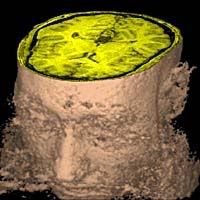
1) On Friday afternoon, I learned that the human male brain matures at 30 years of age. (By contrast, the female brain is mature at 22.) I can't stress enough how relieved I was upon hearing this. I cheered the year-and-a-half of my remaining, relative adolescence. Party on, Wayne! But then I wondered: should I despair that there will, after maturity, be no physical expansion or further connectivity? Oh, well. Sure, I'll have to make do with a lot of fine-tuning, but - let's be honest - it will be wonderful to sort out the mess.
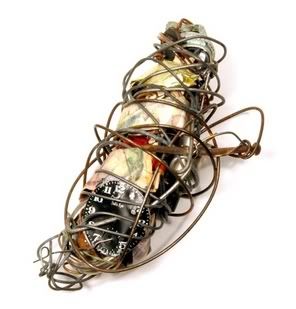
"untitled"
c. 1970
Mixed media
7 x 3 1/2 x 2 1/4 inches
2) On Saturday, while taking a much needed break from painting, I read the most recent issue of ArtForum (Summer 2006). The closing lines of Jenifer P. Borum's review of the Philadelphia Wireman at Matthew Marks rankled me.
Borum writes, "...the question remains: Can or should the Wireman's appropriation of pop-cultural castoffs, produced without any apparent ironic or other critical intent, ever be assigned the same art-historical significance as the work of more canon-savvy practitioners?"
Because Borum focuses on "art-historical significance," I almost forgave the question, but her description of "canon-savvy practitioners" stinks of Art World pretension. Is thoughtful art produced only by a trained, privileged caste? For that matter, need art be thoughtful - as in intellectually stimulating - to be valuable to the maker? I, too, question what, if anything, distinguishes the Philadelphia Wireman's assemblages from the objects produced by innumerable other unrecognized - or under recognized - artists working outside the Art World proper, but Borum's query is more general and divisive. In essence, she asks if any of these "outsiders" is significant.
In response, I ask Borum. What real world significance is assigned to the ironic and critical work of canon-savvy practitioners? For the Philadelphia Wireman and many thousands of other working artists - whether or not they make a living at their craft - the making is definitive. The Philadelphia Wireman probably harbored no illusions of gallery exhibitions or critical bibliographies; for him, the bending and the stuffing and the tying was a curious way to pass - maybe even measure - time. Nothing more, but what more is there? Bollocks to art-historical significance. It will all be redefined (and then erased) in any event.
3) Lastly, on Sunday morning a friend emailed me a video featuring the amazing visual acuity of Steven Wiltshire. (More info here.) Wiltshire suffers from autistic spectrum disorder. He was mute until the age of 9, and his primary mode of communication during the early years was drawing. Although he does talk now, drawing remains central to his life. His architectural renderings are accomplished and he produces them very quickly, with little or no editing. Most remarkable, however, is his ability to observe a scene and then draw it, from memory, almost perfectly. This sounds hard to believe, but I encourage anyone interested in neuroscience or art to check out the video. I was flabbergasted.
Photo credits: ripped remote image from Amazon.com; ripped brain image from www.mabot.com; Philadelphia Wireman image courtesy Matthew Marks Gallery
Monday, June 05, 2006
Reading Mary's Vultures
When I'm in the midst of a studio surge, essay ideas often gestate for months. Jotted notes and fragmented Word documents evidence my intention to write, but I find it difficult to commit. Reading, by contrast, remains an essential activity during these periods and, curiously, poetry often trumps prose, perhaps because it is more like visual art, more open and sensuous.
I've recently been enjoying collections of Mary Oliver and Czeslaw Milosz. Much of Oliver's work compliments my own. Reading her poems, I feel a reciprocated embrace; she often channels a wonderful existential experience. Frankly, if I could get away with submitting "Vultures" as my artist statement, I'd happily do so!
Photo credit: "Soaring," painted by Andrew Wyeth (photograph by Ken Burris, for Shelburne Museum)
I've recently been enjoying collections of Mary Oliver and Czeslaw Milosz. Much of Oliver's work compliments my own. Reading her poems, I feel a reciprocated embrace; she often channels a wonderful existential experience. Frankly, if I could get away with submitting "Vultures" as my artist statement, I'd happily do so!
VulturesDeceptively straight-forward, the poem will open, for readers of a certain disposition, to complex interpretation. For me, "Vultures" is an insightful tracing of a complicated relationship with religion and a paean to the contemplation of death and awesomeness of the universe's messy abundance.
Like large dark
lazy
butterflies they sweep over
the glades looking
for death,
to eat it,
to make it vanish,
to make of it the miracle:
resurrection. No one
knows how many
they are who daily
minister so to the grassy
miles, no one
counts how many bodies
they discover
and descend to, demonstrating
each time the earth’s
appetite, the unending
waterfalls of change.
No one
moreover,
wants to ponder it,
how it will be
to feel the blood cool,
shapeliness dissolve.
Locked into
the blaze of our own bodies
we watch them
wheeling and drifting, we
honor them and we
loathe them,
however wise the doctrine,
however magnificent the cycles,
however ultimately sweet
the huddle of death to fuel
those powerful wings.
Photo credit: "Soaring," painted by Andrew Wyeth (photograph by Ken Burris, for Shelburne Museum)
Monday, May 15, 2006
Hyaena Holmes

Artist and good friend Michael McDevitt was so offended by the quality of my original spotted hyena image (see here), that he whipped up the above piece. This noir Hyaena Holmes is a definite improvement over the unforgivably primitive mouse work in the original. Thanks, Michael!

Tuesday, May 09, 2006
Hans Bellmer and Davor Vrankic
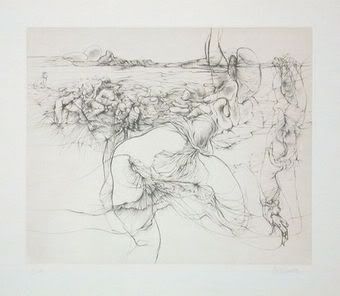
Hans Bellmer
Untitled
c.1960
Engraving
19 11/16 x 25 9/16 inches
Miguel Abreu Gallery: This unpretentious, storefront gallery opened just two months ago. I know nothing of their planned program - the website is not very informative - but when I saw the current listing on ArtCal, I made a point of jotting down the address. One isn't often afforded an opportunity to see a gallery exhibition of works by Hans Bellmer. Though celebrated chiefly for his ball-jointed doll sculptures(1), I've long admired - and preferred - the artist's erotic drawings, particularly those that incorporate landscape.
The exhibition features a selection of framed prints, photographs and drawings, most of which are small in scale. Bellmer's draftsmanship is superb; as a result, the prints and drawings are more intriguing than the photographs. I couldn't help but feel, however, that a considerable share of the work on display suffers for the artist's unconscious process. Eroticism can be used intelligently (for example, the engraving pictured above), whereby it is marshaled to communicate base universality. On the other hand, it can be presented as a visual stream of consciousness, honest but unmindful, which usually leads to sexual objectification and reductive signing (the engraving below). Granted, it's difficult to avoid the latter result but, as is evidenced by Bellmer's successes, it's not altogether impossible.
The Bulgarian surrealist poet and writer, Nora Mitrani, is quoted in the gallery's press release; she suggests that Bellmer aims to "destroy the contradiction between the interior and exterior." This is a worthy ambition and, gloriously, the artist sometimes succeeds. Usually, though, he produces mannered works too libidinous to transcend personal record. Not that there's anything really wrong with that. Even Bellmer's lesser works are lovely and sensual, but they don't have the staying power or resonance of his infrequent triumphs.
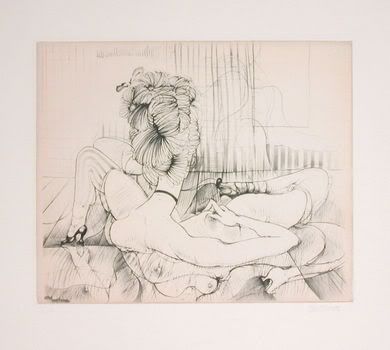
Hans Bellmer
Untitled
c.1960
Engraving
19 11/16 x 25 9/16 inches
(Note: Neither of the Bellmer works pictured here are on display at Miguel Abreu Gallery. See credit/source at bottom.)
+++++
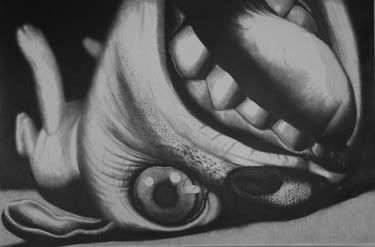
Davor Vrankic
"Asphyxia Series, Untitled"
2005-2006
Pencil on paper
31 x 46 inches
The Proposition: I expected Hans Bellmer's drawings to be the art highlight of the day, but I was pleasantly surprised by Davor Vrankic's recent works, on display at The Proposition, in Chelsea. Vrankic's drawings astonished me. Rarely do I enter a contemporary art gallery and feel that I am in the presence of significant work, but there is no better way to describe my reaction to Vrankic's dexterous pictures.
In matters of craft and technique, Vrankic minds the masters past, but his imagery - cartoonish, grotesque and anxious - is borne of a contemporary vision. As the press release puts it, Vrankic "combin[es] the logic of synthetic images with classical drawing." Standing in front of some of the smaller works, such as "Scenes from Interior, Untitled" (below), I thought of inspirations as diverse as Brueghel, Bosch, Caravaggio, Durer, Hitchcock, Welles, and Crumb, but also of countless graffiti artists and lesser known cartoonists.
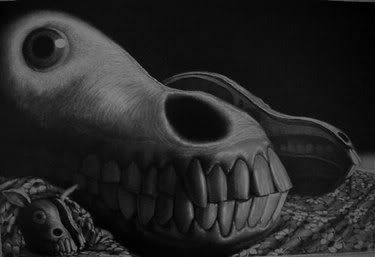
Davor Vrankic
"Scenes from Interior, Untitled"
2005-2006
Pencil on paper
13 1/2 x 19 3/4 inches
The objects Vrankic depicts - slabs of raw meat, plush toys, miniature Candyland landscapes - are all associated with saturated color. There is something foreboding, then, about the monochromatic presentation. This feeling is heightened by the artist's choice of vantage point. Often low to the ground or so close to the subject as to make the viewer feel relatively insignificant, the objects Vrankic depicts are subjected to the cruel stretching and distortions of a camera lens. Photographs and film convince; we believe in these realities. At the same time, the cartoonish proportions and plasticity of the objects - in one drawing, a steak is cut into the shape of a gingerbread man - remind us of their artifice. This duplicity is as intelligent and critical as it is fun.
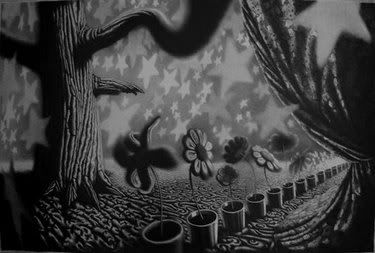
Davor Vrankic
"Scenes from Interior, Untitled"
2005-2006
Pencil on paper
13 1/2 x 19 3/4 inches
Happily, the press release confirms that the artist - or maybe the dealers - are thinking about the ambivalence present in the works, and I left the gallery feeling generally good about the state of things. I look forward to seeing more of Vrankic's work. It is exceptional.
Photo credits: Bellmer images ripped from www.bartschi.ch; Vrankic images ripped from The Proposition website
(1) Bellmer is often cited as an influence on the work of Cindy Sherman. The gallery's press release also mentions his prominent position in the pantheon of Mike Kelley and Matthew Barney. In the case of Sherman and Kelley, these associations are based on rather literal connections. All three artists have, at some point, mutilated or hybridized dolls and stuffed animals. Bellmer's drawings and prints, however, have a universal appeal that his doll sculptures lack, and today his biomorphic visions inform the work of innumerable young artists working in two dimensions. (Robert Gutierrez springs to mind), particularly those with a predilection for the graphic.
Wednesday, May 03, 2006
Todd McCollister in Scrawled (v1n4)

The latest issue of Scrawled, v1n4, has been published online. Be sure to check out my piece on Todd McCollister's artwork.
There is plenty of good content in the issue, but you'd be remiss to overlook Erik Sorensen's latest collection of links from around the world wide web. (Erik is also the head ape at Monkeys For Helping, one of the best places to find a hearty laugh when you need one.)
In June (Scrawled, v1n5), my column will feature the painting and sculpture of Deborah Simon.
Photo credit: ripped from Scrawled website
Subscribe to:
Posts (Atom)