
A chilly wind blew strong off the Hudson River, energizing me further, and I visited almost thirty shows. I had planned to mention more than the five below but, as I've written here often of late, "my energies are directed toward the studio," and writing about other artists' work only makes me want to work on mine that much more.
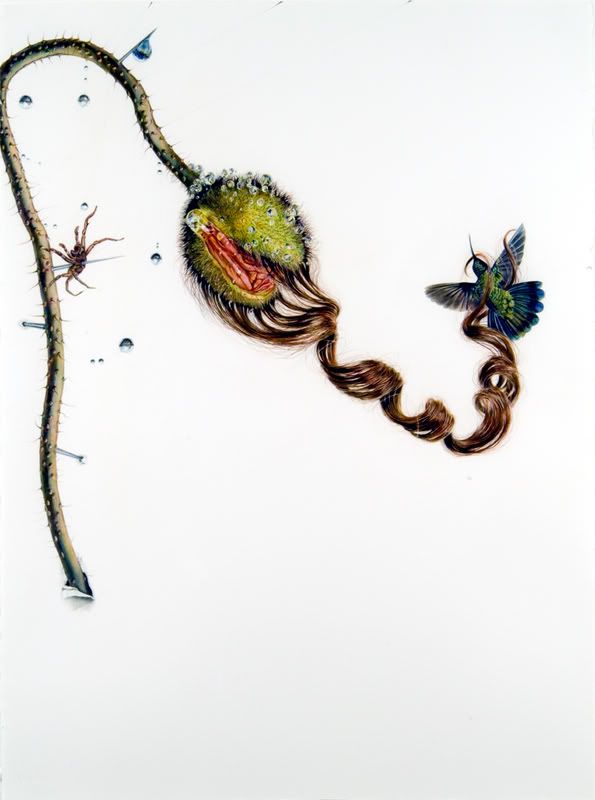
Julia Randall
"Decoy #8"
2006
Colored pencil on paper
30 x 22 inches
Jeff Bailey Gallery: "Decoys and Lures," Julia Randall's sophomore outing at Jeff Bailey Gallery, is impressive. Randall's works on paper showcase her sensitive technique. Her craft is impeccable, rivaling that of the finest botanical illustrators (of this or any other day), and she uses her superior skills to create contemporary artworks that are as beautiful as they are violent, and as whimsical as they are erotic.
Randall's "Lures" series is aptly titled; these sensuous colored pencil drawings focus on human lips. Viewers glimpse a bit of tongue here, some teeth there, but we're preoccupied with the moist flesh. It's generally difficult to take a long look at lips without becoming at least the slightest bit libidinous and, as I looked at "Lure #1," my own lips involuntarily parted in anticipatory wanting. That doesn't often happen when I contemplate artwork; for that matter, it doesn't usually happen when I look at fashion photography or any other medium that appeals to our id by focusing on organs associated with sexual signaling. Randall's "Lures," though, isolate the lips, making them a spectacle unto themselves. This is effective enough, but my appreciation of the "Lures" doesn't go much deeper, and I found myself considering the "Lures" conceptual studies for the "Decoys."
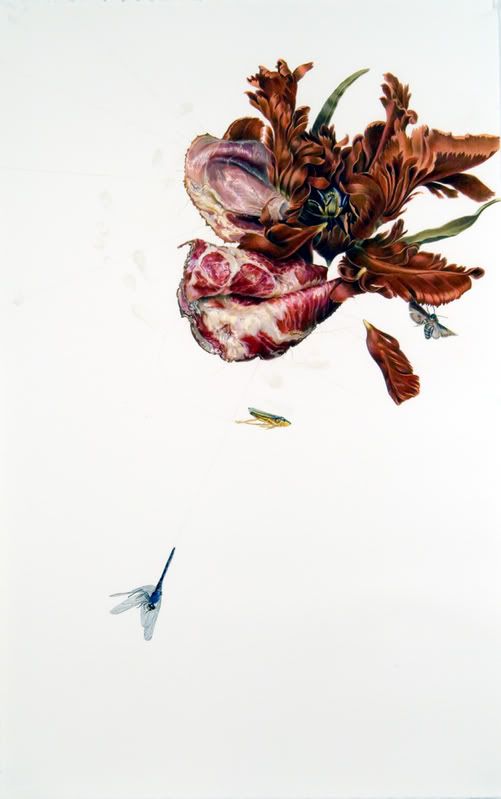
Julia Randall
"Decoy #4"
2006
Colored pencil on paper
41 x 26 inches
The "Decoys" are, as the gallery's press release states, drawings of "strange flowers and plants hybridized with human and animal traits." Indeed, many of Randall's creations are surreal riffs on carnivorous plants like the well known Venus Flytrap (Dionaea muscipula). The depicted hybrids are decoys in the sense that they bait or seduce other life forms into approach, and then devour or ensare them. Given the curious combinations seen in the series - pitcher plants meld with electrical cords; dental scrapers act as floral supports; belts and chains secure petals to stem - the work does, as the press release puts it, "hint at the perils of human meddling with the natural world," but there is still more visceral and complex content. The works warn of the practical, philosophical, and moral risk involved in genetic mutation and other biotechnology, but they also remind us that scientific exploration (indeed, our very curiosity) is instinctual and as natural as the rest of creation.
Randall's "Decoys" are celebrations of all Nature's orifices, physical and metaphysical, and of our natural desire to enter into and emerge from these orifices time and again. Viewers glimpse starry skies through several of Randall's flowers, an allusion to the scalar continuum. Further, the artist draws trompe l'oeil tears, holes, and sliced strips on her grounds, thus "implicating the viewer" in the ambivalent dissection and probing of her pictures. The human hand belts, cuts, pokes; it acts as an erotic investigator, at once involved in sex play, scientific exploration, and an ambivalent, feline violence. We can't help ourselves! The medical equipment and the metal thorns emerging from organic stems are fetish items and talismans of industrialized scientific inquiry. As Camille Paglia writes, "sex is probings, plumbing, secretions, gushings...the bloody open mouth of mother nature." But where Paglia would argue that science, the product of the male, or Apollonian mind, with its right angles and projections, is in opposition to sex, Randall's decoys remind viewers that things are rarely so dualistic. The lines drawn between male and female, man and animal, and science and art are increasingly indistinct.
Paglia has also written that "art is form struggling to wake from the nightmare of nature." Julia Randall's art, however, is form that embraces the "nightmare," celebrating the awesome sensuality of our apparently amoral universe. Paglia is correct to imply art's moral imperative, but moral and ethical actions are themselves an outgrowth of Nature, consciousness having evolved from morally blind, yet sensate material. Randall's works play with this ambivalent relationship. I left the gallery grinning, eager to find something to poke, in one way or another.
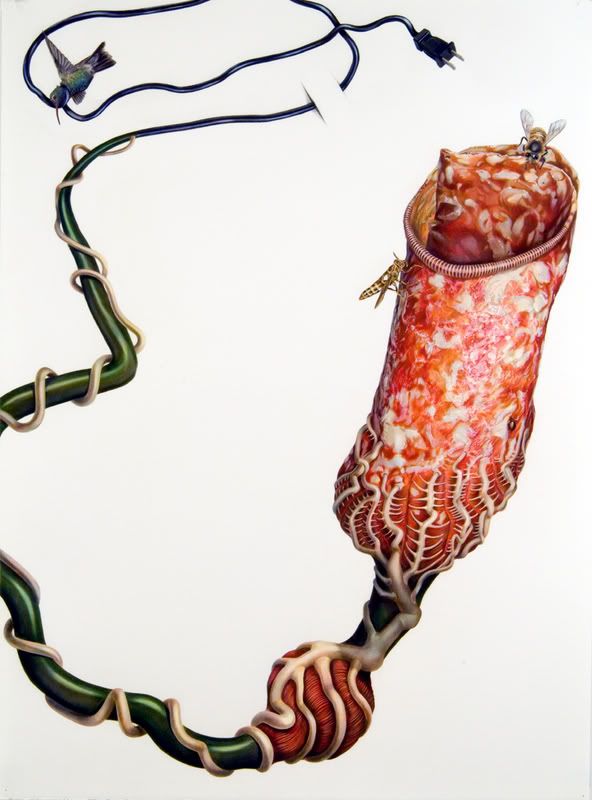
Julia Randall
"Decoy #6"
2006
Colored pencil on paper
46 x 34 inches

Eva and Franco Mattes
"Harpo Jedburgh"
2006
Digital print on canvas
36 x 48 inches
Postmasters Gallery: Binary, the artist duo of Eva and Franco Mattes (aka 0100101110101101.org), is back. I was disappointed by their last outing at Postmasters. "United We Stand," a media campaign/send-up of "a Hollywood-style blockbuster," was, like most of Binary's work to date, an "incomplete, lazy affair that never really [got] off the ground." I was hopeful, though, when I learned the duo was working within (and presumably making work about) Second Life, the growing virtual community and market that is so much in the news these days.
Consider just a sampling of "real world" stories about Second Life in recent months.
- "First-Rate Art in Second Life" (Regarding the launch of the first "real world" magazine dedicated exclusively to the art scene in Second Life)I assumed that after "living in the virtual world...for over a year" Binary would riff on some of these fascinating goings-on. Second Life, currently occupied by over 4 million inhabitants from all over the "first" globe, is a microcosm of our contemporary social and political geography. As such, it is a valuable mirror, ripe for rumination, dissection, or parody. Many of the artist groups and communities living and interacting in Second Life are aware of this. I salute them for it. (Second Life is the contemporary MUD (multi-user dungeon) and to better understand the value and psychological significance of these worlds, I recommend reading Julian Dibbell's terrific article "A Rape In Cyberspace: How an Evil Clown, a Haitian Trickster Spirit, Two Wizards, and a Cast of Dozens Turned a Database Into a Society," originally published in The Village Voice in 1993.)
- "Second Life opens for business: Toyota, Circuit City, Dell, Sears and Adidas have set up shop in the S.L. virtual world"
- "Terrorists mock-bomb Second Life shops: Home-grown terror group wants democracy in the virtual world"
So what does Binary bring back to us after a year's sojourn in Second Life? 13 portraits of the most popular and good looking Second Life celebrities. That's right, folks...surrounded as they must have been with so many fascinating socio-political happenings in that world, Binary opts to present gallery visitors with shots of Second Life's equivalent of Justin, Lindsey, and Paris! I suppose one could argue that rendering our culture of distraction and celebrity in this fashion is meritorious, but I fear the end result is as forgettable as the lion's share of our superstars.
Also irksome is the patronizing tone Binary takes in the gallery's press release. They refer to their time in Second Life as a "flanerie," and they (or the gallery) characterize the inhabitants of the virtual world as "peculiar." So once again, Binary, I thumb my chin and leave." This duo has a knack for turning promising ideas into stupid and vapid art. I have little hope left for these two. The art world should be embarrassed by Binary's lowest common denominator appeal.

Eva and Franco Mattes
"Nyla Cheeky"
2006
Digital print on canvas
36 x 48 inches

Allison Hawkins
"Ink Blanket"
2006
Ink and graphite on paper
12 x 11 inches
The Proposition: "Spiderwort," Allison Hawkins' second solo effort at The Proposition, reads like an unfinished poem. One gets the sense that this accumulation of fragments will add up to something interesting (maybe even something powerful) as the artist matures. Hawkins' most potent ink and watercolor works - "Ink Blanket" or "Your Skin Is A Quilt," for example - hint at a rich interior universe of magic and essential mystery. Much of the artist's imagery seems born of our hypnagogic moments, those seconds immediately preceding sleep, when our thought processes are as defined by the denied, interior animal as by our conscious experience.
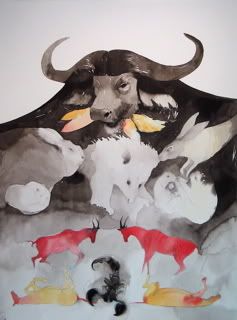
Allison Hawkins
"Your Skin Is A Quilt"
2006
Ink, watercolor and graphite on paper
30 x 22 inches
The gallery's press release suggests that Hawkins "[speaks] from a place where nostalgic memories and fanciful visions merge." True enough, but works like "Ink Blanket," celebrate a particular brand of nostalgia, one fundamental to the unabridged Homo sapien experience, one that spans millennia. Perhaps we could call it a longing for essential being, for the "live animal"? Hawkins doesn't merely reference the hands on the walls at Lascaux; she presents us with some of her own transfigurations. What the press release characterizes as "a youthful longing to retreat to...refuge, where one can explore quietly without taming," is not, in fact, a retreat at all, but rather a heroic attempt at the whole truth.
Unfortunately - at least in "Spiderwort" - the artist intersperses afterthoughts, unrealized experiments, and flights of fancy among her successes. I wouldn't encourage anyone to stop playing or to limit themselves to one clearly defined body of work, but I do wish Hawkins had been more selective in deciding what works to include in this show. The exhibition would be stronger, more of a piece, I feel, if half of the twenty-one works were excluded.
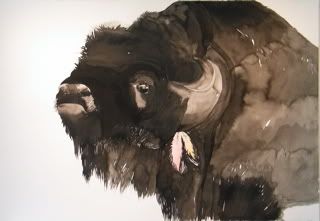
Allison Hawkins
"Goofball"
2007
Ink and watercolor on paper
41 x 60 inches
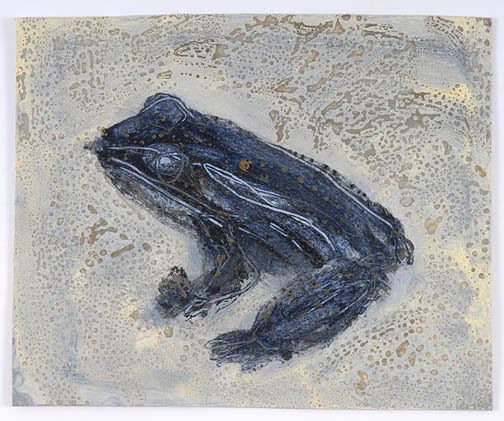
Colin Cochran
"Frog"
2006
Mixed media with oil on gessoed board
8 x 9 5/8 inches
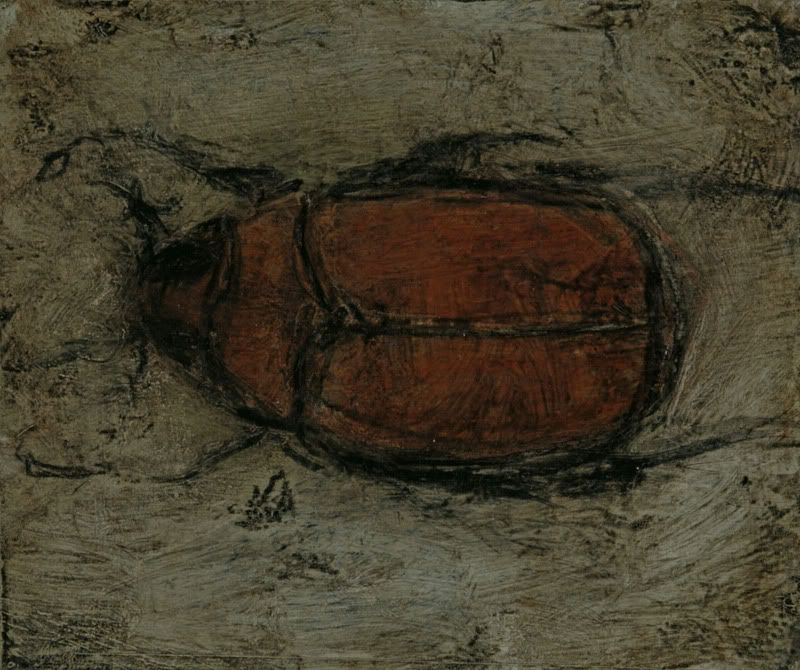
Andre Zarre Gallery: Two blocks south of The Proposition, at Andre Zarre Gallery, another artist has tapped into the same deep vein as Hawkins, drawing from the well of existential associations attached to the animal form. Colin Cochran's small mixed media paintings of crows, beetles, cows, dingos, and other animals are straightforward exercises in composition, contour, and color, but the artist's confidence and command of the medium(s) make these humble, even "primitive" paintings special. Indeed, in some cases the little works possess an air of monumentality.
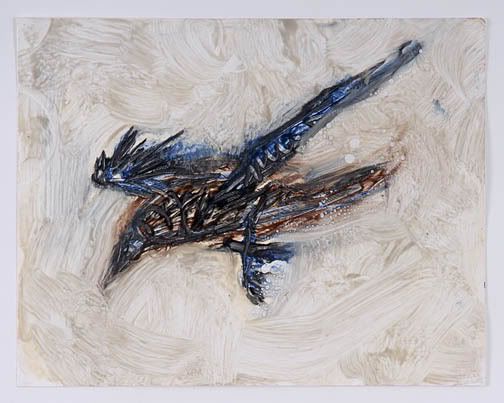
Colin Cochran
"Crow Magnon"
2006
Mixed media with oil on gessoed paper
11 x 14 inches
Interestingly, Cochran's animal subjects are largely anonymous. Although the surfaces of his paintings are rich in texture, distinguishing markings are absent; viewers must recognize the cast of characters in silhouette. In the case of an elephant or even a raven, this process is unconscious and immediate, but what kind of mole or beetle are we looking at? Enthusiastic about wildlife biology as I am, such details are important.
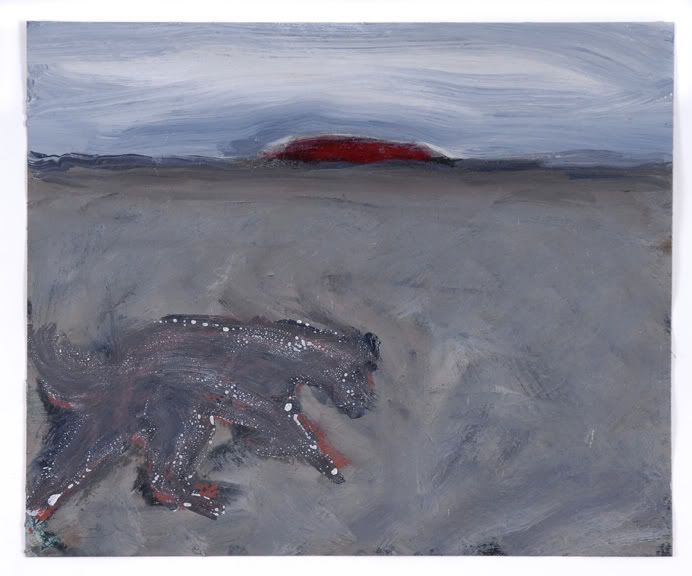
Colin Cochran
"Dawn and the Dingo"
2006
Mixed media with oil on gessoed paper
14 x 17 inches
After spending a few minutes with Cochran's work, however, it occurs to me that his subjects do not want to be identified in this way. I recalled a conversation I had a few years ago while paddling down the Colorado River. I had become pleasantly frustrated in my efforts to determine if I had just spotted a female Wilson's Warbler (Wilsonia pusilla) or a male Yellow Warbler (Dendroica petechia), species which are almost identical, when a friend pointed out that many "primitive cultures" did not distinguish between species in a family. Coyote and Wolf were given separate billing, but often a hawk, no matter the species, is Hawk and a sparrow is just Sparrow, or maybe even just Bird. My friend feels that there is something to be said for this imprecise classification scheme. If behavior across a family is similar, why should we create distinctions based on our own criteria? Does it really matter that the back and head of the female Wilson's Warbler should be a bit more olive than that of her cousin, the Yellow Warbler? Of course, the wildlife biologist in me disagreed (and still does); after all, how can one comprehend or track adaptation and evolution unless some system is in place, albeit a system necessarily in constant flux? But this was beside the point for my friend. Essential experience of the other animal does not need classification or specificity, he insisted. In fact, the experience is likely that much more rich and immediate when the trimmings have been dispensed with. Bird, he felt, was good enough.
And so it is with Cochran's paintings. Beetle and Frog are good enough...and so they are.
Colin Cochran
"Beetle"
2006
Mixed media with oil on gessoed board
8 x 9 1/2 inches
Robyn O'Neil
"The Fall"
2007
Graphite on paper
6 1/2 x 10 inches
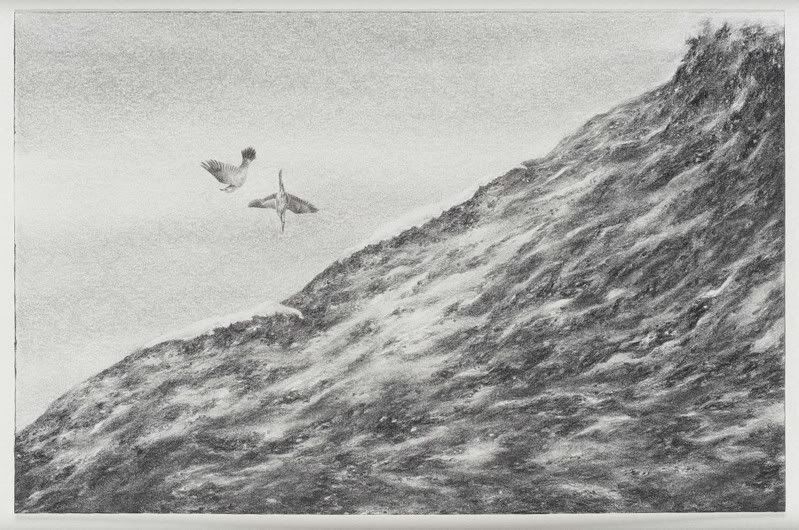
Clementine Gallery: Since seeing her first solo show at Clementine in 2003, my admiration for Robyn O'Neil's drawings has been tentative. The spare, even desolate landscapes and lonely human figures (even when gathered in a group, O'Neil's cloaked nomads seem isolated and fearful) of her New York solo debut appealed to me, but I felt that the work was still gestating. The drawings she produced in 2004 and 2005 were more consistently satisfying. In many, the lonely humans were replaced by statuesque moose or humble pine trees; O'Neil seemed to be imbuing her world with more magic, but I still wasn't sold. Perhaps I resisted because O'Neil's vocabulary is so close to my own? Whatever the case, "This is a descending world," the artist's third solo show at Clementine, proves my initial supposition correct; O'Neil's work is now showing signs of real maturity and confidence, both with respect to technique and content.
Robyn O'Neil
"The Passing"
2006
Graphite on paper
66 x 66 inches
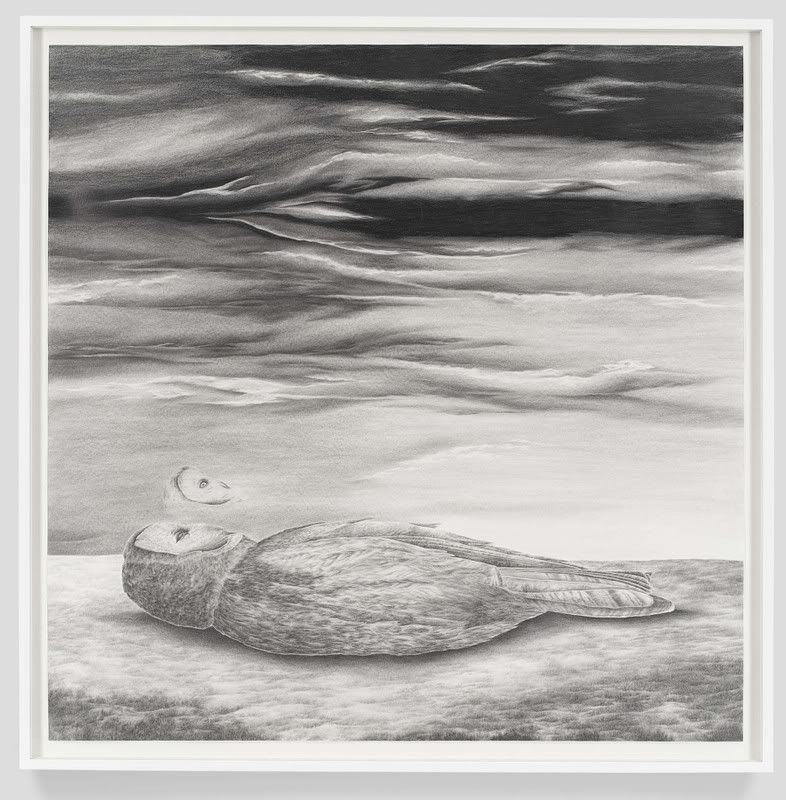
In the front gallery, O'Neil shows four large works on paper. "The Ruin" and "The Passing" are the strongest of these. The melancholic landscapes are less complex than those of O'Neil's previous outings, and their relative simplicity allows viewers to more easily appreciate the power of O'Neil's element (and elements). The ocean is rendered superbly in "The Ruin." Its unfathomable volume is majestic and frightening and, like the branch suspended above it, the sea seems sentient, a wise observer of time's passage. The owl that lays rigid in "The Passing" is as dead as its eyes suggest. While the spirit's energy seems to rise phantom-like away from the raptor's head, the ground gently settles as it prepares to take the corpse. These are the first of O'Neil's works I've seen that merit sustained meditation; they breathe with a mystical intensity that I associate with the work of Charles Burchfield.
Robyn O'Neil
"Masses and masses rove a darkened pool; never is there
laughter on this ship of fools"
2007
Graphite on paper
79 x 161 1/8 inches
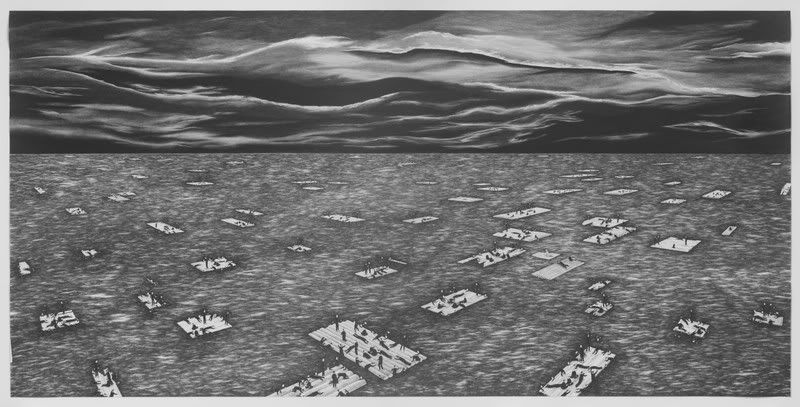
Also hanging in the front room is the exhibition's centerpiece, "Masses and masses rove a darkened pool: never is there laughter on this ship of fools." Over six feet tall and thirteen feet wide, O'Neil's "...ship of fools" can not be ignored. It is impressive both in scale and technique. Any artist familiar with graphite immediately comprehends the feat of patience (and perhaps endurance) this picture represents. Unfortunately, the formality of the piece - the ocean and rafts read as a perspectival grid, effectively flattening the plane and reminding us of vanishing point exercises in high school art class - prevents it from being the show standout. It is worth noting, though, that O'Neil's interpretation of the old allegory is distinctly contemporary. The medieval understanding of the allegory was that each person has his or her vices and sins; from person to person these behaviors can be ignored or laughed at but when considered together, as symptoms of the whole, such individual folly becomes sinister and dangerous. Earlier artists who depicted the "Ship of Fools" - most notably those of the Northern European Reformation, such as Bosch or Durer - portrayed the "fools" as individuals on board one overfull craft. Each face was distinct, each pursuit ridiculous, self-serving, or plain stupid. O'Neil, however, draws faceless men, all clad in suits, clamoring about on so many rafts. The shared vessel is no longer one boat; here it has become the ocean (or even the world) itself, with the occupants not so much sinning as mooning after mirages. My minor quibbles with O'Neil's execution aside, it is an appropriately distressing work; considering the large drawing, I find myself reminded that we live in the Age of Ennui, Aimlessness, and Distraction. Even our sainted celebrities aren't safe for long.
The small works displayed in the back gallery make for a mixed bag, but are generally rewarding. Drawings like "The Silence" and "The Abandon" are forgettable, but "The Fall," "The Growth," "The Fade," and "The Loss" are lyrical, moving, or a bit of both. I'm biased by her subject matter, but I feel that O'Neil is capable of becoming one of our generation's important artists. I eagerly await more work.
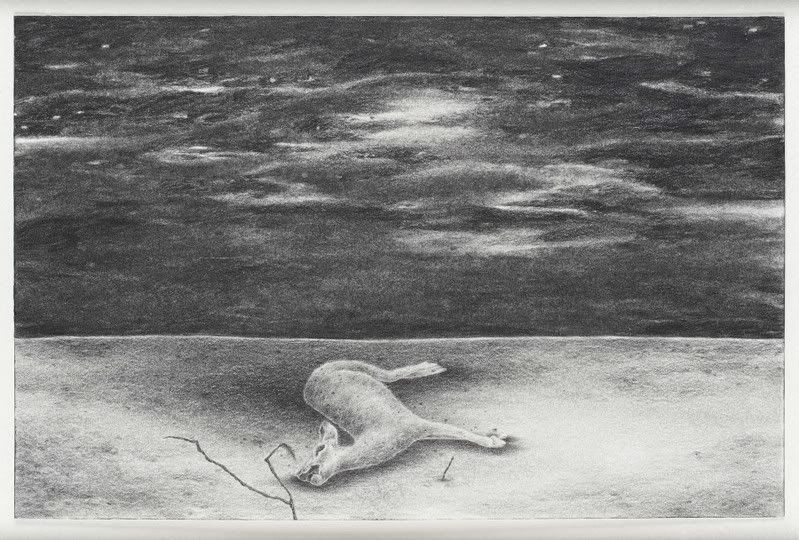
Robyn O'Neil
"The Growth"
2007
Graphite on paper
6 1/2 x 10 inches
Photo credits: Julia Randall images courtesy Jeff Bailey Gallery; Binary images ripped from the Postmasters website; Allison Hawkins images courtesy The Proposition Gallery; Colin Cochran images courtesy Andre Zarre Gallery and Joyce Goldstein Gallery; Robyn O'Neil images courtesy Clementine Gallery

