Showing posts with label bad art. Show all posts

Monday, December 12, 2011

I Can See The Whole Emperor!


In a 2006 post titled "Lichtenstein the Ingrate," I bemoaned Roy Lichtenstein's elitism. I explained that I was bothered less by the famous artist's "questionable sampling" of newspaper and comic book artists' work than I was by his disregard for the skill of those he copied. In a 1963 interview, Lichtenstein distinguished between his source material and his paintings.
"What I do is form, whereas the comic strip is not formed in the sense I'm using the word; the comics have shapes but there has been no effort to make them intensely unified...The difference is often not great, but it is crucial."
Throughout my late teens and twenties, Lichtenstein's comic-inspired artworks inflamed my sense of righteous indignation. I don't get especially worked up about Lichtenstein's appropriation anymore, but I still believe the man was a charlatan. Had he acknowledged his indebtedness to the artists he imitated, his comic panel paintings could be interpreted as a cynical project highlighting the role of class and money in the appraisal of culture (i.e., it's not fine art if it's in a newspaper, but if it's in a gallery and the "right" person will pay a lot of money for it, it is). That still wouldn't make it particularly thoughtful artwork, but Lichtenstein could have been remembered as a winking champion of the comic artists that nourished him.


Left: William Overgard original
Right: Lichtenstein's rendition

In 2006, I believed that Lichtenstein was "turning into a cultural blip." I took comfort in that presumption, but it's no longer so clear to me that Lichtenstein will be forgotten. A recent ArtInfo article by Judd Tully compares last month's Christie's auction sales price of Lichtenstein's "I Can See The Whole Room!...And There's Nobody In It!" to the EBay auction sales price, last August, of the William Overgard artwork that was the source of Lichtenstein's painting. The former sold for $43,202,500; the latter, for $431. According to the art market, then, the Lichtenstein version is worth more than 100,000 times what the Overgard original is worth! Sure, Lichtenstein's is a bigger picture, but the enormity of the price difference is testament to the intangibles in play in the art market. I love looking at, writing about, and making art, but contemplation of the art market is a depressing affair.

Image credit: "The Emperor's New Clothes" illustration, ripped from My Fresh Plans site (illustrator uncredited); Overgard and Lichtenstein reproductions "appropriated" from The Daily Cartoonist

Friday, August 19, 2011

Making More "Live Animals"


Two weeks ago, I presented a lecture at the Art College Center of Design, in Pasadena, California, titled "Aesthetics, Ethics, and Experience." It was my first attempt to respond to the question of how contemporary artists might connect the "fine arts" to society at large, and I drew from an array of sources, classical (Heraclitus; Aristotle) and contemporary (Dave Hickey; David Milch; Erik Reece), to constellate what I'd like to think Aristotle would have described as a virtuous way of being in the world (as an artist). After the lecture, one of the students remarked that it was the "most liberal arts style" approach she'd come across in art school. I appreciated her compliment, but it reminded me of the urgent need for more generalism in arts education.

As I often insist, there is a lot of beautiful and compelling artwork produced and exhibited today, but it generally lives apart from popular culture. We -- that is, those of us active in the fine arts -- are complicit in this ghettoization because we're content to carry on a conversation among ourselves. Moreover, because we've come to preference our tribe's voices over others, there is a surplus of insider commentary and critique passed off as art. Almost all of this work and wordiness is irrelevant to the world outside the ghetto walls and, because young artists are educated in this context, with little or no pedagogical emphasis on disciplines other than art theory, the art and commentary become, over time, increasingly provincial. The wellspring of this contemporary predicament is as old as modernism.

On the heels of co-curating "A Live Animal" with Selene Foster, I've been rereading John Dewey's brilliant Art & Experience essays (1934). Dewey writes, and I quote him at length because he articulates the crux of the problem so eloquently:
" [Art is today] isolated from the human conditions under which it was brought into being and from the human consequences it engenders in actual life experience. [...] Art is remitted to a separate realm, where it is cut off from that association with the materials and aims of every other form of human effort, undergoing, and achievement. A primary task is thus imposed upon one who undertakes to write upon the philosophy of the arts. This task is to restore continuity between the refined and intensified forms of experience which are works of art and everyday events, doings, and sufferings that are universally recognized to constitute experience.

[...] So extensive and subtly pervasive are the ideas that set Art upon a remote pedestal, that many a person would be repelled rather than pleased if told that he enjoyed his casual recreations, in part at least, because of their esthetic quality. The arts which today have most vitality for the average person are things he does not take to be arts: for instance, the movie, jazzed music, the comic strip, and, too frequently, newspaper accounts of love-nests, murders, and exploits of bandits. For, when what he knows as art is relegated to the museum and gallery, the unconquerable impulse towards experiences enjoyable in themselves finds such outlet as the daily environment provides.

[...] For the popular notion comes from a separation of art from the objects and scenes of ordinary experience that many theorists and critics pride themselves upon holding and even elaborating. The times when select and distinguished objects are closely connected with the products of usual vocations are the times when appreciation of the former is most rife and most keen. [...] Theory can start with and from acknowledged works of art only when the esthetic is already compartmentalized, or only when works of art are set in a niche apart instead of being celebrations, recognized as such, of the things of ordinary experience. Even a crude experience, if authentically an experience, if more fit to give a clue to the intrinsic nature of esthetic experience than is an object already set apart from any other mode of experience. [...The] trouble with existing theories is that they start from a ready-made compartmentalization, or from a conception of art that 'spiritualizes' it out of connection with the objects of concrete experience. The alternative, however, to such spiritualization is not a degrading and Philistinish materialization of works of fine art, but a conception that discloses the way in which these works idealize qualities found in common experience. Were works of art placed in a directly human context in popular esteem, they would have a much wider appeal than they can have when pigeon-hole theories of art win general acceptance.

[...] The sources of art in human experience will be learned by him who sees how the tense grace of the ball-player infects the onlooking crowd; who notes the delight of the housewife in tending her plants, and the intent of her goodman in tending the patch of green in front of the house; the zest of the spectator in poking the wood burning on the hearth and in watching the darting flames and crumbling coals."
Amen, Mr. Dewey...though I'd add that the "primary task" to "restore continuity between" works of art and the everyday is not only the obligation of the art writer; it is also incumbent upon the conscientious artist. Artists need to make art that connects to common human experience, and both artists and art writers need to communicate more effectively with the general audience.


I thought of Dewey's argument when watching a video of Scottish cyclist Danny MacAskill that was recently shared by a friend on Facebook. The video offers a more visceral (and therefore meaningful) aesthetic experience than most of the contemporary art I've viewed in the last weeks. An acrobat with his bike, Macaskill is Dewey's "live animal," "fully present, all there" because of he has honed his craft and is, as we often hear athletes put it, "in the zone."

Can contemporary fine art inspire people to exclaim, as one person did in the comments under my friend's Facebook posting of the Macaskill video, "That's crazy & beautiful!"? Can artists again enthuse the general audience?

I believe that we can, and I hope that I can one day have an opportunity to design (or help to design) an undergraduate or graduate art curriculum that prioritizes generalism and social responsibility.

Photo credit: photo of Danny MacAskill ripped from CyclePath Magazine

Thursday, March 24, 2011

Communicating Art's Relevance (Or Not)


Science journalists have penned a profusion of articles about the scientific community's failure to communicate effectively with the general public. The articles bemoan how un- or misinformed Americans are about the science of vaccination, global climate change, mass extinction, and myriad other subjects. But the journalists don't blame the great unschooled for their ignorance; instead, they point the finger at scientists and, almost as often, at themselves. As a result, there are a growing number of journals, graduate programs, and institutions devoted to tackling the science literacy problem.

The aptly named Center for Communicating Science, at Stony Brook University, is one of these. It's mission is straightforward: "to enhance understanding of science by helping train the next generation of scientists and health professionals to communicate more effectively with the public." It's an uphill battle, but we must all hope that their efforts (and those of similar institutions or programs) succeed. Presuming (hopefully) that the majority of the world's states remain liberal democracies, the future health of the planet and our species may be contingent on a greater popular appreciation of science.

Although it is a matter of less urgency and consequence, the contemporary American art world should consider a comparable movement. We also need programs dedicated to training "the next generation of [curators and art] professionals to communicate more effectively with the public." I'm not being facetious. There are brilliant, sensitive art writers and curators working today, but they are a small minority who, despite their talents, generally fail to reach a popular audience. Just as so much good science is shrugged off (or even angrily rejected) by the public, so, too, with art. Most Americans see science as extraneous esoterica crafted by white-coated wonks. Similarly, contemporary art is seen as the province of effete Onanists devoid of "family values."

But the respective responses of the two realms to these ugly public perceptions is critically different. The scientific community has confronted the issue head-on, spilling ink, hosting panel discussions, and building programs. Whether or not this conscientious approach will change things for the better remains to be seen, but scientists and science academics can't be criticized for inaction. Should an art writer or organization assert, however, that negative popular sentiment indicates the art world is faltering, they won't receive donations for a new graduate program or institution dedicated to improving the art world's communication skills. In fact, many (if not most) professionals in the art world rankle at the suggestion that fine art should even consider appealing to the masses. They believe that popularity debases art because, in order to achieve it, the artist must cater to the interests and intellect of the lowest common denominator. This stance is obviously elitist but, more importantly, it's also defeatist. Shouldn't those of us who care about art's role in society strive to make it accessible to the general public? After all, unlike those skeptical of science, "Joe the Plumber" isn't the only one who dismisses contemporary art! The large majority of my college-educated friends -- scientific researchers, English professors, political journalists, doctors, lawyers, actors, musicians -- make no space for contemporary art in their lives. Contrary to the avant garde aspirations and claims of so many artists, curators, collectors, and critics, most of America views the contemporary art world as a cultural backwater; it has become functionally irrelevant (excepting its role as a luxury commodity market).

But the art world is not irrelevant; there is vital, inspiring contemporary artwork being produced, work that the public can be in dialogue with (and even without initiation into our art cult)! But the onus is on us, as representatives of the art world, to make a case for why fine art matters today. If curators and artists (or dealers writing press releases) can't express why an artwork or body of work is vital, then they need to ask themselves hard questions. Is this work really and truly meaningful? Is it made with intent to improve, in whatever way, the world (i.e., not intended merely as an exercise in critique)? Clinging to the myth of the avant garde is unacceptable unless the "vanguard" work is, in the view of the curator, artist, or dealer, essential. Art professionals shouldn't be making or promoting work that they can't make an impassioned case for and, in order to do so, they have to be able to speak about art intelligently and plainly.

I'm interested in hearing reader's thoughts on this subject. Barring the introduction of requisite communication courses in American art programs, what are some ways to begin to chip away at the wall between the art world and the rest of it? Can we be as relevant and respected as pop music or Hollywood, creative industries that produce both edifying brilliance and schlock, but that are not maligned by the general public? Can the American art world play as much of a role in the lives of citizens as does the European art world, an orbit in which the educated classes regularly visit galleries and recognize the names of prominent fine artists? What do you think?

Update: Jessica Palmer, ever erudite, remarks on this post at Bioephemera. I encourage readers to jump over to BioE for her take; Jessica is an artist, writer, and science communicator...though she wears other hats, too.

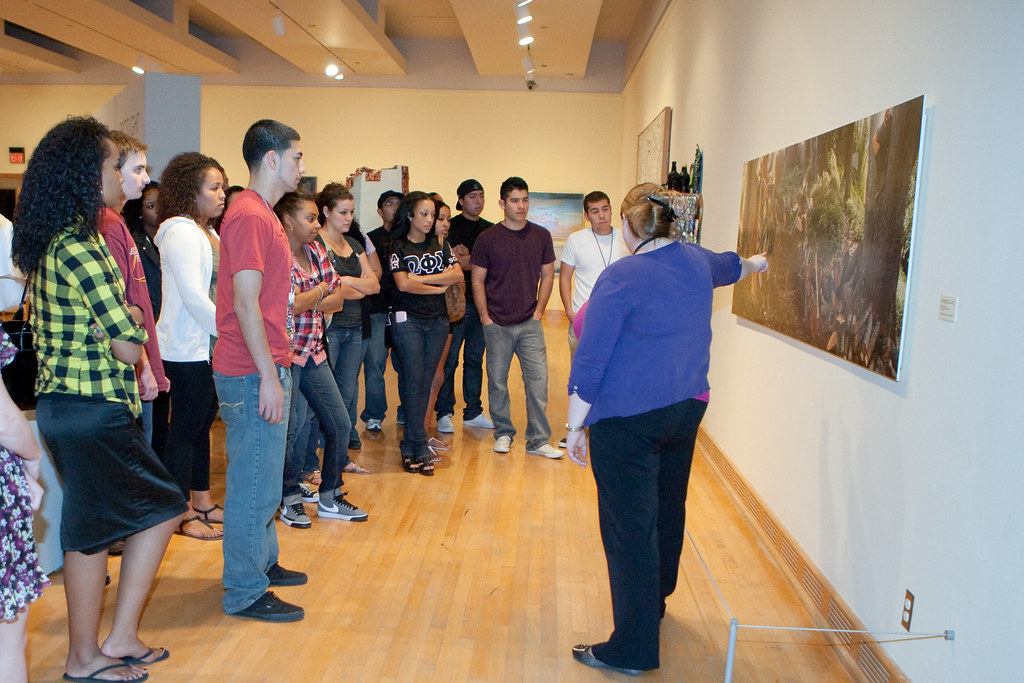
Photo credit: copyright 2009, Diane Wallace, ASU Art Museum

Sunday, January 31, 2010

The Logical Consequence

"'Art for art' is a tactical slogan, a necessary rebellion against philistine didacticism and political control. But pressed to its logical consequences, it is pure narcissism."

- George Steiner

Saturday, January 09, 2010

The Art Community and Common Sense


Ryan Trecartin
"I-BE AREA"
2007
"Everybody gets so much information all day long that they lose their common sense."

- Gertrude Stein
We're a week-and-a-half into 2010, and I'm hoping that the din produced by so much fin-de-decade media will soon die down. It's no secret that we citizens of the United States (and all other essentially "Americanized" peoples) are principally defined by our consumption. What's more, after decades of adaptation to the consumer role, we've become so fond of the talk surrounding our consumer products that the consumer reviews themselves have become another kind of consumable. Regrettably, this is no less true in the arts.

I've made a contrarian effort this year to avoid most of the "Top" lists and their Op-Ed equivalents, but I've not been totally chaste. The diviners of social, political, or cultural trends have been working furiously to meet their deadlines, and the surplus of art-related stock-taking is in large part responsible for the dearth of new HH content. Anything that I write here will only add to the pervasive and stupefying hubbub; it is further distraction from the business of life well-lived.

And yet, here I sit, writing this post. Like all the other commentators, I'm guilty of editorializing and contextualizing that which is better meditated upon individually or mulled over with our loved ones. And I'm guilty of adding one more perspective to the countless millions already vocalized, furthering the unfortunate and wrong-headed belief that subjectivity reigns. What I'm engaging in, then, is dangerous. While post-modern notions of relativism are valid and philosophically valuable, our globalized culture must strive to sort, such that we can, the wheat from the chaff. That is to say, in a time of increasing cross-cultural interaction, the need for some consensus, some agreed upon hierarchy of moral, ethical, and aesthetic value, is acute. It is a dangerous and exciting era; as such, it is a good time to be a artist.

I agree with Roberta Smith's contention that "the years 2000 to 2009 saw the emergence of a tremendous number of really good, interesting, promising artists." My list of "really good" artists, however, is very different from hers, and Ryan Trecartin, one of the artists that the New York Times' critic celebrates in her recent article, "Make Room for Video, Performance and Paint," is definitely not on it. I don't know Trecartin personally, and he may be a well-meaning, pleasant enough person, but his artwork is poisonously self-absorbed. In this respect, at least, Smith is right to assert that he is an important representative of the decade past. The art world, and especially that of New York City, the community to which I'm most attached, has seen an explosion of navel gazing.

To be fair, most artists engage in some level of narcissism. At the end of the 1990s, when I was in my early twenties, I had puerile aspirations to produce "art videos" of my ejaculating penis (paging Sterling Ruby), and my paintings were dominated by angst-ridden self-portraits and hyper-sexualized imagery. The few paintings of that period that survive are today stacked in my parents' Virginia garage, partly covered by a plastic tarpaulin and years of accumulated mouse shit and winter-killed wasp corpses. Such is the fate of personal history. Serpent-like, we periodically shed our skins and move on, hopefully a little more wise. Some of us, however, put our sheddings and bruises on display, mistaking personal exposure for bravery. Indeed, in some contexts it is brave, but when the sharing is marshalled in service of a cult of personality, it is a celebration of individual dysfunction. And when such exhibitionism is mistaken for art, it is an indication of critical and cultural dysfunction.

Believing that art is fundamental to humanity, and that it is transformative and sacred, I don't accept Freud's famous contention that the artist is a neurotic who seeks to attenuate or postpone confrontation of his or her mature psyche. In fact, for most of our species' tenure, the role of the artist was precisely the opposite; we were called upon to ground our brethren is real experience, be it material or metaphysical. Yet Freud's categorization accurately describes much of the juvenalia that passes for contemporary art. Certainly, we artists should be embarrassed by this trend, but you can't kill the messenger, as the saying has it; Trecartin and others creating hysterical or megalomaniacal artworks are reflections of the dominant (and apparently yet ascendant) iCulture. It is instead the critics and the gallerists, the purveyors of taste, that should be most ashamed of themselves.

Essayist, critic, and philosopher George Steiner is far more intelligent and incisive than I, so I include a pastiche of pertinent excerpts from his 1989 book, Real Presences.
"The usages and values predominant in the consumer societies of the West today [are] the secondary and the parasitic[...]. Literate humanity is solicited daily by millions of words, printed, broadcast, screened, about books which it will never open, music it will not hear, works of art it will never set eyes on. A perpetual hum of aesthetic commentary, of on-the-minute judgments, of pre-packaged pontifications, crowds the air. Presumably, the greater part of art-talk or literary reportage, of music reviews or ballet criticism, is skimmed rather than read, heard but not listened to. None the less, the effect is antithetical to that visceral, personal encounter[...]. There is little 'ingestion'; it is the 'digest' that prevails.

[...]

The journalistic vision sharpens to the point of maximum impact every event, every individual and social configuration; but the honing is uniform. Political enormity and the circus, the leaps of science and those of the athlete, apocalypse and indigestion, are given the same edge. Paradoxically, this monotone of graphic urgency anaesthetizes. The utmost beauty or terror are shredded at close of day. We are made whole again, and expectant, in time for the morning edition.

[...]

Two principal impulses energize the American spirit: immanence and egalitarianism. The crux of American time is now. The past matters in direct reference to its usability in and by the present. [...] No other culture has so dignified the immanent. [...] Poets, novelists, choreographers, painters of the most derivative or passing interest, are made the object of seminars and dissertations, of undergraduate lectures and post-doctoral research. The axioms of the transcendent in the arts of understanding and of judgment [...] are invested in the overnight."
Steiner, I presume, frowns on the Top Ten lists and "best of the decade" summaries as much as I do. I also believe that he would dismiss as "derivative or [of] passing interest" most (though not all) of the artists that Smith praises in her article. The cultural longevity of most on Smith's list is questionable, certainly alongside the likes of Alec Soth, Bill Viola, Matthew Day Jackson, Omer Fast, or Tom Uttech, all contemporary artists crafting intelligent and soulful artworks.

Smith writes, at the article's close, "In all, we are confronted with the distinct possibility that quantity and quality may not be so mutually exclusive after all. More means more better." That's very true. But more also means more bad, of course, which is why we today have an urgent need for critics, curators, and gallerists who, like Steiner and Donald Kuspit, are willing to reside outside the community, to avoid political entanglements, and to judge, sometimes harshly. To those critics, artists, and gallerists already plugged in, let's begin this decade, this arbitrary but useful marker in our human journey, with a renewed commitment (a resolution, if you prefer) to be more rigorous, contemplative, and socially committed. The art world, like the world at large, needs fixing, and responsible action is the only thing for it.

Happy Twenty-Ten. Here's hoping that it's healthy and auspicious.

Image credit: Ryan Trecartin, 2007

Thursday, November 02, 2006

Lichtenstein the Ingrate


The most recent email newsletter from ArtKrush, a sister publication of Flavorpill, featured this Boston Globe article about Roy Lichtenstein's questionable sampling. The journalist, Alex Beam, writes:
"Color me naive, but I never thought Lichtenstein's work was a direct copy of scenes from comic books. I assumed that he stylized certain scenes suggested by the comic vernacular of the 1950s and 1960s. 'He tried to make it seem as though he was making major compositional changes in his work, but he wasn't,' says [David] Barsalou, who teaches at the High School of Commerce in Springfield. 'The critics are of one mind that he made major changes, but if you look at the work, he copied them almost verbatim. Only a few were original.'"
Barsalou's website, "Deconstructing Roy Lichtenstein," shows the original comic panels alongside the related Lichtenstein painting. It's worth a look.

That Lichtenstein stole his imagery from superior artists doesn't particularly bother me. At least, it bothers me a lot less today than it did a decade ago. The disapproving murmurs regarding "the implications for copyright law" will soon be mute; for better or worse, intellectual property is swiftly becoming a thing of the past. Lichtenstein's "borrowing" may have been deemed outrageous in the 1960s - had he been exposed - but we now live in the era of the re-mix and the sample. It doesn't matter that he stole. (Curiously, Lichtenstein got rich turning work intended for print reproduction into "one-of-kinds." Today, we are beginning to see some back swing of this pendulum, with reproduction and dissemination gaining ground on the one-of-a-kind sacred object.)

What does bother me - nay, what infuriates me - is Lichtenstein's elitism. The effete hack sampled, but he did so without acknowledging the source. He knew he could get away with it, as his social situation protected him from any outcry on the part of the comic artists. Lichtenstein was a member of the "high art" aristocracy. All but a few of that circle - artists, critics, dealers, and collectors alike - held the more popular (and populist) art forms in contempt, believing them trivial, mundane, and intellectually bereft. And to that, I expectorate, "Fuck you, assholes."

A decade ago, when I was more likely to let fists fly, Lichtenstein was the one artist I dreamed of pummeling. I can't rationalize this rage, but one rarely can; I loathe the man for his absurd insistence that his cribbed paintings were works of art while the source was mere froth.

Happily, I rest more easily these days, confident that Lichtenstein is quickly turning into a cultural blip, one of the many hundreds of artists celebrated in his or her lifetime, only to be discarded or, at best, relegated to the footnotes decades after their death.

The moral of the story: we like comics better than phonies and, Roy, we're fed up with your kind.

Photo credit: image ripped from "Deconstructing Roy Lichtenstein"

Thursday, October 05, 2006

Questions of gender as content


Jennifer Dalton
"Art Guide"
2006
Map, colored pins, painted wooden frame
9 1/2 x 10 1/2 x 1 1/4 inches


Of late, there's been a lot of protest, commentary, and debate concerning the shamefully low percentage of women showing in the art world. It's true; the contemporary art world is dominated by men. Furthermore, I'm assuming that the majority of these men are heterosexual Caucasians, meaning the art world, reflecting the 20th century American teenagers read about in their high school textbooks, is white, male, and straight.

The art blogging community, ever expanding, has fed well on a steady diet of relevant posts, especially following the publication of Jerry Saltz's recent "Where The Girls Aren't" piece in The Village Voice. I generally enjoy Saltz's writing, and this piece is no exception. Saltz writes, "According to the fall exhibition schedules for 125 well-known New York galleries—42 percent of which are owned or co-owned by women—of 297 one-person shows by living artists taking place between now and December 31, just 23 percent are solos by women." Wow; that's astonishing and embarrassing, especially when I note that 60 percent or more of my artist friends are women, and I feel this number representative of the working artist population in New York, if not the United States at large. We have reason to take stock of the situation; there is no ignoring the numbers.

And yet, I can't help but feel the subject itself a bit, well, dated. Is the sex (or sexual preference) of an artist still so important? I mean, sure, most folks across our great, prudish nation are very concerned with sex and sexuality. Debates rage about female golfers on the PGA tour and the sexuality of politicians. But we're not talking about the general public here (no matter how much I'd like the art world to expand it's reach). The voices involved belong to a relatively small, very progressive group of educated individuals.

The question may sound a bit naive, but why are we still "seeing" skin, sex, or sexuality in art that doesn't focus on these issues? Frankly, most art that does take on these issues is didactic, a breed of intellectual illustration which, while worthy of consideration, fades from memory and relevance in much the same way an excellent piece of journalism does. By contrast, most artwork I see these days, whatever the medium, lacks an overt agenda. Until I see the name or, in some cases, until I read the press release, I don't know much about the maker's makeup. Frankly, I don't care to. The art will either ring my bell or it won't. If I later learn about the artist's background and find that these details inform the work further, hooray, but until I want to peel back that layer, I don't need to know hooey. Art, I feel, is a beast best viewed apart from the artist.

At times I feel like shrugging off the issue. Shouldn't we be concerned with the product as opposed to the personality or biography? Yet the imbalance of the sexes is real, and it mustn't go ignored. I'm proud to be friends with ambitious artists and curators who are devoting energy and thought to addressing and, hopefully, rectifying the problem. Still, I can't shake the longing for that day, a millennium or more on, when miscegenation and a dissatisfaction with ol' time fundamentalism will result in our wearing one skin and being more tolerant of varied beliefs. Maybe then we can set to the business of real - meaning global - humanitarian and environmental progress...and artists can expend more energy thinking about art rather than who made what and why.

Photo credit: ripped from Winkleman Gallery; Normally, I would have asked Edward for permission, but he's out of the country and without frequent Internets access...and I'm compulsive.

Friday, November 11, 2005

Photoshop Play

"It appears likely that there are about ten times as many artists in the U.S. today as there were in 1950 while the population of the country as a whole has only doubled. Are Americans five times as talented as they were in 1950? Or does this increase in quantity merely reflect demand, and correspond to a dilution in quality?"
-Piri Halasz, The New York Art World (July/August 2005)
Step #1:
Open Adobe Photoshop and create a new file. (My example below is 120 dpi; 4 x 4 inches.) Insert a few randomly chosen blocks of color. It doesn't matter how you place these blocks or the colors that you choose. You can even use a brightly colored photograph or, better yet, an anime still.


Step #2:
Using the Wave command (found under the Filter/Distort drop-down menu), make the following selections:
Type: Sine
Generators: 6
Wavelength: 230 - 575
Amplitude: 220 - 490
Horiz: 70%
Vert: 30%
Click "OK."

The results will look something like this:


Step #3:
Again use the Wave command, but play with the setting as you see fit this time. Don't be afraid to use the "Randomize" button to preview possible results.


Step #4:
Repeat Step #3 until you are satisfied with what you see on the screen. If you want to add the illusion of depth, you might create more layers, but remember to be careless about any and all editing you do. Just point-and-click until something strikes your fancy.

Before you know it, you will have produced a study for a Shirley Kaneda painting.


Step #5:
Congratulate yourself and then compare your mini masterpiece to an original Shirley Kaneda (see below).


Shirley Kaneda
"Untitled #5"
2003
Mixed media on watercolor paper
16 x 12 inches


Granted, Kaneda's watercolor is more subtly colored and dynamic than my toss-off exercise, but you get the idea. A painting by Shirley Kaneda is, for the most part, produced by using one Photoshop filter repeatedly!

I'm not pulling back any curtains in this post. In her recent artist statements, Kaneda makes clear her indebtedness to Photoshop. She asserts that her work "investigates the relationships between the 'photographic' and the painted or between the unique and the reproducible, as well as how new technologies might be employed to supplement traditional form."

I'm no proponent of modernism, with it's misplaced faith in forward progress, the original or the new, but Kaneda's statement would suggest that her questions are more successfully limned by James Rosenquist and Marcel Duchamp, among many others. By all means, take an existing concept/genre and mine it again, in your own fashion, but please do so thoughtfully. Making a boring, if colorful "drawing" in Photoshop and painting directly from the print? That's a shallow excavation, Ms. Kaneda, and I can't help but think you're capable of better.

Lest readers think I'm being a cranky doctrinaire, slavishly championing handicraft over content and aesthetic delight, I should explain myself. I wince when I spot obvious Photoshop techniques used in contemporary painting because I have relied on some of the same tricks in the past. In graduate school, I produced a number of abstract watercolors and digital prints using exactly the same process Kaneda does. I also created many studies - and a few paintings - that resemble David Salle's new "vortex" series (see image below).


So what's up with established artists turning to Photoshop to generate bad paintings? Young, searching artists commonly experiment with digital filters but they usually outgrow these tools. The filters themselves are created by a team of talented designers, engineers and programmers deserving of kudos, but when abused by painters, the same filters become crutches.

Photo credit: Hungry Hyaena, Feigen Contemporary, Hustler of Culture

Thursday, October 27, 2005

Considering Excavations


On Tuesday night I attended a cocktail reception at Mixed Greens' new Chelsea digs, a nice, contemporary space with a comfortable flow. The reception was billed as a private affair and there were only twenty to thirty people in attendance, making art viewing and navigation easy.

The affair was pleasant enough; I sipped white wine and shuffled about the room, chatting with an artist friend of mine who had spent the day studying for the Graduate Record Exam (GRE). When I applied to art graduate programs in 1999, no schools requested GRE scores, so I was surprised to learn that Stanford, a program on my friend's list, does so. In most respects, I feel that the requirement is a good one; too many artists lack a liberal arts grounding. My friend, however, but pointed out that the GRE isn't a reliable measure of general knowledge, even if it does provide review committees with some sense of an applicant's aptitude. We moved to the bar area, refilled our empty plastic cups and the conversation moved in some other direction.

Still, this is a concern that I return to regularly. Many contemporary artists, despite the impressive sums they (or their family) have spend on graduate schooling, are un(der)educated, ignorant especially of literature, science, and history. This cultural and intellectual illiteracy compromises their work. Little wonder so many artists draw only on their immediate experience or the events of the day without regard to context beyond art world borders!

Some of the onus for this failure must be placed on the art world itself. When applying to art graduate programs, prospective students have a better chance of being accepted if they are familiar with "the system." Attending an undergraduate program with a "fine arts" focus, rather than a general liberal arts college with multi-disciplinary requirements, makes the applicant more art world savvy. These fine arts undergrad programs are essentially high-priced trade schools; the young artist is an apprentice. Their time in these stepping stone institutions prepares them well for many aspects of the art world - whether graduate school applications, grant writing, or mastery of art speak - but it leaves them unable to discuss the similarity between Shakespeare and H. L. Mencken or the political factors which led to the twentieth century's European nationalism. In fact, some of the artists I know deride such knowledge as esoteric (or "nerdy") and conversations about these subjects as self-consciously "heady." (Last week's "The Significance of Pluto to the Waterboy" essay addresses this anti-intellectual posturing.)

But what serious artist wouldn't want to learn as much as possible and, more importantly, apply it? T.H. White's Merlin, in "The Once and Future King," puts it well.
“You may grow old and trembling in your anatomies, you may lie awake at night listening to the disorder of your veins, you may miss your only love, you may see the world about you devastated by evil lunatics, or know your honour trampled in the sewers of baser minds. There is only one thing for it then—to learn. Learn why the world wags and what wags it. That is the only thing that the mind can never exhaust, never alienate, never be tortured by, never fear or distrust, and never dream of regretting.”
Personally, I agree with the wizard's prescription, but it doesn't apply universally. A great many ignorant people are perfectly happy! Still, the work of even the happiest, un(der)educated artist risks cultural irrelevance because it is too tied to art world insularity.

The celebrated art critic Donald Kuspit insists that most contemporary art "reifies innovation into novelty and upsets the balance, leaving a disspirited intellectuality in its wake." Indeed, the art world's decision to prioritize innovation is an imaginative failure. Moreover, the work produced in the quest for novelty is usually (and paradoxically) unoriginal, overly indebted to art world and auction house trade winds.

The variety of art world artist that I'm critiquing might be characterized as Archilochus's hedgehog, the creature that knows only one "big thing." The hedgehog is a specialist, in the context of the art world, shaped by trade school and the market. The fox, according the Archilochus, is a generalist, an animal that knows many things, but nothing so well as the hedgehog knows his or her one. Not surprisingly, I gravitate toward artwork made by foxes whose excavations are broad, even if their digs are more shallow. Digging deeply in just one spot will eventually make your work irrelevant to all but those who share your particular focus.

Bear in mind that, compared to most contemporary artists, I'm an intellectual conservative. I might even be labelled something of a traditionalist. Although I champion cultural relativism, I detest postmodern approaches to philosophy or morality; I'm as much a realistic pragmatist as I am a progressive dreamer, and I'm often out of step with contemporary aesthetic thinking. When I find a work of art frivolous, cloying or stupid, it's likely that other artists and critics will agree that it is superior, possibly even historically important!

Alvin Lustig, the twentieth century designer, believed that
"modernism reflected larger social goals of integrating art and life, blurring the boundaries that had separated high art and utilitarian object. As he put it, 'If I seem to place a heavy mantle of responsibility on the shoulders of those who are really only expected to make nice shapes and colors, it is because history demands it. Every act that allows productive facilities to serve only itself, contributes inevitably to the threat of destruction that already looms on the horizon.'"
That a work engages the intellect or is truly utilitarian is important to me. Lustig may have considered only architecture and graphic design capable of fulfilling these requirements, but I feel strongly that the best contemporary painting, drawing and sculpture can communicate in as vital a way as the walls of Lascaux. Centuries have complicated our interpretation of images, and necessitated that we process a great deal more information than our forebears, but we remain the essential ape.

Photo credit: ripped from mathscareers.org

Wednesday, April 06, 2005

Oh, Beautiful Vapidity…

A friend sent me this music video today.

The song is composed and performed by Dennis Madalone, a New Jersey stuntman-cum-singer/songwriter who wants the listener to know that his
“compassion for others inspires him to write lyrics and create melodies…to share his feelings so that it may be a reflective comfort in ‘your’ life.”
The message of this single, entitled “America We Stand As One,” is to “carry on, hold on and stay strong for we all are truly one.” Apparently, Madalone’s “we” doesn’t apply to folks born outside our proud city walls. This here song, American brothers and sisters, is for us and us alone.

And this brings me to the video. Rarely do you have a chance to see so many clichés packed into a three-minute clip...unless you’re watching a spoof. The video opens with our blue-collar man, illustrated by his All-American, torn blue-jeans, strolling alone on the beach. Soon Dennis is joined by some twinkly special effects, otherwise known as angels. And, with these divine companions watching his back, Dennis breaks into full-throated, patriotic song.

The lyrics are thoughtless and mundane, belying the claim that Madalone is “truly an artist with power, passion and originality.” Canned passion, I'll grant him, but power and originality are not at all represented.

He stands defiant, holding, alternately, a small stars-and-stripes hanky or a large United States flag, while singing,
“I had to go, but it’s OK, You see I’m with you in a different way…America….USA, We stand as one…and we must carry on.”
The homepage claims that “this new rock anthem fills you with hope and comforts you with a spiritual message from our Loved Ones." In fact, I presume that the majority of US citizens under forty years of age (and a great deal of those above) are too savvy to accept “A.W.S.A.O.” as anything other than the hackneyed crap it is. Yet still I find myself becoming worried about the percentage of the populous that will respond to Dennis Madalone’s “sincerity” and “moral integrity.”

This worry may be in part due to the results of a Gallup Poll conducted November 7-10, 2004. When asked, “Which best describes your views of the origin of life?,” the responses were as follows:
Man developed with God guiding, 38%

Man developed with no help from God, 13%

God created man in present form, 45%
45 percent? Dear God…I think I'll go pump up the volume on Mandalone's "America" and stick my hand in a fu*king blender.

Sunday, March 27, 2005

Hara-kiri Karaoke


I'm rarely sure what to make of performance art. Usually I walk away bemused or, worse, embarrassed for the artist or artists responsible. Once in a great while, I do come across a performance that amuses or interests me but, almost invariably, these satisfying works are video documents of a performance, not live performance. Am I more comfortable watching someone engage in curious behavior on film than in person? Perhaps, but I also feel that video works are stronger conceptually. Having made a number of short films, I'm guessing this may be a result of the post-production process, an opportunity for the artist to tinker with presentation.

The performance pictured above, by Ryoga Katsuma, occured during the opening of the most recent group show that I participated in. Katsuma exhibited several of his "action paintings" and a video in "Le Petit Prince," and, for the bulk of the evening, he sat on a folding chair in the gallery space, drawing quick portraits of anyone who would sit for him. His sketches bore little resemblance to the sitters, but some of the drawings were nice enough.

At one point, however, quite unexpectedly, Katsuma stood up, howled, and went through the motions of commiting seppuku on the floor of the gallery. I stood nearby, sipping red wine from my plastic cup and watching the reactions of others in the room. (The brown shoes and jeans at the top of the picture are mine.)

Frankly, the performance made me uncomfortable. Even though I am a devotee of, for lack of a better description, awkward-moment-comedy, Katsuma's intentions were clearly not comedic. In fact, I'm at a loss as to what it was he was trying to communicate. Curiously, after the initial, despairing howl, he mimed the act in total silence but, in the background, the sounds from his video, in which he also ends his life in a crying fit, were synced to his mouth movements in the gallery space. It was a marriage of pre-recorded performance with live action. I suppose you could describe it as hara-kiri karaoke; it was baffling and alarming, but also rather forgettable.

Yup, I just don't know what to make of most performace art...

Saturday, March 05, 2005

To Be Art Or Not To Be Art

Image hosted by Photobucket.com
As I approached the door of Matthew Marks Gallery this afternoon, three young women walked out, laughing. As they passed me, one of them exclaimed, "That was, without a doubt, the worst of the worst! I've never seen something that bad."

The gallery is currently exhibiting recent work by Robert Gober. Upon entering, the first "sculpture" I saw was rather simple. Resting on its side, on top of a simple concrete slab, was an unopened package of diapers. As I recall, they were Huggies brand. That was the artwork; Gober purchased a package of Huggies and placed it on a concrete slab in a New York art gallery.

In his recent review of "The Gates," The New Yorker art critic, Peter Schjeldahl, writes, "Art used to mean paintings and statues. Now it means practically anything human-made that is unclassifiable otherwise." Reading this, I recalled a comment I overheard a tourist make last year. He was looking at TRANSMOTION, a multi-media, roving installation constructed on the flatbed of a tractor-trailer, and he said to his wife, "Well, if you don't know what it is, it must be art."

This afternoon, looking at Gober's diapers, I considered both of those definitions. Because I could identify the object at my feet as diapers, Gober's "sculpture" failed to pass the tourist test. Gober doesn't make the diapers, but they are "human-made." Will this sculpture pass the Schjeldahl test? No. I'm looking at a package of Huggies, for God's sake! Huggies are classifiable as, well, diapers. They hold baby shit. They're not art.

In the rear of the gallery, I studied a lactating, crucified Christ. This Christ, though, has been beheaded or perhaps he never had a head. The water-milk coming from Christ's nipples fountains out away from his hanging body and enters a small, rough pit in the floor of the gallery. Now this, I'm sure, is art! I'm momentarily pleased, but then realize that it is bad art.

Gober gives me Huggies and a headless, lactating Christ. Feeling the same way the three young ladies had, I quickly exited the gallery.