Showing posts with label hunting. Show all posts

Sunday, June 30, 2013

In Harness at Aggregate Space

An Aggregate Space "Selfie"; West Oakland, CA; June 2013
I'm grateful to both Aggregate Space and The Featherboard Writing Series for granting me time (and a desk away from my home office/studio) to focus on new writing and photograph projects. Having begun work on my two e-chapbooks (described in more detail here), I'm even more enthusiastic about the possibilities. I spent most of today in Aggregate Space's second floor office and editing area, where I wiled away the hours ruminating on some of my early hunting experiences in dove fields.

Disappointingly, it seems unlikely that the e-chapbooks will be available by the time the residency ends in early August, but the kind folks at The People's E-book have agreed to let me be a part of the second wave of Beta testers for the platform. Currently, I plan to produce two limited edition print (i.e., non-digital) chapbooks in partnership with Aggregate Space and The Featherboard Writing Series, and then I'll turn those limited editions into freely distributed e-books after the residency's end.


Image credit: copyright, Christopher Reiger, 2013

Tuesday, September 08, 2009

Kimmel Harding Nelson Residency: Day 2


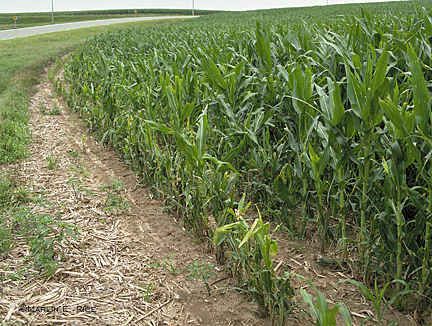
Iowa corn field

The Flying Nun

As our plane approached Omaha, Nebraska, I surveyed the irregular grid of rectangles and squares formed by western Iowa's country roads. Cumulus clouds cast dark shadows of punctuation over the vibrant greens, yellows, and siennas of the state's corn and soybean harvest.

I tend to think of our nation's industrialized monoculture as a rigid corporation of hundreds of thousands of acres of symmetrical fields, but, in practice, even agribusiness can only bend the land so much. At an altitude, one sees that our fields are as shaped by the extant topography as they are by human manipulation. Indeed, some of Iowa's fields, with their rounded edges and calligraphic plow lines, could, from the air, be mistaken for southeast Asian rice paddies.


Aerial view of western Iowa agriculture

My neighbor on the plane was a pleasant Benedictine sister. Dressed in full habit, she was en route to Norfolk, Nebraska, for an assembly of the world's Benedictine Monastic Missionaries. She works and resides in Namibia, Africa, assisting with education and HIV/AIDS prevention. I deeply appreciate the charitable activity and lifelong devotion of such missionaries, but I remain wary of the proselytizing component.

At several points in my conversation with the sister, I felt as though she was soft-selling her faith. She commended me on my given name, Christopher, explaining that I was named after the Catholic saint that supposedly carried the young Yeshua of Nazareth across a river. (Of course, that isn't quite right. The saint, if the man in fact existed, was named for his deed; the Greek word Christophoros translates as "bearer of Christ.") She was also happy to learn that my vocation, my calling, was art, and encouraged me to use my artwork to "usher in Christ's love everlasting." I replied with a noncommital "um hmm," and left it at that.

Perhaps because my response was ambiguous, she persisted. Inspired by my affinity for art, she recollected a visit she made to the Norman Rockwell Museum, where she viewed a sculpture by Rockwell's son, Peter. According to the nun, the sculpture featured a crucifix crowned by devil horns. The piece sounds wholly adolescent, but it evidently upset one of the nun's companions, who couldn't understand why the "symbol of all that is good" would be paired with "the symbol of all that is evil." The nun reassured her friend by pointing out that "at least Peter Rockwell isn't an atheist." She weighted the last word, and shook her head as she pronounced it. I'm not sure what element of the sculpture informed her confident conclusion about Rockwell's metaphysics, but her story made clear her negative feelings for those who doubt or deny her particular faith.

Some minutes after the Rockwell anecdote, she expressed pleasure at Pope Benedict XVI's decision to expand contemporary Catholic use of the Tridentine Mass, a Latin text that vilifies Jews. Considering the nun's clear dislike of atheists and her implied disapproval of non-Christian religious beliefs, I'm happy that I dodged any questions that, squarely answered, would have revealed something of my personal path from a Christian baptism, to agnosticism, to atheism, to my current exploration of and identification with panentheistic or panendeistic Judaism. Part of me was disappointed in myself for not confronting her ecumenical failure, but, frankly, I was more interested in looking out of the plane's window.


Auto repair yard on Central Avenue; Nebraska City

First Impressions of Nebraska City

If you define "city" as a settlement with a large population, Nebraska City is a misnomer. Compared to New York City, my home for almost a decade, Nebraska City is a population blip. New York City's population, estimated at 8.5 million, is 1,200 times Nebraska City's roughly 7,000 residents.

Shortly after we loaded the minivan with our bags and left the Omaha airport, Ron, the owner (and sole employee) of Tree City Taxi Service, said that most Kimmel Harding Nelson Center residents that come to Nebraska City from big cities experience some degree of culture shock. But, although I now live in New York City, I originally hail from Locustville, Virginia. Locustville's population was just 99 when I lived there, and I don't believe that the number has significantly increased or decreased in the years since. Compared to my hometown, Nebraska City is, as its name suggests, a veritable metropolis!


Closed store on Central Avenue; Nebraska City

In conversation with Ron, I gathered that the largest employer in Nebraska City, the American Meter Company, has recently laid off a significant number of its employees. Two other companies that the townspeople depend upon, Cargill Meat Solutions and Diversified Foods & Seasonings, are also facing cutbacks. As a result, many of Nebraska City's citizens are struggling to make ends meet. The economic woes are apparent on the town's main street; it seems as though every block on Central Avenue is home to at least one vacant storefront.

Ron also confirmed my assumption that white-tailed deer, turkey, carp, and channel catfish are major focal points of the region's outdoor recreation. He proudly told me that two of his granddaughters, decked out head-to-toe in camouflage gear, already accompany their dad deer hunting. The image of the camouflaged little girls made me smile, perhaps because I fondly recall the too-big camouflage outfits of my childhood.

Along with hunting and fishing, the major pastimes in eastern Nebraska are high school and college football. This afternoon, from the kitchen window of my residency apartment, I watched the middle school football team practice. I wondered if, compared to their coastal peers, a greater percentage of Nebraska's teenage athletes bank on athletic scholarships and dream of going pro. Many of the players' parents arrived early and watched them from the edge of the practice field.


View on 6th Street; Nebraska City

Photo credits: image of Iowa corn field, ripped from Iowa State website; image of western Iowa fields, ripped from Legacy By Design blog; all photographs of Nebraska City, Hungry Hyaena, 2009

Tuesday, June 09, 2009

Offerings, Tallies, Records


Christopher Reiger
"cost benefit analysis"
2008
Pen and sumi ink, gouache, watercolor and marker on Arches paper
12 x 12 inches
"What if, while you read the last few paragraphs, something in the world has changed? What if, during the past five minutes, someone, somewhere, sent you a text? Shouldn’t you go and check?

Being addicted to the wired universe might be perfectly healthy, of course, and it’s certainly defensible beneath the triumvirate of technology, curiosity, and progress. I’m the first to admit that there’s something enchanting and invigorating about my computer. There’s magic in reading a note from a friend in Rome and clicking through Halloween pictures from New Jersey and verifying John Steinbeck’s birth date in two clicks. The Internet is indeed its own strange, blessed fountain of light.

[...I'm] not the first to wonder about all this, [...] not the first to sense that maybe our shared life is rushing by too quickly, too feverishly. [I'm] not the first to feel as if [I'm] scrambling to make [my voice] heard against an infinite and obliterating silence.

During the five days [...] I spent in the mountains, [I] saw lots of Shoshone pictographs, paintings made in caves mostly, and under overhangs: finger-painted elk and owls and dogs and triangle-bodied hunters with bows. Many of the pictographs in that area include hash marks, like rows of fence posts scratched downhill, but it’s anyone’s guess as to what these marks originally meant. Maybe they were offerings to the spirit world, or tallies of successful hunts, or records of vision quests. Maybe they were the consequence of someone sitting beside a fire and thinking happily away.

Whatever they once meant, they mean something else now. They mean memories are fragile, beliefs are tenuous, contexts are temporary. They mean nothing is stable—not mountains, not species, not cultures, not e-mail."

- Anthony Doerr, "Am I Still Here?" (from the January/February issue of Orion Magazine)

Monday, April 13, 2009

Being Prey


"The bank now presented a high, steep face of slippery mud. The only obvious avenue of escape was a paper bark tree near the muddy bank wall. I made the split second decision to leap into its lower branches and climb to safety. I steered [the canoe] to the tree and stood up to jump. At the same instant, the crocodile rushed up alongside the canoe, and its beautiful, flecked golden eyes looked straight into mine.

Perhaps I could bluff it, drive it away, as I had read of British tiger hunters doing. I waved my arms and shouted, 'Go away!' The golden eyes glinted with interest. I tensed for the jump and leapt. Before my foot even tripped the first branch, I had a blurred, incredulous vision of great toothed jaws bursting from the water. Then I was seized between the legs in a red-hot pincer grip and whirled into the suffocating wet darkness."
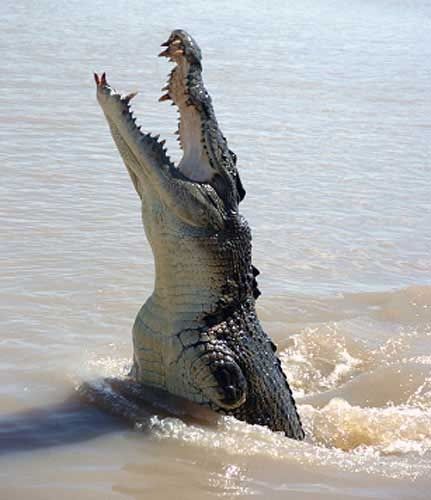
Val Plumwood, an Australian feminist and environmental activist who died last year, describes a nearly fatal attack by a saltwater crocodile (Crocodylus porosus) in her 2000 essay "Being Prey."

In 1985, in Australia's Kakadu National Park, Plumwood's canoe was repeatedly struck by the crocodile until, capsize imminent, she attempted escape into an overhanging tree. Her attempt failed; the croc took Plumwood underwater and "death rolled" her three times. Incredibly, Plumwood survived the attack. Once she'd managed to surmount the steep bank, her injuries forced her to crawl almost two miles before a park ranger found her.

The terrifying experience inspired Plumwood to ponder the frayed relationship between humanity and the rest of the animal kingdom. In the course of doing so, she questioned the usual motivation for adopting a vegetarian diet.
"Although I had been a vegetarian for some ten years before the encounter with the crocodile and remain one today, this knowledge makes me wary of the kind of uncontextualized foundation for vegetarianism that suggests that predation is either a negligible anomaly or an unredeemable ethical deficiency in the ecosystem. The presentation of the food chain as a (potentially) peaceful order ideally subject to nonviolent reconfiguration leads ultimately toward the thoroughly anti-ecological position that the earth is ethically improved by the elimination of predation."
I couldn't agree more. Similar thinking inspired me, five years ago, to become a vegetarian unless I kill or catch the animal myself. Predation is natural, even when we are the prey.

Photo credit: ripped from Virgin Media

Wednesday, January 16, 2008

Two Exceptions Taken

"My own experience is that the more we study art, the less we care for nature. What art really reveals to us is nature's lack of design, her curious crudities, her extraordinary monotony, her absolutely unfinished condition. Nature has good intentions, of course, but, as Aristotle once said, she cannot carry them out."
-Oscar Wilde

Wilde produced so many clever, insightful passages, but now and again he comes off as an arrogant buffoon. (On the plus side, the quote suggests that Wilde, were he still with us, would not be a proponent of Intelligent Design...so there's that.)

+++++

"Violence and brutality aside, if you were ever unsure of how ridiculous hunting can seem in modern terms, [artist] Angela Singer spells it out. Singer has explored the notion of the hunt and its trophies for a number of years and while her subjects explicitly reference the idea, her process pointedly undermines the esteem of hunting for trophy.

Trophy hunting in New Zealand does not have the social prowess as in Britain, but is still very much a red-blooded sport. It represents a regressive urge to connect with the natural and instinctive animal self and is emblematic of macho stereotypes of man-as-hunter."
-Anna Jackson, writing on the sculptures of Angela Singer in NY Arts

Really, Anna, we should talk. I have a feeling you might rethink your characterization of hunters and hunting...or at least allow for some anomalies.

Knee-jerk, reductive reactions to any complex subject are frustrating. I'm assuming that Jackson is a vegetarian; if not, she should have acknowledged this contradiction. She also embraces the now common stereotype of the hunter as a trophy hound. Certainly, the majority of hunters will mount at least one of their animal kills (whether head, rack or whole hide), but a great many find the idea repugnant, and are instead concerned with the meal and the experience.

But Jackson characterizes that experience as "regressive." Is connecting with the "natural" and "instinctive animal self" a bad thing? What of shitting, sex, and the feeling that possesses you in those (hopefully) rare moments when your life is in imminent danger? What of meditation or "spiritual" ecstasy?

I'm not a typical proponent of hunting; my views on the "issue" are nuanced and often contradictory, but when a person calls hunting "ridiculous" and "regressive" without explaining their perspective, my hackles rise.

Friday, January 04, 2008

Field To Table

I killed and ate one duck during my annual winter trip to the Eastern Shore. It's become a tradition...though "ritual" is perhaps a better word for it.

A vegetarian otherwise, my days of frequent hunting and fishing outings are gone, but the process of killing, preparing and consuming fish, fowl or flesh remains important to me. Once familiar to all, the steps involved are now considered foreign (even low) by the majority of contemporary meat eaters.

I have written on this subject several times before; rather than reiterate the same ideas, I thought I'd post some pictures of the process.

+++++


Lucy, a yellow Labrador Retriever, carries the fallen duck back to the blind.

+++++


Dead hen American black duck (Anas rubripes), on the left, and a hen mallard (Anas platyrhynchos), shot by a hunting companion, laid on the dock before the cleaning begins.

(My father and I make every effort to avoid shooting black ducks. The species experienced a gradual population decline in recent decades. Fortunately they are now rebounding in the Atlantic Flyway. Still, I would prefer to kill a mallard, but on this particular morning I failed to correctly identify the species as it winged past. It wasn't until Lucy retrieved the bird that I realized my mistake with a groan. Sadly, most duck hunters don't pick-and-choose species at all. Indeed, many hunters are no better at distinguishing species "on the wing" than your average urbanite.)

+++++


Ducks after plucking.

+++++


Ducks following gutting. The heads, wings and innards have been removed, and the heart of the black duck saved (on pan). The heart of the mallard had been mostly destroyed by the shot and could not be saved.

(When I was young, the duck liver could also be saved and eaten, but environmental pollutants have led biologists to discourage the consumption of internal organs.)

+++++


My hand following the gutting, a shockingly beautiful reminder of what meat consumption entails. I'm baffled by people who find such images disturbing yet continue to eat meat. They are the very definition of unreasonable and irresponsible.

(This isn't to suggest that I condemn contradiction. Indeed, I embrace it, but logic wins out in this case. If you find an act (any act) reprehensible or grotesque, how can you, with a clear conscience, ask it of someone else?)

+++++


Cleaned birds on pan, readied for rinsing and final preparations. Note how much more fat the mallard (bird on bottom) has than the black duck.

(Anas rubripes is considered a "wilder" or "gamier" species and, in my estimation, the meat tastes better for it.)

+++++


Me, cleaning and picking off remaining pin feathers.

+++++


The two ducks are now ready to be cooked. I ate the black duck that same evening. It was delicious.

+++++


My irreverent father sometimes says, half jokingly, "Make sure you finish everything on your plate. It died for your sins." In the days of environmental footprint quizzes, carbon trading programs, and hybrid automobiles, most western eating habits could fairly be deemed hedonistic. My annual kill, then, is sacramental. I "sin," if you will, so that I might reconfirm my decision, five years ago, to stop eating meat unless I am personally responsible for the killing involved in bringing meat to the table.

I'm not a true moralist, however. I realize that there is no universal code of ethics - only that which we, as individuals or societies, project onto others - but I do wish more people would consider their individual impact on the lives and environment of the animals we share this planet with, and depend upon for physical and emotional sustenance.

Photo credit: All images, Hungry Hyaena, 2007

Sunday, August 19, 2007

Routine Passing


Looking northeast from the dike rim at Heron's Foot, December 2006

"Spitz-spop, Christopher. Rise and shine." My father's familiar refrain. He opens the bedroom door and flicks on the light.

I groan and stagger from my bed to the middle of the room, where my clothes are laid out on the floor like a fallen scarecrow. Sleeves spread out to the side, an undershirt is placed on a thermal top that rests, in turn, on two sweaters and a camouflage button down. Likewise, a pair of tightie-whities rests atop long johns and a pair of camouflage pants. A pair of folded athletic socks is stacked on two heavy, woolen pair.

Absent-minded, I dress.

In the bathroom, I fight through the two undergarment layers before I can relieve myself, reminding myself that, next time, I should remember to visit the toilet before I dress. I wash my hands, splash some water on my face and decide not to brush my teeth.

Downstairs, my father is almost ready, his oatmeal and peeled banana half eaten. I pour milk on a bowl of cereal and eat quickly. Nothing is said. Outside it is still black.

On the dining room table are two shotguns, two boxes of shells (one .20 gauge and one .12), two pairs of wool gloves and two camouflage, wool face masks. My father is already in his boots when I finish my cereal. He is by the backdoor, double-checking the canvas decoy bag and his necklace of duck calls.

"All set?"

"Yes," I reply.

I carry the guns, gloves, shells and face masks to him, then slip on my own boots.

Once outside, my eyes adjust. It isn't black, not really. The moon's blueish glare reveals more than you might expect. My father and I walk in silence down the long clamshell drive, then cross quiet Seaside Road. We move through an opening in the roadside hedge that you'd overlook were it not for a solitary holly planted among the cedar and pine. A stout wooden footbridge spans a deep ditch inside. Another twenty steps and we crest the dike, moving east along the rim.

The decoys shift and bounce in their bag and the duck calls jostle on my father's chest. I can hear his breathing; his footsteps fall heavier than mine. I resent him for this.

At the dike's northeast corner we descend the left bank into the upper marsh, where a cedar tree island ekes out a life drinking brackish water. Around this island the cordgrass lays down in gentle waves. I want to stop, to remain for the morning in this spot, to shed these layers and lay like the cordgrass, to be part of the marsh, part of something not me, something greater. This is what I wanted at ten years of age.

Instead, I followed my father to the duck blind, where he put out the decoys and we awaited the morning flight. Now, almost twenty years later, I lay alongside the island most every time I visit Heron's Foot. It is a good place to lie.

Photo credit: Hungry Hyaena, 2006

Tuesday, March 20, 2007

Brian Lesteberg


Brian Lesteberg
"Fallen Doe, Voltaire, ND, 2003"
C-Print
40 x 32 inches

I was introduced to photographer Brian Lesteberg's terrific "Raised To Hunt" series via Alec Soth's blog. Regular readers of HH will likely know about my connection to hunting and fishing; although I usually carry a camera instead of gun these days, hunting continues to inform my life and philosophy, even living in New York City. Most art viewers, no matter their background, will appreciate Lesteberg's handsome photographs for their marriage of compositional simplicity and compelling content, but those of us who recognize the visceral moments Lesteberg has captured are, I believe, moved in a more fundamental way.


Brian Lesteberg
"Bradley, Sheridan County, ND, 2003"
C-Print
40 x 32 inches

Although my favorite image in the series is "Fallen Doe, Voltaire, ND, 2003," "Bradley, Sheridan County, ND, 2003" is more closely tied to my own experience. In the fall of 2005, I wrote about a flight of Canada geese passing south over my apartment in Astoria, Queens. The birds' calls triggered memories of Thanksgiving morning goose hunts.
"[These] could well be descendants of Canadas I hunted years ago, lying on my back in a cold-hardened, fallen corn field with a 12-gauge Browning over-and-under heavy on my chest. Looking down from several thousand feet, a group of geese would spot our decoy spread and begin a long, beautiful pitch to us, a pitch that might last many minutes and, for some of the birds, would be their last. Hours later, a cooked goose would emerge from the oven, dressed and ready for Thanksgiving dinner. My family never ate turkey."

Brian Lesteberg
"Dad Field Dressing a Goose , McClusky, ND, 2001"
C-Print
40 x 32 inches
Lesteberg's work has the same poetic resonance as Alessandra Sanguinetti's pictures; both photographers are evidently attached to the processes and rituals they document, but they allow themselves enough remove to open up their work to interpretion.


Brian Lesteberg
"Hoof Track with Blood, Voltaire, ND, 2003"
C-Print
40 x 32 inches


Photo credit: all images courtesy Brian Lesteberg

Thursday, April 20, 2006

Undoing The Gordian Knot

Michael Pollan, Hunting, and The Rest Of It

Image hosting by Photobucket
"The fact that you cannot come out of hunting feeling unambiguously good about it is perhaps what should commend the practice to us....If I've learned anything about hunting and eating meat, it's that it's even messier than the moralist thinks. Having killed a pig and...now looking forward (if that's the word) to eating that pig, I have to say there is a part of me that envies the moral clarity of the vegetarian, the blamelessness of the tofu eater. Yet part of me pities him too. Dreams of innocence are just that; they usually depend on a denial of reality that can be its own form of hubris."
-Michael Pollan, "The Modern Hunter-Gatherer"
I'm always pleased when I come across an article that clearly conveys a concept I have been striving to articulate with limited success, so I'm indebted to a co-worker for bringing to my attention Michael Pollan's (relatively) recent essay, "The Modern Hunter-Gatherer," in The New York Times Magazine (March 26, 2006). Pollan, the author of The Botany of Desire, Second Nature, and, most recently, The Omnivore's Dilemma, is a sensitive, thoughtful proponent of hunting. But whereas most writers who wax poetic about the hunt are guilty of romanticizing and simplifying what is, in fact, quite messy(1), Pollan argues that the hunter can not be a moralist. Rather "the grown-up hunter, the uneasy hunter...recognizes the truth" that resides in contradiction, or, as Robert Kimber put it in his excellent Living Wild & Domestic, "the uncompromising romantic has to compromise with the realist."

Image hosting by Photobucket

Before I continue, however, let me provide some background explanation of why Pollan's piece strikes a chord. As I wrote in my March 2005 essay, "Hunting JFK,"
"I consider myself a conscientious hunter. I eat no meat, including fish, unless I catch it or kill it myself. I kill only a few animals a year and catch only ten or so fish. I live on a vegetarian diet otherwise, aiming to minimize my contribution to the environmental degradation wrought by the meat [and fishing] industr[ies]. I will hunt only those species biologists deem to have 'surplus' populations, such as white-tailed deer (does only), mallard ducks (drakes only), cottontail rabbits."
Environmental degradation was not Pollan's principal motivation, but his reasons for picking up a rifle and heading into the woods of northern California to stalk and kill a feral pig (Sus scrofa), an introduced species descended from the European wild hog, are no less significant. The son of "one of the world's great indoorsmen," Pollan had never hunted. He "had long felt that, as a meat eater, [he] should, at least once, take responsibility for the killing that eating meat entails. [He] wanted, for once in [his] life, to pay the full karmic price of a meal." That Pollan should feel this way is admirable. Most well-educated Westerners are now too timid, too cloaked in denial, to address such base issues. Turning again to Kimber, "If the step from hunter to herdsman-plowman was the first great step in the process of alienation from nature and self, then surely the step from herdsman-plowman to city dweller, driver of combines, and feedlot engineer has all but completed that process."

All contemporary omnivores - the vast majority of humans - are necessarily implicated in the grisly business of meat "manufacture." The pork chop on the plate is more than a tasty entree; it was recently a living animal. After stunning, assuming that process goes smoothly, the pig's throat is slit by machine (or man) and the viscera is spilt before meat preparation begins. Every pig-eater who prefers to cast such realities from her mind is afraid of more than blood and gore or even the potential for undue suffering on the part of the animal. She is, above all else, afraid of confronting her own mortality. If, on the other hand, you know what it's like to kill a fellow creature, you consume flesh with full knowledge of what brings the food to the table: execution. Pollan suspects as much, even if he remains suspicious of the "ecstatic" language used by the likes of Ortega y Gasset and Hemingway.(1)

Pollan's account of the boar hunt makes for good reading, but his consideration of the aftermath is especially excellent. He struggles with his confused, intense reaction to the shooting and dressing, a polite term for gutting, of the large animal.
"...the rest of the organs tumbled out onto the ground in a heap, up from which rose a stench so awful it made me gag. This was not just the stink of pig wastes but those comparatively benign smells compounded by an odor so wretched and ancient that death alone could release it. I felt a wave of nausea begin to build in my gut. The clinical disinterest with which I had approached the whole process of cleaning my pig collapsed all at once: this was disgusting."
My upbringing was very different from Pollan's. I grew up assisting in the gutting and preparation of dove, quail, duck, deer, rabbit, squirrel, and other animals. As I told a Scrawled correspondent in a recent interview,
"Some of my early memories are, quite literally, bloody...As a child pondering the blood of a slain animal, I was deeply moved, at once overwhelmed with sorrow, and energized by the realization that the neon red glowing on my trembling hands was spilt life. The more familiar I became with death, the more tied to life I felt. It was an introduction to 'the Circle of Life,' even if it wasn't at all what Disney force-fed us."
Pollan draws similar conclusions, but because his is a new experience, he searches for an explanation where those us accustomed to death do not. This search begins with an examination of his nausea.
"...[W]hat was this attack of revulsion all about, anyway? Disgust, I understood, is one of the the tools humans have evolved to navigate the omnivore's dilemma - the elemental question of what we should and should not eat. The emotion alerts us to things we should not ingest, like rotten meat or feces. And surely that protective reflex figured in what I was feeling as I beheld these viscera, which no doubt did contain microbes that could sicken me. Our sense of disgust, as Steven Pinker has written, is 'intuitive microbiology.'"
Pollan's revulsion is the product of our animal hard-wiring. Routine killing and butchering may arrest or weaken this disgust - repetition dulls all sensation - but it remains an inevitable reaction. Like it or not, we are genetically adapted to the Pleistocene lifestyle Hemingway pined for. Pollan may cope well enough in modern-day California, making a living from selling words, but he still becomes ill at the sight of undesirable innards and, when hunting, turns into what he calls "alert man"(2), a more aware animal, one making full use of its senses. Ever conscientious, though, Pollan probes further and discovers something more than genetic coding in his violent revulsion.
"...there had to be more to it than that, and later, when I did some reading on disgust, I acquired a better idea what else might underlie my revulsion. Paul Rozin, a cultural psychologist at the University of Pennsylvania, points out that many of the things that disgust people do come from animals — bodily fluids and secretions, decaying flesh, corpses. Beyond the sanitary reasons for avoiding certain parts and products of animals, these things disgust us, Rozin suggests, because they confront us with the reality of our own animal nature. So much of the human project is concerned with distinguishing ourselves from beasts that we seem strenuously to avoid things that remind us that we are beasts, too — animals that urinate, defecate, copulate, bleed, die, stink and decompose...Exactly why we would strive so hard to distance ourselves from our animality is a large question, but surely the human fear of death figures in the answer."
Ah, yes, and so we arrive again at existential fear and the reason most folks prefer to distance themselves from the killing of the animals they consume. To "[pay] the full karmic price of a meal," Pollan must not only execute the pig, but also own up to the deed. Coming to terms with killing is far more challenging than pulling a trigger.
"What disgusted me about 'cleaning' the animal was just how messy — in every sense of the word — the process really was, how it forced me to look at and smell and touch and even to taste the death, at my hands, of a creature my size that, on the inside at least, had all the same parts and probably looked very much like me. The line between human and animal I could discern here, gazing into that carcass, was nowhere near sharp...In this, I decided, was one of the signal virtues of hunting: it puts large questions about who we and the animals are, and the nature of our respective deaths, squarely before the hunter, and while I'm sure there are many hunters who manage to avoid their gaze, that must take some doing."
For years I've tried to express as much so simply, but I tend to talk around the core of the matter, relying heavily on co-opted constructs and borrowed phrases. Even when I do feel I'm in the ballpark, most folks still willing to listen dismiss my attempts as little more than morbid rambling. After all, I live in New York City and, as far as most people know, eat a strict vegetarian diet. Why am I interested in championing hunting? What sense does that make? Pollan's remarks on the "signal virtues of hunting," particularly the difficult questions raised by the killing of other animals, suggest an answer.

One sometimes hears hunters - the more literary among them, anyway - say, "I kill to have hunted; I do not hunt to kill." This hackneyed comment refers principally to the heightened sense of immediacy and awareness alluded to earlier. Pollan likens this sense to a marijuana high; in fact, it is merely our inborn predatory instinct at work. But while there is certainly much to be said for the act of hunting itself, it is the killing that for me remains the essential existential experience. The hunt allows us to access our rarely used programming, to make full use of our special abilities, but the kill is like a Zen koan, a Gordian knot undone only by willful ignorance or reliance on moral certitude.

As Pollan suggests, avoiding the animal gaze "must take some doing." To approach a fallen animal, a creature you have just killed, is difficult but transfiguring. In the glazing eyes of the dead beast, you confront your own mortality. Terrifying though this may seem, I associate these moments with a profound sense of oneness with the natural world. In accepting responsibility for the brutal deed and recognizing my connection to the slain animal, my ego is reduced. There is an exhalation of the isolated, confused experience of contemporary life, and an inhalation of the universal(3). Dr. Morris Berman's analogy is pertinent: the experience removes the respectful hunter from the vertical, hierarchical world view and allows him to reside as part of the horizontal stretch, if only for a spell.

Unfortunately, I'm no stranger to the so-called "hero shot," the photograph of a hunter standing or kneeling behind a freshly killed animal. (In the case of smaller game, like rabbit or duck, the hunter proudly displays the creature in his hands.) It's a simple enough composition, dull and undistinguished: hunter, weapon, and prey. Usually the hunter smiles broadly. Open any contemporary "hooks-and-bullets" magazine and you'll find these images on most every page. I've never cared for these photos but, because my father is an outdoor writer, I've grown accustomed to his requests for such pictures. These days, article sales depend on the quality of the accompanying photographs as much as they do the writing, so I dutifully pose and do my best to muster a smile. Judging by my father's regular appeal - "C'mon, Christopher. Let's see a happy face. Look like you're enjoying yourself." - I don't often succeed. Why should I smile? I've just killed an animal. I'm spacey and contemplative. I'd prefer to be left alone, given adequate time to commune with the creature I have killed, minus the backslapping and the misdirected camaraderie. The experience is special, certainly, but not celebratory or joyous.

Image hosting by Photobucket


Apparently, most hunters do not suffer such brooding thoughts. Even Pollan, despite describing his emotions in the first moments after killing his boar as "surging and confused," admits to feeling proud and "unambiguously happy." It isn't until he sees the photograph of himself "kneeling on the ground behind a pig the side of whose head has erupted in blood," "one proprietary hand" placed "on the dead animal's flank," that he realizes how strange his happiness is.
"The man is looking into the camera with an expression of unbounded pride, wearing an ear-to-ear grin that might have been winning, if perhaps incomprehensible, had the bloodied carcass sprawled beneath him been cropped out of the frame. But the bloodied carcass was right there, front and center, and it rendered that grin - there's no other word for it - obscene. I felt as if I had stumbled on some stranger's pornography....No one should ever see this."
Some of the more seasoned hunters I know will write off Pollan's reaction as silly, indicative of a weakness borne of liberal ("sissified") elitism and a life removed from the realities of nature. There is some truth to that, surely, but what of their own unwillingness to consider the situation completely? They are just as guilty of ignoring the knot's complexity; they opt to "undo" it with denial's blade. As I see it, the ignorance of the prideful "sport" hunter is equivalent to that of the staunch anti-hunter(4).

And that brings me to an obvious distinction; Michael Pollan and I are not typical hunters. In fact, the more used to the predominantly vegetarian diet I become - it's been several years since I ate meat regularly - the less often I will hunt or fish in the future; maybe one day I will stop altogether, instead concentrating on a backyard vegetable garden. I am familiar already with the gravity of killing and the associated ego erasure. Given the power of that experience, it will always inform my art making, my writing, and the way I live my life. The insight may, like a tattoo, fade with time, but it will not disappear. Pollan, too, is unsure if he will hunt again, despite only having done so once. I am sympathetic, even if I feel he should try other forms of hunting before abandoning the practice altogether. We - and I mean all of us, not just hunters - need more voices like his, voices that challenge the intellectual hegemony of dullardism, on both the Left and Right. There are no simple answers to complex questions, and there are only so many times the Gordian knot can be cleaved by ignorance or denail.

For more, visit this interview with Michael Pollan.

Photo credits: Gordian Knot image ripped from homepage of Matthew Cadwallader; boar hunt photos ripped from Southeastern Outdoors and Suwannee River Ranch websites

+++++

(1) "I recognize this kind of prose: hunter porn. And whenever I've read it in the past, in Hemingway and Ortega y Gasset and all those hard-bitten, big-bearded American wilderness writers who still pine for the Pleistocene, it never failed to roll my eyes. I never could stomach the straight-faced reveling in primitivism, the barely concealed bloodlust, the whole macho conceit that the most authentic encounter with nature is the one that comes through the sight of a gun and ends with a large mammal dead on the ground..." ("The Modern Hunter-Gatherer," The New York Times Magazine, March 26, 2006)

(2) "Nothing in my experience has prepared me for the quality of this attention. I notice how the day's first breezes comb the needles in the pines, producing a sotto voce whistle and an undulation in the pattern of light and shadow tattooing the tree trunks and the ground. I notice the specific density of the air. But this is not a passive or aesthetic attention; it is a hungry attention, reaching out into its surroundings like fingers, or nerves. My eyes venture deep into thickets my body could never penetrate, picking their way among the tangled branches, sliding over rocks and around stumps to bring back the slenderest hint of movement. In the places too deeply shadowed to admit my eyes, my ears roam at will, returning with the report of a branch cracking at the bottom of a ravine, or the snuffling of a. . .wait: what was that? Just a bird. Everything is amplified. Even my skin is alert, so that when the shadow launched by the sudden ascent of a turkey vulture passes overhead I swear I can feel the temperature momentarily fall." ("The Modern Hunter-Gatherer," The New York Times Magazine, March 26, 2006)

(3)Although some friends tell me they have achieved a similar sensation while practicing yoga, I have not. There have been instances of immediacy, moments when, while in the midst of a yoga session, I feel a vital connection to the world around me, but these experiences are exceptional and, what's more, absent any sense of mortality. Yoga has granted me a connection, but it hasn't erased all sense of self.

(4)"I've looked at Angelo's pictures again, trying to figure out why they should have shamed me so. I realize it isn't the killing it records that I felt ashamed of, not exactly, but the manifest joy I seemed to be feeling about what I'd done. This for many people is what is most offensive about hunting - to some, disgusting: that it encourages, or allows, us not only to kill but also to take a certain pleasure in killing. It's not as if the rest of us don't countenance the killing of tens of millions of animals every year. Yet for some reason we feel more comfortable with the mechanical killing practices, out of view and without emotion, by industrial agriculture." ("The Modern Hunter-Gatherer," The New York Times Magazine, March 26, 2006)

Wednesday, December 14, 2005

Linkage

I don't have time to write much today, but I thought I would provide a few links, all of which merit a looksee. In case you're a reader from a particular camp, though, I've broken these down into three categories:

For the artsy-fartsy readers:

Read the latest Art Fag City post, a review of/reaction to last week's The Believer Event at P.S.1. I disagree with some of AFC's ideas - most vehemently with the notion that "there has never been a time where civilizations wanted to be reminded of their mortality" - but there is a lot of good grist for the mill in the post.

Also, check out Winkleman's post on purity in photography. The subject explodes in several directions, all of interest, in the Comments section. This is yet one more example of a Winkleman post turning into a enjoyable, insightful forum. Good stuff.

For the science mavens:

I highly recommend this post at Vitriolic Monkey. In it, Devo proposes a novel way to integrate Intelligent Design into our high school biology curriculum. His solution is sure to produce a why-didn't-I-think-of-that moment in any self-respecting science nerd.

And for the conservationists and environmentalists:

I encourage readers interested in debating the morality and ethics of hunting to visit Sphere. Tom Andersen writes about the hunting of white-tailed deer (Odocoileus virginianus) in Darien, Connecticut. He summarizes the correlative relationship between suburban sprawl and increasing deer populations, the connection of wealth and private landownership, and the often wide gap between sustainable practice and the average hunter's approach. All of this is a few short paragraphs!

Thursday, November 10, 2005

Dreaming of Release


Steve Mumford
"The AK-47 Round, Squad from Bravo Company takes cover during a nighttime patrol after a shot is fired nearby"
2003
Watercolor wash


Last night I dreamt that I was listening to dispatches from Iraq on the radio. By now we're all familiar with such reports: "A car bomb exploded in Fallujah today, killing three marines and injuring twelve civilians." But in my dream, I wasn't painting in my studio or cooking dinner in my kitchen while listening to the unhappy news. I was instead sitting on a second-story porch in Baghdad, with three Iraqis and an American soldier for company. In front of me, on the floor of the porch, rested a helmet. Instead of the standard steel pot, this helmet was formed from frosted glass. Realizing that it belonged to me, I anxiously wondered if all my body armor was equally delicate.

The radio reports of bombings and fire fights ran together endlessly. The Iraqi man to my right whittled at a bit of wood and one of his friends savored tea from a pot that sat on a small stool. From our elevated vantage point, I watched the bustle of Baghdad street life. Over the radio and the murmur of the people below, we could hear the crackle of approaching gun fire.

The dream was soaked in yellows, browns and whites, the muted colors of our western conception of the Middle East. Gradually, this monochromatic scheme clued me in to the unreality of the scene. This, I realized just before I awoke, isn't war. This is only me dreaming of reclaimed immediacy, a longing for direct engagement with my surroundings and the associated stretching of time experienced when the conscious being is forgotten and the animal acts alone.

I believe that the dream was inspired by three things. In the hour before I went to sleep, I admired a photograph of sculptor Joseph Zito's glass helmet in Art in America and, in the same magazine, read artist Dawn DeDeaux's account of her return to New Orleans one month after Hurricane Katrina. DeDeaux writes,
"Katrina is the indifferent manifestation of a weather pattern to be measured in centuries, not seasons. Thinking in such meteorological time, biblical scale and mythic proportion, contemporary art is the smallest speck of time, and I am wiped off the map."
I also spent some time yesterday thinking about my father's struggles with his current book project, an account of his two tours in Vietnam, his wartime work for the RAND corporation, and his experiences as a key translator of Vietnamese at the Paris Peace Talks. My father is the author of over thirty books, the majority of which deal with conservation and natural history. Some of these earlier books were long in coming, but none seemed so difficult as the current one. I'm convinced that the shift in subject matter is responsible.

I've rarely seen my father cry. Excusing tears brought on by the Hollywood dream machine, his recollections of Vietnam are usually responsible. "Over there," he sometimes found himself "in the shit," as Max Fisher would put it. Details are only reluctantly shared, but he saw some terrible things, both "on the ground" and in the control room. I've never pressed him for the whole truth, but I look forward to reading his story when the book is completed.

My father's negative experiences in Vietnam and his relatively leftist political leanings didn't stop him from encouraging me to enter the military, however. When I came of age, I gave the Army some thought - even though my father was a Navy man, I believed that I could more quickly become a trained helicopter pilot by entering the larger force - but ultimately decided service was not for me. I was not adrift; I knew that I wanted to be an artist and so concluded that the military would just delay my vocation. I finished undergraduate schooling never having joined ROTC, and I rarely second guess that decision.

But last night's dream points to an experiential void, one that sometimes haunts me in the city. In the country, at least, time spent outdoors, observing animal behavior and other natural phenomena, sustains my desire for immediacy. Furthermore, hunting, infrequent though the practice has become in my life, confirms that I am still alive, that I am still connected to the animal I murder, butcher and consume. (The move from country to city was added motivation to give up meat and fish - except that for which I am personally responsible.) Here in the city I am coddled, things feel "taken care of" and life becomes routine, punctuated only by late nights of inebriation. Silly errands take on unwarranted import in such a setting. Self importance is the order of the day and any sense of interconnectedness that one has cultivated evaporates, forcing many urbanites to turn to yoga or some other activity that might enable them to reconnect with real time.

I'm grateful that my day job is in a building which overlooks the East River. I can watch the wakes of passing ships slap at the reinforced perimeter of Roosevelt Island, pushing imperceptibly at the foundation, while the herring gulls circle and dip above, their predatory eyes on the look out for some scrap of thoughtlessly discarded food. This scene allows me a glimpse of the time scale that DeDeaux described, what she calls "meteorological time" or "mythic proportion." This moment is connected with the vast expanse.

When young men dream of war, they are entertaining thoughts of self destruction; more precisely, they dream of destroying the ego, wishing for it to be replaced by the group experience, by the animal drive, by the eyes of the hungry herring gull. This same erasure is achieved in times of crisis. That which is not of immediate relevance falls away, and the individual's decisions are dominated by the lower and mid brain, the portion residing at the top of the brain stem (including the amygdala, pons and medulla oblongata).

Recent events along the Gulf Coast of the United States and in Pakistan remind us of this reality. In her essay, "The Uses of Disaster," (published in Harper's Magazine) Rebecca Solnit addresses this precedence.
"This joy - this unspoken and perhaps unspeakable relief in disaster - also hints at an unfamiliar version of human nature...In his 1961 study, 'Disasters and Mental Health: Therapeutic Principles Drawn from Disaster Studies,' sociologist Charles Fritz asks an interesting question: 'Why do large-scale disasters produce such mentally healthy conditions?' One of the answers is that a disaster shakes us loose of ordinary time. 'In everyday life many human problems stem from people's preoccupation with the past and the future, rather than the present,' Fritz wrote. 'Disasters provide a temporary liberation from the worries, inhibitions, and anxieties associated with the past and the future because they force people to concentrate their full attention on immediate moment-to-moment, day-to-day needs.' This shift in awareness, he added, 'speeds the process of decision-making' and 'facilitates the acceptance of change.'"
I need not fight in a war - especially one that I am opposed to - to achieve such a shift in awareness, but living in the city does prioritize ego over the live animal.

I'm happy to be heading home for Thanksgiving this year. I look forward to taking a long walk and to being outside at first and last light.

Photo credit: reproduction of Steve Mumford's artwork ripped from Artnet.com

Friday, October 28, 2005

Branta canadensis


Last night, after a satisfying workout and a shower, I crawled into bed and picked up a worn copy of "Bullfinch's Mythology". Some short time later, I was distracted from reading by a row in the street below. Two drivers shouted empty threats at one another, punctuating their proclamations with horn honks. I looked at the clock: 1:38 AM. I lowered the open book to my chest and stared at the ceiling, waiting for the unnecessary argument to conclude.

Then, I heard it. At first, I believed it an auditory hallucination. It persisted; barely audible, from high above Astoria, Queens, the sound fell to me. I moved to the bedside window to better listen. By happy chance, the angry drivers moved on, leaving 30th Street relatively quiet. The sound came clear then.

The first Canadas of the season - my first Canadas, anyway - were flying overhead. I imagined their pinion feathers quivering and bending in the cold fall air, their long black necks extended as they exchanged flight updates in the familiar "V" echelon.
"You there?"
"Yeah, you're still there?"
"Oh, yeah."
"Should we rotate the leader position?"
"Not yet."
"Check."
"Attention! Turn more southwest."
"You there?"
"Yeah, you're still there?"
All this, communicated by a steady stream of honk-grunts, a sound impossible to reproduce on the page.

A profound longing, a stretched sadness, came over me as the big birds passed above, making their way south to Delaware, Maryland, North Carolina, or even my childhood home on the Eastern Shore of Virginia. These birds might well be descendants of Canadas that I hunted years ago, lying on my back in a cold-hardened, fallen corn field with a 12-gauge Browning over-and-under heavy on my chest.

Looking down from several thousand feet, a group of geese would spot our decoy spread and begin a long, beautiful pitch to us, a pitch that might take many minutes and, for some of the birds, would be their last. Hours later, a cooked goose would emerge from the oven, dressed and ready for Thanksgiving dinner. My family never ate turkey.

My thoughts return to the present and, glancing at the book nearby, I recall that geese are said to have alerted the Romans of the Gauls' approach, honking out a warning that allowed Roman soldiers to call for reinforcements, even though they still failed to defend the city against the invading army. Almost 2,400 years later, the Canadas above Queens were providing me with a warning of sorts, or more properly a reminder.

They told me that I need to return to fallow winter fields, to lie motionless as cold burns my exposed face and frozen corn stalks rudely stab my lower back. As the birds begin their descent, even breathing slows; only eyes track the existential marvel of Canadas and snows noisily and clumsily finding ground around my body. Whether or not I rise with my gun is unimportant; in fact, I doubt I will carry one into the field many more times. What matters is the erasure of any and all separation, the highlighting of the intimate connection I share with the geese, the field, the morning.

Later, inside the house, huddled around the firestove, my hands burn as they adjust to the warmth and coffee is brewing and people are laughing and we all wear too-heavy woolen clothes and boots. Outside, the geese number in the thousands; they clamor skyward from the saltwater marshes that lie between the barrier islands and the peninsula. The birds break into their loose, hungry skeins and head inland, circling high before pitching into fields to feed. All the while they call. If you are less fortunate than I, still in bed at dawn when the birds take wing, you will likely be awoken by their blanket of sound.

They call on those winter Virginia mornings just as they called over Queens last night, though with many more voices. The birds fade away south from my New York apartment. I roll away from the window, turn out the light and go to sleep happy.

Photo credit: www.highgrove.com, 2005

Tuesday, August 09, 2005

Go! Go! Conservation Force!

With the creation of the Sierra Sportsmen Network, the Sierra Club has offered an olive branch to hunters. The network describes itself as,
"a countrywide, thousands-strong group of conservation-minded anglers and hunters. Since the Sierra Club was founded in 1892, hunters and anglers have played a leadership role in our work to preserve the wild places and wildlife all Americans enjoy. We have built this community website for angler and hunters like you, a place to share your passion for the outdoors!"
Would that more environmental organizations recognized the vital contribution that hunters and anglers make to conservation! Unfortunately, skepticism runs deep on both sides: many Sierra Club members remain opposed to hunting and many hunters are suspicious of welcoming gestures from "left-wing tree huggers."

Knowing that I'm always on the lookout for happy marriages of outdoorsmen to environmentalists, a colleague recently directed me to the Conservation Force website. The organization's decision to use the word "force" in their name seemed unnecessarily aggressive, but I forgave this superficial point and initially responded well to Conservation Force's mission statement.
"The mission of Conservation Force is the conservation of wildlife and the natural world. The purpose is to establish and further conservation of wildlife, wild places and our outdoor way of life.

The name "Conservation Force" stands for three forces. First, that hunters and anglers are an indispensable force for wildlife conservation, second, that Conservation Force is a collaborative effort combining forces of a consortium of organizations and, third, that Conservation Force itself is a proactive force to be reckoned with because of its record of successes."
Intrigued by the encouraging, if ineloquent statement, I decided to explore the Conservation Force website further. Sadly, the group proved to be less than I'd hoped.

Three of the seven links on the Conservation Force homepage deal with hunting: "Role of Hunting," "Why We Hunt," and "Info for Hunters." This is unusual for a conservation group, even one that stresses the importance of hunting and angling in their mission statement. I soon learned why; the "Role of Hunting" page makes clear that Conservation Force is more interested in promoting hunting than in supporting conservation.
"In the last quarter of the 20th Century, a new conservation tool arose from regulated sport hunting. The safari hunting industry began providing new conservation opportunities. Safari hunters were some of the first ecotourists. Their contribution has become world renowned through programs such as CAMPFIRE, the Chobe Enclave Conservation Trust, BOPParks, etc. Tourist safari hunting is the most efficient, effective, self-funding tool to conserve wildlife, promote biodiversity and provide immediate benefits to rural people in remote areas."
Both safari hunting and traditional ecotourism allow "rural people in remote areas" to equate their native flora and fauna with revenue, thereby encouraging local conservation efforts and more thoughtful stewardship...but safari hunting is not "the most efficient, effective, self-funding tool to conserve wildlife." Certainly, big game hunts generate revenue that is used for conservation projects, but traditional, low-impact ecotourism is far more popular and lucrative.

Conservation Force claims that "[safari hunting] has the potential to generate more income for land owners from a given number of wild animals than wildlife cropping, ranching and viewing tourism." This is a misleading statement. Proponents of safari hunting cling to the revenue argument because big game hunters pay handsomely for the animals they shoot. In addition to general safari fees, each hunted animal must be paid for. A waterbuck, for example, can cost the hunter $2,500, and a leopard or cheetah might net $5,000. Indeed, if there were as many hunters as ecotourists, the Conservation Force argument would be legitimate. But this is not so. Even with the exorbitant trip rates and animal permits, safari hunting generates a fraction of the revenue that ecotourism does. Conservation Force also asserts that safari hunting is "self limiting, as tourists lose interest automatically when trophy quality decreases." Regrettably, this is not true; I've met many trophy hunters, and know that most trophy hunters will settle for a lesser trophy.

These above points can be debated, however. It wasn't until I reached the "Why We Hunt" page that I lost all hope.
"At Conservation Force we believe that attack on hunters is immoral! We believe that there is a moral right to hunt within sustainable limits and that it is so important to man in human terms that it is deserving of protection on moral grounds. It is anti-social, offensive and immoral for anti-hunters to attack what is so unique and fundamentally valuable in human terms to the significant minority who hunt....As beings we are programmed or designed to be hunters. It is our essence. Hunting made us human. It has shaped our evolution and development. It is our "authenticity." (Paul Shepard) Hunting uniquely provides self actualization, completeness and expression which are complex, higher order needs deserving of protection. These are human needs higher on the needs scale than food, and security."
Ignoring the shoddy writing and clumsy quotation attribution, the suggestion that it's anti-social to attack hunting on moral grounds is outrageous! Such thoughtless rhetoric is what gives hunters a bad name.

I've written here about the "completeness" of hunting and I feel strongly about the importance of outdoor experience to all humans, but the claim that "self-actualization" is a higher "need" than food and security is just dumb. The preeminent psychologist Abraham Maslow is best remembered for his Hierarchy of Needs. At the bottom of the pyramid are the physiological needs, such as nutrition, sleep, water and breathable air. The next strata of Maslow's scheme includes good health and security. The third level is friendship, love and affection. Self-actualization is a level five need! It is not something every human requires. A starving, anti-social human in a dangerous environment doesn't hunt a deer to "learn something about herself," but for the food and clothing the dead animal will provide. Are the good folks at Conservation Force really suggesting otherwise?

The third objective of Conservation Force - found on the "Organization" page - is to "insure the continued contribution and positive perception of the hunting and angling conservation community." It appears that they're going about this objective in the wrong way.

(July 2007 update: I'm proud to report that my uncle, renowned environmental historian and author Dr. John Reiger, is the first interviewee on the group's website.)

Friday, July 15, 2005

Virtual misdeeds and nonvirtual deaths


I meant to comment on this Los Angeles Times article weeks ago, when Organic Matter first brought it to my attention. In March, when I first learned of John Lockwood's online business venture, I wrote "Hunting JFK." Fortunately, LA Times journalist Nancy Vogel wrote an informative piece entitled, "Online Hunting Firm Is Now The Quarry."

Lockwood's ingenuity, if you want to call it that, allows, say, an obese, potato-chip eating kid in New York City to "virtually hunt" online. With a click of his mouse, this sedentary urbanite can kill a real animal in Texas. This assumes that the kid in question is a responsible individual. He or she could just as easily opt to "kneecap" the deer, much as an adolescent gamer might "jack" a cop car or beat a prostitute to death in "Grand Theft Auto." After all, there are no consequences in the "real world" when you flaunt Mosaic Law in the virtual world.

But Lockwood has created something far more sinister than "Grand Theft Auto." "GTA" is merely a video game that encourages licentious behavior. Lockwood's "game," on the other hand, is real life-and-death. The knowledge that the "virtual hunter" is remotely firing an actual bullet at a living creature might actually increase the twisted delight some gamers feel when doing something terrible in the virtual world.

I used to love video games and, in virtual worlds, my avatars regularly engaged in unethical behavior. Playing the "Ultima" series, for example, I often resorted to thievery to keep my bag o' gold full and my armor strong. In the "Civilization" series I frequently made international treaties only to buy time enough to position my navy and army units. Once ready, I would stage simultaneous attacks on allied cities, wiping out their culture, burning down their churches and stealing all their science advancements. Most recently, playing "Fable," my character preyed on innocents who seemed (to me) corrupt in some way, not unlike Kevin Spacey's serial killer in the movie "Seven."

All of these virtual misdeeds do have a negative effect on the "real world" me, whether I like to admit it or not. "Oh, it's only fun and games," gamers say with a smile, but such immoral role-playing is more "real" than we realize. Part of the appeal of creating a "bad" character in a video or role-playing game is the knowledge that such actions are unacceptable in this world. You are acting out, but doing so via 1s and 0s rather than glocks and nuclear launches. What happens, then, when you combine the two worlds?

In "Hunting JFK," I wrote:
"Murder, even for our soldiers in Iraq, is becoming an abstraction. From fist to blade, blade to spear, spear to arrow, arrow to bullet, bullet to...what? How can you describe a system whereby the man-boy assassinating JFK on the computer screen might as well be gunning down Iraqis with a SWORDS [unit] or knocking off a big buck on a Texas game farm? For that matter, is not the murder of the pixel proxy similar to the pricking of a voodoo doll? A clear association is made by the gamer; the digitized image on the screen - your quarry - represents a flesh-and-blood human. When you pull the plastic trigger and assassinate JFK, that's that. You can turn off the gaming console and hit the sack. No police will show up at your door. No posttraumatic stress disorder will accompany your return to civilian life. No bang. Just a click.

The disconnect between animal and meat on the plate is but part of the problem; with every passing month, the disconnect between hand and killing becomes more ingrained in our culture and, as I see it, such a trend does not bode well for empathy. With less empathy in the world, abstraction of the 'other,' already a natural inclination, becomes that much more easy. This leads, of course, to more violence."
The concerns I described in that post are deserving of rumination, but there is a more immediate problem with Lockwood's scheme, though it can easily be extended to all "ranch hunt" scenarios, virtual or otherwise. Lockwood tells Vogel that, "The only difference between an Internet customer and one who visits the ranch to hunt...is that the electronic customers can't walk the land and their view is limited to a narrow camera viewfinder." As I see it, this ignores the most essential difference; the individual is "hunting" for thrill rather than food. Of course, I am giving too much credit to any yahoo who would opt to hunt on a "real world" Texas "game farm," but as I see it, hunting is about the relationship between the animal, the killer and the exchange of energy that comes from eating a creature you took the life of. Predation should be a humbling experience for humans, not a cause for high fives or triumphant photo shoots.

Lockwood is quick to defend his arrangement, pointing out that "meat processing" is available. Theoretically, you can use your mouse to kill an animal and have the meat shipped to you in clean, plastic-wrapped containers. In fact, Lockwood says "he has received inquiries from soldiers in Iraq and Spain, including one who said he was less interested in hunting than in getting meat to his family." Oh, really? Unless this soldier shares my dietary restrictions, I don't see why he couldn't use the money he would spend on the "virtual hunt" to buy his family some dinner.

Anyway, rather than my rambling on about this infuriating subject, I recommend linking over to the Vogel piece and reading about Dale Hagberg's experience. Lockwood uses Hagberg's case to justify the business. For me, Hagberg's ecxperience is absurd and sad. In fact, the picture painted is a thorough condemnation of our base desires. Hell, if Hagberg and Lockwood were characters in "Fable," I'd behead them and steal their money.


Photo credit: screenshot from "Fable" courtesy Gamespot.com; John Lockwood photograph, Jack Plunkett /AFP/Getty Image

Friday, June 24, 2005

I've Got Some Explaining To Do

“Conservation is also about choices in our daily lives. It’s not only about how we commute to work but whether we choose to commute at all. It’s about what kind of fabrics we wear and what kind of beverage containers we buy. It’s even about the kind of heating we have in our homes.”

-George Reiger, “Heron Hill Chronicles”
My recent “Where’s the Beef?” post inspired a reader to send me an email that, using unnecessarily harsh language, made explicitly clear his opinion that my diet is nonsensical and unethical. Each to his or her own; I suppose I should turn the other cheek, so to speak, but the reader's invective makes me think that I should better elucidate my choices.

My diet's principal motivation is environmental and rational. I prohibit meat consumption unless I have hunted or fished the creature myself. The water and land use problems associated with industrial meat farming can not be ignored. More strict federal regulation of grazing, feeding and watering practices would no doubt ameliorate their negative impact, but such legislative salves can not eliminate the fundamental environmental challenges posed by large-scale, commercial meat production. According to the USDA, growing crops for farm animals requires nearly half of the U.S. water supply and 80% of its agricultural land! Those are astounding (and very troubling) numbers. The steep decline in offshore fish populations makes poorly regulated commercial fishing ecologically untenable, as well. Surf and turf consumption is therefore unethical. There's no other way to put it.

The ethical call may sound Sisyphean to many of us, but every individual should be compelled (by his or her conscience) to do what they can to mitigate our negative impact. Certainly, as my angry reader points out, plastics (made from oil) are ubiquitous, industrial dairy farms are responsible for environmental problems, and cotton, the base ingredient of my wardrobe, is the among the world's most environmentally destructive crops. While it is difficult for me to avoid consuming plastic products, cotton clothing and milk, I can (and do) take simple steps to avoid these items as much as possible. An increasing percentage of my wardrobe is now hemp or synthetic (also problematic, but not as bad as cotton) and I buy only soy or organic dairy products. If, however, I’m dining at a restaurant that doesn’t offer such alternatives, I won’t refuse the cheese that I'm served. Without retreating to ascetic life, each of us must pick our battles after considering the facts, and I believe that industrialized meat production is among the most serious threats to the world’s environment and to human rights.

Peter Singer, the Australian philosopher, ethicist, and author of “Animal Liberation,” sums up my dietary habits well.
The Peter Singer suggested diet:

- replace animal flesh with plant foods
- replace factory farm eggs with free-range eggs if you can get them; otherwise avoid eggs
- replace the milk and cheese you buy with soymilk, tofu, or other plant foods, but do not feel obliged to go to great lengths to avoid all food containing milk products
It may seem surprising that Singer, a father of the contemporary animal rights movement, should serve as a guideline for a hunter and fisherman. Though animal rights concerns wasn't the principal motivation for my shift to vegetarianism, I do consider such moral considerations integral to my mongrel philosophy.

A moral hunter aims to make every kill as humane as he (and, increasingly, she) possibly can. Unfortunately, even the best hunters will sometimes make a poor shot, and I am deeply disturbed by the long minutes spent tracking a wounded deer or the quiet, slow-motion gasps of a mourning dove as I squeeze the last breaths from its small breast.

Like humans, critically wounded animals go into shock. The endorphin rush associated with serious physical trauma prevents neurons from communicating normally and, as a result, one feels little, if any, pain. The dying animal enters a trance-like state in the final moments. This accounts for the military medical field practice of treating screaming soldiers before the wounded fighters that quietly stare off into space; if a wounded soldier is quiet, he or she has suffered only minor injury or is beyond medicine.

Crippled animals, like screaming, wounded soldiers, are often suffering a great deal. Their body is programmed for survival; the neurons let the pain “scream” to make sure that the animal knows where the source is. I used to believe that wounded non-human animals felt the same amount of pain as wounded humans, but I now fear they may feel more. Unable to reason what has happened to them, the stress of the experience must be that much greater. That I have been responsible for such awful moments in the life of another creature is a terrible reality, but I do feel better about facing such realities myself, rather than entrusting them to underpaid laborers half a continent away.

Even anti-hunters (many of whom continue to eat meat, a ludicrous fact!) sometimes find themselves in similarly distressing situations. A motorist that strikes an animal while driving is morally obligated to put the injured animal out of its misery or attempt to assist it.(1) Those drivers that opt to drive away, shirking responsibility and doing their best to evict the incident from their mind, are acting in a morally weak fashion. As I see it, it's no less irresponsible than a human "hit-and-run," for which convicted individuals often go to jail.

Simply put, it is immoral to allow a suffering animal a slow, perhaps agonizing death after having caused it direct harm. Increasingly, people I talk to claim that their benevolence prevents them from extinguishing the pained creature's life. In fact, they're often horrified by the suggestion that they kill it. My thinking that they should is, in their eyes, barbaric. These individuals are victims of their own good intentions, lies designed to make their little world more comfortable. I have no patience for such people; I disdain them as I do the “trophy hunter” or the violent environmental activist.

As Rien Poortvliet, the Dutch author and painter, wrote in his excellent picture book, “Dogs,”
“Some people would rather see you fool around with an animal than put it out of its misery…a little artificial leg here, a plastic duck bill there, and if necessary, wheels attached to it – anything is better than dead. ‘No, I couldn’t do that!’ Well, what good is that to a cat in pain, run over by a car? It is sometimes such an ‘animal lover with clean hands’ who drives on. I know those types who say, ‘How can you possibly shoot a roebuck?’ But where does that fur coat, that snakeskin bag, come from? She doesn’t care. You also mustn’t bother her with stories of where real cutlets and chicken breasts come from. She has never struck one animal.”
No matter how bloody and miserable the driver's responsibility to brain a raccoon with a tire iron, wringing the neck of bluebird, or snapping the spine of a house cat is, it must be done.

Doing so has left me shaken up for days. I once came upon an eastern box turtle (Terrapene carolina carolina) that someone had run over. The shell was cracked and internal organs had been forced out of the gaps, but the turtle struggled on, attempting to make it to the other side of the road. Familiar with basic turtle anatomy, I realized that this reptile was doomed. I did what had to be done. I cried while doing it. If that makes me less of a man, I could care less.

It may seem illogical to some readers that I can be a compassionate, ethical person and a hunter. Indeed, there is some conflict. As a result, I hunt less with each passing year (maybe seven times in the last two years) and I've become more interested in pursuing only those quarry I know that I am likely to kill cleanly. Deer and other ungulates, for example, are animals that I am comfortable continuing to hunt, as my rifle marksmanship is good. As my shotgun ability continues to decline (the less often you do it, the worse you become), bird hunting becomes less tenable. I loathe knowing that I may “knock down” a bird and be forced to chase the terrified duck, dove, quail, pheasant or goose to end its life in a brutal fashion. Yet I also realize that death via disease, starvation or “natural” predation is equally awful. Such is Nature’s way, but few of Nature’s actions contribute to real degradation of the environment, even if they can sometimes pose a threat to biodiversity.

(1) If the animal seems as though it is not seriously injured, please take it to your local veterinarian. Having worked in a veterinary clinic, I know that most good vets are excited to have curious patients brought to them. During my short time at the clinic, we received a hawk and an owl that had been struck by cars. Both recovered and were eventually released.

Photo credit: a.sanpal.co.jp; no credit given on site