Showing posts with label reconstitution. Show all posts

Wednesday, September 18, 2013

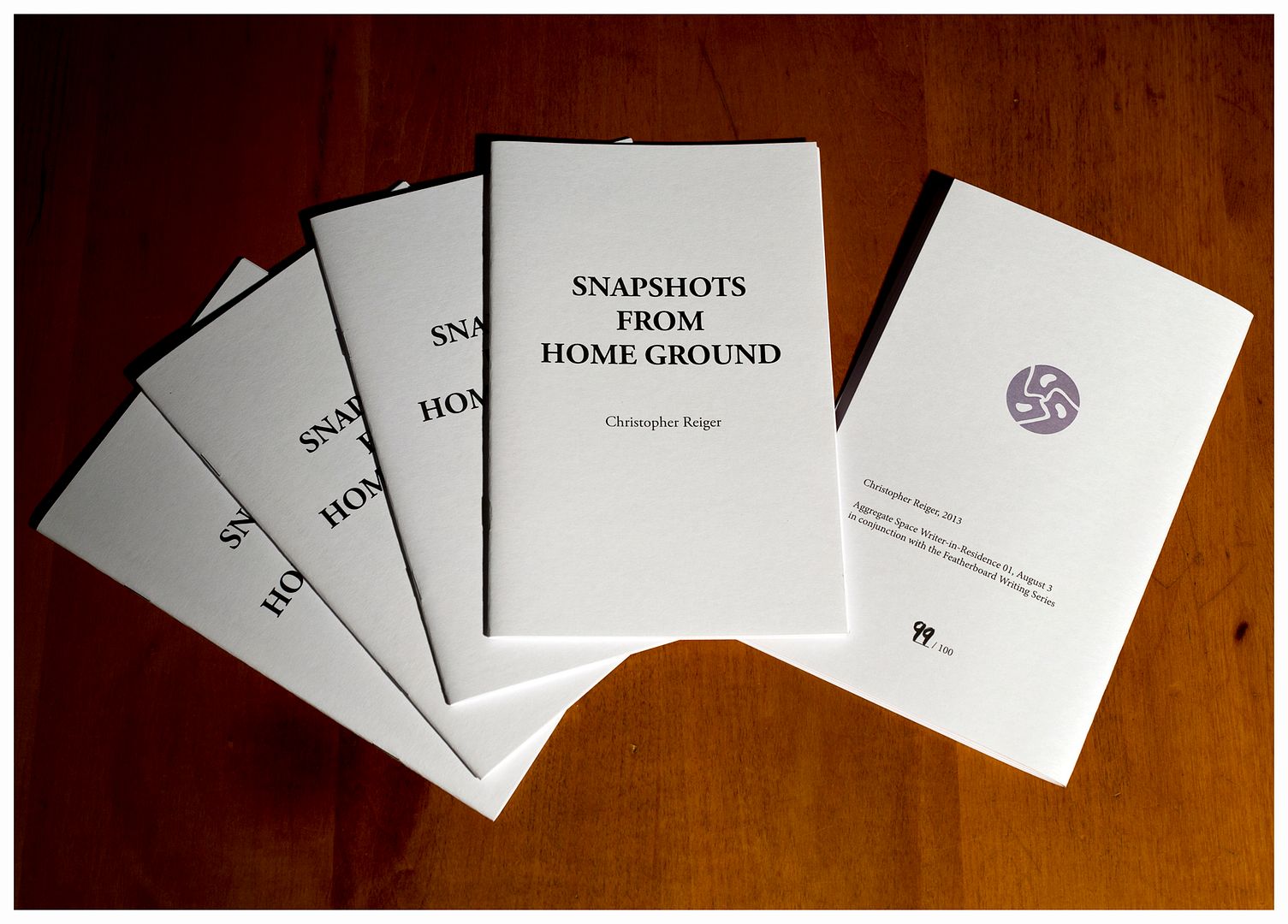
Snapshots From Home Ground Chapbook

Snapshots From Home Ground Chapbook, 2013

Snapshots From Home Ground, the limited edition chapbook I produced in conjunction with the Aggregate Space Writer-in-Residence and Featherboard Writing Series, was released in early August 2013. A meditation on my rural upbringing on the Eastern Shore of Virginia, the book is comprised of eight vignettes and a selection of photographs taken by either me or my father.

Copies are available through both Aggregate Space and Featherboard. (I also plan to release a free e-chapbook version later this year.)

Below, I've published "Good Boy," the chapbook's opening sketch, and also include a number of "snapshots" of book spreads.

Tuesday, November 27, 2012

Heide Hatry's Provocative Flowers

Heide Hatry is not a household name, but the New York-based German artist's reputation is blossoming. She has smartly positioned herself at the intersection of the art world and popular culture and, as a result, is of particular interest to me, convinced as I am that the fine arts need mass reach (if not necessarily mass appeal -- see Thomas Kinkade) in order to play the vital cultural role they're intended to.

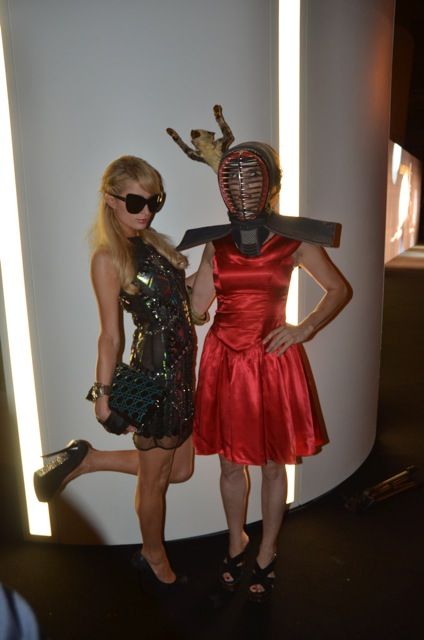
Heide Hatry, right, with Paris Hilton at the Guggenheim Museum
In September, Hatry performed "Schrodinger's Cat" at Lady Gaga's Guggenheim Museum perfume launch. Although Gaga's arty public appearances and carefully cultivated persona evidence how readily pop culture co-opts and/or draws inspiration from the fine arts, most people view Gaga as a pop star, not an artist. Hatry, on the other hand, is always identified as the latter, so when she is photographed rubbing shoulders with the likes of Paris Hilton or her work is written about by the scientist and popular writer Steven Pinker, I'm heartened. The art world isn't usually so accessible.

Naysayers might dismiss Hatry as the art world equivalent of a shock jock, insisting the popular attention she has received is only the result of her pushing our buttons. Certainly provocation plays a part, but Hatry has so far managed to balance titillation with thoughtful questions. (Arguably, Damien Hirst managed to do the same for a time...before he jumped the preserved shark.)

Wednesday, July 25, 2012

Platte Clove Residency: Some Remove

Plattekill Falls; Platte Clove Nature Preserve;
Catskills; NY; July 2012
On the first afternoon of my residency at Platte Clove, after settling into the cabin and familiarizing myself with local trail maps, I decided to explore a short path that begins a few steps from the cabin's porch and winds its way down one of the valley's uppermost gorges to Plattekill Falls. It was a lovely reintroduction to the Catskills. Late afternoon sunlight filtered through the mixed forest's overstory, unevenly illuminating a floor decorated with eastern hemlock cones. Hidden from view in the canopy above, red-eyed vireos ceaselessly repeated their lilting questions.

Saturday, December 12, 2009

Sunset, Sunrise


Heron Hope sunset; November 2009

"Our destiny, our being's heart and home,
Is with infinitude, and only there;
With hope it is, hope that can never die,
Effort and expectation, and desire,
And something evermore about to be."

- William Wordsworth, The Prelude


"Indeed, from within the murkiness of human knowledge and experience, we rightly wonder, is there any room for theology as such - or has it gone the way of all heavenly things? Perhaps all that remains is some mode of natural piety, such as the shudder before the mortal mysteries (with Goethe), or the felt ecstasies of springtime (with Wordsworth). Surely this is a lot, and unsettles the mind from its human habitudes. But is there more?

[...] Like all matters human, theology must be grounded in earthly experience and understood from within its forms. The phenomenal world is all that we have. This is the sphere that lies before us in our everyday existence; it conditions the products of aesthetic perception; and it provides the sphere for theological experience and reflection.

[...] As natural beings we are, in the most elemental sense, coextensive with this realm: our bodies are composed of it, our stomachs take in and digest its matter, and we traffic with this world all our days until we die and are decomposed into its elements. [...] To more properly sense [the] unfolding of the Godhead into world-being, so to speak, or to perceive or intuit its penetrations therein, we must first return to our ordinary experiences."

- Michael Fishbane, Sacred Attunement: A Jewish Theology


Sunrise at Heron Hope; November 2009

Happy Hanukkah, folks.

Photo credits: Hungry Hyaena, 2009

Thursday, October 15, 2009

Autumn Birds and Birding


View of Manhattan skyline from Central Park, Manhattan

On my way to the gym Tuesday morning, on the corner of 64th Street and 1st Avenue, I discovered a dead American goldfinch (Carduelis tristis). Feathers askew, a pink wound was visible on the head of the small, yellow bird. The injury was likely sustained when the goldfinch crashed into a window of one of the nearby apartment towers. I said a quiet goodbye to the bird, and continued on my way. An hour-and-a-half later, while running a work errand, I came upon a dead red-bellied woodpecker (Melanerpes carolinus), crumpled on the corner of 68th Street and York Avenue. People gave the bird's body little attention.

It's the time of year when our avian brethren fall from the sky above Manhattan and land, sometimes dead, sometimes injured, sometimes merely confused, on the city's sidewalks. It is the time of autumn migration and restlessness. Neither the goldfinch nor the woodpecker are properly migratory species, but both birds will sometimes fly a short distance south when the temperature drops.

I can't say whether or not the individuals that I found on Tuesday morning were on the move when they met their respective ends. Still, their fate is a common one during New York City's autumn. As the NYC Audubon Society's Project Safe Flight mission statement explains,
"Located at the nexus of hundreds of bird species’ migratory routes, New York City’s tall buildings and reflective glass pose a serious threat to over 100 species of migratory birds, some of which are experiencing long-term population declines."
Resident species are also vulnerable, of course. Since Project Safe Flight's inception, in 1997, "over 4,000 dead and injured birds have been collected and documented in [Audubon's] database." That number is a fraction of the total bird deaths that Manhattan's buildings cause.

What can each of us do to help curb the buildings' toll? The easiest action involves turning off your office or apartment lights at night. Many office towers leave the lights on, needlessly wasting electricity and killing birds. As Project Safe Flight’s Lights Out New York initiative explains,
"Lights can distract birds from their migration path and cause them to collide with buildings during bad weather. Turning off the lights and drawing the blinds can help save thousands of birds from over 100 different species every year."
Let's help our feathered friends fly safely, folks.

+++++


Watching a Winter Wren on the wall of Belevedere Castle; Central Park, Manhattan

I rose earlier than usual on Wednesday morning, so that I could be at Central Park's Loeb Boathouse by 7:30 AM, where I met five other Nature Conservancy bird watchers. The six of us spent a very pleasant two and a quarter hours birding.

I love being outdoors in the early morning, and I greatly enjoyed observing even the familiar species as they foraged, fought, and flitted about. House finches (Carpodacus mexicanus) and European starlings (Sturnus vulgaris) are species taken for granted by most birders, but, illuminated by the morning sunlight, each is a marvel.

I was especially excited to see several Eastern phoebes, a relatively common species that, courtesy of Edward Hoagland, I associate with my beloved notion of reconstitution, and a winter wren (Troglodytes troglodytes), a dark, small relative of the more familiar Carolina wren (Thryothorus ludovicianus), a bird for which I was almost named. (Wren Reiger would have been a hard sell on the grade school playground, and I'm thankful that my parents elected to shelve the name.)


Belvedere Castle; Central Park, Manhattan

Photo credits: All images, Hungry Hyaena, 2009

Wednesday, September 09, 2009

Kimmel Harding Nelson Residency: Day 3


Grain Elevator; Nebraska City

Soundtrack

It's a treat to recognize voices that were once familiar enough to be taken for granted. After years of city living, my ears hunger for the soundtrack I knew in childhood.

Yesterday morning, the staccato lament of a mourning dove (Zenaida macroura) greeted me as I dressed. Later, standing beside an overgrown lot, I listened to the rasp-rattle-click of grasshoppers in the tall grass. Nearby, on the same block, the up-and-down whine of cicadas reverberated within me. At mid-day, as I explored the grassy fringes of a grain elevator operation on the western bank of the Missouri River, my progress scattered noisy grasshoppers, large and small, in every direction.

As I type this post, a male field cricket's (Gryllus pennsylvanicus) insistent plea sounds from a dark corner of the studio. I locate and playback a recording of the call on my laptop, hoping that the sound of another male suitor might draw the cricket out of the shadows for some Orthoptera fisticuffs. The aural lure fails, but I'm made happy by the attempt; the cricket cries for a mate and, with a keyboard click, I call back.

Life, I'm reminded by the persistent call of this cricket, and by the grasshoppers, the mourning dove, and the cicadas, is fleeting, yet rich and good. As Nebraska native, anthropologist, and author Loren Eiseley writes of "endlessly reiterated" frog calls,
"I suspect that to some greater ear than ours, man's optimistic pronouncements about his role and destiny may make a similar little ringing sound that travels a small way into the night."
Every creature's song is at once insignificant and grand. The middle school marching band is passing by my studio now, and the cricket and I are quiet.


Middle school marching band practice; Nebraska City

A Kettle of Vultures

Appropriately enough, as I walked past a mortuary two doors west of the KHN Center, I noticed seven turkey vultures circling low above the town. The night before, I'd read Lia Purpura's poetic essay "On Coming Back as a Buzzard" in the September/October issue of Orion. Given my dual love of natural history and language, I'm embarrassed to admit that, before reading Purpura's piece, I didn't realize that a group of vultures on the ground is called a "venue," and a group of vultures in flight is called a "kettle."

Watching the peaceful, unchoreographed aerial dance of this Nebraska City kettle, I recalled Mary Oliver's beautiful poem, "Vultures," as well as some of Purpura's essay, written from the perspective of a vulture.
"As a buzzard, I’d know the end of a thing is precisely not that. Things go on, in their way. My presence making the end a beginning, reinterpreting the idea of abundance, allowing for the ever-giving nature of Nature—I’d know these not as religious thoughts. It’s rather that, apportioned rightly, there’s always enough, more than enough. 'Nothing but gifts on this poor, poor earth,' says Milosz, who understood perfectly the resemblance between dissolve and increase. Rain scours and sun burns away excesses of form. And rain also seeds, and sun urges forth fuses of green."
"On Coming Back as a Buzzard" is a paean to reconstitution. How smart and satisfying to embrace the natural end as another corporeal beginning! I pray that my dead body will be saved from the poisonous excesses of a mortuary, that it will instead be wrapped in a simple cloth, laid in a simple wooden box, and buried without the insult of preserving chemicals and concealing makeup. I pray that the worms and the soil will consume me, will leech me and take me, so that my matter will become energy for other forms. I utter this prayer in silence as I look up at the dark birds.


Turkey vultures on roof; Harborton, VA

Elsewhere, Purpura writes,
"I'd love best the movement of stages and increments, to repeat 'this bank and shoal of time' while below me banks and shoals of a body went on welling/receding, rising and dropping. I'd be perched on a wire, waiting, ticking off not the meat reducing, but how what's left, like a dune, shifts and reconstitutes."
Even when alive, our bodies are forever in flux, forever "shift[ing] and reconstitut[ing]." After death, though, a profound reinterpretation and recycling of "self" takes place.

The biologists, writers, painters, and physicists who worship Nature are enthused by reconstitution because it is plain, profound truth. As the poet Galway Kinnell describes it in his terrific poem, "The Quick and the Dead," "the crawling of new life out of the old, which is what we have for eternity on earth."


St. Mary's Episcopal Church; Nebraska City
First Episcopal church in Nebraska; Founded 1857

But most folks, many of them good, kind people, don't share this enthusiasm for reconstitution. I presume, perhaps wrongly, that Nebraska City is home to many such individuals. On what grounds do I make this presumption? Firstly, it's a safe speculation anywhere in the world. Most humans prefer a supernatural view of afterlife. Secondly, Nebraska City is home to a good number of churches (nineteen, by my present count), and I make assumptions (sometimes wrong) about the stripe of belief held by the majority of American Christians. No doubt there are exceptions to the rule, but most of the religious Christians I know frown upon materialistic interpretations of life everlasting. Some go so far as to reject my panentheistic or panendeistic conceptions of morality and material being as heretical nonsense.

No matter; live and let die. I find the Christian notions of ascension and self-conscious afterlife ridiculous, and most Christians find my cherished reconstitution as a bit of larvae, a bit of root, a bit of this and that, grotesque and even offensive. Neither conception, though, prevents the individual from acting ethically, and that is, above all, what matters. As Purpura puts it,
"[The vulture] gets to reorder your thoughts about troves, to prove the spilled and shoveled-aside to be treasure. To reconfer notions of milk and honey, and how to approach the unbidden."
Put more explicitly, one man's materialistic mess is another man's milk and honey.

Photo credits: all photos, Hungry Hyaena, 2008, 2009

Monday, March 09, 2009

Revisiting reconstitution


Christopher Reiger
"Continuity"
2007
Sumi ink and watercolor on Arches paper
11 1/2 x 14 1/2 inches

In "Becoming phoebes," I described the satisfaction I feel when contemplating the giving over of contained corporeal energy to the rest of life. I dubbed this process "reconstitution" and, citing the essayist Edward Hoagland as a writer who "speaks to the magic of" this process, included an excerpt from his terrific book On Nature.

A week later, I picked up the most recent issue of Harper's Magazine and read Hoagland's essay "Curtain Calls," an inconsistent and rather bleak take on the contemporary state of things. I later debated the merits of Hoagland's rich pessimism with my father, and decided that older writers must be forgiven some of their bitter steepings; after all, it generally holds that older thinkers long for what once was and younger thinkers dream of what may be.

In any case, Hoagland again dedicated some lovely passages to the notion of reconstitution. In light of the recent, related post, I thought I should share them here.
"If this globe is the only heaven we have, I doubt the trip will be a long one. Downward into the seethe of soil and the sea, we landlubbers become marine again.

I believe in continuity through conductivity: that seething underpinnings of life's flash and filigree, its igniting chemistry, may, like fertilizer, appear temporarily dead, but spark across species like the electricity of empathy, or as though paralleling the posthumous alchemy of art.

Gazing out the window, I see nothing but motion, high and low - scudding clouds, swinging leaves, right down to the millipedes (if I step outside) seething in the soil. Death, be not proud. Plant me when I die so that I can seethe with them."

Tuesday, February 24, 2009

Becoming phoebes


Eastern phoebe (Sayornis phoebe)


The renowned naturalist, entomologist and sociobiologist Edward O. Wilson maintains that belief in the afterlife developed as a human coping mechanism, as a way for our enlarged brains to contend with mortality. He writes,
"Our conscious minds hunger for a permanent existence. If we cannot have everlasting life of the body, then absorption into some immortal whole will serve. Anything will serve, as long as it gives the individual meaning and somehow stretches into eternity that swift passage of the mind and spirit lamented by Saint Augustine as the short day of time."
Today, religious literalists look forward to Pearly gates or seventy-two virgins while most rational secularists, frightened of death's finality, strive to reject it. The first perspective is delusional, the second, incomplete; both are fearful.

Yet there is at least one sensible and beautiful conception of the afterlife, and it is not at all fearful: reconstitution. Most people find contemplation of the body's posthumous decomposition uncomfortable. But the knowledge that my corporeal substance will rot and, in doing so, release energy for use by the rest of things is deeply satisfying.

Poet Galway Kinnell describes reconstitution in his poem "The Quick and the Dead" as "the crawling of new life out of the old, which is what we have for eternity on earth." But beyond the biological, death remains a mystery.

I can not, one way or the other, speak to supernatural transference, though I feel that metaphysical notions of self or soul preservation are misguided. The "me," I think, will rot with my body, but the flow keeps on keeping on, until the end of time.

The author and essayist Edward Hoagland, the writer that inspired this blog's first post, speaks to the magic of reconstitution in his book On Nature.
"In my stint in the army, working at the hospital morgue, I'd noticed how commonly the dead had managed at the last moment a benign or temperate sort of smile. This circularity is neither alarming nor incongruous, but rather seems to make things whole and complete. In the summer, dancing butterflies of pretty colors will congregate where I've gone outside to piss in the grass. The glint of tiger yellow or cobalt blue in their beautiful wings may be enhanced by the minerals that they so crave and that my body has declared surplus. And if a nesting phoebe soon grabs one, she is going to profit also -- which is a foretaste of the myriad uses that more extensive portions of me will be put to eventually."
We are all, then, becoming phoebes, butterflies, mud and gas. I find so much joy in the thought.

Image credit: ripped from Photographs From Virginia section of Kirk Rogers' site

Monday, September 29, 2008

"Implant" at UBS Art Gallery


Michael Pollan working his garden


Curator Jodie Vicenta Jacobson cites Michael Pollan's The Botany of Desire as inspiration for "Implant," a Horticultural Society of New York exhibition sponsored and hosted by the international financial firm UBS. Jacobson is especially interested in Pollan's assertion that plants "use us" to further their evolutionary objectives. Although the notion that "plants control humans" is simplistic spin on what is in fact a complex web of interdependence, I smile on attempts to shake up (or down) the Judeo-Christian scalae naturae and so was predisposed to Jacobson's conceptualization of "Implant."

Unfortunately, most of the work Jacobson includes is only tangentially relevant to Pollan's thesis. Perhaps she believes that a curator should avoid intellectual illustration, that it is better for viewers to ruminate on the art with a loose curatorial contention in mind. Even if this is her stance, however, the selections seem arbitrary. In an accompanying brochure, she states that "the personal artist/subject bond is forged within a larger context of each individual's intrinsic understanding of his/her place in nature." The statement is valid (if vague) but, even though all the paintings, drawings, sculptures and videos in "Implant" include floral or botanical imagery, with few exceptions they are not about flowers or vegetation. Considered as a whole, "Implant" reflects, at worst, an intrinsic misunderstanding of our place in nature and, at best, a disinterested remove from the rest of life. One senses that many of these artists do think seriously about the so-called natural world, but have little firsthand experience with it.


Ann Craven
Studio view, December 2003


What, really, do such "art about art" works as Simon Starling's flowery chaise lounge and Karen Kilimnik's photographs of her still-life paintings have to do with the show's conceit? Or Carol Bove's bookshelf and Ann Craven's stacked watercolors? Certainly, Craven paints pretty canaries and orchids, but she is less concerned with the behavior or anthropological significance of Serinus and Orchidaceae than she is with questions of reproduction and commodification. The critical insistence that Craven's paintings "undercut Disney-esque references" and "raise questions about domestication...[of] once wild species"(1) is a stretch. The paintings don't communicate these ideas, and a viewer should not take a leap of faith that the paintings do not themselves impel (no matter what the accompanying wall text prompts).

One of the volumes included in Bove's bookshelf arrangement is propped open to a lovely botanical illustration; Bove's other books are placed spine-out, so that their titles can be easily read. The viewer is meant to ponder the connections between the artist's selections, but when I scan the books included, I don't find myself thinking on horticulture or the human/plant relationship; the work is principally concerned with 1960s soul searching.

What are these works doing here? Did Jacobson cherry-pick artists she likes and then try to find a connection between their work and the notion that plants control humans? That's a bass-akwards way to curate, but Jacobson herself lends credence to the charge in a brochure accompanying "Implant." A section called "Artist Focus: Felix Gonzalez-Torres" begins,
"I have been thinking about the 'Implant' exhibition in relation to Felix Gonzalez-Torres from its very inception. I consider him a keystone artist, not only for this exhibition, but for my entire curatorial program, and moreover in the world view of contemporary art. Contemplating Gonzalez-Torres' work in relationship to this specific exhibition has led me to various ends, both specific and open. The context of the exhibition is determined by the relationship between the artists involved, who, like Gonzalez-Torres, are not artists that primarily work with plants, but artists that have in a sense collaborated with plants to further a more specific idea. Therefore, 'Implant' is not narrowly themed, but quite open..."
It seems as though Jacobson admits that her primary aim is to assemble a terrific group of artists in one exhibition, so why hem them in with an unsuitable theme? I suppose only Jacobson could answer the question (and I invite her to), but it's a shame that so many horticulture enthusiasts and botanists who visit the show will be at turns irritated and baffled by Ms. Jacobson's curation.

Granted, I'm more of a stickler for lucid curation than most. I assume that my grumbling about "Implant" will be shrugged off by many readers. Perhaps that's fair, but Jacobson's curatorial missteps might be more easily overlooked if they weren't a front-and-center distraction.


Tacita Dean
"Baobab III"
2001
Black & white photograph on fibre paper
26 1/2 x 41 inches


The exhibition overview ignored, many of the works in "Implant" are good to excellent: Darren Almond's long exposure photographs are meditative and beautiful; Zach Harris's otherworldly paintings descend from Charles Burchfield and Buddhist mandalas; Nick Cave's frantic flower tower mannequin is a playful delight; Tacita Dean's handsome photographs present the curious baobab tree, a species whose branches evoke neuronal dendrites. Yet none of these four artists contribute works that seem, as Jacobson put it, "rooted in a radical concept offered by horticultural author(2) Michael Pollan."

Curiously, it is often the more traditional work in "Implant" that best conveys her assertion that plants "choose" the artists to immortalize them. Carol Woodin's luminous watercolor on vellum paintings might even be dismissed as antique by contemporary art viewers. The works are more or less straightforward botanical undertakings, celebrating their subjects through careful observation, but they also reveal nature's amoral underbelly. Woodin's orchids all but drip with exotic sex, appealing to the voluptuary in each of us. Furthermore, Woodin's fine handling, unorthodox cropping and recessed presentation choices create an almost sacred experience for the viewer. In doing so, Woodin makes strange and wonderful that which we too often take for granted.(3)


Peter Coffin
"Untitled (Greenhouse)"
2002
Greenhouse, plants, speakers, instruments
96 x 96 x 120 inches


Peter Coffin's whimsical "Untitled (Greenhouse)" is a far cry from Woodin's work, but it is also succeeds with regard to Jacobson's theme. A small greenhouse is stocked with a variety of plants, but also with a drum kit, keyboard, guitars, microphones and amplifiers. Interested in musician-plant communication, Coffin booked several bands to play inside "Untitled (Greenhouse)" during the exhibition reception, and apparently intended that a soundtrack play whenever musicians were not performing. Distressingly, the greenhouse was quiet on the Friday morning of my visit. Not wanting the plants to go without aural stimulation, I entered the low-ceilinged structure to tap out a beat on the snare. (The plants, I'm sure, forgave my inadequacy.)

The feyness of Coffin's project makes it easy to like, but the artist is also riffing on the notion of pneuma, breath as vivifying force. As William Gass writes, "Language is born in the lungs and is shaped by the lips, palate, teeth, and tongue out of spent breath - that is, from carbon dioxide. That is why plants like being spoken to." Literally, our voice gives the plants breath. Taking this one step further, we can ask Proust's question of musical communication: "[Might music] not be the unique example of what might have been - if the invention of language had not intervened - the means of communication between souls?" If, as I mentioned earlier, Jacobson aims to make room for open-ended riffing on the part of the viewer, Coffin's greenhouse is her best pick.

By contrast, a photograph taken by Felix Gonzalez-Torres, the work (and artist) Jacobson had in mind since the inception of "Implant," is conceptually relevant, but aesthetically weak. The picture, "Untitled (Alice B. Toklas' & Gertrude Stein's Grave, Paris)," shows flowers planted and placed on the graves named in the title. The picture includes attractive flowers, but the photograph itself is unremarkable; it is not, as Jacobson contends, "a beautiful picture of flowers." Value is attributed by the viewer's knowing the specifics, namely that she is looking at flowers on the graves of two notables. Gonzalez-Torres is surely moved by the contemplation of displaced energy or reconstitution, by the realization that the flowers in a sense (and, in some respects, literally) feed on the break down of Toklas' and Stein's corpses. Although I share his appreciation for the contrast between individual mortality and communal integrity (or immortality), a poetic observation alone does not qualify as a work of visual art. Furthermore, the photograph highlights how very detached the industrialized imagination is from the natural world that shaped us. Though Gonzalez-Torres likely realized this, his picture reminds me that the mystical and holistic properties of plants, as part of an integrated worldview, are largely lost, the frame of reference fractured, secularized and compartamentalized. Plants placed atop a grave are mere signifiers of memorial; they no longer possess mana.

Yet I am hopeful. We are beginning to reconsider our relationship to the world around us. It is a good sign that, despite having very little practical experience with or knowledge of the outdoors, many of the artists included in "Implant" are inspired to incorporate floral imagery or ideas loosely connected to the plant world. Michael Pollan's is but one voice in a growing chorus encouraging urbanites and suburbanites to reconnect with the food chain by participating in community supported agriculture (CSA), reconsidering their usually negative opinion of hunting, and simply spending more time outdoors. Most importantly, however, plants are regaining a little of their mana among modern man.

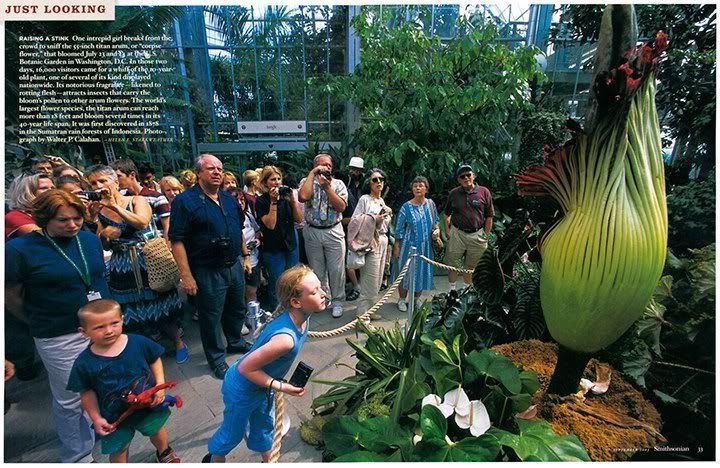
As I departed the UBS building, I thought of a photograph published in a magazine some years ago. When I returned to my apartment, I dug through my files and scrap books until I found it.

Man, meet plant!


Walter P. Calahan
2003
C-print for Smithsonian Magazine


(1) Jane Kallir, "The Animal in Contemporary Art"
(2) Horticultural author? Pollan is a now influential journalist and professor whose writing explores a range of issues related to moral and ethical stewardship and consumption, sustainability, anthropology, and psychology. Why pigeonhole him?
(3) Admiring her paintings, I recalled the experience of anticipatory wanting with Julia Randall's works at Jeff Bailey Gallery.

Photo credits: Michael Pollan working in his garden, ripped from The Sydney Morning Herald(via The New York Times); Ann Craven studio image, ripped from the artist's website; "Baobab III," ripped from Frith Street Gallery website; "Untitled (Greenhouse)," ripped from Phil Moore's Flickr collection; Corpse flower image ripped from Walter P. Calahan's website

Sunday, August 19, 2007

Routine Passing


Looking northeast from the dike rim at Heron's Foot, December 2006

"Spitz-spop, Christopher. Rise and shine." My father's familiar refrain. He opens the bedroom door and flicks on the light.

I groan and stagger from my bed to the middle of the room, where my clothes are laid out on the floor like a fallen scarecrow. Sleeves spread out to the side, an undershirt is placed on a thermal top that rests, in turn, on two sweaters and a camouflage button down. Likewise, a pair of tightie-whities rests atop long johns and a pair of camouflage pants. A pair of folded athletic socks is stacked on two heavy, woolen pair.

Absent-minded, I dress.

In the bathroom, I fight through the two undergarment layers before I can relieve myself, reminding myself that, next time, I should remember to visit the toilet before I dress. I wash my hands, splash some water on my face and decide not to brush my teeth.

Downstairs, my father is almost ready, his oatmeal and peeled banana half eaten. I pour milk on a bowl of cereal and eat quickly. Nothing is said. Outside it is still black.

On the dining room table are two shotguns, two boxes of shells (one .20 gauge and one .12), two pairs of wool gloves and two camouflage, wool face masks. My father is already in his boots when I finish my cereal. He is by the backdoor, double-checking the canvas decoy bag and his necklace of duck calls.

"All set?"

"Yes," I reply.

I carry the guns, gloves, shells and face masks to him, then slip on my own boots.

Once outside, my eyes adjust. It isn't black, not really. The moon's blueish glare reveals more than you might expect. My father and I walk in silence down the long clamshell drive, then cross quiet Seaside Road. We move through an opening in the roadside hedge that you'd overlook were it not for a solitary holly planted among the cedar and pine. A stout wooden footbridge spans a deep ditch inside. Another twenty steps and we crest the dike, moving east along the rim.

The decoys shift and bounce in their bag and the duck calls jostle on my father's chest. I can hear his breathing; his footsteps fall heavier than mine. I resent him for this.

At the dike's northeast corner we descend the left bank into the upper marsh, where a cedar tree island ekes out a life drinking brackish water. Around this island the cordgrass lays down in gentle waves. I want to stop, to remain for the morning in this spot, to shed these layers and lay like the cordgrass, to be part of the marsh, part of something not me, something greater. This is what I wanted at ten years of age.

Instead, I followed my father to the duck blind, where he put out the decoys and we awaited the morning flight. Now, almost twenty years later, I lay alongside the island most every time I visit Heron's Foot. It is a good place to lie.

Photo credit: Hungry Hyaena, 2006

Tuesday, June 20, 2006

Scale and Time On My Mind


I imagine many readers are already familiar with "The Powers of Ten," the simple, but profound short film produced by Charles and Ray Eames, of Eames design fame.

A few weeks ago, I posted "Vultures," a poem by Mary Oliver. As a throw away lead-in, I suggested that the poem could effectively replace my artist statement, communicating the ideas that I always write around. The subject of "Vultures," like so much of Oliver's work, is the rather messy process of "resurrection" via recycling (or what I prefer to term "reconstitution"). I die today to sustain that which will be tomorrow.

I've long been fascinated by death, compost, and their associated sauces. Much of my writing reflects this interest, but only rarely have I written about issues of scale. Initially scale and resurrection may seem disparate matters, but I believe that infinite regression, or travel within, leads to infinite progression, or travel without. Similarly, the reduction (or the extinguishing) of one life leads to another, new one (or many). With this in mind, "The Powers of Ten" is powerfully resonant.

Riffing on this idea, I recommend a listen to a recent episode of RadioLab. In it, co-host Jad Abumrad interviews Ann Druyan, Carl Sagan's widow and, along with him, one of the creators of the Voyager golden record, which I wrote about at some length here.

If you have some time to kill, watch "The Powers of Ten," and then listen to the RadioLab episode. They make for an exciting combo, and the Radiolab episode reaffirmed my belief that the golden record is "the culmination of modern art." What an arrogant, absurd, beautiful gesture?!

Thursday, March 16, 2006

The Human Face: Ambivalence As Objectivity

"Gaiety and glee are usually twinned with misery, however, which sneaks up on you like an ocean wave, filling your mouth with seawater, and can almost take you under, like a nether beast risen from below."
-Edward Hoagland, Compass Points

Image hosting by Photobucket
Woody Allen and the Voyager 1 disc

In moments of profound sorrow, my chest collapses, as if compressed by some exterior force. Air escapes my lungs and a temporal vertigo consumes me. Such absolute heartache is, thankfully, extremely rare. In my twenty-eight years, it has been summoned twice by women and, on several occasions, by the realization that, though all existence is fleeting, humanity must continue to strive. Contemplation of this proposition has, in the extreme, led to sobbing, but the tears are ambivalent, like the sentiment itself, simultaneously borne of intense joy and pathos.

Most recently, I was thus overcome while contemplating an image of the Voyager 1 disc in the pages of National Geographic. The gold-plated, copper record, placed on board the interstellar bound spacecraft in 1977, is, to my mind, the culmination of modern art. NASA's Jet Propulsion Laboratory describes the record as follows:
"...a phonograph record...containing sounds and images selected to portray the diversity of life and culture on Earth. The contents of the record were selected for NASA by a committee chaired by Carl Sagan of Cornell University. Dr. Sagan and his associates assembled 115 images and a variety of natural sounds, such as those made by surf, wind and thunder, birds, whales, and other animals. To this they added musical selections from different cultures and eras, and spoken greetings from Earth-people in fifty-five languages, and printed messages from President Carter and U.N. Secretary General Waldheim.

Each record is encased in a protective aluminum jacket, together with a cartridge and a needle. Instructions, in symbolic language, explain the origin of the spacecraft and indicate how the record is to be played. The 115 images are encoded in analog form. The remainder of the record is in audio, designed to be played at 16-2/3 revolutions per minute. It contains the spoken greetings, beginning with Akkadian, which was spoken in Sumer about six thousand years ago, and ending with Wu, a modern Chinese dialect. Following the section on the sounds of Earth, there is an eclectic 90-minute selection of music, including both Eastern and Western classics and a variety of ethnic music.

Once...Voyager...leave[s] the solar system (by 1990, [it] will be beyond the orbit of Pluto), [it] will find [itself] in empty space. It will be forty thousand years before [it] makes a close approach to any other planetary system. As Carl Sagan has noted, 'The spacecraft will be encountered and the record played only if there are advanced spacefaring civilizations in interstellar space. But the launching of this bottle into the cosmic ocean says something very hopeful about life on this planet.'"
If aliens should happen upon the Voyager 1 spacecraft and discover the disc, they are expected to play the record and learn something of our species' history. In this sense, the engraved disc is a tool and, as such, it will one day be considered an artifact, if it isn't already. (A reproduction will more likely find a home at the Smithsonian Institution than the Metropolitan Museum of Art.) But the disc is an object of abstract utility, a symbol representative of modern philosophy's crest. It was manufactured moments before the Enlightenment wave began to break: part Scientific Revolution, part postmodern doubt. Given this transitional moment of conception, the record is an embodiment of contradiction. It is a leap of faith taken by the faithless - the late twentieth century being the pinnacle of secularism - and a tool, crafted with aesthetics in mind, that is unlikely to be put to use. But, above all, the contradictory power of the Voyager 1 disc resides in the recorded content. An attempt to limn a collective portrait of humanity, the disc is at once a gesture of hopeful optimism and naive hubris.

Image hosting by Photobucket
The Necker Cube

I'm preoccupied by such ambivalence. Most people think of the word, ambivalent, as a pejorative. Without question, it can be used in a disparaging way, especially when interpreted only to mean indecision, but what of the word's other meaning, "the coexistence of opposing attitudes or feelings"? This latter usage accurately describes the balance sought by yogis, the Chinese yin-yang symbol, and the quantitative and qualitative possibilities figured in E=MC2. Contradiction, in this sense, is an altogether natural, even positive, phenomenon.

From my late teens on, I've been obsessed with another symbol of contradiction and ambivalence, the Necker Cube. The drawing figured prominently in the margins of my undergrad notebooks and throughout old sketchbooks; it was of particular interest to me during the peak of my drug experimentation. Flipping through an old "trip journal," I came across the hallucinogen-inspired rant below, proof that, if you keep pen and paper handy, not everything flashing through a chemically-addled mind is worthless (even if poor motor control makes it nearly illegible).
"A good idea will always contradict itself or, at least, the person exploring this idea will accept the reverse to be true as well. There are always multiple truths (2 symbolically, many more literally). It is the impossible middle-ground that is important. This is the yearning chasm, the heart, the Meadowlands. The yearning chasm must never be achievable, but does provide something to aim for. This target is our quaquaversal. At the peak of this quaquaversal - at the point of slope's origin - is the ylem. We can never reach the ylem; we can not even claim to know of it's existence, except on faith. Therefore, I have already arrived at a prime contradiction, making my logic sublimely impotent."
Unfortunately, when sober, humans are not programmed to readily accept such ambivalence; we prefer "empirical" truth, assigning meaning, often moral in nature, to our observations. Our data gathering can be objective, but our interpretation and the resulting intellectual constructs are rarely so. As a species, we are reluctant to give ourselves over to ambivalence. When faced with doing so, our bodies react in unusual, sometimes surprising ways; hence, my involuntary sobbing while contemplating the Voyager 1 disc. To contemplate the ambivalent universe is to be simultaneously overcome by wonder and mired in tragedy.
"...the idiosyncratic surfaces of the other orbs floating serenely in space; the pristine interstellar vacuum; the inscrutable emptiness of intergalactic space, that immense, echoing, absolutely featureless void enveloping the spinning galaxies: it all serves as a perfect philosophical mirror image, reflecting back the quandry of the species, the limitations of human knowledge. The frail architecture defined by our distant tools, which places the human race at the center of 'what's known,' is actually our own map of ourselves - a chart that we'll hand down to successive generations, who one day may see a charming primitivism, or even an prescience, in our view of all that."

-Michael Benson, "A Space In Time" (Atlantic Monthly, July/August 2002)
Many artists vacillate between the poles of glee and misery, of joy and sorrow, but one of my favorites, Woody Allen, is firmly entrenched in the tragic camp. In a recent Manchester Guardian profile ("Master of Neurosis," Guardian Weekly, Jan. 6-12, 2006), Allen tells Emma Brockes that, although he wouldn't trade his sense of humor for physical beauty, he "would've exchanged being funny for being a tragedian." He continues, "I always would've done that, from day one, to now, I mean, I always would have preferred that. [...] I wish my career could have been one in which film after film has not been comedies, but been dramas and tragedies." Reading the profile, one gets a sense of Allen's general melancholy; as he describes it, "I'm almost burning on a low flame of depression." I used to associate such a temperament with keen intelligence - and there is no denying Allen's brilliance, whether or not you like his films - but, lately, I feel depressives, like Allen, are denying the opposing pull, choosing the one-directional shrug of apathy over the contradiction of ambivalence.

Near the end of the piece, Brockes asks Allen, after having listened to him bemoan the pointlessness of it all, "Isn't having children a consolation of some sort?"
"No. There's no sense of continuity. No sense of, no sense of...I always used to think that art is the intellectual's Catholicism. You think that because your work may be seen after your death, or read, after your death, that it's compensation. But it's not. Not kids, or art or anything. There is nothing compensating about your own death."
Allen's bleak world view reminds me of a character I created for a screenplay I never completed, an angst-ridden twenty-something with a penchant for drug-fueled conversation and navel gazing - a thinly veiled reflection of myself at twenty-one. At one point, early on in the action, this character stands in a salt marsh with a friend and delivers a rambling monologue. Near the end of it, he says,
"I don't know...I think our answers - if you can call them that - are no more sensible than...I don't know...a mole. I mean, sometimes I like to think about...you know....'future man,' like, poking his fingers around in a human skull, my skull. But then I realize how far fetched that is. I mean, I won't be lucky enough to be a fossil. I've never even won at Bingo."
Presumably, this character would share Allen's feeling about children and art. With good reason: the idea that immortality may be achieved via lineage or the leavings of a creative career is short-sighted, as both, eventually, will be buried and forgotten, long before humanity vanishes. But Allen and my unfinished proxy are wrong to believe death offers nothing in the way of compensation. As our bodies rot, the contained energy - your concentrated mass - is released into the humus and the ether. Again, E=MC2 or, as Galway Kinnell, my favorite contemporary poet, puts it in "The Quick and the Dead," "the crawling of new life out of the old, which is what we have for eternity on earth." In this sense, even after our species is gone and other lifeforms populate the planet, each of us remains an essential piece of the weave, recycled and reconstituted.

Contrary to Woody, I feel there is much joy in accepting our inevitable decomposition, even if our conscious minds yearn for permanence, making eulogistic joy rather wistful. Meanwhile, Voyager 1 continues it's interstellar journey to boldly go where no man has gone before.

Photo credits: images ripped from Nature Publishing Group, lnx.indajaus.com, and The Focusing Institute website

Monday, January 09, 2006

A Rose For Emily


A duck, cooked rare and partially carved, sat on the oval serving platter in front of me. Underneath the bird, blood mingled with the yellow-white fatty oils released during the roasting. As I half listened to my parents' conversation, the two secretions danced a slow-motion Rorschach ballet. I was intrigued, content to admire the interplay for what it was, the meeting of two immiscible liquids, when suddenly the interaction ceased abstraction.

There, under the dark stump of the drake mallard's neck, the blood and oil limned a perfect silhouette...of a duck. I was rendered speechless. This is more incredible than a moldy Wonderbread Elvis or some dust bunny Jesus!, I thought excitedly. The initial shock absorbed, I brought the minor miracle to the attention of my parents. They didn't share in my enthusiasm. My mother was disgusted - "Oh, for goodness sake!" - and my father, baffled - "Ummmmm." They resumed eating.

A few minutes later, the three of us discussed my need to drive to a friend's house to pick up my digital camera, forgotten there the night before, following a lengthy battle with some delicious mulled wine. Thinking it likely that my friends - or their parents - would check out the pictures saved in the camera's memory, I winced. Along with some shots of their Christmas party - happy, mother-daughter poses - they would find some photographs of dead rat pups; not your standard Yuletide fare. (I had obtained the rat pups, already dead, to feed one of my snakes, but upon opening the cloth they were wrapped in, I found their arrangement curious and decided to treat the tiny rodents as a peaceful, rolling landscape; the pictures may or may not work their way into a painting.) I told my parents about the possibility of these photos being discovered. My father looked up from his plate. I swear I could almost read his mind: Duck blood silhouettes...Dead rat pup portraiture....Duck blood silhouettes...Dead rat pup portraiture.

"You know," he finally said. "You seem to be fascinated by death."

"I am," I replied.

"I wonder where that comes from. For me, death is inevitable...so there's no reason to think about it. The end comes and that's that. Why waste time worrying about that which you can't control?"

"Alright, sure...but I don't worry about death...and it isn't the end in my estimation. I don't mean that in a supernatural sense...just that when our bodies rot, our energy continues. E=MC2. Nothing can be subtracted from the weave...only reconstituted. That's exciting, and that's why I'm fascinated by death. It's nothing to be afraid of. It's release from one form...a changing of vessels and a loss of consciousness."

I paused, realizing this wasn't the whole truth. I also find death calming, even beautiful, when it is unencumbered by ceremony or histrionics. I didn't know how to explain such a notion, though, so I didn't continue.

"Hmmm....it seems you have a little Latin in you," my father finally said.


Whatever you want to call it - morbid, macabre, melancholy - I am charmed by that which many folks find grotesque. In my case, though, this quality is certainly not a product of Latin blood; rather, I believe it is closely linked to the region and climate of my childhood. It's difficult to grow up in a small, southern town and not become acquainted, even comfortable, with death and decay. The stereotypes are well established: cars resting on cinder blocks alongside occupied houses with rotting porches and peeling paint; toppled headstones, uncut grass, and strewn beer bottles in backyard cemeteries; butchered deer carcasses and full garbage bags dumped on the road berm; abandoned furniture and household appliances in the middle of the woods (how do they get there?); the derelict house with kudzu, raccoons, and snakes in residence.

Many American scholars and authors have considered the Southerner's cozy relationship with decline and decay, trying to better understand its genesis. Some folks suggest it is the product of a deep-seated, defeatist attitude, borne of the Civil War - alternatively known as The War of Northern Aggression - while others feel it has more to do with the southern climate, an often oppressive blend of high humidity and heat. As with most anything, a combination of factors is responsible, but I believe that climate is the critical component. The Southern Gothic literary tradition, for example, shares much in common with the magic realism of Mexico and Central America. Texans of European ancestry may not celebrate Dia De Los Muertos, but most of them appreciate it; the holiday finds even more advocates in the bayous of Louisiana and the bald cypress swamps of Arkansas. The "Latin blood" that my father referenced may, in fact, have little to do with blood. Dia De Los Muertos is of Latin American origin, not Spanish; its history is indigenous to the region, and the Spanish colonizers were horrified by the macabre ceremonies of the pagan natives. They did manage to force Catholicism upon this indigenous population, but they could not replace the established rituals entirely.

Centuries later, those mores continue to inform the culture of the American South, Mexico, and Central America. Inhabitants are caricatured as moving more slowly than their northern neighbors - "laid back" on a good day, "lazy" on a bad - and caring a great deal less about progress and modernization, usually to a fault. Family and religion are central to daily life in these parts, and marriage and death captivate the Southern/Latin American imagination. Having grown up in the rural, American South, I view the Northeastern (and Midwestern), tight-lipped approach to blood-and-guts reality with suspicion - this despite my deep appreciation of New England's landscape and culture. Returning to Virginia's Eastern Shore this Christmas, I saw much that touched me and reminded me that, at heart, I remain relatively Southern, even though the accent and the religion were long ago discarded.


Photo credit: "Love Seat in Marsh, Bull's Landing, 2005," "Deer Carcass and Dryer, 2005," "Vultures on Deer Carcass, Burton's Shore, 2005," all photos, Christopher Reiger, 2005

Tuesday, December 13, 2005

Border (Bio)diversity (of opinion)


The Robert Smithson in me is bemused by international borders, particularly those boundaries that are not physically demarcated, lines that exist only in cartography and our collective political imagination. Last night, I contemplated a striking black-and-white photograph of the Mexico-U.S. border. The image was dominated by a rural "vehicle barrier" fence (similar to the one shown above), far removed from an official border checkpoint or crossing. In the desert of the American Southwest, this fence draws an arbitrary line in wire and steel.

It struck me as an emblem of humanity's absurdly tenuous existence, a reminder that our species is an insignificant mote in an incomprehensibly tremendous weave. As the artist Carl Buell wrote in the comments section of a recent HH post,
"With every change in sea level and shoreline, with the raising or eroding of every mountain range, with every changing weather pattern, life spreads out as it can and comes into contact with new environments, opportunities and hazards...As I get older (than dirt), I find myself starting to think like the hills themselves. Some day after eroding and washing out to sea, I’ll be a hill again."
Indeed, each of us (and, eventually, our species) will be reconstituted, and our arbitrary borders, those lines in the mud of space-time, will be erased. In this respect, the border fence is a healthy reminder of our existential folly, but it also reveals humanity's darker inclinations. We build fences, after all, to divide "us" from "them," the demonized "other."

The photograph that inspired this post was printed in the most recent issue of Wildlands Connection, the Wildlands Project newsletter. It accompanied an article about wildlife bottlenecks at the Mexico-U.S. border. The Wildlands Project's mission is to create vast, uninterrupted linkages, known as wildlife corridors, that will extend from Canada into Mexico (on the Rockies spine) and from Canada into Florida (on the Appalachian spine). The U.S.-Mexico border fence is a major obstacle to the organization's first goal.

Yet physical barricades are but one of the obstacles that ambitious conservationists face. Consider wildlife trade legislation that protects species in one country, but not another, adjacent nation. If strict laws prohibit the trapping or hunting of a species in China, for example, but not in neighboring Mongolia, is the Chinese legislation effectively addressing species welfare (particularly when Chinese citizens are paying top dollar to have the killed contraband imported)? Similar issues haunt conservation efforts the world over.

The humanitarian and social concerns that ethically-minded conservationists must take into account present a more nuanced hurdle. Environmental groups in the European Union are warring with one another about how best to create the legislative and physical infrastructure necessary for sustainable energy development. How can you raise thousands of wind turbines without hindering bird migration, ruining aesthetics, or plopping towers in the backyards of folks too poor and disenfranchised to protest?

If the various interest groups in the EU, one of the most environmentally progressive governing bodies in the world, are at odds, is it realistic to expect conservation to become a truly supra-national affair? After all, the EU's concerns are petty alongside those of the southern hemisphere. Whereas Europe is a sprawl of cultivated landscape relatively lacking in biodiversity, the "Third World" represents the usually disastrous meeting of remarkable biodiversity and an exploding human population. Impressed by our terrible example, the citizens of these nations emulate the unsustainable behavior of the "First World." In order to counter the detrimental environmental effects of Third World industrialization, international legislation will face increasingly substantial challenges. The supra-national bodies can create laws, but can we enforce these laws without wielding the colonial sceptre? More critically, can we conserve biodiversity and healthy ecosystems without subjugating the rights of the humans that call the Third World home?

These questions bring me to "Climate of Fear," a recent book by the eloquent Nigerian poet, essayist and Nobel Laureate, Wole Soyinka. Though Soyinka is writing about humanity's attempt to cope with terrorism, his political thrust is applicable to all realms, and his message is clarion.
"The gray zones of moral definitions where relativity reigns and remote cause are evoked to justify the abhorrent will continue to haunt certain casts of mind. The rest will insist on the primacy of an ethical will, one that dictates that some deeds demand to be judged within an identifiable and shared moral universe, however restricted...The ethical will is the redeeming assertion that, even when all other considerations of social conduct are subjected to the fortuitous, one, an ethical core, remains inviolate."
All of our fences fail. Perhaps we should recognize in that certainty both an entropic truth and an implicit morality. Within the context of this "shared moral universe," we are impelled to remove artificial barriers, whether they are constructed to stem the natural tide of human migrations or to protect us from our enemies. No matter the justification for the boundaries we draw, they are immoral inventions. And man, it is said, is the moral animal.

Photo credit: ripped from Kris Eggle's website

Tuesday, December 06, 2005

The Plant Whisperer


In high school, I enjoyed reading William Faulkner's meandering sentences. I often contrasted Faulkner's verbosity with Ernest Hemingway's short, punctuated descriptions. Despite their dramatic stylistic differences, both writers excel as story tellers, but it was the writing itself, the technique, that made or broke a piece.

These days, though I'm more inclined to read non-fiction, I struggle through poorly crafted work, no matter how excellent the narrative or the conceit. I'm a pretentious reader, I suppose. Fortunately, there are many contemporary essayists who excel at their craft. The prose of Edward Hoagland and William Gass, to offer two notable examples, is often so compelling that I am moved to read it aloud.

Superior writing should not remain on the page; it must be released, through annunciation. This is most often true of poetry. Designed for the ear as much as the mind, the best verse floats somewhere between abstract instrumentation and lucid communication.

I was therefore delighted to stumble upon William Gass's essay "The Sentence Seeks Its Form: What Can We Do To Find Out How Writing Is Written?" in the most recent issue of BookForum. Gass's best passages make me purr with satisfaction or, less happily, make me aware of my relative failings as a writer. Consider the following selection.
"When we breathe, we take in the oxygen we need to live, but we also acquire at the same time the air necessary to form words, and these are sent forth, when we exhale, in the same way that the lion growls or the hyena chortles. Breath (pneuma) has always been seen as a sign of life and was once identified with the soul. Don't fall for phrases like 'gut feeling' or 'coming from the heart.' Language is born in the lungs and is shaped by the lips, palate, teeth, and tongue out of spent breath - that is, from carbon dioxide. That is why plants like being spoken to. Language is speech before it is anything. It is born of babble and shaped by imitating other sounds. It therefore must be listened to while it is being written."
A friend once told me that he sometimes became sexually aroused when reading good literature. At the time, I laughed off this idea; I was convinced that he was exaggerating. Years later, I'm not so sure. Though my literary pleasures are never sexual, they remain a form of intense arousal, a brief euphoria that can be cultivated and revisited. As Gass puts it, "That is why plants like being spoken to. Language is speech before it is anything."

Photo credit: ripped from the Access Excellence Health website

Wednesday, October 12, 2005

Other Problems

"There were other problems, but these were not so obvious at the beginning. I was six when my mother asked my father to get her a garbage can. I wondered what a garbage can was. She said a garbage can was a container for things that had to be thrown away because they had no use whatsoever. That was news to me. We'd never had to throw away anything before. Paper bags, for instance, we crumpled and rolled around and then used in the outhouse. Bran left from sifting the wheat flour to make bread was given to the chickens, as were potato peels and other vegetable skins. Table scraps went to the puppy, and rotten fruit and vegetables were returned to the earth, which gave them back to us the next summer in red and yellow and green. Nothing was wasted. So I could not see why Mother would need a garbage can, not at first. But it became clearer to me as the days went by. We had new things in the village, things that could not be fed to the dogs or the chickens or the earth, things that would not even burn."
- Anwar F. Accawi, "Unbreakable Wonder" (Harper's Magazine, September 2005)

Saturday, June 11, 2005

Commonplace Book Excerpts #1


I apologize for the dearth of posts in the last two weeks. Despite having ample time to write, I've lacked the inclination. The same is true of painting. Whenever I prepare to work, it's as though my hands won't cooperate with my mind; the process becomes frustrating.

I assume that both creative struggles are linked to my still nameless illness. After several blood tests and many “negative” results, I know only what it is not; it is not Epstein-Barr (or “mono”), CMV (cytomegalovirus), Hepatitis A, B, or C, or West Nile virus. All these ailments were suspected at one time or another, but have since been ruled out.

To date, I've missed eleven days of work at my laboratory job and, though I plan to return to work on Monday morning, I don't expect to work an eight-hour shift for some time. Even a simple cat-sitting job just six city blocks from my apartment exhausted me such that I slept from 2:00 until 6:00 PM today! Not surprisingly, alcohol is prohibited, as is exercise until July 1st. If I’m not socializing (and I’m certainly not), I don’t feel the need to nurse a beer, but not being allowed to run or work out is particularly frustrating. My arms and chest have atrophied and everything seems to sag. I've lost nearly ten pounds in the past few weeks.

At any rate, because I want to remain active on Hungry Hyaena, but seem to have trouble focusing for long enough to compose coherent rambles – the “Fairy Tale” post took me three cross-eyed hours to write – I've decided to add a new “feature” to the blog, one which suits my temporarily scattered state. Beginning today, I will sometimes present quotes or anecdotes without commentary. I keep commonplace books, journals filled with images, quotations, and notes of all sorts, some of which are really beautiful, but too often forgotten by me as I continue to add more.

+++++
- Giordano Bruno (1548-1600), Italian philosopher and alchemist; burned at the stake in Rome for heretical writing and pronouncements, including his faith in Copernican astronomy. “Man is no more than an ant in the presence of the infinite,” he wrote, and upon receiving the death sentence for his beliefs, he is said to have stated, “Perhaps you, my judges, pronounce this sentence against me with greater fear than I receive it." While he was burning, the customary crucifix was presented to him, a chance to repent, but he mustered the strength to push it away and look towards the sky.
+++++
- The German city of Hamburg was fire bombed by the British Royal Air Force for several nights in July of 1943. Below is a selection from Hans Erich Nossack’s account of the bombing and the days that followed.
“…the convicts in striped uniforms who were called in to clear away ‘the remains of what had once been human beings’…could reach the corpses in the air-raid shelters of the death zone only with flamethrowers, so densely did the flies swarm around them, and so thick were the floors and steps of the cellars with slippery finger-length maggots. Rats and flies ruled the city. The rats, bold and fat, frolicked in the streets, but even more disgusting were the flies, huge and iridescent green, flies such as had never been seen before. They swarmed in great clusters on the roads, settled in heaps to copulate on ruined walls, and basked, weary and satiated, on the splinters of the window panes.”

I include Nossack’s writing not only to highlight the atrocity of war and our own human tendency to prefer neat history to the real mess, but also because I find the passage curiously beautiful, in the same way that a Hieronymous Bosch depiction of Hell might be. In all the copulating, feeding, and general excess, nature is at work, cleaning up what is, in effect, an all too natural mess, horrible though it may be.
+++++
- Lastly, the image that leads this post is a stunning photograph. Unfortunately, I don't know the photographer or the year. It is taped into one of my journals, presumably before I began to keep track of provenance. At any rate, I thought it a nice companion to Nossack’s description of Hamburg.

Thursday, March 10, 2005

Natural Disasters, Icebergs, and Cockroaches


I didn't expect much from the Roland Emmerich film, "The Day After Tomorrow.” Because of my interest in global warming, the televised trailers caught my eye initially, but the sour reviews convinced me to skip the film in theaters. Two months after it was released on DVD and video, however, I decided to rent it.

The movie features a young, blind chemotherapy patient who clings to his copy of "Peter Pan.," much of the dialogue is ham-fisted, and the central father-son story line is threadbare. Still, “The Day After Tomorrow” is markedly better than I expected. The special effects, lampooned by some critics, are excellent and the acting, contrary to critical consensus, is fine. It’s no triumph of cinema, but it does make the viewer ask some tough questions about how we spend our days here.

And while the movie does greatly exaggerate the speed of a sudden onset ice age, is it really deserving of the vitriolic criticism it received? Anthony Lane, writing in The New Yorker, proclaims that he is “determined to double his consumption of fossil fuels” after seeing the film. Perhaps such negative reactions (even those shrouded in half-jest) are a result of the film’s proposal that civilization, movie criticism included, will be wiped away, whether by water, wind, fire, or deep shaking?

Such a humbling possibility should not be taken lightly. Organic Matter recently brought this BBC article on “supervolcano” risks to my attention. In the article, geologist Stephen Self says, “We don't want to be sensationalist about this, but it's going to happen. We just can't say exactly when.” This statement could be applied to any number of natural disasters.

Even in our age of technological wizardry, one in which we litigate to postpone death, clone half-breeds to "save" endangered species, and play video games to wage war, Nature remains our master and commander. It is often said that the cockroach will survive long after humanity expires, after our achievements are covered and meaningless. Perhaps the statement has lost some of its impact through repetition, but I always find myself returning to the chestnut.

The cockroach will survive long after humanity expires. It's a humbling thought, and quite something to consider. An old “artist statement’ of mine comes to mind:
"Whenever I attempt to “explain” my work I find myself thinking of desolate highways or an empty bed with strewn sheets. Long, lonely stretches of highway make me think of icebergs and the tenuous nature of humanity’s accomplishments. To some extent, everything makes me think of our imminent demise: the dust under the sofa, the stars above, pencil shavings, my computer screen. This acceptance of death, whether it be that of an individual or a species, results not in nihilism but in optimistic pessimism. Though we will continue to make mistakes until our end, Nature, herself, will learn from our efforts."
In short, as scary as “The Day After Tomorrow” or supervolcanos are, as helpless as we would be in the face of such natural wrath, we are but part of the greater whole. Though our accomplishments and temples may corrode and crumble, though no one will be here to appreciate them, our energy will live on. The great experiment will continue. Dear, flawed Albert got it right: E=MC2.

Photo credit: ripped from Manaaki Whenua Landcare Research website