I'm pleased to announce that one of my mixed media paintings is included in "Imaginatio(n)ow," an exhibition curated by artist and curator Christina You-sun Park in conjunction with Arizona State University's Institute for Humanities Research. I've included the text of the press release below. If any Hungry Hyaena readers are near Tempe, Arizona, please check out the exhibition!

Showing posts with label imagination. Show all posts
Showing posts with label imagination. Show all posts
Tuesday, February 05, 2013


Thursday, September 22, 2011
Kija Lucas' Stars & Pillows

"Hubble Ultra-Deep Field"
2004
Glow-in-the-dark star stickers dotted the ceiling of my childhood bedroom. Every night, before sleep, I marveled at the phosphorescent firmament. Over time, however, the stickers' charge diminished and the ceiling's constellations grew dim. Likewise, the burgeoning egocentrism of adolescence dulled my capacity for wonder; for years, I gave little consideration to the night sky. By the time I'd matured enough to be awed anew, adult life had carried me from rural locales to the electric glow of New York City, where all but the brightest celestial bodies were swallowed by our species' illumination.
Today, whenever I find myself in sparsely populated areas at night, I'm startled and humbled by the brilliance of the stars and my relative insignificance. The famous Hubble Ultra-Deep Field (HUDF) image evokes a similar awe. The HUDF was produced by compositing visual data from the Hubble Space Telescope, and the colorful result provided astronomers with a 13.2 billion-year-old picture of our universe. The orange, yellow, blue, and purple marks that spot the HUDF are primordial galaxies that formed shortly after the Big Bang. The photograph is attractive, but it appeals more to our imagination; it's capable of elating a viewer as much as the heavens can an enthusiastic amateur astronomer or glow-in-the-dark star stickers can a child. The incomprehensible grandeur of the cosmos is intoxicating.

"Origin Story No. 4"
2011
Silver gelatin prints, tape
30 x 40 inches
The HUDF came to mind as I admired Kija Lucas' "Origin Story No. 4," a photogram collage included in Root Division's "Introductions 2011" exhibition, the non-profit's annual survey of a dozen Bay Area emerging artists. Although the abstract imagery of "Origin Story" appears cosmic, the galaxies and gases of Lucas' picture are more earthly. The artist gathered dust from her studio floor, placed it on light-sensitive photo paper, and then exposed the paper. Afterward, she cut the resulting photograms into 2x2 inch squares and rearranged them; the seams of the collage create an unsteady grid, adding to the impression of an extraterrestrial survey. But the white-specks and smears might also be construed as microscopic lifeforms near the deep-sea floor, the products of a particle accelerator's "God-particle" collision, or documentation of activity in another sphere invisible to the human eye. The photogram's easy transition between the unfathomably vast (i.e., the universe) and the subatomic speaks to the mystical notion that scale is Ouroboros-like, that infinite travel "inward" (i.e., moving ever smaller) eventually leads to the infinitely large.

"Pillow No. 4"
2011
Archival pigment print
23 x 30 inches
Does Lucas intend "Origin Story No. 4" as a rumination on such matters? I don't know. But the artist also includes another body of work in "Introductions 2011" that invites a complimentary interpretation: a series of photographs of old pillows, presented specimen-like on black backgrounds. The pillows' patterned fabric, stained with mold and sweat, is testimony to their years of service. In the context of "Origin Story," it's hard not to think of these well-used pillows cradling the craniums of people transitioning between waking life and dream, a liminal state conducive to contemplative insight into the incomprehensible. Yet the beautiful photographs are also anthropological documents; Lucas treats mundane pillows as artifacts worthy of sustained consideration. What do they tell us about ourselves? What do the patterns mean: the fleur-de-lis, the crop of diamonds? Specific answers will be provided by viewers, but Lucas' overarching project attests to the human inclination to collect and interpret, to grope for understanding.

"Pillow No. 6"
2011
Archival pigment print
23 x 30 inches
Image credits: HUDF, courtesy of NASA; Kija Lucas images, courtesy the artist
Friday, January 14, 2011
Artifacts

"Various Video Game Controllers, Maps, and a Robotic Accessory"
2007
Ballpoint pen on paper
15 X 19 inches
It's been five years since I owned a video game console. It's been even longer since I abandoned myself to a game, a happy pastime (read: addiction) of my teens and early twenties. Just as I made a teenaged vow that I would always be knowledgeable about new music -- Damn it, I wouldn't be the adult who plays the same John Denver tape on the car stereo, day after day! -- I also promised myself that I'd always own a technologically sophisticated gaming system. Although I accepted the cruel fact that my body would age and degrade, I believed that I'd remain young at heart if I remained a serious gamer. In retrospect, this latter, already broken vow seems laughably naive. If I were still gaming (even casually), I'd be hard-pressed to juggle my art-making with my writing, my volunteer commitments with earning a living, my solitary "thinking time" with my relationship; where would gaming fit!?
In any case, artist Butt Johnson's drawing "Various Video Game Controllers, Maps, and a Robotic Accessory" strikes a nostalgic chord. Over the years, I've owned or used all of the controllers depicted (with the exception of the unfamiliar robot). Today, a little more than twenty-five years after the release of the tremendously popular Nintendo Entertainment System (NES) console, we consider the system's controller (top row, third from the right) an artifact of a bygone gaming era. And the Atari joystick? A fossil! It's curious to feel wistful about technology so recently outmoded.

On a tangentially related note, I recommend Nick Paumgarten's New Yorker profile of Shigero Miyamoto, one of the creative minds behind Nintendo's success and the creator of revolutionary games like Super Mario Bros., The Legend of Zelda, and Star Fox. He's also one of the idea men behind the industry-dominating Wii console. Like Paumgarten, I find it revealing that Miyamoto cites his active imagination and the outdoors as the foundation of his creative success.
"When Shigeru Miyamoto was a child, he didn’t really have any toys, so he made his own, out of wood and string. He put on performances with homemade puppets and made cartoon flip-books. He pretended that there were magical realms hidden behind the sliding shoji screens in his family’s little house. There was no television. His parents were of modest means but hardly poor. This was in the late nineteen-fifties and early nineteen-sixties, in the rural village of Sonobe, about thirty miles northwest of Kyoto, in a river valley surrounded by wooded mountains. As he got older, he wandered farther afield, on foot or by bike. He explored a bamboo forest behind the town’s ancient Shinto shrine and bushwhacked through the cedars and pines on a small mountain near the junior high school. One day, when he was seven or eight, he came across a hole in the ground. He peered inside and saw nothing but darkness. He came back the next day with a lantern and shimmied through the hole and found himself in a small cavern. He could see that passageways led to other chambers. Over the summer, he kept returning to the cave to marvel at the dance of the shadows on the walls.My solitary, television-deprived childhood was akin to Miyamoto's, an enchanted, wondrous world of books and nature. That changed during my sixth grade year, when my parents purchased a television. A few years later, they presented me with a Nintendo console. For years after that purchase, I spent more time with a console controller in my hand than I did exploring or contemplating the world around me.
Miyamoto has told variations on the cave story a few times over the years, in order to emphasize the extent to which he was surrounded by nature, as a child, and also to claim his youthful explorations as a source of his aptitude and enthusiasm for inventing and designing video games. The cave has become a misty but indispensable part of his legend, to Miyamoto what the cherry tree was to George Washington, or what LSD is to Steve Jobs. It is also a prototype, an analogue, and an apology -- an illuminating and propitious way to consider his games, or, for that matter, anyone else’s. It flatters a vacant-eyed kid with a joystick (to say nothing of the grownups who have bought it for him or sold it to him) to think of himself, spiritually, as an intrepid spelunker. The cave, certainly, is an occasion for easy irony: the man who has perhaps done more than any other person to entice generations of children to spend their playtime indoors, in front of a video screen, happened to develop his peculiar talent while playing outdoors, at whatever amusements or mischief he could muster. Of course, no one in the first wave of video-game designers could have learned the craft by playing video games, since video games didn’t exist until people like Miyamoto invented them. Still, there may be no starker example of the conversion of primitive improvisations into structured, commodified, and stationary technological simulation than that of Miyamoto, the rural explorer turned ludic mastermind."
It's misguided to dismiss video games as artless or to condemn them as escapism, but I wonder whether my connection to natural history and my investment in ecology would be so concrete had my early, formative years included television and gaming. What if I'd been born eight years later, after the introduction of the NES and home computers?
I have a positive view of humanity; an overview of our species' short history reveals a social animal that takes two steps forward for every step back. Technology is an essential part of this gradual and steady improvement. Psychologically, however, we're growing ever more distant from our fellow species; our contemporary songlines resonate more in the virtual world than in natural history. Technology is no less a part of that unfortunate development.
Image credit: ripped from Butt Johnson's website
Wednesday, September 22, 2010
The RSA's "21st Century Enlightenment"
Sure, the video is 11 minutes long, well over the too-long-to-watch mark for readers casually trolling the blogosphere, but it's worth bookmarking and saving for later. (In fact, I encourage you to watch it on YouTube or the RSA website, as the resolution is better than that of the above embed.)
The ideas articulated are vital and might provide some solace for those of you who, like so many of my friends, suffer from political apocalypse syndrome! Moreover, the animation is terrific and the narrator, like the Royal Society for the Encouragement of the Arts (RSA), is British, satisfying the Anglophile in all of us.
Enjoy.
(Thanks to Michael McDevitt for turning me on to this RSA video.)
Tuesday, August 25, 2009
The Most Fundamental Form of Passion
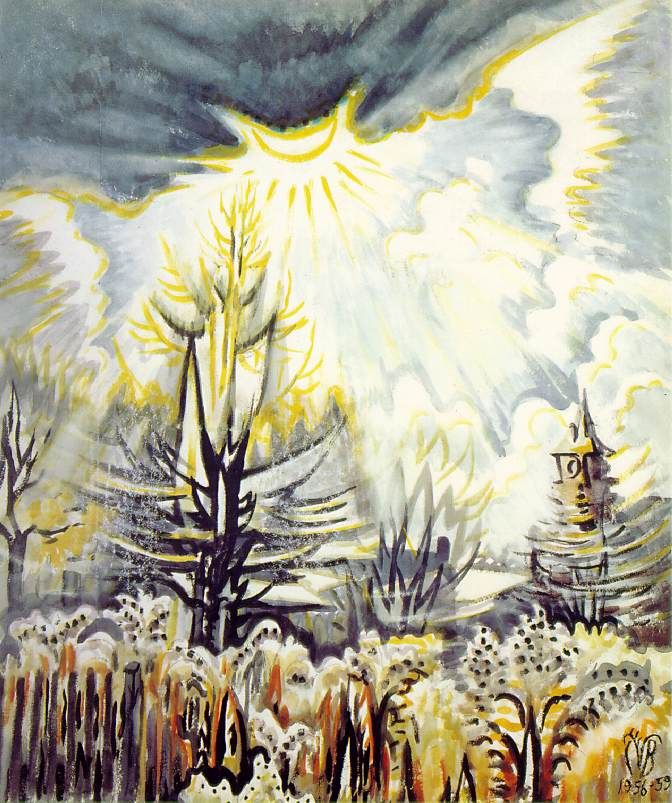
"November Sun Emerging"
1956-59
Watercolor on paper
37 3/4 x 31 7/8 inches
"[How] can we account for that irresistible instinct in our hearts which leads us towards unity whenever and in whatever direction our passions are stirred? A sense of the universe, a sense of the all, the nostalgia which seizes us when confronted by nature, beauty, music - these seem to be an expectation and awareness of a Great Presence. [...] Resonance to the All - the keynote of pure poetry and pure religion. Once again: what does this phenomenon, which is born with thought and grows with it, reveal if not a deep accord between two realities which seek each other; the severed particle which trembles at the approach of 'the rest'?Image credit:Burchfield image ripped from Mark Harden's Artchive
We are often inclined to think that we have exhausted the various natural forms of love with a man's love for his wife, his children, his friends and to a certain extent for his country. Yet precisely the most fundamental form of passion is missing from this list, the one which, under the pressure of an involuting universe, precipitates the elements one upon the other in the Whole cosmic affinity and hence cosmic sense. A universal love is not only psychologically possible; it is the only complete and final way in which we are able to love."
- excerpt from The Phenomenon of Man, by paleontologist, geologist, philosopher, and Jesuit priest Pierre Teilhard de Chardin
Wednesday, July 29, 2009
What is the Prophetic Ideal?
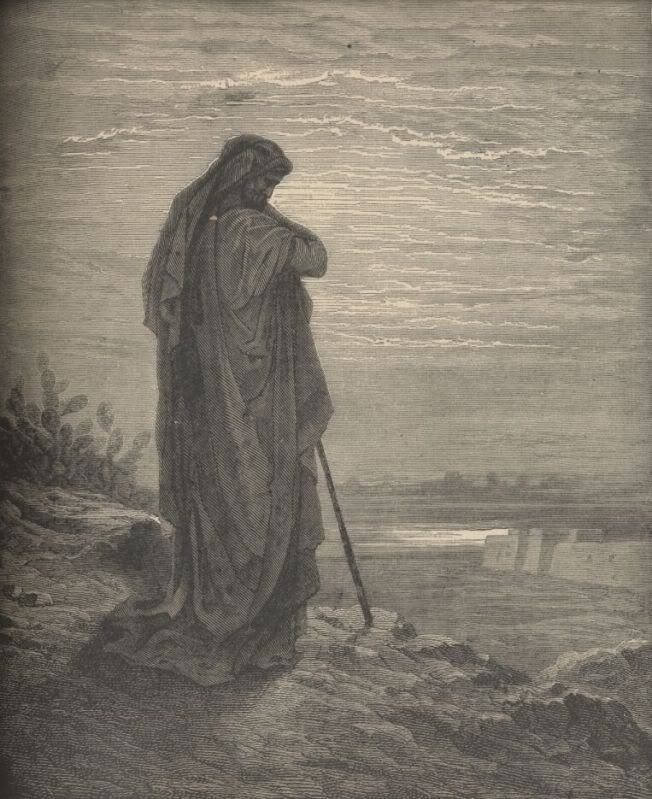
"The Prophet Amos"
1891
Engraving
In the Hebrew Tanakh, the colorful collection of history, anthropology, and mythology better known to Christians as the Old Testament, a number of the prominent prophets decry the institutionalization of Israelite religion. Elijah, Amos, Hosea, Isaiah, and Jeremiah proclaim instead the communal and, in some cases, individual experience of the one, true God. They maintain that God can be best experienced (and, as the ancient Israelites believed, best appeased) through one's devotion to those moral laws, or mitzvot, concerned with righteousness and social justice. These courageous and outspoken men also possess an enmity for the organized priesthood. They insist that the Israelites needn't centralize their worship at Solomon's Temple in Jerusalem, or at any of the other state worship shrines constructed within the kingdoms of Israel and Judah."Let justice roll down like waters, and righteousness like an ever-flowing stream."
-Amos 5:24
Not surprisingly, excepting the rare case when a prophet's ideology was deemed politically expedient, Israelite state leaders frowned on religious populism and the theocracy ignored the prophet's pleas. Typically, the trouble-making prophets were ostracized, expelled, or hunted as fugitives. Yet, ultimately, the prophets' voices proved appropriately prophetic.
For most of their history, Jews have lived in diaspora, their religious faith and identity rooted in a universalist foundation of scripture, theory, and law rather than any centralized site or body. In fact, most contemporary religious historians believe that the flowering of the relatively archaic and essentially polytheistic Israelite religion into Judaism follows the fall of Jerusalem to the Babylonians, in 587 BCE, and that this early, exilic manifestation of Judaism would undergo another upheaval and transformation after the destruction of the Second Temple by the Romans, in 70 CE. In essence, these scholars suggest that the Israelites (and, later, the Jews) had to forgo state power before the moral idealism of their religion could be actualized.
Accordingly, then, the muscular, modern state of Israel poses challenges to Jewish moral idealism. But contemporary Israeli Jews aren't alone in their wrestling with this challenge. Almost 2,500 years after the Hebrew prophets condemned top-down involvement in spiritual matters, liberal-minded, religious individuals of all stripes continue to struggle against blindly restrictive doctrinal authority.
I do not intend to suggest that adherence to dogma is necessarily a bad thing. Moral hand-wringing is a natural component of ethical decision-making, and traditional values of the sort upheld by religious authorities offer each of us a valuable point of reference. But what of contemporary conflicts between religious action and the religious institution? What of those cases in which the civil and moral codes of a religion suggest that the adherent to those codes should act in some way other than that dictated by the religious institution?
Laura Goodstein's recent New York Times article, "U.S. Nuns Facing Vatican Scrutiny" provides an excellent example. Goodstein writes,
"In the last four decades since the reforms of the Second Vatican Council, many American nuns stopped wearing religious habits, left convents to live independently and went into new lines of work: academia and other professions, social and political advocacy and grass-roots organizations that serve the poor or promote spirituality. A few nuns have also been active in organizations that advocate changes in the church like ordaining women and married men as priests."What could possibly be wrong with nuns advocating for progressive social change!? While I respect those individuals who dedicate their life to religious contemplation, aren't the monks and nuns that work for God outside of monastery and convent walls the most exemplary of all religious adherents? Aren't those individuals striving for Thomas Merton's brand of religiously-inspired activism representative of the 13th century theologian and mystic Meister Eckhart's call for believers to "gratefully [return] all that God has bestowed [...] and, by that act of donation, enter the Godhead"? In the eyes of the Vatican, apparently not.
"The investigation was ordered by Cardinal Franc Rodé, head of the Vatican office that deals with religious orders. In a speech in Massachusetts last year, Cardinal Rodé offered barbed criticism of some American nuns 'who have opted for ways that take them outside' the church. [...] The [Vatcian's investigation] focuses only on nuns actively engaged in working in society and the church, not cloistered, contemplative nuns."If the Vatican has spearheaded the investigation only because the Church seeks confirmation that American activist nuns are "attending Mass and keeping the sacraments," all well and good. After all, attending Mass and keeping the sacraments are obligations of religiously observant Catholics, and an individual who has devoted his or her life to the church should certainly be upholding these traditions. If, however, the Church intends to castigate or defrock otherwise devout, responsible nuns for pursuing religious behavior outside of the church, the Vatican officials should be ashamed of themselves.
As the Catholic theologian Walter Brueggemann wrote in The Prophetic Imagination, "The task of prophetic ministry is to nurture, nourish, and evoke a consciousness and perception alternative to the consciousness and perception of the dominant culture around us." For the Catholic nuns, as for the Hebrew prophets millennia before them, the dominant culture is that of their respective religious institutions, one of staid and comfortable orthodoxy. I'm not a Christian, but were I one, and especially if I were Catholic, I would be up in arms over the Vatican's sanctimonious oppression of those exceptional nuns and monks who actually paid attention to the substance of Jesus of Nazareth's memo.
Photo credit: ripped from Wikipedia
Wednesday, March 18, 2009
Cooperation through opposition
"Joints are and are not parts of the body. They cooperate through opposition, and make a harmony of separate forces. Wholeness arises from distinct particulars; distinct particulars occur in wholeness."I announced last week that biologist, writer and artist Jessica Palmer contributed a short essay about one of my 2008 drawings to SEED Magazine's Culture Section. In her article, "Seeing Antlers, Feeling Dendrites," Palmer asserts that good art acts as a vehicle of consilience.
- Herakleitos, circa 500 B.C.E.
Palmer has a more recent, related post on her tremendous blog Bioephemera. In it, she riffs on the complementary relationship of art and science.
"Basically, I think that good art prompts the viewer to find meaningful connections between things that seem unrelated, to draw parallels that previously went unnoticed. Art can be a springboard to insight. Science, which can so easily become insular and near-sighted, needs that springboard, even if - like a shared birthday - it's just a hook to get the story started.I agree heartily, though I would widen the scope of such "linkages" further.
It's worth noting that Darwin was a great scientist precisely because he could make meticulous, minute observations of a single species - he wrote a whole book about earthworm digestion, for heaven's sake! - while also seeing the grand, universal, far-reaching forces that shape finch beaks, beetle shells, poodles and pigeons. It's not easy to make those linkages, in history or in science; sometimes art, literature, or music can give the roving mind a nudge in the right direction. As Gopnik notes in his book, 'there is no struggle between science and art': both are ways of understanding the world, and their strengths are complementary."
There need not be struggle between science and any of the humanities, including - and this is the controversial inclusion - imaginative theology. The x-factor in these relationships is dogmatism. A rigid mindset stultifies ideology, and when science, philosophy or religion become dogmatic, they retard the human imagination and, with it, possibility.
Sunday, September 30, 2007
Jeff Soto at Jonathan Levine Gallery
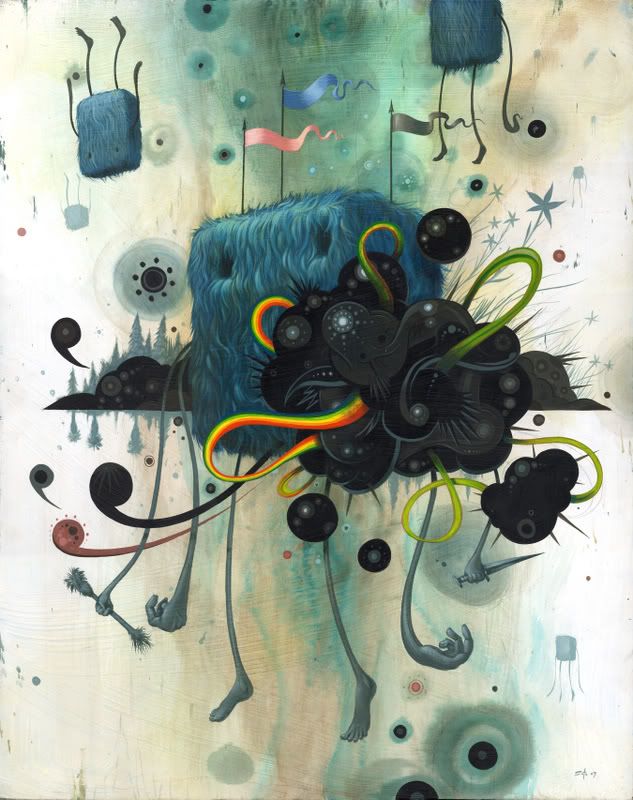
Jeff Soto
"Hope Emerges From Behind A Storm Cloud"
2007
Acrylic on wood
24 x 30 inches
Jonathan Levine Gallery: The press release for Jeff Soto's solo exhibit, "Storm Clouds," speaks to popular misgivings about the state of things. "Soto explores his predominant fears and anxieties over his daughter's future, the civil war in Iraq, and the United States policies on environmental conservation." All well and good, yet I find myself asking if the artist's work communicates these ideas or if the release is merely an effort to lend Soto's cartoonish work gravitas?
Contemplating his paintings, environmental excesses, impending collapse, and enduring wars do not come to mind. Instead I'm more often moved to an exuberant giddiness. I smile wide and often. I feel good about Soto's healthy imagination and his sharing it with us. What I don't feel, however, is anxious; I do not brood. Even when Soto includes imagery of "death and decay" - oil clouds, fighter planes, pirate riggers, bombs - his stylized rendering and punch-out palette leave me feeling enlivened and upbeat.

Jeff Soto
"Earth"
2007
Acrylic on wood
18 x 18 inches
Does this mean the work fails in its intention? I don't believe so. Quoted in the press release, Soto says, "I think we can make things better somehow." Soto's essential optimism is borne out in his work. If fear and anxiety motivate him in the studio, his process is alchemical; the paintings are full of frenzied joy and hope, both of which are much needed psychological commodities in our time.
Jeff Soto's exhibit, "Storm Clouds," is on view through October 6th, 2007. For more information, contact Jonathan Levine Gallery.
Photo credit: images courtesy Jonathan Levine Gallery
Editor's note: This write-up was originally slated to be published in a more high-profile publication, but was refused because of the Jonathan Levine Gallery's "no photo" policy. As an artist and art writer (and blogger and frequent picture taker), I sympathize with the position of the publication, and encourage all gallery directors to examine the "no photo" policy.
Wednesday, June 27, 2007
Singing for the rains
Wednesday, November 16, 2005
Imagined Worlds

"My Heavens!"
2004
Twelve-color lithograph with silver mylar and collage on Amate paper
30 x 51 inches
This past Saturday I visited AXA Gallery, a pleasant exhibition space affiliated with AXA Financial, Inc. Judging by the company's profile (they specialize in "wealth management"), one might assume that AXA gallery exhibitions would be dull and uninspired. Not so. "Imagined Worlds: Willful Invention and the Printed Image, 1470 - 2005," a joint venture between AXA and the International Print Center New York, is a treat.
I'm biased, however; a number of adored artists are included in the show's all-star lineup. Among my personal favorites are Jane Hammond, Tsukioka Yoshitoshi, and Hendrick Goltzius, but works by William Blake, Albrecht Durer, and Pieter Van Der Heyden (after Pieter Bruegel the Elder, as most of his prints are) also stand out. (What a thrill for Hammond to be included in this company!)
The press release describes the exhibition as follows:
"Imagined Worlds...comprises fine art prints, books, and maps from many cultures, spanning five hundred years. Included are images of remote places and imaginary realms, real and fictional scientific investigations, and serious and comic inventions. What each work has in common is that it was created from an unknown, partially known, or completely unseen subject. Whether based on direct observation or pure fantasy, these prints illustrate the power of imagination and subjectivity in the creation and interpretation of images."Fantasy and "imagined worlds" are en vogue in the contemporary art world, particularly among younger, "emerging" artists. Somewhat reluctantly, I include myself in this camp, and the AXA exhibition is a must-see for those of us producing work that deals with invented cosmologies. To elaborate, I've excerpted some of my own thoughts from an older Hungry Hyaena post, "Of Fairy Tales and Flights of Fancy."
"It is with increasing urgency [...] that I view so much contemporary art produced by my contemporaries [...] in their twenties and thirties. An uncredited New Yorker review writer describes this work as, 'gloomy, craft-spun, fairy-tale escapism endemic among young...artists.' A visit to "Greater New York, 2005," a survey of artists living or working in New York City at P.S.1, will illustrate just how prevalent this mode has become. [Much] of the work on display fills the bill, and while the majority of these are paintings or drawings, a number of videos and installations belong to the same impetus. We are a generation uncertain and intimidated. Rather than engage and participate, we have opted to wear the escapist smile, retreating into the worlds of Alice and the Little Prince. Is it enough to express ourselves in this way? Do these cryptic fairy-tales or self-abusive efforts communicate anything more than immediate frustration? After all, it was largely my [childhood] social incompetence which drove me to chase monsters around dark living rooms. How [...] different is this display?"What distinguishes the work on display in AXA's "Imagined Worlds" from most of the artwork at P.S.1 is the artists' knowledge of history and mythology, which is conspicuous in all included works (with a very few exceptions). For example, the works of Goltzius and Blake are grounded in shared, substantial narratives, even if they interpret the tales differently. Most contemporary fairy-tale artworks, on the other hand, are comprised of disparate, personal symbols; these are carelessly collaged onto a flimsy narrative armature, be it social, political, scientific or religious. iCulture is our zeitgeist and it's unsurprising, then, that young artists elect to celebrate themselves rather than addressing more wide-reaching social narratives. This should give us pause. The armatures need to be reinforced and the classical (maybe "established" is the better word here?) narratives on display at AXA are a terrific inspiration.
Jane Hammond's "My Heavens!" was a pleasant surprise. I was already familiar with Hammond's paintings but I knew little of her ongoing collage series. Those collages that I had seen were not particularly memorable, but after being impressed with "My Heavens!" I did some Googling and discovered a number of beautiful pieces by Ms. Hammond. I am enamored of the system of limitations she has set for herself and I covet many of works in the series.
Tsukioka Yoshitoshi, who lived from 1839 - 1892, was one of the last great ukiyo-e printmakers. He is renowned for his weak constitution - he was prone to debilitating depression - and violent imagery as much as he is for his outstanding craft. Contemporary graphic designers (not to mention artists at large) can learn a lot from the Japanese master's command of composition and color.
Though "The Lucky Tea Pot of Morin Temple" was not included in "Imagined Worlds," I showcase it because the principal player is a tanuki, a Japanese character/animal that I find especially curious.

"The Lucky Tea Pot of Morin Temple"
1889-1892
Although Hendrick Goltzius' imagery is not as exciting as that of Hieronymus Bosch or Bruegel the Elder, two of his regional predecessors, his handling is exquisite, particularly in his engravings. His paintings are also impressive, though they are too often dismissed by art historians as second-rate.
I can't recommend the exhibition enough. Go check it out if you can.
Photo credits: "My Heavens!" ripped from Jane Hammond's website; "The Lucky Tea Pot of Morin Temple" ripped from SinisterDesigns.com
Tuesday, November 15, 2005
Thank G-d for the Dalai Lama

Once in a long while, I describe myself in a way that reveals an aspect of my personality or ideology that I had not before acknowledged. This past Saturday, I explained my fascination with biology (and in a more general sense, all the sciences) to a friend as we viewed the excellent "Imagined Worlds" exhibition, at AXA Gallery (more on this terrific show in an upcoming post).
"If not for the painting monkey on my back," I said. "I'd be very happy to work as a field biologist. I think my love of the sciences is, in large part, rooted in a lack of faith in objective scientific truth." Wait! What? I've never framed the idea in that way, but that's exactly right! My love of science is that of the skeptic; my faith is provisional. How bizarre!?
I'm sometimes mischaracterized, even by friends, as a dogmatic champion of science over all other truths or cosmologies. I believe they label me thus for three reasons.
1) I reject the primitive notions of an interventionist sky-god and deny the singular "truth" claims of any religion.
2) I am particularly excited by evolutionary theory.
3) I am a stickler for taxonomic nomenclature.
If considering only these three qualities, I, too, might assume that we're talking about a hardcore bio geek, an individual unwilling to consider "alternative" explanations or allow magic into his or her world view. But I have other interests that provide me counterpoise. Obviously, the visual arts are very important to me, but theology, philosophy, and ethics are among my favorite subjects.
Stacked on my nightstand this month are the following books: The Larousse Encyclopedia of Myth; Bulfinch's Mythology; John Ruskin's On Art and Life; C.S. Lewis's The Discarded Image, an exploration of medieval cosmological transitions; Ernst Mayr's What Evolution Is; and Frans De Waal's Our Inner Ape. As I see it, these books on mythology, aesthetics, theology, history, and evolutionary inheritance are all intimately related. A back-and-forth reading of such texts allows me to cobble together my own cosmology.
For example, I accept that the fundamental elements produced by the Big Bang were hydrogen and helium, but I also conceive of the two primordial elements as Erebus and Nox, the Greek gods begotten by Father Chaos. When these two gods mated, Nox gave birth to a son named Aether, among other offspring. Aether is the personification of the heavens, of the "upper sky," and is therefore synonymous with the celestial elements that formed in the swirl of early space-time. Similarly, I embrace the mystical Jewish conception of the universe's origins, the creation of "Without End" (Ein Sof) from "Nothing" (Ayin, or the cosmic seed), both states of a piece with G-d's supreme body.
Given my penchant for hybrid science-myth cosmologies, I was pleased to read this short statement by Tenzin Gyatso, the 14th and current Dalai Lama, in The New York Times. I recommend reading the whole piece, but I've included some highlights below.
"If science proves some belief of Buddhism wrong, then Buddhism will have to change. In my view, science and Buddhism share a search for the truth and for understanding reality. By learning from science about aspects of reality where its understanding may be more advanced, I believe that Buddhism enriches its own world view.Thank goodness for the Dalai Lama's common sense! How I wish the pious folks in Vatican City would issue a statement such as this. And what of Judaism's Orthodox Union? The conservative Muslim clerics? Where are their voices?
[...] While I agree that certain religious concepts conflict with scientific facts and principles, I also feel that people from both worlds can have an intelligent discussion, one that has the power ultimately to generate a deeper understanding of challenges we face together in our interconnected world.
[...] By invoking fundamental ethical principles, I am not advocating a fusion of religious ethics and scientific inquiry. Rather, I am speaking of what I call "secular ethics," which embrace the principles we share as human beings: compassion, tolerance, consideration of others, the responsible use of knowledge and power. These principles transcend the barriers between religious believers and nonbelievers; they belong not to one faith, but to all faiths."
Surprisingly, I see our nation's evangelical Christians offering some signs of hope. Richard Cizik, Vice President of the National Association of Evangelicals, can strive for some forward progress in the grey realm where science and theology overlap, even though groups such as the NAE usually worry me.
Photo credit: ripped from Centre For The Mind website
Friday, August 12, 2005
Random Quotes and Stuff: Installment #3
"Last summer, the F.D.A. approved the leech for use as a medical device, making this only the second time that the agency has authorized such a use for a live animal. (Maggots, which can be applied to wounds to consume infected tissue, were approved in January, 2004.)"I find this news exciting. When I first read about the maggots-as-medicine approval last year, I was elated. I hoped that more people would realize how interconnected everything is if doctors dumped maggots into their festering wounds. Unfortunately, most people feel very differently about composter species and the idea of squirming, white grubs eating their flesh - even dead, dying or inflamed flesh - will likely disturb them. Whatever...I'll just go sit in the corner and play with my leeches.
-John Colapinto, "Blood Suckers," The New Yorker, July 25, 2005
"It makes no difference what men think of war, said the judge. War endures. As well ask men what they think of stone. War was always here. Before man was, war waited for him. The ultimate trade awaiting its ultimate practitioner. That is the way it was and will be. That way and not some other way….It endures because young men love it and old men love it in them."In the early nineties, Operation Desert Storm was featured prominently on network television and in department stores. My Virginian neighbors proudly wore T-shirts emblazoned with the mission name, as though it was a World Series commemorative; to be without one was unusual or, worse, unpatriotic.
-Judge Holden speaking in Cormac McCarthy's novel, Blood Meridian
I was thirteen years old in 1991. I remember watching the green-tinted, "night vision" films of Baghdad air raids as I lay on the floor of my parents' living room, drawing pictures. I wondered, naively, why we still fought wars. After World War II, after the horror of the atomic bomb, I thought, we should know better.
And yet, five quick years later, I seriously considered military service. Being a good patriot requires some service to the country, I told myself, and, more importantly, I would not be "truly alive" until I had charged into harms way, guns blazing. I'm no longer so naive or bloodthirsty, but I think Judge Holden's answer accurate, no matter how damned distressing it may be.
"Children need the dark materials of fairy tales because they need to make sense - in a symbolic, displaced way - of their own feelings of anger, resentment, and powerlessness. Children also benefit from learning about violence and brutishness in fairy tales, Bettelheim writes, for it counters the 'widespread refusal to let children know that the source of much that goes wrong in our life is due to our natures - the propensity of all men for acting aggressively, asocially, selfishly.'"I recently met a young girl - I believe she was six or seven years of age - whom I found especially intriguing. At a Long Island dinner party, the several children present announced that they intended to "put on a show" for the adults, mostly Long Island married couples and a few odd men and women out, myself among them. A few minutes later, this particular girl emerged with a wand, a vaguely ethereal tutu bottom and a wide, toothy grin to announce the name of her segment. "Evil Always Wins," she said, proudly. She proceeded to make her way around the room, lightly touching the heads of all in attendance with her wand, announcing, "Now you have been made evil."
-Margaret Talbot, 'The Candy Man," The New Yorker, July 11 & 18, 2005
I took an instant liking to the precocious girl and found myself pondering her performance for much of the party. I believe she intended to protect the adults from the cruel realities of the world. Because "evil always wins," she magically transformed each of us into evil beings, thereby saving us from future defeat.
Examining this logic from an adult perspective, it stinks of "selling out," an "if you can't beat 'em, join 'em" attitude, but children don't necessarily view the world in this way. For example, when I was ten or eleven, I once longed to be a werewolf or vampire, not so I could surf down Main Street on the roof of a van, but so I could "infect" people I liked, creating an eternal community of kindred spirits. Sure, at twenty-seven this scenario seems dangerously cultish, but I also used to fantasize about tearing away the throats of my "enemies," and if I'm not going to condemn my childhood wants and desires for their violent content, I certainly won't do so for their lack of philosophical foresight. Besides, there are worse fates than lycanthropy or vampirism.
When I later recounted the story of this "evil," little girl, most listeners shook their head and said things like, "Wow, something is sure wrong with her" or "That's disturbing. She's a troubled kid, huh?" I wouldn't be surprised to learn that there is something amiss in the child's life, but most children wrestle with real world nightmares. It's a vital part of growing up. Scars, mental and physical, stay with us, an important part of who we are. An increasingly protective approach to child rearing, though, has taken hold. Disney, as far as I'm concerned, is the embodiment of popular parenting, making formulaic movies to entertain unimaginative children and adults alike. The animation is spectacular, certainly, but the plots are hollow and repetitive alongside those found in, say, Grimms' Fairy Tales.
I brought this up with a parent I know and she told me she would never give Grimms' to her daughter "because they are too frightening." But I agree with G.K. Chesterton, author of "The Ethic of Elfland," who writes that fairytales inspire in children a sense that life "is not only a pleasure but an eccentric privilege." What a marvelous way of putting it!
Wednesday, June 08, 2005
Of Fairy Tales and Flights of Fancy

“The show suggests that artists are connected to events in the outside world but have little sense of what to do about them, other than to create artworks that incorporate their frustration, rage, apprehension or sense of the absurdity of contemporary life.”Who would condemn a child for having an active imagination? In contemporary western culture, most parents celebrate the fantasy lives of their children (or at least tolerate them), no matter how consuming they may be. This is for the good; a rich, imagined world often leads to greater curiosity about the world we inhabit. There are, however, some legitimate concerns for those children who appear to withdraw into fantasy too much, those who exhibit a tendency for escapism. These kids can be spotted at an early age. I should know.
- Eleanor Heartney, Art in America, review of “Greater New York, 2005”
As an only child who grew up in a rural farming village, my interaction with other children was limited to the school day and the rare overnight visit to a friend's house. My father, an unabashed workaholic, kept me occupied with field chores and wildlife conservation projects on most weekends. Our house had no television, the upshot of which was that I won most every reading competition until I reached 6th grade (the year -- holy of holies! -- a television arrived). I turned to books and invention for entertainment. The fields and forests were places of extraordinary mystique, vast plains teeming with bison and Indians or thick, dangerous woods with thieves and bizarre creatures lurking behind every tree. The pond shoreline represented a potential aquatic dinosaur attack, forcing me to walk just so to avoid detection.
But the fun didn’t stop at nightfall. No, if anything, the level of “make-believe” only increased once I was forced indoors. I would stage plays in my bedroom, becoming the voice of a stuffed animal perched on the windowsill and that of the angry, invisible dinosaur, the evil step-mother, the diminutive Lego man on the shelf, and so on and so on. (For some reason, many of these epic plays resulted in a raccoon puppet ripping open my throat. Of course, I was then re-animated as a rabid monster that would stalk the room’s perimeter, hunting imagined company.)
Despite my protests, it wasn’t at all inappropriate then that some kids called me Christopher Robin. I was tremendously uncomfortable in most social situations and I really didn’t trust any of my peers. During recess, I was the kid who retreated to a corner of the playground and talked to myself or played with blades of grass, imagining I don’t know what. It was also not surprising that cartoons, comic books, and drawing soon dominated my life outside of chores and schoolwork. I was every elementary school teachers’ dream, the quiet kid who scores well and gets placed in all the advanced classes, but shows no sign of ego or contempt. In fact, I was just oblivious to most of what was happening around me. I had no idea what interested most of my classmates. I didn’t listen to popular music until the sixth grade and most of my pop culture understanding was garnered from the pages of MAD Magazine. I knew what a phenomenon Michael Jackson was, but I'd never heard his music.
None of this mattered to me, however. I remained an essentially happy kid. I just shut out everything except my drawing, reading, and my fantasies. I'd learned how to tune out without ever having tuned in. Fortunately, the years have been kind to me and, rather than go the way of the Unabomber, I’ve become a reasonably well-adjusted member of society, if still something of a loner who likes to draw, read, and write.
It is with increasing urgency, though, that I view so much art produced by my contemporaries, artists in their twenties and thirties. An uncredited New Yorker writer describes this work as, “gloomy, craft-spun, fairy-tale escapism endemic among young East Coast artists.” A visit to Greater New York, 2005, a survey of artists living or working in New York City at P.S.1, will illustrate just how prevalent this mode has become. Fully 40% of the work on display fits the bill, and while the majority of these are paintings or drawings, a number of videos and installations belong to the same impetus. We are a generation uncertain and intimidated. Rather than engage and participate, we have opted to wear the escapist smile, retreating into the worlds of Alice and the Little Prince. Is it enough to express ourselves in this way? Do these cryptic fairy-tales or self-abusive efforts communicate anything more than immediate frustration? After all, it was largely my social incompetence which drove me to chase monsters around dark living rooms. How much different is this display?
These currents aren't isolated to the eastern seaboard of the United States, though. Admittedly, the majority of young West Coast artists still seem to be preoccupied with abstraction and pretty pictures, but the dystopian fairy-tales are being createed by artists not just from across the United States, but also via imports from Japan, Europe, Iceland, and elsewhere. Peter Schjeldahl recently wrote of Takashi Murakami’s curatorial effort, “Little Boy: The Arts of Japan’s Exploding Subculture,”
“[The included work] suggests a certain pathology: rapturous defeatism, perhaps, that justifies youths who don’t grow up.”It seems as though an entire generation -- global, not just Japanese -- has been forced into perpetual adolescence by the atom bomb that is our modern condition?
At the turn of the century, very few people knew anything about Henry Darger, the reclusive painter/janitor from Chicago who spent the bulk of his solitary life working on a series of collage-like, narrative drawings depicting the history of the Vivian Girls. The currents of the art world, circa the late 1990s, were such that Darger was considered an “outsider” when this term still meant, “Hold him at arm’s length, please.” By 2002, the year I graduated from art school, “outsider” was no longer a bad word. Books on Henry Darger could be found in the window of any Barnes & Noble in town and my own fantasical paintings were receiving admiring attention from curators and dealers. In fact, in 2004, two of my paintings were included in a group show with works by Henry Darger and a number of other contemporary painters who can readily be lumped into the "fairy-tale escapism" camp, including Inka Essenhigh or the currently red-hot Dana Schutz.
This shift in art world tastes had little to do with curatorial sensibility. There were simply too many young artists working in this vein for the movers and shakers to ignore the trend. The compulsive, “outsider” approach of Darger had become, long after his obscure death, standard issue gallery fare. Whether or not one would call it a “movement,” as I have heard some people discuss, is irrelevant. It happened and is continuing to gain momentum. The meaning and the value are for time, the critics, and the public, if they ever come back to contemporary art, to determine.
One has to wonder, though, what sort of work we are dealing with. Darger, as I mentioned above, was almost completely solitary. He attended church daily, made his income as a janitor, and returned to a cramped, disaster of an apartment to continue work on his epic Vivian Girls saga and the associated paintings. He never received any artistic training to speak of. This stands in stark contrast to most of the artists on hand at P.S.1. Not only are we dealing with a return to youthful escapism, but the return is a conscious decision, one being made by folks who have Master’s degrees, iPods, and Friendster accounts. Would Darger have been eager to discuss the latest EP or hit up the late night bar scene? The main difference between those lost souls like Darger and the average art world fantasist of today is a conscious decision. I decided to work as though I were an advanced child, turning inward and looking for my own little haven via the painting process. Darger just did it; for him there was no asking "What happens if I do it this way?"
Despite my enjoying much of the work I see at P.S.1 and throughout Chelsea, I have moved on from such preoccupations in my own studio. Perhaps I felt the room was too crowded with escapists, but most of the decision is a result of my tiring of helplessness. Sure, shit sucks right now, but I don’t feel I can just turn on the rock n’ roll and drift away. I'm excited about my current body of work, even though it has thus far received only lukewarm response; everyone points to the work of two years ago and says, “Now that was really something.” Yes, it was “something” and I still enjoy the paintings, but it ain’t what I’m making now and there are over three thousand other artists, if not many more, weaving similarly self-absorbed fairy-tales out there. Every week, I learn of another terrific young artist working in this vein; I’m rooting for all of them. For my part, though, I’ll head off to my studio and make paintings about the relationship between man and beast, or as some academics call it, anthrozoology. There aren’t as many rocket ships, dinosaurs, or indians populating these works, but I’m still smiling, even if no longer blonde.
Photo credit: Painting by Henry Darger, circa 1960s
Tuesday, April 26, 2005
The End Is Here?

Living in New York City, one quickly grows accustomed to "architectural advertising." Advertisements for gyms, perfumes, record labels, clothing, books, radio stations, television programs, and movies are plastered on subway station walls, phone kiosks, city buses, taxi cabs, and many building facades. In the course of my five years here, I've come to view this colorful assault as a less offensive version of the billboarding of America's highways. The integration of product placement into the urban landscape not only makes more sense, it is also more easily ignored.
With so much visual competition, an ad agency has to come up with a good pitch to standout. For the past month, the new NBC series "Revelations" has been heavily promoted via architectural advertising. Most noticeable are the Metropolitan Transit Authority buses covered (excepting the windows) in an apocalyptic sunset. "The End Is Here," the text proclaims as an evening flight of ravens lifts above a stoic Bill Pullman and Natasha McElhone. The first time I saw one of the "Revelations" buses, I stared after it as it groaned north up Third Avenue. Several times, over the course of the next week, I caught myself involuntarily shaking my head as I passed a "Revelations" poster in a subway station or audibly "tsk-tsking" when I opened a newspaper and was confronted by an advertising spread heralding the mini-series.
What was it that so unsettled me? As a science fiction fan who, for the most part, has a deep respect for thoughtful religiosity, I was surprised by my negative reaction. Upon watching the (disappointing) first episode of "Revelations," though, I realized that it wasn't so much the program's concept that bothered me as it was the advertising itself. After all, a growing number of evangelical Christians believe that the Rapture is imminent. Visit RaptureReady.com and you'll learn that increases in drug abuse, unemployment, environmental degradation, inflation, natural disasters, starvation, and sloth are all desired, even promoted, by Rapturists! The more of these terrible abuses and tragic events, the more the stage is set for Christ's triumphant return. This may be good for the blindly religious Christians among us, but it is not a good thing for a secular democracy, especially the one in which Thomas Jefferson's "wall of separation" protects those of us who are atheistic, agnostic, or members of a religious minority from the tyranny of theocratic nationalism. So why is NBC promoting the tribal apathy associated with Rapturist belief? The bottom line.
Folks who troll the "eco-blogosphere" have likely read a transcript of Bill Moyers' remarks upon accepting the Harvard Medical School's Global Environmental Citizen Award. It makes for troubling reading and, though I do my best to concentrate on environmental success stories, the doom and gloom is difficult to ignore, no matter what "The Death of Environmentalism" authors prescribe.
From Moyers' address:
"Google it and you will find that the best-selling books in America today are the twelve volumes of the "Left-Behind" series written by the Christian fundamentalist and religious right warrior, Timothy LaHaye. These true believers subscribe to a fantastical theology concocted in the 19th century by a couple of immigrant preachers who took disparate passages from the Bible and wove them into a narrative that has captivated the imagination of millions of Americans.Moyers feels strongly about what he is witnessing and his tone is reactionary and not without hyperbole. As a result, some readers, particularly those predisposed to disagree, will write off his statement as the rant of a now impotent journalist. This is unfortunate. Although I think the political influence of evangelical Rapture-types may be slightly exaggerated in Moyers's address, it should not be ignored. More critically, what of the popular element? With the box office success of Mel Gibson's "Passion of the Christ," some media critics have begun to call this the "religious entertainment era." Religious entertainment? Upon first hearing this label I immediately thought of the Middle Ages, when religious entertainment was at its pinnacle. It is difficult to imagine 21st century America regressing to such a degree. Or is it?
[...] I've reported on these people, following some of them from Texas to the West Bank. They are sincere, serious, and polite as they tell you they feel called to help bring the rapture on as fulfillment of biblical prophecy. [...] Go to Grist to read a remarkable work of reporting by the journalist, Glenn Scherer - the road to environmental apocalypse. Read it and you will see how millions of Christian fundamentalists may believe that environmental destruction is not only to be disregarded but actually welcomed - even hastened - as a sign of the coming apocalypse.
[...] As Grist makes clear, we're not talking about a handful of fringe lawmakers who hold or are beholden to these beliefs. Nearly half the U.S. Congress before the recent election - 231 legislators in total - more since the election - are backed by the religious right. Forty-five senators and 186 members of the 108th congress earned 80 to 100 percent approval ratings from the three most influential Christian right advocacy groups."
Jonathan Storm writes in The Philadelphia Inquirer, "lavish and well-made, 'Revelations' sadly seems little more than a cynical grab for the zeitgeist, exploiting the popularity of 'The Passion of the Christ' and 'The Da Vinci Code.' It may attract a big initial audience, curious to see a TV blockbuster pushing the idea that the end is near."
That there exists a "big initial audience" for books, films or television programs "pushing the idea that the end is near" is frightening! It highlights the importance of Moyers's question, "What has happened to our moral imagination?" Are we truly a nation content to be force-fed apathy while participating in an orgy of narcotic consumption? Is there really, as Moyers suggests, an absence of "hocma - the science of the heart?" (The hocma Moyers references is one of Kabbalah's ten Sephirot; it is more often spelled chokhmah, or chochmah, and the best translation is "wisdom.")
I'm presently rereading my father's 1983 Pulitzer Prize nominee, Wanderer on My Native Shore. At the end of the first chapter, which focuses on coastal Maine, he writes,
"...as I contemplate the purple majesty of Cadillac Mountain, I feel an awe for its origins mingled with wonder for human optimism. On one hand, our capacity for hope has created marvelous machinery for drilling through the sea floor. On the other hand, this same optimism has generated laws to protect the eagles soaring over Cadillac Mountain.Well said, Dad. What worries me, though, is the sense that we seem to care less and less about that stretching. Overwhelmed by consumer choices and our slavish routines, apathy has become pandemic. Rather than try to shake the blues, we proclaim the sickness a sign of the apocalypse and, content to wait, pop pills and watch the TV...'cuz Jesus gonna be here, gonna be here soon.
Life may, indeed, be a dream, and the best efforts of all mankind may be nothing more than brief shadows on a granite dome. Yet isn't our persistent stretching for perfection in the face of inevitable death what touches humanity with divinity?
Our greatness lies not in our sense of humor or intelligence, for other creatures besides man exhibit humor and intelligence. Our greatness lies in our knowing that, although we are doomed, we still want to fashion a better arrowhead or drill bit, and that men may devote themselves to preserving a hard, but productive, way of life as well as eagles drifting on the winds of time."
Photo credit: image ripped from inetours.com
Tuesday, March 01, 2005
Alice and the Hyaena

I'm a fan of "Alice in Wonderland" or, more specifically, I'm a huge fan of Alice's insatiable curiosity. Her wide-eyed approach continues to influence children and adults alike and, in my opinion, is a prerequisite for any worthy artist or scientist.
It is both my love of Alice and my fondness for the spotted hyaena (Crocuta crocuta) that inspired me to name this blog Hungry Hyaena. "But what does that have to do with Alice," you may wonder.
Below, I have excerpted from "Through the Looking Glass."
And here I wish I could tell you half the things Alice used to say, beginning with her favourite phrase `Let's pretend.' ...And once she had really frightened her old nurse by shouting suddenly in her ear, `Nurse! Do let's pretend that I'm a hungry hyaena, and you're a bone.'Ever since I came over a hillock in Botswana and found myself "face-to-face" (in fact, the distance was closer to ten yards) with a large female spotted hyaena, I have felt a close tie to this species. They are brutal looking animals but, though most people consider them ugly, filthy creatures, I see something of myself in them.
I'm sure to go on about spotted hyaenas in a later post, but what matters here is the image of Alice, that most creative and curious of souls, gnawing on a bone with her powerful hyaena jaws.
She will be through to the marrow in no time.
Subscribe to:
Posts (Atom)